Saturday, September 12, 2026

End Trump Oil Embargo on Cuba With War Powers Vote, Coalition Urges House Democrats

“Cuba is suffering through a man-made economic and humanitarian catastrophe, caused in significant part by deliberate policy choices of the United States.”


A man walks as the Russian oil tanker Anatoly Kolodkin is seen at the oil terminal in the port of Matanzas, Cuba, on March 31, 2026.
(Photo by Yamil Lage/AFP via Getty Images)


Brett Wilkins
Sep 11, 2026
COMMON DREAMS

Dozens of advocacy groups this week urged House Democratic leaders to force a vote on an existing war powers resolution aimed at endingr President Donald Trump’s unauthorized aggression toward Cuba, including his administration’s deadly de facto US oil embargo.

“Cuba is suffering through a man-made economic and humanitarian catastrophe, caused in significant part by deliberate policy choices of the United States,” 45 groups said in a letter dated September 9 to House Minority Leader Hakeem Jeffries (D-NY) and Foreign Affairs and Rules Committee Ranking Members Gregory Meeks (D-NY) and Jim McGovern (D-Mass.).

“Since January 2026, the Trump administration has imposed an oil blockade that has cut off the island from nearly all fuel imports, allowing only a single tanker to dock over the past seven months alongside minor US sales that are wholly insufficient to sustain the country’s economy and basic services,” the letter continues.


“The consequences have been devastating and far-reaching, and the crisis is deepening,” the groups stressed. “Cuba has endured at least six nationwide grid collapses this year—at times leaving over 9h million people without power, with outages stretching well beyond 20 hours in much of the country. Fuel shortages have stalled transportation, disrupted food and water supplies, and pushed a once-renowned universal healthcare system toward collapse and the rationing of care.”

The groups behind the letter—which include American Friends Service Committee, Center for Economic and Policy Research, Demand Progress, Indivisible, National Nurses United, Pax Christi USA, RootsAction, United Church of Christ, and Win Without War—called for an immediate vote on Rep. Nydia Velázquez’s (D-NY) Cuba War Powers Resolution, H.Con.Res. 106.

The privileged resolution—which can be called for a vote without approval from House Speaker Mike Johnson (R-La.)—would direct the removal of US armed forces from hostilities within or against Cuba absent congressional authorization. The measure targets the de facto US oil blockade on Cuba, which proponents argue amounts to unauthorized hostilities against Cuba.

Velázquez’s resolution came amid the Trump administration’s escalating aggression against Cuba, including threats to attack or even invade the island, economic strangulation including the oil embargo and decades-old blockade that critics said were causing the deaths of infants and sick people, and the US Department of Justice indictment of former Cuban President Raúl Castro for his alleged role in the 1996 shoot-down of planes operated by a hostile US-based counterrevolutionary group following repeated warnings that they had violated Cuban airspace.

In April, US senators voted 51-47—with Democratic Sen. John Fetterman of Pennsylvania joining all but two of his Republican colleagues, Sens. Susan Collins of Maine and Rand Paul of Kentucky—to block a war powers resolution introduced in March by Sens. Tim Kaine (D-Va.), Adam Schiff (D-Calif.), and Ruben Gallego (D-Ariz.).

“Despite falling short of the majority, this was among the strongest votes in congressional history against the use of blockades, and one of the most important stands Congress has taken against US economic sanctions toward Cuba in over six decades,” the 45 groups said in their letter. “The House should take a similarly forceful action at this crucial moment.”
‘A Damn Bloodbath’: Unions Decry Layoffs at McClatchy Papers as Local Journalism Takes Another Hit

“We’ve done everything asked of us, and more,” said one fired journalist. “Yet when corporate plans fail, McClatchy executives run and hide while our workers and this community suffer all the consequences.”


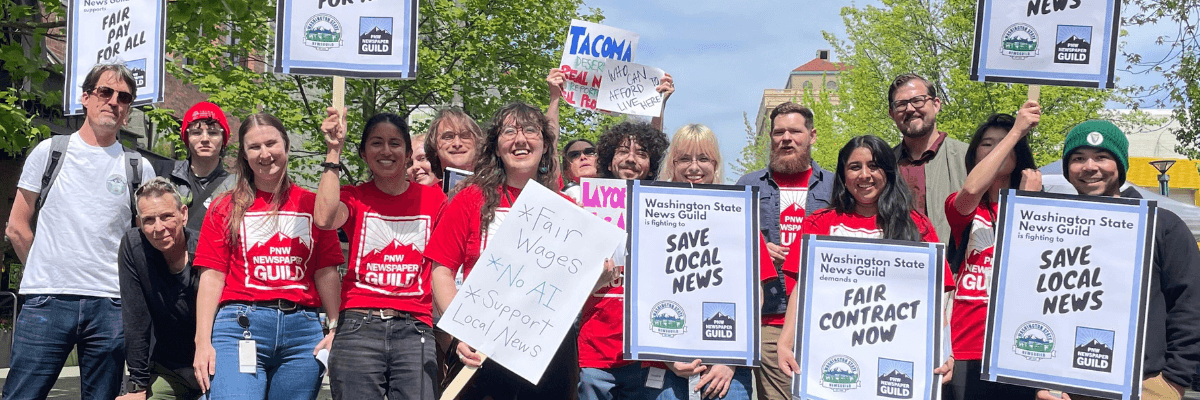
Unionized journalists in Washington state hold signs that say “save local news.”
(Photo by the NewsGuild-CWA)


Jessica Corbett
Sep 11, 2026
COMMON DREAMS

As social media networks filled with posts from journalists “deeply saddened” to reveal they were part of McClatchy’s latest round of “gutting” layoffs this week, newspaper staffers and the unions that represent them highlighted “how local coverage will suffer” because over 90 workers were fired by the hedge fund-controlled publisher.

“I’m part of this bloodbath. After dodging layoffs for my entire 19-year career, I finally caught a stray as the Idaho Statesman gutted 60% of its staff,” said sports writer Michael Lycklama, noting his union membership and six-months severance package.


‘Ugly, Un-American Attack on Our Free Press’: Stars & Stripes Journalists Fired for Saying They Had Independence

“My heart goes out to my coworkers who have poured their blood, sweat, and tears into Idaho,” he wrote. “We’ve done everything asked of us, and more. Yet when corporate plans fail, McClatchy executives run and hide while our workers and this community suffer all the consequences.”

“These layoffs will create holes in our community and leave it poorer,” he stressed. “There are now drastically fewer eyes watching your elected officials. Fewer reporters uncovering shady businesses. And fewer journalists to highlight and celebrate our state’s unsung heroes.”

With at least 90 workers let go across 17 McClatchy publications, the NewsGuild-CWA similarly warned Friday that “the departure of these talented reporters, visual journalists, and writers will immediately leave gaping holes in local coverage for dozens of communities across the United States.”

At least seven reporters were fired from four newsrooms in Washington state: The Bellingham Herald, The News Tribune, The Olympian, and Tri-City Herald. The NewsGuild noted that “Tacoma will no longer have even a single dedicated journalist tracking city hall, Pierce County government, or local schools,” while “the region near the Canadian border lost an environmental watchdog, and the Hispanic community can no longer turn to a Spanish-speaking reporter in Eastern Washington.”


The Pacific Northwest Newspaper Guild, a local representing reporters in Washington and Idaho, highlighted that “these are journalists who investigated local hospitals, served as watchdogs over state and local government, showed up at every high school game, jumped in to cover breaking news like wildfires, covered news in overlooked communities, and monitored development in one of the fastest-growing regions in the country.”

“One of these papers will no longer have a dedicated reporter covering city hall. Another will no longer have anyone dedicated to covering the state capitol,” the union said. “McClatchy has decided that short-term profits for a hedge fund matter more than the well-being of the communities that its newspapers are supposed to serve. That is a model that is destined to fail.”


Employees of multiple California outlets were also impacted. The Fresno Bee lost staffers, as did the Modesto Bee, which laid off 25% of its newsroom. The Sacramento Bee, the city’s “paper of record,” the NewsGuild said, “lost dogged reporters and veteran journalists who worked for decades to serve readers in the capital region.”

Across the country, The Lexington Herald-Leader, “one of two remaining statewide newspapers in Kentucky, laid off half of its Pulitzer-prize-winning newsroom,” the NewsGuild detailed. “Those layoffs include a senior reporter who worked at the Herald-Leader for more than 20 years, all of the paper’s core political team covering the state legislature in Frankfort, the editor of that politics team, the newspaper’s primary city government reporter in Lexington, a longtime high school sports reporter, two University of Kentucky basketball and football reporters, the paper’s only remaining environmentalist reporter in Eastern Kentucky, the paper’s only regional economic development reporter, a photographer, and a video journalist.”


As the union laid out, The State’s cuts included “the only reporter doing environmental coverage for the state of South Carolina, a more than 30-year veteran of the local newsroom; an investigative reporter who was recognized by the SC Press Association for his work on charter schools; the only reporter covering the city of Columbia; the lead reporter on the Darline Graham Senate race; half of our photography team.”

North Carolina breaking news reporter Jeffery Chamer announced on LinkedIn that “I’ve been informed this morning that I was one of eight people being laid off from The Charlotte Observer. I wish I had something uplifting and optimistic to say, but I’m honestly scared and sad right now. In two weeks, we’ll all be unemployed. And that just breaks my heart.”

“I know deep down we’ll all be OK and land on our feet, but for now it all feels terrifying,” he said. “It’s also so shocking to think about the incredible talent the Observer is losing. I love my colleagues. They’re not just incredible reporters, but people too. I will miss them so, so much.”


In Florida, “these layoffs leave the Bradenton Herald with half of its former staff, or only one editor and two reporters,” the NewsGuild pointed out. “There will be no one to report on local government and no professional photographer and videographer to document the news.”

The cuts also hit Florida papers southeast of Bradenton. As the union detailed: “After more than a century of operation, this layoff will leave the Miami Herald without a city hall reporter at the paper’s namesake. It guts the entire writing staff at El Nuevo Herald, our sister paper that has doggedly covered majority-Latino Miami-Dade County in Spanish for decades.”

Longtime former columnist Carl Hiaasen wrote on Facebook that “this is a death blow to the already skeletonized Miami Herald, once one of the country’s top newspapers. I worked there for over 40 [years], and I feel heartsick for the talented journalists who’ve been gutting it out while McClatchy blithely keeps swinging the axe.”

“By the time the company is finished, all the reporters left standing will fit in a phone booth, and millions of readers in South Florida will be forced to scrounge for actual, true local news on the always-reliable internet,” he continued. “It’s tragic, but there’s a lesson here: If you own a newspaper company, don’t sell it to a hedge fund unless you truly don’t give a shit about your readers.”

As The New York Times reported:
McClatchy has newspapers in 14 states. Formerly a family-run business, it was sold to the hedge fund Chatham Asset Management in 2020 after it declared bankruptcy.

The company has gone through rounds of layoffs in recent years. In late 2025, McClatchy closed its breaking-news desk and shut down its Washington, DC, bureau, while carrying out further layoffs across its newspapers.

This week’s layoffs also impacted the Centre Daily Times in Pennsylvania, Missouri’s Kansas City Star, and the Fort Worth Star-Telegram in Texas.

McClatchy leadership said in an internal email that for the past five years, the company has “made a deliberate choice to maintain our investment in local news reporters,” and “consumer revenue declined 41% while local news expenses remained largely flat.”

Thus, “we are reshaping our newsrooms and reducing positions as we align our resources more closely with what our subscribers value,” the company claimed. “We are making these changes because the status quo no longer works.”

Noting that message, Aaron Leibowitz, who left the Miami Herald last month, wrote on social media that “my former colleagues... deserve better than this disingenuous spin from McClatchy’s hedge fund owners. Assuming those revenue figures are accurate, they’re not just the result of consumer choice in a vacuum. They’re also the result of corporate mismanagement.”


Alexandra Duggan is a reporter for the Washington-based Spokesman-Review, which is not a McClatchy outlet—but as journalists across the Pacific Northwest were laid off on Thursday in “a damn bloodbath,” she said on Bluesky that “some are people I’ve worked with, some are calling me crying because their mentors no longer have jobs.”

“Journalism is so needed. Cutting investigative reporters, city reporters… Idaho and Washington will be worse off,” Duggan said. “You might not care about McClatchy, but taking your hatred of hedge funds out on the reporters who are underpaid and just want to write for their communities ain’t it. Those reporters did damn good work, owned by a hedge fund or not. It’s rare you still see people who give a shit, and they did.


Nepal Leaders Call for $20M Climate Justice Payment After Deadly Glacial Floods


Initial observations of the floods found they were caused by glacial collapse, likely a result of the climate crisis.
September 10, 2026

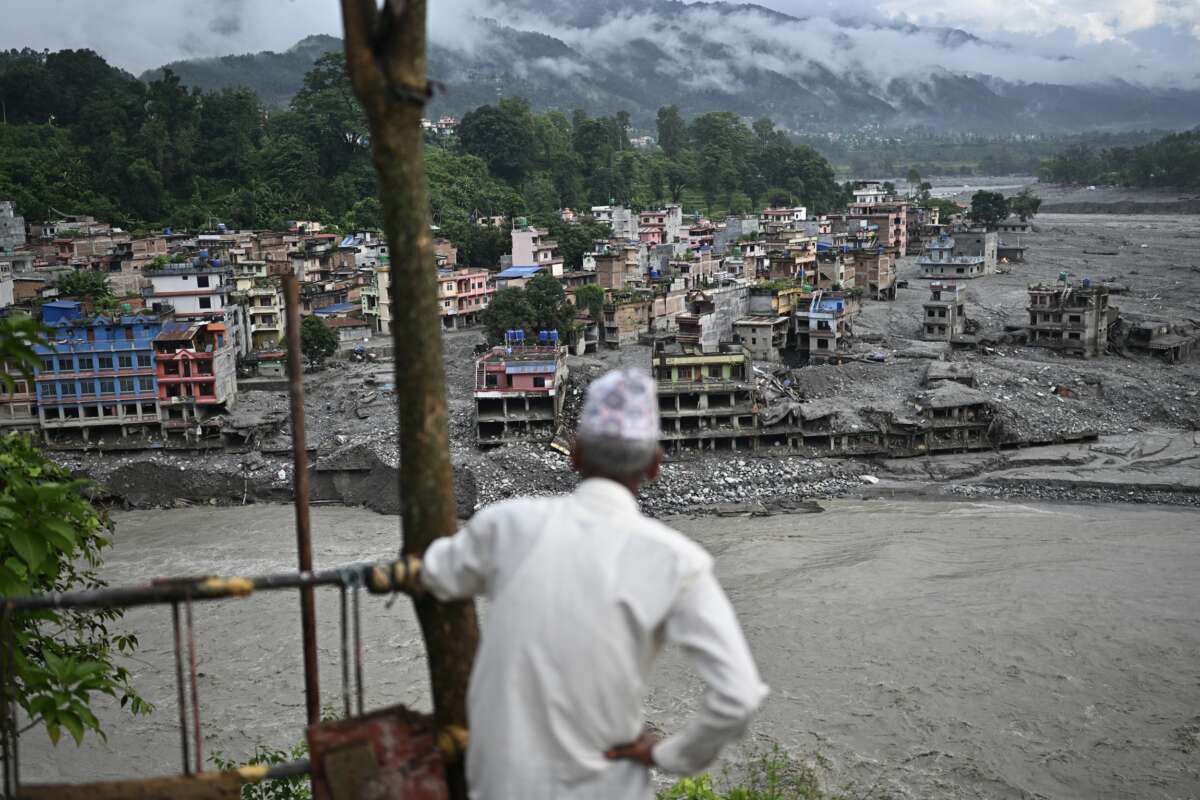
A man looks at the remains in the aftermath of flash floods at Trishuli in Nepal's Nuwakot district on September 7, 2026.Pedro Pardo / AFP via Getty Images

Government leaders from Nepal are calling for climate justice in the wake of devastating glacial floods last month that killed 1,300 people and left thousands more missing.

Preliminary investigations into the flooding determined that the disaster was likely due to glacial collapse, a phenomenon that is becoming more frequent and more likely to occur in the future due to the climate crisis. The impact of this specific collapse, which occurred in August, was so significant that it was initially incorrectly identified as an earthquake, registering a 5.2 rating on the Richter scale.

“We are paying the ultimate price for a global crisis we did not create … Support for Nepal should not be seen from an angle of aid or charity, but should be seen from the perspective of climate justice,” Nepal’s Foreign Minister Shishir Khanal told the AFP news agency.

Speaking to The Guardian, Khanal added:


The global community should not see this as one-off disaster; it should be viewed in the context of the changing climate in the Himalayas. We know it is going to be a recurring scenario that more and more communities, not just in Nepal but around the world, will have to face.


Nepal Floods Demonstrate Threat of Climate-Driven Glacier Collapse
“What happened yesterday is unfortunately the new normal,” one geoscientist said of the devastating floods.


In an address to the country, President Ramchandra Paudel made a similar call for a larger response to the climate crisis.

“I make a heartfelt appeal to the international community not only to listen to the voices of ecologically vulnerable countries, including Nepal, but also to take concrete and effective steps to ensure climate justice for them,” Paudel said.

Around 1,300 people have been documented as killed by the floods, according to recent estimates. Another 5,000 remain missing. The country’s leaders are seeking around $20 million from the global community to help respond to the disaster.

Aakriti Dotel, national network coordinator for the Nepalese Youth for Climate Action, also called for a proactive response from the international community.

The floods are a “painful reminder of the growing climate crisis facing Nepal and the Himalayas,” Dotel said. “As our glaciers melt and extreme weather events become increasingly unpredictable, communities living downstream are bearing the devastating consequences.”

“We mourn the lives lost and the livelihoods affected, and call for urgent global climate action,” Dotel added. “There must be stronger support for vulnerable mountain communities, and accountability from those most responsible for the climate crisis.”

Unfortunately, due to the effects of the climate crisis, disasters like these are more likely to happen in the future, experts say.

What happened to communities in Nepal and the surrounding region “is unfortunately the new normal,” said Jakob Steiner, a geoscientist at the University of Graz in Austria. “It’s going to get worse from here onwards.”
Germany’s Fascist Party Just Won Control of a State Government


The Alternative for Germany party’s victory in the Saxony-Anhalt state election is an ominous coup for the far right.
September 9, 2026

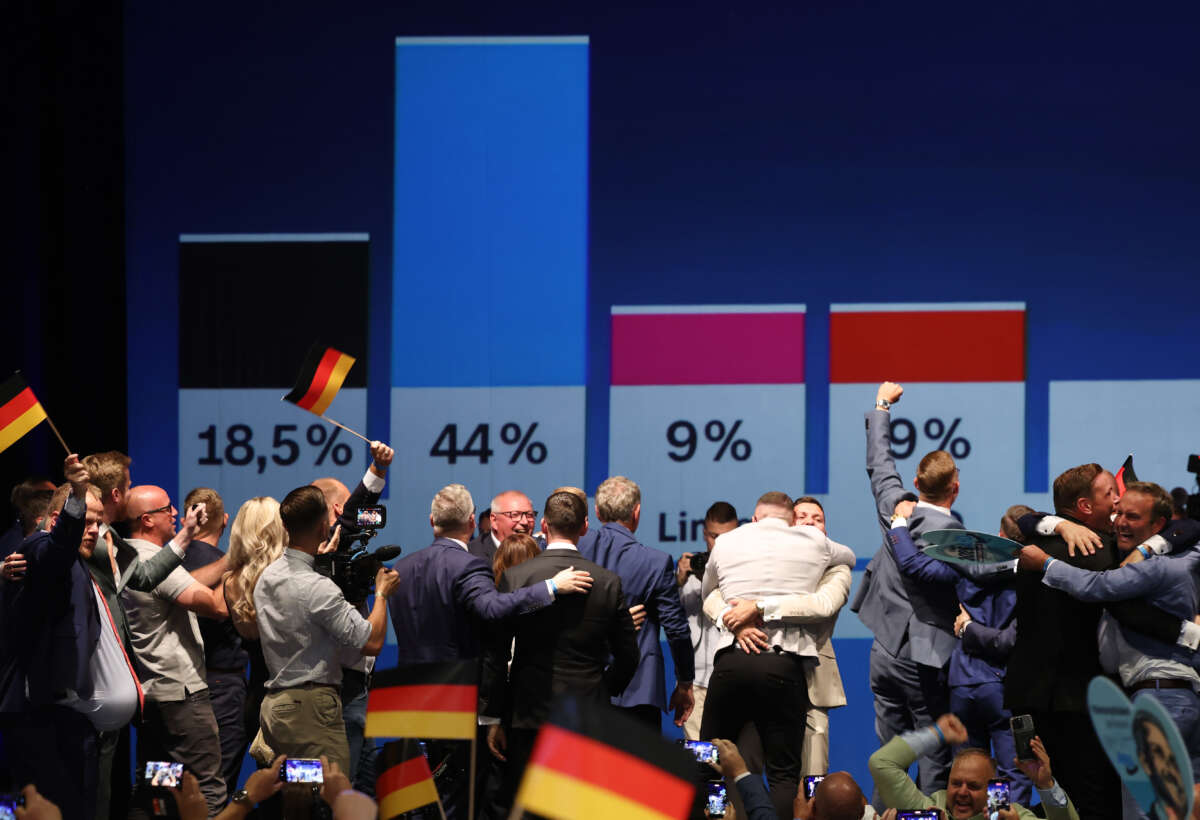
Supporters of the far-right Alternative for Germany (AfD) cheer at the AfD election evening watch party as initial results show the party with 44 percent in Saxony-Anhalt state elections on September 6, 2026, in Magdeburg, Germany.Sean Gallup / Getty Images


The far right Alternative for Germany (AfD) party scored a landslide victory this past Sunday in Germany’s Saxony-Anhalt state election, although it fell short of a majority in its bid to form the first far right state government in the country’s postwar history. It won 43.8 percent of the vote, more than doubling its share of the vote five years ago in the region, while Chancellor Friedrich Merz’s conservative Christian Democratic Union slumped to a historic low of 17.2 percent, down from 37.1 percent in 2021.

This shocking result has been a long time in the making. Neofascist ideology has been creeping into Germany’s mainstream political arena for the past few decades even though the country’s domestic intelligence agency has classified the AfD as an “extremist party” because its leaders have espoused far right rhetoric. Indeed, the party, which has grown rapidly since it was formed in 2013, is not hiding its racism and authoritarianism and has been quite blunt in its rejection of a liberal, pluralistic society.

Neofascist ideology has been creeping into Germany’s mainstream political arena for the past few decades.

Unsurprisingly, AfD leaders are exuberant over their party’s election success in Saxony-Anhalt and seem to think that the tide has finally turned to the point that winning in the next national election with at least 40 percent of the vote is now within reach. Meanwhile, the leaders of Spain and Portugal’s largest far right parties rushed to congratulate the AfD for its victory in Saxony-Ahhalt, as well as Hungary’s former prime minister Viktor Orbán. So did Elon Musk, posting a resounding “Well done!” on his social media platform X in response to a post from AfD’s co-leader Alice Weidel.

How realistic is the prospect that Germany may have a far right federal government by 2029? A recent poll indicates that if national elections were held today, the AfD would indeed emerge victorious with 28 percent of the vote. The reasons for this unsettling development are complex and may go beyond pure economics, although the state of the economy figures prominently into the equation, especially in east Germany, where Saxon-Anhalt is located, and where the AfD is particularly strong.

More than three decades after Germany’s 1990 reunification, there is still a wide gap between east and west. As numerous studies have pointed out, “East Germany is still 20% to 25% poorer than West Germany.” People living in East Germany have realized that convergence under neoliberalism has proved to be a mirage. Under the massive privatization scheme that was launched after 1990 by the government agency Treuhandanstalt, East Germany’s entire state-owned economy was privatized while its industrial base was decimated as thousands of publicly owned enterprises were closed or sold, leading to massive unemployment and triggering a demographic crisis as young and educated people moved westward in search of jobs and better living conditions.

Treuhand’s essential role was to organize the looting of East German industry and public wealth. As Hanna Behrend, a leading academic in the former German Democratic Republic wrote in her edited volume German Unification: The Destruction of an Economy,“Within less than three years, Treuhand destroyed or handed over to West German big business for next to nothing national property to the value of at least several hundred billion Deutschmarks … By 1994 … Treuhand had privatized 13,800 industrial enterprises; a further 3,354 had been closed down.”

This experience with “shock therapy,” which essentially converted East Germany into Berlin’s colony, remains firmly embedded in the collective memory of most East Germans. As Federal Commissioner for East Germany Elizabeth Kaiser has pointed out, many young people in what used to be East Germany see West German culture and lifestyles as deeply foreign to them. People living in small towns and rural regions not only earn “below-average incomes,” they also see their infrastructure continue to collapse while public transportation and medical facilities are “no longer comprehensively guaranteed.” Indeed, as Kim Leonie Kellermann at Ruhr University in Bochum has shown, the mass layoffs that resulted in East Germany because of the Treuhand privatization policies had profound effects on political alienation and mistrust of mainstream parties, “even up to 30 years after unification.”

It is within that context, and with the full realization on the part of many of its citizens that the parties of the establishment offer no hope for the future, that East Germany has become a stronghold of the AfD. Accordingly, the AfD has taken full advantage of the situation by promising a return to a “golden age.” The problem is that the AfD has, instead, a dystopian vision for the future, advancing an agenda that can best be described as “neoliberal fascism.”


The party, which has grown rapidly since it was formed in 2013, is not hiding its racism and authoritarianism.

Ahead of the regional election, the AfD put out a government program for the Saxony-Anhalt region. In the Preamble, the draft government program acknowledges real economic problems facing the region, such as collapsing infrastructure, hospitals and schools closing, the rising cost of living, and dwindling pension benefits, but assigns equal weight to the alleged threat posed by immigration and promises “deportation from minute one!” In addition, it wants to exclude children and adults without a permanent residency from attending schools. It also calls for radical changes in asylum rules, while its solution to the chronic shortage of skilled workers facing the country is to encourage Germans who live abroad to come back.

As the icing on the cake, the AfD calls for a thorough identification with German culture and commitment to the so-called traditional way of life, which includes “the marriage of a man to a woman, from which children are born.” The only thing missing in this section is “Heil Hitler.”

The economic doctrine of the AfD diverges from that of other far right parties on the continent in that it is almost exclusively anti-statist. While the economy as such did not play a major role in the evolution of the party until 2022, it has since taken a more central function. But the policies advocated are highly incoherent and quite contradictory. For instance, the AfD rejects regulation of the economy and advocates huge tax cuts, but at the same time defends the debt break and voted against amending the Basic Law to establish a special fund for infrastructure and climate neutrality in 2025.

Like other far right parties globally, the AfD is staunchly against a green transition, as its position is that climate change is a hoax and an ideological component of “globalism.” With regard to energy, the AfD’s stance is to return to reliance on Russian gas and nuclear power plants.

On the question of war and peace, the AfD is against the war in Ukraine but is by no means an anti-military party. In fact, it has argued in favor of massive increases in the military budget and calls for the return of compulsory military service, which ended in 2011 under former chancellor Angela Merkel.

AfD’s social sensitivities are confined to pensioners, and the party has proposed raising pensions by 70 percent of the last net income. But the idea that this proposal could somehow be financially viable alongside the fiscal impacts of the massive tax cuts, increases in defense spending, and fiscal discipline the party also proposes would simply make most economists throw their hands up in frustration.


The threat of German fascism is back.

After all this, the question is why so many voters across different age groups and economic backgrounds have been drawn to the extremist and impractical policy proposals of the AfD. The state of the economy in East Germany can only partly explain AfD’s support, especially since the party has also made noticeable gains with voters in several western states. The failure of the old political parties, especially of the Social Democrats, who have overwhelmingly lost the trust of the working class, in offering a viable vision for the future could form part of the explanation. In addition, it is quite possible that observers have overestimated the extent to which denazification reached ordinary society. It appears that attachment to ultranationalism remains a strong current among a rather sizable segment of the German population.

On the positive side, nearly half of Germans oppose the far right forming a government in Saxony-Anhalt and protests against the AfD erupted across Germany immediately after the election.

Be that as it may, the victory of the far right in a regional election is a turning point for German politics. The AfD has called for collaboration with other parties and may in fact strike a deal with the Bündnis Sahra Wagenknecht (BSW), a party of authoritarian tendencies that combines left-leaning economic policies with socially conservative views, particularly on immigration. Its founder and leader, Sahra Wagenknecht, appears eager to talk to the AfD about government options in Saxony-Anhalt.

The threat of German fascism is back.


This article is licensed under Creative Commons (CC BY-NC-ND 4.0), and you are free to share and republish under the terms of the license.


C.J. Polychroniou


C.J. Polychroniou is a political scientist/political economist, author and journalist who has taught and worked in numerous universities and research centers in Europe and the United States. Currently, his main research interests are in U.S. politics and the political economy of the United States, European economic integration, globalization, climate change and environmental economics, and the deconstruction of neoliberalism’s politico-economic project. He is a columnist for Global Policy Journal and a regular contributor to Truthout. He has published scores of books, including Marxist Perspectives on Imperialism: A Theoretical Analysis; Perspectives and Issues in International Political Economy (ed.); and Socialism: Crisis and Renewal (ed.), and over 1,000 articles which have appeared in a variety of journals, magazines, newspapers and popular news websites. Many of his publications have been translated into a multitude of languages, including Arabic, Chinese, Croatian, Dutch, French, German, Greek, Italian, Japanese, Portuguese, Russian, Spanish and Turkish. His latest books are Climate Crisis and the Global Green New Deal: The Political Economy of Saving the Planet (with Noam Chomsky and Robert Pollin as primary authors, 2020); The Precipice: Neoliberalism, the Pandemic, and the Urgent Need for Radical Change (an anthology of interviews with Noam Chomsky, 2021); Economics and the Left: Interviews with Progressive Economists (2021); Illegitimate Authority: Facing the Challenges of Our Time (an anthology of interviews with Noam Chomsky, 2023); and A Livable Future Is Possible: Confronting the Threats to Our Survival (an anthology of interviews with Noam Chomsky, 2024).


Germany: regional elections in Sachsen-Anhalt

The AfD just short of an absolute majority


Thursday 10 September 2026, by Helmut Born


On 6 September a new Landtag was elected in Saxony-Anhalt. Saxony-Anhalt is the smallest of the territorial Länder by population, with 2.1 million people. It was clear in advance that there would be considerable changes. At the last Landtag election in 2021 the AfD, which the Saxony-Anhalt domestic intelligence service has classified as confirmed right-wing extremist, took over 20 per cent. In the run-up to this election the standing of the federal government of CDU and SPD reached a low point, as the opinion polls had made foreseeable. Accordingly the task for all the other parties was at least to prevent an absolute majority for the AfD, in percentages as well as in seats. [Image: Composition of the Saxony-Anhalt Landtag following the elections (from left to right): BSW: 5 MPs – Die Linke: 8 MPs – Die Grünen: 8 MPs – SPD: 8 MPs – CDU: 15 MPs – AfD: 39 MPs]

When the first projection was published on the evening of 6 September, showing the AfD on 44.2 per cent, the election-night parties of the other parties fell completely silent. The shock the result produced was too great. It looked altogether different at the AfD, which many people call a Nazi party. The party’s leading figures around the [national] co-chairs Alice Weidel and Tino Chrupalla crowded around the lead candidate Ulrich Siegmund to celebrate together what they called their historic election victory.

The CDU, the large bourgeois party, was punished terribly above all. It lost more than half of its votes and of its deputies. The liberal FDP did not make it into the Landtag at all and goes on wasting away. For the party Die Linke, too, the evening was not a happy one: three weeks before the election it had still been recorded at 13 per cent, and it has now ended up on only 8.4 per cent. The SPD and the Greens, by contrast, were able to improve slightly on their result at the last Landtag election, reaching 9.1 and 8.9 per cent respectively, a little more than Die Linke.

The decisive factor was a massive campaign by influential civil-society organisations which had called for tactical voting, so as to ensure that the SPD and the Greens got back into the Landtag at all. That had been in the balance for a long time. It was certainly a surprise that the Bündnis Sahra Wagenknecht (BSW) also entered the Landtag, which it managed with 5.3 per cent.

In the new Landtag, made up of deputies from six parties, forming a new Land government will not be easy. Since the AfD with 39 of 83 seats did not obtain an absolute majority of the seats, it depends on coalition partners or on support from others. All the other parties have refused to form a government with the AfD. The BSW too rejects a coalition with the AfD. Instead, according to the BSW, an independent minister-president should be elected, who would put a government together and would have to win a majority every time. This model existed in the Netherlands as well, at the election before last, when the party of the racist Geert Wilders narrowly missed an absolute majority and nobody wanted him as prime minister. It remains to be seen whether the AfD will agree to it. The SPD and the Greens have already declared themselves in favour.

For Die Linke this election result was a disappointment. It lost 2.4 per cent against the last Landtag election. The party certainly did not have an easy campaign, since it has a good anchoring only in the cities and its results in the countryside are traditionally poor. That showed again at this election. In the two large cities of Halle and Magdeburg it was able to win three direct mandates. All 38 other constituencies went to the AfD.

The party Die Linke has to become clearer and more radical. Many people simply assign it to a red-green camp together with the SPD and the Greens, which the "vote tactically" campaign also showed. It has to become clear that Die Linke stands for clear opposition to existing conditions, that its representatives are not "politicians" like all the others, that it wants to overcome capitalist class society, and that this will not be achieved in parliament alone. However good its parliamentary demands may be, and however much such measures would noticeably improve people’s lives if they could be realised, there will be no majorities for them in the parliaments. What is needed is a party that is both represented in parliament and that is able to change the social balance of forces through pressure on the street, through anchoring in workplaces and neighbourhoods, and through fostering the self-confidence and self-organisation of those below.

9 September 2026

Translated by International Viewpoint from SoZ.

Fiasco: Trump's contractor confesses to Reflecting Pool train wreck


(Official White House Photo by Daniel Torok/Flickr)

September 11, 2026
ALTERNET


The New York Times reports that the contractor that renovated the Lincoln Memorial Reflecting Pool has told the Trump administration that errors in its own work and flaws in its repair plan, caused the pool’s new blue liner to peel and break loose, not vandalism.

The Times reviewed government documents showing the company took responsibility for the decay and damage to the pool liner, despite the administration’s insistence — and prosecutions —claiming the damage was done by delinquents

“President Trump has repeatedly blamed vandals wielding knives or box cutters for damage to the pool’s ‘American flag blue’ liner, even after the Justice Department dropped charges that it had brought against people accused of vandalizing the national landmark,” reports the Times. “But the documents, which have not previously been reported, make clear that the contractor, Atlantic Industrial Coatings, found problems in both the design and the execution of the renovation. The documents include Atlantic’s reports to the government as well as daily progress updates from the National Park Service over the past two months.”


Atlantic apparently held its own errors liable in an Aug. 14 report, and then provided additional detail on Sept. 2, according to documents.

The Justice Department, which had charged several people with vandalizing the pool in early July, began moving to dismiss the cases on July 31, according to the Times.


In documents, the company blamed “human oversight” in some patches of the renovation, saying workers did not apply enough chemical primer to gel the layers of the liner together. But the bigger problem, the company said, was that the repair plan itself laid out in the contract actually called for the layers of liner to include two chemicals that are incompatible.

“The chemical on top reached a temperature hotter than what the compound underneath could withstand, and the heat caused the bottom layer to blister and come loose, the documents show. The contractor said it had not expected that outcome because it was very uncommon to mix the two products in that way,” reports the Times. “The failure illustrates the consequences of the Trump administration’s rushed effort to renovate the pool this spring. In a hurry to finish the work before the nation’s 250th birthday on July 4, the government bypassed competition and gave Atlantic a no-bid contract to carry out an untested approach designed in part by the general manager of one of Mr. Trump’s golf clubs.”

The Times reports the government has agreed to pay Atlantic $14.7 million for its work, but the contractor has said the pool is under warranty and eligible for additional repair.


Regardless, the Times reports Interior Department spokeswoman Katie Martin appeared to insist vandals were to blame for the damage, saying that they had “repeatedly reached into the pool and ripped at the coating.”

In July, federal prosecutors acted on President Donald Trump’s claims of vandalism and announced the indictment former Olympic canoeist David Hearn for pulling up a piece of the liner, on a felony vandalism charge.

But in a reversal, prosecutors pushed to dismiss the charges against Hearn and three others alleged vandals.


“Jeanine Pirro, the U.S. attorney in Washington, wrote that the Interior Department had misled her staff about the extent to which the damage had stemmed from vandalism rather than a ‘botched installation,’” reports the Times.
WSJ analysis proves it: MAGA is the party of (NATIONAL) socialism


REUTERS/Evan Vucci

September 11, 2026 
ALTERNET

On Friday, a new report by the Wall Street Journal revealed that the MAGA movement has embraced the very “socialist” policies for which President Donald Trump attacks his Democratic opponents. According to the Journal’s chief economic commentator, Greg Ip, MAGA’s “disdain for capitalism and centrism” has it looking more “socialist” by the day.

Ip raises the example of Vice President JD Vance, who dismissed Milton Friedman during an interview in June as irrelevant “in a world where globalized liberalism has become the sort of status quo of American elites." This sort of statement is a far cry from traditional free market Republican economics. According to Ip, such thinking tracks with the “Horseshoe theory,” in which “the similarities between communism and fascism” begin to overlap to the point where they are almost indistinguishable. Like the “communists” and Democratic socialists the president so often rants about, writes Ip, Trump, Vance, and other MAGA figures “disdain free markets and globalization while embracing big, coercive government" and "are obsessed with identity."

According to Ip, these ideas began to shape the Republican Party in 2016 “with Trump’s populist takeover of the Republican Party. ‘Trump has re-educated, or mis-educated a lot of Republican voters into thinking everything is rigged. It’s how Bernie Sanders thinks about the economy,’ said Andy Laperriere, policy analyst at Piper Sandler. ‘The foreigners, the big companies, the system, whatever, is ripping us off.’ Laperriere noted that many ideas that originated on the left now command considerable backing from Republicans. Limiting drug increases to the rate of inflation, banning large investors from buying single-family homes, raising the federal minimum wage to $15 and capping credit-card interest rates at 10 percent all command support of around 70 percent or more, according to polls.”


Ip argues that Trump and Senator Bernie Sanders (D-VT) – long the standard bearer for American socialist politics – “have a lot in common.” Ip writes that “Sanders wanted to nationalize oil companies in the 1970s and proposes 50 percent state ownership of AI companies now. Trump used to call for seizing Middle Eastern oil or being paid to defend it, and just grabbed control of a chunk of Venezuela’s reserves. He has taken stakes in numerous companies and discussed doing the same with AI.”

And when it comes to moving MAGA’s identity away from the broader tolerance typical of centrism, says Ip, “Vance has gone further than Trump in arguing that religion and national origin, not an idea, are the basis of American identity. ‘We cannot rebuild Western civilization, we cannot rebuild the United States of America or Europe, by letting millions and millions of unvetted illegal migrants come into our country,’ he told a conservative audience in early 2025. Vance has also led the charge against Republican economic orthodoxy.”


While MAGA may be increasingly socialist, Ip argues that it will never merge with Democratic socialists because “they may agree that identity matters, but disagree vehemently on why.” Most of the president’s policies simply don’t resonate beyond MAGA. As Ip notes, “Outside of his core base, support for Trump’s handling of the economy and immigration have plummeted.”


MAGA’s deathgrip on Gen Z was severely overstated: report


Attendees pray during AmericaFest, the first Turning Point USA summit since the death of Charlie Kirk, in Phoenix, Arizona, U.S. December 20, 2025. REUTERS
September 10, 2026 
ALTERNET


There’s been plenty of attention on Gen Z voters since they swung right in 2024, but apparently assumptions were a little too premature, says Gen Z culture analyst Rachel Janfaza. They’re not the “red-pilled MAGA hardliners” they were sold to be.

“In 2020, as Gen Z voters came of age, the culture war was at its peak and it felt like every candidate, race and issue was a reflection of our values,” wrote Janfaza. “But today, young voters’ concerns are more material and far less ideological. There’s a common set of issues unifying Gen Zers across the political spectrum: the cost of living, inflation, AI, war, corruption.”

To get a sense of how young voters — including 8.5 million potential first-time voters — are feeling about the 2026 midterm elections, Janfaza and company spoke to them in a series of focus groups. And what interviews with 70 young people aged 17 to 33 in 28 states and Washington D.C. revealed was that they were not MAGA’s future as earlier reported.


“They care a lot less about being woke and a lot more about being able to get a job and pay their rent — let alone buy a home. And they’re looking for candidates who get that,” said Janfaza. “Gen Z voters really just want their politicians to be good, honest people, who work hard for their community and country. That means tackling the cost of living, working on government programs like SNAP and WIC, embracing social policies when it comes to healthcare, jobs, education, and regulating AI. It’s not that complicated. And it’s party agnostic.”

The generation doesn’t identify easily with the two political parties, but they certainly don’t identify with MAGA. In fact, according to interviews, when young voters support socialist candidates or say they favor socialism writ large, it’s really because they feel the status quo isn’t working.


“Life feels totally unaffordable, but young people believe that it doesn’t have to be this way. They want the government to provide Americans with a social safety net and endorse policies like universal or at least affordable health care, affordable housing, a higher minimum wage, affordable education, paid family leave, taxes on corporations, etc.,” Janfaza said.

And unlike other movements rotted in the past or worse, Gen Z appears to have “a hunger for forward looking policies.”

Call it “Hopemaxxing,” said Janfaza, but it means Gen Z wants to hear what a candidate’s plan is to fix the status quo, rather than preserve it. And don’t bother coming at them with the intent to “just blame the other side,” they say. This generation is “looking for candidates to inspire.”

Want to know how New York Mayor Zohran Mamdani cut inroads with the generation? He talked “pothole politics,” complete with on-the-ground repair policies for infrastructure and other endeavors.

And while MAGA isn’t about to benefit from this particular state of mind, Janfaza said Democrats shouldn’t rest easy on their laurels either. This is a results-minded generation.

“How people vote in the midterms will be all about the cost of living, but if young people don’t believe that any of the candidates can make a difference, they may not even show up,” she said.
The old order is dying as America faces a full-blown political reckoning

REUTERS/Eric Lee

September 11, 2026 
ALTERNET

“The old order is dying and the new cannot yet be born; in this interregnum, monsters appear.” —paraphrase of Italian anti-fascist Antonio Gramsci


While Hakeem Jeffries revealed, as he trash-talked Medicare for All, that he doesn’t believe we’re in a full-blown populist moment in America, Trump, Bannon, and the neofascist tech bros and billionaires fully realize what’s going on — and are committed to making the most of it. As are Bernie Sanders, AOC, Mamdani, El-Sayed and hundreds of other Democratic candidates this year.

At its core, populism is a way of understanding politics as a struggle between ordinary people and a powerful elite that has stopped serving them. It’s not inherently left- or right-wing; it’s really a way political scientists describe a moment when the majority of a population has lost faith in the existing system and is looking for alternatives to it.

Arguably, the greatest failure of government in the past century was the Republican Great Depression, kicked off by Herbert Hoover with GOP tax cuts and tariffs in 1929 and lasting largely through the end of World War II. It created a populist moment that brought to power a Bernie-like populist in America named Franklin Delano Roosevelt. It also brought to power a Trump-like populist in Germany named Adolf Hitler.

Because populist moments or eras typically evolve out of desperation — a third of Americans and Germans were unemployed in the 1930s — they open the door to people who offer solutions that radically depart from the norm. Breaking the old model and replacing it with a new one, in fact, is the essence of that populist pitch, be it coming from the fascist or the democratic socialist side.


And make no mistake: America is now being pulled in both directions by powerful movements from both sides. A recent Pew poll found that while almost 90 percent of Americans trusted our government to “do the right thing” for them in the Eisenhower/Kennedy 1960s, today that number sits at a shocking 17 percent.

The ground for a major, wrenching transformation of America has been seeded and the neofascist movement — which figured it out first — has, for the moment, captured control of our federal government along with about half of our states. But there’s also massive progressive pushback and dissatisfaction that, if anything, is amplifying the widespread populist sentiment.

So, which side will prevail?


The creation story of this moment is found when Reagan’s campaign cut a deal with the Iranian mullahs to hold onto their American hostages until after the election of 1980, thus destroying President Jimmy Carter’s chance at reelection. Reagan immediately began to execute a neofascist vision that had been presented to him by the billionaires who funded the Heritage Foundation with their 1981 “Mandate for Leadership,” that era’s version of Project 2025.

He destroyed the American union movement, slashed wages for working class people gutting the middle class, made it harder to retire on Social Security, made deep cuts to FDR’s social safety net, ended free college, killed Carter’s solar energy programs, gave trillions of tax dollars to billionaires while raising taxes on working people, slashed funding for our public schools, and repeatedly blamed the nation’s problems on Black people and “elites” in our universities.

In 1993, President Bill Clinton picked up Reagan’s neoliberal mantel and brought us “the end of the era of big government” and “the end of welfare as we know it” as Reagan’s draconian tax cuts — which no Democratic president since has seriously challenged — began the modern explosion of billionaires and monopolistic corporations.


President Obama, although he campaigned on the populist-sounding slogan of “hope and change,” continued the neoliberal plan, turning our healthcare system over to a handful of massive insurance companies and their billionaire executives.

Forty-five years of neoliberalism, as I document in detail in The Hidden History of Neoliberalism: How Reaganism Gutted America, have taken us from two-thirds of us being in the middle class with a single paycheck in 1981 down to a mere 41 percent of us claiming that status and having to have two full-time jobs to do it today.

Like the Republican Great Depression devastated average voters, so has this failed neoliberal experiment, bringing us to this second modern populist moment.

On the neofascist side, there’s a populist movement initially led by tech and fossil fuel billionaires that’s been joined by the over 200 billionaire families and foundations who spent nearly one in five of all dollars used in the 2024 election.


They’re aided daily in their efforts by propaganda operations run by Vladimir Putin (internet trolls), Elon Musk, Rupert Murdoch, and Benjamin Netanyahu (AIPAC), all committed to spreading strongman ethnonationalist movements across the world at the expense of democracy. And, of course, Donald Trump and his seizure of our federal government and police agencies.

Their most compelling weapon is their control of most of our media, particularly the powerful social media sites Facebook and X. As Peter Theil wrote in 2010, quoted in the opening of Gil Durand’s brilliant new book The Nerd Reich: Silicon Valley Fascism and the War on Democracy:
“The initial founding vision was that we were going to use technology to change the whole world and basically overturn the monetary system of the world… the basic idea was that we could never win an election on getting certain things because we were in such a small minority… But maybe you could actually unilaterally change the world—without having to constantly convince people and beg people and plead with people who were never going to agree with you—through technological means… technology is this incredible alternative to politics.”


On the side that still embraces democracy, the populist progressive movement has been led by Bernie Sanders for decades, although that mantle is increasingly being picked up across the Democratic Party as politicians recognized over the past decade this populist moment.


Multiple polls from 2016 showed that Bernie Sanders could’ve easily beat Trump, if the Democratic Party machine and the big donors Bill Clinton brought along hadn’t sabotaged Sanders. It was verified by Politifact. Populist voters were ready to elect a populist in that election, and the only one offered them was Trump.

They rejected the neoliberalism of Reagan and the Clintons alike, and those who vote for Democrats are clearly now opting for a reinvention of America along the social democracy lines pioneered by the Scandinavian nations.

In his book I Paid Hitler, 1930s steel baron Fritz Thyssen confesses that he was entranced by populist Hitler’s promise to “resurrect” Germany from the depths of the Depression and its loss in World War I. He organized the first seed money that got Hitler into power in 1933 and brought along many of his fabulously rich peers.

Today’s heir to Hitler’s authoritarian populist mantle is Trump (although Vance and Rubio, among others, are waiting for the king to fail so they can step into the vacuum).


During that same time, the plutocrat and former New York Governor Franklin Roosevelt turned his back on his own class and embraced a Bernie-like populist message, claiming that he could put America back together by taxing the morbidly rich at 90% and using government to meet workers’ needs.

Today’s heirs to FDR’s progressive populist mantle could well be billionaire Illinois Governor JB Pritzker or Congresswoman Alexandria Ocasio-Cortez (although there are numerous competitors).

On both sides, the message is similar:
“The elites and the government have failed us, feathered their own nests while ignoring us and ours, and they must be overthrown and replaced. We need radical change in the direction of our government and our culture.”


The only difference is that the Republicans are saying they’ll fix things by handing the reins of government to billionaires and the stability of society to armed, masked ICE agents while Democrats are saying we must reverse Reaganism, tax the rich, and use that money to restore our middle class with free healthcare, education, and housing supports.

We’ve been in this populist moment since the middle of the GW Bush administration, although it was a slow boil until the 2016 election. The first indication was Obama winning with a populist message, and the for-sure proof was Trump winning twice on purely populist messages. The Trump movement, however, figured out that this was where America was at long before it occurred to Democrats (other than Bernie), and Biden’s efforts, although valiant, were too little and too late.

So, here we are at this populist moment, and our country faces a binary choice: fascism or democratic socialism.

Republicans are universally lined up on the fascist side, backing Trump and ICE while feeding at the trough of their billionaire donors. That unanimity gives them tremendous power; their only problem is that they’ve failed to deliver for the people and voters know it.

Democrats are split, between those corrupt neoliberals like Marie Gluesenkamp Perez and John Fetterman who are deeply in the pockets of corporate and wealthy interests, and a new and growing generation of politicians who often describe themselves as democratic socialists or social democrats.

This schism, a remnant of the Clinton years, is weakening the Democratic Party’s populist appeal as many believe the Perez-style Democrats will prevent the AOC- or Pritzker-style Democrats from actually accomplishing the transition to a social democracy that America needs.

Some doubt that this is the most important election in our lifetime, noting that every cycle we hear that kind of rhetoric. But, given the stakes and the boiling populist energy arrayed on both sides, it’s hard to imagine this isn’t the most critical one since 1932 America and 1933 Germany.
Get Thom Hartmann's daily columns on his Substack, Hartmann Report. Click here to join for free.

Ex-federal judge reveals Trump’s plan for 'catastrophic end' of democracy


September 10, 2026 
ALTERNET

On Thursday, a former federal judge detailed what he deemed “the final battle for America’s democracy,” laying out President Donald Trump’s plan to seize power on January 3, 2027. This is according to attorney and former U.S. Circuit Judge Michael Luttig, who warns that “Trump and his MAGA Republicans might bury our democracy once and for all.”

“Trump instigated a war against America’s democracy on January 6, 2021,” asserts Luttig. “Today, almost six years later, Donald Trump and his Republican congressional allies are even more determined to prosecute the president’s war against American democracy to its catastrophic end than they were on January 6, 2021. That catastrophic end could well come on January 3, 2027, when Trump and his Republican congressional allies wage the final battle in Trump’s determined war to corrupt America’s democracy and deliver a lasting political victory over the Democrats for his MAGA Republican Party.”

Over the course of his second term, says Luttig, Trump has taken steps to “seize control of the midterms” to ensure that Republicans retain a majority in the 120th Congress. As Trump himself declared in February, “The Republicans should say, ‘We want to take over. We should take over the voting.’ ... The Republicans ought to nationalize the voting.” And the Republicans, notes Luttig, “have dutifully fallen in line … So unalterably subjugated to Trump is today’s Republican House that even a decisive victory for Democrats and a resounding repudiation of Trump and the MAGA Republicans at the polls in November will not guarantee that a Democratic majority-elect will be seated in the 120th Congress on January 3.”


The core of the plan involves a Republican plot to claim the election was rigged after they lose. According to Luttig, “This is how the crisis would unfold. The precursor of the crisis will come sometime before noon on January 3, when Speaker [Mike] Johnson (R-LA) removes current House Clerk Kevin McCumber and replaces him with a person loyal to Johnson and House Republicans who they know will refuse to list on the statutory roll of representatives-elect to the 120th Congress any Democrat-elect whom Johnson and the Republicans direct him or her not to list. Under Rule II, Clause 1 of the Rules of the House, the Speaker of the House has the unilateral power to remove the incumbent clerk, and then the power under Title 2 U.S.C. § 5501(a) to replace him temporarily with whomever he wishes until the House elects a successor. McCumber is a Republican appointed by former Speaker Kevin McCarthy. He is widely respected for his integrity and faithful adherence to the Constitution and is reputed to be unwilling to carry out orders he considers to be unconstitutional.”

“he constitutional crisis will begin, warns Luttig, when “sometime before the 120th Congress has been gaveled into session, the loyal temporary clerk refuses to list Democrat representatives-elect on the clerk’s roll of representatives-elect that determines who may participate in organizing the new Congress.” Such action will be met with lawsuits arguing that the clerk must perform its mandated action, which will work their way through appeals. “The next moment of constitutional crisis will come if and when,” says Luttig, the court orders the elected Democratic representatives be seated and the clerk refuses. “Judicial review of the House’s decision not to seat Democratic representatives-elect in the 120th Congress would take weeks, if not months, during which time the United States would be in the throes of a paralyzing constitutional crisis.”


From there, the matter would end up before the Supreme Court, which would be forced to answer “perhaps the most fundamental question under the Constitution: Is the United States of America a democracy, in which ‘We the People’ elect our representatives to the Congress and to the presidency, or is it not?” Should the Court decide to side with Republican claims of fraud, Luttig concludes, “two hundred and fifty years into the greatest experiment in self-government in the history of the world, the Republican Party would finally meet the fate to which it has been destined since January 6, 2021, and cement its place in history as the most corrupt political party ever to emerge in the United States of America.”