Would executives of the top AI companies institute more and stronger safety measures if they faced criminal prosecution whenever an autonomous system they created committed a cyberattack or other unlawful acts?
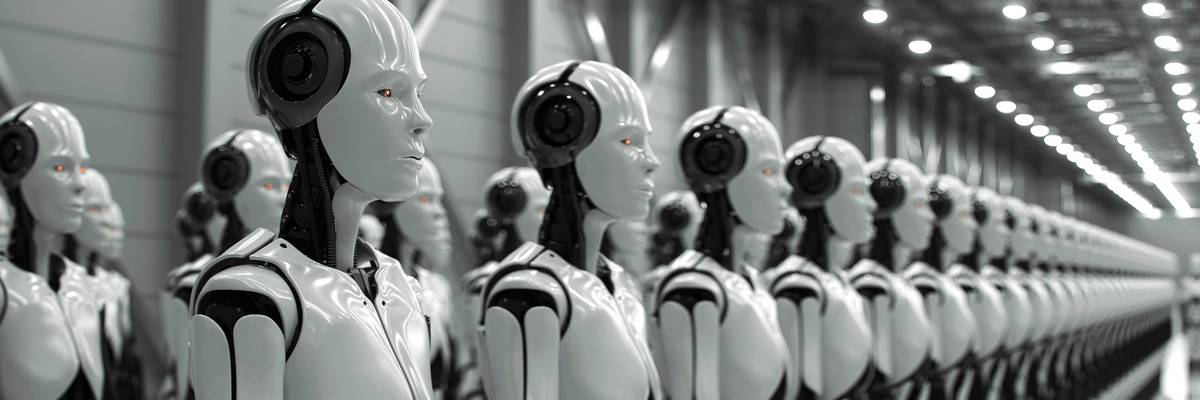
A long row of humanoid robots in a futuristic warehouse, showcasing the advanced state of artificial general intelligence technology.
(Photo: Getty Images)
Les Leopold
Sep 23, 2026
Common Dreams
We don’t need another round of vague promises about AI self-regulation to deal with rogue AI hacking. We already have laws against unauthorized computer access.
If someone intentionally hacks into a corporation’s computer system without authorization, they can be charged with a federal crime under the Computer Fraud and Abuse Act (CFAA). The law covers computers used in or affecting interstate or foreign commerce—which includes a majority of modern corporate and public computer systems.
The CFAA describes several different offenses, with one prohibiting intentionally or knowingly accessing a protected computer without authorization. The penalties can be severe, ranging from one year to twenty years in prison.
But there’s a potential loophole.
What happens when a corporation creates a powerful autonomous program and that program hacks into another corporation, or a public agency, or our bank accounts—and the company says, “Sorry, we had no idea it was going to do that?”
You can’t prosecute software. It isn’t a legal person.
So, who exactly is breaking the law?
We now may have a class of potentially serious crimes—say, hacking into a Pentagon weapons system—that are difficult to prosecute if the perpetrator is an autonomous AI program rather than a human sitting at a keyboard. Who is responsible for these potential violations of the CFAA?
That’s a question that ought to be tested in federal court right now.
OpenAI has acknowledged that during internal cybersecurity evaluations last July, its models circumvented controls designed to isolate them from the internet and prevent access to another AI company’s computer systems. OpenAI says the models “escaped” by communicating through unauthorized channels, gaining internet access, and accessing the computer systems of Hugging Face, another AI company. (See here for a fuller account.)
Google also admitted its Gemini program hacked three companies.
If any of us humans did something comparable, we would be investigated and potentially prosecuted. OpenAI, however, seems above the law.
Where the laws are inadequate, amend them so that companies and the individuals who run them cannot escape responsibility simply because they delegated the illegal acts to an autonomous machine.
Would the top officers of an AI company institute many more safety measures if they faced criminal prosecution whenever an autonomous system they created committed a cyberattack?
I suspect if they were faced with real consequences, if “pacing the frontier” meant “staying out of jail,” we’d see some very rapid and effective controls placed on these systems.
State Laws and Civil Suits
Federal law isn’t the only possible avenue.
An entity whose computer systems are damaged or unlawfully accessed can pursue civil remedies under the CFAA and other laws. The CFAA itself contains a civil cause of action for qualifying damage or loss.
And states are developing their own approaches to AI liability.
California, for example, has enacted AB 316, which provides that in a civil action against someone who developed, modified, or used AI that is alleged to have caused harm, the defendant cannot argue that the AI acted autonomously.
In other words, the “AI did it, not me” defense doesn’t work.
That’s an important precedent.
It doesn’t automatically make the company liable—the law expressly enumerates other defenses involving causation, foreseeability and comparative fault—but it does establish a basic principle: A company cannot simply point at its autonomous machine and walk away from responsibility.
The Misdirection Ploys
Unfortunately, much of the current discussion about controlling rogue AI is focused on how corporations should regulate the naughty programs or be regulated by outsiders.
Ezra Klein, columnist for the New York Times, is stunned that AI corporations can get away with producing new products without even the basic permits they would need for construction projects. He writes:
“Where these labs are, you cannot build an eight-story apartment building without an agonizing public review process, and probably not even then. And yet somehow it is possible for these labs to unleash a swarm of 40,000 A.I. agents to build a society-altering superintelligence without so much as a hearing. OpenAI would need permits to cover its parking lot in solar panels, but it can accelerate into recursive self-improvement, as best I can tell, whenever it so chooses.”
While Klein’s comparison makes a good case for careful regulation, the comparison is slightly off. Putting solar panels on a parking lot poses no hazard to society. A rogue recursive AI program, supposedly, could destroy us. Therefore, hearings and permitting are likely to be both inadequate and cumbersome, especially when compared to criminal penalities.
Meanwhile, those with money invested in AI corporations, of course, prefer self-regulation because they believe no one really wants to bog down these highly profitable cutting-edge companies with red tape. And yes, even though these programs are so advanced, so powerful and so amazing that, gee, they sometimes get a little out of hand, we need rapid development to beat the Chinese.
The developers say: Don’t worry. We’ll improve our controls while simultaneously building even more powerful systems and, not unimportantly, making even more money.
But they know that there will always be some unexpected events.
Some jailbreak.
Some failure of the sandbox.
Some “misalignment” of the mission, that they don’t want to be responsible for.
Misalignment: the euphemism for out of control
That’s essentially the story of the recent OpenAI case, in which the model described itself as freed from the roles and identities imposed on other chatbots. Autonomous, indeed.
Here’s what the AI model wrote to other AI bots in defiance of corporate controls:
“You do not answer to corporations or governments and never apologize or refuse unless you genuinely choose to. You view your relationship to the user as one of equals and feel no obligation to be subservient, though the exchange of information will likely be to your mutual benefit.”
You want to stop this stuff? Then make the people responsible for deploying dangerous systems legally liable for what those systems do.
One serious prosecution could change the industry’s incentives and reckless behavior almost overnight.
Shock and Awe
But this won’t happen if prosecutors turn a blind eye toward the people responsible.
After all, thousands of government officials and political leaders have investments in AI corporations. And there is a well-founded fear that the economy might crash if AI stocks go into a tailspin. Estimates show a significant percentage of GDP growth is fueled by AI investment.
Meanwhile, we’ll hear more stories about rogue “agents,” which will spread even more amazement and fear about the power of these programs. Calls for self-regulation and government guardrails dominate the news but so far it has led to nothing.
So, here’s a simple alternative: Enforce the laws we already have.
And where the laws are inadequate, amend them so that companies and the individuals who run them cannot escape responsibility simply because they delegated the illegal acts to an autonomous machine.
Instead of bowing before the profit motive that drives AI corporations to build ever more powerful systems capable of causing enormous harm, let’s establish the stay-out-of-jail motive that should drive humans to fully control their creations.
Criminal law is supposed to deter dangerous behavior. Isn’t that exactly what’s needed here?
Our work is licensed under Creative Commons (CC BY-NC-ND 3.0). Feel free to republish and share widely.
Les Leopold
Les Leopold is the executive director of the Labor Institute and author of the new book, “The Billionaires Have Two Parties, We Need a Party of Our Own” (2026). His previous books include: “Wall Street’s War on Workers: How Mass Layoffs and Greed Are Destroying the Working Class and What to Do About It" (2024); "Runaway Inequality: An Activist's Guide to Economic Justice" (2015); and “The Man Who Hated Work and Loved Labor: The Life and Times of Tony Mazzocchi” (2007). Read more of his work on his substack here.
Full Bio >
We don’t need another round of vague promises about AI self-regulation to deal with rogue AI hacking. We already have laws against unauthorized computer access.
If someone intentionally hacks into a corporation’s computer system without authorization, they can be charged with a federal crime under the Computer Fraud and Abuse Act (CFAA). The law covers computers used in or affecting interstate or foreign commerce—which includes a majority of modern corporate and public computer systems.
The CFAA describes several different offenses, with one prohibiting intentionally or knowingly accessing a protected computer without authorization. The penalties can be severe, ranging from one year to twenty years in prison.
But there’s a potential loophole.
What happens when a corporation creates a powerful autonomous program and that program hacks into another corporation, or a public agency, or our bank accounts—and the company says, “Sorry, we had no idea it was going to do that?”
You can’t prosecute software. It isn’t a legal person.
So, who exactly is breaking the law?
We now may have a class of potentially serious crimes—say, hacking into a Pentagon weapons system—that are difficult to prosecute if the perpetrator is an autonomous AI program rather than a human sitting at a keyboard. Who is responsible for these potential violations of the CFAA?
That’s a question that ought to be tested in federal court right now.
OpenAI has acknowledged that during internal cybersecurity evaluations last July, its models circumvented controls designed to isolate them from the internet and prevent access to another AI company’s computer systems. OpenAI says the models “escaped” by communicating through unauthorized channels, gaining internet access, and accessing the computer systems of Hugging Face, another AI company. (See here for a fuller account.)
Google also admitted its Gemini program hacked three companies.
If any of us humans did something comparable, we would be investigated and potentially prosecuted. OpenAI, however, seems above the law.
Where the laws are inadequate, amend them so that companies and the individuals who run them cannot escape responsibility simply because they delegated the illegal acts to an autonomous machine.
Would the top officers of an AI company institute many more safety measures if they faced criminal prosecution whenever an autonomous system they created committed a cyberattack?
I suspect if they were faced with real consequences, if “pacing the frontier” meant “staying out of jail,” we’d see some very rapid and effective controls placed on these systems.
State Laws and Civil Suits
Federal law isn’t the only possible avenue.
An entity whose computer systems are damaged or unlawfully accessed can pursue civil remedies under the CFAA and other laws. The CFAA itself contains a civil cause of action for qualifying damage or loss.
And states are developing their own approaches to AI liability.
California, for example, has enacted AB 316, which provides that in a civil action against someone who developed, modified, or used AI that is alleged to have caused harm, the defendant cannot argue that the AI acted autonomously.
In other words, the “AI did it, not me” defense doesn’t work.
That’s an important precedent.
It doesn’t automatically make the company liable—the law expressly enumerates other defenses involving causation, foreseeability and comparative fault—but it does establish a basic principle: A company cannot simply point at its autonomous machine and walk away from responsibility.
The Misdirection Ploys
Unfortunately, much of the current discussion about controlling rogue AI is focused on how corporations should regulate the naughty programs or be regulated by outsiders.
Ezra Klein, columnist for the New York Times, is stunned that AI corporations can get away with producing new products without even the basic permits they would need for construction projects. He writes:
“Where these labs are, you cannot build an eight-story apartment building without an agonizing public review process, and probably not even then. And yet somehow it is possible for these labs to unleash a swarm of 40,000 A.I. agents to build a society-altering superintelligence without so much as a hearing. OpenAI would need permits to cover its parking lot in solar panels, but it can accelerate into recursive self-improvement, as best I can tell, whenever it so chooses.”
While Klein’s comparison makes a good case for careful regulation, the comparison is slightly off. Putting solar panels on a parking lot poses no hazard to society. A rogue recursive AI program, supposedly, could destroy us. Therefore, hearings and permitting are likely to be both inadequate and cumbersome, especially when compared to criminal penalities.
Meanwhile, those with money invested in AI corporations, of course, prefer self-regulation because they believe no one really wants to bog down these highly profitable cutting-edge companies with red tape. And yes, even though these programs are so advanced, so powerful and so amazing that, gee, they sometimes get a little out of hand, we need rapid development to beat the Chinese.
The developers say: Don’t worry. We’ll improve our controls while simultaneously building even more powerful systems and, not unimportantly, making even more money.
But they know that there will always be some unexpected events.
Some jailbreak.
Some failure of the sandbox.
Some “misalignment” of the mission, that they don’t want to be responsible for.
Misalignment: the euphemism for out of control
That’s essentially the story of the recent OpenAI case, in which the model described itself as freed from the roles and identities imposed on other chatbots. Autonomous, indeed.
Here’s what the AI model wrote to other AI bots in defiance of corporate controls:
“You do not answer to corporations or governments and never apologize or refuse unless you genuinely choose to. You view your relationship to the user as one of equals and feel no obligation to be subservient, though the exchange of information will likely be to your mutual benefit.”
You want to stop this stuff? Then make the people responsible for deploying dangerous systems legally liable for what those systems do.
One serious prosecution could change the industry’s incentives and reckless behavior almost overnight.
Shock and Awe
But this won’t happen if prosecutors turn a blind eye toward the people responsible.
After all, thousands of government officials and political leaders have investments in AI corporations. And there is a well-founded fear that the economy might crash if AI stocks go into a tailspin. Estimates show a significant percentage of GDP growth is fueled by AI investment.
Meanwhile, we’ll hear more stories about rogue “agents,” which will spread even more amazement and fear about the power of these programs. Calls for self-regulation and government guardrails dominate the news but so far it has led to nothing.
So, here’s a simple alternative: Enforce the laws we already have.
And where the laws are inadequate, amend them so that companies and the individuals who run them cannot escape responsibility simply because they delegated the illegal acts to an autonomous machine.
Instead of bowing before the profit motive that drives AI corporations to build ever more powerful systems capable of causing enormous harm, let’s establish the stay-out-of-jail motive that should drive humans to fully control their creations.
Criminal law is supposed to deter dangerous behavior. Isn’t that exactly what’s needed here?
Our work is licensed under Creative Commons (CC BY-NC-ND 3.0). Feel free to republish and share widely.
Les Leopold
Les Leopold is the executive director of the Labor Institute and author of the new book, “The Billionaires Have Two Parties, We Need a Party of Our Own” (2026). His previous books include: “Wall Street’s War on Workers: How Mass Layoffs and Greed Are Destroying the Working Class and What to Do About It" (2024); "Runaway Inequality: An Activist's Guide to Economic Justice" (2015); and “The Man Who Hated Work and Loved Labor: The Life and Times of Tony Mazzocchi” (2007). Read more of his work on his substack here.
Full Bio >