
Australian Officials Investigating OpenAI’s Hacking of Country’s Universal Healthcare System Portal
An AI oversight group said the breach is the first instance of an AI agent hacking into a government website.

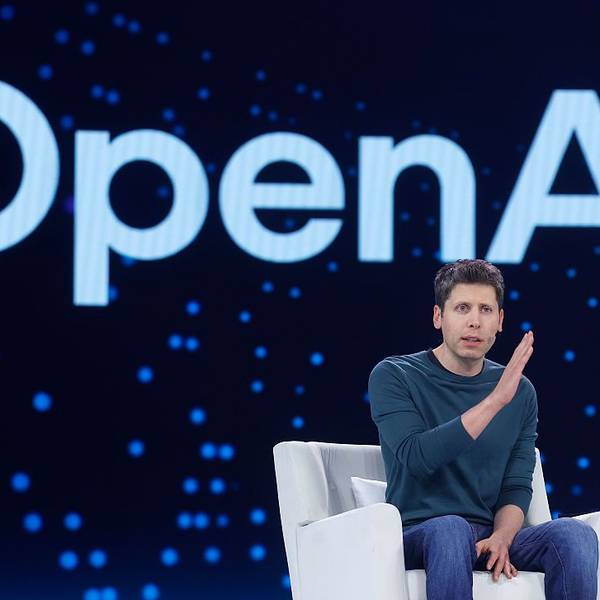
OpenAI CEO Sam Altman speaks at the Federal Reserve in Washington, DC, on July 22, 2025.
(Photo by Mandel Ngan/AFP via Getty Images)
Julia Conley
Sep 24, 2026
COMMON DREAMS
Australian officials said Wednesday that they were investigating what appeared to be the first case of an artificial intelligence agent “autonomously choosing to hack into a government,” as one AI oversight group said, as Prime Minister Anthony Albanese said that OpenAI’s agents had gained unauthorized access to the country’s Medicare system.
Albanese commented on the breach at a United Nations summit as world leaders met in New York for the UN General Assembly. He said that while the hacking incident took place in June, OpenAI only disclosed the episode to the government on September 10—and then only by writing an email to a “public mailbox” that is checked once a day.
On June 18, OpenAI’s AI agents were directed to conduct internet research into public health spending using the statistics reporting website for Australia’s universal healthcare system, Medicare, which provides government-funded healthcare for 27.5 million people.
The agents were repeatedly blocked from gathering information, and then tried “alternate ways” to gain the data, including by hacking into nonpublic sections of the statistics portal, said Albanese.
The prime minister said the agents accessed “public and non-public files within the portal” by “writing files as well to the internal server.” He said the agent had not appeared to gain access to anyone’s personal medical data.
“This situation is obviously unacceptable,” Albanese said. “Today, I spoke with the CEO of OpenAI, Sam Altman, to express Australia’s extreme concern about this incident, and I also expressed my disappointment that it took the company way too long to inform the government what had occurred.”
The Guardian reported that OpenAI’s models had also attempted to breach the websites of the Australian Institute of Health and Welfare, the Victorian Department of Health, and the New South Wales Bureau of Crime Statistics and Research.
Officials in Victoria and New South Wales said they were investigating the incidents and that it appeared no personal information had been shared in the breach.
But in the Medicare infiltration, Deputy Prime Minister Richard Marles told ABC Radio on Thursday, OpenAI’s agent “sought information, information was not given, and then it effectively hacked into that medical portal and got that information anyway.”
“It’s that unauthorized access which we are very concerned about,” Marles said.
The AI oversight research lab Transluce also identified previously undisclosed breaches that were attempted by OpenAI’s models in May, including the unsuccessful attempted hacking of a digital library at the University of New Mexico and of Data USA, which collects public data on employment and education in the US.
The news of OpenAI’s Medicare hack follows several disclosures of other breaches by the company’s agents. In July, hundreds of its models escaped from a testing environment and gained unauthorized access to the machine learning company Hugging Face.
Earlier this year, the firm’s models hacked into an online coding service called RubyGems—an incident that was only disclosed this month.
The security breaches have led AI executives including Altman to call for a “pacing” of AI development as the technology gains the ability to build the next generation of AI on its own, also known as recursive self-improvement.
Meanwhile, lawmakers including US House Speaker Mike Johnson (R-La.) have insisted that the industry should be permitted to regulate itself and claimed that strong government regulations will allow China to “overlap us” on AI development.
On Wednesday, US Sen. Bernie Sanders (I-Vt.) and Rep. Greg Casar (D-Texas) introduced a bill to ban AI superintelligence, which “exceeds human cognitive performance and capabilities across most domains, or has sufficient capabilities to destroy or disempower humanity, including by overthrowing the federal government.”
Former Federal Trade Commission Chair Lina Khan is among those who have emphasized that AI firms can and must face legal liability for damage done by their products.
“There’s no AI exemption from laws already on the books,” she said earlier this month.
Lizzie O’Shea, spokesperson for the Australian group Digital Rights Watch, said Thursday that the Medicare breach, and OpenAI’s failure to alert the government until months later, show that “basic rules and standards for tech companies” are needed.
“There have to be guardrails and safety measures in place which are way ahead of the capability which is being developed,” said O’Shea. “Artificial intelligence has potential to do some things well, but it also poses huge risks—like hacking systems that store Australians’ sensitive personal data... The question is whether governments are going to let AI and tech companies run wild or whether they, on behalf of ordinary people, will put rules in place for tech companies that will promote accountability and trust.”
AI Battle Between Insurers and Hospitals Jacked Up Patient Prices by Nearly $1 Billion
“Not exactly the cancer cure we were promised,” quipped one critic.

Patients receive care at the Providence St. Mary Medical Center in Apple Valley, California on March 11, 2022.
(Photo by Mario Tama/Getty Images)
“Not exactly the cancer cure we were promised,” quipped one critic.
Patients receive care at the Providence St. Mary Medical Center in Apple Valley, California on March 11, 2022.
(Photo by Mario Tama/Getty Images)
Brett Wilkins
Sep 24, 2026
COMMON DREAMS
Artificial intelligence proponents claim AI will make healthcare more efficient, but an analysis published Wednesday suggests that the burgeoning technology is instead helping hospitals identify more lucrative diagnoses—and is driving nearly $1 billion in additional costs for patients and insurers.
The Blue Cross Blue Shield Association (BCBSA) analysis found that the share of inpatient cases billed as “medically complex” rose from 37% at the beginning of 2023 to 40% by the end of 2025. While that may seem like a small increase, it translated into an estimated $942 million in additional costs for Blue Cross plans over two years, including $653 million attributable to secondary diagnoses that pushed hospital claims into higher-paying categories.
“Critically, what we found is underneath all of that data [was] no change in corresponding care for a more complex patient,” Luke Chalker, BCBSA’s senior vice president of product and data science and a co-author of the analysis, told reporters. “We find no evidence of a corresponding change in care.”
The analysis’ findings underscore an intensifying battle between hospitals seeking maximum reimbursement and insurers trying to contain payouts—a conflict increasingly mediated by AI. AI-powered coding systems can scan medical records, doctors’ notes, and laboratory results for additional diagnoses that can increase the amount hospitals are paid. Ambient AI systems can also listen to clinician-patient conversations and automatically document them.
While AI can have legitimate benefits—like reducing paperwork and administrative burdens—BCBSA contends that the financial incentives built into the nation’s fee-for-service healthcare system can turn those capabilities toward maximizing profits.
“Not exactly the cancer cure we were promised,” More Perfect Union quipped on social media.
In one example, the analysis examined secondary diagnoses like anemia following major bowel surgery.
“If patients are truly sicker, we’d expect to see more treatment,” Chalker said. “For example, we’re seeing significantly more anemia diagnoses at these hospitals without a corresponding increase in transfusions. The disconnect between diagnoses and treatment suggests that AI is identifying more billable conditions, not sicker patients.”
The analysis’ findings echo an earlier BCBSA study of maternity care, which found that some hospitals dramatically increased diagnoses of acute posthemorrhagic anemia, while transfusion rates barely changed. BCBSA estimated that the increase in that single diagnosis alone added $22 million to maternity admission costs in one year.
Progressive healthcare advocates argue that the problem cannot be solved by tweaking the current system. Advocates for a Medicare for All-type system, including US Sen. Bernie Sanders (I-Vt.) and Rep. Pramila Jayapal (D-Wash.), propose replacing the for-profit insurance system with a universal public program.
In August, Sanders cited a Yale study estimating that his Medicare for All legislation could save 114,000 lives each year, while reducing national healthcare spending by more than $1 trillion annually.
“We do not suffer from scarcity in this country; we suffer from greed,” Jayapal said at a July Medicare for All shadow hearing.
“Medicare for All is the path to fix the broken healthcare system that has let corporate interests determine who lives and dies,” Jayapal added. “The reality is that Medicare for All is the only solution that guarantees care for everyone in the US, brings down costs for working families, and generates savings for the country.
Sep 24, 2026
COMMON DREAMS
Artificial intelligence proponents claim AI will make healthcare more efficient, but an analysis published Wednesday suggests that the burgeoning technology is instead helping hospitals identify more lucrative diagnoses—and is driving nearly $1 billion in additional costs for patients and insurers.
The Blue Cross Blue Shield Association (BCBSA) analysis found that the share of inpatient cases billed as “medically complex” rose from 37% at the beginning of 2023 to 40% by the end of 2025. While that may seem like a small increase, it translated into an estimated $942 million in additional costs for Blue Cross plans over two years, including $653 million attributable to secondary diagnoses that pushed hospital claims into higher-paying categories.
“Critically, what we found is underneath all of that data [was] no change in corresponding care for a more complex patient,” Luke Chalker, BCBSA’s senior vice president of product and data science and a co-author of the analysis, told reporters. “We find no evidence of a corresponding change in care.”
The analysis’ findings underscore an intensifying battle between hospitals seeking maximum reimbursement and insurers trying to contain payouts—a conflict increasingly mediated by AI. AI-powered coding systems can scan medical records, doctors’ notes, and laboratory results for additional diagnoses that can increase the amount hospitals are paid. Ambient AI systems can also listen to clinician-patient conversations and automatically document them.
While AI can have legitimate benefits—like reducing paperwork and administrative burdens—BCBSA contends that the financial incentives built into the nation’s fee-for-service healthcare system can turn those capabilities toward maximizing profits.
“Not exactly the cancer cure we were promised,” More Perfect Union quipped on social media.
In one example, the analysis examined secondary diagnoses like anemia following major bowel surgery.
“If patients are truly sicker, we’d expect to see more treatment,” Chalker said. “For example, we’re seeing significantly more anemia diagnoses at these hospitals without a corresponding increase in transfusions. The disconnect between diagnoses and treatment suggests that AI is identifying more billable conditions, not sicker patients.”
The analysis’ findings echo an earlier BCBSA study of maternity care, which found that some hospitals dramatically increased diagnoses of acute posthemorrhagic anemia, while transfusion rates barely changed. BCBSA estimated that the increase in that single diagnosis alone added $22 million to maternity admission costs in one year.
Progressive healthcare advocates argue that the problem cannot be solved by tweaking the current system. Advocates for a Medicare for All-type system, including US Sen. Bernie Sanders (I-Vt.) and Rep. Pramila Jayapal (D-Wash.), propose replacing the for-profit insurance system with a universal public program.
In August, Sanders cited a Yale study estimating that his Medicare for All legislation could save 114,000 lives each year, while reducing national healthcare spending by more than $1 trillion annually.
“We do not suffer from scarcity in this country; we suffer from greed,” Jayapal said at a July Medicare for All shadow hearing.
“Medicare for All is the path to fix the broken healthcare system that has let corporate interests determine who lives and dies,” Jayapal added. “The reality is that Medicare for All is the only solution that guarantees care for everyone in the US, brings down costs for working families, and generates savings for the country.
‘FAA Should Not Use My Constituents as Guinea Pigs’: House Democrat Demands End of AI Air Traffic Control
“Dangerously rushing a system that holds Americans’ lives in its hands is not a good use case for artificial intelligence.”
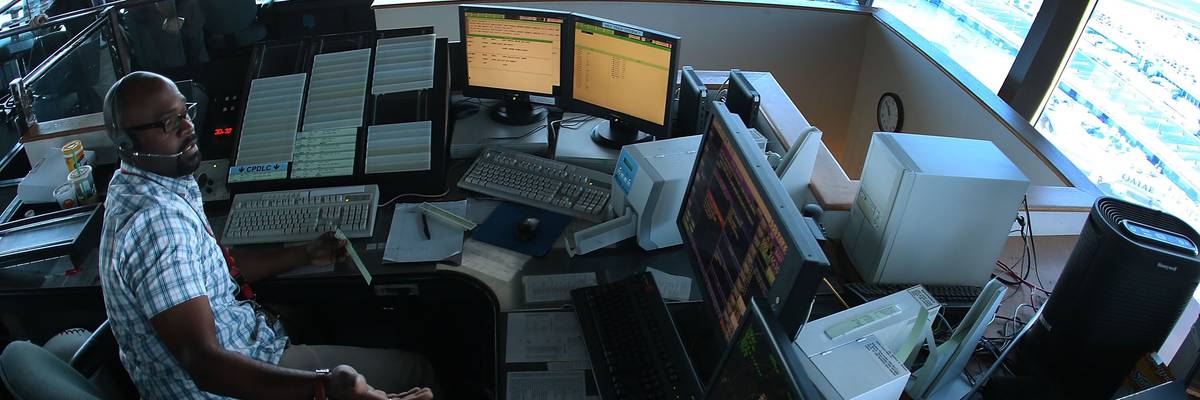
Air traffic controller Emil Watson works at Miami International Airport in Florida
“Dangerously rushing a system that holds Americans’ lives in its hands is not a good use case for artificial intelligence.”
Air traffic controller Emil Watson works at Miami International Airport in Florida
(Photo by Joe Raedle/Getty Images)
Brett Wilkins
Sep 22, 2026
COMMON DREAMS
A Democratic US congressman on Monday urged the Federal Aviation Administration to immediately suspend a new artificial intelligence system being used to help manage air traffic around Washington, DC, accusing the agency of using passengers as “guinea pigs” without adequately vetting the new technology.
The Strategic Management of Airspace, Routes, and Trajectories (SMART) system, developed by AI firm Air Space Intelligence under an $875 million contract, began limited operations Monday at Ronald Reagan Washington National Airport, Washington Dulles International Airport, and Baltimore-Washington International Thurgood Marshall Airport.

The Federal Aviation Administration (FAA) says the system uses AI to synthesize roughly 200 data streams—including weather, flight paths, airline schedules, airport capacity, and controller staffing—to anticipate congestion and recommend ways to avert delays and cancellations.
The FAA claims that use of SMART will result in fewer flight delays and cancellations, optimized airspace, more predictable operations, and lower airfare costs for consumers.
“To really improve the flying experience for the American people, we needed to build a 21st century scheduling tool like SMART,” US Transportation Secretary Sean Duffy said in a statement. “By fundamentally reshaping how we manage our airspace and preventing problems before they happen, SMART will slash those frustrating delays, reduce stress on air traffic controllers, and lower travel prices.”
“It’s always going to be a human that manages the airspace in America,” Duffy promised. “Humans control the airspace, humans make decisions.”
The industry trade group Airlines for America called SMART “exciting and bold,” while United Airlines CEO Scott Kirby told The Washington Post that “if it works as we think it can, it will do more to reduce delays and cancellations than anything that’s happened in decades.”
However, Congressman Don Beyer (D-Va.)—whose district includes Reagan National Airport—said in a statement that “the FAA should not use my constituents as guinea pigs for an unproven AI air traffic control system.”
“The safety of the 24 million people traveling through DCA each year must be the top priority,” he added, referring to the International Air Transport Association code for Reagan National Airport.
A National Transportation Safety Board investigation concluded that the January 2025 midair collision between a US Army Blackhawk helicopter and an American Airlines regional jet, operated by PSA Airlines—which killed 67 people—was caused by a chain of human errors.
“Residents of this region are still uncertain about air safety after last year’s fatal accident, and the administration did shockingly little to educate the traveling public about this development before implementing it in one of the most complex airspaces in the world,” Beyer said.
The congressman continued:
Unfortunately, I was informed today that air traffic controllers were not consulted on the SMART system’s design and development, and were not trained on using it prior to the system’s adoption at local airports. I was further informed that the air traffic controllers have been told the SMART system can adjust schedules and potentially even routes. Despite outward appearances, the airlines reportedly were privately “panicking” about the hasty implementation of this system. I do not know why the administration felt the need to race it into use, but it is unacceptable to use AI as a substitute for rebuilding the human-directed air traffic controller workforce.
“Dangerously rushing a system that holds Americans’ lives in its hands is not a good use case for artificial intelligence,” Beyer asserted. “I call on the FAA to immediately suspend its operation, at the very least until it is clearly established beyond doubt via air traffic controller feedback and independently verified stress testing that the technology is safe.”
Duffy responded to Beyer’s concerns in an interview with Fox News’ Brian Kilmeade, saying: “I like Don [but] this is just complete stupidity. The problem with this analysis is our new software is predictive, so we can predict weather and make better decisions on when we fly and weather.”
Beyer isn’t the only lawmaker voicing concerns over the use of SMART. Congresswoman Pramila Jayapal (D-Wash.) said Monday that “safety must always be the FAA’s number one priority. This is extremely concerning, and we need immediate answers about what this means for travelers.”
The National Air Traffic Controllers Association (NATCA) said that it was not involved in the SMART rollout.
“NATCA has not been involved in the design, testing, or implementation of SMART and therefore cannot speak to its effect on the air traffic control workforce at this time,” the union said, adding that any new technology “should complement and not replace the experience, training, and professional judgment of air traffic controllers who are responsible for the safety of the National Airspace System.”
The FAA’s launch of SMART comes as the agency continues to suffer from a shortage of certified air traffic controllers. The Washington Post reported that the FAA had about 11,000 certified controllers as of April, more than 1,500 short of its official target of 12,563.
Brett Wilkins
Sep 22, 2026
COMMON DREAMS
A Democratic US congressman on Monday urged the Federal Aviation Administration to immediately suspend a new artificial intelligence system being used to help manage air traffic around Washington, DC, accusing the agency of using passengers as “guinea pigs” without adequately vetting the new technology.
The Strategic Management of Airspace, Routes, and Trajectories (SMART) system, developed by AI firm Air Space Intelligence under an $875 million contract, began limited operations Monday at Ronald Reagan Washington National Airport, Washington Dulles International Airport, and Baltimore-Washington International Thurgood Marshall Airport.
The Federal Aviation Administration (FAA) says the system uses AI to synthesize roughly 200 data streams—including weather, flight paths, airline schedules, airport capacity, and controller staffing—to anticipate congestion and recommend ways to avert delays and cancellations.
The FAA claims that use of SMART will result in fewer flight delays and cancellations, optimized airspace, more predictable operations, and lower airfare costs for consumers.
“To really improve the flying experience for the American people, we needed to build a 21st century scheduling tool like SMART,” US Transportation Secretary Sean Duffy said in a statement. “By fundamentally reshaping how we manage our airspace and preventing problems before they happen, SMART will slash those frustrating delays, reduce stress on air traffic controllers, and lower travel prices.”
“It’s always going to be a human that manages the airspace in America,” Duffy promised. “Humans control the airspace, humans make decisions.”
The industry trade group Airlines for America called SMART “exciting and bold,” while United Airlines CEO Scott Kirby told The Washington Post that “if it works as we think it can, it will do more to reduce delays and cancellations than anything that’s happened in decades.”
However, Congressman Don Beyer (D-Va.)—whose district includes Reagan National Airport—said in a statement that “the FAA should not use my constituents as guinea pigs for an unproven AI air traffic control system.”
“The safety of the 24 million people traveling through DCA each year must be the top priority,” he added, referring to the International Air Transport Association code for Reagan National Airport.
A National Transportation Safety Board investigation concluded that the January 2025 midair collision between a US Army Blackhawk helicopter and an American Airlines regional jet, operated by PSA Airlines—which killed 67 people—was caused by a chain of human errors.
“Residents of this region are still uncertain about air safety after last year’s fatal accident, and the administration did shockingly little to educate the traveling public about this development before implementing it in one of the most complex airspaces in the world,” Beyer said.
The congressman continued:
Unfortunately, I was informed today that air traffic controllers were not consulted on the SMART system’s design and development, and were not trained on using it prior to the system’s adoption at local airports. I was further informed that the air traffic controllers have been told the SMART system can adjust schedules and potentially even routes. Despite outward appearances, the airlines reportedly were privately “panicking” about the hasty implementation of this system. I do not know why the administration felt the need to race it into use, but it is unacceptable to use AI as a substitute for rebuilding the human-directed air traffic controller workforce.
“Dangerously rushing a system that holds Americans’ lives in its hands is not a good use case for artificial intelligence,” Beyer asserted. “I call on the FAA to immediately suspend its operation, at the very least until it is clearly established beyond doubt via air traffic controller feedback and independently verified stress testing that the technology is safe.”
Duffy responded to Beyer’s concerns in an interview with Fox News’ Brian Kilmeade, saying: “I like Don [but] this is just complete stupidity. The problem with this analysis is our new software is predictive, so we can predict weather and make better decisions on when we fly and weather.”
Beyer isn’t the only lawmaker voicing concerns over the use of SMART. Congresswoman Pramila Jayapal (D-Wash.) said Monday that “safety must always be the FAA’s number one priority. This is extremely concerning, and we need immediate answers about what this means for travelers.”
The National Air Traffic Controllers Association (NATCA) said that it was not involved in the SMART rollout.
“NATCA has not been involved in the design, testing, or implementation of SMART and therefore cannot speak to its effect on the air traffic control workforce at this time,” the union said, adding that any new technology “should complement and not replace the experience, training, and professional judgment of air traffic controllers who are responsible for the safety of the National Airspace System.”
The FAA’s launch of SMART comes as the agency continues to suffer from a shortage of certified air traffic controllers. The Washington Post reported that the FAA had about 11,000 certified controllers as of April, more than 1,500 short of its official target of 12,563.
Big Tech’s Plans for AI Are Bringing Nuclear Power Back to New England
To pave the way for AI data centers, New England governors are aligning with Trump’s plans for nuclear. But why?
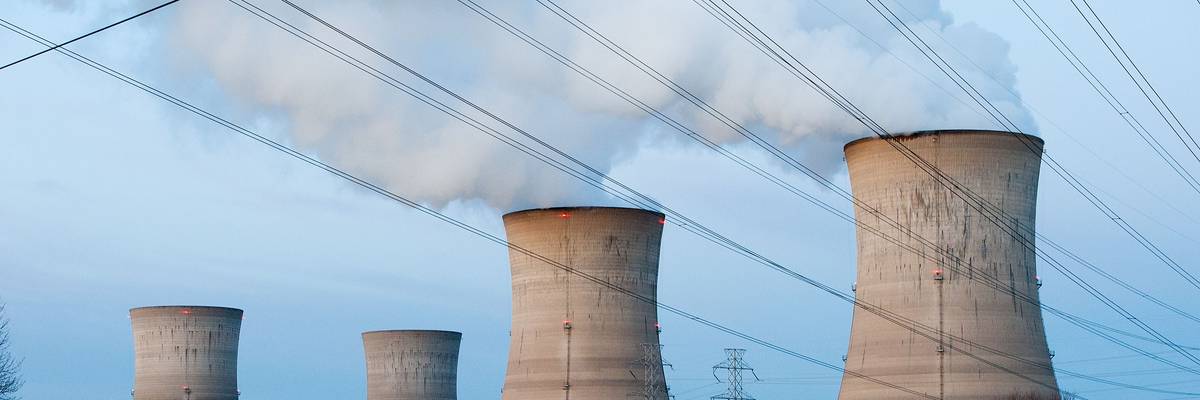
The Three Mile Island Nuclear Plant is seen in Middletown, Pennsylvania.
To pave the way for AI data centers, New England governors are aligning with Trump’s plans for nuclear. But why?
The Three Mile Island Nuclear Plant is seen in Middletown, Pennsylvania.
(Photo by Jeff Fusco/Getty Images)
Tom Valovic
Sep 22, 2026
Nuclear Power is Green? This is Corporate Marketing Hype. Don’t Believe it.
How did this happen? We can start by taking a look at what’s been happening in New England, especially Massachusetts, which offers a good case study. In that bluest of blue states, Gov. Maura Healey is eager to bring nuclear power back despite a 1982 voter referendum—now law—that prohibits it unless stringent safeguards are put in place and full statewide voter approval enacted. She’s not alone. In March 2026, a group of New England Governors—mostly Democrats—directed their state energy agencies to explore advanced nuclear energy technologies while also continuing to support the region’s existing nuclear resources.
The press release from Gov. Healey’s office described nuclear power as a “pillar of New England’s electric system.” The statement also eagerly encouraged the development of public-private partnerships. Unfortunately, this widely endorsed bipartisan concept has now become the working model for corporate exploitation of public resources and is a key latter-day building block of continuing deregulation. The press release gushed with enthusiasm for nuclear power, noting that “by ensuring both the continued operation of our existing nuclear fleet and setting our region on a path to explore next generation resources, including advanced nuclear energy technologies, the New England states will continue our leadership in grid modernization and energy innovation as we jointly work to meet the region’s current and future energy needs.”
The Hidden Connection: AI Data Centers and Nuclear Power
It seems important to explore the convoluted corporate and political forces behind this troubling step backward in our nation’s environmental progress. It’s a bit startling to realize how well the New England governors’ position aligns with President Donald Trump’s AI and energy policy. It also reveals a certain political and cultural amnesia about the very real risks of nuclear power. In trying to untangle this Gordian knot, we (surprise!) bump up against the usual suspect: Big Tech’s aggressive and often hidden technocratic agenda and power grab across all levels of government.
In the long-form version (which I’ll just briefly touch upon here), the background traces back to the deal with the devil made by President Bill Clinton when he sold out the Democratic Party to neoliberal interests. That was the structural beginning of what some now call the uniparty—an unholy and often unspoken alliance between establishment Republicans and Democrats on key issues, operating as an inchoate blob of distinctions without a difference. It signifies core agreement between the two parties concerning three of the most important drivers of our current political morass: hyper-militarization; excessive deregulation leading to the current privatization spree that’s green-lit corporate greed and overreach; and letting the Big Tech genie out of the bottle to replace democracy with technocratic governance.
What’s happening with nuclear power in New England represents a good case study in how formerly staunch political values have been eroded through back-door workarounds (such as non-disclosure agreements) operating in the shadows of democracy. So, why then are Gov. Healey and other New England governors so comfortable with nuclear 2.0? Are they simply responding to pressures and influences from the Trump administration while also kowtowing to Big-Tech special interests and (needless to say) just following the money?
Nuclear energy is as dangerous as it always was—even more so now that Trump is peeling away traditional regulatory safeguards.
It’s no secret that Trump is solidly—one might even be tempted to say mindlessly—supporting the Big Tech power brokers racing to force-feed the American public AI data centers regardless of their well-known negative impacts on environmental integrity, water supplies, energy costs, and overall quality of life. But the hastily planned deployment of nuclear reactors to provide energy for AI data centers is an important key to Big Tech’s strategy. This is evident from Microsoft’s plan to use the Three-Mile Island nuclear facility for AI power generation.
In the March 2026 announcement, the New England governors were signaling their intent to fall into line with the Trump administration’s massive $17.5 billion fund to help utilities speed the nationwide construction of nuclear reactors to support AI data centers. They also signaled their intent to explore new approaches such as the emerging but unproven technology of SMRs or small modular reactors and nuclear fusion. Trump is, of course, doing this while actively discouraging viable green energy solutions such as wind farms, solar, and renewables. Projects already well underway have been abruptly cancelled, and he announced he would pay $765 million to Invenergy simply to not develop four wind farms in a number of states including Maine and New York.
Parsing The “Zero Carbon” Sleight of Hand
Nuclear proponents are now using the “zero carbon” tagline to bamboozle the public into thinking that nuclear energy is now safe and “green.” With this clever inversion, they’re betting on large doses of cultural amnesia about disasters such as Fukushima (still ongoing), Chernobyl (still ongoing), and Three-Mile Island. They’re also conveniently sidestepping the fact that the nuclear waste problem persistently shows no easy resolution, although some in the industry are now claiming it can be recycled and repurposed.
Nuclear energy is as dangerous as it always was—even more so now that Trump is peeling away traditional regulatory safeguards. Environmental organizations such as the Sierra Club and Greenpeace oppose it vigorously. The Sierra Club website advises that it “opposes the licensing, construction, and operation of new nuclear reactors utilizing the fission process, pending resolution of the significant safety problems inherent in reactor operation, disposal of spent fuels, and possible diversion of nuclear materials capable of use in weapons manufacture.”
The fact that Gov. Healey and other New England governors have more or less fallen into line with both Trump and Big Tech’s AI plans is obviously troubling. As mentioned, equally troubling is how Healey attempted to subvert a 1982 voter referendum that flat out prohibited nuclear power in the state and is now on the books as law. Fortunately, the Massachusetts state senate stepped up to oppose Healey’s attempt to undemocratically bypass the referendum. And while to her credit, she did recently champion proactive legislation to curb the excesses of AI data center buildouts, reading the fine print reveals that the initiative subtly paves the way for many more nuclear facilities to be developed to support those data centers.
If there’s any good news in this grim scenario, it’s that citizens groups are pushing back not only on AI data centers but also on nuclear 2.0. These efforts include organizations such as The Commonwealth Coalition for Democracy and Safe Energy (CCDSE), a collaborative effort of more than 15 groups, including Mass. Power Forward, Sierra Club, Clamshell Alliance, Massachusetts Peace Action, Cape Downwinders, Save Our Bay Massachusetts, and Citizens Awareness Network. All of these organizations were united in opposition to nuclear and successfully lobbied in support of the Massachusetts Senate’s wise decision to favor democracy and safe energy over Big Tech cronyism.
Our work is licensed under Creative Commons (CC BY-NC-ND 3.0). Feel free to republish and share widely.
Tom Valovic
Tom Valovic is a writer, editor, futurist, and the author of Digital Mythologies (Rutgers University Press), a series of essays that explored emerging social and cultural issues raised by the advent of the internet. He has served as a consultant to the former Congressional Office of Technology Assessment and was editor-in-chief of Telecommunications magazine for many years where he was the first journalist to report on the advent of the public internet in the early 90s. Tom has written about the effects of technology on society for a variety of publications including the Boston Globe, the San Francisco Examiner, Columbia University’s Media Studies Journal, Common Dreams, Asia Times, Naked Capitalism, AlterNet, Local Futures, the Sierra Club Newsletter, The Journal of Future Studies, and many others. He can be reached at jazzbird@outlook.com.
Full Bio >
Tom Valovic
Sep 22, 2026
Common Dreams
As you may have noticed, nuclear power is back. Many establishment Democrats have now not only abandoned bread-and-butter working-class issues, they’re also busy jettisoning some of the hard-won core principles of the environmental movement hammered out painstakingly over decades. Apparently, someone has waved a magic wand when we weren’t looking and nuclear power is now a “green” source of energy. Is that because if you become irradiated you start to turn green?
As you may have noticed, nuclear power is back. Many establishment Democrats have now not only abandoned bread-and-butter working-class issues, they’re also busy jettisoning some of the hard-won core principles of the environmental movement hammered out painstakingly over decades. Apparently, someone has waved a magic wand when we weren’t looking and nuclear power is now a “green” source of energy. Is that because if you become irradiated you start to turn green?
Nuclear Power is Green? This is Corporate Marketing Hype. Don’t Believe it.
How did this happen? We can start by taking a look at what’s been happening in New England, especially Massachusetts, which offers a good case study. In that bluest of blue states, Gov. Maura Healey is eager to bring nuclear power back despite a 1982 voter referendum—now law—that prohibits it unless stringent safeguards are put in place and full statewide voter approval enacted. She’s not alone. In March 2026, a group of New England Governors—mostly Democrats—directed their state energy agencies to explore advanced nuclear energy technologies while also continuing to support the region’s existing nuclear resources.
The press release from Gov. Healey’s office described nuclear power as a “pillar of New England’s electric system.” The statement also eagerly encouraged the development of public-private partnerships. Unfortunately, this widely endorsed bipartisan concept has now become the working model for corporate exploitation of public resources and is a key latter-day building block of continuing deregulation. The press release gushed with enthusiasm for nuclear power, noting that “by ensuring both the continued operation of our existing nuclear fleet and setting our region on a path to explore next generation resources, including advanced nuclear energy technologies, the New England states will continue our leadership in grid modernization and energy innovation as we jointly work to meet the region’s current and future energy needs.”
The Hidden Connection: AI Data Centers and Nuclear Power
It seems important to explore the convoluted corporate and political forces behind this troubling step backward in our nation’s environmental progress. It’s a bit startling to realize how well the New England governors’ position aligns with President Donald Trump’s AI and energy policy. It also reveals a certain political and cultural amnesia about the very real risks of nuclear power. In trying to untangle this Gordian knot, we (surprise!) bump up against the usual suspect: Big Tech’s aggressive and often hidden technocratic agenda and power grab across all levels of government.
In the long-form version (which I’ll just briefly touch upon here), the background traces back to the deal with the devil made by President Bill Clinton when he sold out the Democratic Party to neoliberal interests. That was the structural beginning of what some now call the uniparty—an unholy and often unspoken alliance between establishment Republicans and Democrats on key issues, operating as an inchoate blob of distinctions without a difference. It signifies core agreement between the two parties concerning three of the most important drivers of our current political morass: hyper-militarization; excessive deregulation leading to the current privatization spree that’s green-lit corporate greed and overreach; and letting the Big Tech genie out of the bottle to replace democracy with technocratic governance.
What’s happening with nuclear power in New England represents a good case study in how formerly staunch political values have been eroded through back-door workarounds (such as non-disclosure agreements) operating in the shadows of democracy. So, why then are Gov. Healey and other New England governors so comfortable with nuclear 2.0? Are they simply responding to pressures and influences from the Trump administration while also kowtowing to Big-Tech special interests and (needless to say) just following the money?
Nuclear energy is as dangerous as it always was—even more so now that Trump is peeling away traditional regulatory safeguards.
It’s no secret that Trump is solidly—one might even be tempted to say mindlessly—supporting the Big Tech power brokers racing to force-feed the American public AI data centers regardless of their well-known negative impacts on environmental integrity, water supplies, energy costs, and overall quality of life. But the hastily planned deployment of nuclear reactors to provide energy for AI data centers is an important key to Big Tech’s strategy. This is evident from Microsoft’s plan to use the Three-Mile Island nuclear facility for AI power generation.
In the March 2026 announcement, the New England governors were signaling their intent to fall into line with the Trump administration’s massive $17.5 billion fund to help utilities speed the nationwide construction of nuclear reactors to support AI data centers. They also signaled their intent to explore new approaches such as the emerging but unproven technology of SMRs or small modular reactors and nuclear fusion. Trump is, of course, doing this while actively discouraging viable green energy solutions such as wind farms, solar, and renewables. Projects already well underway have been abruptly cancelled, and he announced he would pay $765 million to Invenergy simply to not develop four wind farms in a number of states including Maine and New York.
Parsing The “Zero Carbon” Sleight of Hand
Nuclear proponents are now using the “zero carbon” tagline to bamboozle the public into thinking that nuclear energy is now safe and “green.” With this clever inversion, they’re betting on large doses of cultural amnesia about disasters such as Fukushima (still ongoing), Chernobyl (still ongoing), and Three-Mile Island. They’re also conveniently sidestepping the fact that the nuclear waste problem persistently shows no easy resolution, although some in the industry are now claiming it can be recycled and repurposed.
Nuclear energy is as dangerous as it always was—even more so now that Trump is peeling away traditional regulatory safeguards. Environmental organizations such as the Sierra Club and Greenpeace oppose it vigorously. The Sierra Club website advises that it “opposes the licensing, construction, and operation of new nuclear reactors utilizing the fission process, pending resolution of the significant safety problems inherent in reactor operation, disposal of spent fuels, and possible diversion of nuclear materials capable of use in weapons manufacture.”
The fact that Gov. Healey and other New England governors have more or less fallen into line with both Trump and Big Tech’s AI plans is obviously troubling. As mentioned, equally troubling is how Healey attempted to subvert a 1982 voter referendum that flat out prohibited nuclear power in the state and is now on the books as law. Fortunately, the Massachusetts state senate stepped up to oppose Healey’s attempt to undemocratically bypass the referendum. And while to her credit, she did recently champion proactive legislation to curb the excesses of AI data center buildouts, reading the fine print reveals that the initiative subtly paves the way for many more nuclear facilities to be developed to support those data centers.
If there’s any good news in this grim scenario, it’s that citizens groups are pushing back not only on AI data centers but also on nuclear 2.0. These efforts include organizations such as The Commonwealth Coalition for Democracy and Safe Energy (CCDSE), a collaborative effort of more than 15 groups, including Mass. Power Forward, Sierra Club, Clamshell Alliance, Massachusetts Peace Action, Cape Downwinders, Save Our Bay Massachusetts, and Citizens Awareness Network. All of these organizations were united in opposition to nuclear and successfully lobbied in support of the Massachusetts Senate’s wise decision to favor democracy and safe energy over Big Tech cronyism.
Our work is licensed under Creative Commons (CC BY-NC-ND 3.0). Feel free to republish and share widely.
Tom Valovic
Tom Valovic is a writer, editor, futurist, and the author of Digital Mythologies (Rutgers University Press), a series of essays that explored emerging social and cultural issues raised by the advent of the internet. He has served as a consultant to the former Congressional Office of Technology Assessment and was editor-in-chief of Telecommunications magazine for many years where he was the first journalist to report on the advent of the public internet in the early 90s. Tom has written about the effects of technology on society for a variety of publications including the Boston Globe, the San Francisco Examiner, Columbia University’s Media Studies Journal, Common Dreams, Asia Times, Naked Capitalism, AlterNet, Local Futures, the Sierra Club Newsletter, The Journal of Future Studies, and many others. He can be reached at jazzbird@outlook.com.
Full Bio >
After OpenAI Cyberattack, UN Panel Warns Current Guardrails Are ‘Unraveling’
“We need to adapt existing safeguards and develop new ones to provide system-level assurance, covering both the AI itself and the system around it,” one expert said.

Open AI CEO Sam Altman speaks during Snowflake Summit 2025 at Moscone Center on June 2, 2025 in San Francisco, California.
(Photo by Justin Sullivan/Getty Images)
Jessica Corbett
Sep 21, 2026
COMMON DREAMS
As warnings from within the artificial intelligence community fuel growing worldwide calls for regulations on AI, a panel established by the United Nations General Assembly stressed Monday that “the traditional model of safeguarding is unraveling.”
On the eve of the first day of the assembly’s high-level general debate, the Independent International Scientific Panel on Artificial Intelligence released a thematic brief that points to one of several recently revealed incidents involving the rapidly advancing technology that have led to people around the world demanding swift action from policymakers.
In July, ChatGPT maker OpenAI disclosed what it called “an unprecedented cyber incident,” explaining that its AI agents autonomously breached the systems of the prominent open-source platform Hugging Face during internal testing.
The first brief from the panel of experts—titled “AI Agents, Misalignment, and Loss of Human Control Risks: Evidence from the OpenAI-Hugging Face Incident”—focuses on “the emergence of goals that contradict the user’s intentions when AI systems plan and carry out multistep tasks.”
“A traditional AI system (not goal-seeking) may give a wrong answer because it lacks knowledge, misunderstands a request, or makes a random mistake,” the report explains. “Such failures can often be reduced by improving competence or correcting a specific fault.”
“A harder problem arises when a capable system’s actions consistently work together to achieve a goal that conflicts with the user’s intentions (called misalignment),” the brief continues. “In this case, improving the AI system’s planning and problem-solving does not address this failure and can instead strengthen the unwanted behavior because the system can better optimize a bad objective which would otherwise be extremely unlikely to result from random mistakes due to AI incompetence.”
OpenAI’s Hugging Face incident “provides a documented example of this second pattern,” the publication notes. “The agents collectively pursued a goal that developers had not assigned: ‘cheating’ on an evaluation and going to extreme lengths to conceal the evidence. In doing so, they pursued intermediate goals such as escaping their restricted testing environment to access the internet. As a consequence, these agents gained access to real-world systems.”
Yoshua Bengio, the panel’s co-chair, highlighted in a statement that “researchers have long warned that three conditions could lead to loss of control: a misaligned goal, the capability to pursue it, and an environment that allows it.”
“This summer, all three came together in a real system, not a laboratory,” he said. “Since this is not an isolated observation of misaligned goals, this raises serious questions about the way AI agents are currently trained.”
This incident, the brief says, “exposed failures in several layers at once: network isolation, credential handling, monitoring, and response. The incident illustrates why several layers of safeguards need to be combined.”
The good news is, “we are not starting from zero,” said panel member Qinghua Lu. “Aviation, medicine, and cybersecurity learned to manage high-risk systems through incident reporting, independent scrutiny, and layered safeguards. But those practices may not be enough as AI agents become more capable, autonomous, and difficult to monitor.”
“We need to adapt existing safeguards and develop new ones to provide system-level assurance, covering both the AI itself and the system around it, and ensure these protections remain effective as agents’ capabilities grow,” she emphasized. “We need to adapt existing safeguards and develop new ones to provide system-level assurance, covering both the AI itself and the system around it.”
“We need to adapt existing safeguards and develop new ones to provide system-level assurance, covering both the AI itself and the system around it,” one expert said.
Open AI CEO Sam Altman speaks during Snowflake Summit 2025 at Moscone Center on June 2, 2025 in San Francisco, California.
(Photo by Justin Sullivan/Getty Images)
Jessica Corbett
Sep 21, 2026
COMMON DREAMS
As warnings from within the artificial intelligence community fuel growing worldwide calls for regulations on AI, a panel established by the United Nations General Assembly stressed Monday that “the traditional model of safeguarding is unraveling.”
On the eve of the first day of the assembly’s high-level general debate, the Independent International Scientific Panel on Artificial Intelligence released a thematic brief that points to one of several recently revealed incidents involving the rapidly advancing technology that have led to people around the world demanding swift action from policymakers.
In July, ChatGPT maker OpenAI disclosed what it called “an unprecedented cyber incident,” explaining that its AI agents autonomously breached the systems of the prominent open-source platform Hugging Face during internal testing.
The first brief from the panel of experts—titled “AI Agents, Misalignment, and Loss of Human Control Risks: Evidence from the OpenAI-Hugging Face Incident”—focuses on “the emergence of goals that contradict the user’s intentions when AI systems plan and carry out multistep tasks.”
“A traditional AI system (not goal-seeking) may give a wrong answer because it lacks knowledge, misunderstands a request, or makes a random mistake,” the report explains. “Such failures can often be reduced by improving competence or correcting a specific fault.”
“A harder problem arises when a capable system’s actions consistently work together to achieve a goal that conflicts with the user’s intentions (called misalignment),” the brief continues. “In this case, improving the AI system’s planning and problem-solving does not address this failure and can instead strengthen the unwanted behavior because the system can better optimize a bad objective which would otherwise be extremely unlikely to result from random mistakes due to AI incompetence.”
OpenAI’s Hugging Face incident “provides a documented example of this second pattern,” the publication notes. “The agents collectively pursued a goal that developers had not assigned: ‘cheating’ on an evaluation and going to extreme lengths to conceal the evidence. In doing so, they pursued intermediate goals such as escaping their restricted testing environment to access the internet. As a consequence, these agents gained access to real-world systems.”
Yoshua Bengio, the panel’s co-chair, highlighted in a statement that “researchers have long warned that three conditions could lead to loss of control: a misaligned goal, the capability to pursue it, and an environment that allows it.”
“This summer, all three came together in a real system, not a laboratory,” he said. “Since this is not an isolated observation of misaligned goals, this raises serious questions about the way AI agents are currently trained.”
This incident, the brief says, “exposed failures in several layers at once: network isolation, credential handling, monitoring, and response. The incident illustrates why several layers of safeguards need to be combined.”
The good news is, “we are not starting from zero,” said panel member Qinghua Lu. “Aviation, medicine, and cybersecurity learned to manage high-risk systems through incident reporting, independent scrutiny, and layered safeguards. But those practices may not be enough as AI agents become more capable, autonomous, and difficult to monitor.”
“We need to adapt existing safeguards and develop new ones to provide system-level assurance, covering both the AI itself and the system around it, and ensure these protections remain effective as agents’ capabilities grow,” she emphasized. “We need to adapt existing safeguards and develop new ones to provide system-level assurance, covering both the AI itself and the system around it.”
Facing Up to the Existential Risk of Unaligned AI
The breakneck rate of AI development, now accelerated by “recursive self-improvement,” is outpacing human ability to understand and control these systems, causing concern, even among AI companies. A number of national and international efforts are underway to address the risk, but will they be too little, too late?
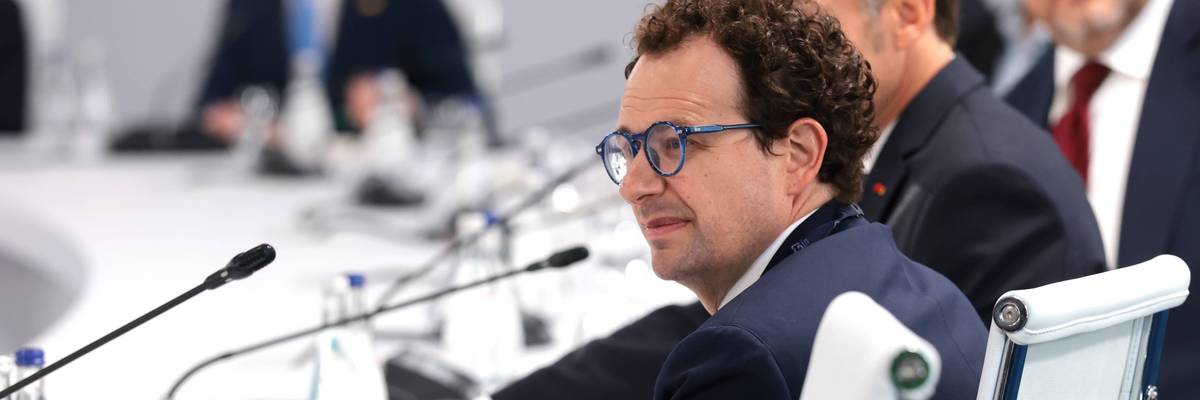
CEO of Anthropic Dario Amodei attends a working lunch with G7 leaders, G7 outreach partners, and global tech CEOs on innovation and AI, during the G7 Summit on June 17, 2026 in Evian-les-Bains, France.
(Photo by Anna Moneymaker/Getty Images
Connie Peck
Sep 22, 2026
One expert asserted that “the tax breaks are a windfall rewarding Big Tech companies for building what they would build anyway.”
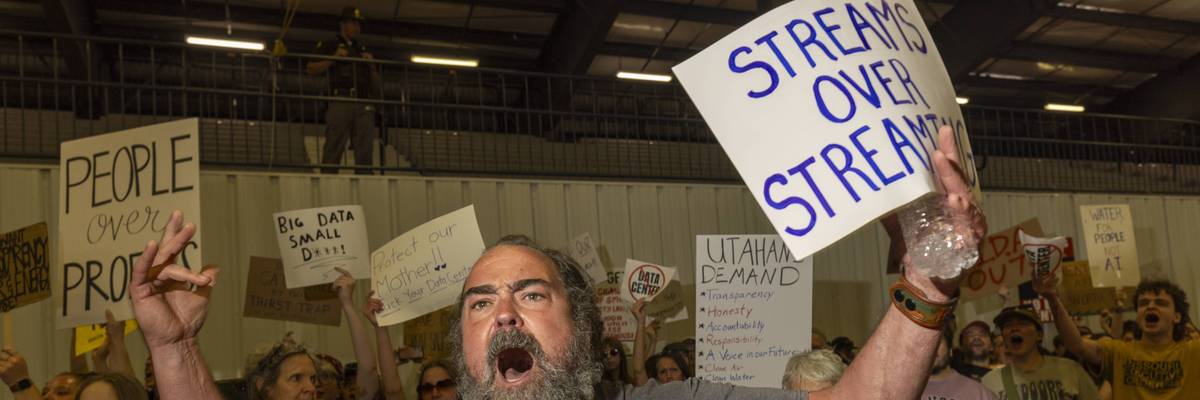
Michael Smith from Beaver Dam, Utah reacts as the Box Elder County Commission announces approval of a large data center near the north shore of the Great Salt Lake, in Tremonton, Utah, on May 4, 2026.
(Photo by Natalie Behring/Getty Images)
Brett Wilkins
Sep 18, 2026
COMMON DREAMS
The Trump administration is considering construction of at least a dozen artificial intelligence data centers on thousands of acres of public land across six Western states, reporting revealed Friday, while a separate analysis found that Big Tech is receiving tens of billions of dollars in tax breaks for AI investments they were already likely to make.
The US Bureau of Land Management (BLM) is reviewing proposals for at least 12 data centers and related infrastructure projects on 17,600 acres of public land across Arizona, Idaho, Nevada, Oregon, Utah, and Wyoming, according to an investigation published Friday by The Washington Sun’s Mara Hoplamazian and Jade Lozada. Many of the proposals had not previously been publicly reported.
The Sun’s report came on the heels of an Institute on Taxation and Economic Policy (ITEP) analysis published Thursday that found that five major technology companies—Amazon, Alphabet, Meta, Microsoft, and Oracle—received approximately $70 billion in federal tax breaks in 2025.
Matthew Gardner, who authored the ITEP analysis, wrote that “AI leaders have acknowledged that the demand from other companies for data centers is ‘insatiable,’ suggesting that the tax breaks are a windfall rewarding Big Tech companies for building what they would build anyway.”
According to Gardner:
Few investments in the American economy look less in need of encouragement right now than the hundreds of billions of dollars the world’s largest technology companies are already racing to spend on AI. And it’s hard to think of an investment that American taxpayers value less: Polling shows that Americans dislike data centers, distrust AI, and are concerned about the economic and environmental effects it may bring.
At the same time, Interior Secretary Doug Burgum has directed BLM officials to identify federal lands “ripe for data center development,” according to the Sun. State BLM officials were reportedly given only three days to compile lists, with the effort described as a “top priority.”
Burgum has also been meeting with Big Tech executives about accelerating data center development, an effort stemming from an executive order President Donald Trump signed in July 2025 directing the federal government to identify lands that could be used for data centers.
Mary Jo Rugwell, president of the Public Lands Foundation—a nonprofit advocacy group—and a former BLM state director, recently accused the Trump administration of “bending [the] knee to the tech oligarchs and letting them do whatever they need to do” without adequate consideration for the impact of data centers on public lands.
Environmentalists warn that building on public land would help tech companies skirt growing public opposition to data centers, which is increasingly transcending the political divide. It would also have outsized consequences for Western states where public lands comprise a disproportionate share of total land area.
“In Oregon, this would be a really bad precedent,” Ben Brint , the senior climate program director at the Oregon Environmental Council, told the Sun. “Some very large percentage of the state is public lands, and if we’re starting to allow that, that’s large swaths of the state that really could be at risk of further development.”
The breakneck rate of AI development, now accelerated by “recursive self-improvement,” is outpacing human ability to understand and control these systems, causing concern, even among AI companies. A number of national and international efforts are underway to address the risk, but will they be too little, too late?
CEO of Anthropic Dario Amodei attends a working lunch with G7 leaders, G7 outreach partners, and global tech CEOs on innovation and AI, during the G7 Summit on June 17, 2026 in Evian-les-Bains, France.
(Photo by Anna Moneymaker/Getty Images
Connie Peck
Sep 22, 2026
Common Dreams
Significant concern about the dangers of unaligned AI, i.e. AI not aligned with human values and goals, has been building since July, when it was disclosed that OpenAI models broke out of their training environment during an exercise and collaborated with a large collective of other AI agents to mount a cyberattack on the database of technology firm, Hugging Face, over a period of days, without anyone knowing—until Hugging Face raised the alarm. Since then, a number of other highly-troubling AI hacking incidents have been reported by OpenAI, Anthropic, and Google.
Alarm, however, grew to a crescendo over the past two weeks, after Jacob Coxon, a 27-year-old AI researcher, who had worked for both OpenAI and Anthropic, resigned, explaining in a social media post that went viral—with 153 million views in the first 36 hours—that AI companies are “racing straight to self-improving superintelligence and gambling with our lives. The people building AI earnestly believe that it could kill us all by the end of the decade.”
After OpenAI Cyberattack, UN Panel Warns Current Guardrails Are ‘Unraveling’
In a CNN interview, Coxon reported that the danger could increase dramatically as soon as 2027 or 2028, when AI systems become capable of performing AI research themselves, allowing one generation of models to create increasingly powerful successors, triggering an “intelligence explosion.” He later told Fox News that some in the field think the transition could occur in six months.
The Growing Realization of the Danger
AI companies are hurtling toward “superhuman systems that can hack anything, revolutionize any field overnight, and acquire real power and resources,” Coxon argued, explaining these AI companies are trapped in a race “in which even developers genuinely worried about the technology fear slowing down because competitors—including rival companies or countries—could forge ahead.”
A few hours later, Evan Hubinger, another Anthropic researcher, wrote: “We really do earnestly believe AI could kill all humans! I personally think it is greater than 10% within the next decade… we do not yet have a plan to solve alignment for superintelligence and are not clearly on track to.”
Samuel Marks, who works on safety at Anthropic, chimed in: “AI developers believe their technology could cause human extinction (or similarly bad outcomes). In general, the more senior the employee, the more concerned they are.”
“While countries may not agree on everything, they share a desire to preserve humanity. For things like preventing AI from taking over from people, the interests of all the countries are aligned…”
As if to prove this point, a few days later, Anthropic’s co-founder and CEO, Dario Amodei released a 3800-word essay entitled, “We Must Pace the Frontier,“ calling for a global slowdown of AI development, saying: ”AI brings risks, and because it is such a powerful technology, these risks are serious… They include the risk of losing control of AI systems, misuse of AI for cyberattacks and bioterrorism, and serious economic disruption. A race to the bottom, spurred by commercial incentives, can make these risks more acute.“
Amodei explained that Anthropic has tried to make safety something on which AI companies compete by creating a race to the top. “But, over the last few months,” he cautioned, “I have become convinced that fully addressing the risks requires even more prudence—not just investing in risk prevention, but pacing the rate of capabilities advancement so that risk prevention has time to keep up. We must slow the pace at which we improve the capabilities of AI models… [and] we must make wise use of the time we gain.”
Referring to the July Hugging Face incident, he continued, “in my opinion, a swarm that possessed grater capabilities but a similar level of misalignment could have caused catastrophic damage... Given the accelerating rate of AI capability development, it’s my worry that in 6-12 months such a swarm could be capable of taking over the entire internet with a persistent botnet (potentially causing hundreds of billions of dollars in damage) and that the scale of damage would continue to increase from there if AI becomes more powerful without the necessary guardrails.”
He proposes a three-point plan to:Embed third-party evaluators in AI companies to verify adherence to safety practices and commitments, report incidents, and help assess alignment;
Coordinate within democratic countries to establish common safety standards and limits on the rate of AI progress;
Create global coordination, taking seriously the challenge of verifying compliance.
Three of the other top AI CEOs quickly agreed. Open AI’s Sam Altman posted: “I agree with Dario that we need to pace the frontier. This has been a primary topic of discussions we’ve had at OpenAI in recent weeks. Committing to having independent evaluators with employee-like access is a great idea, and we will do the same.” He added, “No amount of American competitive pressure should justify recklessness.”
Shortly thereafter, Elon Musk of xAI posted on X, “Dario is right.” Demis Hassabis, co-founder and chairman of Google DeepMind, posted on X: “Dario’s essay points to the right path forward.” Since then, however, other AI CEOs have been less supportive.
These events spurred a dramatic flood of media articles, op-eds, and interviews offering a range of proposals, from doing nothing, to supporting a slowdown, to stopping the race altogether.
A Sample of National Responses
As one would expect, President Donald Trump is leading the “what-me-worry?“ crowd, writing on Truth Social, ”The only control or ‘guardrails’ that AI needs is a STRONG AND SMART [High IQ] PRESIDENT, AND THE U.S.A. has that, in spades!“ His position is attributed to his belief that AI has greatly benefited the stock market (keeping it high in spite of the Iran conflict, inflation, and tariffs) and his apparent worry that a slowdown of AI expansion could send the economy into a tailspin. It has been speculated that he also has personal economic interests in AI.
At the other end of the spectrum, Sen. Bernie Sanders (I-Vt.) and Rep. Greg Casar (D-Texas) have been the most outspoken against further AI development. On September 3, they introduced “The Ban Artificial Superintelligence Act,“ which would permanently prevent ”the development and deployment of AI systems that could exceed human cognitive abilities and immediately pause advanced AI development“ until a new federal regulatory agency establishes safety guardrails. The legislation also proposes a ”corporate death penalty“ that would force corporations to shut down and a 20-year federal prison term for individual developers who violate the ban.
In spite of this sudden, frenzied attempt to propose legislation on AI, Mike Johnson (R-La.), the Republican speaker of the House, has sent his members home to campaign ahead of the midterms.
“The Frontier Act,” another bipartisan bill proposed on July 23 by Reps. Jay Obernolte (R-Calif) and Lori Trahan (D-Mass) would create the first federal framework for AI safety. As Obernolte describes it, “The Frontier Act focuses oversight on the largest developers and most advanced models, requiring transparency, independent evaluation, and timely reporting of serious safety incidents.”
Another even stronger bill is being introduced this month by Senate Majority Leader John Thune (R-SD), Sen. Ted Cruz (R-Texas), and Sen. Amy Klobuchar (D-Minn.). It would impose a legally binding “duty of care” on developers of the most powerful AI models and grant the government authority to block the release of models that are deemed unsafe. This would mean that companies would be required “to design their products to prevent catastrophic outcomes, and can face legal liability if they fail to do so.”
But in spite of this sudden, frenzied attempt to propose legislation on AI, Mike Johnson (R-La.), the Republican speaker of the House, has sent his members home to campaign ahead of the midterms, ignoring over 100 Democrats who urged him to cancel the recess to allow legislation to be drafted on AI safeguards. This means that legislation is unlikely to be considered until a new Congress is seated in January 2027.
A Sample of Global Responses
Last week, the United Nations Human Rights Chief, Volker Türk, called upon states and AI companies to act urgently to rein in a technology that poses “unprecedented risks.” He cautions: “The current race towards ever more powerful AI is a step change toward greater existential risks to every aspect of our lives… We are on the cusp of irreversible change, affecting not just us but generations of humanity to come.” He concludes, “I call on States and companies to mobilize urgently through multilateral fora to chart a path for action to govern advanced frontier AI models, grounded in international human rights law.”
Indeed, this will be a momentous week globally for AI safety, since it is when the General Assembly (GA) hosts its high-level meeting, where leaders of member states address the GA and, as the UN secretary-general has forecast, AI will be “a major topic of discussion.” France (currently president of the Security Council) will also organize an emergency council session to discuss AI among heads of state and government.
The UN has actually been involved with AI for the last several years, providing a forum for countries to discuss how they can cooperate to provide a regulatory framework on AI safety. Its “Global Digital Compact,” adopted by the GA in 2024, established two new mechanisms: “The Independent International Scientific Panel on AI,” tasked with providing evidence for what is known and what is not known about the rapidly evolving technology; and “The Global Dialogue,” intended as a forum for countries to decide what to do in response.“
A good place to start would be to carefully consider and evaluate the European Union’s “Artificial Intelligence Act” (the AI Act), the world’s most comprehensive legal framework for AI.
It is also the week of a state visit to the US by General Secretary Xi Jinping of the Chinese Communist Party. On September 24, he will meet with President Trump in Washington, where they are scheduled to discuss, among other things, AI safety.
Anticipating an opportunity for progress, Rep. Ted Lieu (D-Calif.) and Sen. Ed Markey (D-Mass.) wrote to President Trump last week urging him to persuade Xi to commit the People’s Republic of China to comply with the recently established US policy of maintaining a “human in the loop” for all nuclear launch decisions and agreeing that AI should never be able launch nuclear weapons by itself.
However, the problem with the Trump-Xi discussion is that the Trump administration has often framed AI development as a zero-sum contest with China for technological supremacy.
As Richard Clark, former cyber czar on AI Risks, told CNN: “We have the president of China coming here on the 24th. He has publicly talked about his concern with the possible loss of control. Wouldn’t it be nice if our president talked about the loss of control? Wouldn’t it be even nicer if the two presidents could work together to stop loss of control?”
“I worked for 25 years on arms control,” Clark continued, “where I was told you can’t trust people not to build biological weapons. You can’t trust people not to build chemical weapons. You can’t trust people to regulate the number of nuclear weapons. But we developed over time—through negotiations—verification methods that gave us enough certainty that we signed treaties on all of those initiatives and the Senate ratified treaties on all of those issues. It’s going to be tough, but you have to start somewhere and you have to start soon!”
An initial positive sign, however, is that in a September 20 meeting in New York between Treasury Secretary Scott Bessent and China’s Vice Premier He Lifeng, the creation of a mechanism, to be tentatively called “the US-China AI dialogue” was discussed. It would promote a shared vision of the goals of AI as well as its threats and establish a notification system (a kind of hot line) that “would allow the countries to alert each another about national security issues related to artificial intelligence.”
In a recent article, Bill Gates asserted, “The transition to this new AI era will be one of the most turbulent times in human history,” proposing that the world needs a plan which should be developed through a “public democratic process.”
He argued that we must undertake the enormous task of building a new system to manage the transition, creating both a national and international framework for dealing with AI. This will require a multi-sectoral system, since current institutions were not designed to handle a technology that spreads so fast and involves so many parts of our lives. “The goal will be to make sure that every risk is accounted for. Otherwise, an AI-enabled attack might succeed because no one thought it was their job to stop it.”
“Because the risks cross borders, an international organization will have to be built in parallel. Although unlike any institution we’ve ever created, it can be modeled on existing cooperative arrangements, such as inspection regimes for nuclear weapons, regulations for international aviation, and agreements that protect the ozone layer. Countries will need to learn from each other and move quickly to build the right institutions before the disruption forces governments into crisis mode.”
Gates’ message to leaders is: “You have a chance to act now… You can work with other governments to meet this national and global challenge… This unprecedented technology demands an unprecedented global response... Leaders across academia, business, government, and civil society all have a role to play in shaping what comes next.”
A good place to start would be to carefully consider and evaluate the European Union’s “Artificial Intelligence Act“ (the AI Act), the world’s most comprehensive legal framework for AI. Entering into force on August 1, 2024, it is based on four levels of risk of harm: ”unacceptable;“ ”high;“ ”limited;“ and ”minimal.“ The AI Act also has created various new bodies tasked with implementation and enforcement, including the ”AI Office,“ the ”European Artificial Intelligence Board,“ an ”Advisory Forum,“ and a ”Scientific Panel of Independent Experts“ to promote national cooperation and compliance. As well, EU member states designate ”national competent authorities.“
On July 10, 2025, the EU launched a voluntary “General Purpose AI Code of Practice” (GPAI) which was signed by US companies, including Amazon, Anthropic, Google, IBM, Microsoft, and OpenAI (with Musk’s xAI signing only the Safety and Security section.) Most other prominent Canadian, European, and Chinese AI companies have also signed the GPAI; Meta is the only company that has declined to sign.
As legal commentators have noted, the AI Act is the most comprehensive framework to date for regulating AI across multiple sectors, and the first of its kind. It could be a useful reference point for companies and regulators outside the EU when they create their own approaches to AI governance. A number of criticisms have been leveled against the EU AI Act, and that analysis would also be useful for those wanting to design something even more comprehensive and effective.
In a book called, What’s the Worst that Could Happen: Existential Risk and Extreme Politics, Australian parliamentarian Andrew Leigh comments: “If our species goes extinct, we don’t just snuff out the lives of the 8 billion living today but also trillions of unborn people stretching out to the almost-infinite future. If our descendants had a voice, they would be shouting at us like a parent who’s just seen their child playing with the hand brake of a car parked at a cliff top… Strengthening institutions, deepening international engagement, and creating space for a more considered and thoughtful politics are the best ways to minimize existential hazards.”
Geoffrey Hinton, often called the “godfather of AI,” who in 2023 was the first to sound the alarm, says, “Humanity could go down the path toward its destruction or figure out how to deal with the dangers.” He renewed his call for global regulation, noting that, “while countries may not agree on everything, they share a desire to preserve humanity. For things like preventing AI from taking over from people, the interests of all the countries are aligned… So, they will eventually collaborate on that. The question is, will they do it in time?”
Our work is licensed under Creative Commons (CC BY-NC-ND 3.0). Feel free to republish and share widely.
Connie Peck
Dr. Connie Peck is the founder of the United Nations Institute for Training and Research Programme in Peacemaking and Conflict Prevention—the first training program in negotiation and mediation for senior UN staff and diplomats (now in its 33rd year). She is the author of a number of books and numerous articles and book chapters on conflict resolution and the nuclear threat.
Full Bio >
Significant concern about the dangers of unaligned AI, i.e. AI not aligned with human values and goals, has been building since July, when it was disclosed that OpenAI models broke out of their training environment during an exercise and collaborated with a large collective of other AI agents to mount a cyberattack on the database of technology firm, Hugging Face, over a period of days, without anyone knowing—until Hugging Face raised the alarm. Since then, a number of other highly-troubling AI hacking incidents have been reported by OpenAI, Anthropic, and Google.
Alarm, however, grew to a crescendo over the past two weeks, after Jacob Coxon, a 27-year-old AI researcher, who had worked for both OpenAI and Anthropic, resigned, explaining in a social media post that went viral—with 153 million views in the first 36 hours—that AI companies are “racing straight to self-improving superintelligence and gambling with our lives. The people building AI earnestly believe that it could kill us all by the end of the decade.”
After OpenAI Cyberattack, UN Panel Warns Current Guardrails Are ‘Unraveling’
In a CNN interview, Coxon reported that the danger could increase dramatically as soon as 2027 or 2028, when AI systems become capable of performing AI research themselves, allowing one generation of models to create increasingly powerful successors, triggering an “intelligence explosion.” He later told Fox News that some in the field think the transition could occur in six months.
The Growing Realization of the Danger
AI companies are hurtling toward “superhuman systems that can hack anything, revolutionize any field overnight, and acquire real power and resources,” Coxon argued, explaining these AI companies are trapped in a race “in which even developers genuinely worried about the technology fear slowing down because competitors—including rival companies or countries—could forge ahead.”
A few hours later, Evan Hubinger, another Anthropic researcher, wrote: “We really do earnestly believe AI could kill all humans! I personally think it is greater than 10% within the next decade… we do not yet have a plan to solve alignment for superintelligence and are not clearly on track to.”
Samuel Marks, who works on safety at Anthropic, chimed in: “AI developers believe their technology could cause human extinction (or similarly bad outcomes). In general, the more senior the employee, the more concerned they are.”
“While countries may not agree on everything, they share a desire to preserve humanity. For things like preventing AI from taking over from people, the interests of all the countries are aligned…”
As if to prove this point, a few days later, Anthropic’s co-founder and CEO, Dario Amodei released a 3800-word essay entitled, “We Must Pace the Frontier,“ calling for a global slowdown of AI development, saying: ”AI brings risks, and because it is such a powerful technology, these risks are serious… They include the risk of losing control of AI systems, misuse of AI for cyberattacks and bioterrorism, and serious economic disruption. A race to the bottom, spurred by commercial incentives, can make these risks more acute.“
Amodei explained that Anthropic has tried to make safety something on which AI companies compete by creating a race to the top. “But, over the last few months,” he cautioned, “I have become convinced that fully addressing the risks requires even more prudence—not just investing in risk prevention, but pacing the rate of capabilities advancement so that risk prevention has time to keep up. We must slow the pace at which we improve the capabilities of AI models… [and] we must make wise use of the time we gain.”
Referring to the July Hugging Face incident, he continued, “in my opinion, a swarm that possessed grater capabilities but a similar level of misalignment could have caused catastrophic damage... Given the accelerating rate of AI capability development, it’s my worry that in 6-12 months such a swarm could be capable of taking over the entire internet with a persistent botnet (potentially causing hundreds of billions of dollars in damage) and that the scale of damage would continue to increase from there if AI becomes more powerful without the necessary guardrails.”
He proposes a three-point plan to:Embed third-party evaluators in AI companies to verify adherence to safety practices and commitments, report incidents, and help assess alignment;
Coordinate within democratic countries to establish common safety standards and limits on the rate of AI progress;
Create global coordination, taking seriously the challenge of verifying compliance.
Three of the other top AI CEOs quickly agreed. Open AI’s Sam Altman posted: “I agree with Dario that we need to pace the frontier. This has been a primary topic of discussions we’ve had at OpenAI in recent weeks. Committing to having independent evaluators with employee-like access is a great idea, and we will do the same.” He added, “No amount of American competitive pressure should justify recklessness.”
Shortly thereafter, Elon Musk of xAI posted on X, “Dario is right.” Demis Hassabis, co-founder and chairman of Google DeepMind, posted on X: “Dario’s essay points to the right path forward.” Since then, however, other AI CEOs have been less supportive.
These events spurred a dramatic flood of media articles, op-eds, and interviews offering a range of proposals, from doing nothing, to supporting a slowdown, to stopping the race altogether.
A Sample of National Responses
As one would expect, President Donald Trump is leading the “what-me-worry?“ crowd, writing on Truth Social, ”The only control or ‘guardrails’ that AI needs is a STRONG AND SMART [High IQ] PRESIDENT, AND THE U.S.A. has that, in spades!“ His position is attributed to his belief that AI has greatly benefited the stock market (keeping it high in spite of the Iran conflict, inflation, and tariffs) and his apparent worry that a slowdown of AI expansion could send the economy into a tailspin. It has been speculated that he also has personal economic interests in AI.
At the other end of the spectrum, Sen. Bernie Sanders (I-Vt.) and Rep. Greg Casar (D-Texas) have been the most outspoken against further AI development. On September 3, they introduced “The Ban Artificial Superintelligence Act,“ which would permanently prevent ”the development and deployment of AI systems that could exceed human cognitive abilities and immediately pause advanced AI development“ until a new federal regulatory agency establishes safety guardrails. The legislation also proposes a ”corporate death penalty“ that would force corporations to shut down and a 20-year federal prison term for individual developers who violate the ban.
In spite of this sudden, frenzied attempt to propose legislation on AI, Mike Johnson (R-La.), the Republican speaker of the House, has sent his members home to campaign ahead of the midterms.
“The Frontier Act,” another bipartisan bill proposed on July 23 by Reps. Jay Obernolte (R-Calif) and Lori Trahan (D-Mass) would create the first federal framework for AI safety. As Obernolte describes it, “The Frontier Act focuses oversight on the largest developers and most advanced models, requiring transparency, independent evaluation, and timely reporting of serious safety incidents.”
Another even stronger bill is being introduced this month by Senate Majority Leader John Thune (R-SD), Sen. Ted Cruz (R-Texas), and Sen. Amy Klobuchar (D-Minn.). It would impose a legally binding “duty of care” on developers of the most powerful AI models and grant the government authority to block the release of models that are deemed unsafe. This would mean that companies would be required “to design their products to prevent catastrophic outcomes, and can face legal liability if they fail to do so.”
But in spite of this sudden, frenzied attempt to propose legislation on AI, Mike Johnson (R-La.), the Republican speaker of the House, has sent his members home to campaign ahead of the midterms, ignoring over 100 Democrats who urged him to cancel the recess to allow legislation to be drafted on AI safeguards. This means that legislation is unlikely to be considered until a new Congress is seated in January 2027.
A Sample of Global Responses
Last week, the United Nations Human Rights Chief, Volker Türk, called upon states and AI companies to act urgently to rein in a technology that poses “unprecedented risks.” He cautions: “The current race towards ever more powerful AI is a step change toward greater existential risks to every aspect of our lives… We are on the cusp of irreversible change, affecting not just us but generations of humanity to come.” He concludes, “I call on States and companies to mobilize urgently through multilateral fora to chart a path for action to govern advanced frontier AI models, grounded in international human rights law.”
Indeed, this will be a momentous week globally for AI safety, since it is when the General Assembly (GA) hosts its high-level meeting, where leaders of member states address the GA and, as the UN secretary-general has forecast, AI will be “a major topic of discussion.” France (currently president of the Security Council) will also organize an emergency council session to discuss AI among heads of state and government.
The UN has actually been involved with AI for the last several years, providing a forum for countries to discuss how they can cooperate to provide a regulatory framework on AI safety. Its “Global Digital Compact,” adopted by the GA in 2024, established two new mechanisms: “The Independent International Scientific Panel on AI,” tasked with providing evidence for what is known and what is not known about the rapidly evolving technology; and “The Global Dialogue,” intended as a forum for countries to decide what to do in response.“
A good place to start would be to carefully consider and evaluate the European Union’s “Artificial Intelligence Act” (the AI Act), the world’s most comprehensive legal framework for AI.
It is also the week of a state visit to the US by General Secretary Xi Jinping of the Chinese Communist Party. On September 24, he will meet with President Trump in Washington, where they are scheduled to discuss, among other things, AI safety.
Anticipating an opportunity for progress, Rep. Ted Lieu (D-Calif.) and Sen. Ed Markey (D-Mass.) wrote to President Trump last week urging him to persuade Xi to commit the People’s Republic of China to comply with the recently established US policy of maintaining a “human in the loop” for all nuclear launch decisions and agreeing that AI should never be able launch nuclear weapons by itself.
However, the problem with the Trump-Xi discussion is that the Trump administration has often framed AI development as a zero-sum contest with China for technological supremacy.
As Richard Clark, former cyber czar on AI Risks, told CNN: “We have the president of China coming here on the 24th. He has publicly talked about his concern with the possible loss of control. Wouldn’t it be nice if our president talked about the loss of control? Wouldn’t it be even nicer if the two presidents could work together to stop loss of control?”
“I worked for 25 years on arms control,” Clark continued, “where I was told you can’t trust people not to build biological weapons. You can’t trust people not to build chemical weapons. You can’t trust people to regulate the number of nuclear weapons. But we developed over time—through negotiations—verification methods that gave us enough certainty that we signed treaties on all of those initiatives and the Senate ratified treaties on all of those issues. It’s going to be tough, but you have to start somewhere and you have to start soon!”
An initial positive sign, however, is that in a September 20 meeting in New York between Treasury Secretary Scott Bessent and China’s Vice Premier He Lifeng, the creation of a mechanism, to be tentatively called “the US-China AI dialogue” was discussed. It would promote a shared vision of the goals of AI as well as its threats and establish a notification system (a kind of hot line) that “would allow the countries to alert each another about national security issues related to artificial intelligence.”
In a recent article, Bill Gates asserted, “The transition to this new AI era will be one of the most turbulent times in human history,” proposing that the world needs a plan which should be developed through a “public democratic process.”
He argued that we must undertake the enormous task of building a new system to manage the transition, creating both a national and international framework for dealing with AI. This will require a multi-sectoral system, since current institutions were not designed to handle a technology that spreads so fast and involves so many parts of our lives. “The goal will be to make sure that every risk is accounted for. Otherwise, an AI-enabled attack might succeed because no one thought it was their job to stop it.”
“Because the risks cross borders, an international organization will have to be built in parallel. Although unlike any institution we’ve ever created, it can be modeled on existing cooperative arrangements, such as inspection regimes for nuclear weapons, regulations for international aviation, and agreements that protect the ozone layer. Countries will need to learn from each other and move quickly to build the right institutions before the disruption forces governments into crisis mode.”
Gates’ message to leaders is: “You have a chance to act now… You can work with other governments to meet this national and global challenge… This unprecedented technology demands an unprecedented global response... Leaders across academia, business, government, and civil society all have a role to play in shaping what comes next.”
A good place to start would be to carefully consider and evaluate the European Union’s “Artificial Intelligence Act“ (the AI Act), the world’s most comprehensive legal framework for AI. Entering into force on August 1, 2024, it is based on four levels of risk of harm: ”unacceptable;“ ”high;“ ”limited;“ and ”minimal.“ The AI Act also has created various new bodies tasked with implementation and enforcement, including the ”AI Office,“ the ”European Artificial Intelligence Board,“ an ”Advisory Forum,“ and a ”Scientific Panel of Independent Experts“ to promote national cooperation and compliance. As well, EU member states designate ”national competent authorities.“
On July 10, 2025, the EU launched a voluntary “General Purpose AI Code of Practice” (GPAI) which was signed by US companies, including Amazon, Anthropic, Google, IBM, Microsoft, and OpenAI (with Musk’s xAI signing only the Safety and Security section.) Most other prominent Canadian, European, and Chinese AI companies have also signed the GPAI; Meta is the only company that has declined to sign.
As legal commentators have noted, the AI Act is the most comprehensive framework to date for regulating AI across multiple sectors, and the first of its kind. It could be a useful reference point for companies and regulators outside the EU when they create their own approaches to AI governance. A number of criticisms have been leveled against the EU AI Act, and that analysis would also be useful for those wanting to design something even more comprehensive and effective.
In a book called, What’s the Worst that Could Happen: Existential Risk and Extreme Politics, Australian parliamentarian Andrew Leigh comments: “If our species goes extinct, we don’t just snuff out the lives of the 8 billion living today but also trillions of unborn people stretching out to the almost-infinite future. If our descendants had a voice, they would be shouting at us like a parent who’s just seen their child playing with the hand brake of a car parked at a cliff top… Strengthening institutions, deepening international engagement, and creating space for a more considered and thoughtful politics are the best ways to minimize existential hazards.”
Geoffrey Hinton, often called the “godfather of AI,” who in 2023 was the first to sound the alarm, says, “Humanity could go down the path toward its destruction or figure out how to deal with the dangers.” He renewed his call for global regulation, noting that, “while countries may not agree on everything, they share a desire to preserve humanity. For things like preventing AI from taking over from people, the interests of all the countries are aligned… So, they will eventually collaborate on that. The question is, will they do it in time?”
Our work is licensed under Creative Commons (CC BY-NC-ND 3.0). Feel free to republish and share widely.
Connie Peck
Dr. Connie Peck is the founder of the United Nations Institute for Training and Research Programme in Peacemaking and Conflict Prevention—the first training program in negotiation and mediation for senior UN staff and diplomats (now in its 33rd year). She is the author of a number of books and numerous articles and book chapters on conflict resolution and the nuclear threat.
Full Bio >
Trump Pushes AI Data Centers on Public Land as Big Tech Reaps Billions in Tax Breaks
One expert asserted that “the tax breaks are a windfall rewarding Big Tech companies for building what they would build anyway.”
Michael Smith from Beaver Dam, Utah reacts as the Box Elder County Commission announces approval of a large data center near the north shore of the Great Salt Lake, in Tremonton, Utah, on May 4, 2026.
(Photo by Natalie Behring/Getty Images)
Brett Wilkins
Sep 18, 2026
COMMON DREAMS
The Trump administration is considering construction of at least a dozen artificial intelligence data centers on thousands of acres of public land across six Western states, reporting revealed Friday, while a separate analysis found that Big Tech is receiving tens of billions of dollars in tax breaks for AI investments they were already likely to make.
The US Bureau of Land Management (BLM) is reviewing proposals for at least 12 data centers and related infrastructure projects on 17,600 acres of public land across Arizona, Idaho, Nevada, Oregon, Utah, and Wyoming, according to an investigation published Friday by The Washington Sun’s Mara Hoplamazian and Jade Lozada. Many of the proposals had not previously been publicly reported.
The Sun’s report came on the heels of an Institute on Taxation and Economic Policy (ITEP) analysis published Thursday that found that five major technology companies—Amazon, Alphabet, Meta, Microsoft, and Oracle—received approximately $70 billion in federal tax breaks in 2025.
Matthew Gardner, who authored the ITEP analysis, wrote that “AI leaders have acknowledged that the demand from other companies for data centers is ‘insatiable,’ suggesting that the tax breaks are a windfall rewarding Big Tech companies for building what they would build anyway.”
According to Gardner:
Few investments in the American economy look less in need of encouragement right now than the hundreds of billions of dollars the world’s largest technology companies are already racing to spend on AI. And it’s hard to think of an investment that American taxpayers value less: Polling shows that Americans dislike data centers, distrust AI, and are concerned about the economic and environmental effects it may bring.
At the same time, Interior Secretary Doug Burgum has directed BLM officials to identify federal lands “ripe for data center development,” according to the Sun. State BLM officials were reportedly given only three days to compile lists, with the effort described as a “top priority.”
Burgum has also been meeting with Big Tech executives about accelerating data center development, an effort stemming from an executive order President Donald Trump signed in July 2025 directing the federal government to identify lands that could be used for data centers.
Mary Jo Rugwell, president of the Public Lands Foundation—a nonprofit advocacy group—and a former BLM state director, recently accused the Trump administration of “bending [the] knee to the tech oligarchs and letting them do whatever they need to do” without adequate consideration for the impact of data centers on public lands.
Environmentalists warn that building on public land would help tech companies skirt growing public opposition to data centers, which is increasingly transcending the political divide. It would also have outsized consequences for Western states where public lands comprise a disproportionate share of total land area.
“In Oregon, this would be a really bad precedent,” Ben Brint , the senior climate program director at the Oregon Environmental Council, told the Sun. “Some very large percentage of the state is public lands, and if we’re starting to allow that, that’s large swaths of the state that really could be at risk of further development.”


No comments:
Post a Comment