Trump makes 'final decision' to grant Ukraine Patriot licence, Zelenskyy says
Kyiv has been pushing for a licence to produce Patriot interceptors domestically, arguing that they are crucial to its ability to defend against Russian ballistic missile attacks.
Ukrainian President Volodymyr Zelenskyy said on Friday that US President Donald Trump told him he would allow Ukraine to produce advanced Patriot air defence missiles, after a series of reversals on the issue.
Kyiv is facing a shortage of the missiles, needed to counter Russia's increasing drone and missile attacks on the country, the latest of which killed a 14-year-old boy in the capital on Friday.
During his latest visit to the United States this week, Zelenskyy renewed calls for air defence support, and for the Patriots, which remain the only system reliably able to counter Russia's powerful ballistic missiles.
"At our last meeting, President Trump emphasised to me that yes, I have made a final decision. Ukraine will receive licences for the production of Patriot missiles," Zelenskyy said in a voice note to journalists.
In July, Trump said it would be "pretty cool" to grant Ukraine the licences, before backtracking, saying the United States should be "very careful" before granting Ukraine authorisation.
Ukraine has reported an acute shortage of Patriot interceptors since the United States and Israel went to war with Iran in February, diverting supplies of the advanced systems.
Even if the licences are granted, establishing industrial capacity would require more than a year and would not meet Kyiv's immediate needs.
And Kyiv, preparing for winter, has renewed calls for urgent support.
It needs 5% of the United States' Patriot interceptor missiles to get through the winter and 10% to destroy all of Russia's ballistic projectiles, Zelenskyy said last month.
'Savage and sickening strike'
Moscow has also been aiming at the capital with newly developed jet-powered drones, which have succeeded in bypassing some of the drone interception systems developed by Ukraine.
While it used to target Kyiv mainly during the hours of darkness, Moscow now often attacks in broad daylight.
As people were making their way to work on Friday morning, a drone struck a residential building in the city, killing a 14-year-old boy.
Zelenskyy denounced the attack, calling it "an absolutely savage and sickening strike, devoid of any military logic."
AFP journalists on the spot saw residents gathering around a multi-storey building, with apartments on the ninth and 10th floors left charred by the attack.
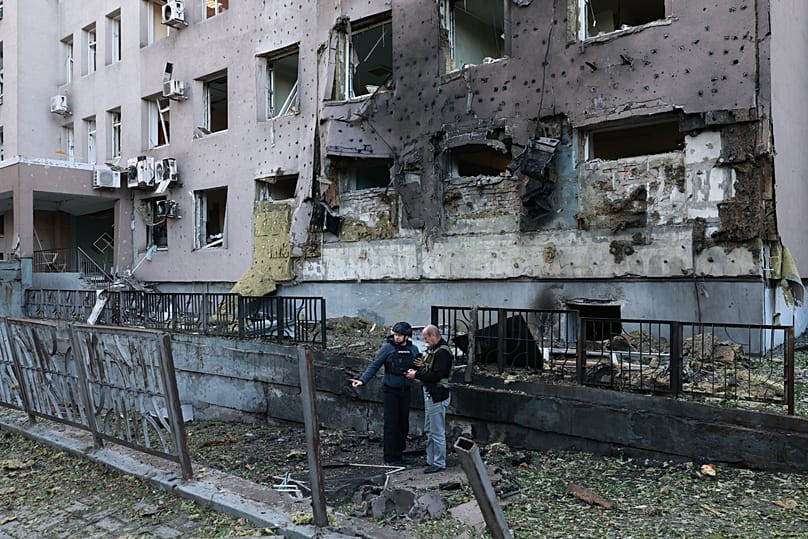
Mykyta Sysoyev, a 23-year-old IT specialist, said he was woken up by an explosion but only realised the strike had hit his own building when he checked the news.
"My jaw dropped a bit," he said. "It's strange: on the one hand, I've got used to it, but on the other, people are constantly dying."
Asked about the increase in drone strikes, he added: "This is a technological race and a technological war...Unfortunately, people will suffer while we're searching for solutions."
In the southern region of Odesa, another person was killed in a repeated strike on a postal facility, authorities said.
EU countries agree to release long-stalled €6.6 billion in military aid for Ukraine
The decision to release €6.6 billion through the European Peace Facility comes at a critical juncture for Ukraine, which is grappling with a significant shortfall in its Ministry of Defence budget that could jeopardize drone deliveries.
European Union countries have agreed to release a €6.6 billion programme of military aid for Ukraine that had stalled since spring 2023, when Hungary imposed a controversial veto that paralysed the initiative.
The agreement at the political level was reached on Friday during a meeting of the Political and Security Committee in Brussels.
"That's good news for Ukraine and bad news for Russia," High Representative Kaja Kallas wrote on social media, announcing the news.
"Moscow's hybrid attacks try to intimidate Europe into scaling back its support for Ukraine. Europe is doing the opposite."
The so-called European Peace Facility (EPF) was designed to partially reimburse weapons and ammunition that member states donate to Ukraine.
In the early years of the war, the EPF was considered one of the bloc's central lines of assistance and was regularly topped up with fresh money.
But in May 2023, Hungary, under then-Prime Minister Viktor Orbán, slapped a veto that stopped the scheme dead in its tracks.
Budapest complained about Kyiv's decision to add OTP Bank, Hungary's largest commercial bank, to its list of "international sponsors of war". The name-shaming catalogue was discontinued in 2024 after pushback from Western allies.
Still, Hungary kept its veto in place, angering other capitals. The EPF eventually fell off the radar as Brussels set up new assistance programmes.
The deadlock was broken only this year when Orbán lost the parliamentary elections in April, and Prime Minister Péter Magyar came to power. Since then, member states have been negotiating the terms for the release of the €6.6 billion.
According to Kallas, the agreement reached on Friday splits the pot into three strands:
- €4.7 billion for reimbursements
- €1 billion for joint procurement of military equipment
- €900 million for the EU mission that trains Ukraine's armed forces
Some countries will wire their share of €4.7 billion in reimbursements directly to Ukraine, Kallas said without naming them.
Several legislative acts need to be adopted before the money is actually released.
The news comes at a precarious time for Ukraine, which is staring down a $27 billion (€23.67 billion) shortfall in its Ministry of Defence.
The European Commission and the International Monetary Fund are in talks with the Ukrainian government to determine a possible solution.
On Friday, Ukrainian President Volodymyr Zelenskyy warned the budget crunch needed to be resolved between October and November to pay for drone deliveries scheduled for the first three months of 2027.
"Everyone understands that Ukraine cannot be left on its own and that more must be invested in Ukrainian-made drones and missiles, because most of this deficit is precisely the funding needed for weapons," Zelenskyy said.
"Everyone understands how difficult it is to get through this period amid constant strikes. Ukraine will not be left alone."

No comments:
Post a Comment