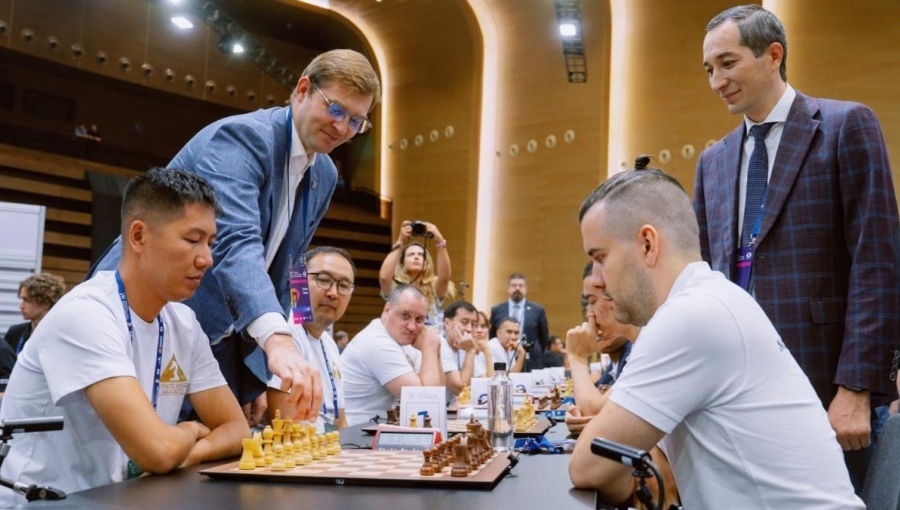
Three businessmen are battling to become the new president of the global chess federation, and Kazakh billionaire Timur Turlov is campaigning with his personal chequebook open. In Samarkand, the annual Chess Olympiad has doubled as backdrop to the end of the campaign trail.
With days to go before FIDE's (Fédération Internationale des Échecs) delegates vote for a new president, the candidates have been working the halls of the biggest Olympiad ever staged. Some 400 teams - 208 in the Open section and 192 in the Women's - have come to Samarkand, beating the record of 380 set in Budapest in 2024, and nearly 2,000 players, around 240 of them grandmasters, are competing in the first Olympiad ever held in Central Asia. Turlov has made himself unusually easy for the press to reach, squeezing interviews in between a lunch with delegates, commission meetings and a string of one-on-ones. "He doesn't shy away from interviews," said his media adviser, Milan Denic, adding that this is why Turlov likes to call himself his own campaign manager.
"We're feeling, frankly, ourselves extremely strong now in terms of position," he told journalists in Samarkand, the legendary city in the middle of the ancient Silk Road.
For the first time in FIDE's history, according to former president Arkady Dvorkovich, all three candidates come from business rather than from the chess world or politics. With three wealthy businessmen in the field, finances are playing a bigger role than in past FIDE races. And Turlov brings the largest business of the three front runners: he is chief executive of Nasdaq-listed brokerage Freedom Holding Corp and president of the Kazakhstan Chess Federation. His wealth is also where his rivals aim their fire, arguing that his bid blurs the line between a corporation and a sporting body.
The backstop
One of the central pillars of Turlov's plans for FIDE is a financial guarantee. He told IntelliNews he has committed at least $8.5mn to FIDE development funds over a four-year term and expects the final sum to pass $10mn.
The money breaks down into roughly $7mn of core development money plus a further $1.5mn earmarked for media. The core fund is meant to pay for open tournaments, coaching and arbiter training, and to subsidise travel for young talent from federations with less resources. Turlov called $8.5mn a floor rather than a ceiling. "I think it will be more than $10mn for sure," he said.
Asked whose money it would be, his own or Freedom's, he answered: "I think it's both. My personal guarantee is there at the end of the day, but I'm almost sure Freedom will also join me," he told IntelliNews in an exclusive interview, adding that he would, "persuade my board".
The weakness of a personal guarantee is that it is personal. When asked whether the money would walk out the door with him if he lost a re-election bid in 2030, Turlov conceded that "nobody knows what will happen in the next few years". He said he expected to remain wealthy enough to keep giving. He also said he would be happy to stay involved and help a new team run FIDE, as he had with Dvorkovich's administration, the outgoing FIDE president.
Freedom Holding has been actively sponsoring chess events long before Turlov’s bid for the presidency, such as organising a world blitz chess tournament on Wall Street in New York in December 2024 as well as the first chess open in Kazakhstan last year.
Making rock stars
The most concrete part of his programme is $1.5mn a year, for at least four years, to build media operations at member federations. It would fund training and dedicated staff, which Turlov says many smaller federations cannot afford. FIDE's own central media team would get a separate and bigger budget.
His logic is commercial. He described chess as a club of smart, wealthy and powerful people, and said governments and corporations will pay to be associated with it. He pointed to FIDE's recent sponsorship deal with Salesforce, which he called the largest single sponsorship contract in the organisation's history. The missing piece, he argued, is visibility.
"If we make our chess players real rock stars, if we make our events attractive and popular for the media, we will definitely achieve much better financial sustainability and independence for each member federation," he said.
The approach has already worked at home, where the Kazakhstan Chess Federation has become one of the country's most popular sports bodies.
Where Freedom ends
His critics' sharpest question is how to separate FIDE from Freedom. The group already has a hand in digital chess: its customers can earn mobile data by solving chess puzzles, and it owns the chess software company ChessBase. Meanwhile, Turlov wants FIDE to take a bigger role in regulating online play. That would leave a Freedom-owned platform operating under rules set by a body its chief executive runs.
The overlap sits exactly where FIDE's reformers want change. Dvorkovich told IntelliNews in an interview in Samarkand that digital transformation is one of the two things FIDE most needs.
"Most of our systems are still based on the previous generation of digital technology, if not an even older one, and that hurts," he said. "We are not using all the potential we have with such a massive base of players and chess lovers.”
Asked whether he would publish every contract between FIDE and Freedom and step back from those decisions, Turlov said he would recuse himself from any deal involving ChessBase and "make things as transparent as possible". He stopped short of committing to publish the contracts but said he did not expect there to be many.
Any such deal would also be vetted from both sides. On Freedom's side, it would count as a related-party transaction at a listed company, so it would have to be approved by an audit committee made up entirely of independent members. "The same would happen on the FIDE side," he said.
On the wider question of wearing both hats, as FIDE president and as Freedom's chief executive, Turlov did not see much of a problem. He pointed to Freedom's existing sponsorship of sport at home.
"I've never seen much conflict of interest between Freedom and a chess federation, or other non-profit activities, such as football in Kazakhstan," he said, adding that he would follow best practice on related-party deals.
He described Freedom as "a financial ecosystem" with no major potential interests in chess. Asked whether keeping the two apart would be hard, he was emphatic: "I'm sure it won't be difficult.”
Dvorkovich's man?
His rivals also cast him as the machine candidate: Dvorkovich's system with a new name on the door. A former Russian first Deputy Prime Minister, some have worried that Dvorkovich is representing the Kremlin’s interests, but he left government service in 2018 and has held no public position since, focusing all his attention on chess since then. Nevertheless, he was added to the EU sanctions list in July, triggering his immediate step down from acting as FIDE’s president, with Viswanathan Anand becoming interim president. The EU sanctioned him on the grounds that his actions supported policies undermining Ukraine’s territorial integrity – a characterisation Dvorkovich has disputed.
The former FIDE president doesn’t deny his support of Turlov’s bid and asked whether Turlov would get his vote, Dvorkovich said: "Yes, 100%.”
Dvorkovich said FIDE needs Turlov's commercial and digital skills, while the rest should change "evolutionarily, not revolutionarily". He also argued that Turlov's consumer-facing business suits a sport with a vast amateur following better than his rivals' work selling to other companies. His one caveat was that Turlov must surround himself with arbiters, grandmasters and trainers.
Turlov insists he is his own man. Asked to name one thing he would do completely differently from his predecessor, he pointed to presidential term limits, which were reversed under Dvorkovich.
"Yes, we'll consider reforming term limits in line with best practice in sports organisations," he said. It was a promise to look at the issue rather than a pledge to restore them.
He was firmer about who would be in charge. "I think I'm a strong leader with a strong reputation of my own. Regardless of what anyone wants, I'll build my own team and culture, and take a different approach to managing FIDE," he said.
Asked what that would mean in concrete terms, Turlov said he could not yet say, because he has never worked inside the organisation. "I know very well how I manage businesses, but I don't have a full understanding of how FIDE is managed," he said. "It's very difficult to judge an organisation if you've never been part of it.”
Once in, Turlov said, he would bring FIDE's culture into line with the one he runs at Freedom, and not everyone would survive the change.
"We'll start changing it to make it more like my management culture. Some people will fit; some won't," he said.
He said who stays would depend on how staff respond to his reforms, including the overhaul of the development funds, on relations and trust with member federations, and on how the team handles conflict. "These are natural management issues, not political ones," he said.
"I need an organisation that will allow me to run the programme I'm campaigning on now," he added. "I'm experienced enough to know that some things look different from the inside. I want to keep my commitments and reform FIDE effectively, but first I need to get inside.”
Rocks thrown
The race has been bruising. Well before the delegates gathered in Samarkand, the three camps were trading formal complaints to FIDE, calls for investigations and threats of legal action, World Chess reported in August. The contest was being fought through the federation's disciplinary machinery as much as on the campaign trail.
Turlov has been in the firing line. Buettner, the co-founder of Freestyle Chess who is running with British chess official Malcolm Pein, wrote to the FIDE Council in early August. His letter, headed "Cease and Desist", accused the federation of lending its staff and communication channels to Turlov's campaign and threatened legal consequences if it did not stop, according to the same report.
Dvorkovich, whose administration was the target of that complaint, called the campaign "very competitive" and, "in some aspects, unfortunately, dirty".
"I don't like it. Using all the tools to achieve the goal is not my style, at least," he said.
In public, Turlov has cast the fight as healthy. "We have a real competition in this election, which is also great," he told journalists in Samarkand. He argued that a hard race forces candidates to get to know the delegates and "start to trust each other".
Both men predicted a Turlov win, though Dvorkovich allowed that the race is close. The decision rests with FIDE's General Assembly, which votes on September 26. Each national federation gets one vote, cast by secret ballot.
"I truly believe we are now living in a moment of chess growth," Turlov said. "We see very strong support for our programme, and we're very confident in our ability to win.”

No comments:
Post a Comment