.JPG) |
| TRUMP GESTAPO |
ICE Denounced for Enacting ‘Official Government Policy of Disappearing People’
“Hiding prisoners from the courts is unconstitutional,” said one expert.
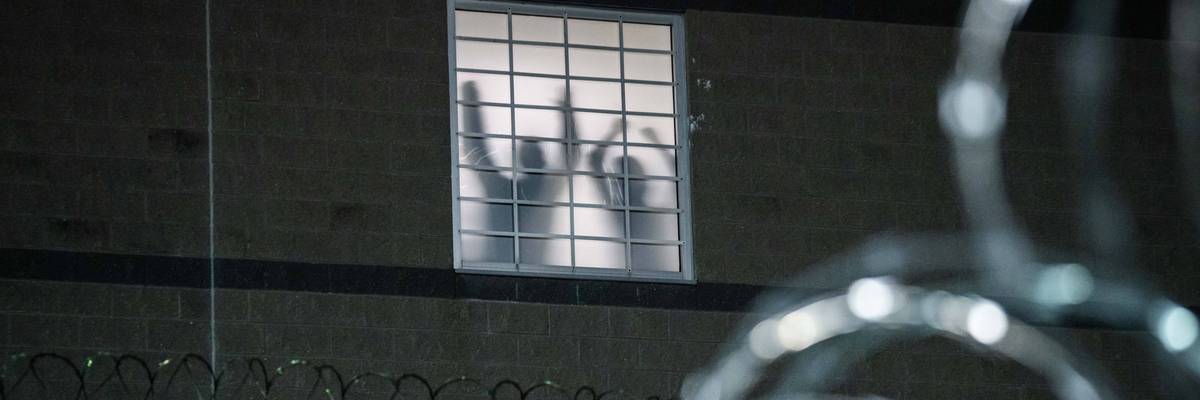
Detainees stand by a window inside the federal immigration center at Delaney Hall in Newark, New Jersey, where US Immigration and Customs Enforcement is housing detained immigrants on May 26, 2026.
(Photo by Adam Gray/Getty Images)
Brad Reed
Sep 21, 2026
COMMON DREAMS
Critics reacted with horror to a Monday report from The Associated Press detailing how US Immigration and Customs Enforcement has abruptly ended its practice of disclosing the locations of thousands of detainees.
According to the AP, ICE “has stopped publicly revealing where it is holding... detainees who are subject to final deportation orders, an unannounced move that has made it far more difficult for lawyers and relatives to find them.”
Sep 21, 2026
COMMON DREAMS
Critics reacted with horror to a Monday report from The Associated Press detailing how US Immigration and Customs Enforcement has abruptly ended its practice of disclosing the locations of thousands of detainees.
According to the AP, ICE “has stopped publicly revealing where it is holding... detainees who are subject to final deportation orders, an unannounced move that has made it far more difficult for lawyers and relatives to find them.”
Immigration attorneys who spoke with the AP said that their clients had “vanished” from the system after ICE removed them from its online detainee locator system last week.
Greg Chen, senior director of government relations at the American Immigration Lawyers Association, told the AP that families of detainees “are freaking out because they think the person has been deported and they don’t know where the person might be.”
Chen added that the new policy has “serious implications” for attorneys’ ability to make contact with their clients.
Michelle Mendez, legal director at the National Immigration Project, told the AP that the new policy is “just another iteration of disappearing people.”
“Why would we do that in the United States of America?” Mendez asked. “It’s something we’d hear about in another country and be concerned about individual rights and due process.”
Tom Jawetz, senior fellow at the Center for American Progress, echoed Mendez’s analysis, writing in a social media post that the AP report reveals “an official government policy of disappearing people,” as “systems for attorneys and loved ones to know where—even whether—a person with a final removal order is in ICE custody have been wiped clean.”
Aaron Reichlin-Melnick, senior fellow at the American Immigration Council, described the new ICE policy as “unprecedented” for US immigration enforcement.
“People who have been detained for months are suddenly disappearing from the locator system—even if they haven’t been moved anywhere,” Reichlin-Melnick explained. “And people newly arrested are not showing up at all, their location now hidden from view.”
Georgetown University political scientist Jonathan Ladd argued that the ICE policy was a fundamental violation of long-established rights in the US that date to before the country’s official founding.
“The government moving or hiding jailed people to avoid review by courts isn’t some loophole in our habeas corpus rights,” Ladd explained. “This government behavior has been considered a violation of the people’s habeas corpus rights since at least the Habeas Corpus Act of 1679.”
Ladd further pointed out that “habeas corpus rights are guaranteed by Article I of our Constitution,” which means “hiding prisoners from the courts is unconstitutional.”
Journalist Gillian Brockell observed that the new ICE policy “will make it nearly impossible to file habeas petitions, because attorneys won’t even know what federal district their client has been moved to to stage for their removal.”
Among those sharing the AP report on social media was Kate Lincoln-Goldfinch, an attorney for Wilbur Rafael Garces Perez, a 28-year-old Venezuelan shot by ICE in Austin, Texas on Sunday.
Initially, she and the immigrant’s wife could not make contact with him, because ICE moved him from the hospital “to an undisclosed location,” but Lincoln-Goldfinch said Monday afternoon that her client “is being held at Pearsall for interrogation.”
“We got Wilber on the phone live from detention at the press conference,” the attorney added. “He says he still has the bullet lodged in his shoulder. He says he is not doing well and has not received the medical care he needs.”
“DHS must not obstruct or otherwise interfere with this investigation by removing Mr. Garces Perez from the country,” said lawmakers.

Wilber Rafael Garces Perez, who was shot by an immigration agent on September 20, 2026, is seen in an undated photo.
(Photo: family photo via X)
Julia Conley
Sep 22, 2026
COMMON DREAMS
The attorney representing Wilber Rafael Garces Perez said Tuesday that a federal judge had granted her emergency request to block the Trump administration from deporting the 28-year-old delivery driver, who was shot by an immigration agent Sunday and has since been transferred multiple times between hospitals and a detention center—all while the officer’s bullet reportedly remains lodged in his back.
“We have filed a federal lawsuit, and the judge has ordered that he be present at the first hearing, which is scheduled for Wednesday, September 30,” said Kate Lincoln-Goldfinch. “And that means he won’t be deported in the meantime.”
Lincoln-Goldfinch applauded the rare piece of “good news” that has come out of Garces Perez’s case since he was shot by an Immigration and Customs Enforcement (ICE) agent while making DoorDash deliveries in his car Sunday afternoon.
As Common Dreams reported, Garces Perez was transferred from an ICE detention center in Pearsall, Texas to a hospital late Monday after reporting that he had lost feeling in the left side of his body, likely as a result of the bullet that remained close to his spine.
But Lincoln-Goldfinch and Rep. Joaquin Castro (D-Texas) said Tuesday that Garces Perez had again been taken back to the detention center.
Castro said he and Rep. Greg Casar (D-Texas) plan to visit Garces Perez at South Texas ICE Processing Center on Wednesday, to “check on his condition and demand his release.”
“It is nothing more than a prison,” said Castro. “Wilber came to the United States legally. He had work permits and was an asylum seeker. None of this should have ever happened.”
Garces Perez arrived in the US in 2024 from Venezuela, using a government program for asylum seekers and the CBP One app that was introduced by the Biden administration to make an appointment for approval from immigration agents. He received a work permit and applied for asylum.
He mistakenly missed an immigration hearing after a notice was sent to an old address, The New York Times reported, which led to his deportation order. He has no criminal history.
Lincoln-Goldfinch had been planning to visit her client in the hospital Tuesday, where he was taken after he called in to a press conference the lawyer was holding Monday and said that he had not received medical treatment for his gunshot wound.
After speaking to Garces Perez via a video call Tuesday morning, Lincoln-Goldfinch reported on social media:
Wilber tells me that after he spoke publicly, guards at the Pearsall detention center forcibly took the tablet from his hands, revoked his communication privileges, and moved him out of the infirmary into an isolated room with a flat bed that cannot be adjusted like a medical bed.
[...]
At the hospital, Wilber says doctors finally spoke directly to him about his care and gave him IV morphine for his pain. We now understand that the gunshot fractured his clavicle and that he has significant swelling and is wearing a sling. We still do not have clarity about the cause or extent of the loss of movement he experienced.
He was discharged back to Pearsall around midnight. Today, he tells me he is receiving only Tylenol and ibuprofen for pain. He remains in isolation, on a flat bed, and without the tablet he previously used to communicate. We are asking for his communication privileges to be immediately restored and for him to be provided an appropriate medical bed and adequate medical care. Most importantly, we are continuing to advocate for Wilber’s IMMEDIATE release.
Also on Tuesday, it was revealed that the ICE agent who shot Garces Perez was not wearing a body camera at the time of the shooting—similar to the case of Johan Sebastián Durán Guerrero, who was fatally shot by an ICE agent in Maine in July.
“Before we hear anything from ICE about, ‘We pulled him over, or he was fleeing, or he was aggressive,’ our response to any statements like that is, ‘We won’t believe you until you show us,’” said Goldfinch-Lincoln. “Show us your body cam footage, show us your dash cam footage.”
On Tuesday, more than 100 members of Congress signed a letter to Homeland Security Secretary Markwayne Mullin and acting ICE Director David Venturella, spearheaded by Casar, calling on ICE to release Garces Perez and “abandon efforts to swiftly deport him or remove him from Texas.”
“ICE has provided no justification for this shooting, and there is no indication Mr. Garces Perez posed a threat to officers,” reads the letter, noting that the Department of Homeland Security (DHS) “has a history of withholding information and attempting to obstruct active investigations into wrongdoing by its agency.”
“DHS must not obstruct or otherwise interfere with this investigation,” said the lawmakers, “by removing Mr. Garces Perez from the country or interfering with the release of footage, data, or other information by Texas state or local agencies involved in the operation.”
Austin Man Shot by ICE Facing Paralysis After Being Refused Medical Care
“This isn’t law enforcement,” said US Senate candidate James Talarico. “It’s lawlessness.”
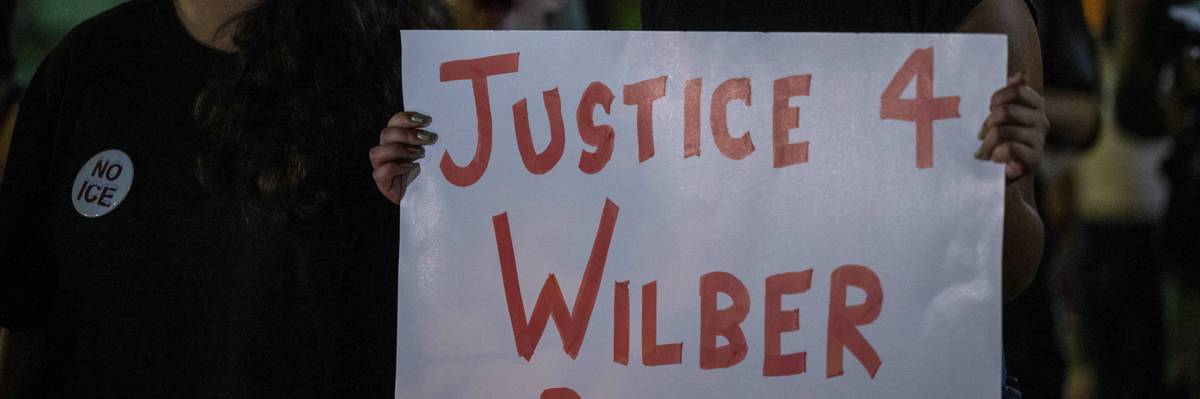
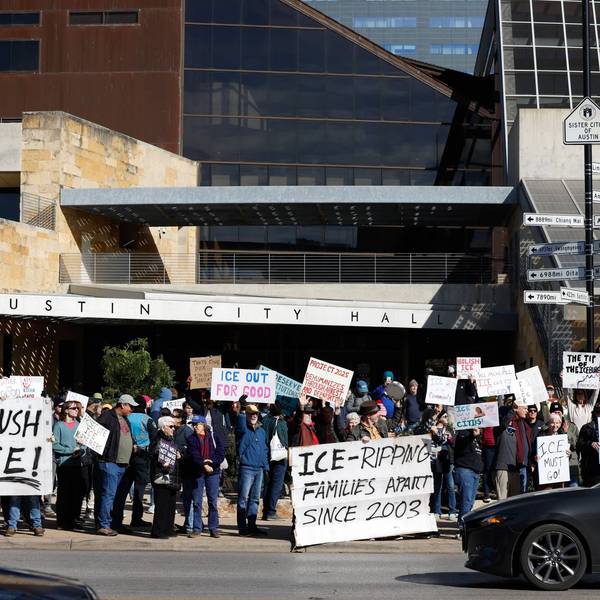
People protest outside the Texas State Capitol in Austin, Texas, on September 21, 2026, a day after Wilber Rafael Garces Perez was shot and wounded by US Immigration and Customs Enforcement (ICE) operation.
(Photo by Ronaldo Schemidt/AFP via Getty Images)
Julia Conley
Sep 22, 2026
COMMON DREAMS
Democrats in Congress on Monday evening were demanding a full, independent investigation into US Immigration and Customs Enforcement’s shooting on Sunday of Wilber Rafael Garces Perez, as it was reported that he had been held in an ICE detention center with a bullet still lodged in his back—close to his spine—and that he was finally being taken to a hospital only after he lost feeling in the left side of his body.
In a video posted on social media, US Rep. Joaquin Castro (D-Texas) recounted how Perez was initially hospitalized after ICE agents in an unmarked SUV sideswiped his car as he was making DoorDash deliveries in Austin, Texas, and then shot him through his windshield as he was trying to pull over.
But “only a few hours after being shot, he was forced out of the hospital,” said Castro, “and sent over to what is known as STIPC, in Pearsall, Texas, along I-35, the South Texas ICE Processing Center.”
Castro and Rep. Greg Casar (D-Texas) spent Monday attempting to gain permission to visit with Perez and raising alarm over the fact that ICE’s bullet had not been removed from his back before he was taken to STIPC, where he was reportedly forced to sleep on a floor.
“He reported that he’s in incredible pain, that he’d not been given any medication,” said Castro. “It’s basically abuse that you would take somebody who has been shot and move them from a hospital to a prison, that kind of prison, within a matter of hours, and then also, it looks like, start the process to deport them immediately.”
Perez entered the country two years ago after using the CBP One application to set up an appointment with immigration agents. The app was introduced by the Biden administration, but President Donald Trump abruptly terminated it immediately after he took office last year. Perez was permitted to enter the country, applied for asylum, and received a work permit.
As Common Dreams reported Monday, Perez’s lawyer, Kate Goldfinch-Lincoln, and his wife were unable to make contact with him when he was first taken from the hospital on Sunday.
After Perez briefly called in from the detention center to a press conference held by Goldfinch-Lincoln on Monday, she said she received a call from another detainee who told her “that officers came in and handled Wilber roughly.”
“According to this detainee, Wilber then lost feeling on the left side of his body, including his arm and leg,” she said. “Wilber has a bullet lodged near his spine. I was told that he was handcuffed, shackled at the feet, placed in a waist chain, and taken to a hospital. I am waiting to find out how he is doing and what his current condition is. We need answers. We need to know that Wilber is safe and receiving appropriate medical care. So far, he has not.”
In response to the update on Perez’s condition, Democratic US Senate candidate James Talarico said: “This isn’t law enforcement. It’s lawlessness.”
Casar called Perez’s transfer back to the hospital “a positive first step,” and credited immigrant rights advocates and community members for “speaking up.”
“Now, we have to make sure he fully recovers, is reunited with his family, and gets to tell law enforcement the full story of how he was shot in the back by ICE,” said Casar.
Reps. Rashida Tlaib (D-Mich.), Ro Khanna (D-Calif.), and Maxwell Frost (D-Fla.) were among the lawmakers calling for a full investigation into the shooting and ICE’s treatment of Perez.
“This is absolutely horrific,” said Frost. “ICE must be stopped. Their regime of cruelty will continue until they are held accountable.”
“By setting aside those unconstitutional policies, the court has restored the rule of law.”

A worker is seen at a construction in Santa Clarita, California
(Photo by Hans Gutknecht/MediaNews Group/Los Angeles Daily News via Getty Images)
Julia Conley
Sep 21, 2026
COMMON DREAMS
A federal judge on Monday handed down a decision in a case brought by US citizen Leo Garcia Venegas, who was detained three times in the Trump administration’s immigration raids at construction sites—but the court’s order, said advocates, will protect workers across the country from federal agents’ warrantless, violent raids.
Chief US District Judge Jeffrey U. Beaverstock in the US District Court for the Southern District of Alabama temporarily blocked Department of Homeland Security officers from conducting raids at construction sites. He issued stays on three DHS policies while Venegas’ case proceeds and said agents had likely violated his Fourth Amendment rights.
The three practices Beaverstock blocked include DHS’ warrantless entry policy; its preemptive detention policy, which allows agents to detain a person simply based on suspicion, even without evidence, that they are an undocumented immigrant; and its continued detention policy, which permits officers to hold a person even after they show evidence of citizenship or lawful presence in the US.
Those policies have resulted in three arrests of Venegas since the spring of 2025, including one instance in which masked officers followed him home from the construction site where he worked, ripped him from his car, tackled him to the ground, and handcuffed and shackled him—all while he was trying to show them his REAL ID to prove his citizenship.
“They can suddenly show up and detain you without having done anything,” Venegas testified in May. “Now I don’t feel free to drive, to go to work, or go to the store.”
The Institute of Justice, which is representing Venegas, noted that the Trump administration has urged all Americans to get their REAL ID cards—which, in most states, have a symbol like a star on them to comply with new rules—and Venegas’ state of Alabama issues the cards only to citizens or those who are lawfully present. Yet a DHS official testified in Venegas’ case that REAL ID cards do not prove that someone is authorized to be in the US.
“Venegas was not promptly released following the production of his REAL ID to officers. Instead, the officers disregarded the veracity of his documentation and continued to detain him,” reads the court order. “A policy that permits such action is likely to run afoul of the Fourth Amendment.”
In the ruling, Beaverstock also noted that DHS last year had claimed Venegas tried to interfere with officers when he was first detained in May 2025—something that video of the arrest did not support.
DHS also claimed that the agency treats construction sites as “open fields” where agents do not need a warrant or even a reason to search the premises and make arrests—but Venegas works in closed construction sites that are posted with “No Trespassing” signs, and was working inside a house that was in the finishing stages of being built when he was arrested for a second time last June.
“Agents walked inside a house where Leo was working, surrounded him, and ordered him to follow them,” said the Institute for Justice last year when Venegas sued the Trump administration. “Again, Leo produced his REAL ID. Again, the agents refused to accept it. They marched him out of the development and detained him alongside other workers they had grabbed—only releasing him (and other lawful residents) 20 minutes later after confirming his citizenship.”
Beaverstock wrote that “the government has not convinced this court that the warrantless entry into a structure—which undisputedly occurred during the June encounter—does not implicate the Fourth Amendment.”
Jared McClain, senior attorney at the Institute for Justice, called the judge’s decision “a huge blow to DHS’ lawless enforcement practices.”
“The government stood up in court and argued that they don’t need warrants to enter private construction sites and round up all the workers, and that they can’t trust government-issued IDs,” said McClain. “By setting aside those unconstitutional policies, the court has restored the rule of law. Construction workers like Leo can finally go to work in peace again.”
“This isn’t law enforcement,” said US Senate candidate James Talarico. “It’s lawlessness.”
People protest outside the Texas State Capitol in Austin, Texas, on September 21, 2026, a day after Wilber Rafael Garces Perez was shot and wounded by US Immigration and Customs Enforcement (ICE) operation.
(Photo by Ronaldo Schemidt/AFP via Getty Images)
Julia Conley
Sep 22, 2026
COMMON DREAMS
Democrats in Congress on Monday evening were demanding a full, independent investigation into US Immigration and Customs Enforcement’s shooting on Sunday of Wilber Rafael Garces Perez, as it was reported that he had been held in an ICE detention center with a bullet still lodged in his back—close to his spine—and that he was finally being taken to a hospital only after he lost feeling in the left side of his body.
In a video posted on social media, US Rep. Joaquin Castro (D-Texas) recounted how Perez was initially hospitalized after ICE agents in an unmarked SUV sideswiped his car as he was making DoorDash deliveries in Austin, Texas, and then shot him through his windshield as he was trying to pull over.
But “only a few hours after being shot, he was forced out of the hospital,” said Castro, “and sent over to what is known as STIPC, in Pearsall, Texas, along I-35, the South Texas ICE Processing Center.”
Castro and Rep. Greg Casar (D-Texas) spent Monday attempting to gain permission to visit with Perez and raising alarm over the fact that ICE’s bullet had not been removed from his back before he was taken to STIPC, where he was reportedly forced to sleep on a floor.
“He reported that he’s in incredible pain, that he’d not been given any medication,” said Castro. “It’s basically abuse that you would take somebody who has been shot and move them from a hospital to a prison, that kind of prison, within a matter of hours, and then also, it looks like, start the process to deport them immediately.”
Perez entered the country two years ago after using the CBP One application to set up an appointment with immigration agents. The app was introduced by the Biden administration, but President Donald Trump abruptly terminated it immediately after he took office last year. Perez was permitted to enter the country, applied for asylum, and received a work permit.
As Common Dreams reported Monday, Perez’s lawyer, Kate Goldfinch-Lincoln, and his wife were unable to make contact with him when he was first taken from the hospital on Sunday.
After Perez briefly called in from the detention center to a press conference held by Goldfinch-Lincoln on Monday, she said she received a call from another detainee who told her “that officers came in and handled Wilber roughly.”
“According to this detainee, Wilber then lost feeling on the left side of his body, including his arm and leg,” she said. “Wilber has a bullet lodged near his spine. I was told that he was handcuffed, shackled at the feet, placed in a waist chain, and taken to a hospital. I am waiting to find out how he is doing and what his current condition is. We need answers. We need to know that Wilber is safe and receiving appropriate medical care. So far, he has not.”
In response to the update on Perez’s condition, Democratic US Senate candidate James Talarico said: “This isn’t law enforcement. It’s lawlessness.”
Casar called Perez’s transfer back to the hospital “a positive first step,” and credited immigrant rights advocates and community members for “speaking up.”
“Now, we have to make sure he fully recovers, is reunited with his family, and gets to tell law enforcement the full story of how he was shot in the back by ICE,” said Casar.
Reps. Rashida Tlaib (D-Mich.), Ro Khanna (D-Calif.), and Maxwell Frost (D-Fla.) were among the lawmakers calling for a full investigation into the shooting and ICE’s treatment of Perez.
“This is absolutely horrific,” said Frost. “ICE must be stopped. Their regime of cruelty will continue until they are held accountable.”
‘Huge Blow’ to ‘Lawless’ Practices of Trump DHS as Court Orders End to Warrantless Construction Site Raids
“By setting aside those unconstitutional policies, the court has restored the rule of law.”
A worker is seen at a construction in Santa Clarita, California
(Photo by Hans Gutknecht/MediaNews Group/Los Angeles Daily News via Getty Images)
Julia Conley
Sep 21, 2026
COMMON DREAMS
A federal judge on Monday handed down a decision in a case brought by US citizen Leo Garcia Venegas, who was detained three times in the Trump administration’s immigration raids at construction sites—but the court’s order, said advocates, will protect workers across the country from federal agents’ warrantless, violent raids.
Chief US District Judge Jeffrey U. Beaverstock in the US District Court for the Southern District of Alabama temporarily blocked Department of Homeland Security officers from conducting raids at construction sites. He issued stays on three DHS policies while Venegas’ case proceeds and said agents had likely violated his Fourth Amendment rights.
The three practices Beaverstock blocked include DHS’ warrantless entry policy; its preemptive detention policy, which allows agents to detain a person simply based on suspicion, even without evidence, that they are an undocumented immigrant; and its continued detention policy, which permits officers to hold a person even after they show evidence of citizenship or lawful presence in the US.
Those policies have resulted in three arrests of Venegas since the spring of 2025, including one instance in which masked officers followed him home from the construction site where he worked, ripped him from his car, tackled him to the ground, and handcuffed and shackled him—all while he was trying to show them his REAL ID to prove his citizenship.
“They can suddenly show up and detain you without having done anything,” Venegas testified in May. “Now I don’t feel free to drive, to go to work, or go to the store.”
The Institute of Justice, which is representing Venegas, noted that the Trump administration has urged all Americans to get their REAL ID cards—which, in most states, have a symbol like a star on them to comply with new rules—and Venegas’ state of Alabama issues the cards only to citizens or those who are lawfully present. Yet a DHS official testified in Venegas’ case that REAL ID cards do not prove that someone is authorized to be in the US.
“Venegas was not promptly released following the production of his REAL ID to officers. Instead, the officers disregarded the veracity of his documentation and continued to detain him,” reads the court order. “A policy that permits such action is likely to run afoul of the Fourth Amendment.”
In the ruling, Beaverstock also noted that DHS last year had claimed Venegas tried to interfere with officers when he was first detained in May 2025—something that video of the arrest did not support.
DHS also claimed that the agency treats construction sites as “open fields” where agents do not need a warrant or even a reason to search the premises and make arrests—but Venegas works in closed construction sites that are posted with “No Trespassing” signs, and was working inside a house that was in the finishing stages of being built when he was arrested for a second time last June.
“Agents walked inside a house where Leo was working, surrounded him, and ordered him to follow them,” said the Institute for Justice last year when Venegas sued the Trump administration. “Again, Leo produced his REAL ID. Again, the agents refused to accept it. They marched him out of the development and detained him alongside other workers they had grabbed—only releasing him (and other lawful residents) 20 minutes later after confirming his citizenship.”
Beaverstock wrote that “the government has not convinced this court that the warrantless entry into a structure—which undisputedly occurred during the June encounter—does not implicate the Fourth Amendment.”
Jared McClain, senior attorney at the Institute for Justice, called the judge’s decision “a huge blow to DHS’ lawless enforcement practices.”
“The government stood up in court and argued that they don’t need warrants to enter private construction sites and round up all the workers, and that they can’t trust government-issued IDs,” said McClain. “By setting aside those unconstitutional policies, the court has restored the rule of law. Construction workers like Leo can finally go to work in peace again.”

No comments:
Post a Comment