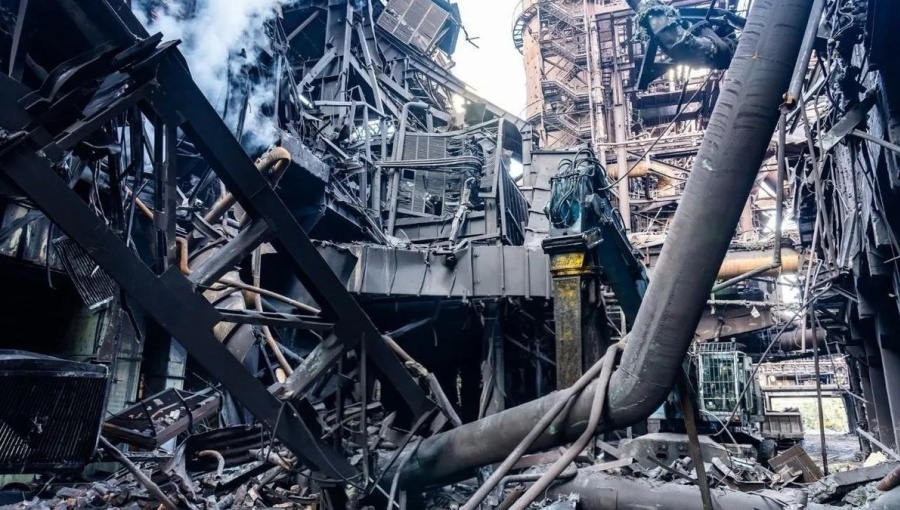
Ukraine went a whole week in September without smelting a single tonne of steel, the first time in 100 years, as Russian missiles and a closed Black Sea shut down its second-biggest export industry.
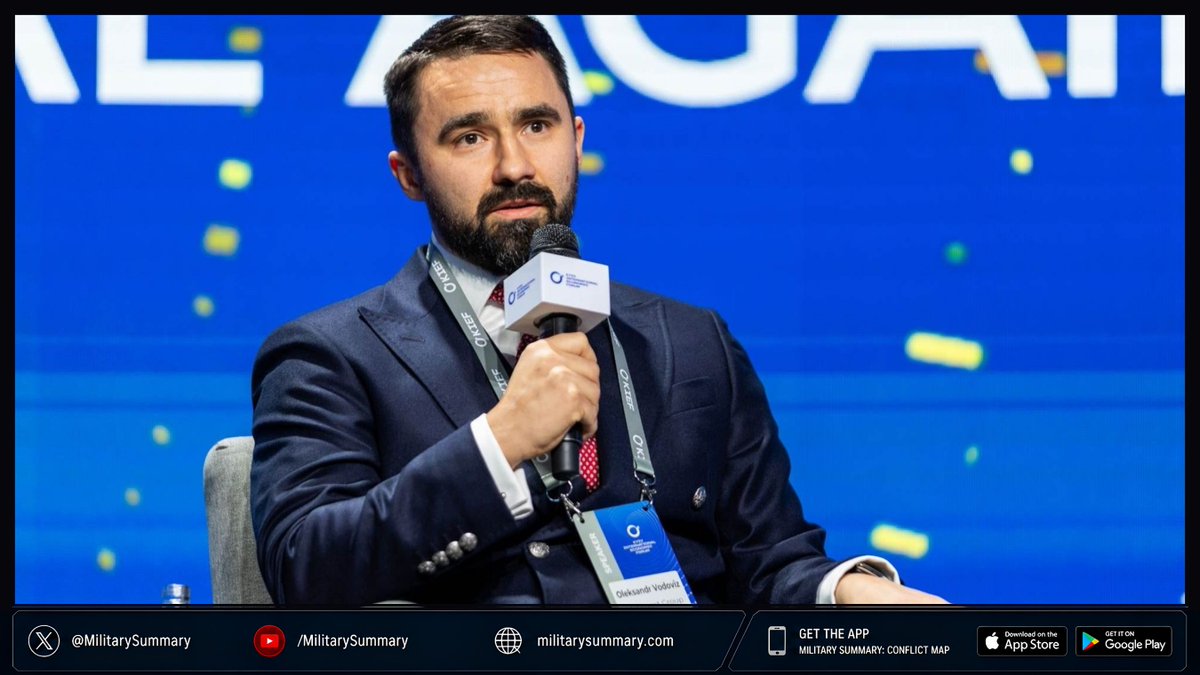
Oleksandr Vodoviz, head of the office of Metinvest's chief executive, speaking at an earlier Kyiv International Economic Forum. Source: Military Summary
"In September there was a week when Ukraine, for the first time in 100 years, did not smelt a single tonne of steel," Oleksandr Vodoviz, head of the office of Metinvest's chief executive, told the Economic Resilience Forum hosted by Forbes Ukraine in Kyiv on September 23, Interfax-Ukraine reported.
All of the country's big steelmakers - ArcelorMittal Kryvyi Rih, Metinvest, the Petrovsky works in Dnipro and pipe and wheel maker Interpipe - have been hit and are not working, he said.
"Absolutely all plants are destroyed," Vodoviz said. "There were multiple hits at each. Many people have lost their lives. We are not operating."
That is going to be a big problem. While Ukraine famously was, together with Russia, the world’s biggest grain exporter, in 2021 the biggest export category was metals, which earned $15.98bn against $15.55bn for crops that year. Since then total exports have almost halved from $68.2bn in 2021 to $40.3bn last year and metals only brought in $4.7bn in 2025, with their share in exports was halved to 11.7%. Now that will fall to zero
Ukraine's exports 2021-2025
Total goods exports
2021
$68.24bn
2025
$40.3bn
Metals exports
2021
$15.98bn
2025
$4.7bn
Metals' share of exports
23.40%
2025
11.70%
Everything else
2021
$52.26bn
2025
$35.6bn
Sources: Economy Ministry via the Cabinet of Ministers, State Customs Service via Mezha
Fortress plants under attack
The Kremlin has been targeting Ukraine’s main factories and plants as part of its economic war, but as steel mills are also very effective as fortresses for Armed Forces of Ukraine (AFU) fighters to hold up in in the battles with Russia’s invading troops, many plants have also been the scene of intense battles and been destroyed in the process.
The most famous was the siege of the Azovstal steelworks in Mariupol, the port city on the Sea of Azov in the Donetsk region. Ukrainian defenders led by the Azov Regiment, alongside marines, border guards and police, held out in the plant's tunnels for weeks after Russian forces had surrounded the city, sheltering civilians until they were evacuated in early May.
Cut off from supplies and with hundreds wounded, the garrison was ordered by Kyiv to lay down its arms after 82 days of fighting, in its commander Denys Prokopenko's count. The last defenders surrendered on May 20, 2022, and Mariupol has been under Russian occupation ever since.
More than 2,000 went into captivity by Russia's count. At least 50 were killed in July 2022 when the prison at Olenivka where many were held was blown up. 188 came home in the September 2022 prisoner swap, which Kyiv paid for by handing over Viktor Medvedchuk, and others have followed in later exchanges. But more than 600 Azov fighters remain in Russian captivity, 270 of them convicted of terrorism, according to Azov commander Colonel Bohdan Hrishenkov, United24 Media reported in August. The owner of the plant, Ukraine’s richest man, Rinat Akhmetov, says the plant is beyond repair and worth a reported $1.4bn. Now all his metallurgical plants have gone offline, the basis of his fortune.
IntelliNews has a ledger tracking the attacks and production status of Ukraine’s leading metallurgical plants in its metallurgy ledger that posts a full list of the is updated every day and is included in the IntelliNews Missile War Monitor.
Destruction of Ukraine’s economy
Metals were Ukraine's biggest source of hard currency before the war, and the industry has stopped just as Kyiv needs every dollar it can earn. The draft 2027 budget leaves a $32.6bn hole to be filled by foreign partners, the hryvnia hit a record low against the euro in August and the National Bank of Ukraine raised its key rate to 16% on September 17. Losing steel on top of the grain trapped by the port blockade of Odesa takes out the country's two biggest export earners at once.
And the destruction of the metallurgical sector comes on top of the more recent Russian effort to systematically destroy Ukraine’s retail infrastructure, following Ukrainian President Volodymyr Zelenskiy’s launch of a warehouse war that Russian President Vladimir Putin said had opened a “Pandora’s box” and transition from a war of attrition that has been running for the last four years to the start of a total war.
Rebuilding the metal plants after the eventual end of the conflict will be extremely difficult and require many billions of dollars of investment. Five of Metinvest's blast furnaces and two at ArcelorMittal Kryvyi Rih have been destroyed, Vodoviz said. Restarting a furnace costs about $50mn and building a new one about $500mn. Metinvest restarted one furnace at Zaporizhstal, and it ran for about 10 hours before the plant was hit again by Russian missiles. The company asked ministries for help and was offered UAH2mn-5mn ($44,000-$111,000), he said, and the government has no plan for dealing with the wrecked plants. Metinvest can plan only about a month ahead.
From a quarter of exports to almost nothing
In 2021, the last year before the full-scale invasion, Ukraine exported $15.98bn of base metals and metal products out of $68.24bn of goods, the Cabinet of Ministers said, about 23% of merchandise exports and about 8% of that year's GDP of $199.8bn, on World Bank data. Adding iron ore, the mining and metals complex earned $22.2bn, a third of all exports, according to industry think tank GMK Center. The country made about 21.4mn tonnes of steel that year.
The war cut that down in stages. By 2025 exports of the mining and metallurgical complex had fallen to $6.2bn, or 15.2% of exports, and the sector's share of GDP had slipped to 5.5% from 7.2% a year earlier. On a narrower count of metallurgical products alone, exports were $4.7bn in 2025, about 9% of the total and roughly 2% of GDP, and fell to $1.7bn in the first five months of 2026, about 7% of exports and more than two-thirds below pre-war levels.
Steel output fell 57.3% y/y in August to 277,000 tonnes and pig iron 65.6% to 257,100 tonnes, according to the Ukrmetalurgprom industry association, LIGA.net reported on September 9. By mid-September Russian strikes had idled 90% of steel output and Metinvest had declared force majeure on some contracts. In the week Vodoviz described, it was zero.
The coal went first
The first big blow came from the front line rather than the air. As IntelliNews reported, taking out the Pokrovske coal mine in Donetsk region, owned by Metinvest, very effectively brings Ukraine’s metal production to a halt without touching any of the plants themselves.
The mine was the only source of the coking coal Ukraine's blast furnaces need - the country's other mines in government-held territory produce thermal coal of the wrong grade for steelmaking. Metinvest shut it on January 13, 2025 as Russian troops closed in on Pokrovsk, and the steel industry had to import about 2.5mn tonnes of coking coal a year, Dragon Capital analyst Denys Sakva said at the time – a lot of it from Russia, the only local source of coking coal.
"With its loss, Ukraine's steelmakers are now completely dependent on foreign coal supplies," Sakva said at the time.
Metinvest began shipping coal from its US mines under its United Coal Company, adding sea and rail freight to the cost of every tonne of steel, and by September 2025 was planning to sell the loss-making US unit. The mine had supplied about two-thirds of domestic coking coal demand in 2023, and its loss followed the destruction of Mariupol's Azovstal and Illich works in 2022, which had left the sector working at 15-20% of capacity by early 2023.
Then the ports
The second blow was the closure of the Odesa ports since the missile war escalated in July. Russia's strikes on merchant shipping and the Greater Odesa terminals from late July, part of a wider drone war crippling ports on both sides of the Black Sea, shut the route that carried about half of Ukraine's steel exports, 95% of its pig iron and half its iron ore in the first half of 2026. Industry estimates put the loss at $150mn-200mn a month in export revenue, and the same blockade that set off a global food price shock by trapping Ukraine's grain could cost the economy 5.3% of GDP by 2027 on one estimate.
Ironically it is overflowing warehouses that brought the iron ore producers to a halt, not Russian bombs. Pivdennyi GZK in Kryvyi Rih, controlled by Akhmetov and Vadym Novynskyi, stopped mining at the end of July because shiploads of ore had piled up in warehouses and ports with nowhere to go. Ferrexpo halted its Poltava plant, Ukraine's biggest pellet producer, from August 3 while the plant itself remains largely untouched thanks to three of four planned vessels stuck in port and one struck by a Russian drone. Metinvest's southern ore plant stood idle for the same reason.
And finally the missiles
Now things have gone up a notch and the plants themselves are taking damage. The strikes on the steelworks themselves began in August. A ballistic missile hit Zaporizhstal in mid-August, killing seven workers and stopping the plant, and on the night of August 16 a missile hit ArcelorMittal Kryvyi Rih, forcing a partial shutdown. The two works make about 70% of Ukraine's steel. Kamet Steel in Dnipropetrovska oblast followed, and repeated barrages in early September disabled blast furnaces at all three works.
"The margin of safety is almost exhausted," Ukrmetalurgprom president Oleksandr Kalenkov said in August, warning that further escalation could cost the country half its foreign-currency earnings from mining and metals.
Even before the missiles, EU tariff quotas and the carbon border adjustment mechanism were set to cut exports by 1.3mn-1.5mn tonnes a year, pushing the industry into a "perfect storm", and Metinvest warned in August that EU trade curbs threatened half of Zaporizhstal's capacity. Vodoviz listed the same three problems on September 23: the strikes, the blocked ports and EU restrictions on Ukrainian metal.
Ukraine's economy has been shutting down since Russia turned on its power grid last winter, and Kyiv halved its 2026 growth forecast to 0.5% in August, before the worst of the strikes on the steel mills. Steel survived the loss of Mariupol, the loss of Donbas coal and four years of blackouts. What finally stopped it was a closed sea and a campaign of missiles aimed at its furnaces.
Russia's own mills lifted output 3.3% in July on strong demand from the military industrial sector.

No comments:
Post a Comment