‘Consumers Will Pay the Price’: Fury as Trump Pushes Through Rule Change to Make Vehicles Less Efficient, More Polluting
“Oil companies will get a windfall from gutting the fuel economy standards, but the rest of us are going to be handing over more of our hard-earned paychecks to fill up the tank,” said one environmental lawyer.
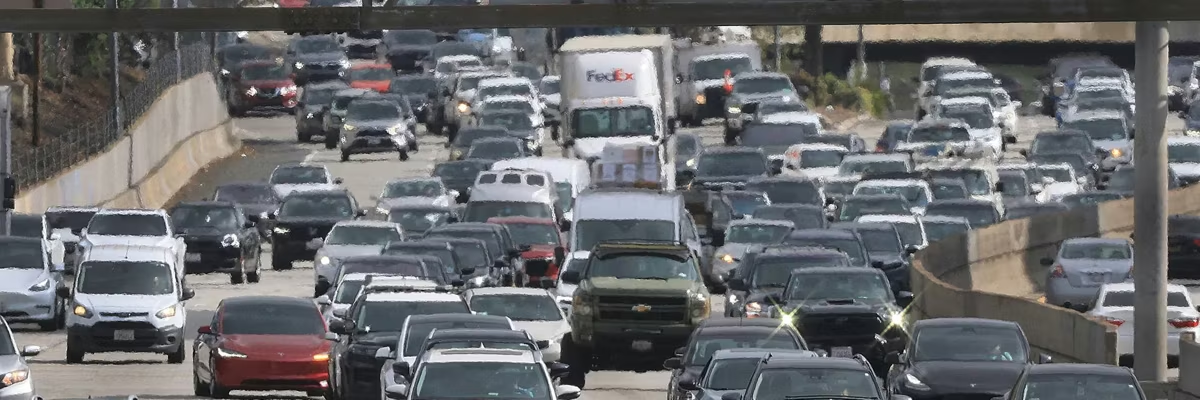
Morning commuters travel along the 110 Freeway in downtown Los Angeles on Thursday, Sept. 17, 2026.
(Photo by Allen J. Schaben/Los Angeles Times via Getty Images)
Stephen Prager
Sep 28, 2026
COMMON DREAMS
Scientists and environmental advocates are warning that the Trump administration’s rollback of fuel economy standards for cars and trucks will not only lead to more pollution but also hurt cash-strapped consumers already reeling from gas price spikes.
The administration announced on Monday that it was weakening the Corporate Average Fuel Economy (CAFE) standards, which require automakers to increase the fuel efficiency of their vehicles each year.
Biden administration rules required a 2% annual increase in fuel-efficiency standards, with the goal of bringing most vehicles to an average of 50.4 miles per gallon by 2031. Under President Donald Trump, the annual target has been reduced to just a 1% improvement each year, meaning five years from now the average car would be required to get just under 34.9 mpg.
The Department of Transportation, which finalized the rule, has argued that efficiency standards put an unnecessary burden on carmakers and has projected that lowering them will “reduce the average cost of a new vehicle by $1,300 for American families” and “save the American people $138 billion over the next five years.”
Transportation Secretary Sean Duffy described the Biden-era increase as one that “forced automakers to produce more expensive electric vehicles that American families didn’t want.”
But Dave Cooke, senior vehicles analyst for the Union of Concerned Scientists’ (UCS) Clean Transportation Program, argues that rather than being a benefit to consumers, “the federal government’s decision to gut fuel economy standards is a handout to automakers and oil companies that will strap American consumers already struggling with an affordability crisis.”
His group has estimated that since CAFE standards were first introduced in 2010, they have saved auto owners about $321 billion at the gas pump. And over just the past seven months, during which Trump’s war with Iran has caused gas prices to soar around the country, UCS estimates that consumers have saved $32 billion.
“Any small reduction in upfront vehicle costs will be outweighed by higher fuel expenses,” Cooke said.
The National Highway Traffic Safety Administration (NHTSA) itself estimated in an impact analysis for the rule days ago that, as a result of the rule change, Americans will consume roughly 122 billion more gallons of gas than they would under the 2024 standards, resulting in average lifetime fuel costs of more than $1,600 more per vehicle—more than the administration estimates consumers will save by buying cheaper cars.
Transportation already accounted for about 17% of average US household spending in 2024, the latest year for which the Bureau of Labor Statistics has published data. Meanwhile, as the war with Iran has driven up costs, oil companies are reporting record profits. The top eight brought in nearly $93 billion in earnings in the second quarter of this year alone, according to an analysis by The Guardian.
“Oil companies will get a windfall from gutting the fuel economy standards, but the rest of us are going to be handing over more of our hard-earned paychecks to fill up the tank,” said Atid Kimelman, an attorney at the NRDC.
Americans won’t just spend more money; they’ll also produce way more planet-heating greenhouse gases. The standards being rolled back were projected by NHTSA to prevent about 659 million metric tons of carbon dioxide, 825,000 metric tons of methane, and roughly 24,000 metric tons of nitrous oxide emissions through 2050.
The Center for Biological Diversity pointed out that the US is already the world’s largest oil guzzler, accounting for 20% of global use, and that transportation is the No. 1 consumer of that oil.
“This move spells short- and long-term disaster for people’s health, the planet, and even US automakers who’ll sit on the sidelines while clean cars advance around the world,” said Dan Becker, the director of the group’s Safe Climate Transport Campaign. “This standard was the biggest single step any nation has taken to save gas, money at the pump, and auto pollution.”
Matthew Davis, vice president of federal policy for the League of Conservation Voters, emphasized that fuel efficiency standards are popular with the American public. A nationwide survey last month by the Global Strategy Group found that 73% of voters nationwide said they’d support “reestablishing fuel efficiency standards for cars and trucks.”
“It is no secret that Trump promised handouts to Big Oil in exchange for campaign spending,” Davis said, “and he is delivering for those billionaire CEOs and polluters while he hurts working families, American manufacturing competitiveness, public health, and the environment at every turn.”
Trump Attack on Trans Rights, Sexual Assault Survivors Continues With Latest Move on Title IX
“The fact that they’re dropping this rule into place abruptly, without a comment period,” said one advocate, “shows how little they care about the safety of our students.”

US Secretary of Education Linda McMahon speaks during the daily briefing in the Brady Briefing Room of the White House in Washington, DC, on November 20, 2025.
(Photo by Brendan Smialowski/AFP via Getty Images)
Julia Conley
Sep 28, 2026
COMMON DREAMS
Education Secretary Linda McMahon’s announcement that the Trump administration was formally rescinding Biden-era anti-discrimination protections was enough to spark outrage among women’s rights and LGBTQ+ advocates on Monday—but one group pointed to officials’ decision to make the change without gathering feedback from the public as even more reason for outcry.
“You get no say,” said Human Rights Campaign (HRC) as the Education Department announced it was taking former President Joe Biden’s Title IX rules off the books and returning to President Donald Trump’s 2020 regulations, which set stricter standards for what constitutes sexual harassment and requires colleges to hold court-like hearings regarding complaints of sexual misconduct, complete with witnesses who can challenge the credibility of survivors or the accused.
HRC said the administration was displaying “contempt for the rule of law and democratic governance” as it “denied the public any opportunity to comment on the dangers of returning to these prior rules, and has announced that the changes will go into effect tomorrow.”
“In its typical Orwellian fashion, the administration claims that ‘engaging in public notice and comment would be contrary to public interest,” said HRC.
Biden had amended Title IX regulations in 2024, clarifying protections against discrimination for students who are pregnant or are parents, transgender, or have other sex differences, and strengthening protections against sexual harassment and assault. The guidelines were subject to court challenges brought by Republican states.
The Trump administration has already been enforcing aspects of its own interpretation of Title IX, including by targeting schools that allow transgender students to play on women’s and girls’ sports teams. The Education Department said on social media Monday that in rescinding Biden’s Title IX rules, “the Trump administration is formally putting into regulation what the law has said all along: Title IX’s protections are based on SEX, not ‘gender identity.’”
Kelley Robinson, president of HRC, said Monday that Title IX “is, quite simply, about protecting students and ensuring that they are safe from abuse, harassment, and discrimination while they pursue their education. But Donald Trump and his cronies aren’t interested in any of that.”
“Instead of enforcing protections for students, they’re rescinding them,” said Robinson. “They don’t care if sexual harassment and assault go unaddressed. And they’re happy to strip funding away from school districts and states that are actually trying to keep students safe. We know who will be hurt: women, girls, and others who are vulnerable to sexual harassment, assault, and abuse—including LGBTQ+ students. The fact that they’re dropping this rule into place abruptly, without a comment period, denying families, educators, loved ones and the students themselves a say in how they should be treated, shows how little they care about the safety of our students.”
Democratic Gov. JB Pritzker of Illinois, a vocal critic of Trump and a potential 2028 presidential contender, said Monday that his state would continue working to ensure that all students of all gender identities are safe on campuses. He accused Trump of “once again attacking the civil rights protections that help make our country great.”
At the National Women’s Law Center, Shiwali Patel, the group’s senior director of education justice, noted that the decision came as prosecutors reopened a high-profile sexual assault case at Cornell University, following public outrage.
“The Cornell University case is a devastating example of why robust federal Title IX enforcement matters,” said Patel. “Sexual harassment and assault continue to be pervasive in schools and, to the fullest extent possible, we should be working to enforce the laws that protect student survivors of sexual violence. Yet, Education Secretary Linda McMahon and the Trump administration have decided to ignore what survivors need, instead weaponizing Title IX to attack trans students.”
“While the administration is unlawfully eroding protections for trans students under the guise of ‘protecting women and girls,’ they are systematically weakening the very laws that keep students safe and schools accountable,” added Patel. “'Protecting women and girls’ means not limiting Title IX protections based on students’ reproductive traits and anatomy and enforcing Title IX to make sure schools are inclusive spaces that provide equal educational opportunity for all students.”
At HRC, Robinson said the decision “drives home how essential it is that we take action at the polls this November to start bringing some accountability to an administration that has turned its back on the very students Title IX was written to protect.”
Report Delivers ‘Starkest Warning Yet’ on How Climate Emergency Is Causing ‘Profound Changes’ for Oceans
“The ocean is transforming before our eyes: Warming, rising seas, and ecosystem degradation are interconnected signs of significant and long-term change.”

A coral reef around Taravai Island with many acropora corals is seen on February 16, 2018 in the Gambier Islands, French Polynesia.
(Photo by Alexis Rosenfeld/Getty Images)
Julia Conley
Sep 30, 2026
COMMON DREAMS
The 10th annual Copernicus Ocean State Report, released Wednesday by a team of more than 100 international scientists, provided the latest reminder that, as one United Nations official said, “the ocean is one of the clearest indicators of the profound shifts” that the climate crisis is causing.
Data gathered by Mercator Ocean International, the nonprofit that produced the report, revealed “an ocean warming at an alarming pace, with far-reaching consequences for marine life, coastlines, and communities worldwide,” said the group.
The study delivers ocean scientists’ “starkest warning yet of the profound changes sweeping across the ocean, as a likely unprecedented El Niño takes shape in the Pacific,” said Mercator, referring to the natural warming trend that is expected to be made more intense this year by planetary heating.
Drawing on four decades of data from satellites, buoys, sensors, and modeling, the scientists found that 2024 was marked by record-breaking marine heatwaves as well as an unprecedented extreme low sea level event, causing levels in the Bothnian Bay between Sweden and Finland to plunge 60 inches, bringing ferries to a halt for 18 hours.
Heatwaves in the Mediterranean and Black seas lasted more than 30 days and raised water temperatures by more than 8.3°F (4.6°C) above average.
“These are not isolated hot spells; they are occurring against a backdrop of sustained ocean warming that is changing the conditions marine ecosystems experience,” Blanca Fernández-Álvarez, a report author and a conresearcher at the Mediterranean Institute for Advanced Studies, told CNN.
But along with extreme events documented in the report, the scientists found unmistakable trends showing no sign of letting up, including persistent damage to marine life due to ocean heating fueled by continued oil and gas extraction.
Small island states—some of the countries least responsible for carbon emissions that are leading to record heat absorption by the oceans—face worsening, “overlapping pressures” including sea-level rise that could wipe out coastal and island communities and the growing threat of more intense tropical cyclones.
Over the last three decades, reads the report, “ongoing reorganization of marine ecosystems around the world” hasr been made clear by persistent changes in growth patterns of phytoplankton, which support food webs and carbon flows, in nearly 5% of the ocean.
Heat stress also contributed to coral bleaching in 84% of the world’s reefs, threatening marine ecosystems as well as coastal communities that rely on reefs for protection and tourism.
“The ocean is transforming before our eyes: Warming, rising seas, and ecosystem degradation are interconnected signs of significant and long-term change,” said Pierre Bahurel, director general of Mercator Ocean International.
As humans have continued to emit carbon and other greenhouse gases despite warnings from energy experts and scientists, the rate of ocean heating has doubled over the past two decades, causing sea surface temperatures to skyrocket to record highs in 2023, 2024, and this year.
In 2025, the report says, the ocean absorbed an additional 23 zettajoules—about 40 times the energy consumed by the entire world last year. The energy absorption is equivalent to 12 atomic bombs going off every second for one year.
The global mean sea level rose by 3.8 ± 0.3 millimeters each year between 1999-2025, and the ocean has become about 17% more acidic over the last four decades, wreaking havoc on crucial underwater ecosystems.
Peter Thomson, the UN secretary-general’s special envoy for the ocean, emphasized that the dangers posed to the world’s oceans by continued fossil fuel extraction have been made clear over 10 years of reports by Mercator, as well as other warnings from scientists.
“What it tells us is unmistakable: The ocean is changing, and those changes are reaching into the lives, livelihoods, and security of people everywhere,” said Thomson. “We have the knowledge. We have the evidence. Now we need the political will to act.”
Despite Trump’s War on Clean Energy, Renewables Have Added 34 Times More Capacity Than Fossil Fuels and Nuclear
“Clearly, the White House has bet on the wrong horse.”
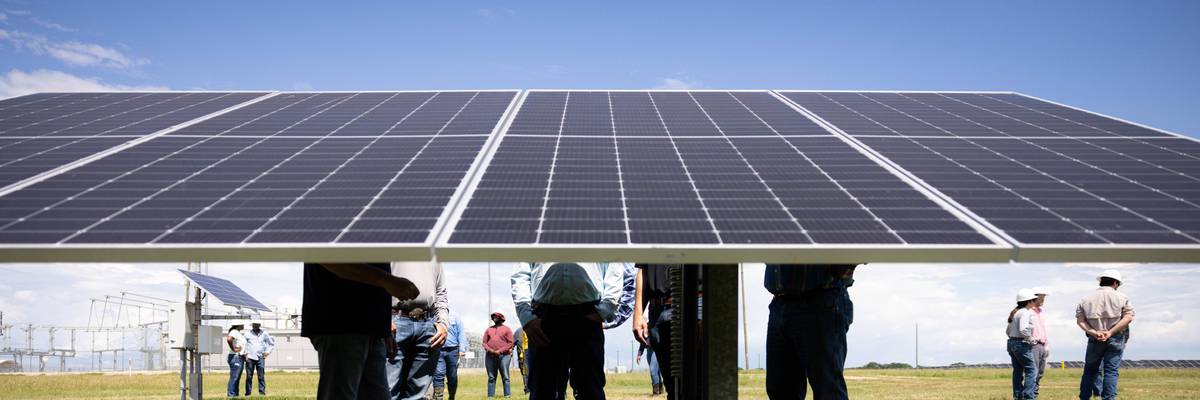
Landowners, educators, and government employees learn about grazing sheep and growing hay under solar panels during a tour of a Solar Stampede site in Saltillo, Texas on May 28, 2026.
(Photo by Angela Piazza/The Dallas Morning News via Getty Images)
Stephen Prager
Sep 28, 2026
COMMON DREAMS
The Trump administration has waged a multi-front war on clean energy during the president’s second term. But according to newly published government data, it hasn’t worked.
Over the past 18 months, despite the administration’s best efforts, solar, wind, and battery storage added nearly 89 gigawatts of capacity—more than 30 times the growth of fossil fuels and nuclear power combined.
That is according to an analysis of new data from the US Energy Information Administration (EIA) released Monday by the nonprofit SUN DAY Campaign, which tracks federal renewable energy data.
From February 2025 through July 2026, utility solar capacity—large-scale projects that provide electricity to power grids—rose 33% over the previous year compared with the same time during 2025, while wind capacity rose 8%. The storage capacity for batteries, meanwhile, roughly doubled.
By contrast, US coal capacity dropped by 2.4%. Natural gas capacity rose by just 1.5%, while the capacity for fossil fuels and nuclear power combined rose by just 0.3%.
At the start of the second Trump administration, renewables accounted for a combined 22.3% share of US electrical generation. Eighteen months later, they now account for 29%.
“Over the last 18 months, the Trump administration has used every conceivable trick to delay, hinder, or cancel new clean energy projects,” said the SUN DAY Campaign’s executive director, Ken Bossong.
This has included an effective ban on wind development, a repeal of clean-energy tax credits in last year’s Republican budget law, a rollback of electric vehicle subsidies, and the cancellation of solar grants, as well as a host of policies meant to ramp up the production of oil, coal, and gas.
The growth of solar and wind reflects an economic reality that Trump has struggled to reverse: Wind and solar are among the cheapest sources of new electricity in much of the country, according to data from the EIA, which expects solar to remain the fastest-growing US source of power generation through 2027.
“Clearly,” Bossong said, “the White House has bet on the wrong horse.”
Alito Recusal in Landmark Climate Case Called ‘Bare Minimum’ Given Big Oil Tactics
Oil companies warned Alito that if the Supreme Court didn’t exempt them from state climate lawsuits, it could adversely affect his personal investments.
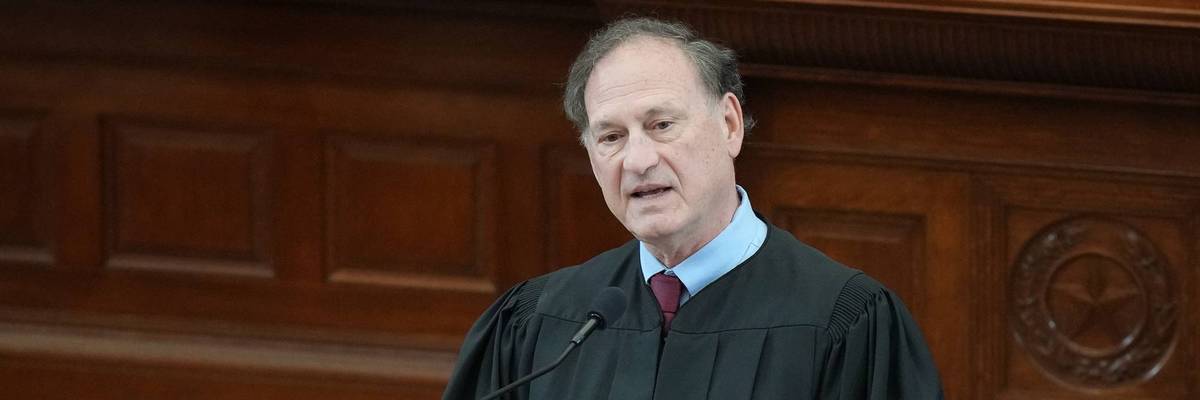
US Supreme Court Justice Samuel Alito speaks during the investiture ceremony for Texas Supreme Court justices Kyle Hawkins and James Sullivan at the state Capitol in Austin on Thursday, May 7, 2026.
(Photo by Jay Janner/The Austin American-Statesman via Getty Images)
Stephen Prager
Sep 29, 2026
COMMON DREAMS
Following years of pressure from critics who called out his severe conflicts of interest, the right-wing Supreme Court Justice Samuel Alito has recused himself from a major climate case on Monday, just days before the lawsuit was scheduled to be heard.
Next week, the court is scheduled to hear oral arguments in Suncor Energy v. County Commissioners of Boulder County, a case nearly a decade in the making that could determine whether oil giants can face billions of dollars worth of lawsuits for climate-related damages and misleading the public about the planet-heating effects of fossil fuels.
A coalition of environmental groups and anti-corruption watchdogs has pushed for Alito to recuse himself from the case because the justice personally holds stock in ConocoPhillips and Phillips 66—companies that face around two dozen climate lawsuits that could be directly affected by his ruling.
As Hannah Story Brown, the deputy research director on climate and governance issues at the Revolving Door Project, explained back in 2023, the Suncor case was promoted strategically by oil companies to allow Alito to get around his oil investments.
“While most of the lawsuits were brought against a dozen or so different fossil fuel companies, the Colorado municipalities are only suing ExxonMobil and Suncor Energy—the stocks of which Alito does not own,” she wrote for The American Prospect. “This presents an opportunity to get around Alito’s likely recusal from considering the other four petitions to which ConocoPhillips and Phillips 66 are parties.”
In May, a Supreme Court spokesperson said Alito had declined to recuse because he had no financial interest in either company that is a party to the Boulder case and had been advised by court counsel that recusal was not required.
However, in September, just weeks before oral arguments, the group Consumer Watchdog found that shareholders, including Alito, had received warnings from the two companies that climate lawsuits could adversely impact their businesses and, in turn, his investments. Oil industry groups, meanwhile, told the court in briefs that a ruling in the Suncor case could make those lawsuits go away.
“Justice Alito has a direct and documented financial stake in the outcome of Suncor v. Boulder,” explained Alexandra Nagy, Organizing Director of Consumer Watchdog. “Under the Supreme Court’s own Code of Conduct, Alito should recuse.”
Federal law expressly states that judges—including Supreme Court justices—must disqualify themselves from cases where their “impartiality might reasonably be questioned.” However, there has historically been a lack of enforcement for Supreme Court justices, because there is no higher court to rule on whether those ethics rules have been violated.In 2023, following revelations about Justice Clarence Thomas’ receipt of gifts and travel from billionaire donor Harlan Crow, the Supreme Court adopted its own nonbinding ethics code.Also informing that ethics policy were revelations about Alito, who was found to have taken a luxury fishing vacation with GOP billionaire investor Paul Singer, whose hedge fund has invested billions of dollars in Suncor. Singer’s hedge fund had business before the court at least 10 times, during which Alito did not recuse himself.The justices ultimately still determine whether to disqualify themselves from cases, and critics have derided the ethics code as a “PR stunt.”On Monday, however, the clerk of the Supreme Court sent a single-sentence notice to the parties in Suncor v. Boulder that “Justice Alito has determined that he will not continue to participate in this case.” It provided no further explanation for the justice’s decision.
In a post on social media, the Revolving Door Project called it “bad news for Exxon, and a win for the power of public pressure calling out the blatant corruption” of the court led by Chief Justice John Roberts, adding that the group had been “calling for [Alito’s] recusal for YEARS.”Kathy Mulvey, director of the Fossil Fuel Accountability Program at the Union of Concerned Scientists (UCS), also celebrated the decision but emphasized that it should never have taken this long to come to fruition.“Justice Alito’s recusal in this case should’ve been a foregone conclusion,” Mulvey said. “While we welcome today’s announcement as a step toward a fairer, more impartial process for all parties involved, Justice Alito’s decision is the bare minimum we should expect from a justice on our nation’s highest court.”UCS filed an amicus curiae brief before the court last month documenting what it described as ExxonMobil and Suncor’s “concealment and denial of the hazards they knew would result from the normal use of their fossil fuel products.”“Internal corporate documents and other evidence now in the public domain show that the fossil fuel industry employed many of the same deceptive strategies used by the tobacco and lead industries, which have been the subject of extensive litigation,” Mulvey explained. “In those cases, courts addressed claims that manufacturers possessed substantial internal knowledge regarding the dangers of their products while simultaneously conducting coordinated public campaigns to minimize, obscure, or cast doubt upon those dangers.”She added that “communities like Boulder deserve their day in court, through a process protected from financial conflicts of interest and from an industry hell-bent on securing immunity from liability.”Alito’s recusal could have major ramifications for the case’s outcome. With only eight justices participating, a 4-4 split would leave intact a Colorado Supreme Court ruling allowing Boulder’s climate lawsuit to proceed, while producing no nationwide precedent that could shut down similar cases elsewhere.The question of whether states and municipalities can sue fossil fuel companies takes on new urgency as the Trump administration halts federal action on the climate crisis and states and municipalities are left to fend for themselves.An analysis commissioned in 2018 projected that the area around Boulder County would require between $96 million and $157 million to make only some of the necessary adaptations to climate change through 2050.“What [Boulder] was saying was: ‘We want damages for this because we’re spending a ton of money dealing with climate change,” explained Sam Sankar, senior vice president at Earthjustice, in an interview with Slate. “'We’re having to reinforce roads to deal with extreme heat or extreme precipitation. We’ve got to rebuild infrastructure to deal with hundred-year floods that are happening every other year now. We’re dealing with heat stress and heat stroke and all the things that the people in our town are being affected by. We’ve never had wildfire seasons like this in the past. It’s very hard for us to deal with, and we’re spending a ton of money to upgrade systems, to fight the fires, or even to deal with the aftermath of these things.”’“What Suncor and Exxon are trying to do right now is stop the case from going forward,” Sankar said. “What they’re saying is that this kind of case shouldn’t even get off the ground. There shouldn’t be a trial; there shouldn’t be any kind of judgment. They should be let off the hook before the trial begins.”
‘A Match Made in Hell’: Former GOP House Leader to Head Big Pharma Lobby
“Cantor, like PhRMA, is an experienced reverse Robin Hood, legislating money away from working families and toward giant corporations.”
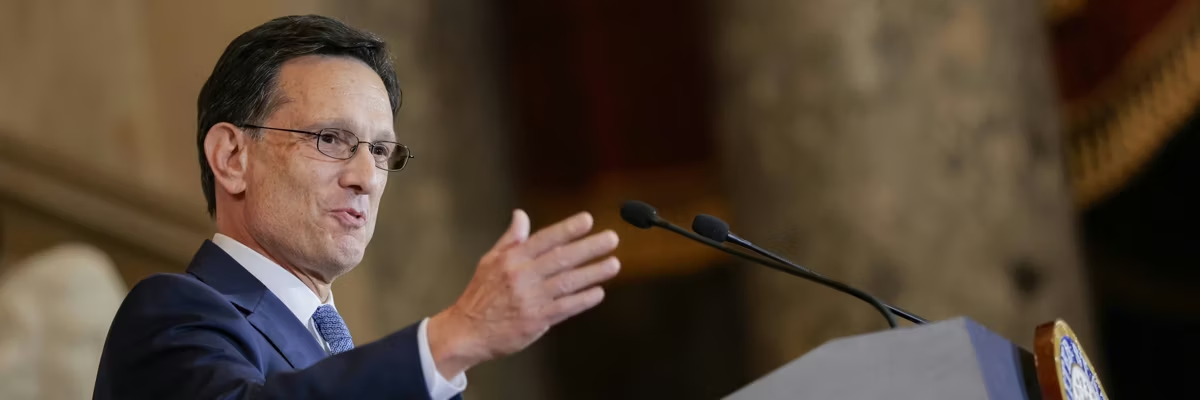
Former Rep. Eric Cantor speaks during a portrait unveiling ceremony in the U.S. Capitol on September 15, 2026 in Washington, DC.
(Photo by Heather Diehl/Getty Images)
Stephen Prager
Sep 29, 2026
COMMON DREAMS
In what advocates for lower drug prices call “a match made in hell,” one of the pharmaceutical industry’s most powerful lobbying groups is tapping a former Republican leader in the US House of Representatives to head its political operations.
Pharmaceutical Research and Manufacturers of America (PhRMA) named former Rep. Eric Cantor (R-Va.) as its president and CEO on Tuesday amid what is shaping up to be a major fight over the government’s ability to regulate prescription drug prices.
Cantor served in Congress from 2001-14 and was named House majority leader in 2011. He resigned in 2014 after losing his Republican primary in a stunning upset to the Tea Party-backed former Rep. Dave Brat.
According to recent polling from KFF, more than half of US adults say they worry about affording prescription drugs and nearly three-quarters say the government should do more to limit prices.
PhRMA emphasized that Cantor’s appointment to replace the outgoing CEO Stephen Ubl comes at “a pivotal moment for America’s biopharmaceutical industry.”
It is certainly spending like it. As Politico reported on Tuesday, pressure from voters to address the affordability of prescription drugs has been met with an unprecedented lobbying blitz by PhRMA, which poured a record $38 million into efforts to keep Capitol Hill in line.
PhRMA said Cantor’s “global business acumen coupled with policy and political experience at the highest levels of government make him an ideal person to lead PhRMA during this critical next chapter.”
Peter Maybarduk, the access to medicines director for the consumer watchdog group Public Citizen, agreed that Cantor was a perfect fit for PhRMA, but for very different reasons.
“Cantor, like PhRMA, is an experienced reverse Robin Hood, legislating money away from working families and toward giant corporations,” Maybarduk said.
During his tenure in Congress, Cantor received roughly $900,000 from the pharmaceutical and health product industry, putting him 19th among all House candidates between 1999 and 2018, according to a JAMA Internal Medicine study of data from the Center for Responsive Politics.
That spending paid dividends, with Cantor voting against legislation aimed at lowering prescription drugs—including one bill in 2003 that would have allowed Americans to import low-cost prescription drugs from abroad and another in 2007 that would have required the federal government to negotiate drug prices for Medicare recipients.
After 50 Years of Anti-Choice Hyde Amendment, Campaigners and Lawmakers Say ‘Enough Is Enough’
“Everyone, no matter who they are, where they live, how much money they make, or how they get their insurance, deserves access to abortion care without barriers.”
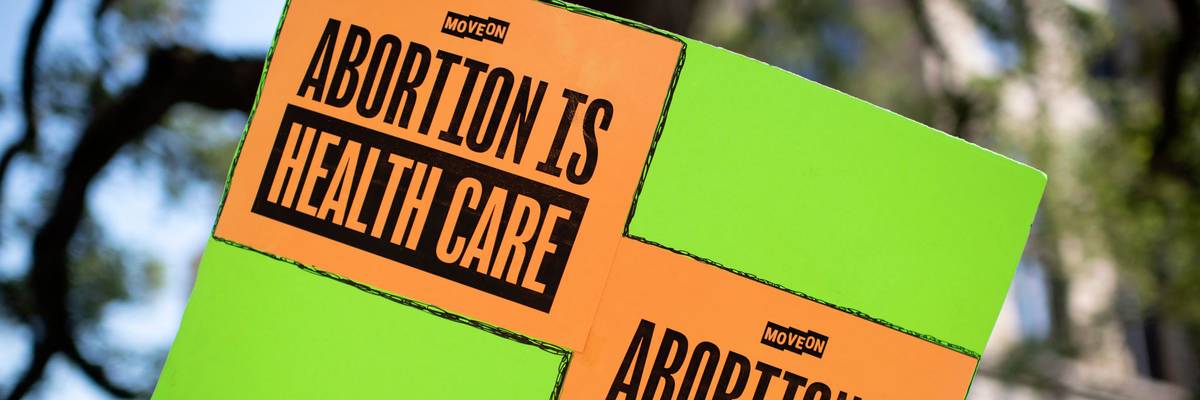
An abortion rights demonstrator holds a sign outside of the Harris County Courthouse during the Women’s Wave march in Houston, Texas, on October 8, 2022.
(Photo by Mark Felix/AFP/Getty Images)
Julia Conley
Sep 30, 2026
COMMON DREAMS
On Wednesday, reproductive rights groups marked half a century of abortion care being “baselessly set apart from all other healthcare,” with coverage for abortions blocked in government-funded healthcare plans like Medicaid, which about 16 million women of reproductive age rely on.
“Our constituents have suffered the consequences,” said the Congressional Reproductive Freedom Caucus, chaired by Reps. Diana DeGette (D-Colo.) and Ayanna Pressley (D-Mass.).
For 50 years, the Hyde Amendment—proposed by the late Rep. Henry Hyde (D-Ill.), who expressed his wish to prevent “anybody having an abortion” and said blocking federal funds within the Medicaid program from being used for care was the best way to do so—has stopped hundreds of thousands of people from obtaining abortion care, and has been called by anti-abortion groups “one of the greatest achievements of the pro-life movement to date.”
The Reproductive Freedom Caucus denounced the budget rider that has been reeimplemented in appropriations bills every year since 1976 as “a dangerous, racist, and classist abortion ban. An abortion ban for the working class and people of color, who disproportionately receive health insurance through the federal government.”
The caucus noted that more than 200 House Democrats have supported efforts to repeal the amendment, and advocacy groups on Wednesday called on Congress to pass the Equal Access to Abortion Coverage in Health Insurance (EACH) Act, which would permanently repeal the Hyde Amendment.
“Without solutions like the EACH Act, the Hyde Amendment will continue to force people with low incomes to struggle for the care they need or carry a pregnancy against their will,” said the National Women’s Law Center (NWLC). “Everyone, no matter who they are, where they live, how much money they make, or how they get their insurance, deserves access to abortion care without barriers.”
In addition to low-income people who rely on Medicaid, said the National Network of Abortion Funds (NNAF), the Hyde Amendment blocks abortion care for Indigenous people who use the Indian Health Service, people in federal prisons, disabled people, military service members and their families, and federal employees, among others.
Twenty-nine states follow Hyde Amendment restrictions, which include “exceptions” for pregnancies resulting from rape or incest or cases in which a pregnant person’s life is at risk. Twenty-one states use state funds to cover abortion care, but nearly half of US women of reproductive age who use Medicaid live in states that either ban abortion care or bar them from getting abortions using the federally funded healthcare plan.
NNAF highlighted the network’s decades of work to counter the Hyde Amendment by ensuring people who need abortions can access funding, which abortion funds across the country obtain through grassroots donations as they also advocate to end the Hyde Amendment.
“By the 1990s—less than two decades after Hyde first passed—28 abortion funds had formed across the country. Twenty-two of those funds started the National Network of Abortion Funds (NNAF) in 1993,” said NNAF. “We joined together to build strategic power and end the Hyde Amendment. Today, our network has nearly 100 member abortion funds, and our fight against Hyde continues.”
“The fierce abortion funds in our network have raised money, arranged travel, connected folks to clinics, provided practical support, and fought restrictions in their states and communities,” the group added. “Despite endless challenges, their tireless work has built power for our collective goal: Make abortion accessible for all.”
Abortion funds have helped people obtain care across the country, but the NWLC emphasized that the Hyde Amendment has still left hundreds of thousands of women with no choice but to pay for abortions out of pocket—often pushing them to delay care while they gather funds or to carry a pregnancy to term when they don’t want to or can’t afford to become a parent.
“While abortion costs vary by location, facility, and stage of pregnancy, the median out-of-pocket costs in 2023 were $563 for medication abortion, $650 for first-trimester procedural abortion, and $1,000 for second-trimester abortion care,” said NWLC. “Those costs account for just the procedure itself, not additional expenses. And yet, nearly half of American families cannot afford the true cost of living... So, when the Hyde Amendment denies someone abortion care, the compounding costs can push people further into a struggle to survive and meet basic needs.”
Dr. Jamila Perritt, president and CEO of Physicians for Reproductive Health, remembered Rosie Jimenez, a 27-year-old mother and aspiring teacher who died in 1977, almost exactly a year after the Hyde Amendment was passed, after being denied Medicaid coverage for an abortion.
“Hyde has harmed generations of people seeking abortion care,” said Perritt. “Women like Rosie Jimenez, the first known person to die because of Hyde Amendment restrictions, should still be here. No one, no matter what insurance they have access to or who they are, should be denied abortion care, full stop.”
Stateline reported Tuesday that with weeks to go until the midterm elections and President Donald Trump’s approval rating plummeting to record lows, anti-abortion groups are increasingly concerned that a Democratic majority could repeal the amendment, which it came close to doing in 2022.
“If there becomes a pro-abortion majority in Congress, then Hyde is going to be one of the first things to go, probably, especially because it’s been in the spotlight more recently,” Gavin Oxley, spokesperson for Americans United for Life, told Stateline. Particularly since Trump told Republicans to be “a little flexible” on the Hyde Amendment when the party was pushing to end subsidies under the Affordable Care Act, Oxley said “there are some Republicans who may not be as committed to protecting Hyde.”
Perritt expressed hope that Congress could pass the EACH Act, which now “has the highest amount of support... ever seen with over 200 co-sponsors.”
“As a DC-based OB-GYN and abortion provider, I see patients burdened with the cost of abortion care, forcing them to choose between basic living needs and lifesaving healthcare,” she said. “The Hyde Amendment is a zero-sum constraint that is not about patients’ health and autonomy, but instead about punishing people for making informed decisions about their bodies, families, and futures. Enough is enough.”
“We do not need another Hyde Amendment anniversary,” said Perritt. “We need to repeal the Hyde Amendment for good.”
UN Experts Demand End to Trump’s Third-Country Deportations
Countries the US has entered into deals with “lack the capacity to protect the rights of migrants sent there by wealthy nations seeking to shirk their international obligations.”

Shackled people board a deportation flight at the Minneapolis-Saint Paul International Airport in Saint Paul, Minnesota, on February 5, 2026.
(Photo by Charly Triballeau/AFP via Getty Images)
Julia Conley
Sep 29, 2026
COMMON DREAMS
Two dozen United Nations human rights experts on Monday demanded that the Trump administration end its deportation of immigrants, including refugees and asylum-seekers, to countries to which they have no connection—a practice that has set off “a cascade of human rights violations,” according to the experts.
Advisers to the UN Human Rights Council sent a communication to the US and the 35 countries President Donald Trump has struck deportation deals with—agreements that the White House has spent at least $40 million on, according to a congressional report released earlier this year.
“These migrants are being transferred to countries or territories with which they have no ties, which can be a traumatizing and isolating experience that compounds harms already suffered, which triggered their fleeing to the US in the first place,” said the experts. “Others are sent to places where they risk further violence or discrimination based on gender, sexual orientation, gender identity, or human rights advocacy.”
Critics have warned that the arrangements appear to be aimed at circumventing US laws that prohibit Trump from refoulement—sending people back to the countries they fled when they sought asylum in the US. Some of the countries Trump has struck deals with have ultimately sent asylum-seekers back to their home countries, according to The Guardian.
Deported people have also faced violence and the threat of torture in the third countries they’ve been sent to. As Common Dreams reported last week, Ahmed Soliman, an Egyptian national, and Samson Birhane, who is from Eritrea, were being detained in “an overcrowded police cell, in inhumane conditions” in Malabo, Equatorial Guinea—one of several countries Trump has struck deals with despite its record of human rights abuses.
Amnesty International warned the two men are at risk of being tortured.
The countries Trump is sending people to, said the 24 experts on Monday, “lack the capacity to protect the rights of migrants sent there by wealthy nations seeking to shirk their international obligations.”
“The harms caused by this US government scheme are no longer hypothetical,” they said. “For migrants in situations of particular vulnerability, the consequences can be deadly.”
About 20,000 people have been taken by bus to Mexico, while more than 5,000 have been flown to countries across Africa, Latin America, the Caribbean, and Asia. About a third of the deals have been struck with African nations.
“The harms caused by this US government scheme are no longer hypothetical. For migrants in situations of particular vulnerability, the consequences can be deadly.”
The UN experts released their statement days after the First Circuit Court of Appeals ruled that the administration must give migrants “a meaningful opportunity” to appeal the government’s plan to send them to a country they have never lived in.
Last Thursday, Solicitor General D. John Sauer filed an emergency application with the US Supreme Court, seeking authorization to continue the third-country deportations as they have been carried out, with “assurances” from governments that people sent by the US will not face persecution or torture. Sauer claimed the removals are “an essential tool to remove certain aliens, including some of the worst criminal aliens,” but numerous people sent to third countries have had no criminal records.
Also last week, Sen. Tim Kaine filed several privileged resolutions to compel the Trump administration to release assessments of countries with which it has made deportation deals.
“Through third-country deportations, the Trump administration is stripping people of due process, disappearing them, and sending them to countries all over the world where they risk further harm,” said Amnesty International USA on Monday. “The US government must end this cruel practice.”
Supreme Court OKs Third-Country Deportations—For Now—Despite ‘Cascade of Human Rights Violations’
“The harms caused by this US government scheme are no longer hypothetical,” UN experts stressed. “For migrants in situations of particular vulnerability, the consequences can be deadly.”

People take part in an April 9, 2025 protest in Caracas, Venezuela against the deportation of alleged Venezuelan criminals from the United States to a high-security prison in El Salvador.
(Photo by Jesus Vargas/picture alliance via Getty Images)
Brett Wilkins
Sep 29, 2026
COMMON DREAMS
The US Supreme Court on Tuesday temporarily cleared the way for the Trump administration to resume rapidly deporting immigrants to countries other than their own, even as United Nations experts warned that the policy is putting deportees at heightened risk of human rights violations.
In a one-page order, the justices—who did not rule on the legality of the policy—stayed a lower court ruling that required the administration to give people facing a so-called third-country deportation notice wan opportunity to raise concerns that they could face persecution or torture in the destination country. The court agreed to hear the administration’s appeal, with oral arguments scheduled for December.
The high court said it will consider whether the US District Court for the District of Massachusetts has jurisdiction over the case, whether it had authority to issue classwide relief, and whether the Trump administration’s policy violates federal immigration law, the Constitution’s due process clause, the Foreign Affairs Reform and Restructuring Act, or the Convention Against Torture.
The court’s three liberal justices—Sonia Sotomayor, Elena Kagan, and Ketanji Brown Jackson—said they would have rejected the administration’s request to lift the lower-court order.
US Attorney General Todd Blanch responded to the order on social media, posting, “Now for the second time, SCOTUS just granted our stay in conducting all third-country removals of illegal aliens.”
“Again, this is entirely lawful and a critical tool for immigration enforcement,” he added. “Unlike the lower court, SCOTUS waited to hear from both sides before making the decision.”
Tuesday’s ruling came one day after two dozen United Nations human rights experts urged the United States and 35 countries that have entered deportation agreements with the Trump administration to halt the practice, which is “triggering [a] cascade of human rights violations including torture.”
“These migrants are being transferred to countries or territories with which they have no ties, which can be a traumatizing and isolating experience that compounds harms already suffered,” the experts said, warning that they face “further violence or discrimination based on gender, sexual orientation, gender identity, or human rights advocacy.”
“The harms caused by this US government scheme are no longer hypothetical,” the experts stressed. “For migrants in situations of particular vulnerability, the consequences can be deadly.”
The UN experts’ warning followed an urgent appeal issued earlier this month by Amnesty International that two men deported to Equatorial Guinea under a secret deal—one of them Egyptian and the other Eritrean—were at risk of being tortured in detention in the African nation, which has an abysmal human rights record. Amnesty said that the men had already been beaten and violently arrested by police after arriving in the country.
The Trump administration has deported roughly 25,000 people to more than two dozen countries under often secret agreements and at a cost to taxpayers of tens of millions of dollars. Most have been sent to Mexico, while others have been transported to countries including Liberia, Guyana, and Equatorial Guinea.
The Supreme Court has already intervened in a related case involving eight men whom the administration sought to deport to war-torn South Sudan, although only one was originally from that country. In that case, Sotomayor warned that the policy exposed “thousands to the risk of torture or death.”
The justices’ latest order will remain in effect until the court issues its judgment in the case. Until then, the administration can resume the expedited removals that the lower court had sought to restrict.
Housing Protests Across Spain Win Concessions After Eviction of 87-Year-Old Sparks UprisingThe Cabinet of Prime Minister Pedro Sánchez approved two decrees aimed at protecting tenants, but Spain’s leftist social rights minister called the two-part strategy a “trap.”

Hundreds of people halt an eviction on Calle Navas de Tolosa in Madrid, Spain on September 29, 2026.
(Photo By Victor Fernandez/Europa Press via Getty Images)
Brett Wilkins
Sep 29, 2026
COMMON DREAMS
Spain’s Cabinet on Tuesday agreed to take other measures meant to address a growing housing crisis amid nationwide protests triggered by an 87-year-old woman’s temporary eviction—but some leftists warned that splitting the proposed reforms into two parts was an intentional ruse designed for one key demand to be rejected by lawmakers.
María del Carmen Abascal Martín‘s eviction on September 23 sparked demonstrations in Madrid and cities across Spain, including Barcelona, Sevilla, Málaga, Santiago, Murcia, Palma, and Zamora. On Saturday, around 30,000 people marched in Madrid, while hundreds of tents subsequently sprang up in the Puerta del Sol, where protesters have been camping out for days, demanding major reforms to Spain’s housing system. On Tuesday, protesters in Madrid also successfully stopped a planned eviction on Calle Navas de Tolosa, with the expulsion postponed until October 14.
Prime Minister Pedro Sánchez’s Spanish Socialist Workers’ Party (PSOE)-led Cabinet announced two decrees on Tuesday, which must now be approved by lawmakers if they are to take effect. One of the measures would guarantee protections against evictions of economically or socially vulnerable tenants through 2030, extend certain existing rental contracts until the end of 2028, regulate short-term and room rentals, and bar so-called vulture funds from purchasing homes until 2028.
The second decree seeks automatic renewal of rental contracts—a key demand of tenant organizers—although that measure faces a more uncertain path to parliamentary passage.
Abascal’s eviction had quickly become a symbol of a housing crisis driven by rising costs and a supply shortage that has priced many people out of the market in Europe’s fourth-largest economy. The 87-year-old, who had lived in her Retiro apartment since 1956, was evicted after the property was acquired by the real estate firm Urbagestión, which reportedly jacked up her monthly rent from roughly €500 to €1,650.
Images of Abascal being removed from her home on a stretcher by police sparked global outrage and demands for Spain’s socialist-led government to halt her eviction and protect vulnerable tenants from forced displacement.
Under an agreement reached with Urbagestión, Abascal will return after leaving the hospital under an eight-year lease, paying no more than 30% of her income—approximately €500 a month. The agreement was reached after more than four hours of negotiations involving her family, lawyer, the Madrid municipal housing agency, and the Madrid Tenants Union.
Activists attributed both Abascal’s return home and the government’s concessions to the power of mass mobilized people.
“Seeing that this has an outcome gives us hope,” one protester, Laura, told Spanish public broadcaster RTVE. Another demonstrator, Gracia, declared, “Every night here is a victory.”
Simón, a protester who spent the night at the encampment, told EFE: “We’re not camping out just for the sake of camping. We’re making a demand. It’s great that Maricarmen is getting her apartment back, but more measures are needed.”
Fina Parra, a spokesperson for the Madrid Tenants Union, called Abascal’s eviction “the straw that broke the camel’s back because it touched all of our hearts.”
Parra stressed that the protesters’ objective is not “a half-measure law,” but legislation that “actually stops the bleeding of evictions.”
Sara Barros, a protester interviewed by Democracy Now!, said, “What we are demanding is that the rental market be regulated, because rents are unaffordable and people simply cannot afford them.”
Progressive politicians also welcomed the reversal of Abascal’s eviction—which Sánchez called a “social tragedy”—and looked forward to implementing reforms.
“The street got Maricarmen to stay,” said Gerardo Pisarello, the leftist first secretary of the Congress of Deputies, the lower chamber of Spain’s Parliament. “If we have already achieved one victory, we can achieve another.”
Some leftists are wary of the Sánchez government’s decision to split the housing package in a way that makes the most important tenant protection easier to defeat in Parliament.
Minister of Social Rights Ione Belarra of the Podemos party called the decision “a trap” whose “only objective” is to “whitewash the government and contain social mobilization.”
Belarra further contended that Sánchez’s strategy is “the opposite of what should be done when you really want to solve the housing problem.”
Ahead of High-Stakes Election, Analysis Details Economic Gains of Brazil Under Lula
“The past almost four years have seen Brazil accomplish a great deal in terms of bringing people out of poverty, creating jobs, curbing hunger, and raising standards of living.”

Brazilian President Luiz Inacio Lula da Silva, Bahia Gov. Jeronimo Rodrigues, Sen. Jaques Wagner, and Senate candidate Rui Costa attend a campaign event on August 28, 2026 in Salvador, Brazil.
(Photo by Joao Aurelio/NurPhoto via Getty Images)COMMON DREAMS
An analysis released Wednesday documents some of the major economic gains that Brazil has made over the past four years during the third term of President Luiz Inácio Lula da Silva, who is currently in a close battle for reelection against rival Flávio Bolsonaro.
The analysis, published by the US-based Center for Economic and Policy Research (CEPR), finds that, between 2022 and 2025, the Brazilian economy grew by a cumulative 8.9%, easily outpacing the average rate of growth in other South American countries.
This growth has been coupled with a drop in the unemployment rate, which has fallen from more than 9% in the second quarter of 2022 to just 5.4% in the second quarter of 2026.
Both poverty and food insecurity fell dramatically in the first two year’s of Lula’s term, the analysis finds, and in 2025, “Brazil was removed from the Food and Agriculture Organization’s Hunger Map after chronic undernourishment fell below 2.5%.”
CEPR’s report also gives credit to Lula’s policies for improved economic conditions, including a new minimum wage law, an expanded maternity leave program, and increased average payments to low-income families given through the Bolsa Família program.
The economy during Lula’s term is far from perfect, however, and the report flags high interest rates set by Brazil’s central bank as a key factor in raising consumers’ borrowing costs and increasing the rate of household delinquency.
CEPR also noted the negative impact of online betting apps, which Lula has pledged to ban starting next month, on Brazilian workers.
“Brazilian households lost an estimated R$62.5 billion (US$11.2 billion) to online betting in 2025,” the report says, “while some 802,000 Bolsa Família households spent more than 2% of their income on betting in January 2025.”
Jake Johnston, CEPR’s director of international research, said that “the past almost four years have seen Brazil accomplish a great deal in terms of bringing people out of poverty, creating jobs, curbing hunger, and raising standards of living.”
“This was done,” Johnston added, “despite the lingering impact of the Covid pandemic, external economic shocks that affected the global economy, and excessively high interest rates.”
The first round of Brazil’s presidential election is set to take place on Sunday, and recent polls show Lula with a narrow lead over Bolsonaro, son of former Brazilian President Jair Bolsonaro, who is still serving a criminal sentence for efforts to instigate a coup after his loss in the 2022 election.

.JPG)


