Countries the US has entered into deals with “lack the capacity to protect the rights of migrants sent there by wealthy nations seeking to shirk their international obligations.”

Shackled people board a deportation flight at the Minneapolis-Saint Paul International Airport in Saint Paul, Minnesota, on February 5, 2026.
(Photo by Charly Triballeau/AFP via Getty Images)
Julia Conley
Sep 29, 2026
COMMON DREAMS
Two dozen United Nations human rights experts on Monday demanded that the Trump administration end its deportation of immigrants, including refugees and asylum-seekers, to countries to which they have no connection—a practice that has set off “a cascade of human rights violations,” according to the experts.
Advisers to the UN Human Rights Council sent a communication to the US and the 35 countries President Donald Trump has struck deportation deals with—agreements that the White House has spent at least $40 million on, according to a congressional report released earlier this year.
“These migrants are being transferred to countries or territories with which they have no ties, which can be a traumatizing and isolating experience that compounds harms already suffered, which triggered their fleeing to the US in the first place,” said the experts. “Others are sent to places where they risk further violence or discrimination based on gender, sexual orientation, gender identity, or human rights advocacy.”
Critics have warned that the arrangements appear to be aimed at circumventing US laws that prohibit Trump from refoulement—sending people back to the countries they fled when they sought asylum in the US. Some of the countries Trump has struck deals with have ultimately sent asylum-seekers back to their home countries, according to The Guardian.
Deported people have also faced violence and the threat of torture in the third countries they’ve been sent to. As Common Dreams reported last week, Ahmed Soliman, an Egyptian national, and Samson Birhane, who is from Eritrea, were being detained in “an overcrowded police cell, in inhumane conditions” in Malabo, Equatorial Guinea—one of several countries Trump has struck deals with despite its record of human rights abuses.
Amnesty International warned the two men are at risk of being tortured.
The countries Trump is sending people to, said the 24 experts on Monday, “lack the capacity to protect the rights of migrants sent there by wealthy nations seeking to shirk their international obligations.”
“The harms caused by this US government scheme are no longer hypothetical,” they said. “For migrants in situations of particular vulnerability, the consequences can be deadly.”
About 20,000 people have been taken by bus to Mexico, while more than 5,000 have been flown to countries across Africa, Latin America, the Caribbean, and Asia. About a third of the deals have been struck with African nations.
“The harms caused by this US government scheme are no longer hypothetical. For migrants in situations of particular vulnerability, the consequences can be deadly.”
The UN experts released their statement days after the First Circuit Court of Appeals ruled that the administration must give migrants “a meaningful opportunity” to appeal the government’s plan to send them to a country they have never lived in.
Last Thursday, Solicitor General D. John Sauer filed an emergency application with the US Supreme Court, seeking authorization to continue the third-country deportations as they have been carried out, with “assurances” from governments that people sent by the US will not face persecution or torture. Sauer claimed the removals are “an essential tool to remove certain aliens, including some of the worst criminal aliens,” but numerous people sent to third countries have had no criminal records.
Also last week, Sen. Tim Kaine filed several privileged resolutions to compel the Trump administration to release assessments of countries with which it has made deportation deals.
“Through third-country deportations, the Trump administration is stripping people of due process, disappearing them, and sending them to countries all over the world where they risk further harm,” said Amnesty International USA on Monday. “The US government must end this cruel practice.”
Supreme Court OKs Third-Country Deportations—For Now—Despite ‘Cascade of Human Rights Violations’
“The harms caused by this US government scheme are no longer hypothetical,” UN experts stressed. “For migrants in situations of particular vulnerability, the consequences can be deadly.”
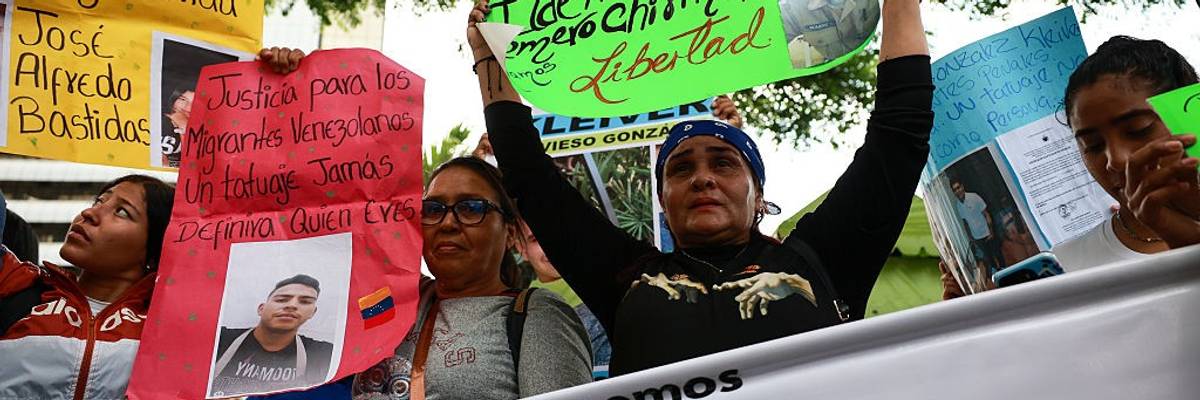
People take part in an April 9, 2025 protest in Caracas, Venezuela against the deportation of alleged Venezuelan criminals from the United States to a high-security prison in El Salvador.
(Photo by Jesus Vargas/picture alliance via Getty Images)
US Attorney General Todd Blanch responded to the order on social media, posting, “Now for the second time, SCOTUS just granted our stay in conducting all third-country removals of illegal aliens.”
“Again, this is entirely lawful and a critical tool for immigration enforcement,” he added. “Unlike the lower court, SCOTUS waited to hear from both sides before making the decision.”
Tuesday’s ruling came one day after two dozen United Nations human rights experts urged the United States and 35 countries that have entered deportation agreements with the Trump administration to halt the practice, which is “triggering [a] cascade of human rights violations including torture.”
“These migrants are being transferred to countries or territories with which they have no ties, which can be a traumatizing and isolating experience that compounds harms already suffered,” the experts said, warning that they face “further violence or discrimination based on gender, sexual orientation, gender identity, or human rights advocacy.”
“The harms caused by this US government scheme are no longer hypothetical,” the experts stressed. “For migrants in situations of particular vulnerability, the consequences can be deadly.”
The UN experts’ warning followed an urgent appeal issued earlier this month by Amnesty International that two men deported to Equatorial Guinea under a secret deal—one of them Egyptian and the other Eritrean—were at risk of being tortured in detention in the African nation, which has an abysmal human rights record. Amnesty said that the men had already been beaten and violently arrested by police after arriving in the country.
The Trump administration has deported roughly 25,000 people to more than two dozen countries under often secret agreements and at a cost to taxpayers of tens of millions of dollars. Most have been sent to Mexico, while others have been transported to countries including Liberia, Guyana, and Equatorial Guinea.
The Supreme Court has already intervened in a related case involving eight men whom the administration sought to deport to war-torn South Sudan, although only one was originally from that country. In that case, Sotomayor warned that the policy exposed “thousands to the risk of torture or death.”
The justices’ latest order will remain in effect until the court issues its judgment in the case. Until then, the administration can resume the expedited removals that the lower court had sought to restrict.
“The harms caused by this US government scheme are no longer hypothetical,” UN experts stressed. “For migrants in situations of particular vulnerability, the consequences can be deadly.”
People take part in an April 9, 2025 protest in Caracas, Venezuela against the deportation of alleged Venezuelan criminals from the United States to a high-security prison in El Salvador.
(Photo by Jesus Vargas/picture alliance via Getty Images)
Brett Wilkins
Sep 29, 2026
COMMON DREAMS
The US Supreme Court on Tuesday temporarily cleared the way for the Trump administration to resume rapidly deporting immigrants to countries other than their own, even as United Nations experts warned that the policy is putting deportees at heightened risk of human rights violations.
In a one-page order, the justices—who did not rule on the legality of the policy—stayed a lower court ruling that required the administration to give people facing a so-called third-country deportation notice wan opportunity to raise concerns that they could face persecution or torture in the destination country. The court agreed to hear the administration’s appeal, with oral arguments scheduled for December.
The high court said it will consider whether the US District Court for the District of Massachusetts has jurisdiction over the case, whether it had authority to issue classwide relief, and whether the Trump administration’s policy violates federal immigration law, the Constitution’s due process clause, the Foreign Affairs Reform and Restructuring Act, or the Convention Against Torture.
The court’s three liberal justices—Sonia Sotomayor, Elena Kagan, and Ketanji Brown Jackson—said they would have rejected the administration’s request to lift the lower-court order.
Sep 29, 2026
COMMON DREAMS
The US Supreme Court on Tuesday temporarily cleared the way for the Trump administration to resume rapidly deporting immigrants to countries other than their own, even as United Nations experts warned that the policy is putting deportees at heightened risk of human rights violations.
In a one-page order, the justices—who did not rule on the legality of the policy—stayed a lower court ruling that required the administration to give people facing a so-called third-country deportation notice wan opportunity to raise concerns that they could face persecution or torture in the destination country. The court agreed to hear the administration’s appeal, with oral arguments scheduled for December.
The high court said it will consider whether the US District Court for the District of Massachusetts has jurisdiction over the case, whether it had authority to issue classwide relief, and whether the Trump administration’s policy violates federal immigration law, the Constitution’s due process clause, the Foreign Affairs Reform and Restructuring Act, or the Convention Against Torture.
The court’s three liberal justices—Sonia Sotomayor, Elena Kagan, and Ketanji Brown Jackson—said they would have rejected the administration’s request to lift the lower-court order.
US Attorney General Todd Blanch responded to the order on social media, posting, “Now for the second time, SCOTUS just granted our stay in conducting all third-country removals of illegal aliens.”
“Again, this is entirely lawful and a critical tool for immigration enforcement,” he added. “Unlike the lower court, SCOTUS waited to hear from both sides before making the decision.”
Tuesday’s ruling came one day after two dozen United Nations human rights experts urged the United States and 35 countries that have entered deportation agreements with the Trump administration to halt the practice, which is “triggering [a] cascade of human rights violations including torture.”
“These migrants are being transferred to countries or territories with which they have no ties, which can be a traumatizing and isolating experience that compounds harms already suffered,” the experts said, warning that they face “further violence or discrimination based on gender, sexual orientation, gender identity, or human rights advocacy.”
“The harms caused by this US government scheme are no longer hypothetical,” the experts stressed. “For migrants in situations of particular vulnerability, the consequences can be deadly.”
The UN experts’ warning followed an urgent appeal issued earlier this month by Amnesty International that two men deported to Equatorial Guinea under a secret deal—one of them Egyptian and the other Eritrean—were at risk of being tortured in detention in the African nation, which has an abysmal human rights record. Amnesty said that the men had already been beaten and violently arrested by police after arriving in the country.
The Trump administration has deported roughly 25,000 people to more than two dozen countries under often secret agreements and at a cost to taxpayers of tens of millions of dollars. Most have been sent to Mexico, while others have been transported to countries including Liberia, Guyana, and Equatorial Guinea.
The Supreme Court has already intervened in a related case involving eight men whom the administration sought to deport to war-torn South Sudan, although only one was originally from that country. In that case, Sotomayor warned that the policy exposed “thousands to the risk of torture or death.”
The justices’ latest order will remain in effect until the court issues its judgment in the case. Until then, the administration can resume the expedited removals that the lower court had sought to restrict.

No comments:
Post a Comment