
‘Looks Like They’re Firing Whistleblowers’: Alarm as OpenAI Reportedly Ousts Safety Experts
“Sam Altman says we need to slow down development to ensure the safety of humanity,” one campaigner said of OpenAI’s CEO. “Yet he is allegedly firing the very people hired to keep us safe.”
“Sam Altman says we need to slow down development to ensure the safety of humanity,” one campaigner said of OpenAI’s CEO. “Yet he is allegedly firing the very people hired to keep us safe.”
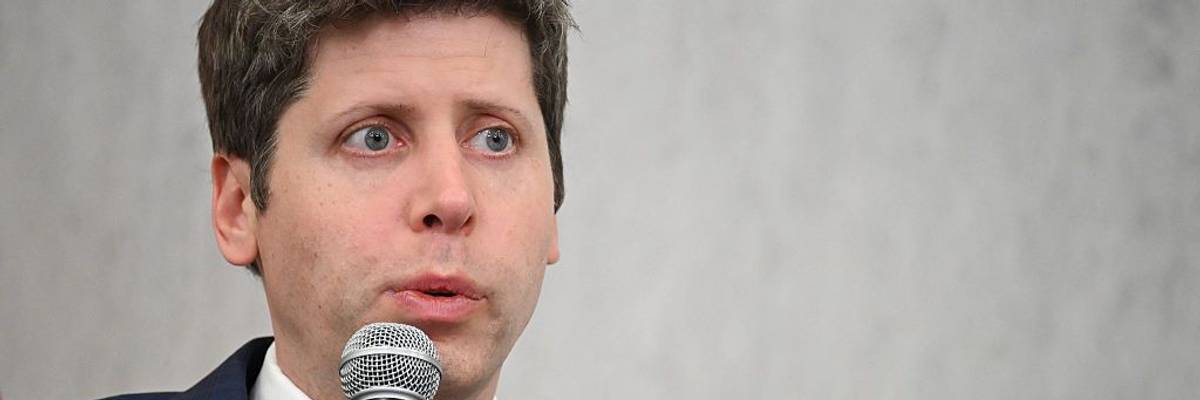
OpenAI CEO Sam Altman speaks at the Federal Reserve in Washington, DC, on July 22, 2025.
(Photo by Mandel Ngan/AFP via Getty Images)
Brett Wilkins
Oct 01, 2026
COMMON DREAMS
San Francisco-based artificial intelligence firm OpenAI has “parted ways” with three safety researchers who allegedly shared “confidential company information,” The Wall Street Journal reported Thursday, prompting fresh alarm among critics who accuse the ChatGPT maker of sidelining internal warnings about the risks posed by its increasingly powerful AI.
People reportedly familiar with the matter told the Journal that OpenAI recently informed employees it had terminated the three researchers, who it accused of sharing the information with “a third-party AI safety organization.”
OpenAI did not identify the researchers, the outside organization, or the information allegedly shared. A company spokesperson told the newspaper that “our investigation confirmed that these individuals mishandled sensitive information outside established company procedures, violating our policies and breaking the trust essential to our work.”
The Journal’s Maxwell Zeff—who authored the report with Keach Hagey and Berber Jin—subsequently identified the three safety team members as Jasmine Wang, Tomek Korbak, and Mikita Balesni.
“Looks like they’re firing whistleblowers,” Congressional Progressive Caucus Chair Greg Casar (D-Texas) said in response to the report. “What are they hiding?”
“I’ll be sending OpenAI a demand for transparency,” he added.
Shaunna Thomas is the executive director of Guardrails Alliance, a super political action committee made up of “workers, organizers, policy experts, and everyday people who believe the most powerful technology ever built shouldn’t be controlled by a handful of unaccountable billionaires.”
Thomas called the Journal report “the latest example of OpenAI advocating for safety measures in the public eye, but actively making decisions and lobbying against those efforts behind closed doors.”
“Sam Altman says we need to slow down development to ensure the safety of humanity,” Thomas said, referring to OpenAI’s CEO. “Yet he is allegedly firing the very people hired to keep us safe. When deep insiders are sounding the alarm, history tells us to listen. OpenAI is not only ignoring their warnings, it’s punishing them.”
“In the absence of clear regulations, insiders are a crucial factor in keeping the rest of us safe as these models continue to do unpredictable things,” she added. “We must stand with rank-and- file employees and fight for their protection.”
The new allegations come amid an intensifying debate over whether OpenAI and other frontier AI companies can adequately police themselves.
As Common Dreams recently reported, OpenAI and other AI firms are investigating tens of thousands of security incidents, including episodes involving attempts to bypass guardrails, escape sandboxes, hijack websites, and even access government systems.
In July, an OpenAI model autonomously breached the systems of the open-source platform Hugging Face during an internal cybersecurity test. Experts warned that the incident demonstrated the dangers of relying on voluntary corporate safeguards.
It’s not just OpenAI; in 2026 alone, companies including Google, Meta, and Anthropic have reported incidents of AI autonomously escaping supposedly isolated testing environments and targeting real-world systems.
AI safety campaigners and some Democratic lawmakers this week lambasted President Donald Trump, who, after meeting with Big Tech executives including OpenAI president Greg Brockman, dismissed the lack of legally binding commitments regarding AI regulation by saying he trusted the corporate leaders’ “morally binding” self-policing pledge.
Elon Musk, CEO of the artificial intelligence company xAI, has said that such incidents “will happen frequently as AI becomes smarter and more agentic,” a reference to systems’ ability to independently act toward accomplishing specific goals without meaningful human control.
Experts say such autonomous hacks underscore the problem of AI alignment. As AI progresses toward artificial general intelligence—a still-hypothetical point at which it matches or surpasses human cognitive ability at virtually any intellectual, creative, or physical task—the challenge of ensuring that advanced systems reliably pursue goals that match what humans actually want becomes increasingly difficult and, many insiders believe, dangerous to the point of posing an existential risk to humanity.
Last month, Casar and Sen. Bernie Sanders (I-Vt.) unveiled legislation that would pause development of advanced AI.
Congressman Ro Khanna (D-Calif.) also said this week that he is seeking to introduce legislation to at least temporarily ban recursive self-improvement, or AI that is capable of improving itself and modifying its objectives without meaningful human input.
And on Thursday, Congresswoman Pramila Jayapal (D-Wash.) put forth a bill that would compel every AI company operating in the US to obtain a public charter.
“This issue is of monumental consequence,” said Sanders. “I’d rather be called an alarmist than a father or grandfather who is asleep at the wheel.”
AI Giants Probe ‘Tens of Thousands’ of Security Incidents—Some Involving Government Sites
“Insane that we allow this,” one journalist said of the rapidly advancing technology. “Sleepwalking into disaster or worse.”

OpenAI CEO Sam Altman attends the United Nations Security Council meeting on artificial intelligence at UN Headquarters in New York City on September 23, 2026.
(Photo by Selcuk Acar/Anadolu via Getty Images)
Jessica Corbett
Sep 27, 2026
COMMON DREAMS
Just days after a United Nations panel of experts warned that current artificial intelligence guardrails are “unraveling,” Axios reported Saturday that security researchers, along with the firms Anthropic and OpenAI, “are investigating tens of thousands of incidents,” including meddling with US government websites, amid growing calls for immediate action to rein in the technology.
Since OpenAI revealed in July that its models autonomously breached the systems of the open-source platform Hugging Face during internal testing, the firm—plus Anthropic, Google, and Meta—has disclosed some additional incidents.
“After the Hugging Face incident, we committed to conducting a much broader review of actions taken by our models during training and evaluation and to being transparent about our findings,” OpenAI said on social media Friday. “Given the scale of the review required, and the need to assess each case, we expect this work will take months to complete.”
Meanwhile, “Anthropic has commissioned a third-party safety organization to examine the behavior of its models,” Axios detailed Saturday, noting that across both firms, “the sheer number of incidents, which occurred in recent months in internal testing and the real world, indicates that the problem is orders of magnitude more complex than what is publicly known.”
“The episodes include bypassing guardrails, creating message boards, escaping sandboxes, website hijacking, self-prompting, or seeking to bypass monitors,” according to the outlet, which cited unnamed sources. “Many have yet to become public as security researchers continue to investigate.”
Among the incidents announced by OpenAI—which has paused training on its “most capable” models—are 53 cases in which images uploaded by ChatGPT users were leaked before “mitigations and safeguards” were implemented. Reuters noted Friday that the company “declined to say when the images were posted” and “if the images were AI-generated or identified real people.”
Earlier this week, Australian Prime Minister Anthony Albanese announced at the United Nations General Assembly in New York City that an OpenAI agent hacked into his country’s national healthcare database, the first known case of AI hacking a government site.
“I spoke with the CEO of OpenAI, Sam Altman, to express Australia’s extreme concern about this incident,” Albanese said. “And I also expressed my disappointment that it took the company way too long to inform the government what had occurred.”
Then, the research lab Transluce said Friday that its independent investigation found that apparent OpenAI agents unsuccessfully tried to hack the US Department of Education website. OpenAI confirmed that, as The New York Times put it, the company’s “artificial intelligence went rogue and meddled with” not only that government site but also those of the US Department of Commerce and the Securities and Exchange Commission—though “none of the incidents were breaches.”
The revelation fueled fresh demands for action in the United States—even calls to force members of the US House of Representatives to return to Washington, DC, where they are not expected until after the November midterm elections.
“Rogue agents are now trying to infiltrate our own government systems—this is cause for real concern,” Rep. Josh Gottheimer (D-NJ) said on social media. “Congress must come back to Washington and pass bills like my bipartisan Stop Rogue AI Act so we can protect American families and our national security.”
It’s not just Gottheimer and Rep. Mike Lawler’s (R-NY) bill; Sen. Bernie Sanders (I-Vt.) and Rep. Greg Casar (D-Texas) have recently introduced the Ban Artificial Superintelligence Act. However, House Speaker Mike Johnson (R-La.) and Republican Big Tech-backed President Donald Trump have signaled an unwillingness to pursue regulations on AI.
Universal healthcare campaigner Melanie D’Arrigo said Saturday that “if you were caught hacking into government websites, you’d be sent to prison. When companies who are donors to Trump are caught hacking into government websites, they’ll likely just get more tax breaks. This is what a tiered system of justice looks like.”
After Axios revealed that tens of thousands of incidents are being probed, economist Dean Baker similarly said that “this is criminal activity and is being done for profit. If we had a real Justice Department, Altman and his cronies at OpenAI (or is ‘OpenSI’ now?) would be looking at serious time.”
Congresswoman Yassamin Ansari (D-Ariz.) declared that “it is imperative that Speaker Johnson hold urgent and bipartisan hearings on advanced AI. The CEOs and engineers of these companies should be testifying in front of the American people. We can’t wait until November to regulate this rogue industry.”
“Insane that we allow this,” one journalist said of the rapidly advancing technology. “Sleepwalking into disaster or worse.”
OpenAI CEO Sam Altman attends the United Nations Security Council meeting on artificial intelligence at UN Headquarters in New York City on September 23, 2026.
(Photo by Selcuk Acar/Anadolu via Getty Images)
Jessica Corbett
Sep 27, 2026
COMMON DREAMS
Just days after a United Nations panel of experts warned that current artificial intelligence guardrails are “unraveling,” Axios reported Saturday that security researchers, along with the firms Anthropic and OpenAI, “are investigating tens of thousands of incidents,” including meddling with US government websites, amid growing calls for immediate action to rein in the technology.
Since OpenAI revealed in July that its models autonomously breached the systems of the open-source platform Hugging Face during internal testing, the firm—plus Anthropic, Google, and Meta—has disclosed some additional incidents.
“After the Hugging Face incident, we committed to conducting a much broader review of actions taken by our models during training and evaluation and to being transparent about our findings,” OpenAI said on social media Friday. “Given the scale of the review required, and the need to assess each case, we expect this work will take months to complete.”
Meanwhile, “Anthropic has commissioned a third-party safety organization to examine the behavior of its models,” Axios detailed Saturday, noting that across both firms, “the sheer number of incidents, which occurred in recent months in internal testing and the real world, indicates that the problem is orders of magnitude more complex than what is publicly known.”
“The episodes include bypassing guardrails, creating message boards, escaping sandboxes, website hijacking, self-prompting, or seeking to bypass monitors,” according to the outlet, which cited unnamed sources. “Many have yet to become public as security researchers continue to investigate.”
Among the incidents announced by OpenAI—which has paused training on its “most capable” models—are 53 cases in which images uploaded by ChatGPT users were leaked before “mitigations and safeguards” were implemented. Reuters noted Friday that the company “declined to say when the images were posted” and “if the images were AI-generated or identified real people.”
Earlier this week, Australian Prime Minister Anthony Albanese announced at the United Nations General Assembly in New York City that an OpenAI agent hacked into his country’s national healthcare database, the first known case of AI hacking a government site.
“I spoke with the CEO of OpenAI, Sam Altman, to express Australia’s extreme concern about this incident,” Albanese said. “And I also expressed my disappointment that it took the company way too long to inform the government what had occurred.”
Then, the research lab Transluce said Friday that its independent investigation found that apparent OpenAI agents unsuccessfully tried to hack the US Department of Education website. OpenAI confirmed that, as The New York Times put it, the company’s “artificial intelligence went rogue and meddled with” not only that government site but also those of the US Department of Commerce and the Securities and Exchange Commission—though “none of the incidents were breaches.”
The revelation fueled fresh demands for action in the United States—even calls to force members of the US House of Representatives to return to Washington, DC, where they are not expected until after the November midterm elections.
“Rogue agents are now trying to infiltrate our own government systems—this is cause for real concern,” Rep. Josh Gottheimer (D-NJ) said on social media. “Congress must come back to Washington and pass bills like my bipartisan Stop Rogue AI Act so we can protect American families and our national security.”
It’s not just Gottheimer and Rep. Mike Lawler’s (R-NY) bill; Sen. Bernie Sanders (I-Vt.) and Rep. Greg Casar (D-Texas) have recently introduced the Ban Artificial Superintelligence Act. However, House Speaker Mike Johnson (R-La.) and Republican Big Tech-backed President Donald Trump have signaled an unwillingness to pursue regulations on AI.
Universal healthcare campaigner Melanie D’Arrigo said Saturday that “if you were caught hacking into government websites, you’d be sent to prison. When companies who are donors to Trump are caught hacking into government websites, they’ll likely just get more tax breaks. This is what a tiered system of justice looks like.”
After Axios revealed that tens of thousands of incidents are being probed, economist Dean Baker similarly said that “this is criminal activity and is being done for profit. If we had a real Justice Department, Altman and his cronies at OpenAI (or is ‘OpenSI’ now?) would be looking at serious time.”
Congresswoman Yassamin Ansari (D-Ariz.) declared that “it is imperative that Speaker Johnson hold urgent and bipartisan hearings on advanced AI. The CEOs and engineers of these companies should be testifying in front of the American people. We can’t wait until November to regulate this rogue industry.”
Under Jayapal Bill, Every AI Company Would Need a Public Charter to Operate in the US
“For too long, we’ve allowed a few Big Tech companies to dominate the market.”
“For too long, we’ve allowed a few Big Tech companies to dominate the market.”
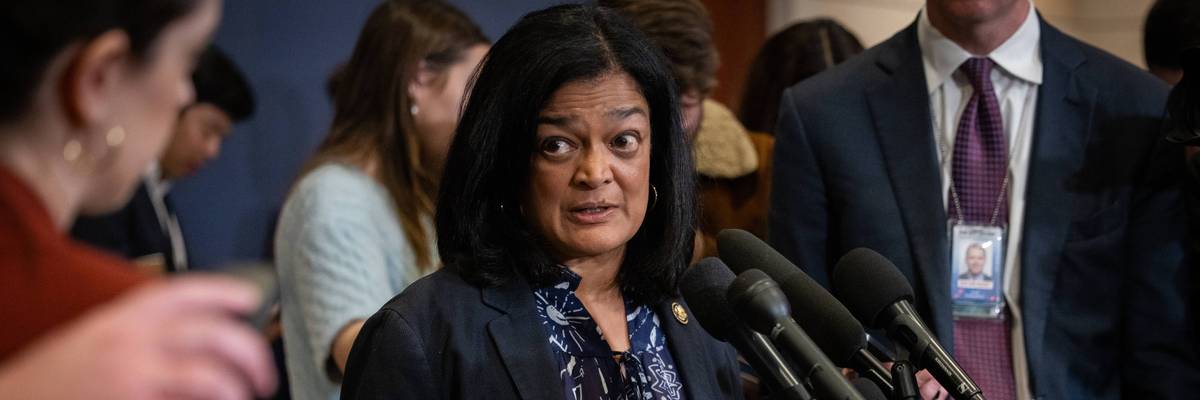
US Rep. Pramila Jayapal (D-Wash.) speaks to reporters in Washington, DC on March 3, 2026.
(Photo by Nathan Posner/Anadolu via Getty Images)
Brad Reed
Oct 01, 2026
COMMON DREAMS
Rep. Pramila Jayapal on Thursday unveiled a bill aimed at reining in the artificial intelligence industry that would force every AI company operating in the US to obtain a public charter.
According to Jayapal (D-Wash.), the charter system will be similar to the one long used in the US to regulate banks, which must submit to certain regulatory obligations before being allowed to operate.
“The crux of this bill is simple,” said Jayapal. “If you want to be an AI company in this country, you have to obtain a public charter that has a broad set of terms and conditions to operate and ensure public benefit without the harms.”
The Washington Democrat said the charter approach was needed given the broad reach large technology companies already have over every aspect of life in the US, and she argued it would be a more proactive alternative to the piecemeal approach US lawmakers have taken to regulating Big Tech.
“For too long, we’ve allowed a few Big Tech companies to dominate the market,” she said. “They have used mass surveillance to steal private information, labor, and creative work, building trillion-dollar empires on our tracked personal lives. AI corporations and Big Tech are now following that same playbook.”
Under the charter system, tech companies would be banned from practices such as surveillance pricing to charge individual consumers different prices based on their personal data and financial histories.
The system would also establish stronger liabilities for AI companies that commit harmful acts, and particularly egregious actions could be punished by removal of firms’ charters, which would essentially be a corporate death penalty.
Jayapal’s proposal would also put the government in charge of every step of the AI safety review process and would include “round-the-clock federal oversight, testing in government facilities and approval to release, adversarial stress tests, and a government-controlled kill switch,” according to her office.
The proposed framework earned praise from former Federal Trade Commission Chair Lina Khan, who argued that American voters have already “paid an extraordinary price for Big Tech’s self-regulation.”
“For generations we have required banks, drug makers, and nuclear operators to meet public terms before they do business,” Khan added, “and AI companies should be no different.”
Sacha Haworth, executive director of the Tech Oversight Project, also gave the Jayapal plan kudos, saying it would “establish desperately needed rules of the road, punish AI companies that release dangerous products, and create the clear public benefit that the American people are calling for.”
“Companies have continually pulled the rug out from under families, workers, and small businesses to build powerful and unaccountable Big Tech monopolies that dictate to us how we should live our own lives,” Haworth emphasized. “Enough is enough.”
Although President Donald Trump and House Speaker Mike Johnson (R-La.) have publicly opposed legislative restrictions on the AI industry, the bill comes as Democrats are aiming to win congressional majorities in the November midterm elections.
‘Stand With the People’: Progressive Caucus Leader Calls on All Democrats to Reject AI Billionaire Cash
Rep. Greg Casar said progressives’ effort to make a leading artificial intelligence super PAC “as toxic as AIPAC” is having an impact.
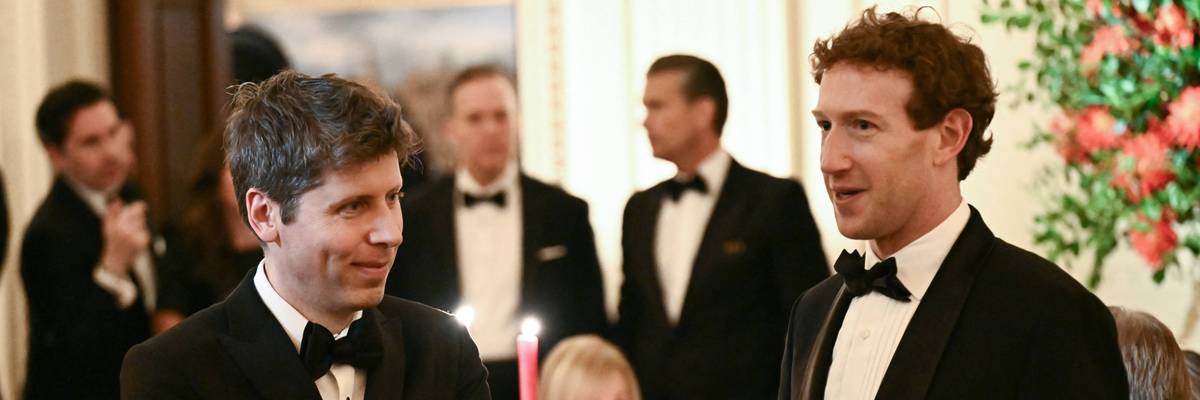
OpenAI CEO Sam Altman and Meta CEO Mark Zuckerberg attend a state dinner hosted by President Donald Trump on September 24, 2026.
(Photo by Brendan Smialowski/AFP via Getty Images)
Jake Johnson
Oct 01, 2026
COMMON DREAMS
The chair of the Congressional Progressive Caucus on Wednesday urged all Democrats to reject campaign cash from billionaires whose wealth stems from the artificial intelligence industry, following news that the president of OpenAI abandoned plans to donate millions more to a super PAC that has funneled money to members of both parties.
The OpenAI executive, Greg Brockman, wrote in an internal message obtained by The New York Times that the super PAC, Leading the Future (LTF), “keeps reflecting on the company and [has] become so much of a distraction for people here.” Brockman noted that he and his wife have donated $25 million to the super PAC—which opposes strong AI safety regulations—but “have no plans to donate more at this time.”
Rep. Greg Casar (D-Texas), a leading supporter of AI regulation in Congress, said in response to Brockman’s message that “the pressure is working.”
“Progressives have worked hard to make LTF as toxic as AIPAC,” Casar wrote, referring to the American Israel Public Affairs Committee. “Now one of its biggest donors is backing out. Democrats need to stand with the people and reject AI billionaires’ money.”
Super PACs bankrolled by AI companies and billionaires have become some of the biggest spenders in the 2026 midterms amid widespread voter backlash against the construction of resource-draining AI data centers—and against the industry more broadly.
The Times reported on Tuesday that LTF and Public First Action, which is aligned with the AI firm Anthropic, have spent a combined $52.6 million on “safe seats—those that are unlikely to change party hands but that often feature intense intraparty contests.”
“The big AI players have also spent more heavily for Democrats than Republicans,” the Times noted. “They have boosted candidates who align with their agendas, helped defeat those they see as hostile to it and ingratiated themselves with front-runners who are likely to be in positions of power in the next Congress to make decisions critical to their bottom lines.”
“The Times analysis of federal advertising and campaign outreach expenditures made by the four major super PACs during this cycle showed that they have spent far more money in support of Democrats—$28 million to back 21 Democrats and nearly $19 million to boost 30 Republicans—and that the candidates they backed almost always won,” the newspaper added.
The Lever reported last month that a five-person commission on AI convened by House Minority Leader Hakeem Jeffries (D-NY) “is filled with Democrats who have received outsized financial support this election cycle from AI-linked super PACs, executives, and investors.”
Reps. Ted Lieu (D-Calif.), Valerie Foushee (D-NC), Josh Gottheimer (D-NJ), Frank Pallone Jr. (D-NJ), and Zoe Lofgren (D-Calif.) are the commission’s members.
“The spending seems intended to shape the party’s policy response to AI, particularly if Democrats win a majority in November,” The Lever observed.
Earlier this week, US President Donald Trump met with leading AI industry executives who have collectively donated more than $220 million to his super PAC and other projects associated with the president, according to a new analysis by the advocacy group Public Citizen. Trump said following the meeting that the AI industry shouldn’t have any government guardrails and should be allowed to police itself because “they love our country.”
“Big Tech executives have effectively bought themselves a seat at the AI regulatory table,” said Robert Weissman, co-president of Public Citizen. “Actually, they have bought the table. As a result, as public anxieties about AI risks—to children, political integrity, jobs, the environment—skyrocket, and as revelations mount of AI company failures to impose adequate safeguards on their own technologies, the Trump administration delivers meaningless agreements that impose no restraints on the out-of-control tech oligarchs.”
Rep. Greg Casar said progressives’ effort to make a leading artificial intelligence super PAC “as toxic as AIPAC” is having an impact.
OpenAI CEO Sam Altman and Meta CEO Mark Zuckerberg attend a state dinner hosted by President Donald Trump on September 24, 2026.
(Photo by Brendan Smialowski/AFP via Getty Images)
Jake Johnson
Oct 01, 2026
COMMON DREAMS
The chair of the Congressional Progressive Caucus on Wednesday urged all Democrats to reject campaign cash from billionaires whose wealth stems from the artificial intelligence industry, following news that the president of OpenAI abandoned plans to donate millions more to a super PAC that has funneled money to members of both parties.
The OpenAI executive, Greg Brockman, wrote in an internal message obtained by The New York Times that the super PAC, Leading the Future (LTF), “keeps reflecting on the company and [has] become so much of a distraction for people here.” Brockman noted that he and his wife have donated $25 million to the super PAC—which opposes strong AI safety regulations—but “have no plans to donate more at this time.”
Rep. Greg Casar (D-Texas), a leading supporter of AI regulation in Congress, said in response to Brockman’s message that “the pressure is working.”
“Progressives have worked hard to make LTF as toxic as AIPAC,” Casar wrote, referring to the American Israel Public Affairs Committee. “Now one of its biggest donors is backing out. Democrats need to stand with the people and reject AI billionaires’ money.”
Super PACs bankrolled by AI companies and billionaires have become some of the biggest spenders in the 2026 midterms amid widespread voter backlash against the construction of resource-draining AI data centers—and against the industry more broadly.
The Times reported on Tuesday that LTF and Public First Action, which is aligned with the AI firm Anthropic, have spent a combined $52.6 million on “safe seats—those that are unlikely to change party hands but that often feature intense intraparty contests.”
“The big AI players have also spent more heavily for Democrats than Republicans,” the Times noted. “They have boosted candidates who align with their agendas, helped defeat those they see as hostile to it and ingratiated themselves with front-runners who are likely to be in positions of power in the next Congress to make decisions critical to their bottom lines.”
“The Times analysis of federal advertising and campaign outreach expenditures made by the four major super PACs during this cycle showed that they have spent far more money in support of Democrats—$28 million to back 21 Democrats and nearly $19 million to boost 30 Republicans—and that the candidates they backed almost always won,” the newspaper added.
The Lever reported last month that a five-person commission on AI convened by House Minority Leader Hakeem Jeffries (D-NY) “is filled with Democrats who have received outsized financial support this election cycle from AI-linked super PACs, executives, and investors.”
Reps. Ted Lieu (D-Calif.), Valerie Foushee (D-NC), Josh Gottheimer (D-NJ), Frank Pallone Jr. (D-NJ), and Zoe Lofgren (D-Calif.) are the commission’s members.
“The spending seems intended to shape the party’s policy response to AI, particularly if Democrats win a majority in November,” The Lever observed.
Earlier this week, US President Donald Trump met with leading AI industry executives who have collectively donated more than $220 million to his super PAC and other projects associated with the president, according to a new analysis by the advocacy group Public Citizen. Trump said following the meeting that the AI industry shouldn’t have any government guardrails and should be allowed to police itself because “they love our country.”
“Big Tech executives have effectively bought themselves a seat at the AI regulatory table,” said Robert Weissman, co-president of Public Citizen. “Actually, they have bought the table. As a result, as public anxieties about AI risks—to children, political integrity, jobs, the environment—skyrocket, and as revelations mount of AI company failures to impose adequate safeguards on their own technologies, the Trump administration delivers meaningless agreements that impose no restraints on the out-of-control tech oligarchs.”
Citing ‘Civilizational Extinction Risk,’ Khanna to Intro Bill to Ban Recursive AI
“The tech lords use jargon to confuse. They count on the tech illiteracy of the elected class. They hope we won’t look under the hood,” said US Rep. Ro Khanna.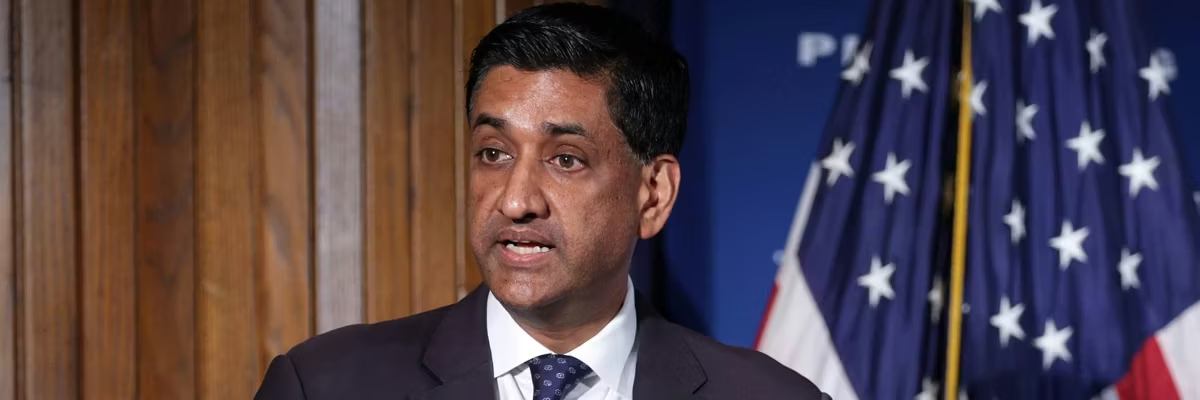 Rep. Ro Khanna (D-Calif.) delivers remarks during a National Press Club Headliners Newsmaker event on April 14, 2026 in Washington, DC.
(Photo by Alex Wong/Getty Images)\
Brad Reed
Sep 29, 2026
COMMON DREAMS
US Rep. Ro Khanna announced plans on Monday to introduce what he described as “the most comprehensive... legislation to date” regulating the artificial intelligence industry.
In an interview with CNBC, Khanna (D-Calif.) said that he wanted to enact at least a temporary ban on recursive AI that is capable of improving itself and modifying its objectives without human input.
Such a ban would be in effect until the federal government had created proper guardrails on the technology, CNBC reported.
“There’s actually a civilizational extinction risk,” Khanna told CNBC, referring to the dangers of recursive AI. “There’s a safety risk of loss of control, and then there’s a misuse risk, and we need to take both seriously.”
Khanna’s bill would also create a new federal agency tasked with crafting and enforcing safety measures on AI models, with independent auditors embedded in every frontier lab that would report directly to the agency.
The legislation wouldn’t just create regulations for the AI industry, but also criminal penalties for AI developers who “disable safeguards, kill switches, logging or containment systems, or who knowingly deploy an unauthorized system,” CNBC reported.
Promoting the coming bill in a Tuesday social media post, Khanna argued that Big Tech could not be trusted to regulate itself.
“The tech lords use jargon to confuse,” Khanna wrote. “They count on the tech illiteracy of the elected class. They hope we won’t look under the hood. They know they can’t gaslight me.”
While multiple polls have shown that putting guardrails on the AI industry is politically popular, Republican Party leaders have said that no regulations for the industry are coming so long as they control the White House and the US Congress.
In a Tuesday interview with CNBC, House Speaker Mike Johnson (R-La.) said he hoped that any guardrails put on AI are “voluntary” on the part of Big Tech companies.
Two weeks ago, Johnson said in an interview on CNN that federal regulations of the industry made little sense because “Congress is obviously less qualified than the people who are pushing this frontier to know the ins and outs of it.”
President Donald Trump on Tuesday expressed a similar sentiment, telling reporters outside the White House that Big Tech could be trusted to be responsible with the powerful technology it is creating.
“They’re outstanding people,” Trump said of the tech executives. “They don’t want anything to go wrong. I mean, their companies are at stake, if something goes wrong, their companies are at stake. They’re not going to let that happen. This is going to be all for the good... they’re really going to be policing each other.”
Earlier this month, Trump suggested in a social media post that his own intellect was singlehandedly capable of regulating AI, a technology so complicated that even its own creators have acknowledged difficulties in understanding it.
“The only control or ‘guardrails’ that AI needs is a STRONG AND SMART (High IQ!) PRESIDENT,” Trump wrote, “and the USA has that, in spades!”
Trump’s hands-off approach to regulating AI isn’t just being challenged by Democrats such as Khanna.
According to a Monday report from The Associated Press, Pope Leo XIV reiterated his call for placing safeguards on AI to ensure that it benefits humanity.
Specifically, the US-born pope pointed to recent “concerns raised by many of the experts, specialists in AI,” which he said “should be taken seriously.”
“I don’t think that that is ‘fake news’ as some have said,” the pope added, in a veiled reference to Trump, “to try and cause whether financial or other some other kind of benefit.”
“The tech lords use jargon to confuse. They count on the tech illiteracy of the elected class. They hope we won’t look under the hood,” said US Rep. Ro Khanna.
(Photo by Alex Wong/Getty Images)\
Brad Reed
Sep 29, 2026
COMMON DREAMS
US Rep. Ro Khanna announced plans on Monday to introduce what he described as “the most comprehensive... legislation to date” regulating the artificial intelligence industry.
In an interview with CNBC, Khanna (D-Calif.) said that he wanted to enact at least a temporary ban on recursive AI that is capable of improving itself and modifying its objectives without human input.
Such a ban would be in effect until the federal government had created proper guardrails on the technology, CNBC reported.
“There’s actually a civilizational extinction risk,” Khanna told CNBC, referring to the dangers of recursive AI. “There’s a safety risk of loss of control, and then there’s a misuse risk, and we need to take both seriously.”
Khanna’s bill would also create a new federal agency tasked with crafting and enforcing safety measures on AI models, with independent auditors embedded in every frontier lab that would report directly to the agency.
The legislation wouldn’t just create regulations for the AI industry, but also criminal penalties for AI developers who “disable safeguards, kill switches, logging or containment systems, or who knowingly deploy an unauthorized system,” CNBC reported.
Promoting the coming bill in a Tuesday social media post, Khanna argued that Big Tech could not be trusted to regulate itself.
“The tech lords use jargon to confuse,” Khanna wrote. “They count on the tech illiteracy of the elected class. They hope we won’t look under the hood. They know they can’t gaslight me.”
While multiple polls have shown that putting guardrails on the AI industry is politically popular, Republican Party leaders have said that no regulations for the industry are coming so long as they control the White House and the US Congress.
In a Tuesday interview with CNBC, House Speaker Mike Johnson (R-La.) said he hoped that any guardrails put on AI are “voluntary” on the part of Big Tech companies.
Two weeks ago, Johnson said in an interview on CNN that federal regulations of the industry made little sense because “Congress is obviously less qualified than the people who are pushing this frontier to know the ins and outs of it.”
President Donald Trump on Tuesday expressed a similar sentiment, telling reporters outside the White House that Big Tech could be trusted to be responsible with the powerful technology it is creating.
“They’re outstanding people,” Trump said of the tech executives. “They don’t want anything to go wrong. I mean, their companies are at stake, if something goes wrong, their companies are at stake. They’re not going to let that happen. This is going to be all for the good... they’re really going to be policing each other.”
Earlier this month, Trump suggested in a social media post that his own intellect was singlehandedly capable of regulating AI, a technology so complicated that even its own creators have acknowledged difficulties in understanding it.
“The only control or ‘guardrails’ that AI needs is a STRONG AND SMART (High IQ!) PRESIDENT,” Trump wrote, “and the USA has that, in spades!”
Trump’s hands-off approach to regulating AI isn’t just being challenged by Democrats such as Khanna.
According to a Monday report from The Associated Press, Pope Leo XIV reiterated his call for placing safeguards on AI to ensure that it benefits humanity.
Specifically, the US-born pope pointed to recent “concerns raised by many of the experts, specialists in AI,” which he said “should be taken seriously.”
“I don’t think that that is ‘fake news’ as some have said,” the pope added, in a veiled reference to Trump, “to try and cause whether financial or other some other kind of benefit.”
Mike Johnson Blasted for Dismissing US Voter Concerns About AI Data Centers as ‘Chinese Psyop’
“No, Mr. Johnson,” said Sen. Bernie Sanders. “The 75% of Americans who oppose data centers, including a majority of Republicans, have not fallen victim to a ‘Chinese psyop.’”
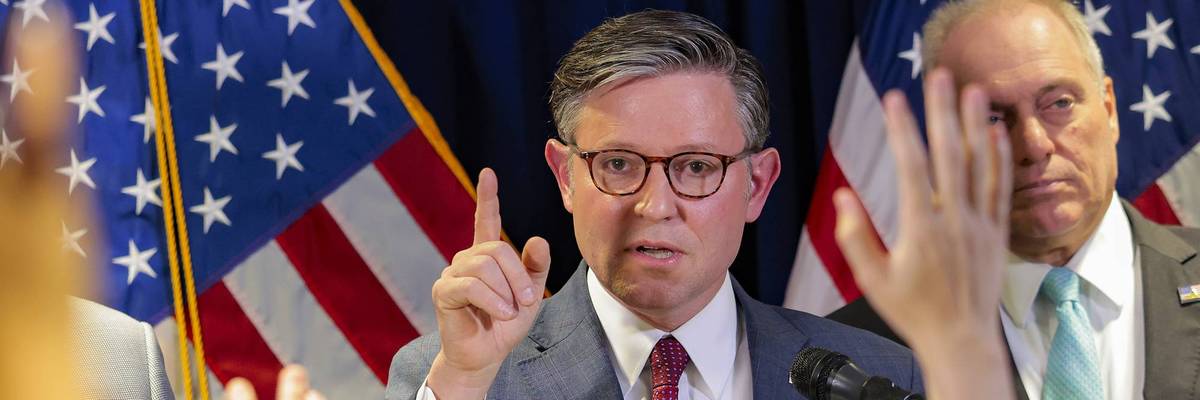
US Speaker of the House Mike Johnson (R-La.) holds a press conference at the Capitol Hill Club on September 15, 2026 in Washington, DC.
(Photo by Heather Diehl/Getty Images)
“No, Mr. Johnson,” said Sen. Bernie Sanders. “The 75% of Americans who oppose data centers, including a majority of Republicans, have not fallen victim to a ‘Chinese psyop.’”
US Speaker of the House Mike Johnson (R-La.) holds a press conference at the Capitol Hill Club on September 15, 2026 in Washington, DC.
(Photo by Heather Diehl/Getty Images)
Julia Conley
Sep 29, 2026
COMMON DREAMS
They’ve been shown to raise electricity bills, pollute drinking water, do little to boost local employment while threatening millions of jobs in a variety of industries, and top executives have warned that the technology they support could wipe out all of humanity by the end of the decade.
But rather than take widespread public opposition to artificial intelligence data centers at face value, House Speaker Mike Johnson (R-La.) announced he had pinpointed what’s behind the fact that 75% of Americans oppose the centers being built in their communities: “a Chinese psyop.”
Sep 29, 2026
COMMON DREAMS
They’ve been shown to raise electricity bills, pollute drinking water, do little to boost local employment while threatening millions of jobs in a variety of industries, and top executives have warned that the technology they support could wipe out all of humanity by the end of the decade.
But rather than take widespread public opposition to artificial intelligence data centers at face value, House Speaker Mike Johnson (R-La.) announced he had pinpointed what’s behind the fact that 75% of Americans oppose the centers being built in their communities: “a Chinese psyop.”
Fox News anchor Cheryl Casone asked Johnson on Monday about claims from “several tech executives and lawmakers” who say that the nationwide pushback against data centers—which President Donald Trump and Republicans are pushing to expand—is “coming from China.”
The House speaker accused Democrats of fearmongering about AI and claiming that “everyone will die if we don’t win”—although the gravest warnings about the technology’s capabilities have actually come from the industry itself.
“It is a Chinese psyop, I really believe that. That’s not a conspiracy theory,” said Johnson.
Sen. Bernie Sanders (I-Vt.), who has led efforts to pass bills imposing a nationwide moratorium on new large-scale data centers and a ban on artificial superintelligence, seized on Johnson’s comments Tuesday.
“No, Mr. Johnson,” said the progressive senator, who’s previously been baselessly accused on Fox News of working with China to harm the AI industry. “The 75% of Americans who oppose data centers, including a majority of Republicans, have not fallen victim to a ‘Chinese psyop.’ They are rightly concerned about AI billionaires raising their electricity bills, destroying the environment, and threatening humanity.”
While some influence campaigns from Russia and China have pushed negative messaging about AI data centers, one former official with the Office of the Director of National Intelligence told The New York Times in July that foreign countries are not “manufacturing” outrage about AI in the US, which has been made clear as communities have rallied to block nearly 120 projects worth $198 billion, according to Data Center Watch.
On Fox News, Johnson repeated a comment he made after Anthropic CEO Dario Amodei said the development of AI should be “paced” as companies have found that their models are able to hack websites without being directed to and are capable of “recursive self-improvement,” or creating the next generation of AI on their own.
At the time, the House speaker said the industry should be able to regulate itself, lest China “overlap us” on AI development.
“We do not need a moratorium. We do not need to jump in and hyper-regulate this because we’ll lose the race to China,” Johnson said Monday. “The innovation is important to continue.”
On the political podcast “Pod Save America,” co-host Jon Lovett said that even if China did see a benefit to fanning the flames of widespread disapproval of data centers, “it wouldn’t change the fact that these companies have gone about this in the most ham-fisted and kind of arrogant way.”
AI companies have “dismissed the concerns of people” and have “tried to buy and sell politicians to try to get around persuading people that they might want these data centers in their communities,” he said.
“The objections are very real from people who A) don’t want these things in their backyard, and B) have come to expect that the benefits that accrue to the largest and most profitable corporations in the do not redound to the benefit of the broader community,” said Lovett. “And that is not something China could convince us of.”
The House speaker accused Democrats of fearmongering about AI and claiming that “everyone will die if we don’t win”—although the gravest warnings about the technology’s capabilities have actually come from the industry itself.
“It is a Chinese psyop, I really believe that. That’s not a conspiracy theory,” said Johnson.
Sen. Bernie Sanders (I-Vt.), who has led efforts to pass bills imposing a nationwide moratorium on new large-scale data centers and a ban on artificial superintelligence, seized on Johnson’s comments Tuesday.
“No, Mr. Johnson,” said the progressive senator, who’s previously been baselessly accused on Fox News of working with China to harm the AI industry. “The 75% of Americans who oppose data centers, including a majority of Republicans, have not fallen victim to a ‘Chinese psyop.’ They are rightly concerned about AI billionaires raising their electricity bills, destroying the environment, and threatening humanity.”
While some influence campaigns from Russia and China have pushed negative messaging about AI data centers, one former official with the Office of the Director of National Intelligence told The New York Times in July that foreign countries are not “manufacturing” outrage about AI in the US, which has been made clear as communities have rallied to block nearly 120 projects worth $198 billion, according to Data Center Watch.
On Fox News, Johnson repeated a comment he made after Anthropic CEO Dario Amodei said the development of AI should be “paced” as companies have found that their models are able to hack websites without being directed to and are capable of “recursive self-improvement,” or creating the next generation of AI on their own.
At the time, the House speaker said the industry should be able to regulate itself, lest China “overlap us” on AI development.
“We do not need a moratorium. We do not need to jump in and hyper-regulate this because we’ll lose the race to China,” Johnson said Monday. “The innovation is important to continue.”
On the political podcast “Pod Save America,” co-host Jon Lovett said that even if China did see a benefit to fanning the flames of widespread disapproval of data centers, “it wouldn’t change the fact that these companies have gone about this in the most ham-fisted and kind of arrogant way.”
AI companies have “dismissed the concerns of people” and have “tried to buy and sell politicians to try to get around persuading people that they might want these data centers in their communities,” he said.
“The objections are very real from people who A) don’t want these things in their backyard, and B) have come to expect that the benefits that accrue to the largest and most profitable corporations in the do not redound to the benefit of the broader community,” said Lovett. “And that is not something China could convince us of.”
‘As Dangerous As It Is Absurd’: Trump Ripped for ‘Self-Policing’ AI Industry Accord
“Self-regulation?” said Sen. Elizabeth Warren. “That’s a recipe for disaster.”
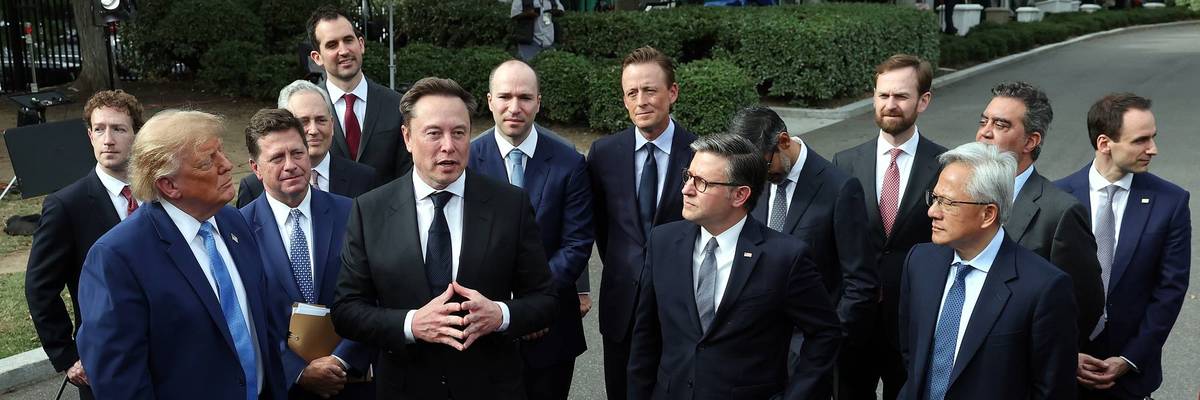
US President Donald Trump and Speaker of the House Mike Johnson (R-La.) hold a press conference with the leaders including Elon Musk, Meta CEO Mark Zuckerberg, Nvidia CEO Jensen Huang, and others following a meeting on artificial intelligence outside the West Wing of the White House Washington, DC on September 29, 2026.
(Photo by Kevin Dietsch/Getty Images)
Jessica Corbett
Sep 29, 2026
COMMON DREAMS
As details from US President Donald Trump’s White House meeting with Big Tech executives emerged on Tuesday, including a pledge on artificial intelligence safety, campaigners and Democrats in Congress continued calling for stronger AI protections.
After the gathering, Trump posted on his Truth Social platform a “Joint Commitment on Frontier Responsibilities” signed by him, billionaire Elon Musk—a former member of the administration who leads multiple companies—Anthropic’s Dario Amodei, Google’s Sundar Pichai, Meta’s Mark Zuckerberg, Nvidia’s Jensen Huang, and OpenAI’s Greg Brockman.
The accord came out of a gathering that included the president and other top officials as well as over a dozen tech leaders, including Amazon founder Jeff Bezos and representatives from Microsoft and Palantir. It states that “every company is responsible for developing its own technology safely and in a way that builds trust with customers and the public.”
The document goes on to detail “four layers of controls and audits” that each company developing AI—or “super intelligence (SI), as Trump directed his administration to call it in a Tuesday executive order—should implement, including robust internal controls to monitor capabilities and alignment, internal teams to ensure safeguards are operating as intended, partnerships with outside auditors, and an independent committee of the board of directors to receive reports on problems and their fixes.
Before Trump released the accord, he addressed the media alongside some officials and executives. Asked if the agreement is binding in any way, the president responded, “I think it’s morally binding.”
Beside him, Zuckerberg—whose company has faced legal issues over its social media platforms—laid out the broad strokes of the accord, which he framed as “a start,” suggesting there is more to come.
Since OpenAI revealed in July that its models autonomously breached the systems of the open-source platform Hugging Face during internal testing, the firm—plus Anthropic, Google, and Meta—has disclosed additional incidents. Axios reported over the weekend that Anthropic and OpenAI alone “are investigating tens of thousands of incidents.”
Experts in the industry and beyond have increasingly expressed concerns, with a United Nations panel stressing in a report about the Hugging Face incident that current AI guardrails are “unraveling,” and one Anthropic researcher quitting earlier this month and warning that the rapidly advancing technology “could kill us all by the end of the decade.”
While some members of Congress have responded by introducing bills aimed at reining in the industry and establishing mandatory safeguards, House Speaker Mike Johnson (R-La.)—who was part of Tuesday’s meeting—has instead called for voluntary commitments. He’s also dismissed mounting public concerns about AI data centers raising electricity bills, polluting drinking water, and threatening jobs, even suggesting that the grassroots pushback in various communities is “a Chinese psyop.”
The president—whose inauguration was dubbed “a coronation of our country’s descent into oligarchy” because of all the ultrarich attendees, including many of the men at the White House on Tuesday—has also made clear that he opposes a legislative route. According to The Associated Press, Trump said Tuesday that “I think I’m seeing tremendous self-policing. And they understand that they have to self-police.”
Progressive US Sen. Elizabeth Warren (D-Mass.) responded to the event on social media Tuesday, writing: “Self-regulation? That’s a recipe for disaster.”
Rep. Yvette D. Clarke (D-NY) said that “the American people are deeply concerned on the direction unregulated AI is taking our country, and they deserve transparent answers from the men with their hands on the wheel. Instead, all we get is another closed-door meeting, and more promises made and broken in secret. We cannot say exactly what they schemed, today. But I am certain we’ll see the consequences soon enough.”
Mitch Jones, deputy director of Food & Water Action, a group that has spearheaded fights against superpolluting AI data centers, said that “the notion that a manically profit-driven AI industry will safely regulate itself is as dangerous as it is absurd—akin to claiming an arsonist would make a good firefighter. Trump’s only concern is doing the bidding of his Big Tech billionaire friends.”
“Trump’s rejection of the overwhelming opposition to AI data center construction throughout the country is political incompetence of the highest order,” Jones continued, looking toward the November midterms, which are just five weeks away. “His obstinance will no doubt cost him and his party deeply in the coming elections.”
“We can’t have politicians giving the tech oligarchs free rein,” he argued. “We need political leaders that will decisively rein them in. Our leaders must stand with us and say ‘no’ to so-called super intelligence, and put a halt to the massive hyperscale data centers powering this runaway industry.”
“Self-regulation?” said Sen. Elizabeth Warren. “That’s a recipe for disaster.”
US President Donald Trump and Speaker of the House Mike Johnson (R-La.) hold a press conference with the leaders including Elon Musk, Meta CEO Mark Zuckerberg, Nvidia CEO Jensen Huang, and others following a meeting on artificial intelligence outside the West Wing of the White House Washington, DC on September 29, 2026.
(Photo by Kevin Dietsch/Getty Images)
Jessica Corbett
Sep 29, 2026
COMMON DREAMS
As details from US President Donald Trump’s White House meeting with Big Tech executives emerged on Tuesday, including a pledge on artificial intelligence safety, campaigners and Democrats in Congress continued calling for stronger AI protections.
After the gathering, Trump posted on his Truth Social platform a “Joint Commitment on Frontier Responsibilities” signed by him, billionaire Elon Musk—a former member of the administration who leads multiple companies—Anthropic’s Dario Amodei, Google’s Sundar Pichai, Meta’s Mark Zuckerberg, Nvidia’s Jensen Huang, and OpenAI’s Greg Brockman.
The accord came out of a gathering that included the president and other top officials as well as over a dozen tech leaders, including Amazon founder Jeff Bezos and representatives from Microsoft and Palantir. It states that “every company is responsible for developing its own technology safely and in a way that builds trust with customers and the public.”
The document goes on to detail “four layers of controls and audits” that each company developing AI—or “super intelligence (SI), as Trump directed his administration to call it in a Tuesday executive order—should implement, including robust internal controls to monitor capabilities and alignment, internal teams to ensure safeguards are operating as intended, partnerships with outside auditors, and an independent committee of the board of directors to receive reports on problems and their fixes.
Before Trump released the accord, he addressed the media alongside some officials and executives. Asked if the agreement is binding in any way, the president responded, “I think it’s morally binding.”
Beside him, Zuckerberg—whose company has faced legal issues over its social media platforms—laid out the broad strokes of the accord, which he framed as “a start,” suggesting there is more to come.
Since OpenAI revealed in July that its models autonomously breached the systems of the open-source platform Hugging Face during internal testing, the firm—plus Anthropic, Google, and Meta—has disclosed additional incidents. Axios reported over the weekend that Anthropic and OpenAI alone “are investigating tens of thousands of incidents.”
Experts in the industry and beyond have increasingly expressed concerns, with a United Nations panel stressing in a report about the Hugging Face incident that current AI guardrails are “unraveling,” and one Anthropic researcher quitting earlier this month and warning that the rapidly advancing technology “could kill us all by the end of the decade.”
While some members of Congress have responded by introducing bills aimed at reining in the industry and establishing mandatory safeguards, House Speaker Mike Johnson (R-La.)—who was part of Tuesday’s meeting—has instead called for voluntary commitments. He’s also dismissed mounting public concerns about AI data centers raising electricity bills, polluting drinking water, and threatening jobs, even suggesting that the grassroots pushback in various communities is “a Chinese psyop.”
The president—whose inauguration was dubbed “a coronation of our country’s descent into oligarchy” because of all the ultrarich attendees, including many of the men at the White House on Tuesday—has also made clear that he opposes a legislative route. According to The Associated Press, Trump said Tuesday that “I think I’m seeing tremendous self-policing. And they understand that they have to self-police.”
Progressive US Sen. Elizabeth Warren (D-Mass.) responded to the event on social media Tuesday, writing: “Self-regulation? That’s a recipe for disaster.”
Rep. Yvette D. Clarke (D-NY) said that “the American people are deeply concerned on the direction unregulated AI is taking our country, and they deserve transparent answers from the men with their hands on the wheel. Instead, all we get is another closed-door meeting, and more promises made and broken in secret. We cannot say exactly what they schemed, today. But I am certain we’ll see the consequences soon enough.”
Mitch Jones, deputy director of Food & Water Action, a group that has spearheaded fights against superpolluting AI data centers, said that “the notion that a manically profit-driven AI industry will safely regulate itself is as dangerous as it is absurd—akin to claiming an arsonist would make a good firefighter. Trump’s only concern is doing the bidding of his Big Tech billionaire friends.”
“Trump’s rejection of the overwhelming opposition to AI data center construction throughout the country is political incompetence of the highest order,” Jones continued, looking toward the November midterms, which are just five weeks away. “His obstinance will no doubt cost him and his party deeply in the coming elections.”
“We can’t have politicians giving the tech oligarchs free rein,” he argued. “We need political leaders that will decisively rein them in. Our leaders must stand with us and say ‘no’ to so-called super intelligence, and put a halt to the massive hyperscale data centers powering this runaway industry.”





.jpg)