Thursday, October 15, 2026


Copper price forecasts lifted for 2026 but tariff “collapse” still on the table
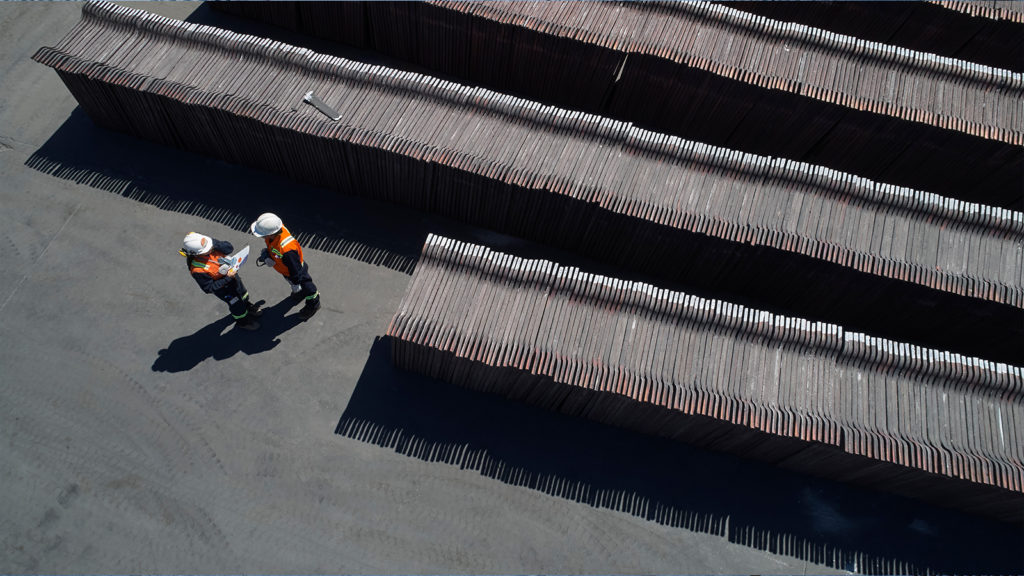

Where do we send these? Credit: Glencore

Copper pulled back from a three-week high on Wednesday after US inflation data put a Federal Reserve rate hike this month back on the table, and word of a preliminary deal to avert a strike at BHP’s Escondida, the world’s largest copper mine, took some of the supply premium out of the price.

Comex copper for December delivery traded at $6.6695 a pound (about $14,704 a tonne) late morning in New York, down 0.8%, after touching $6.7890 earlier in the session. The most-active contract’s record settlement of $6.89 was set on September 9, the day before a report that the White House tariff plan had stalled knocked more than 5% off the price.

In London, three-month copper climbed as far as $14,700 a tonne, its highest since September 23, before easing to $14,532 by early afternoon. Cash copper settled at a record $14,822 on Monday and $14,741 on Tuesday, and LME inventories have fallen for seven straight sessions to 229,650 tonnes.

US consumer prices accelerated in September on a surge in gasoline costs, and the CME’s FedWatch tool put the odds of a quarter-point hike at the Fed’s late-October meeting at about 44%, double the day before, Reuters reported. New York Fed President John Williams said he still sees one more hike this year.

Two sources told Reuters that Escondida’s supervisors’ union and the company had reached a preliminary agreement, which members were voting on Wednesday morning, and a union leader told Bloomberg a deal was “virtually done”. Unions at Antofagasta’s Centinela returned to talks on Tuesday after a week-long stoppage, while the open pit at Codelco’s El Teniente remains shut after a deadly landslide.

Copper price 2026: Comex most-active contract
Click on chart for live prices.

Copper’s 2026 advance has forecasters raising their numbers for the second time in three months, and with the metal averaging $13,471 a tonne for the year to date, the 2026 revisions mostly bring the sheet into line with the tape.

Macquarie now has copper averaging $13,573 this year, BMO Capital Markets $13,619 and BMI, a unit of Fitch Solutions, $13,500, up from the $12,700 it moved to in July. The differences open up from next year, and they come down to how much of the 1.5 to 2 million tonnes of copper now sitting in the United States is counted as surplus.

Copper price forecasts: annual averages 2026-2030, Macquarie, BMI, BMO, Bloomberg consensus and Deutsche Bank

“The great copper gamble”

Macquarie, which in July called the rally “running ahead of reality”, has lifted its 2027 average by 14% to $12,750 and pushed the cycle low to $12,000 in the fourth quarter of next year from $11,000 a quarter earlier, while its long-term price rises to $10,500 a tonne in 2025 dollars.

Prices “have disconnected from the fundamentals and could arguably move higher or lower depending on the outcome of the Section 232,” the bank’s strategists write in a quarterly compendium whose copper chapter is headed “The great copper gamble”, listing the metal among its preferred commodities for the next six to nine months “but very binary”.

The fundamentals as Macquarie counts them are a 223,000-tonne surplus this year after a 531,000-tonne disruption allowance, and surpluses averaging more than 700,000 tonnes a year from 2027 as mine supply grows 4.9% next year and 4.3% in 2028, with Collahuasi, Grasberg, Kamoa-Kakula and Centinela ramping up, Tia Maria starting and Cobre Panama back in full from mid-2027.

Global demand growth slows to 1.5% in 2027 on its numbers, with none at all in China, where construction-related copper use is shrinking 9% a year and air conditioner makers are “again looking at aluminium substitution.”

Visible stocks worldwide are up 300,000 tonnes this year, but that is the US build; everywhere else they are down 168,000 tonnes, and Macquarie says sentiment will not turn until LME and Shanghai inventories start rising again, either quickly on a tariff decision or gradually as its forecast surpluses feed through.

Macquarie’s four tariff scenarios run from a January 1 that passes with no announcement at all, which it rates most likely, to a definitive decision against a duty, which it rates least likely: “the CME price will most likely collapse, taking the LME price with it, and the arb will invert,” with surplus US stocks reappearing in LME warehouses in the US and Asia.

A tariff announced six to eight weeks ahead of implementation would pull a last wave of metal into the US and leave the rest of the world “very tight”, while a formal six-month delay would see the spread fade as it did for platinum and palladium after the critical minerals decision.

Expectations are also growing that a scrap export ban will be folded into any decision; an immediate ban would take about 600,000 tonnes a year of contained copper off the world market.

“Has the market misread US inventory?”

BMO Capital Markets arrives at a very different place from a similar starting point. Its quarterly price deck, published two days before Macquarie’s, raises its long-term copper price by 47% to $16,000 a tonne in real terms, or $18,000 nominal by 2030, with $14,675 for 2027 and $16,000 for 2028, and the bank puts itself 46% above consensus on the long-term number. Its market balance is close to balanced throughout: an 83,000-tonne surplus this year, then small deficits from 2027.

The argument turns on what the US hoard, now close to 2 million tonnes on BMO’s estimate, or about a year of American consumption, actually represents. China’s refined copper imports have run below trend and its exports above trend since the tariff trade began, a cumulative swing of about 1.6 million tonnes on a net basis, which BMO reads as Beijing allowing its strategic reserve to run down while Washington built one.

“Instead of there being a build in above ground inventory over the last 2 years, there has been a geographical redistribution from ‘not visible’ to ‘visible’, meaning today’s price of ~$14,500-15,000/t is fundamentally supported,” the bank writes. Had China bid for metal alongside the US, “copper prices today would in fact be much, much higher,” and at some point China will want to restock.

BMO expects no tariff decision before the US midterms in November, which may see copper “pause for breath” and keep the Comex-LME spread narrow, but says investors it talks to are coming around to the view that the US stockpile “could simply stay in situ for many more years.”

Rising dependence on scrap, with China’s secondary refined output heading for 3.3 million tonnes this year from 2.8 million, is the other leg of its case: scrap is the marginal unit, and it only comes out at higher prices.

BMI sits between the two. It still views the rally “as having extended beyond what fundamentals alone would suggest” and has the market in a 43,000-tonne surplus this year, but has cut its 2026 mine supply growth forecast to 1.1% from 2.4% with Chilean output down 4%, and expects a deficit from 2027 that widens to 1.7 million tonnes by 2035 as demand grows 3% to 4% a year on grids, EVs and data centres.

Its 2027 forecast is $12,900, rising to $15,000 in 2029 and an unchanged $17,000 in 2035. The International Copper Study Group, meeting this week, lifted its 2026 surplus to 104,000 tonnes and kept 2027 at 368,000 tonnes.

Surplus or deficit? Copper market balance forecasts from Macquarie, BMO, BMI and ICSG

The arb has gone, the metal has not

The spread that built the US stockpile has all but disappeared on a spot basis. Comex October copper at $6.62 a pound trades below LME cash, which at Tuesday’s $14,741 works out to $6.69, and John Gross of The Copper Journal calculates the month-to-date average has flipped to an 85-point LME premium from a 17-cent Comex premium in June.

Most of that is London’s doing: the backwardation that put cash $164.50 over three months at Monday’s settlement, since narrowed to $115.50, reflects how little spot metal is left outside the US.

Aurubis, Europe’s largest copper producer, has offered customers a record premium of $347 a tonne for 2027 supply, 10% above this year’s level, Benchmark Minerals reported, and a company spokesperson told Bloomberg that “a lot of material has relocated to the US, leaving warehouses quite empty.”

Further down the curve the premium survives. December Comex at $14,704 a tonne sits about $170 over LME three-month, which Macquarie read at the end of September as the market pricing a 10% chance of a 15% duty (on Wednesday’s prices the same arithmetic gives about 8%).

That is too little to pull fresh shipments across the Atlantic, but enough to keep what is already there in place as long as the Comex curve pays traders to hold it. The tonnes still arriving are cargo booked months ago: Comex stocks rose another 6,500 tonnes last week to 713,000 tonnes, with 100,000 tonnes of African and South American copper due through October.

Deutsche Bank takes the stockpiling argument furthest. Daniel Ghali, the bank’s new head of metals research, told the Wall Street Journal that with China adding to its strategic reserve for decades and the tariff threat pulling metal into American sheds, the two countries could be sitting on 71% of the world’s supply by the end of the year. On that trajectory copper “simply won’t be available” to users elsewhere by the end of 2028, an outcome averted only by prices high enough to force substitution into aluminium.

He sees $10 a pound, or $22,050 a tonne, in the second quarter of 2027, almost 50% above current levels. Even a decision against tariffs may not free the metal, he told the paper, since the LME has warehouses in the US and copper may simply be shuffled between American sites rather than leave the country.

Gross points to copper’s premium over aluminium, which hit a record $5.08 a pound in September, more than double its July 2022 low. “Clearly, this rising premium cannot continue indefinitely, but who among us will step forward to say it’s at the top?” he writes. His September monthly report makes the longer point: China consumed 58.9% of the world’s refined copper last year, up from 12.4% in 2000. “There are too many copper eggs in China’s basket.”

Miners still pricing $5 copper

Copper producers fell with the metal on Wednesday, Lundin Mining down 3.9%, Freeport-McMoRan 3.7%, Southern Copper 3.3% and Teck Resources 2.9%, but the year has been kind. Southern Copper is up 44.1% in 2026, taking its market value to $169 billion, with Glencore ahead 38.6%, BHP 38.0% and Freeport 37.4% at a $100 billion valuation. Teck has gained 36.1% and Anglo American 29.2%. Lundin has managed 13.0%, Antofagasta 7.5% with Centinela on strike, and First Quantum 3.0%.

RBC Capital Markets calculates that North American copper producers at 1.0 times net asset value imply a copper price of $5.03 a pound, from $5.98 for Freeport down to $3.96 for Ivanhoe Mines, against a futures price near $6.70. The group trades at 0.9 times net asset value, in line with its 10-year average.

Comex copper is up more than 18% in 2026.


5 Challenges Facing South America’s Copper Boom

  • Escondida supervisors, about 1,020 workers at the world’s largest copper mine, said they would strike at 8 a.m. local time Wednesday, a week after workers walked out at Centinela.
  • Chile’s August copper output fell 12.8% to 369,500 tons, the lowest monthly total since February 2011, and a fatal landslide hit Codelco’s El Teniente on Sunday.
  • The IEA still sees primary copper supply about 25% short of requirements by 2035, while Peru targets $33 billion in mining investment and Argentina’s Vicuña aims for a final investment decision by year-end.

Supervisors at BHP’s Escondida, the world’s largest copper mine, said they would strike at 8 a.m. local time Wednesday after government-led mediation failed to produce a contract. The union represents about 1,020 workers at a mine that supplies roughly a quarter of Chile’s copper, and the stoppage follows a walkout at Antofagasta’s Centinela that began Oct. 7. Both land as governments across the Andes ask miners for far more copper, not less.

Demand will not wait

S&P Global projects that copper demand will climb from 28 million metric tons in 2025 to 42 million tons by 2040, with AI data centers and defense each roughly tripling their consumption, and it warns that supply could fall 10 million tons short. The IEA still sees primary supply about 25% short of requirements in 2035, down from a 30% gap in last year’s edition.

Copper runs through grids, electric vehicles, wind and solar farms and the AI data center buildout, which S&P says could account for 14% of U.S. power demand by 2030, so a shortfall in the metal reaches well beyond mining. BloombergNEF has warned that a tight market could bring cost inflation or delays for electrification projects. Peru is targeting at least $33 billion in mining investment over five years, and Chile’s pipeline tops $100 billion over the decade.

Chile keeps losing output

Chile’s copper output fell 12.8% in August from a year earlier to 369,500 tons, the lowest monthly figure since February 2011, according to national statistics data reported by Bloomberg. On Sunday, heavy rain triggered a landslide at Codelco’s El Teniente mine that killed two contractors and led the company to partially suspend operations, and El Niño could bring more rain to Chile and Peru in the months ahead.

Cochilco expects national production to fall 2.6% this year to 5.27 million tons before recovering to 5.55 million in 2027. TD Securities analysts said strike votes, worker fatalities and operational disruptions have helped “maintain a supply-risk premium,” and copper has held close to its September record high.

China’s acid squeeze

Morgan Stanley estimated in April that 1.1 million tons of Chile’s annual leached copper output, more than half its refined production, could be exposed to a Chinese ban on sulphuric acid exports. Miners use the acid to leach metal from ore, and Chinese customs data showed shipments to Chile fell to zero in March, with Beijing reportedly planning a full halt from May.

Permits and protests

Permitting in Chile can take as long as 12 years in some cases, according to GlobalData, and President José Antonio Kast ordered ministers in March to clear 50 pending claims tied to about $16 billion in projects. In Peru, President Keiko Fujimori’s government wants to authorize 240 exploration and extraction projects this year, yet the Observatory of Mining Conflicts counts nearly 200 social conflicts nationwide, 64 of them tied to mining and other environmental disputes, and says most of the main mining regions voted against her.

Argentina starts from zero

Argentina has not produced copper since the Alumbrera mine closed in 2018, which makes Vicuña, the BHP and Lundin Mining venture, its biggest test. The project received the top tier of RIGI benefits this year, and its backers are targeting a final investment decision on a $7.1 billion first phase before year-end, with first copper planned for 2030.

In April, a judge in neighboring La Rioja ordered a 30-day suspension and blocked machinery from using an access road through the province, saying the province had been left out of the environmental assessment. A San Juan court allowed work to continue days later.

By Charles Kennedy for Oilprice.com


BHP averts strike at world’s biggest copper mine


The tentative deal followed last-minute talks after earlier negotiations failed. (Image: Screenshot from TRT World | YouTube)

BHP (ASX, LON: BHP) and the supervisors’ union at its Escondida mine in Chile have reached a preliminary agreement to avert a strike at the world’s largest copper operation.

Members of Union No. 2 will vote online on the mining company’s latest proposal between 9:15 a.m. and 11:30 a.m. local time. If they reject it, the work stoppage would begin on Thursday, October 15, at 8:00 a.m., local newspaper La Tercera reported.

The tentative agreement emerged from last-minute negotiations after earlier contract talks failed to produce a deal. 

The prospect of a shutdown had supported copper prices amid concerns that lost production at Escondida could tighten global supplies. A ratified agreement would remove one immediate threat to output, although Chile’s copper industry faces mounting operational and environmental risks.

Mounting disruptions

Labour disputes, operational setbacks and extreme weather linked to a stronger-than-expected El Niño are testing Chile’s copper producers, adding uncertainty to supply forecasts as analysts question the sustainability of recent price gains.

A deadly snow avalanche at Codelco’s El Teniente mine over the weekend halted production at an open-pit section of the operation. El Teniente is the world’s largest underground copper mine and the state-owned producer’s biggest operation.

The incident adds to concerns highlighted in an early October study by GEM Mining Consulting, which estimated that an average 5.2% of production at Chile’s largest copper mines was vulnerable to strikes, severe weather, accidents and geological problems.

El Teniente, Escondida among riskiest

GEM’s Production-at-Risk Index assessed 14 major copper operations against eight threats, assigning risk scores ranging from 2.6% to 9%.

El Teniente ranked as the most exposed operation, with 9% of production at risk, followed by Los Pelambres at 8% and Escondida at 7.5%. Nine of the mines assessed had at least one threat classified as high risk.

The findings suggest that even if Escondida’s tentative labour deal is ratified, Chilean copper production remains vulnerable to disruptions beyond collective bargaining. 


Charterparty Details are Key in an Era of Constrained Chokepoints

AMP
File image courtesy AMP

Since the February 2026 commencement of the military operations in Iran, the issue of maritime shipping chokepoints has dominated headlines, with the focus on the Strait of Hormuz and the Bab el-Mandeb Strait, linking the Persian Gulf and the Red Sea (respectively) to the Indian Ocean and global shipping lanes more broadly. Even before this, the Federal Maritime Commission (FMC) initiated a broad-based fact-finding proceeding titled “Investigation Into Transit Constraints at International Maritime Chokepoints” focusing on seven key passages that have an outsized effect on global oceangoing trade: the Northern Sea Passage, the English Channel, the Malacca Strait, the Singapore Strait, the Strait of Gibraltar, the Panama Canal, and the Suez Canal. The FMC’s inquiry noted the 2021 grounding of the EVER GIVEN in the Suez Canal, which blocked that crucial maritime artery for six days, resulting in cascading backups for the following traffic.

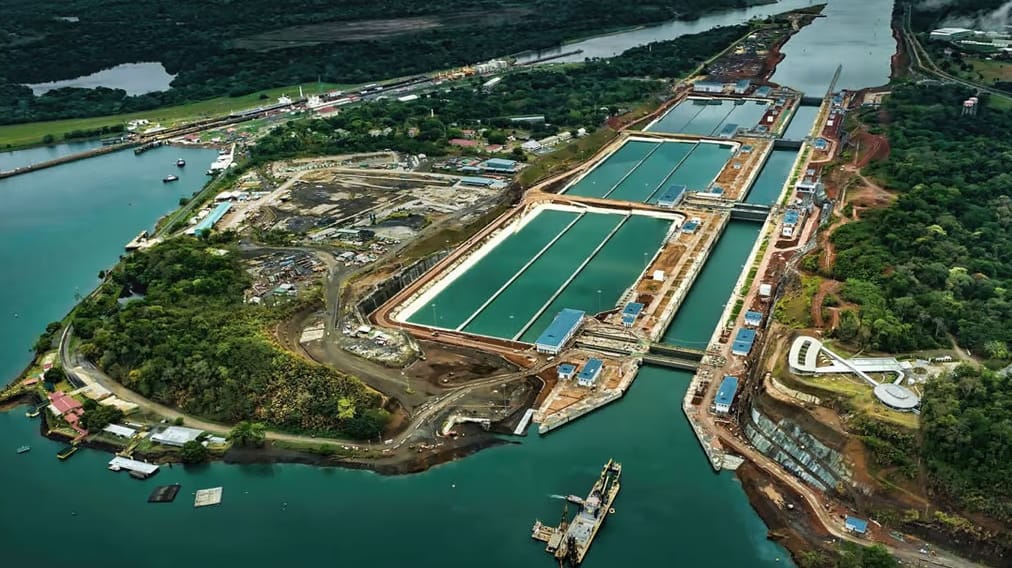
War and accidents are not the only causes of maritime chokepoints. Many of the bottlenecks identified in the FMC investigation, including the Suez and Panama canals, are susceptible to weather-related restrictions (and in fact, the EVER GIVEN incident was caused in part by an uncommonly strong sandstorm with high-velocity winds). With the advent of an unprecedented and historic El Nino phenomenon in 2026, the issue of maritime bottlenecks is becoming a problem well beyond the Middle Eastern war theater due to effects on the water levels in Gatun Lake, the manmade body of water that controls the passage draft for vessels transiting the Panama Canal. Due to the extreme drought conditions brought on by this year’s “Super El Nino” event, the water level in Gatun Lake has been trending well below historic levels, leading to increasing levels of passage restrictions by the Panama Canal Authority (PCA).

These conditions led to both draft restrictions and per-day transit restrictions in September 2026, the latter of which included a cap for daily vessel transits at 34 as of September 4, with a further reduction to 32 transits starting September 15. There had been anticipation of even further reductions to 29.5 in October, but the PCA recently indicated these additional cuts would not be necessary — at least through December — due to meagerly higher rain levels in August/September. However, the previous restrictions led to PCA auctions for transit slots, resulting in a record-breaking $5.3 million bid (for a liquefied natural gas tanker) for transit on September 1, which “exceeded the previous record of $4.6 million set earlier in August and was nearly 100 times the median auction price of about $55,000 recorded before February.”  

The unanticipated delays, and potentially unanticipated costs, of navigating maritime chokepoints affected by human-generated or naturally occurring restrictions can have serious implications for charter party (C/P) terms, particularly with regard to laycan, redelivery, and termination terms.

As an obvious example, delays due to chokepoint restrictions may affect a chartered vessel’s ability to deliver within the designated C/P laycan period.

The situation may be even more complicated at the end of a C/P when the vessel is being redelivered. Generally, a C/P redelivery deadline will be deemed to be approximate absent specific, express wording stating otherwise: “Where a time charter is for a stated period, the date for re-delivery should be regarded as an approximate date only, unless there is a clear agreement to the contrary.” (See THE “DIONE,” SMA No. 860A (1974)). 

In either case (i.e., whether redelivery date is approximate or a date certain under sufficiently express C/P language), the final voyage of the vessel to the redelivery port generally must adhere to the so-called legitimate final voyage doctrine. This rule requires that a time charterer’s “final” voyage instruction on the redelivery voyage must be issued in circumstances that would reasonably allow — based on all known or reasonably knowable facts at the time the order is issued and/or when the final voyage is ready to commence — for the vessel to be timely redelivered to the redelivery port. “As a general rule, a shipowner is not obliged to obey a charterer’s order to perform an illegitimate last voyage, defined as a voyage that cannot be completed in time for the vessel to be redelivered within the contract period.” (In Re Addison Shipping & Trading SA v. Bayoil U.S.A. Ltd., SMA No. 3791 (2003)).

Further, a charterer’s tender of an illegitimate final voyage order may amount to a repudiatory breach of the C/P, which could potentially allow the owner to assert a claim for direct or consequential damages due to the breach. Whether and how the doctrine applies — and in particular the point (or points) in time at which the reasonableness of timely redelivery should be assessed — are highly fact and circumstance dependent and will also depend on the relevant C/P wording.

Due to the Panama Canal transit and draft restrictions currently in place and anticipated through the fall, as well as the dynamic circumstances resulting from hostilities emanating from the Iran conflict, the legitimate final voyage doctrine should be a front-and-center consideration for both vessel owners and time charterers for vessels whose trade patterns require chokepoint transits as part of any redelivery voyage. If a vessel’s redelivery voyage commences on the Pacific side of the Panama Canal bound for a Caribbean/Atlantic-side redelivery port (or vice versa), careful consideration must be given by both the charterer and the owner as to whether there is a reasonable basis for that voyage to be completed within the redelivery period.

The same is true for vessels transiting other chokepoints facing war-related restrictions. In this regard, “[t]he relevant time for considering the question of reasonableness of an estimate as to the length of the last voyage is [generally] immediately prior to the last voyage” (Wilford, Coghlin and Kimball, TIME CHARTERS, p. 90 (3rd ed. 1989)); although some authorities indicate that what might be an initially legitimate final order may be rendered illegitimate by a change in circumstances after issuance and before commencement of that voyage. This inquiry is necessarily fact-intensive and fact-specific, and will also depend largely on the terms of the C/P itself.

Given the highly circumstantial factors informing the doctrine, numerous questions may arise if a vessel finds itself held up and waiting in line until the next round of capped canal transits or caught in wartime transit restrictions. Likewise, force majeure principles generally will not apply if there is an alternative rerouting that can avoid a chokepoint — even if that alternative is more costly and time-consuming. (See Ocean Tramp Tankers Corporation v. V/O Sovfracht (The Eugenia) [1963] 2 Lloyd’s Rep 381 (CA)).

Does the legitimate final voyage doctrine require that a charterer or owner participate in a Panama Canal Authority auction to ensure timely redelivery in a trans-canal redelivery voyage? If so, who will bear responsibility for the auction price under the C/P terms? If not, who is responsible, and at what rate, for any alternative routing around the Panama Canal, including potentially via the much longer (and sometimes more perilous) routes through the Strait of Magellan or the Drake Passage around South America?

Similarly, if a vessel must reroute around the Strait of Hormuz or Bab el-Mandeb Strait, does hire remain due for any extended period of the voyage? If so, at what rate? And what party is responsible for any increased war risk insurance premium? How do “utmost despatch” and “deviation” clauses (and potentially other similarly directed clauses) affect the situation? Likewise, how do any delays (whether waiting for canal passage or rerouting) affect cost allocations under the C/P terms for things such as bunkers, pilotage, and other operating expenses? With respect to PCA draft restrictions, who will bear responsibility for any cargo carriage restrictions/limitations resulting from reduced capacities to comply with those restrictions?

These are all potential questions that should be front of mind for vessel owners and charterers as maritime chokepoints continue to be affected by the Iran hostilities and ancillary conflicts, and as the Panama Canal continues to experience the historic environmental impacts of the Super El Nino.

Chris Hannan is a partner in the Maritime Practice Group at Jones Walker and a member of the maritime litigation, arbitration, and dispute resolution team. He represents clients across the maritime, insurance, and energy sectors in high-stakes litigation and complex regulatory and contractual matters, both domestically and internationally.

The opinions expressed herein are the author's and not necessarily those of The Maritime Executive.


Massive Cyber Attack Threatens Release of Data from 38 Maritime Companies

cyberattack
A total of 38 companies appear caught up in the current attack with ransom amounts ranging in the millions of dollars

Cybersecurity firms are alerting the maritime community to what appears to be a massive data breach possibly exposing 38 organizations ranging from shipping lines to ports, terminal operators, and agencies. According to the information, a newly emerged, shadowy “data-theft extortion operation,” n0n Group, posted the names of the 38 organizations on October 12 and gave them one week to pay millions in ransom or have their data released.

The list of companies includes the offices of major shipping lines, including Ocean Network Express (ONE) in Singapore, CULines, T.S. Lines, and companies in South Korea, Japan, and Indonesia. It also includes ports and terminals ranging from South Korea to India, Saudi Arabia, Spain, Brazil, and Vietnam.  In addition to agencies supporting shipping operations, it also reaches into related businesses, including Chinese crane manufacturer ZPMC. 

Not a lot is known about the group, which first emerged on the scene in September and, prior to this, has appeared to make broad opportunistic strikes according to the security firm SOCRadar. Before this, it believes the group, which is likely located in Russia, had hit a total of 21 organizations ranging from investment firms to telecommunications, retail, education, and the pharmaceutical industry in a total of 17 countries. 

None of the shipping companies and others among the 38 organizations that were listed on a dark web site have publicly confirmed the attack. SOCRadar says the companies have until October 19 to make payments with Bitcoin, or their data will be published. The ransom amounts vary by the amount of data n0n claims to have, with SOCRadar saying it is between $2.4 million and $14 million, although the group indicates a willingness to negotiate with at least some of the organizations.

SOCRadar analyzed the information and believes the exposure likely came out of one shared system. It notes that n0n appears to avoid traditional ransomware development and instead manipulates a victim’s data with administration tools. The current attack seems to be centered on firms in Asia.

The breach appears to involve a narrow group of categories, reports SOCRadar, such as EDI messages, manifests, gate and equipment interchange records, terminal system configuration, release documents, and deployment material.  It notes that the attack resembles other unrelated mass-exploitation extortion campaigns in 2023 and 2024, where a flaw in one widely deployed fire transfer product in a single application created the exposure.

The Israeli maritime cybersecurity company Cydome has also released an analysis of the attack. It writes, “Our assessment points to a possible compromise of a shared environment associated with CLT, a maritime software provider with documented ties to many of the named organizations. The source and scope remain unconfirmed.”

Cydome advises maritime operators, “This highlights the importance of checking supplier exposure, reviewing vendor access and assessing credentials shared through support channels.”


U.S. Navy Seeks Contractors for $15 Billion Puget Sound Shipyard Upgrade

Bremerton

The U.S. Navy is moving towards  the selection of a contractor for its massive Bremerton naval shipyard overhaul, one of the largest maritime infrastructure projects in the Northwest in a generation. The $15 billion project includes the construction of a massive new drydock for aircraft carriers at Naval Base Kitsap, plus related improvements to the adjacent waterfront.

Most of the existing shipyard at the Bremerton base dates back to the turn of the 20th century and is now well over 100 years old. The newest drydock was built during the Cold War. All of it was laid out for an earlier era of shipbuilding and an earlier generation of Navy tonnage; modern supercarriers are far bigger than the vessels in service in the 1890s. 

The multi-award contract will offer up to five prime contractors the opportunity to split up the project into sections, each allocation valued at $1 billion minimum. Various phases of design and construction will be awarded to the selected contractors as the project progresses, generally in tranches of several billion dollars at a time. 

"This project is a massive engineering undertaking that will require the highest levels of industry expertise," said Capt. Troy Brown, the project officer for Multi-Mission Dry Dock, in a statement earlier this year. "We encourage companies of all sizes, including our local and regional small businesses, to review the Sources Sought notice . . . Partnering with us means joining the team directly responsible for delivering the foundation of fleet readiness."

The objective of the overhaul is to give the Bremerton yard - the heart of the area's local economy - the capacity it needs to keep overhauling the nuclear-powered carrier and submarine fleet. It is the only West Coast yard certified to do nuclear carrier refueling, a deep, multi-year overhaul process.

The scope of work for installing a new carrier-sized drydock at an existing yard is massive. The site will need demolition of existing facilities, installation of new tunnels, substations, rail systems, crane tracks, flooding and dewatering systems, and new off-site facilities for relocating some existing functions. 

Bids are due by December 1, and contractor selection is expected in 2027. Physical site work could begin as early as 2030, according to the GAO's estimates. The independent auditing agency believes that the overall Navy-wide public yard upgrade program will cost about $200 billion and take approximately 50 years to complete, based upon its own analysis of planning documents. 

WAR ON GREEN ENERGY

Trump Administration Asks Court to Let It Re-Evaluate Revolution Wind's COP

offshore wind turbines
Revolution Wind has completed installing 65 offshore wind turbines and was expected to complete commissioning by the end of the year (Orsted)

The Trump administration is renewing its challenges to Ørsted’s offshore wind farm, Revolution Wind, located off the coast of Rhode Island. The Department of Justice is asking a District Court in the District of Columbia to remand its prior approval of the construction and operations plan (“COP”) for further review on a project that has completed construction and is in the final stages of commissioning.

It marks the third time the Trump administration has challenged the 704 MW wind farm project, which is contracted to supply power to Connecticut and Rhode Island. In August 2025, it sought to stop construction while the project was approximately 80 percent complete, but it was rejected by the courts. In December 2025, the administration included Revolution Wind in its stop-work orders, this time contending the operations posed a risk to national security due to the potential for radar interference. The courts again rejected the stop-work order and let the project resume construction in January 2026.

The Department of Justice made its new filing in a case being pursued by an environmental group that has been challenging the project in the courts for years. Green Ocean has been suing the Department of the Interior and Revolution Wind, contending the project would cause harm to the environment.

The new filing made on October 9 asked the court to grant Green Ocean a summary judgment on its claims against the National Marine Fisheries Service and the U.S. Army Corps of Engineers, related to the approval of the project. Further, it says the Department of the Interior agrees that remand of its prior approval of the construction and operations plan (COP) for the Revolution Wind Project is warranted so that the agency can reevaluate its compliance with the Outer Continental Shelf Lands Act.

The project gained its approval in 2023 during the closing days of the Biden administration. The Trump administration is alleging the Bureau of Ocean Energy Management issued the approval after it found that its preferred alternative was “expected to have major impacts on commercial fisheries and for-hire recreational fishing; cultural resources; other marine uses: scientific research and surveys; and visual resources.”

The federal government is asking the court to send the approval of the COP back to the Department of Interior for further review. It would create a state of uncertainty for the project after years of review.

Revolution Wind, which is located approximately 15 nautical miles off the coast of Rhode Island, completed the installation of its final, number 65, wind turbine in September. It had begun delivering power to the grid in March 2026 and is in the final stages of commissioning, with the project expected to be fully completed by the end of the year.

Revolution Wind represents a $6.2 billion investment led by Ørted. Its investment partner in the project is Skyborn Renewables, which is owned by Global Infrastructure Partners, a division of BlackRock.

While the administration has repeatedly sought to derail offshore wind energy projects and faces several lawsuits, this move came as a surprise. Last month, the U.S. Senate reported it had reached a bipartisan compromise for the overhaul of the permitting process for large infrastructure projects. It included power plants and cabling. 

The Republicans are anxious to move reforms forward, citing the growing power demands, especially for AI data centers, a priority of the administration. Democrats made a condition of their support for the reforms an agreement that the administration would stop its challenges to previously permitted renewable energy projects, including offshore wind and solar. Experts point out that the new challenge to Revolution Wind would likely endanger the compromise for overhauling the approval process for infrastructure projects.

The Financial Times reports the Pentagon had recently sent out documents indicating it was resuming some of the reviews it had stalled earlier in the Trump administration. The delays in the reviews had become an issue for the courts after an earlier decision that said the administration could not have an open-ended review of the approval process. In addition to the court cases challenging individual projects, the administration has been sued both by California and a coalition of eastern states over its buybacks of offshore wind leases.


Despite Rumors, Logistical Shortfalls Rule Out Russian-Iranian Oil Blending

Rumor
Hundreds of miles of Caspian Sea transit separate Iran from Russian shores (NASA file image)

Speculation has recently mounted that Iran is managing to export its crude oil using routes over the Caspian Sea. Given the Iranian regime’s sanctions-breaking expertise, developed over nearly 50 years, one might expect the Iranians capable of putting such diversions in place. But as yet there is little public evidence that they have managed to do so in any appreciable quantity.

Iranian oil is produced onshore in the southwestern province of Khuzestan (from the Ahvaz, Gachsaran, Marun and Aghajari oilfields) and offshore in the Gulf from the Abuzar, Doroud, Foroozan and Salman fields. Iran’s domestic oil is largely refined in Gulf coastal areas close to the producing fields, in part because pipelines headed northwards have to go through the Zagros Mountains.

There is however the Ahwaz-Ray Oil Pipeline, which can deliver 300,000 bpd of crude from the Dezful oilfield to Tehran refineries.  This supplements a small 100,00 bpd capacity pipeline from Yeke Tut on the Caspian coast to Tehran and thence to Tabriz, which is fed by crude purchased from Russia, shipped south across the Caspian. These two crude pipelines therefore enable refineries to produce petroleum products for Tehran and north-western Iran. There is also a petroleum product pipeline delivering 204,000 bpd of petrol and diesel direct to Tehran from the south as well. 

But for the moment there is no means of getting Iranian crude in bulk from the main producing fields in the southwest past Tehran to the Caspian. It might be possible to switch the flow of the Tehran to Yeke Tut pipeline, and make it an export rather than an import pipeline – and to convert it even to carry petroleum products such as diesel. It should also be feasible to expand the terminal at Yeke Tut to handle greater volumes. 

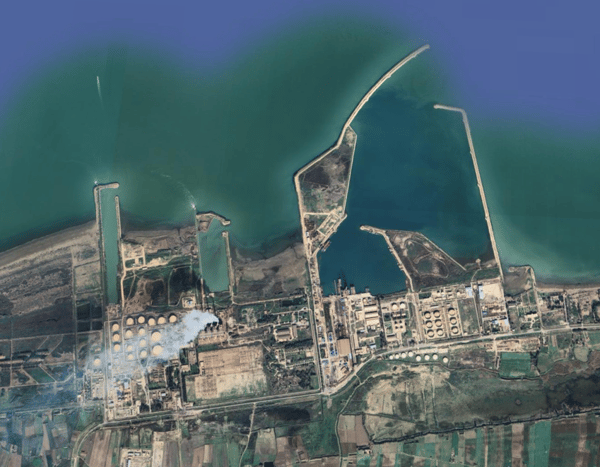
The Caspian coast oil pipeline terminal at Yeke Tut north of Zaghmarz (Google Earth/Airbus/CJRC)

From Yeke Tut, Iran would need a tanker fleet to move the crude north across the Caspian. Russia does have a fleet of shallow-draft tankers which can navigate both the Caspian and Volga-Don Canal system, but Russia is already facing difficulties exporting what it produces itself. Even Iranian ingenuity is unlikely to deliver a quick technical or infrastructure solution to these gaps in the network. 

Caspian region pipeline networks (CIA World Factbook)

Iranian pipelines, including natural gas (red) (CIA World Factbook)

A number of other export solutions might be available to Iran if it enjoyed normal relations with its neighbors to the north. But Iranian threats have soured relationships, and diplomatic exchanges and visits by Iran to these northern neighbors are usually received coolly.  

In theory, Iranian oil could be shipped through the BTC pipeline to Ceyhan from Baku, but there is no way of getting Iranian oil to Baku. Nor would Azerbaijan – which has a tense diplomatic relationship with Tehran - want to facilitate such an arrangement.

At the moment, Baku takes in Kazakh oil shipped across the Caspian Sea from Aktau. The oil is shuttled across the Caspian by five specially-designed, shallow-draft, Kazakh-flagged crude tankers, several of which are owned by foreign investors.

This fleet has been built up by Kazakhstan to reduce dependency on shifting its oil through the Caspian Pipeline Consortium (CPC) pipeline, which runs north of the Caspian through Russian territory. A study of the AIS tracks of these five tankers show them largely sticking to the Aktau-Baku route, and none ever going near Iranian waters. (However, AIS does show that some may periodically visit Makhachkala, north of Baku on Russia's Caspian coastline.)

For Iran, the ultimate goal would be to resume the 90% of exports of oil which went to China, now that shipborne exports by ship have been completely cut by the US naval blockade. The CPC in Kazakhstan already moves oil eastwards to China through Alashankou, but again there is no logistical means to get Iranian oil into the CPC, either at Aktau or elsewhere. The Kazakh government would not in any case be keen on the idea, as the risk of sanctions would also jeopardize the running of the CPC pipeline westwards.  

Given Iranian ingenuity, the sanctions-breakers will be trying to invent new routes. They may be particularly focused at the moment on increasing exports of products such as diesel and petrol rather than crude, which technically would be easier than increasing crude exports. But they face formidable infrastructure challenges, and their adversaries are watching for any signs that they are making a breakthrough. Ukraine has already demonstrated it has the capability to detect and engage any available Russian-associated targets in the Caspian Sea.

The opinions expressed herein are the author's and not necessarily those of The Maritime Executive.


China Merchants Energy Shipping & RINA to Explore AI-Driven Ship Operations

China Merchants Energy Shipping and RINA Partner to Explore AI-Driven Ship Operations and Next-Generation Maritime Technologies

[By: RINA]

China Merchants Energy Shipping (CMES), one of the world's leading shipping and maritime transportation companies, and RINA, the multinational inspection, certification, ship classification and engineering consultancy group, have signed a Memorandum of Understanding (MoU) establishing a framework for strategic cooperation across maritime safety, digitalisation, operational excellence and emerging shipping technologies.

The agreement creates a platform for long-term collaboration, enabling the two organisations to combine their expertise and explore opportunities that support innovation and the evolving needs of the maritime sector. The partnership expands on the existing relationship between CMES and RINA and provides a framework for cooperation across a range of technical and operational areas.

Under the MoU, CMES and RINA will explore initiatives related to fleet safety and risk management, carbon emissions management and regulatory compliance, digitalisation and data-driven vessel operations, as well as the application of artificial intelligence to areas such as predictive maintenance, energy efficiency and operational decision-making. The agreement also encompasses the study of alternative fuels, alongside smart shipping technologies, automation and other innovations relevant to the future development of the maritime industry.

The cooperation will additionally promote technical exchange, research activities and knowledge sharing, with the aim of supporting operational excellence and helping both organisations navigate a rapidly evolving regulatory and technological landscape.

The products and services herein described in this press release are not endorsed by The Maritime Executive