Thursday, October 22, 2026


Russia's Black Sea strikes in Romanian waters test NATO's response - Carnegie Europe

Russia's Black Sea strikes in Romanian waters test Nato's response - Carnegie Europe
Drone attacks on shipping have spilled into Romanian and Bulgarian jurisdiction while sabotage hits targets on land, challenging Nato's response, a Carnegie Europe analyst argues. / bne IntelliNewsFacebook
By Ben Aris in Berlin October 20, 2026

Russia's drone strike on a tanker inside Romania's territorial waters last week is a new escalation that tests Nato's mutual defence clause, Carnegie Europe senior fellow Dimitar Bechev argued in a commentary on October 20. 

Bechev said the October 14 drone attack on the Comoros-flagged tanker Yara J near the port of Sulina was the first to land in Romania's territorial waters rather than its exclusive economic zone (EEZ), where earlier strikes had taken place in an event that could in theory trigger Nato's Article 5 collective security clause and spark a world war.

Tensions between Europe and Russia have been rising as the US withdrawal of support are pushing the nascent Euro Nato into ever more assertive action to help its ally Ukraine, which Russia matches with an escalating hybrid war. With no conversation between Moscow and Brussels at all, the risk of a mistake that could spark a direct clash between Russia and Europe are growing, say experts.

Russia “has crossed another red line”, and Nato and the EU now have to work out how to respond, Bechev wrote.

Seven ships have been hit by aerial and underwater drones this month along the same stretch of EU and Nato coastline, and 27 crew are confirmed dead or missing, according to the commentary. Two of the vessels sank off Bulgaria in attacks on October 6 and 13, and Sofia called off the search for the crew of the Alpha Watan less than a day after it went down.

The strikes carry Russia's campaign against Ukraine's sea trade to the doorstep of two EU and Nato members just as the alliance weighs how far to reinforce its southern flank, and they land days before Bulgaria, whose government wants to mend ties with Moscow, elects a president on October 25. Bechev frames the moment as a double escalation: horizontal, as strikes spill into Romanian and Bulgarian jurisdiction, and vertical, as sabotage raises the stakes on land.

“Directly or by proxy, Russia is de facto prosecuting its war on the union’s and the alliance’s territories, both at sea and on land,” he wrote.

The EU is struggling to deter hybrid attacks pitched below the Article 5 threshold, according to Bechev. Security services still cooperate poorly across borders, the division of labour between the EU and Nato is unsettled, and governments remain reluctant to use offensive responses.

Ukraine squeezed at sea

Russia is pressing its advantage as winter arrives, the commentary says. Ukraine's access to early-warning intelligence has been sharply reduced by US restrictions, its interceptor stocks are running low and its Starlink satellite access has reportedly been throttled at the behest of the Trump administration.

Odesa, Chornomorsk and Pivdennyi, which handle 95% of Ukraine's grain exports, are under constant threat from port strikes, and the Danube offers no safe alternative: grain ships leaving the Romanian river port of Galati have also been hit, Bechev wrote. Container traffic at Odesa has already stopped and shifted to the Danube, and the closures have fed a food price shock on world grain markets.

Turkey has called for a deal to restore freedom of navigation, with Foreign Minister Hakan Fidan warning that the Black Sea must not become a new front, and Kyiv has asked Ankara for help as $10bn of farm exports face risk. Bechev expects Moscow to press ahead regardless.

Bucharest has reported at least six incursions by Russian drones, and Romanian F-16 fighters shot down two drones over the country's territorial waters on October 17. Romania has logged 35 unauthorised drone incursions so far this year against nine in 2025, and has shot down six, Stars and Stripes reported. The airspace breaches began well before the shipping attacks, with Romania downing its fourth Russian drone in August. Bechev reads the October 17 incident as a sign of Russia's readiness to take risks.

Bulgaria's hybrid front

Bulgaria has also been suffering from the campaign onshore. Weapons depots exploded in August and September, including a fire at an EMCO ammunition depot that investigators treated as possible sabotage. On the night of October 9-10, 11 antennas at a classified Starlink facility near Sofia were set on fire, and arrest warrants have been issued for two German nationals suspected of the arson. Bechev links the attack to an earlier one on a Starlink ground station in Poland, where Russian involvement has been suspected.

Prime Minister Rumen Radev is one of the loudest voices in Brussels for restoring economic ties with Moscow and talking to President Vladimir Putin, and he has warned Europe against escalation with Russia. Sofia has pulled out of the coalition of the willing backing Ukraine, presenting the move as serving the cause of peace. Caretaker President Iliana Yotova shares Radev's views and is courting the Russophile vote, and she leads the polls ahead of the October 25 presidential election.

Their positions have not shielded Bulgaria from the attacks, and both have been reluctant to blame Moscow, while Radev appears to be pleading privately for help from Nato and the US, Bechev wrote.

“The moral of the story is that being friend or foe makes little difference to the Russians. They will look for opportunities and soft targets to strike at Ukraine and its Western supporters,” he wrote.

What Nato can do

Romania, a Russia sceptic, and Bulgaria, a dove, have nonetheless taken the same line, asking for a bigger Nato presence in the Black Sea. The North Atlantic Council, the alliance's top decision-making body, is meeting at their request, though neither country has invoked Article 4, which triggers formal consultations on whether an ally's territorial integrity is at stake. Romanian Foreign Minister Oana Toiu said the council would meet in Brussels on October 20 to discuss expanding Nato's military presence and surveillance in the region, according to Stars and Stripes.

The European Council has condemned the attacks on civilian shipping and called for navigation to be restored. Bulgaria's defence minister now says the country will join Nato's anti-drone initiative after earlier saying it would not, and Sofia has asked allies for aircraft, air policing support and surface-to-air missile systems.

Bechev argues the escalation at sea is for Nato to handle, both because Article 5 is being tested and because Romania and Bulgaria want a regional command with Turkey, a leading Nato ally outside the EU. He proposes broadening the mandate of the Turkish-Romanian-Bulgarian mine-clearance naval mission to monitor all three countries' territorial waters and enforce freedom of navigation, and stepping up Nato air policing over the Black Sea. Ankara can also play a diplomatic role through its ties to Moscow, he wrote.

He is cautious about what a show of force can achieve.

“A show of strength will not necessarily solve the problem. In all likelihood, it will contain the strikes deeper into the Romanian and Bulgarian EEZs,” Bechev wrote, adding that it falls to Ukraine and its Western allies to find a counter to Russia's drones and restore commercial shipping out of Odesa and other ports.

 

Russia builds 200 missiles, 10,000 drones a month, Ukrainian intelligence says

Russia builds 200 missiles, 10,000 drones a month, Ukrainian intelligence says
Ukraine's military intelligence puts Russian output at more than 200 missiles and about 10,000 strike drones a month, with up to 700 ballistic missiles in stock before winter. / bne IntelliNewsFacebook
By Ben Aris in Berlin October 21, 2026

Russia is building more than 200 missiles and about 10,000 strike drones a month, Ukraine's Main Directorate of Intelligence (HUR) told NV on October 20.

The agency puts the stockpile as of October at up to 700 ballistic missiles, several thousand cruise missiles of various types and more than 6,000 strike drones. Of the missiles coming off the lines each month, 110 are ballistic.

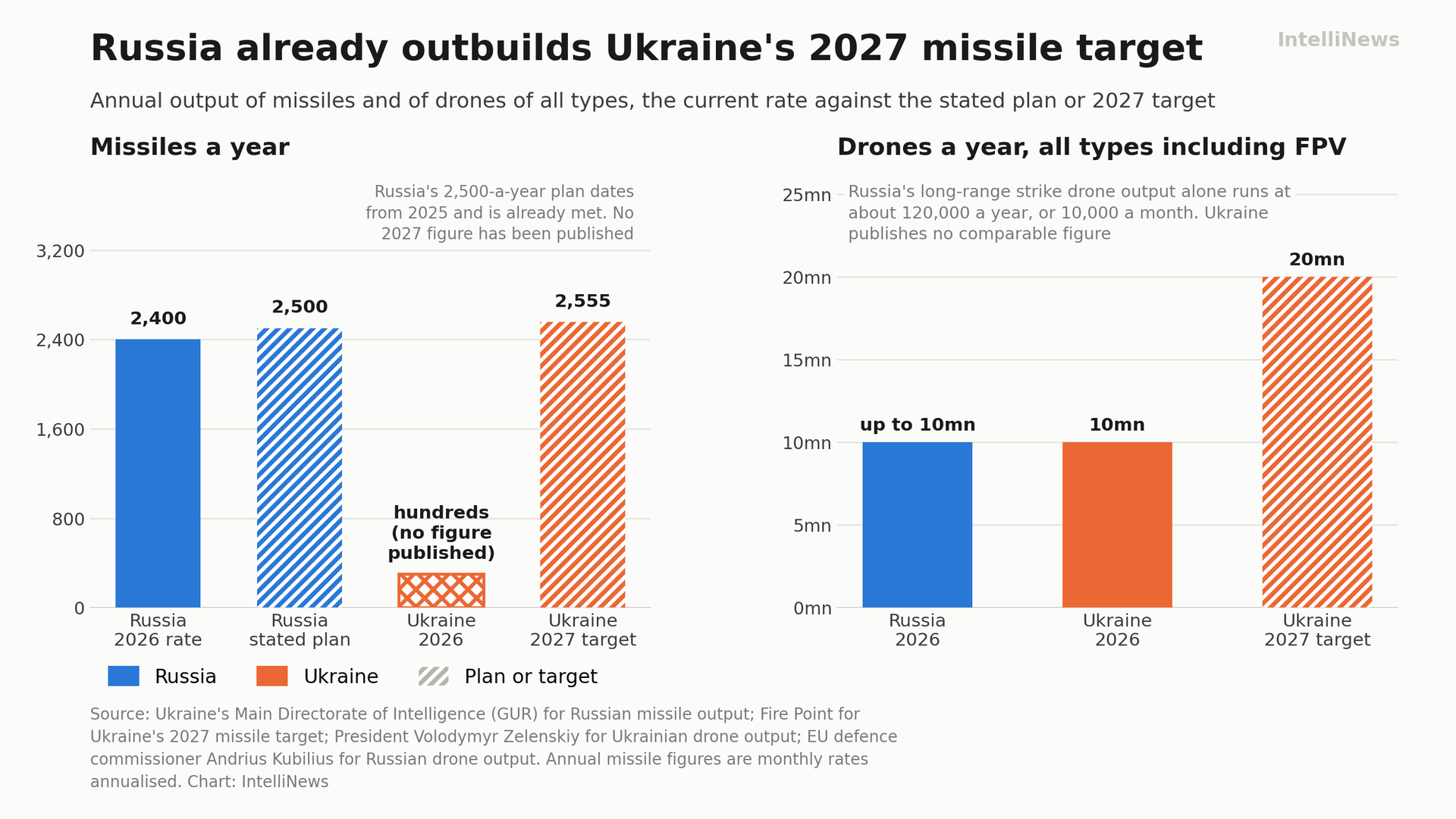
That is a war industry already running past the plan Ukrainian intelligence set out for it a year ago, when it reported a Russian aim to double missile output to 2,500 a year and lift drone production to 2,700 a month. The headline missile rate annualises to more than 2,400 a year, while the named classes add up to about 225 a month; the drone figure is almost four times the stated 2,700-a-month plan. Ukraine, which started the war with no missile industry of its own, still counts its missile output in the hundreds a year.

Russia already outbuilds Ukraine's 2027 missile target. Annual output of missiles and of drones of all types, the current rate against the stated plan or 2027 target. Russian missile output is GUR's monthly figure annualised; Russia's 2,500-a-year plan dates from 2025 and no 2027 figure has been published. Drone totals include FPV models and are not like for like with long-range strike output.

Ukraine now makes 10mn drones a year and wants 20mn with help from its partners, President Volodymyr Zelenskiy said in July, against about 4mn in 2025. Its missile and drone arsenal is the mirror image of Russia's: the missile side rests on the Neptune and the Flamingo, whose maker Fire Point plans serial production from 2027 at up to seven a day, or 2,555 missiles a year, with a ballistic programme that saw its first combat use, of the FP-7, in October.

Russian missiles 

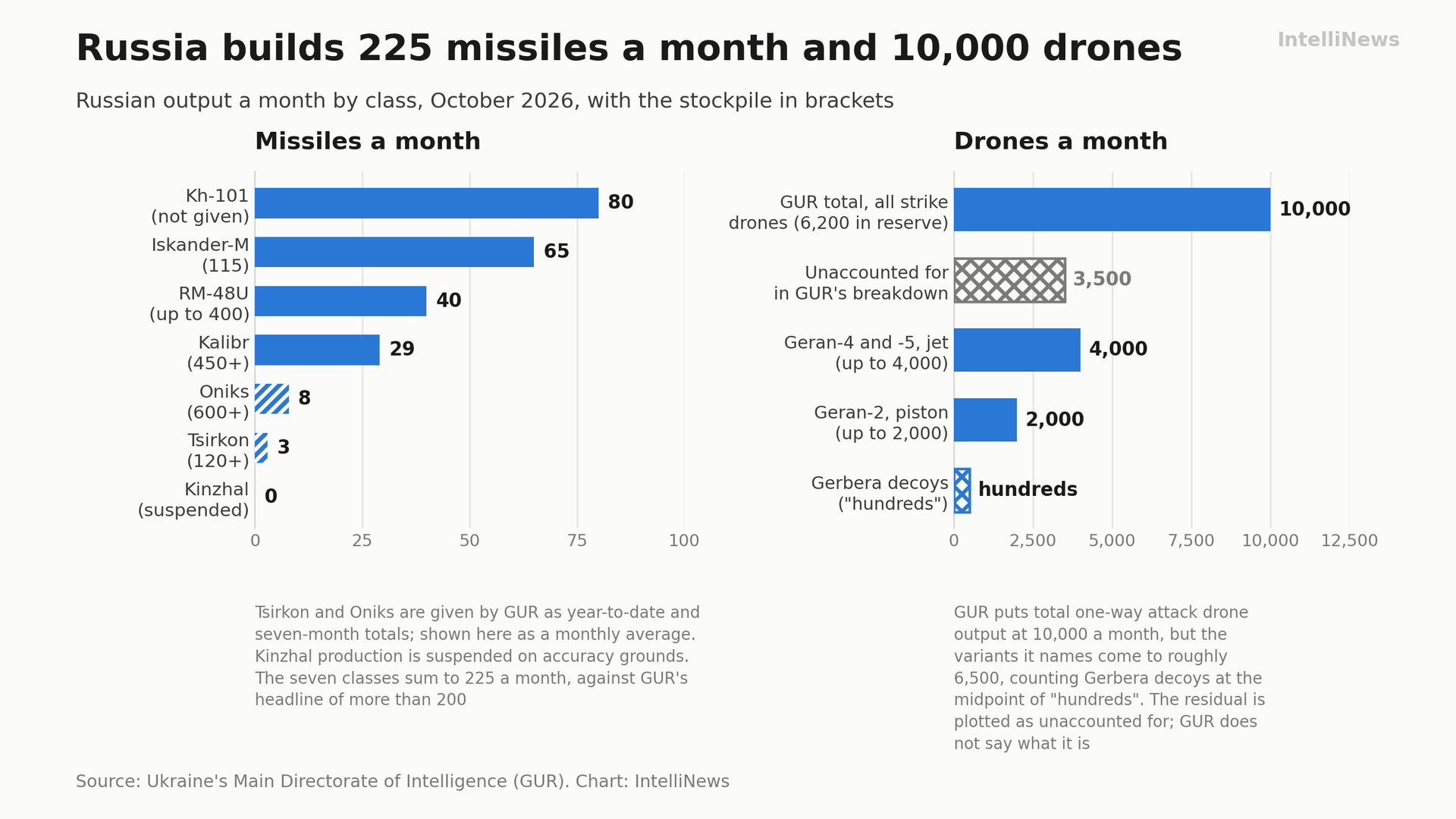
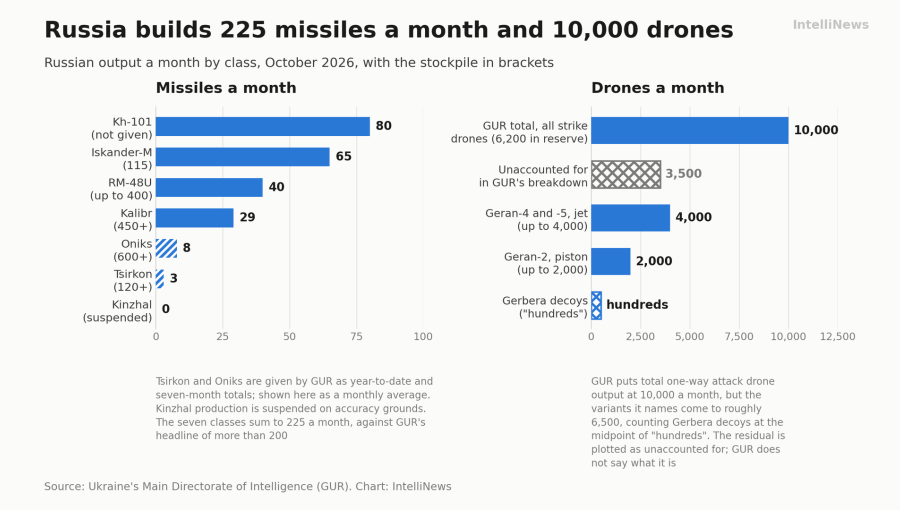
The Kh-101 remains the mainstay of Russia's mass strikes, with a monthly plan of more than 80 and factories said to be beating it. Iskander-M output runs at up to 65 a month against a stock of about 115.

The RM-48U, an S-300PM and S-400 air defence missile adapted to hit ground targets, is made at about 40 a month from a stock of up to 400, and the sea-launched Kalibr at about 29 against more than 450 held. Most new Kalibrs go to the strategic reserve and to the fleets because Ukrainian air defences shoot down so many, the agency said.

Russian output a month by class, October 2026, with the stockpile in brackets. Tsirkon and Oniks are given by GUR as year-to-date and seven-month totals and are shown here as a monthly average; Kinzhal production is suspended. GUR's drone total of 10,000 a month is larger than the variants it names, and the residual is plotted as unaccounted for. Source: Ukraine's Main Directorate of Intelligence (HUR).

Stocks of the modernised Oniks anti-ship missile, now given a longer range and a heavier warhead, exceed 600, of which more than 55 were built in the first seven months of 2026.

The hypersonic Tsirkon passes 120, with just over 30 made this year. Production of the Kinzhal aeroballistic missile has been suspended because it was not accurate enough, and that capacity switched to conventional ballistics.

The list leaves out the Banderol, the cheap light cruise missile Russia put into mass production in August.

Russian drones

On drones the agency gives a total of 10,000 one-way attack aircraft a month and an operational reserve of about 6,200 Geran airframes of all modifications, jet-powered ones included. Since the summer the effort has gone into the jet Geran-4 and Geran-5, at up to 4,000 a month, alongside up to 2,000 piston Geran-2s and hundreds of plywood and foam Gerbera decoys flown to drain air defences and expose Ukrainian launcher positions.

This year's state order for Geran-type and decoy drones at the Alabuga special economic zone in Tatarstan has passed 100,000 units, a figure intelligence said showed "a systemic bet by the enemy on exhausting the Ukrainian air defence system", Ukrainska Pravda reported on October 21.

Russia is also developing a modernised Iskander-M with a projected range of 550-700 km, against up to 500 km now. GUR deputy head Vadym Skibitskyi said in September that Russia planned to finish testing a new ballistic missile reaching 800 km by the end of 2026, and in August he put the defence industry's performance against its own missile plans at 110-120%.

Ukraine goes into winter with its interceptor missiles run dry and Russia again working to freeze it into submission by taking down the grid.


Russia strikes Kyiv with three cluster-warhead ballistic missiles, Zelenskyy says

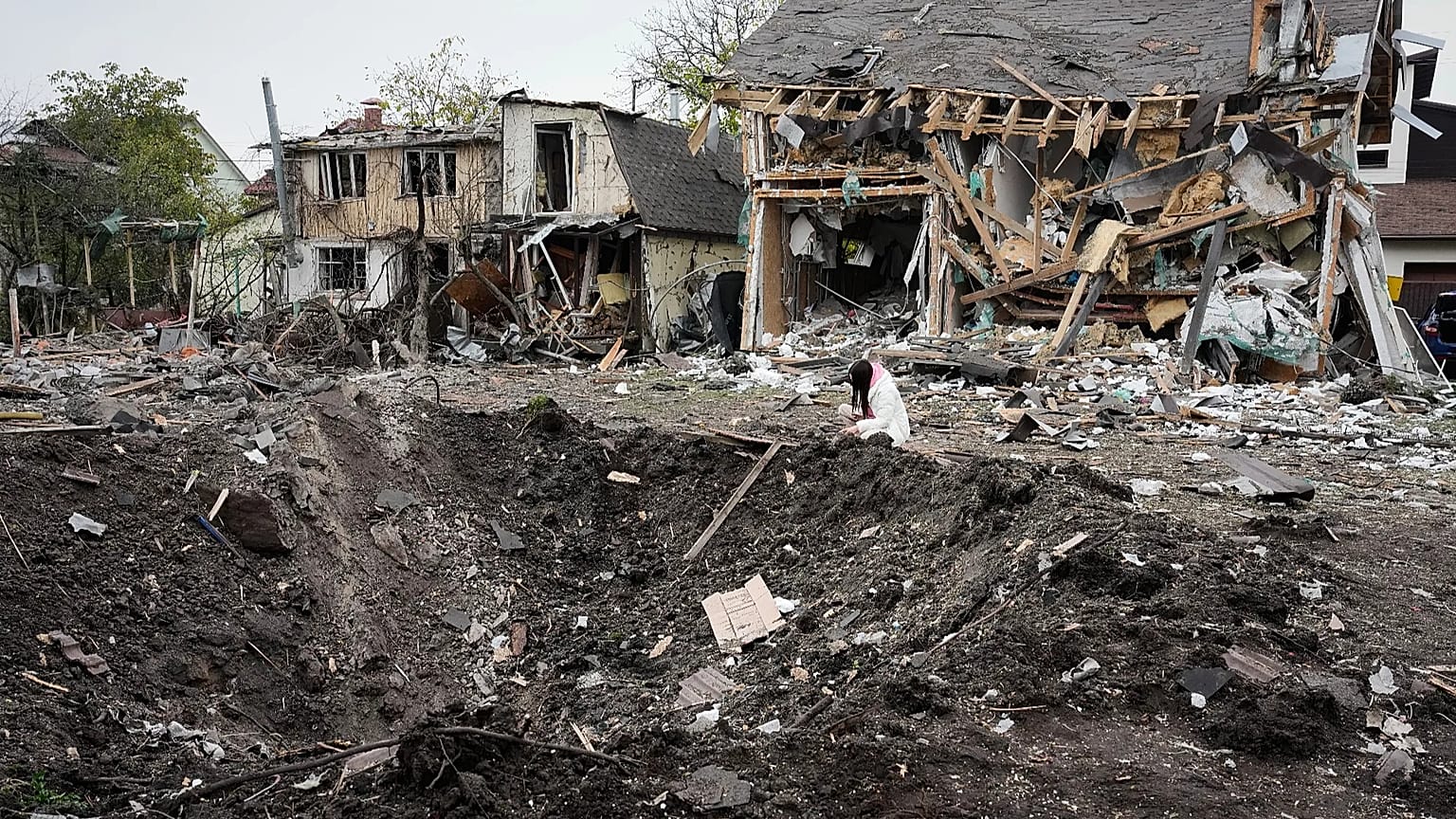
A woman looks at a crater after a Russian missile strike in Kyiv, Ukraine, Thursday, Oct. 22, 2026.
Copyright AP Photo

By Sasha Vakulina
Published on


The latest Russian bombardment of Ukraine's capital came just hours after US envoy Steve Witkoff met Vladimir Putin in St Petersburg, underscoring the stark contrast between Washington's renewed diplomatic efforts and Moscow's continuing attacks on Ukrainian cities.

Russian forces struck Kyiv overnight with three ballistic missiles carrying cluster warheads designed to inflict maximum casualties across densely populated areas, Ukrainian President Volodymyr Zelenskyy confirmed on Thursday.

One of the missiles struck Pechersk, the Ukrainian capital's historic centre, hitting an area between the Kyiv-Pechersk Lavra and the Holy Presentation Monastery, damaging religious buildings, homes, shops, cafés and other civilian infrastructure.

The missiles were designed to detonate in the air as they approached their targets, dispersing explosive submunitions across an area 400 metres in diameter, Zelenskyy said.

Serhii Beskrestnov, Ukraine's presidential adviser known by his callsign "Flash", earlier identified one of the missiles as an Iskander equipped with a K5 cluster warhead.

At least two dead and dozens injured

"This warhead detonates above the ground and is used specifically for inflicting maximum harm to people and equipment over an area of 400 by 400 metres," Beskrestnov said, adding that its 58 bomblets explode in the air.

Zelenskyy accused Moscow of deliberately targeting civilians in Kyiv's historic centre, insisting that the choice of both weapon and location was intentional.

"This is another extraordinarily revealing strike – revealing because it was no accident. The choice of weapon was deliberate, the choice of target area was deliberate, and so was the intent to inflict as much loss and damage on civilians as possible," he said.

"There was no military target nearby, not even in theory, and the weapon was designed to cause widespread destruction."

The strike was part of a large-scale Russian aerial assault on the Ukrainian capital and surrounding region overnight on 21–22 October.

At least two people were killed and 34 others injured, including five children, across the affected areas, according to Zelenskyy.

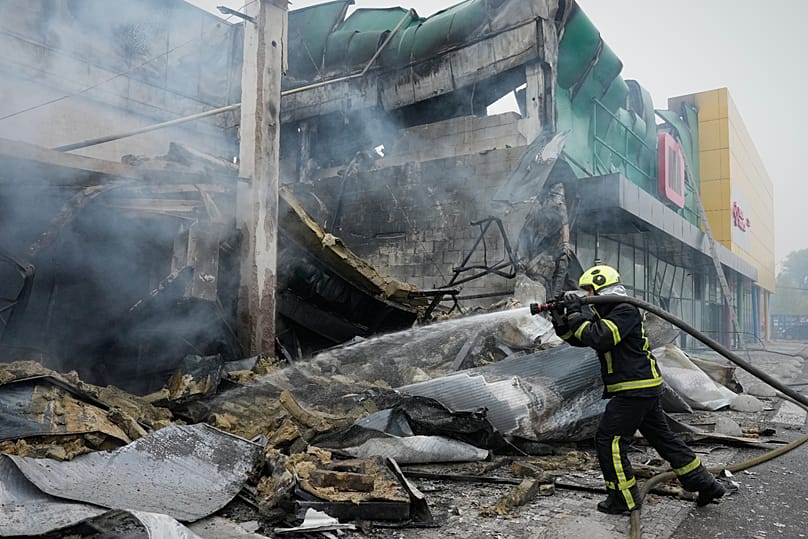
Firefighters try to extinguish a fire after a Russian missile attack in central Kyiv, Ukraine, Thursday, Oct. 22, 2026. AP Photo

The bombardment came in several waves, with ballistic missiles and drones striking residential neighbourhoods, transport facilities and medical infrastructure across the capital.

Kyiv authorities reported damage in the Holosiivskyi, Obolonskyi, Pecherskyi, Sviatoshynskyi and Dniprovskyi districts.

Ukraine's Air Force said Russia had launched 210 drones, including 110 jet-powered variants, alongside Iskander-M, S-400, Zircon and Onyx missiles.

Ukrainian air defences intercepted or suppressed 181 drones, including 87 jet-powered variants, while strikes were recorded at 32 locations and falling debris at another eight.

Zelenskyy said Russia had fired 21 missiles in total during three waves of ballistic strikes on Kyiv.

The attacks continued throughout Thursday, with further strikes reported in Kharkiv, Dnipro, Marhanets, Mykolaiv and Kherson, as well as several other regions. In Kharkiv, a commuter train was hit, according to the Ukrainian president.

Zelenskyy said Russia had carried out more than 170 strikes against critical energy facilities since 11 October, despite Ukrainian air defences intercepting significant numbers of drones and some missiles.

He warned that Ukrainian intelligence identified Russian priorities for further attacks in the coming weeks, accusing Moscow of exploiting delays in Western air defence supplies.

"Russia is clearly taking advantage of the slowdown in air defence supplies from our partners," he said, calling for the accelerated delivery of military assistance already approved by Ukraine's allies.

The overnight bombardment came just hours after US special envoy Steve Witkoff met Russian President Vladimir Putin in St Petersburg as Washington sought to revive negotiations to end the war.

During the visit, Witkoff described Putin as a "humanitarian", despite the Russian president being wanted by the International Criminal Court over the alleged unlawful deportation and transfer of Ukrainian children.

Zelenskyy said on Wednesday that Ukraine was ready to accept literally any form of truce, on any aspect of the war, that Russia would be willing to agree to.

But following the latest attacks, the Ukrainian president questioned Moscow's willingness to pursue peace.

"Russia has not changed the way it wages this war, and it is taking no steps that would signal a genuine desire to end it," he said.


Ukraine's partners peel away as Poland dispute threatens arms package over UPA honours

Ukraine's partners peel away as Poland dispute threatens arms package over UPA honours
An unnamed source said a Polish arms package was on hold after a Lviv tribute to wartime nationalists; Poland’s defence ministry denied the report. / bne IntelliNewsFacebook
By Ben Aris in Berlin October 22, 2026

Poland has put a large weapons package for Ukraine on hold after Lviv regional councillors voted to dedicate 2027 to the far-right  Ukrainian Insurgent Army (UPA), RBC-Ukraine reported on October 21, relations with several of Ukraine's allies deteriorate thanks to diplomatic blunders. 

Later the same day, Poland’s defence ministry spokesman called the report “false information”, RBC-Ukraine reported, but relations with Poland are tenser than first appear due to lingering animocity over the Volhynia WWII massacre and a growing resentment to the million Ukrainian refugees living in the country. 

Councillors in Lviv voted on October 20 to name next year after the UPA, which served as the military wing of the OUN-B (the Banderite faction of the Organization of Ukrainian Nationalists) and has been accused by historians of participating in mass ethic cleansing and other atrocities. The year is also dedicated to UPA's commander Roman Shukhevych and the nationalist poet Oleh Olzhych.The regional authorities had "managed" to hold the vote just as Warsaw was preparing the shipment, the source said.

"Their irresponsible actions have now put delivery of this package on hold. Intensive efforts are underway through back channels to resolve a problem that was created out of nothing."

Ukraine fatigue is gathering momentum fast. When the UN General Assembly voted to condemn the invasion in March 2022, 141 states backed the text and just five opposed it – including Russia. This month, when Russia put its own resolution counting Western sanctions among the modern forms of colonialism to the Assembly’s Fourth Committee, only 49 countries voted against it — the US, the UK, Japan, Israel, Ukraine and all 27 EU members among them — while every BRICS state voted in favour, backing the Russian motion. The coalition that once mustered 141 votes against Moscow can no longer reliably field 50, and almost all of those it does field are Western.

Relations rows

The quarrel is the third in a month between Kyiv and a country it counts as a friend. South Korea is pulling half its diplomats out of Kyiv, Ukrainian President Volodymyr Zelenskiy has accused US President Donald Trump of pushing Ukraine to capitulate, and a growing number of EU governments say they will not help fill a €70bn hole in Ukraine's 2027 war budget.

The coalition behind Kyiv has shrunk from the whole EU, under the Biden administration, to the coalition of the willing and now to a handful of leaders whose voters are losing patience with the heavy spending going to 

Warsaw reacted angrily. Prime Minister Donald Tusk said such demonstrations "only harm Ukraine", and Foreign Minister Radoslaw Sikorski asked for a five-year Schengen entry ban on Sviatoslav Sheremeta, the councillor behind the resolution. Defence Minister Wladyslaw Kosiniak-Kamysz called the vote unacceptable and said it "deepens divisions" between the two nations. "The Ukrainian authorities must distance themselves from this position," he said.

Kyiv moved quickly. Ukraine's foreign ministry called the Lviv decision "counterproductive", and Poland's Deputy Foreign Minister Marcin Bosacki said officials close to Zelenskiy had promised it would not take effect. The announcement has since disappeared from the council's website, although it has not been formally revoked.

History wars

The UPA is honoured by many Ukrainians as an independence army that fought Soviet rule, but its units killed an estimated 30,000 to 60,000 Polish civilians in Volhynia and eastern Galicia in 1943-1944, crimes Poland regards as genocide. Between 20,000 and 30,000 Ukrainians were also killed in the violence.

The Lviv vote reopens a wound that had barely closed. In the spring Zelenskiy gave a special forces unit the honorary title "Heroes of the UPA", and on June 19 Polish President Karol Nawrocki stripped him of the Order of the White Eagle, Poland's highest award. Senior politicians in Warsaw then threatened to block Ukraine's EU accession bid unless Kyiv stopped glorifying the UPA. Polish voters are with them: 44% favoured suspending military aid over the UPA honours in a July poll, against 41% who wanted it to continue.

The shift in Kyiv's memory politics has been driven from the top. In May Zelenskiy attended the reburial of Andriy Melnyk, a wartime leader of the Organisation of Ukrainian Nationalists who offered to march alongside the Wehrmacht, with his chief of staff Kyrylo Budanov at his side. Budanov presented it as the first step towards a "Pantheon of Prominent Ukrainians".

The links between the state and the far right are an uncomfortable fact that Kyiv's allies have mostly chosen not to discuss. Andriy Biletsky, founder of the Azov movement, now commands the army's 3rd Corps and regularly appears in presidential polls, and veterans of Azov's political wing run frontline technology units showcased to Western defence companies.

Seoul walks out

South Korea said on October 20 it would withdraw about half of its embassy staff from Kyiv, after recalling its ambassador on October 8 for the first time in protest since a 2008 dispute with Japan. A charge d'affaires and the consular team will stay.

The row began when Zelenskiy told the UN General Assembly on September 23 that Ukraine had handed two captured North Korean soldiers to Seoul. South Korea says both sides had agreed to keep the transfer secret to protect the men's families in North Korea. Kyiv "had taken no positive steps" despite repeated requests for an explanation and an apology, foreign ministry spokesman Park Doo-soon said. Seoul is one of the few Asian democracies that has backed Ukraine politically and with humanitarian aid.

Trump turns

The break with Washington is the most damaging. "I believe steps have been taken to convince Ukraine to capitulate," Zelenskiy told Bloomberg in an interview on October 18, accusing the US of slowing Starlink connections, delaying Patriot interceptors and failing to pass on early warnings of Russian ballistic missile launches.

The quarrel followed Trump's deal with Russian President Vladimir Putin to hold off new sanctions in exchange for Russian diesel exports to cool fuel prices before the November 3 midterms. Trump has since said "somebody else" should negotiate for Ukraine and told reporters that "Russia frankly has been fine on Ukraine". It is the worst rupture since the Oval Office shouting match of February 2025, after which Kyiv spent weeks getting relations "back on track" by agreeing to US-led ceasefire talks.

Kyiv can least afford it now. Ukraine's interceptor missiles have run dry as Russia steps up strikes on the grid, and Nato officials fear the personal feud could force Kyiv into a painful settlement, Bloomberg reported on October 20.

Running out of money

Europe is also tiring of the bill. The EU has already lent Ukraine €90bn for 2026-2027, but Zelenskiy has asked for at least €70bn more to cover next year, putting the cost of the war in 2027 at €155bn. EU leaders agreed at their October 15-16 summit that the €70bn gap must be covered, but Czech Prime Minister Andrej Babis said straight afterwards that Czechia would not guarantee more borrowed EU money for Kyiv.

Bulgaria followed on October 20. "Bulgaria cannot contribute to this EUR 70 billion," Prime Minister Rumen Radev said, state news agency BTA reported. Radev had already pulled Bulgaria out of the coalition of the willing in July, saying it would not take part in a group "that insists on continuing financial and military aid to Ukraine", Ukrinform reported. With Slovakia refusing state military aid since Robert Fico returned to power in 2023, most of Central Europe is now outside the camp paying for Ukraine's war.

In France, the far-right frontrunner for next spring's presidential election, Marine Le Pen, has pledged to end financial support for Kyiv while continuing to train Ukrainian troops and supply military aid, the Kyiv Post reported.

Germany remains Kyiv's biggest European backer, but at a political cost to Chancellor Friedrich Merz. "My biggest concern is not our economy," Merz told the Berlin Global Dialogue this week, saying he worried more about Russia's influence on German society, the Berliner Zeitung reported. Only 15% of Germans are satisfied with his work, the AfD leads at a record 30% and more than four in 10 say German support for Ukraine has gone too far, an INSA poll for Bild am Sonntag showed in early October, Euronews reported.

That leaves Ukraine relying on a shrinking circle of governments in Berlin, Paris, London and the Nordic and Baltic capitals, whose leaders remain committed even as their voters drift away.


Thailand deepens reliance on Israeli arms, purchasing anti-drone system from IWI

Thailand deepens reliance on Israeli arms, purchasing anti-drone system from IWI
IWI logo / Israel Weapon Industries US on FacebookFacebook
By IntelliNews Tel Aviv bureau October 22, 2026

Thailand has purchased the Arbel computerised anti-drone system from Israel Weapon Industries (IWI), local Globes reported, marking the technology's operational debut in East Asia.

The procurement suggests growing demand in Thailand for Israeli arms. In September, IntelliNews said the Royal Thai Air Force plans to acquire Israel Aerospace Industries' Rampage standoff missiles alongside Elbit Systems' MPR-500 penetration bombs and Lizard III guidance kits.

This followed Thailand’s decision last December to accelerate a deal worth more than $100mn with IAI for the Barak MX air defence system, which marked the country's first acquisition of an Israeli air defence platform.

Bangkok’s decision to retrofit existing weapon inventories builds upon established operational links with IWI, a subsidiary of Sammy Katsav's SK Group, whose Tavor X95, Galil ACE, and Negev platforms were deployed extensively along the Cambodian frontier during recent border frictions.

The transaction, which follows deployments across 25 partner nations, equips existing Royal Thai Armed Forces infantry rifles through a modular lower-receiver replacement.

The plug-and-play mechanism integrates computerised trigger-control technology directly into standard 5.56mm service weapons, mechanically firing the initial round before regulating fire rates automatically to neutralise loitering munitions without requiring external targeting sensors or secondary platforms.

The contract highlights not only a rising East Asian demand for Israeli weapons, but a growing concern among such customers over potential regional security risks, particularly as China-Taiwan tensions simmer.

Recognising this growing demand, Israeli defence industry executives have strengthened engagement with Japanese leaders in the hopes of securing future defence export deals.

Japan is anchoring regional procurement momentum, raising its defence expenditures by 25% over the 2020–2026 cycle from $48bn to $60bn and allocating JPY 1 trillion ($6.4bn) specifically to unmanned systems.


Serbian students march into Belgrade ahead of crucial election

Serbian students march into Belgrade ahead of crucial election
Thousands greet student marchers with fireworks, music and flags as the movement prepares for a final rally ahead of Sunday’s vote / studenti.orgFacebook
By Tatyana Kekic in Belgrade October 22, 2026

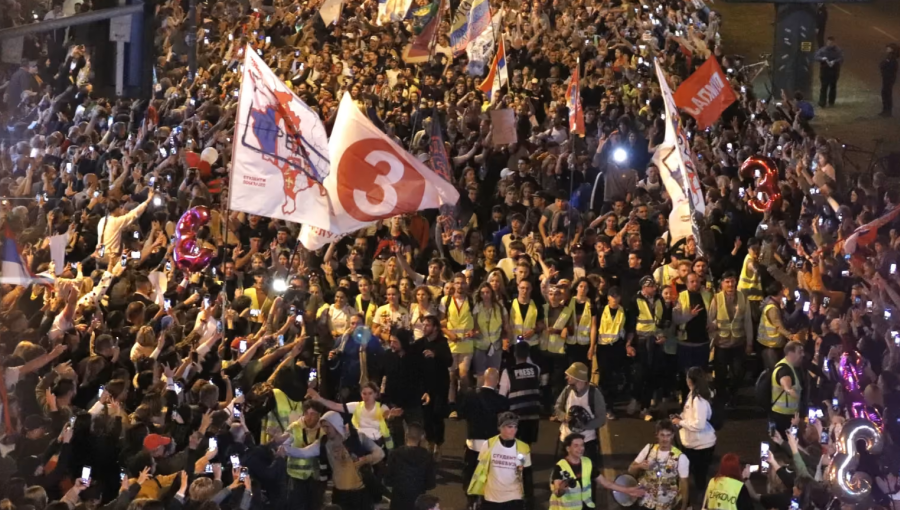
Cheers, music and fireworks greeted students arriving in Belgrade from across Serbia on the evening of October 21, in a festive show of support ahead of a final rally that will test whether their anti-government movement can turn two years of protests into electoral gains.

Long columns of students and supporters who had walked from the north, west and east of the country were welcomed by large crowds near the University of Belgrade’s Rectorate, where a red carpet was laid out for their arrival. People waved flags, blew whistles, lit torches and sang as the marchers entered the capital.

The arrival was a prelude to a final rally on October 22 at Slavija Square, where the student-backed electoral list, running under the name “Students Win”, is due to gather at 18:00 under the slogan “Victory is Calling”.

The scenes echoed the energy of the mass demonstrations that have swept Serbia since November 2024, when 16 people were killed by the collapse of an exterior roof at the railway station in the northern city of Novi Sad.

What began as demands for accountability over the disaster and for the release of classified documents behind the station’s renovation grew into a wider movement against corruption and the long-standing rule of Aleksandar Vucic and his Serbian Progressive Party (SNS). Students have organised university blockades, strikes, road closures and repeated mass rallies, drawing support from people across the country.

Thursday’s planned gathering in Belgrade marks a decisive moment for the movement as it seeks to carry that momentum from the streets to the ballot box in Sunday’s snap parliamentary election.

The students were joined on their marches by cardiologist and university professor Ilija Srdanovic, who heads their electoral list, as well as theatre director Zeljko Hubac, actor Tihomir Stanic and sociologist Jovo Bakic.

The movement has brought together academics, doctors, engineers, artists and other public figures, campaigning on a platform focused on institutional reform, judicial independence, anti-corruption measures and greater transparency in public procurement.

But the enthusiasm on display in Belgrade poses a central question for the election: can a movement that has mobilised large crowds and reached communities across Serbia translate its public support into enough votes to challenge a ruling party that has dominated politics for more than a decade?

The Serbian Progressive Party (SNS), in power since 2012, is also holding its final campaign rally in Belgrade on October 22, at 16:00 at a sports hall in New Belgrade. The party has organised rallies in other cities, including Nis and Novi Sad.

Vucic, who resigned as president in September to campaign as the SNS candidate for prime minister, has said the party wants to demonstrate that it expects to win across the country.

Some recent polls suggest the student-backed list could significantly reduce the SNS’s support. However, the ruling party retains extensive political networks and a strong base among older voters, while the student movement is seeking to mobilise undecided voters and convert a broad coalition of supporters into votes with a broad programme centred on corruption and institutional reform.

The final rallies will take place against a backdrop of concerns about unequal media access, pressure on public-sector employees, the unfair use of state resources and possible electoral irregularities. Opposition parties and civil society groups have raised concerns about the fairness of the electoral environment.

Meanwhile, the detention of six men ahead of the vote has prompted allegations of political intimidation. Prosecutors said the men were suspected of preparing to overthrow the constitutional order during Sunday’s election. Opposition figures have described the case as politically motivated and intended to intimidate the opposition.

Belgrade is also preparing for two major sporting events on Thursday evening. Red Star Belgrade will host Denmark’s Copenhagen in the UEFA Conference League at the Rajko Mitić Stadium, while Partizan and Red Star meet in a EuroLeague basketball derby at the Belgrade Arena. Tickets for the basketball game have sold out, with around 20,000 spectators expected.

The concentration of political supporters and sports fans across the capital has raised questions about security and crowd management.

For the student movement, the focus will be on Slavija Square, which has hosted several major demonstrations since the Novi Sad disaster. A rally there on 15 March 2025 drew an estimated 300,000 people, according to the Archive of Public Gatherings (Arhiv javnih skupova).

The challenge now is to turn the solidarity and enthusiasm visible on the streets into an electoral force. Sunday’s vote will show how far the protests have shifted public opinion — and whether the movement can mount a serious challenge to the political establishment it has spent nearly two years opposing.