Wednesday, October 21, 2026


Source: Dollars & Sense

I dream of seeing the title of this post on bumper stickers, billboards, and personal tattoos. The slogan “Tax the rich and save the world” comes from a message from the Patriotic Millionaires—a group of more than 200 high-net-worth Americans, from investors and executives to filmmakers and heirs, who are actively lobbying Congress to raise their own taxes. 

Millionaires are watching billionaires pull further ahead financially, and watching their coastal properties sink closer to the waterline as unchecked carbon emissions push sea levels higher. As ecological economist James K. Boyce explains, the concentration of wealth that drives carbon-intensive consumption is the same force blocking the public investment needed to address it: The ultra-wealthy have the resources to protect themselves from environmental degradation, as well as the political power to resist dealing with it. Taxing the rich could help keep the planet livable for the rest of us. 

The growing visibility of wealth concentration is rousing a coalition of economists, lawmakers, labor unions, and the worried rich who are pushing back against four decades of trickle-down orthodoxy. Their message is gaining traction: the ultra-wealthy are not paying their fair share, and working-class voters are getting shafted.

The Myth of 40%

A useful place to start is with a number you’ve probably heard: According to the Wall Street Journal, the top 1% of taxpayers pay about 40% of all tax revenue. Jeff Bezos recently reiterated this scandalously misleading claim. The figure applies only to federal income taxes, ignoring both Social Security taxes and state and local taxes. The Congressional Research Service estimates that about 63% of U.S. tax filers pay more in payroll taxes—Social Security and Medicare—than they do in federal income taxes. In addition, state sales taxes and local property taxes eat up a larger percentage of the income of low and middle-income families than those at the top.  

When the full tax picture is considered, the wealthy’s “fair share” argument really falls apart. Paul Krugman dissects Bezos’s claims in detail, and John Miller examines the Wall Street Journal’s panicky response to Republican Mitt Romney’s proposed tax reforms. The structural roots of the problem are powerfully explained by Emmanuel Saez and Gabriel Zucman in The Triumph of Injustice, which documents how the U.S. tax system systematically privileges income from capital over income from labor. The most striking and consequential strategy rests on wealth accumulation: the very rich let their assets grow, untouched and tax free (capital gains aren’t taxed unless and until assets are sold for a profit). When the very rich need cash, they borrow against those assets at interest rates far below the income tax rate on wages—allowing wealth to compound while generating no taxable income at all. Capitalists have good reason to love capital.

California in the Headlines

In a Left Hook post last October, I described some important steps toward “taxing the top.” Now California has captured national attention with a ballot initiative that could make history. This coming November, voters in the state will decide on the 2026 Billionaire Tax Act—a one-time levy of 5% on billionaire wealth, spread over five years. If passed, it would be the first tax anywhere in the world explicitly targeted at the combined personal and business wealth of billionaires. The initiative was drafted with input from Saez and Zucman and has already collected 1.6 million signatures—nearly double the number needed to qualify for the ballot.

The case is straightforward. California’s roughly 250 billionaire households—0.001% of the state’s families—now hold wealth equal to more than half of California’s entire annual economic output. Yet from 2019 to 2025, while their wealth grew an average of over 15% per year, they paid on average just 0.26% of their wealth annually in state income taxes. The four wealthiest Californians—Sergey Brin, Larry Page, Jensen Huang, and Mark Zuckerberg—paid an effective tax rate of just 0.07% of their wealth. Because they didn’t sell their stock, its rising value was simply never taxed.

The proposed tax would raise approximately $100 billion—enough to offset the federal health care and social program funding that the Trump administration has stripped from the state. Critics warn that billionaires will flee to Nevada or Florida, but Saez and Zucman have done the math: even if every single California billionaire departed, it would take 25 years for the resulting loss in tax revenue to exceed the one-time haul from the wealth tax. Washington state has already passed a millionaires’ tax, and New York City’s mayor is proposing a 2% levy on residents earning over $1 million—California is widening a door that other states can walk through.

The Momentum in Washington

While private wealth has been concentrating for some time, the policies of the Trump administration have dramatized the dynamics. The Institute on Taxation and Economic Policy (ITEP) has done the unglamorous work of actually following the money—and its findings are striking. All but the richest 5% of Americans are paying higher taxes on average than they did last year. 

Elected officials are taking notice. The 118th and 119th Congresses have seen a cluster of Democratic-sponsored bills targeting capital income and accumulated wealth. None has advanced out of committee under the current Republican majority, but together they represent the most sustained and varied legislative push on this front in a generation. Four proposals stand out:

Senator Markey’s (D-MA) Equal Tax Act would require millionaires and billionaires who earn most of their income through investments to pay the same tax rates as wage earners and would close loopholes that allow the super-rich to shelter income from taxation entirely. Senator Bernie Sanders (I-VT) is a cosponsor, and the Patriotic Millionaires have energetically lobbied for it.

The Ultra-Millionaire Tax Act of 2026, sponsored by Senator Elizabeth Warren (D-MA) and Representatives Pramila Jayapal (D-WA) and Brendan Boyle (D-PA) with more than 45 cosponsors, would impose an annual 2% tax on the net worth of households and trusts exceeding $50 million, with an additional 1% surtax on wealth above $1 billion. To discourage tax avoidance through expatriation, it includes a 40% exit tax on any U.S. resident worth more than $50 million who renounces citizenship.

The Billionaire Minimum Income Tax Act, promoted by Representatives Steve Cohen (D-TN), and Don Beyer (D-VA) would require households with a net worth exceeding $100 million to pay a minimum annual 25% tax rate on their full income—including unrealized capital gains. Under the current law, gains on assets that are never sold are simply never taxed; this bill closes that gap.

The ROBINHOOD Act—introduced by Representative Dan Goldman (D-NY), a multimillionaire who acknowledged the bill would raise his own taxes—targets the “buy, borrow, die” strategy directly, imposing a 20% excise tax on loans and lines of credit backed by capital assets such as stocks, bonds, and real estate. It is the most targeted legislative response yet to the borrowing-instead-of-selling loophole described above.

Crossing the Divide

A majority of working-class Trump supporters may already agree with the core of this agenda. Research suggests that more than half—53%—of white working-class Americans, a core MAGA constituency, believe the best way to grow the economy is to raise taxes on wealthy individuals and businesses and invest in education and infrastructure. A 2025 poll by The Working Class Project found that working-class voters overwhelmingly believe the GOP is looking out for the wealthy, billionaires, and big corporations—not them.

Researchers who study the MAGA coalition identify a significant segment they call “Anti-Elites”—voters who are genuinely suspicious of concentrated power, supportive of economic redistribution, and persuadable on tax policy. Both the California initiative and the national legislative push offer a rare opportunity to speak to these voters on their own terms. Why should a nurse or a truck driver pay a higher effective tax rate on their income than Mark Zuckerberg pays on his? Why should billionaires be able to borrow billions against untaxed stock gains while working families lose Medicaid?

Even millionaires stand to gain from a more sustainable economic environment. Morris Pearl, chair of the Patriotic Millionaires, is refreshingly candid about his motives: “Millionaires like me want less inequality because we and our families will be better off in a society with less economic disparity. I’m not any more altruistic than the next person—I’m just greedy for a different kind of country.”

Now there’s a form of greed that might actually do some good. The California ballot initiative, the cluster of bills in Congress, and the polling that reveals some political realignment—these are not isolated developments. They are pieces of a gathering challenge to four decades of upward redistribution. It might even be a gathering storm.


This article was originally published by Dollars & Sense; please consider supporting the original publication, and read the original version at the link above.
avatar

Nancy Folbre is a Professor of Economics at the University of Massachusetts Amherst and an associate editor of the journal Feminist Economics. She is the author of Greed, Lust, and Gender: A History of Economic Ideas (Oxford University Press).


Source: Originally published by Z. Feel free to share widely.

Spain votes on November 29 in a snap general election, and less than four weeks before the official campaign opens, housing, which in my reading opened the window of opportunity that led Prime Minister Pedro Sánchez to call it early, has become the issue that holds the Spanish left together. Survey microdata from the CIS, Spain’s state-run polling institute, already reveal an electorate built around it: 1.2 million people aged 18 to 34 who lean left and do not currently plan to vote for Sánchez’s Socialist Party (PSOE), although three in four name it as their second choice or the party closest to their views.

My argument is that this group forms an orphaned housing vote. It already cares about the issue, and what will decide its behavior is whether the government’s housing measures actually exist by the time it goes to vote. Many of them make up their minds in the final week and respond more to the threat of a loss than to a promise, so whether they come to trust that the measures address their situation directly and effectively will determine whether they vote at all, and for whom.

The debut generation

The group comes from pooling the CIS’s July and September barometers, reweighted to the actual 2023 vote because both waves overstate recalled Socialist voting by between 31% and 44%. These are young people who do not report an intention to vote Socialist but keep a tie to the party, and 77% name it as their second choice or closest party. They number 1,229,000, within a range of 1.03 to 1.43 million, or 3.4% of the resident electorate for November 29.

What defines them is the stage of life they are in. Fifty-seven percent are between 18 and 24, 92% are single and 60% are women; 38% are students, compared with 12% of young voters who still back the Socialists. Half of them arrive at this election without having voted in the last one, since 41% were too young in 2023 and another 10% stayed home; many belong to the 1,615,127 new voters the national statistics office counts for November 29, which is why I call them the debut generation. Their average ideological self-placement is 3.2 on a scale where 1 is the most left-wing position and 10 the most right-wing, and 75% rate Sánchez 5 or higher on a 1-to-10 scale, while 67% say they have little or no confidence in him, which is what is usually called a soft vote.

An available electorate

In 1990 the political scientists Stefano Bartolini and Peter Mair called this electoral availability: the share of the electorate that is not held in place by an identity or an organization and can therefore change its vote from one election to the next. Their study of a century of European elections showed that availability grows or shrinks with the strength of voters’ social and organizational ties to parties, and in my reading someone who has never voted has hardly any tie to break.

These voters are available in the most literal sense. Twenty-nine percent do not yet know who they will vote for and 15% would abstain or cast a blank ballot, while 60% say they vote “depending on what convinces them most.” Forty-one percent decide in the final week, on the day before the vote, when campaigning is banned, or on election day itself, compared with 30% of young voters who still back the Socialists.

Housing appears among the three most pressing personal problems for 63% of the group, more than double the rate for the electorate as a whole (27%), but that concern is not the same as support, because young Socialist loyalists cite it even more often (70%). In a regression that controls for sex, age, education, income and employment, housing has no measurable effect, and what separates the two groups is being a student, which cuts the odds of being a loyalist to a third.

Housing, in the letter of the decree

The CIS Housing Barometer asks people who do not own their home, would prefer to, and do not plan to buy within two years why they are not buying. A lack of money for the down payment is cited by 80.7% overall, and the figure rises in the categories that make up this group, to 88.5% among 18- to 24-year-olds and 89.7% among students. In the same survey, 77% of those aged 18 to 24 and 52% of those aged 25 to 34 say they would not qualify for a mortgage.

The government’s main response so far is Royal Decree-Law 29/2026, published in Spain’s official gazette on October 7, a package whose preamble addresses, among others, “young people who are unable to move out” of their parents’ homes. A royal decree-law is a measure the government can issue in cases of “extraordinary and urgent need”; it has the force of law from the date it sets, but it is repealed unless the Congress of Deputies votes to uphold it. This one extends existing residential leases by up to two additional years, caps annual rent increases at 2% through the end of 2027 when landlord and tenant do not agree otherwise, suspends in certain cases, through 2030, evictions of vulnerable households with no alternative housing, and creates a public loan to cover the down payment on a first home.

Read to the letter, the package does not reach the whole group equally. The rental measures in that decree have been in force since October 8 and protect people who already have a lease, who in my reading are mostly the roughly 579,000 young people in the group who already work, 67% of whom cite housing as a problem. The down-payment loan supplements a private mortgage and leaves its eligibility rules to a Cabinet resolution that, as of October 18, does not exist, so it requires what the survey says many of them lack. For the roughly 443,000 students aged 18 to 24 (an indicative figure, based on 65 interviews), the whole package is a promise about the years ahead, and it is only worth something if it still exists when they need it.

What can be lost

Daniel Kahneman and Amos Tversky showed in 1979 that people judge outcomes as gains or losses relative to a reference point, and that the curve by which they weigh losses is steeper than the one for gains. Put simply, losing something hurts more than gaining the same thing feels good, although, and this is my own reading, a loss weighs more when the thing at stake is already in hand.

On October 2, Spain’s Congress refused to ratify the first two housing decrees, and the main one, Decree-Law 26/2026, was defeated 178 to 172, with the conservative People’s Party (PP), the far-right Vox, the Catalan pro-independence party Junts and the small Navarrese conservative party UPN voting against. The government approved new versions on October 6, and with parliament now dissolved the decision passes to the Permanent Deputation, a standing committee of 69 lawmakers. Article 78.2 of the Spanish Constitution gives that body “the powers that correspond to the Chambers, in accordance with Articles 86 and 116,” and Article 86.2 requires Congress to rule expressly “on their ratification or repeal.” The October 16 session ratified flood-relief aid and left the housing decrees off the agenda; press reports place the vote on November 12, the day before the campaign begins. The second of the new decrees, on the stability of rental contracts, would only take effect on November 15 if ratified, and according to the fact-checking site Maldita, the Basque Nationalist Party’s announced opposition currently leaves it short of a majority.

My reading is that this vote changes what is at stake, because a parliamentary defeat only becomes an electoral cost for those who inflict it when voters feel something has been taken from them. The rental measures in Decree-Law 29/2026 are already in force and would lapse without ratification, so for young renters November 12 could bring a loss with a date attached and responsible parties who are not limited to the right. The down-payment loan, with no Cabinet resolution and no application process, can only be lost as an expectation. If the measures reach the campaign as headlines, their opponents will have a ready-made charge of electioneering to aim at an audience in which two in three distrust the prime minister. If they are known, ratified and working before the 13th, these voters will have a perceived risk of losing an opportunity that could push them to the polls on the 29th.

What each bloc wants

For the left, the priority is for what has been approved to work before the campaign starts, which in the case of the loan depends solely on the Cabinet, and to concentrate on urban provinces and the areas the law designates as stressed housing markets, where the rental crisis eats into people’s capacity to save. Madrid, Barcelona, València, Seville, Murcia, Alicante and Málaga account for 49% of the group. The left’s temptation is to announce more than the decrees actually say.

The political scientist Oriol Bartomeus wrote on October 6 that the People’s Party’s standing is propped up “by the PSOE’s weakness more than by its own performance.” The right arrives strong, with the PP and Vox together at around 51% in the polling average, compared with 45.4% in 2023. The best card for the center-right and the right is to shift the conversation from housing to economic growth and identity, now that the media firestorm over the late-July migrant influx into Ceuta, the Spanish city on the North African coast bordering Morocco, is dying down. In the preliminary results of the CIS October barometer, 68% describe their personal economic situation as good or very good while 58% say Spain’s is bad, which is the opening through which that message can enter. The most effective move against my argument belongs to the PP, because pledging to keep the rental measures, or allowing their ratification on November 12, would defuse the sense of loss, although it would force the party to explain its October 2 vote and to compete with Vox. It has a legal argument at hand, since several constitutional scholars consulted by Maldita question whether it is legitimate to reissue texts that the full Congress has just rejected, and do not rule out that the Constitutional Court could strike the decrees down in whole or in part.

The identity frame also has a date. Mujeres Caballas, a citizens’ group from Ceuta, is organizing a march in Madrid on October 25 that will end outside Congress, demanding, in the platform’s words, a “safe, dignified and peaceful Ceuta.” Turning it into campaign fuel tempts both those who want to change the subject and those who want to use it to stoke fear of the right, and both moves are costly, because the cost falls on relations between Ceuta’s communities.

If that change of frame works and the right wins, it faces a mirror image of the current term: a PP-Vox coalition whose partners would fight to hold on to their own voters, with a strong chance of serious tensions once the honeymoon ends. If it fails, the scenario is a People’s Party exhausted after eight years in opposition, which could lose further ground to a centrist option or to the radical right. As for the Socialists, if the orphaned vote stays home, they will have to explain why measures designed for that generation did not arrive in time, and if they win, they will have to govern with partners who do not currently back all of them.

The objection

The strongest objection to this argument is one I made myself in the Spanish policy magazine Agenda Pública on October 14. In the CIS post-election survey of 2023, late deciders moved mostly within their own bloc, and there was no late surge of abstainers favoring either side. Bartomeus also warned that Vox will compete for new voters, especially the half million men who will vote for the first time, and I am not certain the orphaned vote has only one suitor.

The votes in play range from 292,000, if only the group’s undecided voters and abstainers moved, to 768,000 if everyone with some tie to the Socialists did, or between 1.2% and 3.1% of the valid vote in 2023, a gap that separates two definitions of the group and is not a confidence interval. The low end rests on 72 interviews, and the microdata end on September 4, before the decrees and before the election was called.

On November 12 the Permanent Deputation will decide whether the housing decrees reach the campaign alive, and seventeen days later we will know whether anyone has adopted Spain’s orphaned housing vote, or whether that million-plus young people spend election day in someone else’s home.

Alma Ruiz is a Spanish political analyst based in Ceuta. She writes on Spanish elections for Agenda Pública and at almaruiz.es.

Sources

Bartolini, S., and Mair, P. (1990). Identity, Competition and Electoral Availability: The Stabilisation of European Electorates 1885-1985. Cambridge: Cambridge University Press.

Kahneman, D., and Tversky, A. (1979). “Prospect Theory: An Analysis of Decision under Risk.” Econometrica, 47(2), 263-291.

CIS (Centro de Investigaciones Sociológicas), July 2026 barometer (study 3571) and September 2026 barometer (study 3577), microdata; 2026 Housing Barometer (study 3532); preliminary results of the October 2026 barometer (study 3582).

INE (National Statistics Institute), voter rolls for the general election of November 29, 2026.

Spanish Constitution, Articles 78.2 and 86.2. Royal Decree-Law 29/2026, of October 6, Boletín Oficial del Estado no. 249, October 7, 2026.

Congress of Deputies, agenda of the plenary session of October 2, 2026.

Maldita, on the Permanent Deputation and the housing decrees, October 7, 2026. Alcalá Hoy, on the Permanent Deputation session of October 16, published October 17, 2026. Guía del Ocio, on the October 25, 2026 march in Madrid. Euronews, “Thousands of protesters take to the streets in Madrid over Ceuta migrant crisis,” September 26, 2026.

Bartomeus, O., “29N: empieza el baile,” Agenda Pública, October 6, 2026. Ruiz, A., “El espejismo de los doscientos escaños de PP y Vox,” Agenda Pública, October 14, 2026.

Alma Ruiz is a political analyst in Ceuta who has worked as an immigration and asylum lawyer on the southern border. Her website is at https://almaruiz.es/.


Source: Originally published by Z. Feel free to share widely.

Even though workers are usually referred to in labor law as the weaker party, they are far from helpless. When workers come together in unions, they create the capacity to organize industrial action and win collective bargaining. When this happens on a broad front, unions become the vehicle through which the working class moves toward a brighter future.

Not even those workers who may appear the most vulnerable – migrant workers – are helpless. On the contrary, once the organizing gets going, they can become both an engine and a spearhead of class struggle.

In recent years, a small trade union in Sweden – the syndicalist union SAC, particularly its Stockholm Local – has distinguished itself by defending migrant workers against all kinds of crooks. A rambunctious Russian-speaking union shakes up Sweden’s labor movement, writes the freelance journalist Volodya Vagner. In Jacobin Magazine, he urges Swedish unions to wake up to new forms of exploitation and points to syndicalist examples of direct action.

But then labor law enters the drama offering help on the way as well as pitfalls and roadblocks. In 2019, the Swedish parliament introduced an anti-strike law. The law was pushed through by the Social Democratic government with support from top leaders of the three big union confederations – LO, TCO and Saco. The law entails certain amendments to the Swedish Co-Determination Act (abbreviated MBL). This has turned MBL into a legal thicket, a miserable mess.

At this point, the MBL framework may be difficult to grasp, but workers shouldn’t give up – for then employers have already won. Despite the anti-strike law, Swedish unions still have the right to launch so-called wage-extraction blockades to recover unpaid wages and take solidarity action in support of other workers. And this is just for starters – so join me for a closer analysis!

I will begin by discussing so-called soft pressure as a prelude to industrial action.

Soft Pressure

These are methods that don’t count as industrial action (in legal terms) and therefore aren’t covered by prohibitions against industrial action. This includes various forms of moral and psychological pressure, ranging from employees speaking with one voice to management at staff meetings to launching petitions and excluding bosses from workers’ social gatherings.

Soft pressure shouldn’t be underestimated. When employers aren’t receptive to arguments and facts, soft pressure can sometimes work wonders – simply because it creates a very uncomfortable situation for bosses.

Soft pressure also functions as a kind of union strength training. When a group of co-workers have successfully carried out soft pressure, they are soon ready for industrial action. Perhaps slowdowns, maybe an overtime blockade, perhaps even a strike. Once management has experienced industrial action, soft pressure too tends to become a sharper weapon. Management then knows that soft pressure may be followed by something even more uncomfortable. At that point, it might very well be deemed best to meet the staff’s demands.

Now, let’s proceed to industrial action and the legal framework in Sweden.

Three Types of Situations

To get a clear picture of the MBL framework, we need to distinguish three types of situations. I start from the assumption that a syndicalist union wants to know if it has the right to take industrial action.

In the first type of situation, the syndicalist union is bound by a collective agreement (a union contract, as it’s called in the U.S.). This entails an almost total ban on industrial action (under Section 41 of MBL). In other words, a no-strike clause automatically follows every collective agreement. This contrasts with U.S. labor law, which allows union contracts without such clauses.

In the second type of situation, the employer is not bound by any collective agreement at all. In this situation, it is permitted to take industrial action for almost any demand but forbidden to take action with the purpose of exerting pressure in a legal dispute (under Section 41e of MBL). For example, it’s forbidden to respond to unlawful dismissals of workers with industrial action demanding that employers comply with the Swedish Employment Protection Act. Unions are expected to resolve legal disputes in negotiations and ultimately in court.

In the third type of situation, the syndicalist union is not bound by a collective agreement, while the employer is bound by agreements with other unions. In this situation, the purpose of the syndicalist union’s industrial action must be to conclude a collective agreement (under Section 41d of MBL). For industrial action to be allowed, the union must first propose a collective agreement in negotiations and subsequently have that proposal rejected by the employer.

The mentioned ban on industrial action in legal disputes applies in all situations, not only type-two situations.

Exceptions to the Peace Obligation

In legal terms, when industrial action is prohibited, unions are said to be under an industrial peace obligation. In all three types of situations outlined above, there are exceptions to this obligation. I have already mentioned the two most important ones in Swedish labor law: wage-extraction blockades and solidarity actions.

In Sweden’s private labor market sector, unions always have the right to take solidarity action in support of lawful industrial conflicts. In the public sector, however, restrictions apply to employees who exercise public authority, for example case officers in government agencies. These employees may (according to Section 23 of The Public Employment Act) participate in solidarity actions in support of conflicts solely within the public sector (not the private).

Now, given the rules governing the industrial peace obligation and its exceptions, what practical possibilities are at hand?

Flexible Syndicalists

As noted above, industrial action aimed at concluding a collective agreement is lawful in Sweden when a union finds itself in the type-three situation. Such actions can create many possibilities for resolving conflicts in the workplace. A real-life example involves a syndicalist union that demanded a collective agreement granting it the right to appoint health and safety delegates (in Swedish: skyddsombud).

The syndicalist union issued a notice of industrial action in support of this demand. The employer refused to conclude an agreement but offered to remedy certain work environment problems in exchange for the union refraining from industrial action and from demanding a collective agreement. This offer was accepted. At the same time, the union retained the right to resume industrial action in pursuit of a collective agreement.

Industrial Action and Reinstatement

Swedish law provides for a specific kind of negotiation intended to function as private enforcement of labour law. This procedure is known as tvisteförhandling, which translates to legal dispute negotiation. When unions request such negotiations, they claim damages for the employer violating the law and demand that the counterparty comply with its legal obligations.

Industrial action to win a legal dispute negotiation is forbidden precisely because it amounts to exerting pressure in a legal dispute (Section 41e of MBL). As mentioned above, unions may not use industrial action to demand that employers comply with the Employment Protection Act. However, industrial action in interest disputes falls outside this prohibition. In such disputes, the union is not asserting a specific interpretation of law but simply asserting workers’ interests.

For example, to push for the reinstatement of dismissed workers through industrial action constitutes pressure in an interest dispute (not pressure in a legal dispute). Such action is probably lawful when the employer isn’t bound by any collective agreement – that is, the above-mentioned type-two situation. In this situation, the purpose of industrial action doesn’t have to be the conclusion of a collective agreement.

Bringing the Employer to the Bargaining Table

Swedish employers often refuse to bargain. However, industrial action aimed at forcing employers to fulfil their legal duty to bargain is forbidden, as it constitutes pressure in a legal dispute. Nevertheless, lawful industrial action in pursuit of a collective agreement can have the bonus effect of bringing employers to the bargaining table.

If a syndicalist union finds itself in the type-three situation (that is, the union is not bound by a collective agreement while the employer is bound by agreements with other unions), the union must first propose a collective agreement in negotiations. Once the employer rejects the proposal, the union may take industrial action. However, if the employer refuses to negotiate, industrial action may be taken even without prior negotiations.

In type-two situations, there are even greater possibilities to motivate employers to show up at the bargaining table. In such situations, the purpose of industrial action doesn’t have to be the conclusion of a collective agreement. The union may take industrial action for almost any demand, which may also have the effect of bringing the counterparty to negotiations. It is only in type-one situations – when the union is a party to a collective agreement – that the industrial peace obligation is almost total (Section 41 of MBL).

A Brutal Labor Market

In recent years, the number of cases in which Swedish syndicalists have sued employers has increased dramatically. This is understandable, given how often employers refuse to pay wages and refuse to meet with unions in negotiations. Even supposedly serious employers in Sweden’s public sector refuse to negotiate time and again.

Public sector employers are also quick to use taxpayer money to buy out workers, with or against the workers’ will. How do employers do this? When Swedish workers are unlawfully dismissed and win their case in court, there is no guarantee that they will get their jobs back. The employer can always pay damages and ignore the court’s decision (according to Section 39 of the Employment Protection act). Large sums of taxpayer money are spent on buying out union shop stewards and health and safety delegates.

Extra Everything

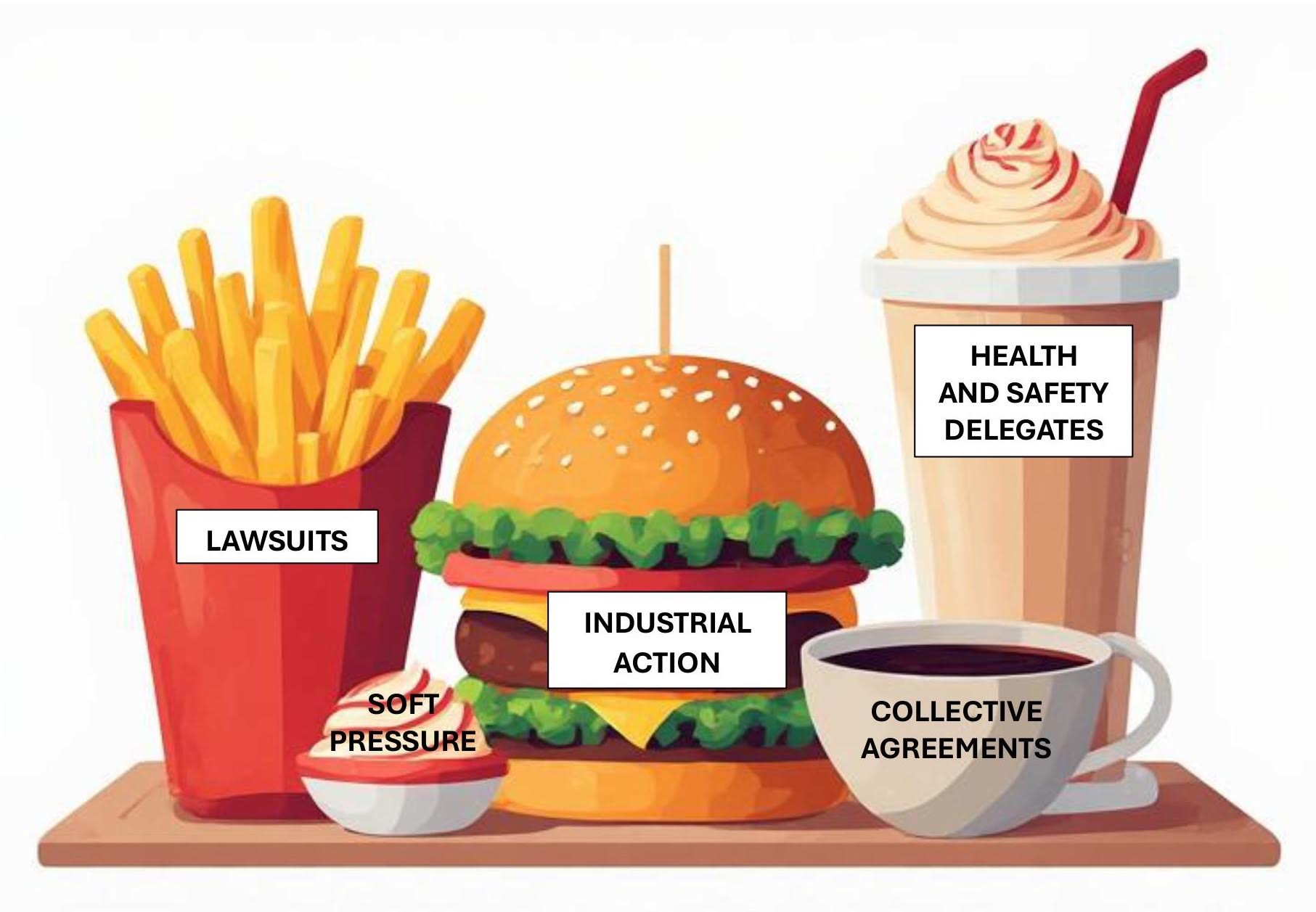
In the brutal labor market of today, we need a syndicalism with Extra Everything. More soft pressure as a prelude to industrial action! More lawsuits and wage-extraction blockades to recover unpaid wages! More industrial action that motivates employers to come to the bargaining table and reinstate our sacked fellow workers! More syndicalist collective agreements! And more health and safety delegates!

All of this presupposes more workers beginning to organize on the job. As lawyers, we can help by getting the legal tangle out of the way, so that workers can focus on organizing.

After all, the courts are an arena fundamentally rigged in favor of employers. At best, law can be used to defend current rights of workers, but not to push the frontline forward. It is on home ground that we move forward – in our own backyard, the workplaces.

Rasmus Hästbacka is a labor lawyer and member of the syndicalist union SAC.