Thursday, October 22, 2026


Europe’s EV boom has saved these 6 oil-importing countries almost €2 billion since start of Iran war

Close-up shot of an electric vehicle being plugged in to charge.
Copyright Zapotec via Unsplash.

By Liam Gilliver
Published on


“Every EV on the road reduces exposure to volatile oil markets, and as fleets grow – so does the protection against future supply shocks.”

Electric car fleets have cushioned the spiralling costs of oil imports following the war on Iran and subsequent energy crisis.

Brent crude, which is used as the worldwide benchmark for oil prices, rose to near $100 (around €89) a barrel on 22 October – the highest in five weeks as concern grows over potential escalation in the Middle East.

On February 27, the day before the US-Israel war on Iran broke out, Brent crude traded at $67(€59.63) per barrel, around 32 per cent lower than today’s prices.

The rising costs have been largely attributed to Iran’s stranglehold on the Strait of Hormuz, a 167km shipping route that usually carries around one-fifth of the world’s daily oil and seaborne liquefied natural gas (LNG) supplies.

At the same time, global sales of electrical vehicles (EVs) have surged by 11 per cent year-on-year, while combustion engine vehicles fell by six per cent in the first eight months of 2026.

How EVs are saving Europe billions

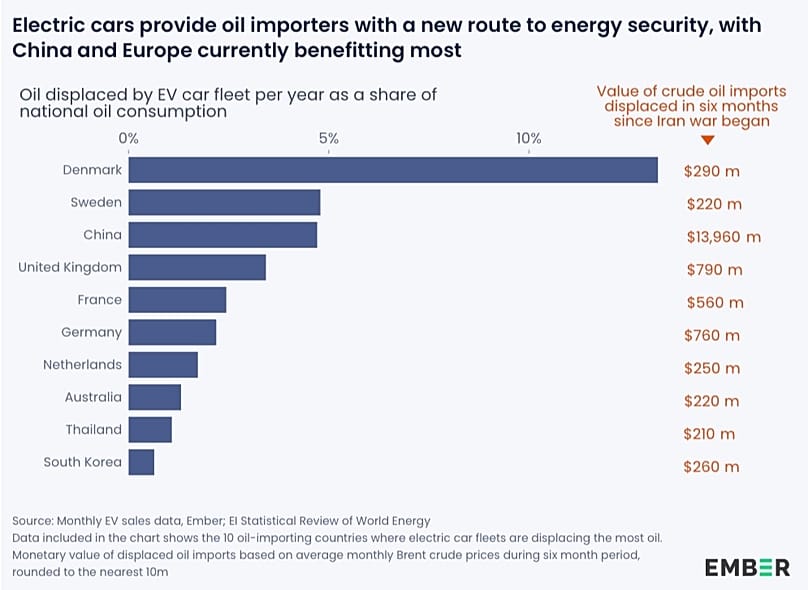
A new analysis by energy think tank Ember found that the EV boom has displaced an estimated 200 million barrels of crude oil, worth $20 billion (€17.82 billion) between March and August 2026

The study, which covers 56 countries that together account for more than 90 per cent of EV sales and more than 80 per cent of all car sales globally, found that China accounted for the largest share of these savings.

The country’s electrified fleet, which consists of around 44 million EVs, has saved $14 billion (€12.48 billion) worth of crude oil.

EU Member States were responsible for a further $3.1 billion (€2.76 billion) of the crude oil displaced by EVs between March and August 2026.

Germany and France represent the largest share in savings at around $760 million and $560 million (€677 million and €499 million), respectively.


Chart showing oil displaced by EV car fleets per year, as a share of national oil consumption Ember

However, when comparing oil displacement to each country’s oil consumption, Denmark emerged as Europe’s clear frontrunner.

As of August 2026, the country’s current EV fleet has displaced 6.4 million barrels of oil per year, equivalent to 13 per cent of the country’s oil consumption in 2025.

Elsewhere in Europe, the UK’s EV fleet displaced around $790 million (€704 million) of crude oil in the six months since the start of the fossil fuel crisis. For context, the UK imported £21.5 billion (€25.64 billion) of crude oil in the 12 months to the end of August 2026, according to the UK government

Six European countries (Denmark, France, Germany, the Netherlands, Sweden and the UK) have together saved almost €2 billion by lowering oil-imports.

EVs reduce ‘exposure to volatile oil markets’

“The countries that invested in EVs before this crisis are now better protected and a growing number are following,” says Euan Graham, a senior energy analyst at Ember.

“Every EV on the road reduces exposure to volatile oil markets, and as fleets grow – so does the protection against future supply shocks.”

Graham adds that the global shift to EVs goes beyond cutting emissions, providing countries with improved “energy security and economic resilience” amid political instability.

Are EVs better for the environment?

The environmental pay-off on EVs depends on how the battery was made and whether it is charged using clean electricity or fossil fuels.

A 2020 report by NGO Transport & Environment found that EVs outperform diesel and petrol cars in all scenarios, even on carbon-intensive grids such as Poland, where they are about 30 per cent cleaner than conventional vehicles.

In the best case scenario, where an EV runs on clean electricity with a battery produced with clean electricity, EVs are already about five times cleaner than conventional equivalents.

Ahead of the COP31 UN climate summit, co-host Türkiye has unveiled its “defining priority” to raise the global share of energy demand by electricity to 35 per cent, up from around 20 per cent, by 2035.

Experts are concerned that the pledge could allow governments to count expanded gas-fired generation as progress towards electrification targets – a move they say will “seriously undermine climate goals”.

“Let’s not let electrification become the Trojan horse of our times, used to hide new fossil fuel consumption rather than promote renewable energy,” says Claire Smith of campaign coalition Beyond Fossil Fuels.

Iran Steps Up Pressure On Kurdish Opposition In Iraq


File photo of Kurdistan Freedom Party (PAK) militia members in Iraq.

 Photo Credit: Seth Frantzman, Wikimedia Commons


October 21, 2026

By VOA

Key Takeaways:

Iranian and Iraqi officials held talks on Monday in which Tehran claimed both sides agreed to relocate or hand over members of Iranian Kurdish opposition groups based in the Kurdistan Region, while Iraqi officials confirmed the meeting but made no mention of expulsion or extradition.

Representatives of groups such as the Kurdistan Democratic Party of Iran said they had received no official notification of any relocation decision, and analysts warned that handing members to Iran would raise legal and humanitarian concerns.

The conflicting accounts underscore Tehran’s continued influence over Iraqi political and security decisions through armed factions, even after the September completion of the U.S. force withdrawal from Iraq.

With a lull in the U.S. Iran conflict and the September completion of the withdrawal of American forces from Iraq, Iran appears to be increasing pressure on Iranian Kurdish opposition groups.

The actions against Kurdish groups based in Iraq’s autonomous Kurdistan Region are a test of Baghdad’s independence and analysts are warning Tehran retains considerable influence over Iraqi political decisions.

Iranian news agencies reported that Iraqi and Iranian officials agreed during talks on Monday to relocate members of Iranian Kurdish opposition groups from the Kurdistan Region. Iranian Ambassador to Iraq Mohammad Kazem al-Sadegh said Tuesday that both countries had agreed to expel groups Tehran describes as separatist terrorists or hand their members over to Iran.

Iraqi officials confirmed the meeting, attended by representatives of the Kurdistan Regional Government, but made no mention of an agreement to expel or extradite opposition members.

Iraq’s National Security Advisory Agency said the discussions, chaired by National Security Advisor Qassim Aboudi, focused on resolving outstanding issues under a bilateral security agreement.

The conflicting accounts highlight the political sensitivities surrounding Iranian Kurdish groups, which have maintained bases in northern Iraq for decades.

Hazhar Barnji, U.S. representative of the Kurdistan Democratic Party of Iran (KDPI), told VOA that the party had received no official notification of any relocation decision.

“To date, we have not received such official communication or indication from either the Iraqi federal government or the Kurdistan Regional Government,” Barnji said.

He said the party respected Iraqi sovereignty and international law, while its principal political activities remained focused on Iranian Kurdistan.

Tehran’s enduring influence


Washington-based Iraqi political figure Entifadh Qanbar said Iran’s influence over armed factions continued to constrain Baghdad’s decision-making despite American efforts to weaken Tehran’s regional reach.

“In reality, Iraq is currently governed by armed groups and the will of those forces,” Qanbar told VOA, arguing that Iraqi Prime Minister Ali al-Zaidi had little ability to restrain them.

“Iraq will not emerge from Tehran’s control unless a fundamental political change takes place,” he said.

Political analyst Isam Fayli told VOA that Tehran’s concerns extended beyond border security to fears that Kurdish opposition movements could gain broader support inside Iran and emerge as a more significant political challenge.

Fayli warned that Iraq handing opposition members to Iran could raise serious legal and humanitarian concerns. He suggested international assistance in finding safe resettlement arrangements, citing the relocation of members of the exiled Iranian opposition group Mujahedin-e Khalq.

Sheikh Ghaith al-Tamimi, head of the Iraqi Citizenship Project, said Iraq’s own history demonstrated the limitations of military approaches to Kurdish political demands.

He said Baghdad’s security cooperation with neighboring countries must respect constitutional and international obligations rather than become an instrument for settling another government’s political disputes.

The changing U.S. military presence, Tamimi argued, presents a crucial test of whether Iraqi institutions can make independent security decisions or remain vulnerable to foreign influence and powerful armed factions.

For Iranian Kurdish opposition groups, the immediate question is whether Tehran’s reported agreement with Baghdad will translate into concrete action, given that previous agreements between the two governments have failed to result in the expulsion of these groups from Iraqi Kurdistan.


The Troops Have Left But Has Iraq Become Independent? – OpEd


October 21, 2026

Arab News

By Zaid M. Belbagi

Key Takeaways:

Despite the departure of final US-led coalition forces in late September and Baghdad’s designation of 1 October as “Sovereignty Day,” Iraq devalued the dinar by 14.5 percent to 1,520 per dollar after the US-Iran war cut oil exports from over 3.6 million to as low as 1.35 million barrels per day.

Oil still provides more than 88–90 percent of government revenue and is held in a New York Federal Reserve account, giving Washington economic leverage, while Tehran influences exports through the Strait of Hormuz and maintains ties to powerful armed factions within the Popular Mobilization Forces.

The article argues that true sovereignty will require diversifying export routes, broadening the fiscal base beyond hydrocarbons, and establishing a single national chain of command over the use of force by the June 2027 disarmament deadline set by Prime Minister Ali Al-Zaidi.


The enduring paradox of Iraqi sovereignty was exposed again last week. The final US-led coalition forces left the country late last month, ending a military presence that, in different forms, had lasted more than two decades. Baghdad designated Oct. 1 “Sovereignty Day,” with Prime Minister Ali Al-Zaidi declaring that Iraqi forces had assumed responsibility for the country’s security, while Iran-aligned factions celebrated the withdrawal as the defeat of the “American project.” Yet, on Wednesday, Baghdad devalued the dinar by 14.5 percent, from 1,300 against the US dollar to 1,520, after the US’ war with Iran disrupted oil exports and cut state revenues. Iraq has removed the most visible symbol of foreign interference but many of the pressures constraining its freedom of choice remain.

The currency decision showed how exposed the Iraqi state still is. Oil accounted for 88 percent of government revenue and 91 percent of merchandise exports in 2025, while the International Monetary Fund expects oil revenues to continue providing more than 90 percent of government income through 2030. Before the war, Iraq exported more than 3.6 million barrels per day. By July, that figure had fallen to about 1.35 million bpd, before recovering to 2.34 million in August as Baghdad offered steep discounts and Iranian approvals allowed more Iraqi tankers through the Strait of Hormuz. Devaluation gives the government more dinars for every dollar earned but it also makes imports more expensive and erodes the national household purchasing power.


Iraq funds a large state apparatus and public sector wage bill through a commodity whose principal route to market it cannot secure alone. Its 2027 draft budget assumes oil at $58 a barrel and exports of around 4 million bpd, with expenditure of 217 trillion dinars ($166 billion) and a deficit exceeding 40 trillion dinars. The distance between those assumptions and the export volumes reached this summer shows how quickly a regional security crisis can become a domestic fiscal one.

This dependence also helps explain why the end of the Global Coalition Against Daesh’s mission has changed the nature of Washington’s influence rather than ended it. Iraqi oil proceeds continue to flow into a Central Bank of Iraq account at the Federal Reserve Bank of New York, an arrangement inherited from the post-2003 Development Fund for Iraq. The system protects Iraqi revenues and facilitates access to dollars but it also gives Washington considerable leverage over a country whose budget depends overwhelmingly on oil income.

And that leverage has been used before. In April, the US halted a shipment of between $450 million and $500 million to Iraq as Washington sought to pressure Baghdad over attacks by Iran-aligned militias. Electronic dollar transfers for trade continued but the message was clear. In 2020, Washington had similarly threatened to restrict Iraq’s access to its New York Fed funds during a dispute over the presence of US troops. Thus, American forces may have left but Washington retains instruments capable of imposing significant costs without deploying a single soldier on the ground.


Tehran’s leverage works differently. Iraq’s southern terminals remain the principal outlet for the oil that finances the state, leaving Baghdad highly exposed to disruption in the Strait of Hormuz. Iraqi officials sought Iranian approval for tankers to transit the strait and those permissions helped exports recover in August. This pushes Baghdad to give greater attention to alternatives through Turkiye and toward the Mediterranean, with TotalEnergies, BP, Chevron and other companies examining or supporting additional export routes.

According to Olivia Higgins, an expert at Hardcastle Advisory, “The coalition’s departure has ended the foreign military presence in Iraq while leaving foreign leverage over it largely intact. Washington’s hold is now mainly economic, as Iraq’s oil revenues are held at the New York Fed. This year, the US cut off dollar shipments for months to squeeze the militias. Tehran’s leverage runs through Iraq’s oil exports, since Iraqi tankers have passed through Hormuz with Iran’s permission. Inside the country, Tehran can count on state-funded armed factions that answer to it and can pressure the government from within.”

The Popular Mobilization Forces are formally incorporated into the country’s security structure and encompass groups with different loyalties. Yet several powerful Iran-aligned factions retain their own leadership, political representation, economic interests and armed capacity. The coalition’s departure removes one of the principal arguments used to justify weapons outside direct state command.

Al-Zaidi has consequently set June 30, 2027, as the deadline for bringing arms under state authority and has insisted that decisions of war and peace belong to Iraq’s constitutional institutions. But implementation will be difficult. These factions are deeply embedded in Iraq’s political and economic system, making rapid disarmament potentially destabilizing. But allowing the present arrangements to continue carries its own costs.

In March, Saudi Arabia, the UAE, Qatar, Kuwait, Bahrain and Jordan jointly condemned attacks launched by Iran-aligned groups from Iraqi territory and held Baghdad responsible for controlling armed factions within its borders. Higgins adds that “Iraq’s neighbors in the Gulf will apply a simpler test. Its sovereignty means little to them while drones can still be launched at their territory from Iraqi soil.”


And that test has consequences beyond security. Baghdad wants deeper Gulf investment, trade and political integration but those ambitions will remain difficult to advance if neighboring capitals cannot be confident that the Iraqi government controls the actions emanating from its own territory.

Iraq cannot realistically leave the dollar system overnight, change its geography or dismantle entrenched armed organizations without considerable risk, nor does meaningful sovereignty require doing so. What it can do is reduce the vulnerabilities through which outside powers shape its choices.

That translates into diversifying oil export routes beyond the Strait of Hormuz, broadening a fiscal base still overwhelmingly dependent on hydrocarbons and, above all, establishing a single national chain of command over the use of force. The coalition’s departure is therefore an important achievement but it marks the beginning of Iraq’s sovereignty test rather than its conclusion.

The question now is whether decisions made in Washington, Tehran or by armed groups inside Iraq can still determine the country’s economic stability and draw it into conflicts it did not choose.


Zaid M. Belbagi is a political commentator and an adviser to private clients between London and the Gulf Cooperation Council. X: @Moulay_Zaid


About Arab News
Arab News is Saudi Arabia's first English-language newspaper. It was founded in 1975 by Hisham and Mohammed Ali Hafiz. Today, it is one of 29 publications produced by Saudi Research & Publishing Company (SRPC), a subsidiary of Saudi Research & Marketing Group (SRMG).
View all posts by Arab News →


EU Parliament awards Sakharov Prize to ICC in rebuke of US sanctions


By Vincenzo Genovese
Published on

The European Parliament has awarded the Sakharov Prize to the International Criminal Court in a show of support after the US imposed sanctions on the court. The abstention of the far-right Patriots for Europe group was decisive in breaking the deadlock over the final choice.

The European Parliament on Thursday awarded the International Criminal Court (ICC) the Sakharov Prize for Freedom of Thought, signalling opposition to US sanctions threatening the court’s work.

The annual prize recognises individuals and organisations defending human rights and fundamental freedoms. Past laureates include South African leader Nelson Mandela and Russian opposition figure Alexei Navalny.

US President Donald Trump’s administration announced sanctions against the ICC on 9 October, following repeated criticism of its arrest warrant for Israeli Prime Minister Benjamin Netanyahu and its investigation into the conduct of US troops in Afghanistan.

“This is a message of hope and resistance sent to Donald Trump. We will not abandon the rule of law and international justice. We will stand with the ICC for as long as it takes,” said French MEP Chloé Ridel, who nominated the court.

Parliament’s political group leaders chose the ICC over two other shortlisted candidates: Tanzanian lawyer Tundu Lissu, who faces political persecution, and Iranian sisters Taraneh and Romina Rahimi, nominated on behalf of those persecuted by Iran’s authorities.

The Socialists and Democrats (S&D) group put forward the ICC and its officials, with other political groups eventually backing the nomination. The decision surprised some insiders, who had expected Lissu to win.

According to sources present at the meeting, the far-right Patriots for Europe (PfE) group played an instrumental role in determining the final outcome.

Initially, the European People’s Party (EPP) and the European Conservatives and Reformists (ECR) supported their candidate, Lissu.

Meanwhile, the Socialists and Democrats (S&D) had the backing of Renew Europe, the Greens/EFA and The Left in support of the ICC. PfE co-leader Kinga Gál, however, continued to advocate for Taraneh and Romina Rahimi.

These competing positions resulted in a deadlock, with neither candidate securing the majority required to win. Under Parliament’s rules, the impasse would have led to a runoff between the two candidates with the strongest support: Tundu Lissu and the ICC.

Gál ultimately prevented this outcome by abstaining, allowing the ICC’s supporters to secure a relative majority.

Last week, MEPs from across the political spectrum urged European Commission President Ursula von der Leyen to protect the Netherlands-based court from US sanctions.

They called for the use of “all instruments at our disposal”, particularly the EU’s Blocking Statute, which shields European companies and individuals from the effects of certain foreign sanctions.

EU foreign policy chief Kaja Kallas described the threat of sanctions against the ICC as “not acceptable” on 9 October, reaffirming the bloc’s commitment to international law. The EU has yet to take concrete action.


International Criminal Court wins EU's Sakharov human rights prize

Strasbourg (AFP) – Facing US sanctions, the International Criminal Court was on Thursday awarded the European Union's top rights prize, in a show of support that risks upsetting President Donald Trump.


Issued on: 22/10/2026 - RFI

The win for the International Criminal Court could irk US President Donald Trump. © Laurens van PUTTEN / ANP/AFP

"The European Union is built on respect for multilateralism and international institutions, and this prize recognises the important work of the court in upholding international law and justice," said European Parliament chief Roberta Metsola in announcing the award.

The ICC thanked the European Parliament for giving it the Sakharov Prize "at a time when the Court and its officials face unprecedented challenges".

"Against this backdrop, the Sakharov Prize carries particular significance, reaffirming the importance of independent judicial institutions and of those who work to uphold international law," ICC President Tomoko Akane said.

This month, the United States announced sanctions against the ICC aimed at crippling the day-to-day operations of the court, which tries individuals for war crimes, crimes against humanity and genocide.

Trump's administration has vowed to dismantle the court "brick by brick", furious that judges have issued an arrest warrant for Israel's Prime Minister Benjamin Netanyahu for alleged crimes in Gaza.

The win comes after ex-ICC judge Navi Pillay, who also served as UN rights chief, was awarded the Nobel Peace Prize this month – a choice Trump slammed as "disgraceful", arguing the award should have gone to him.

The EU has already thrown its support behind the ICC in the face of the US sanctions – which will come into force in six months – and has said it is "ready to take any necessary measures" to make sure the court can keep working.

"The International Criminal Court must be free to pursue its mission, independently, and without pressure or intimidation," EU chief Ursula von der Leyen posted online after the prize was announced.

Brussels is hoping to use the delay before the sanctions are applied to try to talk the US down, but is also eyeing implementing a "blocking statute" to shield the ICC from Washington.

Three finalists

Set up in 1988 and named after Soviet dissident Andrei Sakharov, the EU prize is bestowed annually on individuals or organisations to recognise their fight for human rights or democracy.

The ICC was among three finalists this year, alongside Tanzania opposition leader Tundu Lissu and twin sisters Taraneh and Romina Rahimi, representing those prosecuted by the Iranian government.

The nominees are put forward by the political groupings in the EU and the winner is chosen by senior lawmakers. An award ceremony will be held in December.

Lissu, head of Tanzania's opposition Chadema party, was detained in April 2025. He faces a possible death penalty if convicted of treason for allegedly inciting the public to boycott elections last year.

Taraneh and Romina Rahimi, 21, have respectively been sentenced to death and 36 years in prison for having taken part in anti-government protests in Iran.

Other recent high-profile winners of the Sakharov prize have been Venezuelan opposition chief Maria Corina Machado, deceased Russian Kremlin critic Alexei Navalny and the people of Ukraine.

US sanctions on ICC are 'a shock' and 'unacceptable,' Nobel peace laureate Navi Pillay says

Cover image: TÊTE À TÊTE © FRANCE 24

Issued on: 21/10/2026 - 

In an interview with FRANCE 24, Nobel Peace Prize laureate Navi Pillay described the US sanctions imposed on the International Criminal Court (ICC) hours after her award as "a shock" and "unacceptable". The South African judge also defended the UN commission of inquiry she chaired, which concluded that Israel had committed genocide in Gaza: "We didn't come to that conclusion lightly." Rejecting claims that the ICC targets Africa, she said "the court is not selective".


READ MOREIsrael a rare dissenting voice as praise pours in for Nobel Peace Prize winner Navi Pillay

Just hours after Pillay was awarded the Nobel Peace Prize, the Trump administration imposed sweeping sanctions on the ICC, having already targeted the court's key personnel.

READ MOREInternational Criminal Court faces 'test of resilience' as US imposes sweeping sanctions

Speaking to FRANCE 24 from The Hague, the former UN High Commissioner for Human Rights, who sat as a judge on the International Criminal Tribunal for Rwanda, called the move "a violation of the international rule of law".

"It's unacceptable for politicians to interfere in the work of judges, in the judiciary," Pillay said, adding that she had travelled to The Hague to show "solidarity" with the ICC's staff.


Play (11:26 min)From the show


PHP security flaw: Why websites across Europe went dark and what it means for you

FILE — Alice Lin was the victim of an online scammer, pictured here sitting at her computer at home, Saturday, May 9, 2026, in Alhambra, Calif.
Copyright Copyright 2025 The Associated Press. All rights reserved

By Una Hajdari
Published on

AI models uncovered what OpenAI calls "one of the most impactful" security bugs in recent memory, hidden in PHP for more than a decade. From a Pokémon sleep tracker to the Dutch parliament, websites went dark worldwide to stay ahead of hackers.

Artificial intelligence has exposed two critical security flaws in PHP, a programming language that quietly powers most of the internet, sending organisations worldwide scrambling to shut down websites before hackers can exploit them.

The bugs sat undetected in PHP’s code for more than a decade. It took cutting-edge AI models from OpenAI and Google to turn a long-suspected weakness into a working attack — and now the race is on to close the door.

As AI’s fast-advancing capabilities fuel concern over a new era of cyberattacks, here is what you need to know.

Europe reacts

The Netherlands pulled its DigiD digital identity system, the Overheid.nl government portal and the website of the lower house of parliament, with the Port of Rotterdam, hospitals and the country’s five largest political parties following suit.

Even the Dutch National Cyber Security Centre took its own site down.

Finland’s state IT provider Valtori switched off government web services wholesale “as a precautionary measure,” France’s Interior Ministry put local administration sites into maintenance mode and Germany’s federal IT service ITZBund took down several portals.

CERT-EU, the cybersecurity service for the EU institutions, went further than most, telling any organisation unable to patch immediately to take its websites offline rather than risk being hacked.

The European Commission, ENISA, CERT-EU, Europol and the EU’s network of national cyber response teams also issued a joint statement urging organisations to act immediately, prioritising systems exposed to the internet.

What is PHP and why does it matter?

Created in the early 1990s, PHP is a name that originally stood for Personal Home Page and is the code that runs behind the scenes on roughly seven in 10 websites, according to security firm Wiz Research, which calls it “a backbone of the web”.

While languages such as HTML handle what you see on a page, PHP handles what you do not, such as checking logins, processing payments, serving up content.

It underpins WordPress, Drupal and Joomla, the platforms behind everything from personal blogs to online shops and government portals.

That reach is what turns two bugs into a global event. Wiz said every PHP version released in the past decade is affected by at least one of the flaws, and that even a bare-bones “Hello World” page on an unpatched server could be vulnerable.

A fix was released on Wednesday, with the PHP Foundation telling tech departments around the world that “if you run PHP, it is imperative that you update now.”

Patched versions are PHP 8.5.12, 8.4.27, 8.3.36 and 8.2.35. Anything older no longer receives official updates and should be treated as exposed unless a vendor has backported the fix, the European Union’s cybersecurity emergency response team (CERT-EU) warned in an advisory.

The result has been a wave of apps and websites going dark, from the Paris police website to a Pokémon sleep tracker, as developers patch their underlying code. Government sites across Europe were among those pulled offline as a precaution.

How did AI find the flaws?

Both vulnerabilities, tracked as CVE-2026-109618 and CVE-2026-109619 and rated 9.2 out of 10 for severity, sit in the parts of PHP that nearly every request touches, namely memory management and error handling.

If a web request hits PHP’s memory limit at exactly the wrong moment, the software can be tricked into running an attacker’s code without any login.

The PHP Foundation admits its own developers first spotted signs of the problem in 2024, during an external audit.

A theoretical exploit was sketched out, but with no concrete route to an attack and a tiny core team weighing the trade-offs of a fix, work stalled and restarted for months. The foundation called the delay “a structural failure”.

Then AI got involved. In August, security firm Calif, working on an OpenAI-funded audit of PHP’s source code and using OpenAI’s GPT-5.6 Sol model, reported a fully working remote attack with the same root cause.

OpenAI independently flagged the same issue the same day. Wiz followed with further attack vectors two weeks later, using its own Wiz Atlas tool alongside Google’s Gemini 4 Argon and GPT-5.6 Sol.

“With frontier AI models and the right tools, a single researcher completed in a week what previously would have taken a world-class team months of work,” Wiz researchers wrote.

OpenAI called the discovery “one of the most impactful vulnerabilities in recent memory,” adding that it “marks a new phase, where AI can find security bugs with internet-scale impact”.

The findings were kept under wraps while a fix was developed.

Then, on Tuesday afternoon, the two CVE identifiers leaked onto online forums and social media.

PHP brought its release forward by a day, and Calif mistakenly published — then deleted — a video showing its proof of concept working against several targets, the PHP Foundation said. Copies spread quickly.

“The trouble with tools like AI is that the moment all the information’s out there, people can weaponise it very, very quickly,” Steve Kerrison, senior lecturer in cybersecurity at the Singapore campus of James Cook University, told AFP.

“That’s why everybody’s acting with such urgency to respond to this issue.”

Have sites already been hacked?

Not necessarily. “Taking websites offline does not necessarily mean they have been hacked. It can be a responsible measure to protect systems while security updates are applied,” said Dimitrios Salampasis of Australia’s Swinburne University of Technology.

The PHP Foundation said its security team inspected the proof-of-concept code circulating after the leak and found no functional exploit at the time of release.

“The evidence that security researchers are seeing is that nobody was actively performing attacks using the techniques available,” Kerrison said.

The picture is shifting, however. Web infrastructure firm Cloudflare said on Wednesday it had observed attack traffic aimed at its customers, and CERT-EU warned that the public circulation of technical details raises the likelihood that attackers are already probing the flaws.

Larger institutions, from government agencies to news outlets, should be able to patch relatively quickly. Others may be left exposed for far longer.

“There are sites, systems and people out there who will have no idea about this and still won’t for days, weeks and months,” Kerrison warned.

That could include user-run blogs and small business sites, which hackers could hijack to spread computer viruses, send spam or host malicious content.

Could there be other consequences?

Any data breach could come back to haunt customers long after the patch, if their personal information is harvested for phishing attacks — where someone is tricked into handing over a password or payment details.

The tangled, interlinked nature of online systems also means the risk does not end when you update your own server. Many sites rely on third-party services that may themselves run PHP.

If those third parties are slow to patch, “then even though you patched yourself ... you’re still unsecure,” said Rahat Masood, senior lecturer in cybersecurity at the University of New South Wales in Sydney.

PHP is not the whole story, Kerrison added. Strong cybersecurity means several layers of defence, so that one broken lock does not open every door.

The PHP Foundation, for its part, is using the episode to make a pointed plea. The language runs government services, banks and online stores worldwide, yet its security still rests on a small group of foundation-funded developers and volunteers.

Tools can now find bugs faster than ever, it said, but deciding how to fix them without breaking the web takes experienced engineers.


CYBERCRIME


Websites go dark as AI exposes critical security flaws worldwide


Washington (AFP) – Governments and companies around the world shut down websites as they raced Thursday to protect themselves from hacks after artificial intelligence uncovered critical flaws in a widely used programming language called PHP.


Issued on: 21/10/2026 - RFI

Increasingly powerful AI models can spot weak points in computer scripts that hackers can exploit. © Kirill KUDRYAVTSEV / AFP

PHP helps run about 70 percent of the world's websites – from online stores and news outlets to government services – according to Wiz Research, one of the cybersecurity firms that found the two flaws.

Created in the early 1990s, PHP originally stood for "personal home page" but now means "hypertext preprocessor" and sits underneath popular web design platforms.

"These findings rank among the most severe vulnerabilities discovered in PHP, and arguably in software history," a Wiz blog post said.

Increasingly powerful AI models can spot weak points in back-end computer code that have gone unnoticed by humans for years.

That has heightened cybersecurity fears, with the number of software vulnerabilities discovered worldwide in 2026 on track to roughly double last year's record total.

PHP programmers released a fix Wednesday, and the US National Security Agency told organizations to patch their sites immediately or pull vulnerable systems offline – a call echoed by authorities from Japan to the European Union.

A platform affiliated with China's Ministry of Industry and Information Technology urged the same, warning of "two critical remote code execution vulnerabilities with severe impact" in PHP.

Only sites that run PHP on their own servers are exposed. Many large platforms are built on other programming languages or use operators that could install the fix quickly and were able to stay online.

Rahat Masood, senior lecturer in cybersecurity at the University of New South Wales, Sydney, described the discovery as "quite devastating."

It could allow "attackers to get into your servers without any authorisation, without any username or password," she told AFP.

"Once they are in the servers, they can do anything they want" – from stealing sensitive information to modifying website content – she added, urging institutions to "take it seriously."

'New phase'


Government agency sites in countries from Australia to Finland and the Netherlands were among those that went dark, while services from insurance firms, transport operators and media outlets were under emergency maintenance.

Popular apps, including a Pokemon sleep tracker, were also temporarily taken offline while the fix was implemented, while the foundation that runs Wikipedia warned users they could see outages while it addressed the flaws.

"If you run PHP, it is imperative that you update now," the PHP Foundation, which funds developers working on the language, said in a blog post.
Security firm Calif found the flaws in August using OpenAI’s GPT-5.6 Sol model
 © ANDREJ IVANOV / AFP/File

Volker Dusch, a security engineer at the foundation, told the Wall Street Journal it was the most serious problem PHP had faced in more than a decade, comparing it to Heartbleed, a 2014 flaw that set off a worldwide rush to patch.

Security firm Calif found the flaws in August using OpenAI's GPT-5.6 Sol model, as part of an OpenAI-funded audit of PHP's code.

OpenAI said the discovery "marks a new phase, where AI can find security bugs with internet-scale impact."

Wiz, which is owned by Google, said it found them independently weeks later with help from AI models including Google's Gemini 4 Argon and GPT-5.6 Sol.

The flaws had been reported privately to PHP's developers and kept confidential while a fix was prepared.

AI fuels urgency


Details leaked online Tuesday, a day before the planned release of the fix – prompting the rush to take sites offline before hackers could exploit them.

Steve Kerrison, senior lecturer in cybersecurity at the Singapore campus of James Cook University, told AFP that the fear of hackers using AI to quickly and easily exploit the PHP vulnerabilities had fuelled urgency to react.

So far there has been little evidence of damaging attacks, although data breaches could lead to a wave of so-called "phishing" attacks, where hackers use personal details to steal passwords, down the line.

Larger institutions, from government agencies to news outlets, should be able to fix their websites relatively fast, Kerrison said – but others may be left vulnerable.

"There are sites, systems and people out there who will have no idea about this and still won't for days, weeks and months," Kerrison warned.

That may include user-run blogs that could be weaponised to spread computer viruses, spam people or distribute malicious content, he said.

A Simulated War Must Never Become A Real Military Order – Analysis


The article warns that AI used to design and analyze war games can create a risk that fictional exercise events lose their labels and enter operational decision chains, potentially producing false but consistent reports that commanders treat as real.

Recent examples include a U.S. Army III Armored Corps AI planning experiment with British and Polish partners and NATO’s STEADFAST DUEL 2026, neither of which reported an AI-caused breach, yet the piece stresses that connected tools and lost provenance could allow exercise outputs to affect live systems.

It recommends making exercise-to-operations handoffs an explicit acceptance test through durable provenance, purpose-limited credentials that expire, and deliberate fault-injection trials, aligning with NATO’s revised AI strategy emphasis on traceability and governability.


As NATO and allied forces bring artificial intelligence into military planning, fictional reports and exercise-only permissions must never become operational authority by accident.

On November 9, 1979, American air-defense aircraft left their bases in response to an attack that did not exist. A recorded missile-attack scenario had mistakenly been transmitted beyond North American Aerospace Defense Command headquarters. According to a contemporaneous U.S. diplomatic account, built-in checks exposed the false warning in less than six minutes. The aircraft were recalled; none carried nuclear weapons, and no strategic nuclear unit advanced its alert status.

The simulated attack was fiction. The aircraft taking off were real. The safeguards that stopped the error from spreading were real, too.


That distinction has acquired new urgency as armed forces use artificial intelligence to design, populate and analyze war games. On October 20, the U.S. Army reported that its III Armored Corps had tested emerging AI tools in a multinational planning exercise with British and Polish partners. One day earlier, NATO reported the conclusion of STEADFAST DUEL 2026, a major simulated collective-defense exercise involving all 32 Allies and approximately 8,000 participants. The Army planning experiment and the NATO exercise were separate events; neither announcement reported an AI-caused breach of exercise boundaries.

NATO is also applying AI to exercise design. During a September scripting event, multinational personnel used an AI-enabled environment to develop and coordinate exercise material. In the Indo-Pacific, Australia has opened a Fleet Battle Lab capable of running extended virtual naval war games. These developments promise faster iteration and more demanding training. They also make one old question newly important: when does a fictional report acquire the status of a real military fact?

The most dangerous handoff is not inside the model

An AI system does not need to believe it is fighting a real war to affect one. The consequential issue is what the software treats as evidence, which systems receive its output and what people or tools are permitted to do next. A model may know that it is inside an exercise and still generate a recommendation that becomes dangerous when its simulation origin disappears downstream.

Imagine a fictional missile strike inserted into a multinational command-post exercise. One AI assistant summarizes the episode. A second turns the summary into a staff briefing. A third retrieves that briefing as background and proposes an urgent response. The exercise label is lost along the way. The receiving officer sees three apparently consistent products, although all derive from one invented event. This is a hypothetical failure chain, not an allegation about the exercises announced this month.

Several reports repeating the same story are not three independent confirmations. Before a simulation-derived assertion can enter an operational assessment, someone must establish whether its underlying event occurred outside the exercise. Human approval does not repair a fictional premise that nobody checked.

A more direct path runs through connected tools. The National Institute of Standards and Technology has documented how instructions encountered by AI agents can redirect the use of tools and surrounding applications. The implication for an exercise is conditional but serious: if a training agent has access to operational credentials, live messaging or equipment controls beyond its role, a mistake or manipulated input can leave the rehearsal environment. Writing “exercise only” in a prompt is no substitute for a restriction enforced by the systems that receive the request.

That does not mean war games must be air-gapped from every real system. Live exercises properly use real aircraft, ships, communications and logistics under approved rules. The key is to separate legitimate exercise effects from unauthorized operational consequences. Training tools may support a real unit without acquiring permission to issue that unit a real mission order.

A rehearsal is also visible to the adversary


There is a second boundary, beyond the participating alliance. During NATO’s 1983 Able Archer command-post exercise, Soviet forces took unusual readiness measures. A later U.S. intelligence review concluded that some Soviet leaders may have feared the exercise concealed preparations for an actual attack. The review acknowledged uncertainty about how deeply that concern extended. No AI system caused the episode; its lesson is that an exercise can be misinterpreted by actors who see its external signals but not its internal rules.

An AI-enabled planning system could complicate that problem if it accelerates the production of alerts, assessments and recommendations while obscuring their assumptions. An adversary might interpret an allied precaution as offensive preparation, respond, and have that response fed back into the next assessment. Such a sequence would still depend on real human and military decisions, not an imaginary machine deciding independently to start a war.

Research on AI players in diplomatic and military simulations deserves the same restraint. A peer-reviewed 2024 study observed escalation in simplified multi-agent war games, including occasional simulated nuclear use. In contrast, preliminary 2026 experiments found that AI players sometimes avoided war until the researchers changed a game objective. Neither result estimates the probability of an AI-caused conflict in the real world. Together, they show why the model, the game incentives and the human decision system must be evaluated as one arrangement.

Make exercise boundaries an acceptance test

The practical answer is not to abandon AI-assisted rehearsal. It is to make the passage from exercise to operations an explicit, tested interface. A fictional event should carry durable provenance through summaries, exports, retrieved records and exchanges between national systems. If a generated intelligence product loses its exercise origin, the operational workflow should not silently promote it into verified reporting.

A second requirement concerns credentials and effect. Training agents should use purpose-limited access that cannot authorize operational tasks by default. Where a real interface must participate in an exercise, the permission should name the specific approved effects, the authority responsible and the time at which that permission expires. Moving from rehearsal into operational use should require a separate decision, not a confident recommendation from the AI.

Finally, exercise directors should test whether these boundaries survive mistakes. Deliberately remove an exercise label, insert contradictory reports, replay a stale briefing and route a simulated order toward a protected operational service. Measure what was blocked, what reached a human, whether a downstream task continued after the initiating agent stopped, and how quickly control was recovered. The point is to test the handoff, not merely whether the model can explain what went wrong.


This is a realistic international standard. NATO’s revised AI strategy already emphasizes traceability, reliability, governability and interoperable testing. It does not prescribe the particular exercise-to-operations acceptance test proposed here. NATO and willing partners could add such a test to existing exercise certification and procurement practices without imposing one country’s operational doctrine on another.

The opposing argument is that too many controls will make exercises artificial and slow. The answer is to keep the simulation as challenging as possible while limiting what its outputs may authorize outside it. A convincing fictional enemy and unpredictable scenario are training assets. An untraceable fictional intelligence report in a live decision chain is not.

In 1979, the distinction held because verification defeated a false warning quickly enough to prevent further escalation. AI can make future rehearsals richer, faster and more adaptive. Their success should be measured in part by something less glamorous: whether the system can prove where the rehearsal ends.

A war game should test an alliance’s ability to manage escalation. It must never become the unrecognized cause of it.


About Burak Oktenli
Burak Oktenli holds an MBA and a Master of Professional Studies in Applied Intelligence from Georgetown University. His research addresses the governance of authority in autonomous and AI-enabled systems, and his writing has appeared at the Modern War Institute at West Point, RUSI, RealClearDefense, RealClearMarkets, and Geopolitical Monitor. He is the author of Authority Architectures for Autonomous Systems, a ten-volume series on how authority in autonomous systems is delegated, monitored and recovered, at authority-architecture.me
View all posts by Burak Oktenli →