Saturday, July 18, 2026

US Pacific Northwest Earthquake Experts Say More Coordination, Investment Needed To Prepare For ‘Big One’


July 19, 2026 
 Oregon Capital Chronicle
By Alex Baumhardt


Key Takeaways:

Oregon is making targeted progress on earthquake resilience, including retrofits to the state Capitol, Portland International Airport, and some critical infrastructure, but experts say far more is needed before the anticipated Cascadia Subduction Zone quake (magnitude 7.4+).

Key vulnerabilities remain, including coastal U.S. Route 101, aging bridges, power grid infrastructure, and water supply corridors; a major concern is that many state-owned buildings and essential lifelines would not survive or be usable post-quake.

Experts urge urgent policy actions, such as accelerated retrofits, microgrids/battery storage for coastal areas, better disaster workforce planning, and coordinated regional investment to ensure recovery corridors and infrastructure remain functional after the event.


(Oregon Capital Chronicle) — If the “Big One” — the anticipated massive Cascadia Subduction Zone earthquake — hit today, Oregonians west of the Cascades would be luckiest to find themselves at the recently-retrofitted state Capitol in Salem or on the roof of the new terminal at the Portland International Airport.

The comment from Tom Wharton, an engineer at the Port of Portland, drew laughs from an audience Thursday at the 13th annual National Conference on Earthquake Engineering in Portland, but it wasn’t entirely a joke. Jonna Papaefthimiou, state resilience officer in Gov. Tina Kotek’s office, said few of the 4,000 buildings the state owns would survive. Just five would likely remain standing and be immediately usable in the weeks and months after, she said.


The Port of Portland and the governor’s office are among the members of the region-wide multi-agency Cascadia Lifelines Program housed at Oregon State University, operating as a think tank for stakeholders who meet twice annually to discuss preparation for what seismologists project will be a 7.4 or greater magnitude earthquake in the Northwest in the next 50 years.

The Cascadia Subduction Zone quake occurs off the coasts of Oregon, Washington and California every 500 years and was last recorded in 1700. It could cause Northwest coastlines to lower and retreat, spur widespread flooding and landslides and displace millions of people.

The experts discussed progress: Renovations at the Portland airport and state Capitol that made the buildings more likely to withstand earthquakes, a plan to ensure Washington County residents have access to water sourced from beyond Portland’s system and Kotek’s 2025 executive order mandating large state-owned buildings be retrofitted during the next 35 years and new ones be built to a worst-case-scenario earthquake code.

But the experts also discussed policies that they say should be enacted urgently.

If coastal U.S. Route 101 isn’t retrofitted before the Big One hits and shuts down for any extended period following the quake, “then you’ve lost those coastal communities, and you’re not going to get those back,” said Mike Olsen, an Oregon State University civil engineering professor and the director of the Cascadia Lifelines Program.

The highway is also already under frequent threats of coastal landslides and flooding.

“We don’t need to wait for the earthquake to cause a lot of damage to it. It’s already under a lot of pressure,” he said.
Race to retrofit

In coastal areas that will be most heavily impacted, and that are heavily reliant on grid power from the Bonneville Power Administration, policies that promote community microgrids and battery storage will be key to post-quake recovery, said Leon Kempner, a BPA engineer.

BPA controls most of the Northwest electricity distribution grid. In some coastal areas, such as Lincoln City, it is the source of nearly all power.

Kempner said the agency is racing to retrofit the grid to withstand earthquakes, but it didn’t start implementing seismic code into projects until the 1980s, and it lacks resources to move as quickly as needed.

He also suggested that the Oregon and Washington state legislatures should require BPA and all regional utilities to regularly report to state officials on what they are doing to prepare for the Big One to increase awareness, transparency about planning gaps and potential for collaboration.


Wharton, who explained that much of the state would rely on the airport and the port’s four Willamette and Columbia river terminals to receive recovery aid, said the Port of Portland needs nearly $500 million to upgrade a runway that can survive the quake and handle large Federal Emergency Management Agency aircraft, and other aircraft, landing for support or evacuation.

Port officials will meet with Kotek’s office in the next few weeks to discuss some potential budget requests, he and Papaefthimiou said. Some funding could also come from requesting an advance on annual maintenance dollars from the Federal Aviation Administration or grants from FEMA, “as long as FEMA still exists,” Wharton said.

A recent study by the National Institute of Building Sciences found that the, for now, roughly $450 million investment would have a net $7 billion savings benefit for the state as it tries to recover and rebuild after the quake, he said. But none of that matters if roads and bridges are unusable or nonexistent.
Critical corridors

The Oregon Department of Transportation has identified $40 million worth of bridge deficiencies that, if left unaddressed, leave them vulnerable to the quake, said Yumei Wang, a civil engineering and infrastructure resilience and risk expert from Portland State University.

Olsen and other experts also called for more investment in preparing a disaster response workforce for the state and the region, which would require months of emergency attention and years of rebuilding. Everyone agreed that municipal governments, state leaders, and all regional infrastructure stakeholders need to be more regularly talking and planning together, now.

Mike Britch, an engineering and construction manager at Tualatin Valley Water District, is overseeing a $1.6 billion water infrastructure project to shift the half of Tualatin that relies on water from the Portland Water Bureau to water sourced from the Joint Water Commission that also supplies water to the cities of Hillsboro, Forest Grove and Beaverton.

Part of the project involved building a 2,000 foot “micro tunnel” under the Tualatin River to transport drinking water. Above it, the Roy Rogers Road bridge over the river would not survive the Big One, Britch said, leaving people south of the bridge stranded and unable to get to any area hospitals.

“If I could create a policy and make people do things, I would say I want the state to identify some of these really critical corridors,” he said. “We need some sort of policy to address that.”


About Oregon Capital Chronicle
The Oregon Capital Chronicle, founded in 2021, is a professional, nonprofit news organization. We focus on deep and useful reporting on Oregon state government, politics and policy. Staffed by experienced journalists, the Capital Chronicle helps readers understand how those in government are using — or abusing — their power, what’s happening to taxpayer dollars, and how citizens can stake a bigger role in big decisions.
View all posts by Oregon Capital Chronicle →


 

Iberian rabbit: species hidden by Spain and Portugal for 2 million years

New Iberian rabbit species discovered, July 2026
Copyright Daniel Burón - wildnatfilm.com

By Jesús Maturana
Published on

A CSIC team and universities in Spain, Portugal and the UK say the European rabbit is in fact two species split 2 million years ago, one now in decline.

For more than a century, scientists took it for granted that only a single species of rabbit lived on the Iberian Peninsula, at most divided into two regional variants. A study published in 'Biological Conservation' now calls that into question.

According to its authors, from the Institute for Advanced Social Studies (IESA-CSIC) and research centres in Portugal and the United Kingdom, it is in fact a case of two species with separate evolutionary histories: two lineages, a single label.

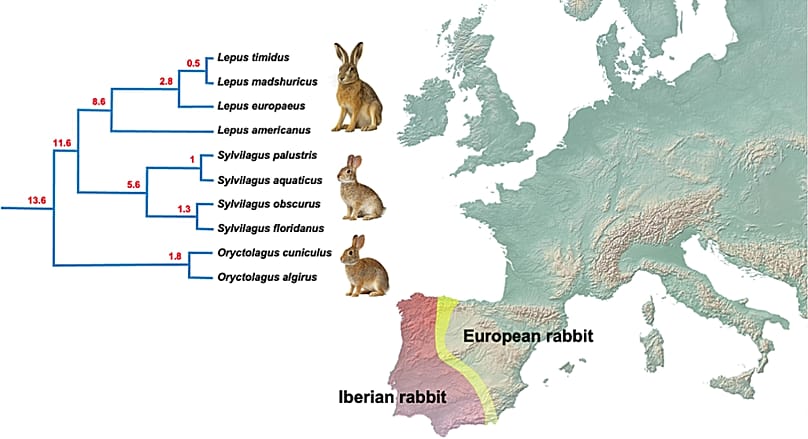
The study 'When taxonomy lags behind evolution: Consevation implications of cryptic diversity in the Iberian rabbit' (PDF (source in Spanish)), coordinated by Rafael Villafuerte and Miguel Delibes-Mateos together with researchers from the TRAMAS group, distinguishes between the Iberian rabbit ("Oryctolagus algirus") and the European rabbit ("Oryctolagus cuniculus").

The former occurs naturally in Portugal and western Spain, while the latter dominates the eastern part of the peninsula and is the source of the populations introduced in Europe, Oceania and the Americas, where it often behaves as an invasive species.

https://images.euronews.com/articles/stories/09/84/26/98/808x439_cmsv2_204c1c82-9c7b-5eea-94ef-83a2c7883421-9842698.jpg

https://images.euronews.com/articles/stories/09/84/26/98/{{w}}x{{h}}_cmsv2_204c1c82-9c7b-5eea-94ef-83a2c7883421-9842698.jpg

https://www.sciencedirect.com/science/article/pii/S0006320726003137?via%3Dihub#f0010 

The two animals diverged roughly two million years ago, when they became isolated in different refuges during glacial periods: one in the Ebro valley, the other in the Gulf of Cádiz. Since then, the researchers explain, they have barely interbred to any significant extent, despite looking very similar at first glance.

What sets them apart

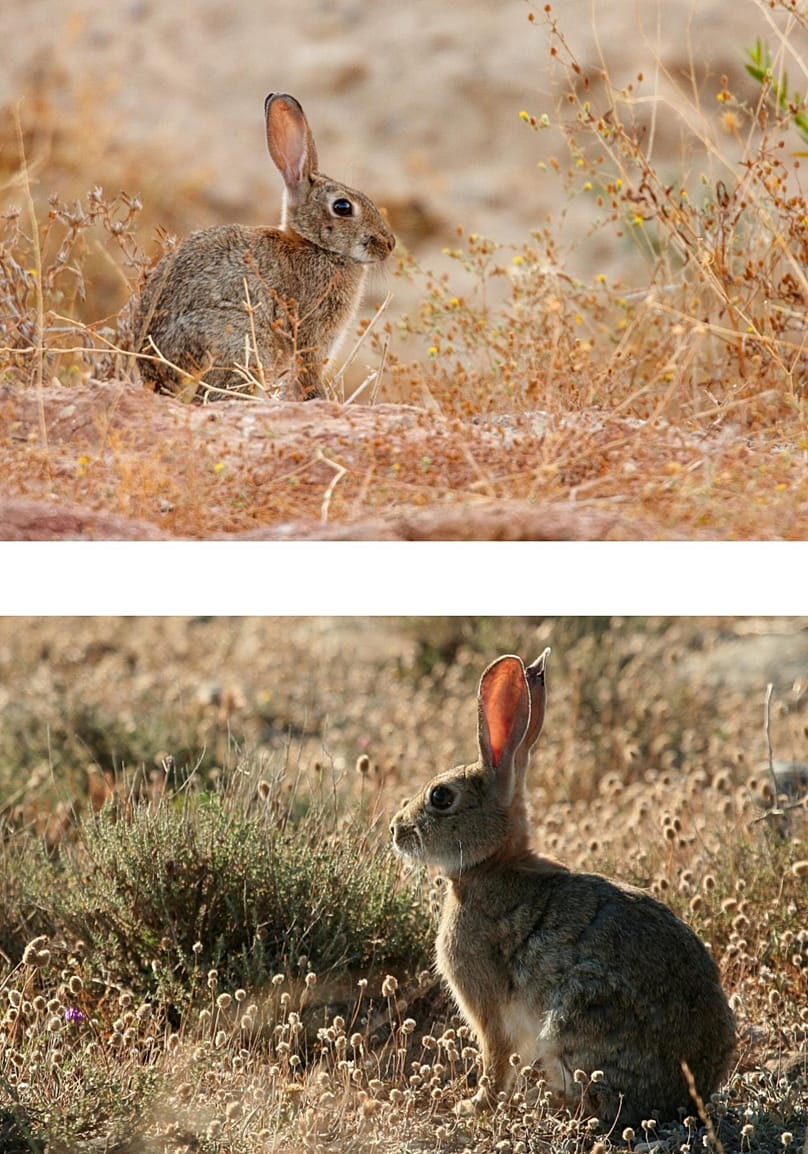
The differences are not confined to the genome. The Iberian rabbit is smaller, with darker fur, smaller litters and earlier sexual maturity than the European species.

They also differ in their gut microbiome, the composition of their meat and the parasite communities they harbour. In Villafuerte's words, "the two species have always been there; what has changed is our knowledge of them".

https://images.euronews.com/articles/stories/09/84/26/98/808x1154_cmsv2_05aa4aa2-345d-5563-a380-b45a158da900-9842698.jpg

https://images.euronews.com/articles/stories/09/84/26/98/{{w}}x{{h}}_cmsv2_05aa4aa2-345d-5563-a380-b45a158da900-9842698.jpg

https://www.sciencedirect.com/science/article/pii/S0006320726003137?via%3Dihub#f0010 

The authors themselves point to precedents: something similar happened with giraffes, long grouped in a single species until genomics revealed that there were in fact four, or with African elephants, now divided into savannah and forest species.

Why does the discovery matter?

This is the aspect that most worries the researchers. While European rabbit populations remain stable or are even increasing across much of their range to the point of causing agricultural damage in some areas, the Iberian rabbit is in marked decline in Portugal and south-western Spain. Managing both as if they were the same species, they argue, has masked the severity of that fall.

The problem is not just statistical. Game restocking operations usually release European rabbits (source in Spanish), which are more abundant and prolific, into areas where only the Iberian rabbit previously lived. That can accelerate its replacement through competition and hybridisation, Delibes-Mateos warns: "We cannot go on managing as a single species two rabbits that have evolved separately for almost two million years".

The issue goes well beyond the animal itself. The rabbit is prey for up to 40 predator species, including the Iberian lynx and the Spanish imperial eagle, so its conservation status shapes that of much of Mediterranean wildlife.

Formally recognising the two species would, according to the authors, make it possible to design monitoring programmes, recovery plans and hunting regulations tailored to each lineage, instead of applying criteria devised for just one of them.

Spain’s Global Presence Inches Up – Analysis


Key Takeaways:

Spain ranks 13th in the 2025 Elcano Global Presence Index (score 312.1), the only major EU country in the top 20 to see a slight increase from 2024, driven by strong service exports, tourism recovery, and scientific output.

Economic presence dominates (61.8% of Spain’s global score), followed by soft presence (26.6%, boosted by tourism and migration) and a declining military share (11.7%).

Spain has undergone a remarkable transformation since 1990, with its global presence rising significantly (from isolation under Franco) thanks to EU integration, multinational expansion, and demographic support from immigration — though challenges remain in manufacturing and long-term demographic sustainability.


Spain remains in 13th position in the 2025 Elcano Global Presence Index and among the other EU countries in the Top 20 –Germany, France, Netherlands, Italy and Belgium– is the only one whose score is higher than in 2024, although only marginally (see Figure 1). The UK, which left the EU in 2020, recorded a fall, part of which can be put down to Brexit. The Conservative government’s post-Brexit foreign policy slogan ‘Global Britain’ has been little more than a hollow promise. The Labour government scrapped it in 2024.

Figure 1. Top 20 countries in the 2025 Elcano Global Presence Index and score change since 2024

RankingScoreChange 2024/25RankingScoreChange 2024/25
1. US3,323.6+32.711. South Korea408.3+13.1
2. China1,980.1+82.812. Italy381.0-3.1
3. Germany904.7-23.013. Spain312.1+0.5
4. UK824.5-44.014. Australia276.3-4.4
5.Japan787.9-11.915. Turkey261.2+2.1
6. France691.7-2.016. Switzerland244.1-13.9
7. Russia639.5+49.717. Singapore239.9+3.4
8. Canada501.4-54.518. UAE235.2+1.1
9. Netherlands450.8-28.619. Belgium209.8-21.9
10.India381.0-10.620. Saudi Arabia207.0-3.4
Source: Elcano Royal Institute.


Methodology: https://www.realinstitutoelcano.org/en/work-document/the-elcano-global-presence-index-methodology/. Source: Elcano Royal Institute.

The index, first calculated for 1990 and now covering 150 countries, is the result of adding together 17 indicators of external projection which are aggregated according to the criteria of experts in international relations. It measures the ability of countries to project themselves beyond their borders and the extent to which they are participating in and shaping the process of globalisation. Global presence is measured on three dimensions: economic presence, including outward foreign direct investment and other elements such as energy, services and exports; military presence, which is determined by the number of troops deployed abroad and; the equipment available for deployment, and; soft presence, which is based on a wide number of factors including exports of cultural products, tourist arrivals and official development aid.

Spain’s economic presence accounts for 61.8% of its global presence (50% in 1990), soft presence 26.6% (14.4%) and military presence 11.7% (35.6%, see Figure 2). Its score rose slightly in the latest index as it was able to make up for losses in some indicators, such as manufacturing and culture, with increases in tourism, sports and information, among others. As one would expect, the EU and the rest of Europe together account for most of the global presence (around 55%).


Figure 2. Spain’s global presence index: absolute values and % share in the index of the economic, military and soft presence dimensions, 1990-2025

Variable19901995200020052010201520202025
Economic presence77.1102.2153.0207.2246.5195.3191.7192.8
% of global presence50.054.763.866.966.465.363.361.8
Energy25.111.127.738.937.165.551.345.9
Primary goods53.6103.3120.0150.1152.4188.1175.5180.6
Manufactures303.3417.2487.9572.5498.8510.5480.0448.0
Services372.3439.9534.3663.7647.1591.2609.9686.6
Investments73.9135.9462.8771.81248.1737.6728.7693.1
Military presence54.952.848.152.958.440.239.036.4
% of global presence35.628.220.017.115.713.412.911.7
Troops1.328.747.346.942.516.331.347.4
Military equipment456.1418.3364.9405.5455.1323.1301.7267.5
Soft presence22.231.938.849.466.463.872.482.9
% of global presence14.417.116.216.017.921.323.926.6
Migrations47.159.390.1210.0307.2270.9297.5284.2
Tourism271.8242.3317.5358.5319.8374.2454.9487.9
Sports30.499.544.396.1103.9117.4105.5113.7
Culture7.061.592.2104.5123.8235.2217.6250.3
Information24.565.973.051.5103.885.784.4103.0
Technology21.128.333.072.089.783.3120.7143.0
Science44.976.1109.2141.4194.5241.7275.8282.9
Education22.848.083.033.888.795.0125.2176.4
Development cooperation108.6144.5149.9215.8394.2117.8171.1227.6
Climate119.9139.4154.1202.1224.9228.3236.4321.7
Global presence index value154.2186.9239.9309.5371.3299.3303.1312.1
Position in the index1311111111131313
Methodology: https://www.realinstitutoelcano.org/en/work-document/the-elcano-global-presence-index-methodology/. Source: Elcano Royal Institute.


The Index measures a country’s actual external projection rather than its power, reputation, or image. Because a strong international presence does not automatically translate into global or regional influence, the link between presence and power ultimately depends on the effectiveness of a nation’s foreign policy. Consequently, the Index reveals not just how present a country is on the global stage, but also the specific nature of that presence

The Index gauges the results of internationalisation, not its means. For example, a country may have deployed a significant number of troops abroad with a defence expenditure that is relatively smaller than that of another country with a smaller military presence abroad. Nor does the Index measure the openness of countries, though it may help to analyse it. The Index considers the external projection of countries and not so much the way in which they absorb the external action of other countries in their national territory. That is why the Index considers the exports of manufactured goods but disregards imports.

Spain’s economic presence is characterised by a strong services sector (75.4% of GDP), a relatively low manufacturing sector compared with Germany or even Portugal and a relatively higher weight of agriculture (3%) than France and Italy. Spain’s economic presence is the key factor in its global presence and largely explains the fluctuations in Figure 3. The global presence rose inexorably until the 2008-14 financial crisis and the Great Recession when it plummeted, intensified during COVID, and since 2022 has picked up again but has yet to reach the previous high (see Figure 3).


The increased economic presence since 1990 has been powered by the surge in exports of goods and commercial services, particularly the latter in recent years, and the expansion of Spanish companies and banks abroad. Service exports rose from €77.9 billion in 2020 to €225.3 billion in 2025, a significant success story that is generally not known, while merchandise exports over the same period increased from €266.3 billion to €392.8 billion. Spain’s global share of service exports is 2.5% compared to 1.7% for goods.

Spain has a hard core of multinationals that began to expand abroad in the 1990s. The outward stock of investment rose from US$15.6 billion in 1990 to US$828.9 billion in 2025. In comparison, Italy’s rose from US$60.2 billion to US$702.7 billion and in GDP terms was also lower than Spain’s.

Of the four largest EU economies, Spain’s global presence has increased the most since 1990, albeit from a much lower starting point (see Figure 4). Its score rose 50.6% compared to 29.3% for Germany, 12.2% for France and 4.7% for Italy.

Spain’s soft presence has been on an almost constant upward path. One of the key drivers of the soft presence is international tourism, which has recovered since the disastrous COVID year in 2020 when the number of visitors plummeted to 18.9 million from 83.5 million in 2019. In 2021, there were 31.1 million, in 2025 96.8 million and this year at least 100 million, double the population. Other factors are the progress made in renewable energy –in 2025 it generated an historic 55.5% of electricity– and greater publication of scientific material.


Another key element of the soft presence is immigrants. Just over 20% of Spain’s population of some 50 million is foreign-born compared to less than 3% of the 38.8 million population in 1990. But for net migration, Spain’s population would have declined in the past 36 years as the fertility rate (1.1 children today) has been consistently below the replacement rate (2.1) at which existing population levels would be maintained. Roughly half the 10 million foreign-born population is Latin American, more than in the rest of the EU together. In a country with a rapidly ageing population –life expectancy of 84 years is one of the world’s highest– and more deaths than births (since 2015), migrants are supporting key sectors such as tourism, agribusiness, social care and construction.

Lastly, the military presence’s share of the global presence has been steadily declining, but Spain still maintains a significant number of military personnel deployed in international missions and bases abroad. More than 170,000 military and police personnel have been deployed overseas since 1989 (4,000 at present).

Although the Index only dates from 1990, it serves as a powerful indicator of Spain’s profound transformation since the isolation of the Franco dictatorship. Entering the multilateral arena later than other major European powers, Spain underwent an intense period of internationalisation that has seen its global footprint expand significantly. The trajectory since 1990 underscores this historical leap: a nation that was once turned inward now enjoys a robust, diversified presence on the world stage.About the author: William Chislett (Oxford, 1951) is Distinguished Senior Fellow at the Elcano Royal Institute. He covered Spain’s transition to democracy for The Times of London between 1975 and 1978. He was then based in Mexico City for the Financial Times between 1978 and 1984. He returned to Madrid on a permanent basis in 1986 and since then, among other things, has written more than 20 books on various countries.


Source: This article was published by Elcano Royal Institute

About Elcano Royal Institute
The Elcano Royal Institute (Real Instituto Elcano) is a private entity, independent of both the Public Administration and the companies that provide most of its funding. It was established, under the honorary presidency of HRH the Prince of Asturias, on 2 December 2001 as a forum for analysis and debate on international affairs and particularly on Spain’s international relations. Its output aims to be of use to Spain’s decision-makers, both public and private, active on the international scene. Its work should similarly promote the knowledge of Spain in the strategic scenarios in which the country’s interests are at stake.
View all posts by Elcano Royal Institute →