Showing posts sorted by relevance for query ECOSOCIALISM. Sort by date Show all posts

Saturday, August 15, 2026

 INTERVIEW

Kohei Saito on degrowth, Marx and the future of the left
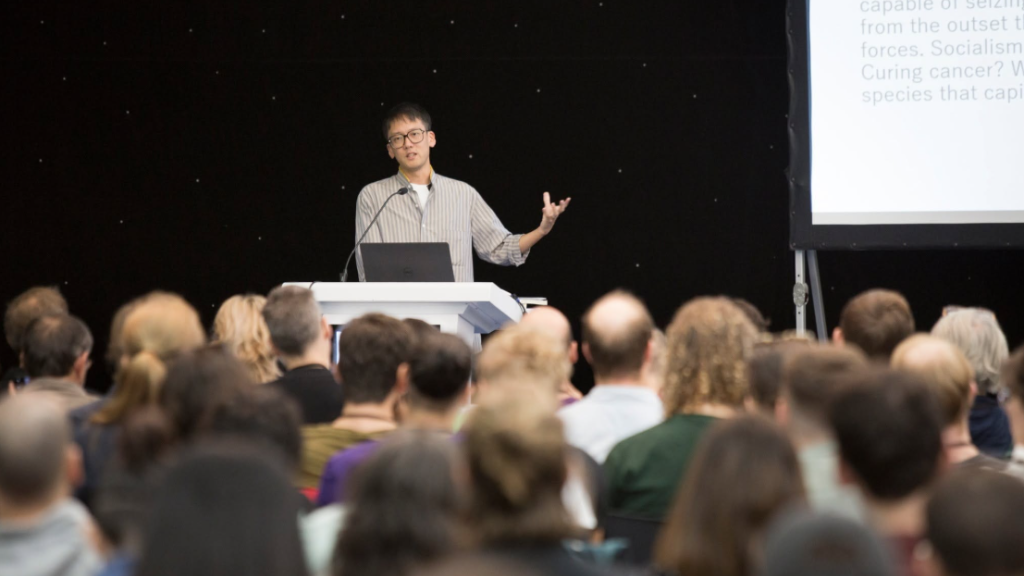

Kohei Saito in Zagreb, September 2023. Photo by the author.

First published in Czech in Alarm. Translation from Notes of a Stubbornly Naive Leftist.

At a time when the world is grappling with deepening ecological and social crises, the search for alternatives has never been more urgent. In this context, the work of Kohei Saito, professor at the University of Tokyo and author of Marx in the Anthropocene and Slow Down: The Degrowth Manifesto, stands out. Saito focuses on the ecological and ecosocialist dimensions of Marx’s thought, arguing that Marx’s work contains ecological insights that have long been overlooked or misread. Although Marx did not explicitly advocate ecosocialism, Saito argues that his ecological thinking can inspire and support contemporary ecosocialist movements and policies aimed at addressing social and ecological injustice.

I met Kohei in Zagreb, where he was one of the keynote speakers at the 9th International Degrowth Conference, which brought together hundreds of participants from around the world, including scientists, academics, activists and politicians, to explore sustainable and just models of economy and society. His talk, titled “Marx and Degrowth: Is It Possible?,” set the tone for a wide-ranging discussion on the relationship between the degrowth movement and political approaches to the climate crisis. For me personally, this discussion was a key starting point in shaping a vision of post-growth democratic ecosocialism as a concrete direction for today’s left-wing politics, one rooted in the tradition of democratic socialism that has its origins in the Prague Spring.

How are you finding the international degrowth conference here in Zagreb, especially given its broad scope and the diverse audience it attracts?

It’s been great, especially due to the participation of many young people. That’s something very different from Japan, where discussion about Marx’s ideas often involve older people. I am very inspired by how this idea of degrowth is spreading among the younger generations and I’m very optimistic that we can build a new future together.

It also has a very broad background. Not just Marxists and activists, but also people from different disciplines: natural scientists, economists, philosophers. And it’s good that the degrowth concept is becoming so attractive to so many people. This is very important for mobilizing people. After all, it is a political idea, and this kind of attractiveness is something that we are actually looking for, right?

While it’s encouraging to see such a wide audience, don’t you feel that there’s a lack of clear direction on implementing the “degrowth” idea?

We are all learning from each other. Degrowth is a relatively new idea and often faces criticism for its inconsistency. I understand your concerns about the lack of direction. What should we do now? It is a very tough question. But we are not here to establish a single political party. The aim of this conference is to exchange new ideas, get to know each other, and build international relationships. I think the conference is successful in this regard. However, I understand that we also need to focus on building new strategies, changing politics and transforming the economic system. And that’s something we should work on right now.

And in relation to that, how do you see the role of ecosocialism and eco-Marxism in positively influencing this movement?

Marxism has been here for many years. If we can overcome the antagonism between ecosocialism and degrowth, I think that Marxism, with its political activism, can contribute in various ways. Addressing your point about the missing strategy, I believe Marxism can concretise the degrowth policies, especially concerning the working class, which currently is not very attracted to the degrowth idea. By integrating Marxist principles with degrowth, we can develop strategies that appeal to a broader alliance and a wider movement against the capitalist system and for climate justice.

During your lecture, you mentioned that some eco-socialists promote growth. Isn’t it contradictory for someone identifying as an eco-socialist to advocate for growth, perhaps in the form of green socialism? How should ecosocialism address this inconsistency?

Like degrowth, ecosocialism is also a very broad category. I recognize that some people are more optimistic about technological progress, and then they can have ecological socialism more associated with growth. But after reading various literature from the degrowth side, I came to realize that kind of eco-socialist growth is too optimistic. And so now I’m actively trying to convince my Marxist friends and colleagues to abandon that kind of technological optimism and try to look for another solution, which is degrowth communism. So, I think ecosocialism is a broader category where some people are more like growth-oriented ecosocialism, but I’m for degrowth communism, a vision of society without growth.

Do you know that in Eastern Europe, especially in Czechia, the terms socialism and communism have negative connotations? Some of my friends are trying to restore the original meaning of these terms. Do you think it’s worthwhile to do so, or should we seek alternative terminology?

Yes, I know. I come from Japan, where communism and socialism have different implications from those in Eastern Europe. When I talk to some people from Eastern Europe, like Czechs, they often criticize the use of the terms socialism and communism. It’s a complicated situation. People should find something that is attractive to them and also historically and politically meaningful. My primary audience is Japanese. However, when I came here to Croatia to share my ideas with people from different parts of the world, the reaction was rather positive. But I also understand that some people are like “no socialism, no communism, that’s like Stalin, it’s very authoritarian” and so on. So, if you think in that way, I respect it. The main thing is that we have to overcome capitalism, and then the post-capitalist society can be called whatever we want. I’m not dogmatic and I remain open to new ideas.

In the Czech Republic, we have some historical experience from the ‘60s, particularly from 1968 when the Russian army, along with other Warsaw Pact forces, intervened to suppress the attempt at “socialism with a human face”. One of the primary ideas was to democratise the economy to better serve the people. Do you think that it is still relevant today?

Of course, democratizing the economy is very important. When I talk about the necessity for more planning, we cannot leave everything to the market, competition and price mechanism. We are currently in a very difficult situation due to the climate crisis. And we must invest in what is necessary and avoid what is unnecessary. So, we need planning, but planning is also the term that reminds people of this old Soviet kind of dictatorship. However, when I say communism, socialism, and planning, it’s more about democratizing the economy. Today’s capitalist economy is not democratic either. We should really seek a new vision of democratising the economy and in doing so, we shouldn’t be afraid to criticise capitalism.

Based on this experience from the ‘60s and also with the new coming ideas, including yours, there is a group of people in the Czech Republic aiming to introduce the concept of democratic ecosocialism to the public as something that is really needed to change society. What’s your take on this?

I had a discussion with someone from the Czech Republic and he was quite critical of socialism. It was a very long debate and then when I talked about socialism, he criticized me for going back to the Soviet Union and that kind of thing. I believe that democratic ecosocialism aligns closely with my views. I want to make it clear that democratic ecosocialism will not aim for infinite growth but focuses on satisfying basic human needs and environmental protection. We don’t necessarily need to label it as “degrowth communism.” There can be various names, and I’m open to suggestions. The key is moving away from a capitalist system centered on constant expansion. When we have socialism, we should not pursue this constant expansion anymore. So, it is basically degrowth.

The focus on the word “democratic” is crucial in promoting systemic revolutionary change. Active public participation is essential for change to be sustainable. Degrowth economics or other alternative economic models, such as the doughnut economy, require institutional transformation. While movements can engage people and exert pressure on existing institutions, they cannot replace them. So, the real question is: how can we effectively bring about institutional change?

That sounds quite rigid. We mentioned democratic ecosocialism in the context of degrowth. Currently, what we primarily have is a movement. We certainly need to institutionalize our demands. But I still think the movement itself is too small. Given the environmental crisis and the pervasive character of neoliberalism, especially post-pandemic, people are realizing that our society prioritizes profit over human lives. I think we have a chance. This experience of the Soviet Union made our future grim for many years. But after the economic crisis of 2008, we’re now embracing new post-capitalist ideas without being burdened by memories of the Soviet era. As I mentioned earlier, a significant number of young people are unhesitant, if not eager, to support post-capitalist ideologies, marking a departure from past sentiments.

We often use GDP as the primary pro-growth indicator; it’s almost like a magic word that currently dominates everything. Do you believe there’s another way to evaluate societal progress?

There are already many indicators, such as the Human Development Index, Genuine Progress Indicator, and many others that actually take into account our happiness, education, equality, environmental impact, and so on. Maybe we can come up with a new one. I’m not an economist so I cannot make something by myself but it’s relatively easy to imagine making things like that. It’s just a political choice. If the government decides to put more importance on these new indicators than GDP, we have a different world. And I’m actually advocating for this in Japan because Japan has been stagnating in terms of GDP for more than 30 years so people are worried but actually, if you look at education, if you look at security, like safety, food, culture, these things are quite good in Japan. So why don’t we use these measures and then promote them outside Japan? And some people are attracted to this kind of idea. So, I mean, we will try.

Finally, I would like to focus on your work. How did you discover the relation between Marx and ecology? I know that it is mostly described in your two books, but can you summarise?

I went to Germany and I started to look at Marx’s notebooks. These notebooks, especially before and after Capital, contain a lot of material on natural sciences. And then I was wondering why Marx had read natural science in order to complete Capital? Capital is about capitalism and critical political economy. It has nothing to do with natural science. Of course, I thought in that way. But then, looking at these notebooks, I realized that he was actually pretty much interested in the issues of ecology, sustainability, and how capitalism actually undermines those conditions. And so, I realized, reading these notebooks, that Marx was quite interested in ecological issues and then especially that dimension we didn’t take into account in the 20th century. By integrating that kind of ecological insight into socialism, I think we can have a more democratic and sustainable type of post-capitalism. That’s something we should do now, and we can have more development and more interaction with the degrowth people, learn from each other, and then build a bigger movement and then institutionalize our demands for the future.

I would like to ask one last question. What will your next book be about?

My next book? So, I’m thinking about the issue of planning. Planning is very important because we cannot leave everything to the market. So, how do we plan? We want to avoid the Soviet kind of planning, right? We need democratic planning or what is it? That’s something that we should consider.

Is this meant as involving people directly in the planning process? The key is to leave some room for people’s initiative, to find the right balance so that we don’t repeat our negative experiences.

Yes, exactly.

Thank you very much.

Monday, January 13, 2025


Britain: Humanity faces a planetary emergency — Statement from Ecosocialism Conference 2024


Published 

Ecosocialism Conference 2024

First published at Ecosocialism Conference 2024.

2024 has witnessed a further acceleration in the environmental crisis. The environment humanity shares continues to be under attack on land, sea, and air by a global capitalist economy that requires constant accumulation and growth, irrespective of the cost to the natural world.

This is signalled by:

  • Earth’s thirteen straight months with a new average heat record to June 2024. The permanent rise in pre-industrial temperatures above 1.5C is now extremely likely.
  • Peer-reviewed science confirming it is inevitable, due to the Antarctic ice melt, that rapidly warming global seas will rise by one metre by the end of this century and an additional further one metre for each of the four centuries following.
  • Six of the nine planetary environmental boundaries continue to be breached, resulting in the chemical poisoning of the planet through fertilisers and ‘forever chemicals’ and a rapid increase in loss of both insect pollination and forests.

Capitalism cannot deliver a solution

November 2024 saw the re-election of Donald Trump as US President, a climate emergency denier, who said “drill, baby, drill’ at a closing election rally. It also saw the further degeneration of the COP process in Azerbaijan, whose president described the country’s natural gas as“a gift from God” to be brought to market. Petrostates tried to remove all reference to fossil fuels and the final financial agreement for poorer nations facing climate chaos was branded a ‘betrayal’ by many.

The genocide in Gaza and the ecocidal nature of modern warfare shows how ‘rules based’ international law is a fraud. Authoritarian rulers and imperialist nations do as they please, with millions of us dealing with the consequences, including the colonial slaughter inflicted by Israel as well as widespread environmental ruin in Ukraine after the Russian invasion.

These events underscore that with polluting production and resource extraction as its bedrock, there is no evidence that the market economics, exploitation, and accumulation so essential to capitalism, can deliver a solution in the interests of all humanity.

As the climate crisis deepens, inefficient, ineffective, and profit-driven technological reforms will be promoted by governments and corporations. While offering some amelioration, these steps will only deepen global inequality and insecurity and fail to tackle the totality of the crisis.

Despite most of the historic carbon being released by industrially developed western states, it is poorer ex-colonial nations that will bear the brunt of climate chaos. It is clear that the richer nations will seek to trap the global south in another round of debt to pay for climate mitigation so they can continue to keep countries subordinate and impoverished.

Confronted by population movements and social struggles resulting from climate breakdown, governments across the globe will further strengthen borders and introduce repressive legislation to police the social turmoil. The rise of authoritarianism goes hand in hand with the climate crisis.

A “just transition”

A market driven capitalist solution will harm workers and small farmers. Jobs in fossil fuel industries, agro-industries and large scale ranching will have to be drastically cut back in order to reduce greenhouse gas emissions. Without massive state intervention, millions of workers will lose their jobs. Farming methods will have to change radically, imperilling the livelihoods of small farmers. Embittered workers and farmers will be used by the far right to undermine reforms.

Billions of people whose lives are being devastated by climate change will receive little help from capitalist governments and institutions. Most of the climate finance being offered to poor countries is in the form of loans. In the face of a global emergency, offers of loans to poor countries is little more than self serving cynicism.

An ecosocialist transition will also begin to undo the legacy of colonialism, where some nations grew rich from others, leaving ex-colonial countries poorer and less able to deal with increasing climate chaos. We confront the crisis united across borders to destroy imperialist divisions and to ensure a good quality of life for all.

A just transition also involves fighting to undo harmful gender divisions where – mainly women – do unpaid labour for capitalism and will also be some of the people to suffer most through climate chaos. This means overthrowing misogynist hierarchies and building broad movements that empower everyone to fight for gender equality within an ecosocialist society.

We need an Ecosocialist movement and programme

There is an urgent need to build a movement with a programme to meet the climate emergency that offers an alternative to the chaos, inefficiency, inequality, and repression resulting from capitalist strategies.

At the heart of an ecosocialist programme is the democratic socialisation of industries and services and the equitable distribution of resources. This necessarily means replacing the domination of capital and its profiteering, which is directly contrary to the interest of humanity and the natural world it is part of, with ecosocialist democracies governed by the interests of the international working class and its allies. Ecosocialism is the only way we will achieve a post-scarcity world where our needs are met and we have an abundance of time, culture and human connection alongside housing, food and public amenities for all.

We urgently need emergency programmes to tackle the crisis we face. We need investment in public programmes to: replace fossil fuels with renewable energy; create cheap and reliable public transport; retrofit and renovate existing housing stock; end the supply of ultra-processed foods poisoning our bodies; radically reduce deforestation; and implement radical measures to clean the oceans, seas, and rivers.

Ensuring a just transition and investing in clean energy will require many trillions of dollars. Governments of wealthy countries are politically unwilling to find this amount of money through conventional institutions. It is clear that we need a massive redistribution of wealth and power away from the large global corporations and the world’s very wealthy individuals if we’re going to finance our response to the climate catastrophe.

There is also work to do to deepen education on these issues, to combat misinformation and conspiracy theories. We need to work to build a broad based movement for ecosocialist education in trade unions, communities and our workplaces.

The Ecosocialist challenge is global

There is no national solution to this crisis. Fighting the ecocide that threatens humanity is a global task that will require the ending of the market economy and the social and economic inequalities it creates, the dismantling of imperialism and its five centuries-long exploitation of the planet, the abolition of borders, militarism, and policing, and the social transformation of the economy from the ground up.

Ecosocialism should aspire to be an international revolutionary movement that challenges the existing capitalist world order by offering a socialist, democratically planned, and egalitarian programme to meet the environmental crisis that humanity faces.

Revolutionary change means being active

Ecosocialists need to be active in the worker’s movement and environmental movement. Active in the trade unions, communities, and in social movements most impacted by the climate crisis. In particular, this means practical and political solidarity with refugees and immigrants and those forced to move as climate conditions make their lives impossible.

Ecosocialists need to fight for reforms in the here and now and always point to a future better world by offering a programme that intends to lead to it, while challenging the idea that capitalism and nature can peacefully coexist.

We also have to fight to radicalise our unions, to challenge bureaucratic inertia and turn them outwards into organisations that fight for the whole class as part of an ecosocialist strategy.

We welcome people who want to join us to help develop this campaign and expand its activities. We want to transform the ideas and theories of ecosocialism into practical action. We might not agree on every slogan or theory but we need to build a mass movement in a spirit of unity and hope – one that is inclusive and fights against all forms of oppression and exploitation.

Our proposed plans

1. Develop the organising strength of ecosocialism both locally and internationally. With Trump in the White House we face an even faster acceleration of biosphere breakdown. A focal point will be COP30 (Belém, Brazil) coming up late 2025. There are plans for big protests and we should spend the next 12 months helping to make the case for massive action around November 2025. We will promote and organise for major events like London Climate Action Week 2025 which will take place from the 21st to the 29th June 2025.

2. Work with the Climate Justice Coalition on mobilisations across Britain and the Global Ecosocialist Network to coordinate internationally. And all other organisations committed to building an inclusive ecosocialist movement.

3. Organise a regular meeting online under the Ecosocialism Conference banner with any individuals and left groups that might be interested to help coordinate ecosocialist strategy and activity.

4. Provide resources for people to organise their own local events (help produce leaflets, provide a speaker etc) to promote ecosocialism, engage new activists and form the basis for a wider network in the future.

5. Focus on trade union conferences next year, getting them committed to backing the COP30 protests, green transition (this will be a fight particularly in Unite and GMB who organise workers involved in the fossil fuel industry). We will liaise with other activists in the union, for instance the Unite Grassroots Climate network, to coordinate this.

6. Improve the website to have more regular articles and keep promoting it, encouraging well known people to write for it as well.

7. Develop a political education campaign to raise awareness and understanding of the crisis and the ecosocialist and social justice response. This should be organised and resourced online and in person and to reach people of all ages and should draw on our most effective communicators, activists and teachers.

Sunday, June 23, 2024

Two (wrong) views on Marx, degrowth, and productivism (plus John Bellamy Foster on ecosocialism and degrowth)

Monthly Review
23 June, 2024


[Editor’s note: LINKS International Journal of Socialist Renewal is sponsoring Ecosocialism 2024, which will be held June 28–30, Boorloo/Perth, Australia. For more information on the conference, including how you can participate online, visit ecosocialism.org.au.]

First published at Monthly Review.

The term Promethean, referring in this context to extreme productivism, first entered into the ecological debate as a censure aimed almost entirely at Karl Marx. It was adopted as a form of condemnation by first-stage ecosocialists in the 1980s and ’90s, who sought to graft standard liberal Green theory onto Marxism, while jettisoning what were then widely presumed to be Marx’s anti-ecological views. However, the Promethean myth with respect to Marx was to be subjected to a sustained attack, commencing twenty-five years ago, in the work of second-stage ecosocialists, represented by Paul Burkett’s Marx and Nature (Haymarket, 1999) and John Bellamy Foster’s “Marx’s Theory of Metabolic Rift” (American Journal of Sociology 105, no. 2 [September 1999])—followed soon after by Foster’s Marx’s Ecology (Monthly Review Press, 2000). Here it was understood that the outlook of classical historical materialism was not that of the promotion of production for its own sake—much less accumulation for its own sake—but rather the creation of a society of sustainable human development controlled by the associated producers. The key analytical basis of this recovery of the classical historical-materialist ecological critique was Marx’s theory of metabolic rift.

On the basis of the recovery of Marx’s deep-seated ecological critique, ecosocialism has made major advances over the last quarter-century. One notable work, in this respect, was Kohei Saito’s Karl Marx’s Ecosocialism (Monthly Review Press, 2017), which brought additional evidence to bear on the critique of the Promethean myth and on the development of Marx’s theory of metabolic rift. The result was the emergence of powerful ecological Marxist assessments of the contemporary planetary crisis provided by a host of thinkers, including such notable figures as Ian Angus, Jacopo Nicola Bergamo, Mauricio Betancourt, Brett Clark, Rebecca Clausen, Sean Creaven, Peter Dickens, Martin Empson, Michael Friedman, Nicolas Graham, Hannah Holleman, Michael A. Lebowitz, Stefano Longo, Fred Magdoff, Andreas Malm, Brian M. Napoletano, Ariel Salleh, Eamonn Slater, Carles Soriano, Pedro Urquijo, Rob Wallace, Del Weston, Victor Wallis, Richard York, and many others too numerous to name.

However, in the last couple of years, the myth of Prometheanism in Marx’s thought has been reintroduced in ghostly fashion by thinkers such as Saito, in his latest works, and by Jacobin authors Matt Huber and Leigh Phillips, representing two opposite extremes on the issue of the role of productive forces/technology. The result has been to erect a “Tower of Babel” that threatens to extinguish much that has been achieved by Marxian ecology.

In his two most recent studies, Marx in the Anthropocene (Cambridge University Press, 2023) and Slow Down (Astra Publishing House, 2024, originally titled Capital in the Anthropocene), Saito has gone back on his earlier contention in Karl Marx’s Ecosocialism that Marx was not a Promethean thinker, and now insists, drawing on the largely discredited work of the “analytical Marxist” G. A. Cohen, that Marx was a technological determinist for most of his life. The about-face by Saito on Marx and Prometheanism is clearly designed to accentuate what Saito now calls Marx’s “epistemological break,” beginning in 1868. From that point on, Marx is supposed to have entirely abandoned his previous historical materialism, rejecting all notions of the expansion of productive forces in favor of a steady-state economy, or degrowth. However, since there is not even the slightest textual evidence anywhere to be found in support of Saito’s claim on Marx and degrowth (beyond what has long been argued, that Marx was a theorist of sustainable human development), Saito is forced to read between the lines, imagining as he goes along. The thrust of his new thesis is that the “last Marx” concluded that the productive forces inherited from capitalism formed a trap, causing him to reject growth of productive forces altogether in favor of a no-growth path to communism. Such a view, however, is clearly anachronistic. Naturally, the fact that planned degrowth is a real issue today (see the special July–August 2023 issue of MR) does not mean that the problem would have presented itself in that way to Marx in 1868, in horse and buggy days, when industrial production was still confined to only a small corner of the world. (On Saito’s analysis, see Brian Napoletano, “Was Marx a Degrowth Communist?” in this issue.)

Ironically, Saito’s thesis that Marx was a Promethean up to and including the publication of Capital (viewed by Saito as a transitional work in this respect) receives strong backing from Huber and Phillips in their article “Kohei Saito’s ‘Start from Scratch’ Degrowth Communism” (Jacobin, March 9, 2024). Proudly holding up a “Promethean Marxism” banner, Huber and Phillips present themselves as belonging to a long tradition of well-known Prometheans, including not only Marx and Frederick Engels, but also V. I. Lenin, Leon Trotsky, and Joseph Stalin. For the Jacobin authors, for whom Marxism = Prometheanism, Saito is thus to be faulted not for suggesting that Marx was Promethean up until the writing of Capital, but rather for his claim that Marx jettisoned his Prometheanism in his white-beard years, failing to carry it all the way to his grave.

Although they adopt a Marxist cover, the views of Huber and Phillips on technology and the environment are virtually identical to those of Julian Simon, author of The Ultimate Resource (Princeton University Press, 1981) and the leading anti-environmentalist critic of the ecological limits to growth within the neoclassical-economic orthodoxy in the 1970s and ’80s (see Foster’s “Ecosocialism and Degrowth” in this issue). The Jacobin authors thus adopt a view that is not so much ecomodernist in orientation as a form of total human exemptionalism from ecological determinants, in which humanity is presumed to be able to transcend by technological means all Earth System limits—including those of life itself. The metabolic rift, we are told, does not exist since it is dependent on a rift in a nonexistent “balance of nature.” Here they ignore the fact that the notion of anthropogenic rifts in the biogeophysical cycles of life on the planet, raising the issue of mass extinction, extending even to human life itself, is central to modern Earth System science. It is not a question of a “balance of nature” as such, but rather one of preserving the earth as a safe home for humanity and innumerable other species.

Going against the current world scientific consensus, Huber and Phillips explicitly deny the reality of the nine planetary boundaries (climate change, biological integrity, biogeochemical cycles, ocean acidification, land system change, freshwater use, stratospheric ozone depletion, atmospheric aerosol loading, and novel entities). Rather, they insist in their total exemptionalism that there are no biospheric limits to economic growth. Hence, “there is no need,” they tell us, “to move to a steady-state economy…to return to more ‘appropriate’ technologies, to abandon ‘megaprojects,’ or to critique…a ‘metabolic rift’ with the rest of nature which,” they say, “[does] not exist.” Words like “commons” and “mutual aid” are classified as mere “buzzwords.” All arguments for “limits to growth” are by definition forms of “Malthusianism.” Nuclear power is to be promoted as a key solution to climate change and pollution generally. To cap it off, they contend, in social Darwinist terms, that capitalism itself is somehow integral to natural selection: “So as far as the rest of nature is concerned, whatever we humans do, via the capitalist mode of production or otherwise, from combustion of fossil fuels to the invention of plastics, is just the latest set of novel evolutionary selection pressures.”

Phillips has gone even further elsewhere: “The Socialist,” he declares, “must defend economic growth, productivism, Prometheanism.… Energy is freedom. Growth is freedom.” The ultimate goal is “more stuff.” What is required is “a high energy planet, not modesty, humility, and simple living.” With a brazen display of irrealism, Phillips bluntly asserts: “you can have infinite growth on a finite planet.” The earth, we are duly informed, can support “282 billion people”—or even more. Marxists who have questioned the nature of contemporary technology, such as Herbert Marcuse, are summarily dismissed as proponents of “neo-luddite positions.” Phillips openly celebrates Simon’s reactionary work, The Ultimate Resource, the bible of anti-ecological total exemptionalism (Leigh Phillips, Austerity Ecology and the Collapse-Porn Addicts: A Defence of Growth, Progress, Industry and Stuff [Winchester, UK: Zero Books, 2015], 59, 63, 89, 250, 259).

Huber and Phillips’s bold advocacy of a “Promethean Marxism” in their Jacobin article was delivered with a panache that must have left the capitalist Breakthrough Institute green with envy. It has already led to a strong backlash in left-liberal environmental circles against the inanities of so-called “orthodox Marxism.” This can be seen in an article by Thomas Smith titled “Technology, Ecology and the Commons—Huber and Phillips’ Barren Marxism” (Resilience, March 21, 2024, resilience.org). Here we are told, in a further retreat from reason, that Huber and Phillips, in their total contempt for ecology, are simply “toeing the Marxist line,” promoting the “promethean Marxist dogma”—as if their views could be seen as representative of “orthodox Marxism” (which, as Georg Lukács famously said, is related entirely to method), or as if their outlook were one with that of Marxism in the world today. Neither is the case. In twenty-first-century conditions, socialism is ecology and ecology is socialism. Perhaps the most important aspect of Saito’s own analysis, despite all of the contradictions in his most recent work, is that it recognizes that a deep ecological view was present classically within the work of Marx (and, we would add, Engels), and that this constitutes a theoretical foundation on which all those committed to the philosophy of praxis today can draw in their struggles to create an economically egalitarian and ecologically sustainable world.
Ecosocialism and degrowth


First published at Monthly Review.

This interview by Arman Spéth with Monthly Review editor John Bellamy Foster is a revised and extended version of the interview first published in Spring 2024 in the journal Widerspruch, Beiträge zu sozialistischer Politik (Contradiction: Contributions to Socialist Politics), Zurich, Switzerland.

Degrowth is on the rise. In recent years, several internationally recognized publications have appeared that speak out in favor of the ecosocialist degrowth approach. The journal Monthly Review, of which you are editor, has adopted this approach recently in your special July–August 2023 issue, “Planned Degrowth: Ecosocialism and Sustainable Human Development.” What are the motives behind this and how do you explain the popularity of left-wing degrowth approaches?

Although “degrowth” as a term has caught on only recently, the idea is not new. Since at least May 1974, Monthly Review, beginning with Harry Magdoff and Paul M. Sweezy, has explicitly insisted on the reality of the limits of growth, the need to rein in exponential accumulation, and the necessity of establishing a steady-state economy overall (which does not obviate the need for growth in the poorer economies). As Magdoff and Sweezy stated at that time, “instead of a universal panacea, it turns out that growth is itself a cause of disease.” To “stop growth,” they argued, what was necessary was the “restructuring [of] existing production” through “social planning.” This was associated with a systematic critique of the economic and ecological waste under monopoly capitalism and the squandering of the social surplus.

Magdoff and Sweezy’s analysis gave a strong impetus to Marxian ecology in the United States, particularly in the fields of environmental sociology and ecological economics, for example in Charles H. Anderson’s The Sociology of Survival: Social Problems of Growth (1976) and Allan Schnaiberg’s The Environment: From Surplus to Scarcity (1980). So, “degrowth” in that sense is not new to us and is part of a long tradition, stretching over a half-century. Our “Planned Degrowth” issue merely sought to develop this argument further under the deepening contradictions of our time.

Yet, while Monthly Review has long insisted on the need to move in the rich countries to an economy of zero net capital formation, today this issue has become more urgent. The term “degrowth” has woken people up to what ecological Marxism has been saying for a very long time. It has become necessary, therefore, to provide a more precise answer as to what this means. The only answer possible is the one that the MR editors provided a half-century ago. Namely, there are two sides to the question. One is the negative one of stopping unsustainable growth (measured in terms of GDP). The other is the more positive one of promoting a planned social response to the capitalist accumulation regime. Our “Planned Degrowth” issue seeks to emphasize this more positive response, one which only ecosocialism can offer.

For ecosocialism, the notion of degrowth, although recognized as a necessity in the more developed economies in our time, in which ecological footprints per capita are greater than what the planet as a place of human habitation can support, has always been seen as simply part of an ecosocialist transition, and not in itself the essence of that transition. A degrowth path, insofar as it is one of deaccumulation, is directly opposed to the internal logic of capitalism, or the system of capital accumulation. In fact, I wrote an article in January 2011 called “Capitalism and Degrowth: An Impossibility Theorem.” The nature of the struggle means going against the logic of capitalist accumulation even while we exist within it. That is the historical character of revolution, today driven forward by absolute necessity. The struggle for human freedom and the struggle for human existence are now one.

The relation of degrowth to ecosocialism is most straightforwardly expressed by Jason Hickel in an article titled “The Double Objective of Democratic Ecosocialism“ in the September 2023 issue of Monthly Review: “Degrowth…is best understood as an element within a broader struggle for ecosocialism and anti-imperialism.” It is a necessity in terms of present conditions in the rich, imperialist core of the capitalist economy, but not a panacea and not a sufficient basis in and of itself in defining ecosocialist change.

The July–August 2023 issue of Monthly Review was on “Planned Degrowth,” but the emphasis of the issue was on bringing planning to bear on our ecological problems more broadly. Thus, within ecosocialism, degrowth is merely a realistic recognition of contemporary imperatives centered in the rich economies with their enormous ecological footprints, while the proper emphasis is on ecosocialist planning rather than the degrowth category itself.

Part of the popularity of the term “degrowth” is because it so squarely offers an anticapitalist approach and cannot be co-opted by the system like so much else. But the overall approach of ecosocialism cannot be articulated just in negative terms, as the mere inverse of capitalist growth. Rather, it needs to be seen in terms of the transformation of human social relations and means of production by the associated producers.

In his bestselling book Slow Down (2024), Kohei Saito claims to have discovered an “epistemological break”—a major transformation in Karl Marx’s thinking in the last years of his life. Marx, he claims, had turned into a “degrowth communist” and discarded his “progressive view of history,” that is, abandoned the idea of the development of productive forces as the driving force of human development history. What do you think about this? How does your degrowth approach relate to your understanding of historical materialism?

Saito’s earlier book, Karl Marx’s Ecosocialism, was a valuable work. However, his more recent work, which includes Slow Down and Marx in the Anthropocene (2022), is wrong where the main theses that he advances with respect to Marx are concerned—even if the idea of degrowth communism, viewed in more general terms, is an important one.

It is true that Saito has raised some fundamental issues. Yet, there is very little that is new in his argument. Marxian ecology has stressed Marx’s theory of metabolic rift for a quarter-century. The fact that Marx advocated what has been called “sustainable human development” has been advanced over that entire period by Paul Burkett, me, and numerous others. Moreover, it has long been emphasized that the mature basis of this in Marx’s work was to be found in the Critique of the Gotha Programme and the letter (and draft letters) to Vera Zasulich—the very sources that Saito relies on almost exclusively in contending that Marx embraced degrowth communism. Even the focus of Marxist ecology on the contributions of Georg Lukács and István MĂ©száros, in this respect, is at least a decade old.

What can be considered new in Saito’s latest work is not substance but form, along with the exaggerated character of the argument that he now advances, which requires that he repudiate much of his own earlier analysis in Karl Marx’s Ecosocialism. In his new works, Saito introduces the notion that Marx altogether abandoned productivism/Prometheanism, which is supposed to have dominated Marx’s thinking at least in latent form as late as 1867 and the publication of Capital. Saito characterizes Marx’s Capital as a transitional work that incorporated an ecosocialist critique while not yet entirely surmounting historical materialism, which Saito himself identifies with productivism, technological determinism, and Eurocentrism. Only in 1868, we are told, did Marx engage in an epistemological break, rejecting the expansion of productive forces altogether, along with historical materialism, thus becoming a “degrowth communist.”

There are two fundamental problems with this. First, Saito is not able to provide a single shred of evidence that Marx in his final years was a degrowth communist in this sense of rejecting the expansion of productive forces. Nor, for that matter, is Saito able to provide evidence that Marx was Promethean and Eurocentric in his mature work in the 1860s (or even prior to that), insofar as Prometheanism is understood as production for production’s sake and Eurocentrism as the notion that European culture is the only universal culture. There is absolutely nothing to substantiate such allegations. The well-known fact that Marx saw collectivist/egalitarian possibilities in the Russian peasant commune (mir) is consistent with his overall outlook of sustainable human development. However, there is no justification for taking this to mean that he thought that a revolution in Tsarist Russia, still a very poor, underdeveloped, largely peasant country, could occur without the expansion of productive forces.

Second, the picture of Marx as a degrowth communist is a historical anachronism. Marx wrote at a time when industrial capitalism existed in only a small corner of the world, and, even then, transportation in London, at the center of the system, was still in the horse and buggy stage (not discounting the early railroad). There was no way that he could have envisioned the full-world economy of today, or the meaning that “degrowth” has assumed in the late twentieth and early twenty-first centuries.

Saito’s analysis in his most recent works is therefore useful mainly in the controversy it has generated, and in the renewed focus on these issues that his work has provided. In the process, he indirectly has helped move us forward. Nevertheless, it is important to apply Marx’s method when analyzing the changed historical conditions of the present, and Saito’s jettisoning of historical materialism does not help in this respect.

You use the terms “degrowth” and “deaccumulation” interchangeably. Can you please explain what links these terms in your understanding?

“Degrowth” is an elusive term, like “growth” itself. The latter reflects the (often irrational) way that GDP is calculated under capitalism, expanding normal capitalist bookkeeping, based on a system of exploitation, to a national and even global level. The real issue is zero net capital formation, that is, instituting a process of deaccumulation. This has long been understood by Marxist ecological economists, as well as other, non-Marxist ecological economists, like the late Herman Daly. Growth, as Marx’s reproduction schemes demonstrate, is based on net capital formation. To recognize this is to emphasize that it is the system of capital accumulation that is the problem.

The idea of “planned degrowth” is at the center of your considerations. Could you explain what exactly you mean by this and how “planned degrowth” differs from other degrowth approaches?

I do not think there is anything complicated about this. Degrowth, and sustainable human development more generally, cannot occur without planning, which allows us to focus on genuine human needs and opens up all sorts of new possibilities blocked by the capitalist system. Capitalism works ex post, through the mediation of the market; planning is ex ante, allowing a straightforward approach to the satisfaction of needs, in line with what Marx in his “Notes on Adolph Wagner” called the “hierarchy of…needs.” Integrated democratic planning operating at all levels of society is the only route to a society of substantive equality and ecological sustainability and to human survival. Markets will still exist, but the path forward ultimately requires social planning in areas of production and investment controlled by the associated producers. This is especially the case in a planetary emergency such as today. As I have indicated, Magdoff and Sweezy argued as far back as May 1974 that stopping growth was essential in the rich economies, given the planetary ecological crisis, but that this needed to be approached more positively in terms of a planned restructuring of production as a whole.
Critics of degrowth

CĂ©dric Durand in his September 2023 article in Jacobin, titled “Living Together,” criticizes the degrowth approach and writes “the abandonment of ‘the productive forces of capital’ and the scaling down of production would result in a de-specialisation of productive activity, leading to a dramatic reduction in the productivity of labour and, ultimately, a plunge in living standards.” Other critics, such as the economist Branko Milanovic, believe, as he wrote in “Degrowth: Solving the Impasse by Magical Thinking,” published on his SubStack in 2021, that degrowth advocates “engage in semi-magical and magical thinking,” because they cannot admit that the approach that they advocate would mean a loss of living standards for the vast majority of the population. How do you respond to these criticisms?

Durand and Milanovic would have a point if the question were one of “capitalist degrowth,” which, as I have already said, is an impossibility theorem. But the very changes needed to address today’s environmental and social crises have to do with changes in the parameters that define capitalism. Thus, attempts to criticize degrowth by insisting that it will reduce “productivity” increases, measured in narrow capitalist value-added terms, is simply to beg the question. The real issues have always been: productivity increases to what end, for whom, at what cost, requiring what level of exploitation, and measured by what criteria? What is the significance of increasing productivity in fossil fuel extraction if it points to the end of life on Earth as we know it? How many lives, as William Morris asked in the nineteenth century, have been rendered useless since compelled to produce useless and destructive goods at ever higher levels of “efficiency”?

Moreover, it is simply not true that economic growth is needed for productivity improvements, if this is seen in terms of real productivity increases (increase in output per labor hour), as opposed to increases in “productivity” measured simply as growth in value-added to GDP, which is a very narrow and misleading—even circular—conception. It is perfectly possible to generate endless qualitative improvements in production, reduce the labor time per unit of output, and thus, to advance efficiency, in a context of zero net capital formation, particularly in a socialist-oriented society. The productivity improvements in that case would be used to satisfy broad social needs, rather than for economic expansion for the enrichment of a few. They would be oriented primarily toward use value. Working hours could be reduced. It would mean that the benefits of productivity would be shared and human capacities in general would be augmented.

In his book Climate Change as Class War: Building Socialism on a Warming Planet (2022) and in his articles for Jacobin magazine, Matt Huber explicitly argues against your view, claiming that solving the ecological crisis requires massive technological expansion. How would you respond to this view?

Jacobin is now the principal left-social democratic journal in the United States, and Huber’s argument is developed in that vein. Social democracy, as opposed to socialism, has always been about a “third way” in which the irreconcilables of labor and capital (today, also including the irreconcilables of capitalism and the earth) can supposedly be reconciled via such means as new technology, increased productivity, regulated markets, formal labor organization, and the capitalist welfare (or environmental) state. However, the basic system would remain untouched. The idea is that social democracy can organize capitalism better than liberalism, not that it will go against capitalism’s fundamental logic. Huber in his book throws into the mix capitalist ecological modernization in a form that does not differ much from liberal ecological modernization, as represented by the Breakthrough Institute, but with the addition, in his case, of organized electrical workers. This perspective has consistently defined Jacobin’s approach to environmental issues, which has generally been opposed to ecosocialism and environmentalism more broadly. I wrote an article titled “The Long Ecological Revolution“ in Monthly Review in November 2017, questioning Jacobin’s strongly ecomodernist approach in this respect, which has included pieces by the author Leigh Phillips, who, in his book Austerity Ecology and the Collapse-Porn Addicts (2015), went so far as to suggest that “the planet can sustain up to 282 billion people…by using all the land[!]” and other similar absurdities.

In an article that Huber cowrote with Phillips in Jacobin in March of this year (“Kohei Saito’s ‘Start from Scratch’ Degrowth Communism”), the two authors reject the planetary boundaries framework advanced by today’s scientific consensus, which seeks to demarcate the biophysical limits to the earth as a safe home for humanity. In the planetary boundaries/Earth System framework, climate change is depicted as just one of nine such boundaries, the transgression of any one of which threatens human existence. In contrast, Huber and Phillips adopt a position virtually identical to that of the neoclassical economist Julian Simon, author of The Ultimate Resource (1981), who pioneered in propagating the notion of total human exemptionalism, according to which there are no real environmental limits to the quantitative expansion of the human economy that could not be overcome by technology; that it is possible to have infinite growth on a finite planet. On this basis, Simon was recognized as the foremost anti-environmentalist apologist for capitalism of his day. In this view, technology solves all problems irrespective of social relations. In near identical fashion, “the only true, permanently insuperable limits that we face,” Huber and Phillips reductionistically claim, “are the laws of physics and logic”—as if the biophysical limits of life on the planet were not an issue. Climate change, according to this view, is merely a temporary problem to be solved technologically, not a social-relational (or even ecological-relational) one. But for Marxists, social relations and technology, while distinguishable, are inextricably and dialectically entangled. An outlook that denies the planetary crisis by resorting to the promise of a technological deus ex machina, while absenting both historical and ecological limits, is in conflict with historical materialism, ecosocialism, and contemporary science—all three.

Today’s scientific consensus, as represented, for example, by the UN Intergovernmental Panel on Climate Change—particularly the stances taken by scientists, rather than governments involved in the process—states with absolute clarity that technology alone will not save us, and that we need a revolutionary-scale challenge to the present political-economic hegemony. We are now on the verge of a 1.5°C increase in global average temperature, and a 2°C increase will not be far beyond that if we do not act quickly. We have now crossed six of the nine planetary boundaries, with the likelihood of crossing still more. Yet, this trajectory could be altered. We already have all the technologies we need to address the planetary crisis, provided that the necessary changes are made in existing social relations. But there is the rub.

Huber and Phillips polemically reject degrowth as a backward strategy, even if organized on a planned ecosocialist basis. They argue rather that net capital accumulation can continue indefinitely if it is greened and if there is a reconciliation between capital and labor, and capital and the earth, along ecomodernist lines. At best this can be seen as the Green New Deal approach, or ecological Keynesianism. But their overall thrust goes beyond that and is, in fact, one of total human exemptionalism in which all lasting environmental limits, associated with the biogeophysical cycles of the earth, are denied. The main fault I find in this analysis is that it is willing to forego scientific realism and dialectical critique for political expediency, ending up with a kind of techno-utopian reformism that in fact goes nowhere, since it backs off from any serious confrontation with the capitalist system. This is hardly rational when the issue is a social system that is now threatening—in a matter of years and decades, not centuries—to transgress the conditions of the planet as a safe place of humanity. There is nothing socialist or ecological about such views.
What to do?

In your article “Planned Degrowth,” you emphasize the need for a revolutionary transformation to overcome ecological challenges. Could you explain what you mean by revolutionary transformation and why you believe it is essential? And how would you respond to the arguments that follow the principle of the “lesser evil” and support the possibility of an ecological transformation within the capitalist system, partly due to the urgency of the situation?

Today’s science says that we need changes in our socioeconomic system, applied technology, and our entire relation to the Earth System, if humanity is not to lay the basis this century for its own complete destruction. If the necessary, urgent transformations in the mode of production (which includes social relations) are not made, we will see death and dislocation of hundreds of millions, perhaps even billions, of people due to climate change this century. Climate change, moreover, is only part of the problem. We have now dumped 370,000 different synthetic chemicals into the environment, most of which are untested and many of which are toxic: carcinogenic, teratogenic, and mutagenic. Plastics, another novel entity in the planetary boundaries classification, are now out of control, with the proliferation globally and in the human body of microplastics, and even nanoplastics (small enough to cross cell walls). Billions of plastic sachets are being marketed by multinational corporations, primarily in the Global South. Global water shortages are growing, forests and ground cover generally are vanishing, and we are facing the sixth mass extinction in the history of the planet.

With six of the nine planetary boundaries now crossed, we are facing unprecedented dangers to human existence, and an existential crisis for humanity. The cause common to all these planetary crises is the system of capital accumulation, and all immediate solutions mean going against the logic of capital accumulation. The struggle will naturally occur within the present system, but in every moment of this struggle we are faced with the urgency of putting people and the planet before profit. There is no other way. Capitalism is dead to humanity.

The scale of the change required must be measured in terms of both time and space. Our relation to both today necessarily must be revolutionary and stretch around the globe. Whether we will succeed or not is something we cannot know at present. But we do know that this will be humanity’s greatest struggle. In this situation there is no “lesser evil.” As Marx said, on a much smaller scale in relation to Ireland in his day, it is “ruin or revolution.”

Finally, how do you assess the feasibility of ecosocialist degrowth with regard to the current political realities (Kräfteverhältnisse)? Where do you see opportunities, where do you see obstacles?

Opportunities are everywhere. Obstacles, largely a product of the present system, are also everywhere. As Naomi Klein said of climate change: This Changes Everything. Nothing can or will remain the same. That is the very definition of a revolutionary situation.

The most concrete and comprehensive study of what could be done practically in our present circumstances is to be found in Fred Magdoff and Chris Williams’s 2017 book, Creating an Ecological Society: Toward a Revolutionary Transformation. As Noam Chomsky said of their book, it demonstrates “that the ‘revolutionary systematic change’ necessary to avert catastrophe is within our reach.”

John Bellamy Foster is editor of Monthly Review and professor emeritus of sociology at the University of Oregon. Arman Spéth is a PhD student at Bard College, Berlin, studying the development of capitalism in post-Soviet Kazakhstan. Until the end of April 2024, he was also an editor of Widerspruch.

Saturday, July 25, 2026

Ian Angus on capitalism, ecosocialism and metabolic rifts

First published at Green Left.

Climate and Capitalism editor Ian Angus joined the Green Left Show to discuss his latest book Metabolic Rifts: Capitalism’s Assault on the Earth System. The discussion covered: Metabolic Rifts (0:50); Why is capitalism to blame? (3:05); Why ecosocialism? (6:05); The importance of science (7:05); Is it too late? (9:55); Capitalism and pandemics (11:59); and Ecosocialism 2026 (15:40).

Sunday, November 30, 2025


Ecosocialism or extinction: Defending life, building free territories and ecosocialism from and for the peoples


Second Ecosocialist Encounter

Statement from the Second Ecosocialist Meeting, held in Belém, Brazil, November 2025, with the participation of 99 organizations and more than 350 people, including a strong presence of organizations representing Indigenous peoples and Afro-descendants.

We don’t sell our land because it is like our mother. Our territory is our body. And we don’t sell our body. We don’t sell our mother. We wouldn’t sell it, because it is sacred.
And we start suffering pressures of invasion, pressure from mining, from agribusiness, which has expanded a lot, pressure from logging companies, which are deforesting our territories. And we have been resisting. 
—Auricelia Arapiun, Coordinator of Indigenous Organizations of the Brazilian Amazon (COIAB).

We gather at moment of profound capitalist attacks on life, within the framework of the actions organized by the peoples in response to COP30. This meeting has allowed us, once again, to reaffirm that both the rise of the far right and the false solutions proposed by governments that call themselves progressive (yet do not hesitate to privatize the commons or facilitate attacks against peoples and leaders who face daily the consequences of the logic of infinite capital growth in their territories) push us to struggle for a world in which living systems are at the center of all our political constructions, and to forcefully reject any attempt at intimidation.

We have seen an example of what happens when, instead of strengthening the struggles of peoples who defend their territories at the risk of their own lives, the defenders of progressive neoliberalism place themselves at the service of capital and predatory extractivism. The political threats suffered by our Indigenous comrade Auricelia Arapiun during her intervention in our roundtable on the current conjuncture clearly reveal a sector acting within communities to sow fear and fragmentation. Yet we — just as Auricelia expressed in her response to the threat — neither remain silent nor compromise.

The offensive of the far right also manifests in our territories through attempts to violate our sovereignty, reproducing the same logics of subjugation and domination that existed in the past and persist today. Against this imperialist offensive, we, ecosocialists, defend a united front to resist and protect ourselves.

Ecosocialism, as a tool to build another world, has become necessary and urgent. The accelerating destruction of ecosystems’ capacity for reproduction and the neocolonial and imperialist character of the supposed alternatives proposed by the very system that created the current climate emergency represent a threat to our continuity as a species, leading us toward a point of no return.

Faced with this challenge, the only possible path is the coordinated organization of our struggles in order to surpass the capitalist system. The organized struggle of peoples, their resistance to systems of domination, and their progress in building other worlds founded on solidarity, complementarity, and reciprocity — respecting the knowledge and cosmovisions of different peoples as well as their legitimate rights to self-defense and self-determination — form the fundamental basis of our strategy.

These days of debate brought together representatives of peoples in struggle from different regions of Abya Yala [an Indigenous name for the Americas, meaning “Continent of life” —ed.] and other continents, who have raised their voices globally to denounce that capitalist and imperialist extractivisms are causing environmental and human destruction in many territories. It is necessary to strengthen the alliances among peoples in resistance in order to combat this destruction, while consolidating forms of life-production historically developed by the peoples and today threatened by the contamination and appropriation of water, land, and air by transnational corporations and governments.

The voices of Indigenous peoples were central in this gathering, identifying a shared context of colonialism, invasion, dispossession, extractivism, and false solutions — accompanied by policies of annihilation and genocide, which not only kill but also render these peoples invisible through criminalization and persecution. At this stage, we see the relationship between body and territory as a fabric where structural violence resides, but also the struggle for life. This struggle manifests in alternative forms of resistance, through the valorization and articulation of knowledge and cosmologies in which ancestry and nature are inseparable; and through self-defense, self-determination, community life, and the importance of hope and unity across territories.

These struggles for life also appear in ecofeminisms, highlighting the struggles of women and feminized bodies across different territories of Abya Yala as they confront the close and historical relationship between capitalism and the violence inflicted on the land, the territories, and women.

From the various forms of extractivism emerges a violence expressed through the contamination and destruction of land; the predation and theft of our commons; the fragmentation of cultural perspectives; and upon the feminized, impoverished, and racialized bodies of thousands of women of the Global South.

This analysis, in addition to identifying capitalism as the structural origin of all territorial violence, also proposes solutions capable of overcoming these contradictions — such as community water management, food autonomy, self-government, community justice, and a subversive conception of care. This vision of care arises from a structural critique of the neoliberalization of the care discourse, which continues to support the logic of capital. In contrast, we position ourselves in favor of collective and community care for radical transformation.

Eco-unionism is a fundamental component of the ecosocialist struggle. The fight for more and better working conditions, combined with the awareness that the exploitation of the working class and the dispossession of our commons serve the interests of capital and mutually reinforce each other, creates the conditions needed to mobilize and advance the structural causes of the oppressions we suffer under capitalism. In this sense, rejecting fracking in Colombia, Latin America, the Caribbean, and worldwide is a task we assume with responsibility to contribute to building free territories. We know that this will only be possible if trade unions articulate with social, popular, Indigenous, and peasant movements in each country, while maintaining their autonomy in defending territories, life, and its reproduction. Through internationalist solidarity, we commit to promoting spaces that denounce violations of labor, human, and natural rights.

From within this shared fabric, we unanimously cry out: Free Palestine, from the river to the sea; ceasefire in Gaza; and condemnation of the genocidal State of Israel for the massacre of the Palestinian people. A people who resist, who sow, who maintain the conviction to stand tall — and whom we embrace through internationalist solidarity, multiplying global actions of support such as BDS and the Flotilla, examples of grassroots resistance that the State of Israel considers threats.

We also demand that governments in the region break their relations with Israel, as in the case of agreements with Mekorot, Israel’s national water company, which has become an instrument of colonial domination. Water is a common good and, in Palestine, it is used as a political and economic weapon: Israel controls water sources, prevents Palestinians from drilling wells, collecting rainwater, or maintaining cisterns, thereby creating total dependence and a system of water apartheid. Palestine is a laboratory of domination whose techniques spread to other territories, and resistance and solidarity with the Palestinian people must be global. We, ecosocialists of the world, stand with and build active solidarity with the Palestinian people and their right to exist.

Days before the start of COP30, we once again observe that this space is incapable of responding to the needs of territories; on the contrary, it presents itself as a mechanism for the financialization of nature. This is why we reaffirm our denunciation and rejection of the payment of odious and illegitimate debts, and call for the dismantling of the international mechanisms that drive and legitimize them. These mechanisms mortgage our future in exchange for the delivery of strategic goods that capital needs for its unlimited reproduction. It is essential to dismantle the debt system, which subordinates and limits the capacity for a planned exit from the system.

We expect nothing from these spaces that propose projects such as carbon credits, which — just like TFFF — embrace the narrative that the problem is that the commons are not yet fully commodified and that there exists a “market failure” to overcome. We also denounce governments complicit in ecocidal projects, such as the Brazilian government which, only days before COP30 in BelĂ©m — an Amazonian territory — approved offshore oil exploitation at the mouth of the Amazon, and which, during COP30, approved the registration of 30 new pesticides.

We reaffirm agroecology as one of the paths that build our ecosocialist strategy. The production of agroecological food, rooted in peasant and Indigenous traditions, is not only an alternative to the dominant agro-food system — whose main actors are agribusiness and commodity production — but also a way to restore and rebuild ecosystems, and to break the alienation between countryside and city, making it fundamental in the fight against climate change. It is crucial to understand that agroecology cannot exist within green capitalism, as it involves, as a political practice, a structural transformation of current relations of production and life.

Recognizing that ecosocialism has for years worked to build manifestos and programs defining this strategy, we discussed the next steps and concluded that there can be no ecosocialism without free territories. We are certain that eco-territorial struggles and the construction of a livable world are the path we must follow, strengthening our initiatives in solidarity, and creating spaces where we can advance the construction of ecosocialism from and for the peoples.

To reach this goal, it is necessary to accumulate victories that show us the way. Carrying out mobilizations and campaigns among the different collectives engaged in building this ecosocialist project is essential to consolidate an integrated and internationalist process of coordinated resistance and shared strategy.

The continuation of this struggle and the construction of the ecosocialist program we need, along with the internationalization of the ecosocialist movement, are tasks we began ten years ago in these gatherings, and which were consolidated with the formation of the Internationalist Network of Ecosocialist Encounters in 2024, following the meeting in Buenos Aires.

Among new initiatives, we announce the Seventh Internationalist Ecosocialist Gathering, to be held in Belgium in May 2026; the International Ecosocialist Seminar, to be held in Brazil as part of the First International Anti-Fascist Conference; and the Third Latin American and Caribbean Ecosocialist Gathering, in 2027, in Colombia. We are convinced that these gatherings must transcend borders and generate common actions of struggle capable of striking simultaneously at the concentrated powers of capitalist extractivism in each territory where we are present.

However, Ecosocialist Gatherings alone are not enough to advance the construction of a program truly rooted in concrete struggles. For this reason, we propose the creation of joint actions and campaigns on Palestine, fossil fuels, mining, debt, and free trade agreements; the defense of water; the struggle against agribusiness; and forest restoration. We also propose mapping which companies are aligned with ecocidal projects in Latin American and Caribbean countries, in order to issue joint denunciations and communiqués. Additionally, we propose organizing territorial ecosocialist meetings prior to the one in Colombia, so that the debates reflect eco-territorialized formulations and proposals.

Finally, we want our space of construction to be living and diverse, capable of generating deep debates among its collectives, in order to think about and question our understanding of ecosocialism — reaffirming that ecosocialism is not a green-tinted socialism, but a proposal for a profound transformation of our relationships, both among ourselves and with nature. It is another way of doing politics, capable of building a new world, dignified and beautiful to live in, for human beings and all other living beings.