Showing posts sorted by relevance for query Hyenas. Sort by date Show all posts

Thursday, October 01, 2026

‘The Lion King’ Got It Backward. 6 Years of GPS Data Just Revealed Lions May Be the Villains in This Famous Rivalry


Jeremy Phillips
Wed, September 30, 2026
A-Z Animals.


Pair of adult Lions in zoological garden© ArtMediaFactory/Shutterstock.com

Key takeaways

GPS data from six years of tracking lions and hyenas in Namibia and Botswana revealed that hyenas tend to avoid lions, with 8 out of 10 tracked hyenas moving away from lions within 10 kilometers.

In The Lion King, the hyenas are the villains: sneaky, greedy, always creeping toward the lions' food. Real hyenas spend a lot of their time doing the opposite.

For six years, scientists in Namibia and Botswana fitted lions and spotted hyenas with GPS collars that logged where each animal was every five minutes. When they lined up the tracks of lions and hyenas moving near each other, one pattern showed up again and again. The hyenas were walking away from the lions, and the lions weren't walking away from them.


The rivalry we think we know

I grew up on that movie too, and it plants a pretty clear picture: hyenas as the thieves, lions as the noble ones defending their turf. Our own coverage of the real rivalry tells a different story. Hyenas tend to avoid lions, and lions often treat hyenas as pests they'll attack given the chance. Pop culture loves the idea of sneaky hyenas stealing a lion's kill, but in reality it usually runs the other way. The Ngorongoro Hyena Project, a team of biologists who study wild hyenas, says lions steal more food from hyenas than hyenas steal from lions, and there isn't much a hyena can do about it besides lying down and waiting for the lion to finish.


Lion vs. Hyena: The Similarities and Differences Between These African Predators

So if you could watch every step both animals took, day after day, who would actually be moving toward whom?

Six years of collars

This wasn't a researcher parked in a truck with binoculars. Seventeen lions and 14 spotted hyenas wore GPS collars that recorded a position every five minutes during their most active hours, and over six years, from 2013 to 2018, those collars sent back 349,163 positions. Picture a dot on the map every five minutes, for six straight years, whether or not a human was anywhere nearby to see it.

The study ran in two places: Etosha National Park in Namibia and the Chobe-Linyanti area in Botswana. Ten times, a lion and a hyena happened to have collars logging positions at the exact same five-minute moments, which let the researchers line up their movements step by step and see who was heading toward whom. The team says this kind of tracking can stand in for watching the animals directly, in places where following them on foot just isn't possible.


When Numbers Matter: 30 Hyenas Challenge a Male Lion
©Mark Sheridan-Johnson/Shutterstock.com


The hyenas kept leaving

Here's the part that would surprise anyone who grew up rooting against the hyenas: they were the ones with cold feet. Within 10 kilometers of a lion, 8 of the 10 tracked hyenas spent more of their steps moving away than toward it. Zoom in closer, to 5 kilometers, and all nine pairs with usable data showed the hyena retreating, every single one strongly enough that it wasn't just chance.

A hyena's odds of moving toward a lion were 0.461, a coin landing on "away" slightly more often than "toward". The researchers say that lean showed up no matter which of the three separate ways they checked the numbers.

One pair makes the whole pattern easy to picture. Lion OF-34309 and hyena SA-33872 had their collars logging at the same moments, and the two animals moved in opposite directions. The lion's toward-ratio was 0.687, a clear and significant approach. The hyena's was 0.299, just as clearly a retreat. Same two animals, same patch of ground, and one of them was closing the distance while the smaller of the two was opening it.


See What Happens When the King of the Jungle Gets Annoyed with a Group of Hyenas
©AfricaWildlife/Shutterstock.com

So were the lions the ones chasing?

Here's where the headline needs to get more specific, because the lions didn't behave as one group. Across the whole population, lions showed no consistent lean toward hyenas at all: the overall chance of a lion moving toward a hyena was 0.517, which sits right on the coin-flip line of 0.5. Only three of the ten pairs showed a significant approach by the lion.

But here's the sentence that matters most. The researchers write plainly: "If hyena activity were aversive to lions, we would expect lion movement relative to hyenas to be biased toward retreat in at least some dyads. We see none."

No lion in the study avoided a hyena, not one.


Inside the Fierce Rivalry Between Lions and Hyenas
©MintImages/Shutterstock.com

And the lions weren't all the same. Male lions leaned toward hyenas: across three male-lion pairs, the mean toward-ratio was 0.573, and all three male pairs came in above the coin-flip line. Female lions, meanwhile, sat at 0.486, which is basically a coin flip. The researchers had actually guessed this before they ran the numbers, predicting that male lions would track hyenas more consistently than females, which is part of why they take the pattern seriously even though it's small.

I'll be honest, two animals is a small number. The male-lion result rests on just two unique lions across those three pairs, and the difference between males and females wasn't statistically significant, meaning there weren't enough animals to be fully sure it isn't chance. And none of this tells us why. The collars record positions and times, not motives. "Villain" is the movie's word, not the scientists'. What the data shows is a lopsided rivalry: the hyena moves off, the lion holds its ground, and if that lion is male, it drifts a little closer.

Why nobody caught this before

This is the part I keep thinking about. Earlier studies that looked at whole landscapes, tracking which parts of a park each species used, found that spotted hyenas don't systematically avoid lions. From far away, that looks like the two species sharing the neighborhood without much fuss. Zoom in to a single afternoon, though, and the hyena in front of a lion is leaving. The fine-scale, step-by-step data caught something the landscape-level studies were never built to see.


Wild Dog Pack Miscalculates Attack On Lone Lioness
©A-Z Animals

That zoomed-in avoidance fits with other things we already know about hyenas adjusting around lions. Hyenas have been found to be more active in daylight in places where lions are present, likely to dodge competition. And hyenas only steal food from lions when they have the numbers to drive them off, rarely doing it when male lions are around, because the presence of a male lion is a significant deterrent to that kind of mobbing. That lines up neatly with the GPS finding: the one kind of lion hyenas are least willing to crowd is the same kind of lion the collars show drifting toward them. The researchers add that hyenas don't respond to lions with one fixed rule; individual hyenas are known to react differently depending on the situation.

The hyenas in the movie creep toward the lions, cackling and scheming. The hyenas wearing collars in Namibia and Botswana spent six years doing the opposite, keeping their distance from an animal that never once leaned away from them. It's sense, given who actually steals from whom. The scientists won't call anyone a villain, and this piece won't either: the collars record where each animal went, not what it wanted.

But if you had to point at who's leaning into this rivalry, the tracks point at the lions, and at the males most of all.



Wednesday, July 03, 2024

 LEOPARD'S VS HYENAS

Spotted apex predator being pressured by spotted pack hunters – and it's our fault


UNIVERSITY OF COPENHAGEN - FACULTY OF SCIENCE
Images from camera traps 

IMAGE: 

IMAGES FROM CAMERA TRAPS IN UDZUNGWA. FROM THE LEFT: FEMALE LEOPARD, HYENA, MALE LEOPARD

view more 

CREDIT: RASMUS W. HAVMØLLER


Who’s stronger? A solitary leopard or cackle of hyenas? And which is best at getting along with humans?

University of Copenhagen researchers closely studied this in a large East African natural area surrounded by rural settlements. The study demonstrates that the presence of humans has a direct impact on the competitive relationship between the two large predator species: leopards (Panthera pardus) – the iconic spotted feline and the spotted hyena (Crocuta crocuta) – a kleptoparasite and pack hunter known for its comical appearance and characteristic 'laugh'.

"We humans continue eating our way into the little bit of wilderness left in the world. As we do, we impact wildlife. This study demonstrates that human disturbance upsets the balance between competing species and that this advantages hyenas," says Rasmus W. Havmøller, the study’s first author and a postdoc at the University of Copenhagen’s Natural History Museum of Denmark.

For months, Havmøller have been using camera traps to observe the dynamics between hyenas and leopards living in Tanzania’s Udzungwa Mountains – an approximately 2,000 km2 national park that is completely surrounded by agricultural and populated areas. The study is the first to combine camera observations of large predators over both time and space in a single analysis.

While the hyena as a species seems to be increasing in numbers, the population of leopards has been in significant decline for decades, both in Africa and worldwide. Since hyenas are the leopards' only competitor in this particular natural area, the ability of the two species to coexist is important for their survival. And here, the local population is an important factor:

"As the local people definitely don’t' like leopards, the leopards retreat as far away from humans as possible. Hyenas, on the other hand, benefit from the fact that humans don’t feel threatened by or pursue them. Consequently, hyenas live in close to human populations and may even exploit humans as shields against the leopards," says Havmøller.

"But the areas nearest to humans are also the areas with the most prey. And as hyenas assert dominance over these areas, it increases their ability to outcompete leopards and potentially threaten the leopard's adaptability," adds Havmøller.

Size matters

The researchers' observations confirm that size matters. While male leopards, which are larger, retain their dominance over hyenas, the situation is different for female leopards, which are smaller.

"Even though the male leopards are the ones in charge, the hyenas aren’t exactly scared off by them. They simply hang out in the background – probably to follow the leopards and steal their prey. But the physical inferiority of the hyenas seems to be compensated for in the areas closest to humans, because male leopards pull out," says Rasmus W. Havmøller, who continues:

"Female leopards, on the other hand, completely change their behavior when hyenas are in the area. They become diurnal, whereas hyenas are primarily nocturnal. This is probably because female leopards are smaller than hyenas, and that they will likely lose in any fight over prey."

Overall, the study shows that the hyenas benefit from living near humans.

"This suggests that the hyena's ability to adapt to areas of human activity may strengthen their overall success as a species and their competitive advantage over other large predators as we humans disturb more and more nature," says Havmøller.

When leopards are pressured, cascade effects may follow

According to the researcher, the shift in female leopard hunting patterns may have negative consequences:

"If you open up for more tourism and build more roads in the national park, the female leopards will be pressured immediately. They aren’t able to differentiate between safari tourists – who are most active during the day – and poachers. In time, they will probably learn that safari guests aren’t dangerous. But if there is a large and rapid influx into the area, you will probably see a decline in their population," says Rasmus W. Havmøller.

If leopards are seriously pressured out of the food chain, one should expect the emergence of what are known as cascade effects in the ecosystem:

"Plucking a large predator like leopards out of a food chain, which can be the ultimate consequence of human disturbances, may have very violent effects. Populations of other species, such as certain monkeys, whose populations are kept in check by leopards, will suddenly become too large and change the balance of the entire ecosystem," says the researcher.

As such, Havmøller hopes that the study will serve to encourage restraint when it comes to managing wilderness areas.

"Our results clearly indicate that human disturbances can change the competitive relationship between important predators. So, I hope that considerations will be made when expanding activities in wilderness areas, so as to roll them out slowly and give animals a chance to adapt. Furthermore, it would be good if the effects of human disturbances were monitored in more places using camera traps," concludes Rasmus W. Havmøller.


HYENAS VS. LEOPARDS 

  • Leopards are unpopular among local people in many places because they may hunt livestock and attack humans. Hyenas, on the other hand, "clean up" by eating sick or dead livestock and don’t pose a problem for humans.
  • Female leopards (approx. 20-43 kg.) are about half the size of male leopards (approx. 51-72 kg). Hyenas are in the middle in terms of weight (approx. 48-56 kg).
  • Leopards are solitary hunters, whereas hyenas hunt in large cackles (clans), which can be an advantage for hyenas in confrontations with leopards.
  • Hyenas are kleptoparasites that regularly steal the prey of other carnivores – including leopards.
  • Leopards on the other hand, are masterful tree-climbers, which allows them to protect their prey from hyenas.


ABOUT THE STUDY

  • The researchers behind the study are: Rasmus W. Havmøller and Linnea W. Havmøller from the Natural History Museum of Denmark, University of Copenhagen; Arielle W. Parsons from Lincoln Park Zoo, USA and Roland Kays from North Carolina State University, USA.
  • The study has been published in the scientific journal Ecosphere.
  • The research is supported by the ERC under the EU’s Horizon 2020 programme.


Map of Udzungwa Mountains, Tanzania

CREDIT

(map from the scientific article)

Saturday, April 08, 2023

Hyenas die also in road accidents

What factors influence the risk of fatal collisions between vehicles and spotted hyenas in the Serengeti? Findings from a long-term study over three decades

Peer-Reviewed Publication

LEIBNIZ INSTITUTE FOR ZOO AND WILDLIFE RESEARCH (IZW)

Two adult female spotted hyenas killed by a car on a main gravel road in the Serengeti National Park. 

IMAGE: TWO ADULT FEMALE SPOTTED HYENAS KILLED BY A CAR ON A MAIN GRAVEL ROAD IN THE SERENGETI NATIONAL PARK. view more 

CREDIT: SONJA METZGER/LEIBNIZ-IZW

The Serengeti in Tanzania is home to large populations of wildlife species, including spotted hyenas (Crocuta ocaliz). While many human activities are prohibited in the national park, driving is allowed in and through the protected area. Using a 34-year long-term data set, a scientific team from the Leibniz Institute for Zoo and Wildlife Research (Leibniz-IZW) analysed which factors contribute significantly to hyenas being run over and killed by vehicles. The results of the analyses indicate that mainly two factors play a role: firstly, the characteristics of the road and secondly, the annual migration of the large ungulate herds in the Serengeti and the associated seasonal changes in the ocalization of the prey animals of the spotted hyenas. These findings provide new insights into which ecological and individual factors influence predators’ risk of fatal collisions with vehicles and were published in the scientific journal Biological Conservation.


Even in protected areas, many wild animals are killed by vehicles worldwide, and these negative impacts of roads continue to increase due to the rise of human populations on the borders of protected areas and the growing interest in wildlife tourism. However, the factors that contribute to fatal collisions between vehicles and wildlife are still poorly understood. 

As part of a long-term study in the Serengeti National Park, the Leibniz-IZW scientists found a total of 104 spotted hyenas that had been run over between 1989 and 2023. Based on these cases, they investigated the question of which spatial and temporal factors particularly contribute to spotted hyenas being run over and killed by vehicles, and whether spotted hyenas of one age group, sex or social status are particularly affected. Long-term studies of this kind are rare. The Serengeti is criss-crossed by a network of roads. The main roads are gravel roads used not only by tourist vehicles, scientists and park staff, but also by trucks, supply vehicles and national bus lines throughout the year. In addition, there are a large number of unpaved wildlife observation and camp access “tracks”.

Overall, two factors proved to be crucial. Firstly, hyenas were more often run over on main roads than on “tracks”, probably because there is more traffic on main roads and vehicles travel faster there. Secondly, the timing and location of fatal collisions varied with the seasonal migration of the large herds of ungulates (wildebeest, zebra and Thomson’s gazelles), which are the main prey of Serengeti spotted hyenas. The results are consistent with other studies showing that the risk of being killed by a vehicle increases with the mobility and distance travelled by the animals. In addition, killed hyenas were found particularly close to watercourses, human dwellings, to which the hyenas are presumably attracted by the presence of human food waste.

“Contrary to expectations, the seasonal variation in the number of tourists in the region did not seem to play a role in the level of mortality,” says Marwan Naciri, who joined the Leibniz-IZW for this project and is the lead author of the publication. 

A special feature of the dataset used in this study is that some of the hyenas that were run over were individually known and therefore factors of their life history could be included in the analysis. For example, the analyses show that adult females were most frequently run over, probably because they are the ones who regularly have to travel long distances between their den and migrating prey herds in order to be able to hunt on the one hand and nurse their cubs left at the den on the other.

“Injuries from illegally laid wire snares also particularly affect adult female hyenas, as we found in a previous study,” says Leibniz-IZW scientist Sarah Benhaiem, involved in both research projects. In summary, roadkills and death by snares could be one of the main causes of death for adult hyenas in the Serengeti.  It is still unclear whether this mortality, which mainly affects adult females, threatens the continued existence of the spotted hyena population in the Serengeti.

Road networks in the Serengenti are likely to expand in the coming decades, including in protected areas. Knowledge of the factors that contribute to fatal collisions between vehicles and wildlife, such as road characteristics, will help design effective mitigation measures, such as reducing the speed and number of vehicles on main roads. Good planning of road construction and implementation of mitigation measures will be essential to ensure wildlife conservation in protected areas.


Publication

Naciri M, Planillo A, Gicquel M, East ML, Hofer H, Metzger S, Benhaiem S (2023): Three decades of wildlife-vehicle collisions in a protected area: Main roads and long-distance commuting trips to migratory prey increase spotted hyena roadkills in the Serengeti. Biological Conservation 279, https://doi.org/10.1016/j.biocon.2023.109950.


Benhaiem S, Kaidatzi S, Hofer H, East ML (2023): Long-term reproductive costs of snare injuries in a keystone terrestrial by-catch species. Anim Conserv 26, 61-71. https://doi.org/10.1111/acv.12798.

Photo caption

Two adult female spotted hyenas killed by a car on a main gravel road in the Serengeti National Park. Photo: Sonja Metzger

Contacts

Leibniz Institute for Zoo and Wildlife Research (Leibniz-IZW)
in the Forschungsverbund Berlin e.V.
Alfred-Kowalke-Str. 17, 10315 Berlin

Dr. Sarah Benhaiem (German, English and French)
Scientist Dept. Ecological Dynamics 
Tel.: +49 30 5168-466
E-Mail: benhaiem@izw-berlin.de

Steven Seet (German, English)
Head Science Communication 
Tel.: +49 30 5168-125
E-Mail: seet@izw-berlin.de

Monday, April 01, 2024


Small birds spice up the already diverse diet of spotted hyenas in Namibia


LEIBNIZ INSTITUTE FOR ZOO AND WILDLIFE RESEARCH (IZW)
Spotted hyena hunting birds at a waterhole in Namibia 

IMAGE: 

SPOTTED HYENA HUNTING BIRDS AT A WATERHOLE IN NAMIBIA

view more 

CREDIT: PHOTO BY MIHA KROFEL


Hyenas are generalist predators (and scavengers) with a broad range of prey species. They are known for hunting (or scavenging) larger mammals such as antelopes and occasionally feed on smaller mammals and reptiles. Being flexible in the choice of prey is a strategy of generalists – and this even extends to small passerine birds, as scientists from the Leibniz Institute for Zoo and Wildlife Research (Leibniz-IZW) and the University of Ljubljana observed in Namibia: Spotted hyenas pursued red-billed queleas, picked them from the ground or the surface of a waterhole and swallowed them whole, at a success rate of approximately one bird every three minutes. These observations were described for the first time in word, photos and videos in the scientific journal “Food Webs”.

The diet breadth of hyenas is matched by few other carnivores. Spotted hyenas (Crocuta crocuta) are known to hunt a variety of larger mammals such as zebras and antelopes in southern and eastern Africa – but also ostriches, flamingos, reptiles, other carnivores. They also scavenge on carcasses from giraffes to elephants and cattle. Until now very few observations of hyenas feeding on small birds were reported. “In our paper we describe for the first time the hunting and feeding behaviour of spotted hyenas on red-billed queleas (Quelea quelea), a passerine bird known for its huge flocks, at a waterhole in the Etosha National Park in Namibia”, say Rubén Portas and Dr. Miha Krofel, scientists working for the Leibniz-IZW and the University of Ljubljana. On two different days they observed, filmed and photographed spotted hyenas chasing flying birds or picking them from the ground or the water surface, and devouring them whole at the waterhole. “We observed that a single hyena can catch on average one bird every three minutes”, the scientists conclude from their observations.

The scientists could draw some conclusions about the feeding behaviour of spotted hyenas from their observations. “It adds to the known variety of the spotted hyena diet and hunting tactics, since this behaviour has not been documented before”, says Portas. “It confirms their flexibility and ability to exploit foraging opportunities and obtaining food from unusual sources. We can also provide a first estimate on the capture rates and the food intake of hyenas hunting passerine birds.” As the observations were limited to a single waterhole, it is possible that the described foraging tactic was specific to the hyenas from the observed clan and occurred as an opportunistic response to an abundant food source, the authors say. Between May and August, thousands of wintering red-billed queleas gather at waterholes in Namibia.

Portas and Krofel regularly carry out field research on vultures, lions, leopards and hyenas and investigate carnivore-scavenger interactions and information transfer in the scavenger community for the GAIA Initiative and InterMuc projects in Etosha National Park. The GAIA Initiative is an alliance of research institutes, conservation organisations and companies with the aim of creating a high-tech early warning system for environmental changes. In several projects, the GAIA partners conduct wildlife research on selected species, their interaction and the functioning of ecosystems they inhabit. On this basis, the GAIA scientists and engineers build and utilize high-tech interfaces to the senses and intelligence of sentinel animals in order to detect critical changes or incidents in ecosystems fast and effectively. To this end, they develop a new generation of animal tags equipped with on-board artificial intelligence (AI), a camera, energy-efficient electronics and satellite-based communication technology.

Monday, October 10, 2022

Daytime pastoralist activities do not negatively affect spotted hyenas in Tanzania


Daytime pastoralist activities do not negatively affect spotted hyenas in Tanzania
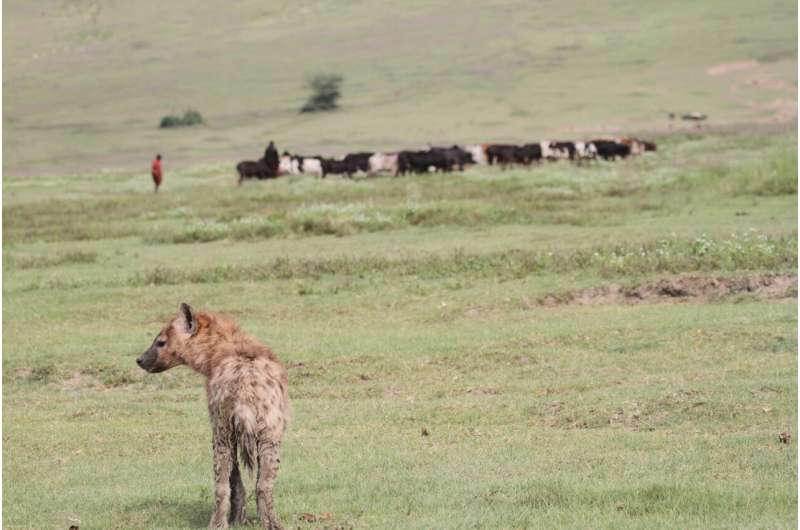
Spotted hyena with Maasai pastoralist and cattle in Ngorongoro Crater.
 Credit: Oliver Höner/Leibniz-IZW

Pastoralists herding their livestock through the territories of spotted hyena clans along dedicated paths during daytime do not reduce the reproductive performance of hyena clans, nor elevate the physiological "stress" of spotted hyenas. This is the result of a new study led by scientists from the Leibniz Institute for Zoo and Wildlife Research (Leibniz-IZW) and the Ngorongoro Conservation Area Authority (NCAA).

The scientists analyzed 24 years of demographic and  from eight  clans—two of which were exposed to activities by pastoralists. The activities of pastoralists were predictable, diurnal and did not disrupt important behaviors in the mostly nocturnal . This may have allowed the population to perform well, the scientists suggest. The open access paper is published in the Journal of Animal Ecology.

Human activities can strongly affect wildlife but the effects can vary greatly, depending on the type of activity and the characteristics of the wildlife species involved. To promote human-wildlife coexistence, it is therefore important to assess which activities are sustainable for a given species.

Most past research has documented major changes in the behavioral response of such species to human activities, but did not examine whether such changes are indicative of the Darwinian fitness of wildlife (in terms of its survival and reproductive success) or physiological effects such as "stress" or allostatic load, which are much more relevant to conservation.

"Acquiring the long-term data for such research—especially on large, group-living carnivores, which may be particularly conflict-prone—is not easy because of the enormous financial and temporal demands involved. We assessed for the first time the Darwinian fitness and the physiological effects of a common human activity—livestock herding—in light of the biology and social system of our wildlife species," explains first author Arjun Dheer, doctoral student at the Leibniz-IZW.

The investigation was conducted on eight clans of spotted hyenas (Crocuta crocuta) living in the Ngorongoro Crater, a UNESCO World Heritage Site in northern Tanzania. "Livestock grazing and using mineral licks occurred predictably on a near-daily basis within the territories of two of our eight study clans between 1996 and 2016," adds Dheer.

This created a natural experiment of exposed and unexposed clans which the scientists exploited. "We tested whether the hyenas of the exposed clans had fewer surviving offspring than the unexposed hyenas and whether the herding activities increased the physiological 'stress' of the hyenas," explains Dr. Oliver Höner (Leibniz-IZW), head of the Ngorongoro Hyena Project and senior author of the paper.

To assess the fitness effects, the scientists used 24 years of detailed demographic data from the eight clans and to estimate physiological stress, they measured the concentration of glucocorticoid metabolites (fGMC) in 975 feces from 475 hyenas. The team also accounted for the effects of additional ecological parameters such as disease outbreaks and the abundance of African lions (Panthera leo), the hyenas' main competitor, and prey.

The main result was that hyena clans exposed to Maasai pastoralists moving through their territory with their livestock had similar juvenile recruitment and fGMC levels as unexposed clans. "Our results suggest that the hyenas in the Ngorongoro Crater coped well with daytime pastoralism," explains Dheer. A likely explanation for the lack of detectable effect on hyenas is that the activity was predictable and minimally disruptive because it occurred during daytime.

"Hyenas are mostly nocturnal when it comes to critical behaviors such as hunting," explains Höner. Even if pastoralist activities forced other critical hyena behaviors such as the nursing of young cubs into nighttime, it might not have been too much of an adjustment for them to make. "Spotted hyenas are behaviourally flexible. In other areas, they were observed to move their cubs to dens further away from the paths that pastoralists used, or to nurse more at night," Höner says.

The authors caution that such results should not be extrapolated in uncritical fashion. "In areas where pastoralism is more intense and environmental conditions such as the abundance of wild prey are less favorable than in the Ngorongoro Crater, pastoralist activities may well have a significant detrimental effect even on a behaviorally highly flexible species such as the spotted hyena," explains Höner.

"Our investigation highlights the need to develop evidence-based coexistence strategies within a local context to benefit both stakeholders and wildlife. It also underscores the importance of interpreting the effects of human activity in light of the socio-ecology of the species of conservation interest," concludes Victoria Shayo (Head, Department of Wildlife and Rangeland Management, Ngorongoro Conservation Area Authority). Additional scientific analyses that cover a variety of anthropogenic activities and species—and that measure effects on fitness and physiology—will be conducive to promoting human-wildlife coexistence.Emotions and culture are most important for acceptance of carnivore management strategies

More information: Arjun Dheer et al, Diurnal pastoralism does not reduce juvenile recruitment nor elevate allostatic load in spotted hyenas, Journal of Animal Ecology (2022). DOI: 10.1111/1365-2656.13812
Journal information: Journal of Animal Ecology 

Wednesday, July 30, 2025


Both humans, nature change where lions and hyenas move


Lions and hyenas sometimes avoid people but can also adapt to human presence


University of Georgia

Lions in the wild 

image: 

The researchers found lions and hyenas tended to avoid particularly crowded roads, especially during the dry season. 

view more 

Credit: Stephanie Periquet Pearce


Lions and hyenas are a familiar sight to tourists visiting Africa, with many looking forward to seeing them in person. But the animals may occasionally spend less time near roads crowded by humans, according to new research from the University of Georgia.

Etosha National Park in Namibia is a popular site to see animals like lions and hyenas. There are many human-made waterholes that animals gather around, often near the main road frequented by vehicles so tourists can get a good look.

But the presence of tourists can disrupt animals’ usual habits and schedules.

“The message here is not that tourism is bad. These large predators need large areas to roam and access prey, and tourism is a huge driver of many economies,” said Jim Beasley, co-author of the study and a professor in UGA’s Warnell School of Forestry and Natural Resources.

A main goal of his lab is understanding how carnivores and other wildlife use space to protect them from conflict with humans. This is especially important for extremely large parks like Etosha, which has many areas for animals to go where humans are less frequent.

“It’s important that we have these large parks that are accessible to tourists so they can come see these animals in the wild,” Beasley said. “But we should make sure that there are areas within these parks that these animals can go where there’s less tourism pressure.”

Animals partial to less crowded areas

The researchers used GPS collars to track the movements of 14 lions and nine hyenas from 2016 to 2024. They found that while lions and hyenas didn’t avoid busy areas completely, they did tend to stay near roads that weren’t as crowded, especially during the dry season.

“The dry season is when tourism is highest, so there’s going to be a lot more traffic,” said Jessy Patterson, lead author of the study and a doctoral candidate in UGA’s Warnell School of Forestry and Natural Resources. “The animals are still staying in that area because that’s where a number of waterholes are found, but they’re going to be found in the parts that are closer to the less trafficked roads.”

Lions seek out water more than hyenas

But the animals weren’t moving just because of people, the researchers said. Lions often stayed near waterholes, likely to drink or hunt.

Hyenas, however, didn’t stay near water as often. This could be because they get more water from their prey. But the animals could also be trying to avoid competition with lions that frequent the waterholes.

Lions also preferred areas with less plant cover compared to hyenas. Lions are ambush predators that use vegetation to hide, so the researchers said this finding was surprising.

“Sometimes, if the vegetation is really dense, lions aren’t able to hunt as successfully,” Patterson said. “Also, herbivores are more fearful on a landscape with large predators. They know if they’re near these areas of vegetation, lions can hide and ambush them. So, herbivores may be avoiding those areas for that reason, which means lions have to go hunt more in the open areas.”

By contrast, hyenas preferred places with more tree cover, likely so they could get out of the sun and cool off in the shade.

Studying animal behavior important for park management

Though no two regions have the exact same landscape, the researchers stressed the importance of understanding areas where large predators choose to rest and hunt. Knowing this could help park officials manage roads and waterholes while making sure animals stay safe and visible to tourists.

“National parks where these large carnivores occur are really important areas for conservation but also tourism,” Beasley said. “Tourism brings in a huge amount of revenue to a lot of countries, and many people want to go see large carnivores in the wild.”

The study was published in Global Ecology and Conservation and co-authored by Stephanie Periquet-Pearce, Madeline H. Melton, Brennan PetersonWood, Dipanjan Naha, and Claudine Cloete.


Hyenas were less likely to stay near waterholes, possibly to avoid confrontations with lions.

Credit

Brennan Peterson Wood