Yazidis embrace new beginnings at Lalish new year celebrations
RUDAW
APRIL 17, 2025
Donya Seif Qazi@donyaseifqazi

Yazidis celebrate Chwarshama Sur, the Yazidi New Year, at the Lalish temple in Duhok province on April 15, 2025.
APRIL 17, 2025
Donya Seif Qazi@donyaseifqazi
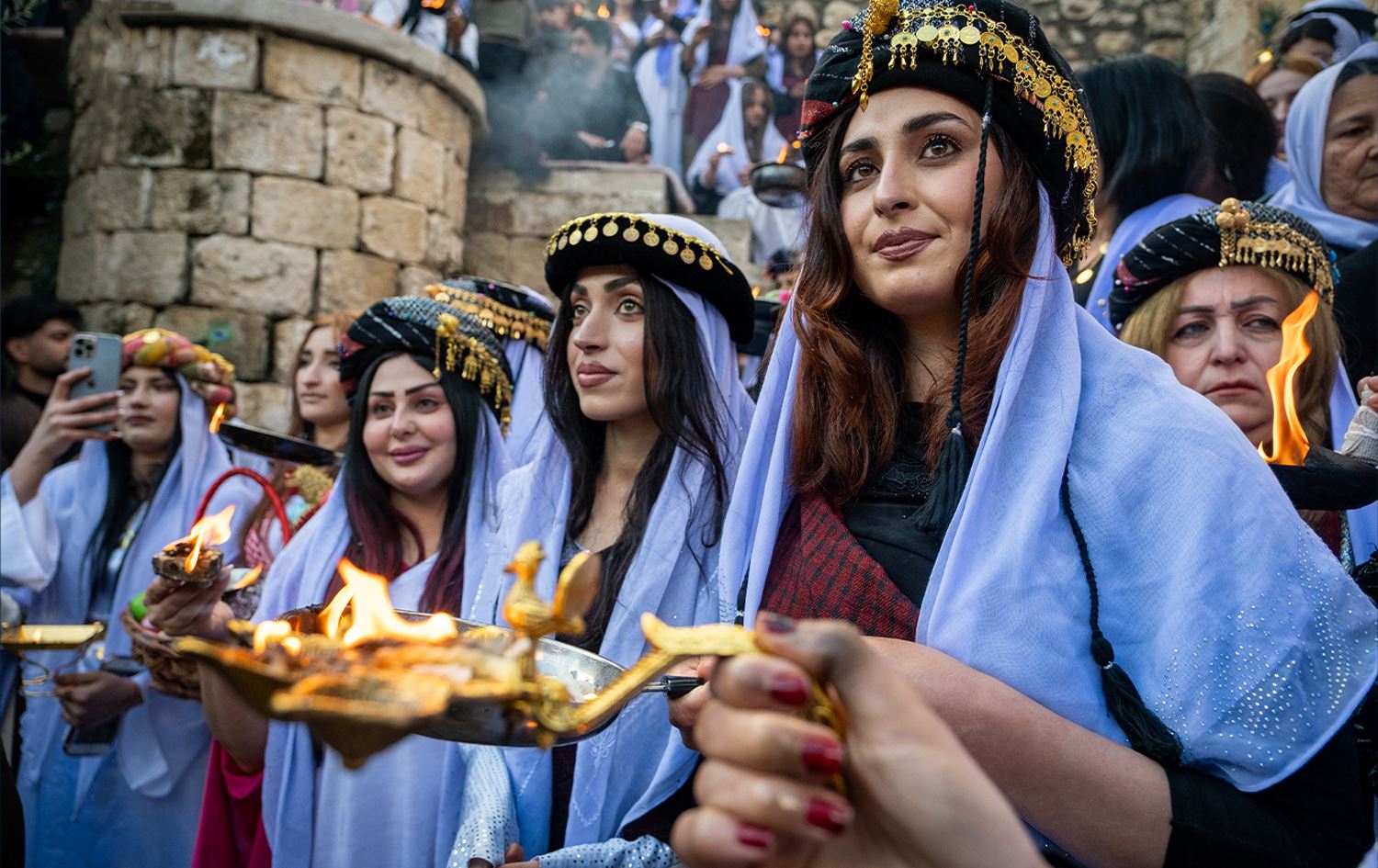
Yazidis celebrate Chwarshama Sur, the Yazidi New Year, at the Lalish temple in Duhok province on April 15, 2025.
Photo: Bilind T. Abdullah/Rudaw
ERBIL, Kurdistan Region - Nestled in the mountains of Duhok province’s Shekhan district, Lalish Temple, the holiest site in the Yazidi faith, hosted Chwarshama Sur (Red Wednesday) on Tuesday evening. The ancient celebration, considered the oldest and most sacred Yazidi tradition, marks the beginning of creation and the renewal of life.
The Lalish site, believed to date back approximately 4,000 years, reflects deep-rooted heritage, with ancient symbols etched into its stone structures, each representing narratives and rituals tied to the historical and religious foundations of the Yazidi faith.
Chwarshama Sur (Red Wednesday), one of the most ancient and sacred celebrations in the Yazidi faith, marking the new year, was hosted on Tuesday evening at the holy Lalish Temple in Shekhan district.
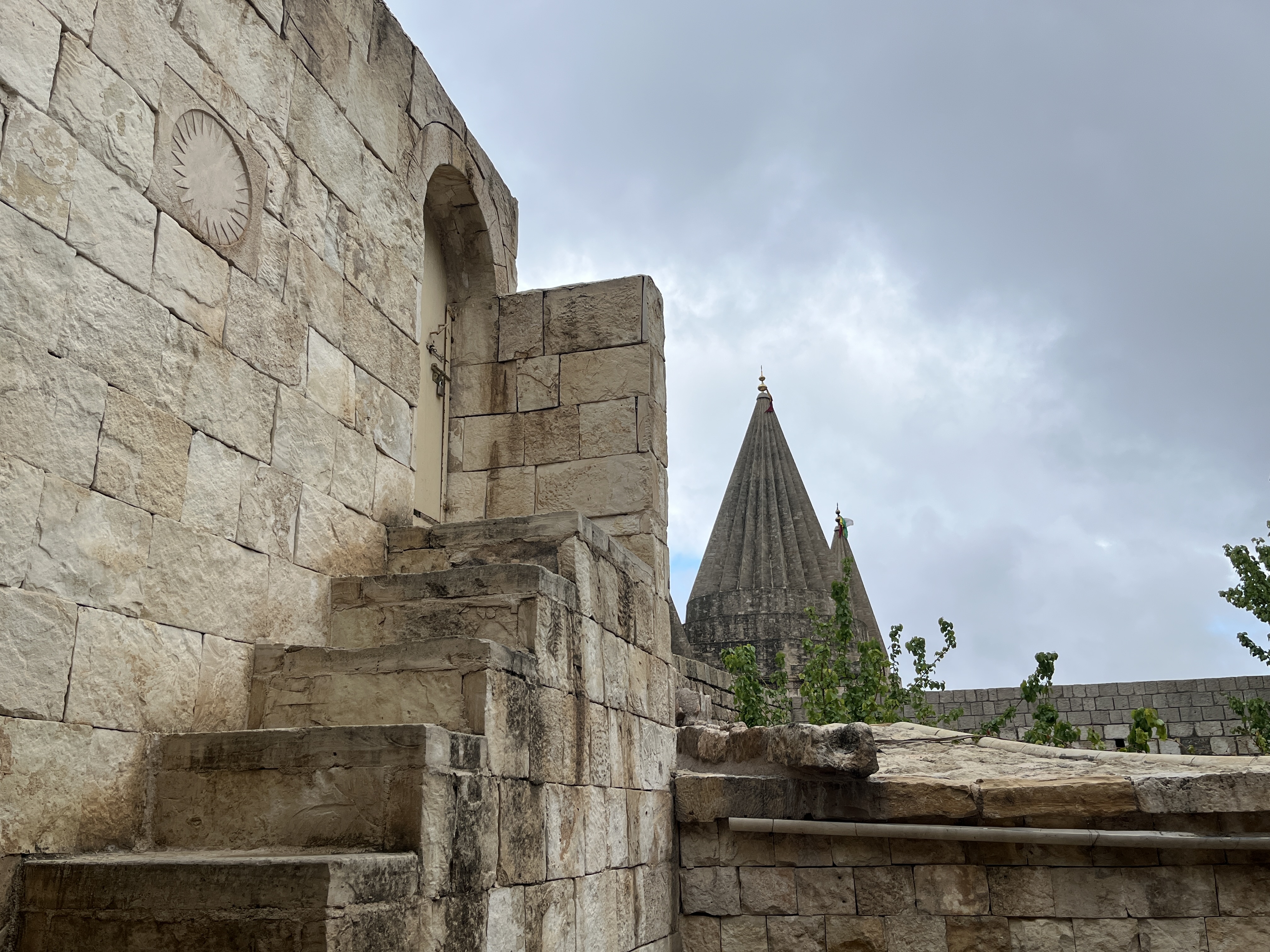
Photo: Donya Seif Qazi/ Rudaw
“Since ancient times, the peoples of the Middle East have welcomed this festival and celebrated it in various ways, with each region calling it by a different name. Yezidis call it the New Year Festival, Babylonians call it the Akitu Festival, and Sumerians call it the Zikmak Festival,” Luqman Mahmoud, from the Lalish communication center, told Rudaw English at the temple.
Each year, Yazidis from around the world return to the Kurdistan Region to celebrate Red Wednesday at the holy Lalish Temple, where they offer prayers and light fires, a deeply rooted symbol in their faith to welcome the rise of life and the new year.
“Fire has a special sacredness in Yazidi mythology. Throughout historical periods, from the time of Sumerian civilization to Babylonian, Median, and Mithraic civilizations, fire has been lit in their temples. Since the Yazidis are the continuation of these civilizations, fire also has a special sacredness in their religious practices,” said Yazidi writer Hogir Haydo.
Haydo noted that, according to belief, the first person to light the sacred fire was named Yazidi, a figure whose act is said to have inspired the fire-lighting ritual that continues in Yazidism to this day.
On the eve of the festival, Yazidis light candles and oil wicks as religious singers recite hymns and prayers throughout the sacred valley.
“This festival dates back to the time when human civilization emerged. This festival was first celebrated in the city of Eridu [viewed as a symbolic place of origin], and until now, the traditions and rituals of the Yazidis continue,” Haydo added.
As part of the ritual, Yazidis boil eggs on the festival day, attaching them with a mixture of mud and special spices. The mixture and the egg are then applied above entrance doors, with a flower placed at the center, symbolizing renewal and protection.
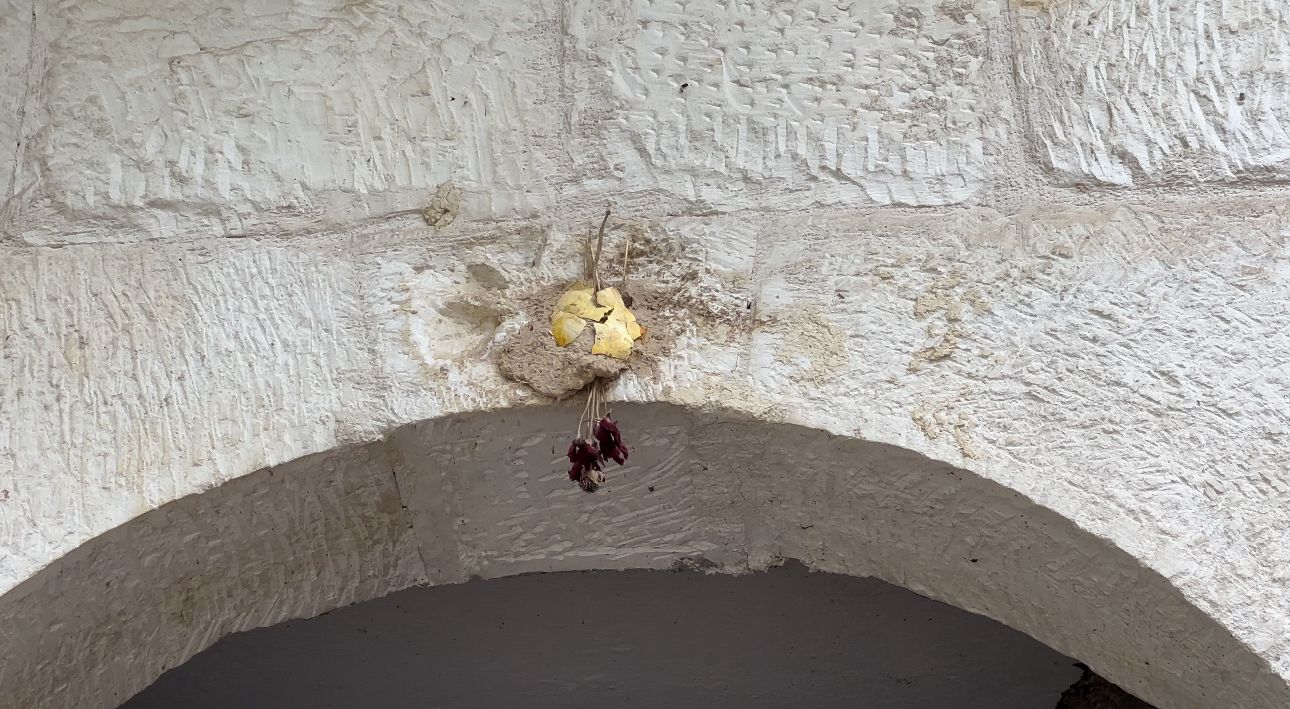
Photo: Donya Seif Qazi/ Rudaw
“Among the rituals of this festival, early on the morning of the festival, women wake up to hang red flowers along with the Giyay Benav [nameless herb] and colored eggshells over the doorways of houses. This is a sign and symbol of the new year, the month of April, and spring, and is a very ancient symbol in Yazidism,” Khald Khdr from the Lalish Media Network said in a statement in 2019.
Farmers hold a sacred role in Yazidism, and the use of eggshells from the festival carries symbolic meaning. The shells are scattered over farmland the following day as a natural fertilizer to nourish the earth. Planting is avoided during this time, as Yazidis believe the earth is reborn and must be treated as a newborn.
Yazidis also refrain from marriage during the second half of April, believing it marks the beginning of the new year, a sacred period in which the month itself is regarded as a bride.
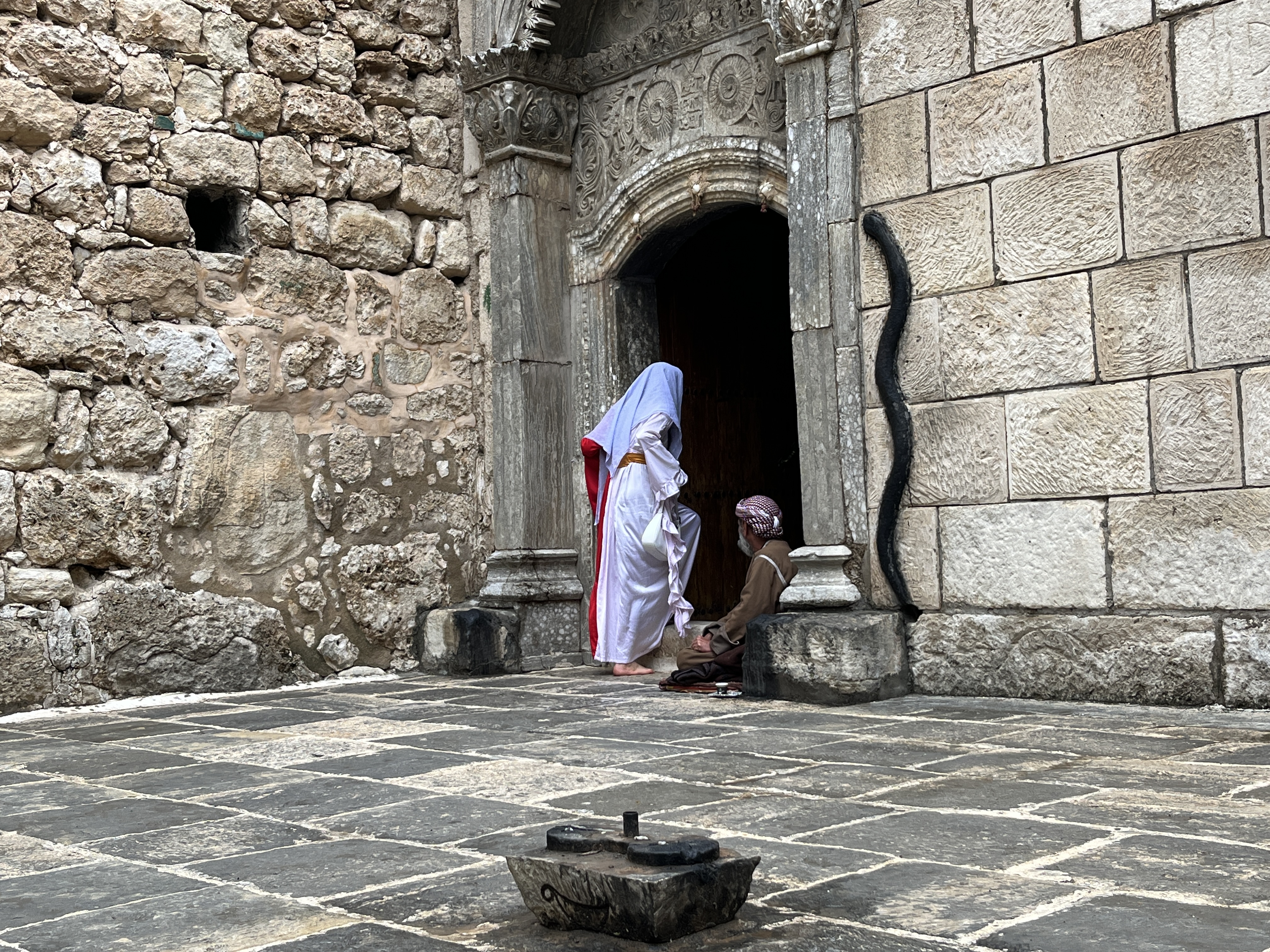
Photo: Donya Seif Qazi/ Rudaw
The cultural richness of the site and its rituals draw a great number of tourists each year, particularly during Yazidi ceremonies.
A group of tourists from Utiel municipality in Spain’s Valencia, who joined the celebrations with a Kurdish tour guide, expressed admiration for the richness of Kurdish culture and the depth of Yazidi traditions.
“My friends and I are coming from Utiel in Spain, and we found out about this event thanks to my guide who brought us here and told us about this special tradition, and all about it, and so far we are having a great time. We didn't know anything about it, and we are so amazed because we haven't seen anything like that before,” Laura Ortiz, the visiting tourist, told Rudaw English.
“Our main goal was to change the image of Kurdistan, which is always linked with war and negativity, to show the real beauty that really exists,” said Mohammed Dilshad, the tourism company founder.
“We were successful to show many different, represent actually many different minorities of Kurdistan to the world as well. For example, we did a tour for the Akito festival, which is the Akkadian, Babylonian, Assyrian New Year, and then the Yazidi New Year, which is the Chashambah Serenisani [ first wednesday of yezidi new year], and we were able to bring a lot of people to see this celebration,” he added.
The Yazidi ethnoreligious community bore the brunt of the Islamic State’s (ISIS) atrocities during their brazen offensive across large swathes of Iraq in 2014, particularly as the jihadists moved on the community’s heartland of Shingal (Sinjar) and captured it.
In the assault on Shingal, ISIS militants abducted 6,417 Yazidi women and children, many of whom were subjected to sexual slavery and forced labor. Although the group was territorially defeated in Iraq in 2017 and in Syria in 2019, it continues to pose a security risk.
To date, 2,590 individuals are still missing, according to statistics provided by Hussein Qaidi, head of the Office of Rescuing Abducted Yazidis, affiliated with the Kurdistan Region Presidency.
ERBIL, Kurdistan Region - Nestled in the mountains of Duhok province’s Shekhan district, Lalish Temple, the holiest site in the Yazidi faith, hosted Chwarshama Sur (Red Wednesday) on Tuesday evening. The ancient celebration, considered the oldest and most sacred Yazidi tradition, marks the beginning of creation and the renewal of life.
The Lalish site, believed to date back approximately 4,000 years, reflects deep-rooted heritage, with ancient symbols etched into its stone structures, each representing narratives and rituals tied to the historical and religious foundations of the Yazidi faith.
Chwarshama Sur (Red Wednesday), one of the most ancient and sacred celebrations in the Yazidi faith, marking the new year, was hosted on Tuesday evening at the holy Lalish Temple in Shekhan district.
Photo: Donya Seif Qazi/ Rudaw
“Since ancient times, the peoples of the Middle East have welcomed this festival and celebrated it in various ways, with each region calling it by a different name. Yezidis call it the New Year Festival, Babylonians call it the Akitu Festival, and Sumerians call it the Zikmak Festival,” Luqman Mahmoud, from the Lalish communication center, told Rudaw English at the temple.
Each year, Yazidis from around the world return to the Kurdistan Region to celebrate Red Wednesday at the holy Lalish Temple, where they offer prayers and light fires, a deeply rooted symbol in their faith to welcome the rise of life and the new year.
“Fire has a special sacredness in Yazidi mythology. Throughout historical periods, from the time of Sumerian civilization to Babylonian, Median, and Mithraic civilizations, fire has been lit in their temples. Since the Yazidis are the continuation of these civilizations, fire also has a special sacredness in their religious practices,” said Yazidi writer Hogir Haydo.
Haydo noted that, according to belief, the first person to light the sacred fire was named Yazidi, a figure whose act is said to have inspired the fire-lighting ritual that continues in Yazidism to this day.
On the eve of the festival, Yazidis light candles and oil wicks as religious singers recite hymns and prayers throughout the sacred valley.
“This festival dates back to the time when human civilization emerged. This festival was first celebrated in the city of Eridu [viewed as a symbolic place of origin], and until now, the traditions and rituals of the Yazidis continue,” Haydo added.
As part of the ritual, Yazidis boil eggs on the festival day, attaching them with a mixture of mud and special spices. The mixture and the egg are then applied above entrance doors, with a flower placed at the center, symbolizing renewal and protection.
Photo: Donya Seif Qazi/ Rudaw
“Among the rituals of this festival, early on the morning of the festival, women wake up to hang red flowers along with the Giyay Benav [nameless herb] and colored eggshells over the doorways of houses. This is a sign and symbol of the new year, the month of April, and spring, and is a very ancient symbol in Yazidism,” Khald Khdr from the Lalish Media Network said in a statement in 2019.
Farmers hold a sacred role in Yazidism, and the use of eggshells from the festival carries symbolic meaning. The shells are scattered over farmland the following day as a natural fertilizer to nourish the earth. Planting is avoided during this time, as Yazidis believe the earth is reborn and must be treated as a newborn.
Yazidis also refrain from marriage during the second half of April, believing it marks the beginning of the new year, a sacred period in which the month itself is regarded as a bride.
Photo: Donya Seif Qazi/ Rudaw
The cultural richness of the site and its rituals draw a great number of tourists each year, particularly during Yazidi ceremonies.
A group of tourists from Utiel municipality in Spain’s Valencia, who joined the celebrations with a Kurdish tour guide, expressed admiration for the richness of Kurdish culture and the depth of Yazidi traditions.
“My friends and I are coming from Utiel in Spain, and we found out about this event thanks to my guide who brought us here and told us about this special tradition, and all about it, and so far we are having a great time. We didn't know anything about it, and we are so amazed because we haven't seen anything like that before,” Laura Ortiz, the visiting tourist, told Rudaw English.
“Our main goal was to change the image of Kurdistan, which is always linked with war and negativity, to show the real beauty that really exists,” said Mohammed Dilshad, the tourism company founder.
“We were successful to show many different, represent actually many different minorities of Kurdistan to the world as well. For example, we did a tour for the Akito festival, which is the Akkadian, Babylonian, Assyrian New Year, and then the Yazidi New Year, which is the Chashambah Serenisani [ first wednesday of yezidi new year], and we were able to bring a lot of people to see this celebration,” he added.
The Yazidi ethnoreligious community bore the brunt of the Islamic State’s (ISIS) atrocities during their brazen offensive across large swathes of Iraq in 2014, particularly as the jihadists moved on the community’s heartland of Shingal (Sinjar) and captured it.
In the assault on Shingal, ISIS militants abducted 6,417 Yazidi women and children, many of whom were subjected to sexual slavery and forced labor. Although the group was territorially defeated in Iraq in 2017 and in Syria in 2019, it continues to pose a security risk.
To date, 2,590 individuals are still missing, according to statistics provided by Hussein Qaidi, head of the Office of Rescuing Abducted Yazidis, affiliated with the Kurdistan Region Presidency.
"The only way for the Yazidi people to ensure and protect their existence, to secure their sociality, and to continue their legacy by adding further values to it is to organize with democratic consciousness and to struggle in unity," KCK said.
ANF
BEHDINAN
Tuesday, 15 April 2025
The People’s and Beliefs Committee of KCK issued a statement to mark Çarşema Sor, the holy day of the Yazidi people.
The statement said: "Our Êzidî (Yazidi) people are celebrating this year’s feast of Çarşema Sor. As a freedom movement, we celebrate our Êzidî people, who have managed to free themselves from genocide, renew themselves from the roots up, and create a new future for themselves based on their old cultural values, on their holy day. We congratulate all Kurds on the traditional Çarşema Serê Nîsanê, and we express our hope that this holy day will be taken as an occasion to strengthen the struggle for democracy, freedom, peace, and brotherhood, which is the longing of the peoples of the region."
The statement added: "Our Êzidî people in Shengal (Sinjar) are preparing to celebrate Çarşema Sor while being under serious threats and intimidation of genocidal threats by the Turkish state and the Iraqi state. In the face of genocidal attacks, the only way for the Êzidî people to ensure and protect their existence, to secure their sociality, and to continue their legacy by adding further values to it is to organize with democratic consciousness and to struggle in unity. It is necessary that modern-day Derweshe Evdes and Eduleshes arise, that the struggle is risen, and that the spirit to protect the Êzidî identity is created. The most meaningful response of the Êzidî people to the genocidal attacks will be to further strengthen their organization of the democratic society and the autonomous administration as a system that can and will guarantee their future according to their own social identity."
The statement continued: "The development of the democratic society in Shengal will continue to have a strong and positive impact on all the people of southern Kurdistan. It will contribute to the democratization of the political system of southern Kurdistan, and through this, a more just and transparent administration can be formed. On this occasion, we call on all the people of southern Kurdistan to see the struggle in Shengal as their own struggle, to embrace it, and to support it by participating in it. We also make this call to all the forces that claim to be in favor of the democratization of Iraq.
Dear Êzidî People,
Çarşema Sor is the holy day of creation, the holy day of resurrection. Throughout history, our Êzîdî people have progressed towards realizing their own social creation and resurrection through their struggle and have carried themselves to these days through struggle. The current period is a period that corresponds to the belief and spirit of the Çarşema Sor holy day, a period that is conducive to new creations and resurrections. Especially the struggle in Shengal, the values that emerged, and the gains as a people gave hope and willpower to Êzidîs living all over the world."
The statement underlined that "the resistance in Shengal paved the way for the Êzidî people to continue their existence in the world, stronger than ever, by meeting their roots. In particular, the developments that have unfolded over the course of the last ten years have shown in practice that the Êzidî people and all Kurds can overcome all kinds of difficulties when they organize and struggle with Apoist consciousness. The tradition of resistance in the face of genocidal attacks proved how strong and unshakable social moral values are. The results of the struggle of our Êzidî people and the Kurds in general, as an updated expression of social morality, have further increased the enthusiasm and excitement of this year’s Çarşema Sor festivities.
We call on the Kurdish people to take this year’s Çarşema Sor as an occasion to understand the process we are going through correctly. It is a necessity of this period to transform our ancient folk culture of solidarity and sharing into a large and strong organization. We see it as a necessity to preserve our moral values that enable us to overcome many difficulties as a society, to strengthen our relations of neighborliness, kinship, and friendship, and to meet the difficult period of struggle ahead in unity. We call on everyone to grow these social values with Apoist consciousness and patriotism and make them the basis for the development of democratic nation organization and the construction of a democratic society."
The statement said: "It is of great cruciality to strengthen the mechanisms of self-defense with the awareness of the dangers posed by various forms of attacks that may develop against our Êzidî people. One needs to be sensitive to collaborators and traitors and to act in a patriotic manner. The religious leaders of the Êzidî people have to play their leading role in this regard, and they have to play their part in strengthening the internal unity of the Êzidîs in the struggle against genocidal attacks and the special warfare.
With these feelings and thoughts, we once again celebrate the holiday of our Êzîdî people, we commemorate all our heroic martyrs who enabled us to celebrate this holiday with great excitement and faith by commemorating Binevsh and Xanes, Mam Zeki Shengali, Dijwar Feqir, and Zerdesht, and we reiterate once again that we will raise our struggle to bring the cause of democracy and freedom of the peoples for which they gave their lives to its ultimate goal."

No comments:
Post a Comment