It’s possible that I shall make an ass of myself. But in that case one can always get out of it with a little dialectic. I have, of course, so worded my proposition as to be right either way (K.Marx, Letter to F.Engels on the Indian Mutiny)
Friday, June 06, 2025
SPACE/COSMOS
UAlbany physicists test scientific approach to UAP research
ALBANY, N.Y. (June 4, 2025) — A team of physicists from the University at Albany has proposed scientifically rigorous methods for documenting and analyzing Unidentified Anomalous Phenomena (UAP) building upon the work of numerous past and present researchers in the field.
The team tested their methods in the field for the first time and reported their findings as part of a special edition of the high-impact peer-reviewed journal Progress in Aerospace Sciences published on June 2.
UAP is the term used by government agencies like NASA to refer to “observations of events in the sky that cannot be identified as aircraft or known natural phenomena.”
Utilizing a diverse set of devices to capture different types of data on many channels, UAlbany authors Matthew Szydagis, Kevin Knuth and Cecilia Levy, along with Ben Kugielsky of UAPx, a non-profit scientific research organization, collected observable-light and infrared images during a field expedition in 2021 to Laguna Beach, California.
The team also used weather radar data and radiation detectors to create a robust framework for documenting and testing potentially anomalous phenomena that moves away from reliance on eyewitness testimony and similarly subjective methods.
“Following on the recent joint Congressional subcommittee hearing on unidentified anomalous phenomena, the study of UAP is slowly moving from the fringe to the mainstream of scientific study,” said Szydagis, lead author and an associate professor of physics at UAlbany. “As this process moves forward, it’s critical that future study of UAPs follows a rigorous, repeatable method that can be tested and confirmed by other researchers. We aim to establish a roadmap for these efforts with this paper.”
Szydagis noted the combination of tools and data sets his team relied on during the study included the first use of National Weather Service public Doppler weather radar data to corroborate observations from other instruments, the introduction of coincidence timing between detectors to determine whether potential anomalies were simultaneously recorded by multiple instruments, and a radiation-detection tool known as the Cosmic Watch to determine whether anomalies observed on infrared cameras were accompanied by detectable ionizing radiation.
New AI-Assisted Image Analysis
To help analyze the data from the infrared cameras, Szydagis developed new software, Custom Target Analysis Protocol (C-TAP), which combines artificial intelligence with human verification to do a pixel-by-pixel analysis of successive camera frames to study differences and distinguish actual observations from digital noise in the camera images — similar to an approach used by physicists like him and Levy to look for direct evidence of dark matter.
The researchers coupled this data with robust trigonometric calculations to identify and exclude known objects in the night sky, such as the International Space Station.
Ultimately, the UAlbany research team succeeded in plausibly explaining all but one of the potential anomalies detected — demonstrating that their method is effective and completing important field-testing of the equipment and analysis software.
“While we did not find evidence indicating that UAP have anything to do with non-human intelligence, we still cannot fully explain our one remaining ambiguity, or potential anomaly, which was a collection of bright white dots within a dark spot seen in multiple videos,” Szydagis said.
Director and producer Caroline Cory of OMnium Media provided funding for all of the California field work to produce the documentary film “A Tear in the Sky” (2022).
A Comprehensive Review of UAP Studies
The special edition of Progress in Aerospace Sciences includes a comprehensive review of studies conducted on UAPs from 1933 to the present, including more than 20 historical government and privately funded projects as well as recent scientific research efforts in Ireland, France, Germany, Norway, Sweden and the United States.
That article, “The New Science of Unidentified Aerospace-Undersea Phenomena (UAP),” aims to clarify the current and historical scientific narrative around UAP and highlight that UAP/UFOs are longstanding global phenomena that have been observed and recorded for well over 150 years, that UAP/UFOs have been observed and studied by astronomers, scientists, and engineers, and that there are currently several serious academic efforts in multiple countries working to collect hard scientific data on UAP using modern instrumentation.
Knuth is lead author of the article, which was co-written by Szydagis and more than 30 other researchers from around the world.
“Given the longstanding, global nature of the UAP/UFO question, the air safety and security implications of their presence, and the potentially profound importance of their nature, studying and understanding these phenomena is of great and urgent importance.” Knuth said.
Journal
Progress in Aerospace Sciences
Article Title
Initial results from the first field expedition of UAPx to study unidentified anomalous phenomena
Global team tracks unusual objects in Milky Way galaxy
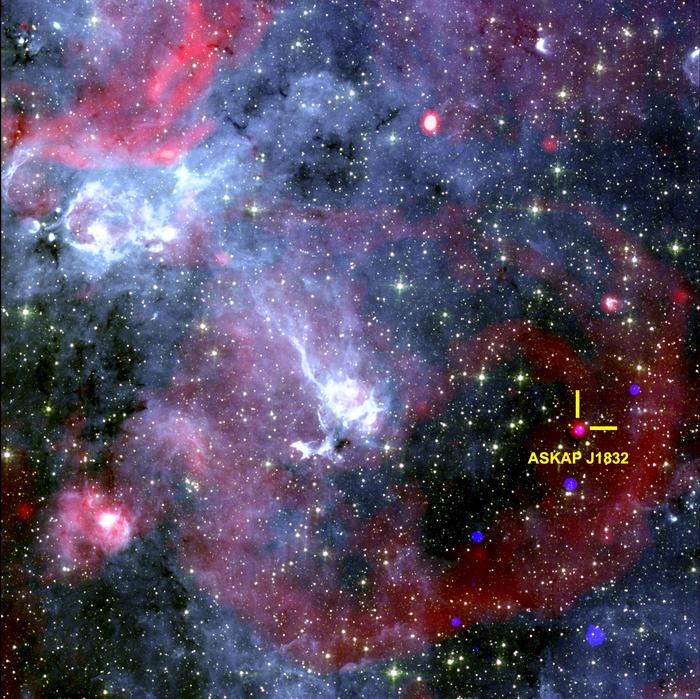
An image of the sky showing the region around ASKAP J1832-0911. Researchers from the U.S. Naval Research Laboratory were part of a global effort to track the newly discovered unusual bursts of radio emission from the object within the Milky Way galaxy. ASKAP J1832-091 emits pulses of radio waves and X-rays for two minutes every 44 minutes. The object is located about 15,000 light-years from Earth.
WASHINGTON, D.C. — Researchers from the U.S. Naval Research Laboratory (NRL) were part of a global effort to track newly discovered unusual bursts of radio emission from an object within the Milky Way galaxy. Information from telescopes in Australia, India, South Africa, and the United States were all used to help identify the object.
In a paper published to the journal Nature on May 28, the international team announced the discovery of the new object, known as ASKAP J1832-091. This new object emits pulses of radio waves and X-rays lasting two minutes and recurring every 44 minutes. Called a long-period transient, or LPT, the object is located about 15,000 light-years from Earth.
LPTs that emit radio waves occurring minutes or hours apart are a relatively recent discovery, but this is the first time an LPT has been detected in X-rays.
“The discovery of energetic X-rays from this new LPT is another important puzzle piece in astronomers’ quest to understand these mysterious objects,” said Tracy Clarke, Ph.D., in NRL’s Remote Sensing Division.
Clarke along with Wendy Peters, Ph.D., and Emil Polisensky, Ph.D., searched archival data from NRL’s VLA Low-band Ionosphere and Transient Experiment (VLITE) and identified additional radio signals from the same object.
“The VLITE data were recorded just one day after the first-ever LPT X-ray detection was made,” Clarke said. “NRL researchers applied advanced processing algorithms to the VLITE data and detected two intense consecutive bursts of radio emission from ASKAP J1832-0911.”
NRL’s findings from VLITE data combined with ASKAP telescope detections that were made eight days before the X-ray detection confirm that ASKAP J1832-0911 remained in an exceptionally bright radio emitting state during the X-ray burst.
“This study showcases an incredible teamwork effort, with contributions from researchers across the globe with different and complementary expertise,” Rea said.
About the U.S. Naval Research Laboratory
NRL is a scientific and engineering command dedicated to research that drives innovative advances for the U.S. Navy and Marine Corps from the seafloor to space and in the information domain. NRL, located in Washington, D.C. with major field sites in Stennis Space Center, Mississippi; Key West, Florida; Monterey, California, and employs approximately 3,000 civilian scientists, engineers and support personnel.
For more information, contact NRL Corporate Communications at (202) 480-3746 or nrlpao@nrl.navy.mil.
Throughput computing enables astronomers to use AI to decode iconic black holes
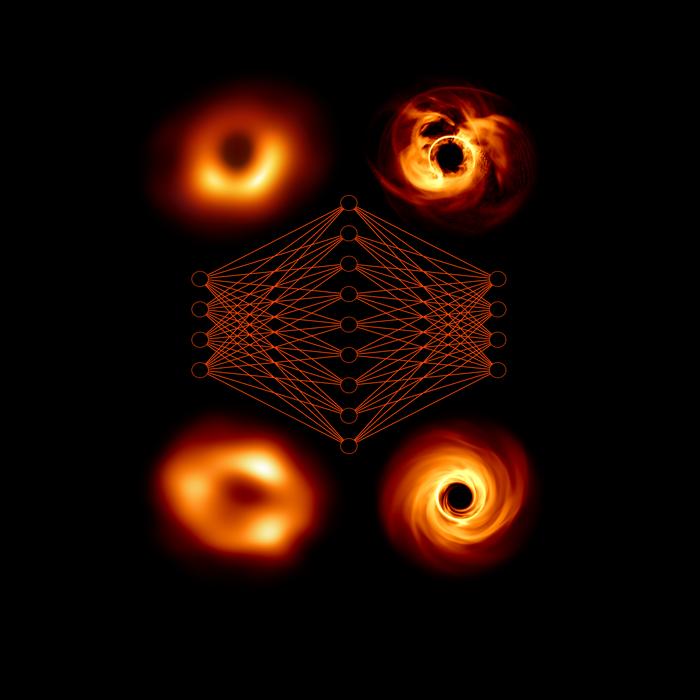
Credit: EHT Collaboration/Janssen et al. (high-resolution version)
MADISON — An international team of astronomers has trained a neural network with millions of synthetic simulations and artificial intelligence (AI) to tease out new cosmic curiosities about black holes, revealing the one at the center of our Milky Way is spinning at nearly top speed.
These large ensembles of simulations were generated by throughput computing capabilities provided by the Center for High Throughput Computing (CHTC), a joint entity of the Morgridge Institute for Research and the University of Wisconsin-Madison. The astronomers published their results and methodology today in three papers in the journal Astronomy & Astrophysics.
High-throughput computing, celebrating its 40th anniversary this year, was pioneered by Wisconsin computer scientist Miron Livny. It’s a novel form of distributed computing that automates computing tasks across a network of thousands of computers, essentially turning a single massive computing challenge into a supercharged fleet of smaller ones. This computing innovation is helping fuel big-data discovery across hundreds of scientific projects worldwide, including the search for cosmic neutrinos, subatomic particles and gravitational waves as well as to unravel antibiotic resistance.
In 2019, the Event Horizon Telescope (EHT) Collaboration released the first image of a supermassive black hole at the center of the galaxy M87. In 2022, they presented the image of the black hole at the center of our Milky Way, Sagittarius A*. However, the data behind the images still contained a wealth of hard-to-crack information. An international team of researchers trained a neural network to extract as much information as possible from the data.
From a handful to millions
Previous studies by the EHT Collaboration used only a handful of realistic synthetic data files. Funded by the National Science Foundation (NSF) as part of the Partnership to Advance Throughput Computing (PATh) project, the Madison-based CHTC enabled the astronomers to feed millions of such data files into a so-called Bayesian neural network, which can quantify uncertainties. This allowed the researchers to make a much better comparison between the EHT data and the models.
Thanks to the neural network, the researchers now suspect that the black hole at the center of the Milky Way is spinning at almost top speed. Its rotation axis points to the Earth. In addition, the emission near the black hole is mainly caused by extremely hot electrons in the surrounding accretion disk and not by a so-called jet. Also, the magnetic fields in the accretion disk appear to behave differently from the usual theories of such disks.
"That we are defying the prevailing theory is of course exciting," says lead researcher Michael Janssen, of Radboud University Nijmegen, the Netherlands. "However, I see our AI and machine learning approach primarily as a first step. Next, we will improve and extend the associated models and simulations."
Impressive scaling
"The ability to scale up to the millions of synthetic data files required to train the model is an impressive achievement," adds Chi-kwan Chan, an Associate Astronomer of Steward Observatory at the University of Arizonaand a longtime PATh collaborator. "It requires dependable workflow automation, and effective workload distribution across storage resources and processing capacity."
“We are pleased to see EHT leveraging our throughput computing capabilities to bring the power of AI to their science,” says Professor Anthony Gitter, a Morgridge Investigator and a PATh Co-PI. “Like in the case of other science domains, CHTC’s capabilities allowed EHT researchers to assemble the quantity and quality of AI-ready data needed to train effective models that facilitate scientific discovery.”
The NSF-funded Open Science Pool, operated by PATh, offers computing capacity contributed by more than 80 institutions across the United States. The Event Horizon black hole project performed more than 12 million computing jobs in the past three years.
“A workload that consists of millions of simulations is a perfect match for our throughput-oriented capabilities that were developed and refined over four decades” says Livny, director of the CHTC and lead investigator of PATh. “We love to collaborate with researchers who have workloads that challenge the scalability of our services.”
Scientific papers referenced
• Deep learning inference with the Event Horizon Telescope I. Calibration improvements and a comprehensive synthetic data library. By: M. Janssen et al. In: Astronomy & Astrophysics, 6 June 2025. [original (open access) | preprint (pdf)].
• Deep learning inference with the Event Horizon Telescope II. The Zingularity framework for Bayesian artificial neural networks. By: M. Janssen et al. In: Astronomy & Astrophysics, 6 June 2025. [original (open access) | preprint (pdf)].
• Deep learning inference with the Event Horizon Telescope III. Zingularity results from the 2017 observations and predictions for future array expansions. By: M. Janssen et al. In: Astronomy & Astrophysics, 6 June 2025. [original (open access) | preprint (pdf)].
Journal
Astronomy and Astrophysics
Method of Research
Data/statistical analysis
Subject of Research
Not applicable
Article Title
Deep learning inference with the Event Horizon Telescope I.
Article Publication Date
6-Jun-2025
A giant planet around a tiny star: A discovery that challenges planet formation theories
An international team of astronomers, including researchers from the University of Liège and collaborators in UK, Chile, the USA, and Europe, has discovered a giant planet orbiting the smallest known star to host such a companion
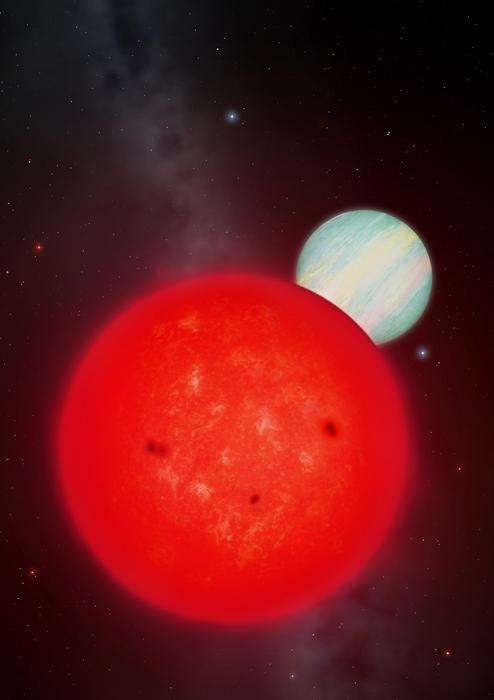
The host star, TOI-6894, is a red dwarf with only 20% the mass of the Sun, typical of the most common stars in our galaxy. Until now, such low-mass stars were not thought capable of forming or retaining giant planets. But as published today in Nature Astronomy, the unmistakable signature of a giant planet — TOI-6894b — has been detected in orbit around this tiny star.
This exceptional system was first identified in data from NASA’s Transiting Exoplanet Survey Satellite (TESS), as part of a large search for giant planets around small stars, led by Dr. Edward Bryant from UCL’s Mullard Space Science Laboratory.
The planetary nature of the signal was then confirmed by an extensive ground-based observation campaign, involving several telescopes — including those of the SPECULOOS and TRAPPIST projects, both led by the University of Liège.
Dr. Khalid Barkaoui, researcher on the SPECULOOS and TRAPPIST teams, oversaw these crucial follow-up observations. He explained: “The transit signal was unambiguous in our data. Our analysis ruled out all alternative explanations — the only viable scenario was that this tiny star hosts a Saturn-sized planet with an orbital period of just over three days. Additional observations confirmed that its mass is about half that of Saturn. This is clearly a giant planet.”
TOI-6894 is now the smallest star known to host a transiting giant planet, with a radius 40% smaller than that of any previous such host.
Prof. Jamila Chouquar, who was an astronomer at ULiege at the time of the discovery, added: “We previously believed that stars this small couldn’t form or hold on to giant planets. But stars like TOI-6894 are the most common type in the Milky Way — so our discovery suggests there may be far more giant planets out there than we thought.”
A Challenge to Planet Formation Models
According to current planet formation models, giant planets are rare around small stars. This is because their protoplanetary disks — the gas and dust reservoirs from which planets form — are thought to lack the material needed to build massive cores and accrete thick gas envelopes.
Dr. Mathilde Timmermans, member of the SPECULOOS team and ULiege astronomer at the time of the discovery, noted: “The existence of TOI-6894b is hard to reconcile with existing models. None can fully explain how it formed. This shows that our understanding is incomplete, and underscores the need to find more such planets. That’s exactly the goal of MANGO, a SPECULOOS sub-program led by myself and Dr. Georgina Dransfield at the University of Birmingham.”
Prof. Michaël Gillon,Fund for Scientific Research - FNRS Research Director at ULiege and head of the SPECULOOS and TRAPPIST programs, concluded: “This giant planet orbiting a tiny star reveals that planetary diversity in the galaxy is even greater than we imagined. Most of the targets observed by SPECULOOS and TRAPPIST are similar stars, or even smaller — so we’re well positioned to uncover more cosmic outliers in the years ahead.”
Astronomers from the University of Hawaiʻi’s Institute for Astronomy (IfA) have discovered the most energetic cosmic explosions yet discovered, naming the new class of events “extreme nuclear transients” (ENTs). These extraordinary phenomena occur when massive stars—at least three times heavier than our Sun—are torn apart after wandering too close to a supermassive black hole. Their disruption releases vast amounts of energy visible across enormous distances. The team's findings were recently detailed in the journal Science Advances.
"We’ve observed stars getting ripped apart as tidal disruption events for over a decade, but these ENTs are different beasts, reaching brightnesses nearly ten times more than what we typically see," said Jason Hinkle, who led the study as the final piece of his doctoral research at IfA. “Not only are ENTs far brighter than normal tidal disruption events, but they remain luminous for years, far surpassing the energy output of even the brightest known supernova explosions.”
The immense luminosities and energies of these ENTs are truly unprecedented. The most energetic ENT studied, named Gaia18cdj, emitted an astonishing 25 times more energy than the most energetic supernovae known. While typical supernovae emit as much energy in just one year as the Sun does in its 10 billion-year lifetime, ENTs radiate the energy of 100 Suns over a single year.
ENTs were first uncovered when Hinkle began a systematic search of public transient surveys for long-lived flares emanating from the centers of galaxies. He identified two unusual flares in data from the European Space Agency’s Gaia mission that brightened over a timescale much longer than known transients and without characteristics common to known transients.
"Gaia doesn’t tell you what a transient is, just that something changed in brightness," said Hinkle. "But when I saw these smooth, long-lived flares from the centers of distant galaxies, I knew we were looking at something unusual."
The discovery launched a multi-year follow-up campaign to figure out what these sources were. With help from UH’s Asteroid Terrestrial-impact Last Alert System, the W. M. Keck Observatory, and other telescopes across the globe, the team gathered data across the electromagnetic spectrum. Because ENTs evolve slowly over several years, capturing their full story took patience and persistence. Recently, a third event with similar properties was discovered by the Zwicky Transient Facility and reported independently by two teams, adding strong support that ENTs are a distinct new class of extreme astrophysical events.
The authors determined these extraordinary events could not be supernovae because they release far more energy than any known stellar explosion. The sheer energy budget, combined with their smooth and prolonged light curves, firmly pointed to an alternative mechanism: accretion onto a supermassive black hole.
However, ENTs differ significantly from normal black hole accretion which typically shows irregular and unpredictable changes in brightness. The smooth and long-lived flares of ENTs indicated a distinct physical process—the gradual accretion of a disrupted star by a supermassive black hole.
Benjamin Shappee, Associate Professor at IfA and study co-author, emphasized the implications: "ENTs provide a valuable new tool for studying massive black holes in distant galaxies. Because they're so bright, we can see them across vast cosmic distances—and in astronomy, looking far away means looking back in time. By observing these prolonged flares, we gain insights into black hole growth when the universe was half its current age when galaxies were happening places—forming stars and feeding their supermassive black holes 10 times more vigorously than they do today."
The rarity of ENTs, occurring at least 10 million times less frequently than supernovae, makes their detection challenging and dependent on sustained monitoring of the cosmos. Future observatories like the Vera C. Rubin Observatory and NASA’s Roman Space Telescope promise to uncover many more of these spectacular events, revolutionizing our understanding of black hole activity in the distant, early universe.
"These ENTs don’t just mark the dramatic end of a massive star’s life. They illuminate the processes responsible for growing the largest black holes in the universe," concluded Hinkle.
Journal
Science Advances
Method of Research
Observational study
Subject of Research
Not applicable
Article Publication Date
4-Jun-2025
The star gets stretched by the intense tidal forces, eventually being ripped apart in a tidal disruption event.
An accretion disk forms around the black hole, powering an extreme nuclear transient ENT.
An infrared Echo tells us that a dusty torus surrounds the central black hole and newly-formed accretion disk.
The ENT outshines the entire stellar output of its host galaxy for nearly a year.
After more than a year, accretion onto the black hole slows and the ENT fades.
Credit
University of Hawaiʻi
Mapping space: Largest map of the universe announced
The multinational scientific collaboration COSMOS releases the largest map of the universe, going back to almost the beginning of time
Credit: M. Franco / C. Casey / COSMOS-Web collaboration
(Santa Barbara, Calif.) — In the name of open science, the multinational scientific collaboration COSMOS on Thursday released the data behind the largest map of the universe. Called the COSMOS-Web field, the project, built with data collected by the James Webb Space Telescope (JWST), consists of all the imaging and a catalog of nearly 800,000 galaxies spanning nearly all of cosmic time. And it’s been challenging existing notions of the infant universe.
“Our goal was to construct this deep field of space on a physical scale that far exceeded anything that had been done before,” said UC Santa Barbara physics professor Caitlin Casey, who co-leads the COSMOS-Web collaboration alongside Jeyhan Kartaltepe of the Rochester Institute of Technology. “If you had a printout of the Hubble Ultra Deep Field on a standard piece of paper,” she said, referring to the iconic view of nearly 10,000 galaxies released by NASA in 2004, “our image would be slightly larger than a 13-foot by 13-foot-wide mural, at the same depth. So it’s really strikingly large.”
The COSMOS-Web composite image reaches back about 13.5 billion years; according to NASA, the universe is about 13.8 billion years old, give or take one hundred million years. That covers about 98% of all cosmic time. The objective for the researchers was not just to see some of the most interesting galaxies at the beginning of time but also to see the wider view of cosmic environments that existed during the early universe, during the formation of the first stars, galaxies and black holes.
“The cosmos is organized in dense regions and voids,” Casey explained. “And we wanted to go beyond finding the most distant galaxies; we wanted to get that broader context of where they lived.”
A ’big surprise’
And what a cosmic neighborhood it turned out to be. Before JWST turned on, Casey said, she and fellow astronomers made their best predictions about how many more galaxies the space telescope would be able to see, given its 6.5 meter (21 foot) diameter light-collecting primary mirror, about six times larger than Hubble’s 2.4 meter (7 foot, 10 in) diameter mirror. The best measurements from Hubble suggested that galaxies within the first 500 million years would be incredibly rare, she said.
“It makes sense — the Big Bang happens and things take time to gravitationally collapse and form, and for stars to turn on. There’s a timescale associated with that,” Casey explained. “And the big surprise is that with JWST, we see roughly 10 times more galaxies than expected at these incredible distances. We’re also seeing supermassive black holes that are not even visible with Hubble.” And they’re not just seeing more, they’re seeing different types of galaxies and black holes, she added.
‘Lots of unanswered questions’
While the COSMOS-Web images and catalog answer many questions astronomers have had about the early universe, they also spark more questions.
“Since the telescope turned on we’ve been wondering ‘Are these JWST datasets breaking the cosmological model? Because the universe was producing too much light too early; it had only about 400 million years to form something like a billion solar masses of stars. We just do not know how to make that happen,” Casey said. “So, lots of details to unpack, and lots of unanswered questions.”
In releasing the data to the public, the hope is that other astronomers from all over the world will use it to, among other things, further refine our understanding of how the early universe was populated and how everything evolved to the present day. The dataset may also provide clues to other outstanding mysteries of the cosmos, such as dark matter and physics of the early universe that may be different from what we know today.
“A big part of this project is the democratization of science and making tools and data from the best telescopes accessible to the broader community,” Casey said. The data was made public almost immediately after it was gathered, but only in its raw form, useful only to those with the specialized technical knowledge and the supercomputer access to process and interpret it. The COSMOS collaboration has worked tirelessly for the past two years to convert raw data into broadly usable images and catalogs. In creating these products and releasing them, the researchers hope that even undergraduate astronomers could dig into the material and learn something new.
“Because the best science is really done when everyone thinks about the same data set differently,” Casey said. “It’s not just for one group of people to figure out the mysteries.”
For the COSMOS collaboration, the exploration continues. They’ve headed back to the deep field to further map and study it.
“We have more data collection coming up,” she said. “We think we have identified the earliest galaxies in the image, but we need to verify that.” To do so, they’ll be using spectroscopy, which breaks up light from galaxies into a prism, to confirm the distance of these sources (more distant = older). “As a byproduct,” Casey added, “we’ll get to understand the interstellar chemistry in these systems through tracing nitrogen, carbon and oxygen. There’s a lot left to learn and we’re just beginning to scratch the surface.”
The COSMOS-Web image is available to browse interactively; the accompanying scientific papers have been submitted to the Astrophysical Journal and Astronomy & Astrophysics.
Journal
The Astrophysical Journal
Looking deeply into the universe’s past, scientists detect bursts of new stars
Prodigious star formation by special galaxies reveals the
The Milky Way hovers in the clear skies over the Cerro Tololo Inter-American Observatory in Chile, with Rutgers graduate student Nicole Firestone in silhouette. Rutgers astrophysicist Eric Gawiser and his group conduct many studies using its facilities.
Researchers led by a Rutgers University-New Brunswick astrophysicist, who looked deeply into space at a period known as “Cosmic Noon” about 2 billion to 3 billion years after the Big Bang, have found that a special class of galaxies were busy experiencing their first major burst of star formation.
The discovery is important, scientists said, because it will answer questions about how galaxies grow and evolve, providing key insights into the early stages of galaxy development and the overall history of the universe.
Reporting their findings in The Astrophysical Journal Letters, the team described crucial details uncovered about the star formation histories of ancient galaxies known as Lyman Alpha Emitters, or LAEs. To perform the study, scientists leveraged sophisticated imaging and machine learning techniques to look at Cosmic Noon, a period in the universe's history believed to be a peak era for galaxy development.
LAEs are galaxies that shine brightly because they are actively forming new stars. Ultraviolet light called “Lyman Alpha” is transformed into visible light as the universe expands, making these galaxies observable from Earth. LAEs are incredibly ancient, dating back more than 12 billion years, acting as cosmic beacons that help scientists understand the early universe.
“LAEs have been identified as progenitors of typical present-day galaxies like our own Milky Way,” said Nicole Firestone, a National Science Foundation Graduate Research Fellow in the Department of Physics and Astronomy at the School of Arts and Sciences and the first author of the study. “Now that we know when they first formed their stars, we have discovered our own galaxy’s ‘origin story,’ unlocking one of the mysteries of creation.”
The original motivation for studying the ancient galaxies was to understand what the Milky Way galaxy looked like when it first started forming stars. Earlier research by Eric Gawiser, a Distinguished Professor in the Department of Physics and Astronomy, showed that LAEs will grow and evolve until they resemble the present-day Milky Way.
“Until now, it remained an open question whether we had looked far enough back in time to find the starting points for the Milky Way and galaxies like it,” said Gawiser, who also led the research team behind the new finding. “Now we know the answer to that question is ‘Yes!’”
Scientists have long wondered whether LAEs are galaxies experiencing their first burst of star formation or if they are older galaxies that have resumed star formation after a period of inactivity. This distinction is crucial for understanding the evolution of galaxies over cosmic time, the researchers said.
“For the very first time, we have been able to definitively show that most LAEs are experiencing their first major starburst at the time of observation and only have very young stars,” Firestone said.
They used data from the ODIN project, a sky survey with a name that is an acronym for “One-hundred-deg2 DECam Imaging in Narrowbands.” The project employs the Dark Energy Camera at the Cerro Tololo Inter-American Observatory in Chile. This camera captures specialized images of the distant universe over a large area of the sky. The team identified LAEs as objects that appear much brighter in these specialized images compared with the colors of light visible to the human eye.
For the analysis, the researchers used a machine-learning technique to analyze the light from these galaxies to infer their physical properties, including the rate of star formation as a function of time. This method allowed them to reconstruct a detailed “life story” for each LAE in their sample. The method used for this was developed at Rutgers by Gawiser and Kartheik Iyer, a former graduate student who worked with the professor.
The study revealed that 95% of LAEs are at their peak star-forming phase. This result confirms that LAEs are in a crucial early stage of development, helping scientists understand the timeline and processes involved in galaxy formation, Firestone said.
The data are a stepping stone in revealing the precise conditions under which galaxies experience significant starbursts. “This discovery helps us understand what our own Milky Way galaxy looked like when it first started forming stars,” Gawiser said.
This collection of images shows the core components of NASA’s Nancy Grace Roman Space Telescope undergoing a vibration test at the agency’s Goddard Space Flight Center. The test ensures this segment of the observatory will withstand the extreme shaking associated with launch.
The core portion of NASA’s Nancy Grace Roman Space Telescope has successfully completed vibration testing, ensuring it will withstand the extreme shaking experienced during launch. Passing this key milestone brings Roman one step closer to helping answer essential questions about the role of dark energy and other cosmic mysteries.
“The test could be considered as powerful as a pretty severe earthquake, but there are key differences,” said Cory Powell, the Roman lead structural analyst at NASA’s Goddard Space Flight Center in Greenbelt, Maryland. “Unlike an earthquake, we sweep through our frequencies one at a time, starting with very low-level amplitudes and gradually increasing them while we check everything along the way. It’s a very complicated process that takes extraordinary effort to do safely and efficiently.”
The team simulated launch conditions as closely as possible. “We performed the test in a flight-powered configuration and filled the propulsion tanks with approximately 295 gallons of deionized water to simulate the propellent loading on the spacecraft during launch,” said Joel Proebstle, who led this test, at NASA Goddard. This is part of a series of tests that ratchet up to 125 percent of the forces the observatory will experience.
This milestone is the latest in a period of intensive testing for the nearly complete Roman Space Telescope, with many major parts coming together and running through assessments in rapid succession. Roman currently consists of two major assemblies: the inner, core portion (telescope, instrument carrier, two instruments, and spacecraft) and theouter portion (outer barrel assembly, solar array sun shield, and deployable aperture cover).
Now, having completed vibration testing, the core portion will return to the large clean room at Goddard for post-test inspections. They’ll confirm that everything remains properly aligned and the high-gain antenna can deploy. The next major assessment for the core portion will involve additional tests of the electronics, followed by a thermal vacuum test to ensure the system will operate as planned in the harsh space environment.
In the meantime, Goddard technicians are also working on Roman’s outer portion. They installed the test solar array sun shield, and this segment then underwent its own thermal vacuum test, verifying it will control temperatures properly in the vacuum of space. Now, technicians are installing the flight solar panels to this outer part of the observatory.
The team is on track to connect Roman’s two major assemblies in November, resulting in a whole observatory by the end of the year that will then undergo final tests. Roman remains on schedule for launch by May 2027, with the team aiming for as early as fall 2026.
The Nancy Grace Roman Space Telescope is managed at NASA’s Goddard Space Flight Center in Greenbelt, Maryland, with participation by NASA’s Jet Propulsion Laboratory in Southern California; Caltech/IPAC in Pasadena, California; the Space Telescope Science Institute in Baltimore; and a science team comprising scientists from various research institutions. The primary industrial partners are BAE Systems Inc. in Boulder, Colorado; L3Harris Technologies in Rochester, New York; and Teledyne Scientific & Imaging in Thousand Oaks, California.
Studying the 12C+12C fusion reaction at astrophysical energies using HOPG target
A Chinese nuclear astrophysics team has made the most sensitive direct measurement yet of 12C(12C,a0)23Na down to Ec.m.=2.22 MeV
In the 12C+12C fusion reaction, an excited compound nucleus 24Mg* is formed. At center-of-mass energies corresponding to the astrophysical Gamow window, this compound nucleus primarily decays through the emission of a proton or an alpha particle, leading to 23Na or 20Ne, respectively.
A research team from the Institute of Modern Physics and Sichuan University has performed a direct measurement of the 12C+12C fusion reaction at a center-of-mass energy of 2.22 MeV using the LEAF accelerator facility. The experiment employed a highly intense 12C2+ beam, a highly oriented pyrolytic graphite (HOPG) target known for its low background, and a ΔE–E telescope combining a Time Projection Chamber and silicon detectors. This setup enabled detection of extremely rare fusion events, with a thick-target yield on the order of 10−17 per incident carbon ion in the 12C(12C,α0)20Ne channel. Under continuous irradiation with a total beam dose of 5 coulombs, the HOPG target suffered approximately 51% reduction in alpha particle yield due to radiation damage. These results represent the most sensitive direct measurement within the Gamow window relevant for stellar carbon burning.
A key step in stellar evolution
The fusion of carbon nuclei (12C+12C) is a fundamental reaction that occurs in the late stages of stellar evolution and in explosive phenomena like Type Ia supernovae and X-ray bursts. However, in stars this reaction proceeds at center-of-mass energies well below 3 MeV, far under the 5.8 MeV Coulomb barrier, where the fusion cross section is extremely small. Direct laboratory measurements at these low energies are therefore very challenging, requiring very intense beams and ultra-pure targets.
Fusion products identified by TPC+silicon telescope system
In the detector, outgoing charged particles from the fusion reaction were tracked by a Time Projection Chamber (TPC) and identified in a silicon-strip array. This ΔE–E telescope design allowed the team to distinguish fusion alphas and protons from any remaining background. With this setup, the experiment directly measured the thick-target yield of the 12C(12C,α0)20Ne (ground-state alpha) channel at Ec.m.=2.22 MeV. Given the extremely small reaction yield, the detected count of alpha particles corresponded to a yield on the order of 10−17 per incident 12C (after correcting for losses) – far smaller than any previous direct measurement. In fact, the authors note that this result “represents the highest sensitivity achieved to date” for the 12C(12C,α0)20Ne channel. The inferred cross section at this energy is on the order of picobarns or less, consistent with theoretical expectations in this deeply sub-barrier regime.
Radiation damage reduces fusion yields
A key finding of the study is the observation of radiation damage in the HOPG target caused by the intense carbon beam. As more beam was delivered, the target surface was progressively altered, reducing its hydrogen content but also degrading fusion yields. The team measured that after accumulating about 5 coulombs of charge, the detected alpha yield fell by roughly 51% and the proton yield by about 25%, compared to initial values. In other words, prolonged irradiation significantly damaged the target surface and suppressed the reaction yield. The researchers applied corrections for this effect when reporting their final yields. In the words of the experimenters, “we find that the yield of α and proton are reduced significantly under intense beam bombardment due to radiation damage of the HOPG.” This underlines the practical difficulty of sustaining long runs at high current in such measurements.
The complete study is accessible via DOI: 10.1007/s41365-025-01714-3
The research is published by Nuclear Science and Techniques. Nuclear Science and Techniques (NST) is a peer-reviewed international journal sponsored by the Shanghai Institute of Applied Physics, Chinese Academy of Sciences. The journal publishes high-quality research across a broad range of nuclear science disciplines, including nuclear physics, nuclear energy, accelerator physics, and nuclear electronics. Its Editor-in-Chief is the renowned physicist, Professor Yu-Gang Ma.
Our detection system consists of a TPC and a silicon detector array. It was installed in the detector chamber filled with counting gas.A large-area Kapton foil with a thickness of 5 µm and an area of 7×21cm2 was used to separate the gas in the detector chamber from the reaction chamber. The Kapton foil was coated with around 100 nm aluminum to prevent from charge accumulation and shield silicon detec tors from the light coming from the beam spot on the carbon target
With the energy loss in TPC and residual energy in silicon detectors, alpha events are well separated from the proton and other events.
The HOPG target composes with a number of graphene layers. After the beam bombardment, the graphene layers on the surface were damaged and formed flakiness and wrinkles structure. This radiation damage mod ifies the surface structure and may potentially influence the detection of low-energy charged particles, a phenomenon that has not yet been studied.
The accompanying picture features researchers from the LEAF accelerator team and the Nuclear Astrophysics Division at the Institute of Modern Physics (IMP), Chinese Academy of Sciences, together with colleagues from the Institute of Nuclear Science and Technology at Sichuan University. This collaborative group is committed to addressing scientific challenges in nuclear astrophysics by utilizing large-scale research facilities independently developed in China.
Average noontime bite-outs intensities (Ibt) in 2014 and 2020. Using Ibt as the intensity metric, (a) and (b) represent the average noontime bite-outs intensities for 2014 and 2020, respectively, in units of TECu. The color scale indicates Ibt of the noontime bite-outs, with warmer colors representing higher value. The region with a value of 0 indicate that no noontime bite-out pattern occurred in those areas during that month.
Around midday, Earth’s ionosphere sometimes experiences sharp, short-lived dips in its electron density—an unusual phenomenon known as a noontime bite-out. A new study takes a global view of these midday disruptions, using finely detailed ionospheric maps to compare their behavior in years of high and low solar activity. The research reveals that noontime bite-outs are more widespread and frequent during solar minimum, especially in winter and at higher latitudes. With detailed tracking of timing, intensity, and duration, the study provides a clearer picture of this elusive phenomenon and offers fresh insights into the daily rhythms of space weather.
The ionosphere is a critical layer of Earth's upper atmosphere that affects radio communications and satellite navigation by reflecting and refracting electromagnetic signals. Among its many behaviors, one stands out for its peculiarity: a sudden midday dip in electron content. These noontime bite-outs, first observed decades ago, can disrupt signals and complicate space weather forecasting. While regional studies have documented the occurrence of bite-outs, their global distribution and causes remain unclear. Due to these uncertainties, there is a growing need to explore their full spatiotemporal characteristics using global, high-resolution datasets.
A research team from Hohai University and Beihang University has published (DOI: 10.1186/s43020-025-00164-x) the most comprehensive analysis to date of ionospheric noontime bite-outs, using five-minute resolution global ionospheric map (GIM) data. The study, released in Satellite Navigation in May 2025, compares bite-out events from 2014 and 2020—years representing solar maximum and minimum, respectively. By scanning latitudes from pole to pole, the team was able to examine how these electron density dips vary with solar activity, season, and geographic location.
The study reveals that noontime bite-outs are significantly more frequent during periods of low solar activity. In 2020, their occurrence extended to wider regions, especially in mid- and high-latitudes, compared to 2014. The team also discovered that winter months consistently show the highest occurrence rates, likely due to lower ionospheric electron content and weaker solar radiation. Using two different intensity metrics—a relative ratio and an absolute value—they showed how bite-outs manifest differently across regions. Most events peaked around 13:00 local time and lasted between 2.5 and 6 hours, with longer durations typically found in summer and during solar maximum years. The underlying causes vary by latitude: near the equator, plasma dynamics such as the fountain effect dominate, while in higher latitudes, poleward winds and neutral atmospheric processes play a larger role. This broad comparison establishes a new benchmark for understanding ionospheric dynamics on a planetary scale.
“This work marks a major advance in our ability to monitor and understand daily ionospheric fluctuations,” said Dr. Cheng Wang, senior author of the study. “For the first time, we have a global, time-resolved picture of how noontime bite-outs behave under different solar and seasonal conditions. These findings will be instrumental in future efforts to model space weather and mitigate its effects on navigation and communication systems.”
By clarifying when and where noontime bite-outs are likely to occur, the study paves the way for more resilient satellite-based systems. Communications and GNSS signals are particularly vulnerable to sudden ionospheric changes, and predictive models could benefit from this new understanding of midday dips. Moreover, the intensity metrics and global mapping approaches developed here offer tools for future studies on ionospheric variability. As solar activity continues to fluctuate, combining physical models with real-time data could unlock better forecasting tools—helping both scientists and engineers navigate the invisible landscape above.
This study has been funded by the National Key R&D Program of China (No. 2022YFB3904402) and the National Natural Science Foundation of China (No. 42474037).
Satellite Navigation (E-ISSN: 2662-1363; ISSN: 2662-9291) is the official journal of Aerospace Information Research Institute, Chinese Academy of Sciences. The journal aims to report innovative ideas, new results or progress on the theoretical techniques and applications of satellite navigation. The journal welcomes original articles, reviews and commentaries.

No comments:
Post a Comment