We Have a Choice: Weapons and War or Food and Health Care

Photograph by Nathaniel St. Clair
For weeks, Congress has been wrapped up in passing President Trump’s big, brutal budget — the one that pays for tax cuts for the wealthy and a trillion-dollar Pentagon budget by taking food stamps and Medicaid away from people struggling to get by.
The GOP-controlled House of Representatives just barely passed this bill — it squeaked through by a single vote. Now the Senate is considering it.
Alongside trillions in tax cuts for the wealthy, the bill also gives big handouts to the Pentagon and the president’s plans to separate immigrant families. It would result in the country’s first-ever trillion-dollar Pentagon budget — and triple annual spending on the mass detention of immigrants.
There’s an army of contractors ready to profit — from the wasteful military contractors who vacuum up more than half the Pentagon budget to the private prison companies that warehouse soccer moms, pediatric cancer patients, and other immigrants caught up in the administration’s dragnet.
To fund those cruel contractors, the president’s big brutal bill cuts Medicaid and food stamps, among other programs that benefit regular people.
The human costs could be staggering. Researchers have found that the cuts to Medicaid and other health programs could lead to 51,000 preventable deaths a year. And millions of Americans who rely on food stamps could go hungry, including four million children.
None of this needs to happen.
I recently co-authored a report looking at what we could fund instead with that extra money for the Pentagon and this anti-immigrant agenda. If lawmakers just rolled back those increases alone, we could more than cover the annual cuts to Medicaid, food stamps, and the Child Tax Credit combined.
In other words, by just letting the Pentagon and deportation budgets stay where they are now, we can save all of those programs — and potentially save lives.
Nationally, we found that these massive increases would be more than enough to cover the 13.7 million people at risk of losing health care — and the 11 million people at risk of losing food stamps.
That report also looked at what the bill does in every state and congressional district. In Maine, for example, the first year of additional spending on the Pentagon and deportations could keep 107,000 people on Medicaid. In Alaska, 87,000 people could stay on food stamps.
In Arizona’s 5th Congressional District, the increase just for the President’s dream of a “Golden Dome” missile shield could keep 7,500 people on Medicaid. In Kentucky’s 4th district, 6,200 people could stay on Medicaid.
Experts have said that the president’s promises for the system are too good to be true. That’s not worth risking lives by cutting medical benefits in any congressional district.
Then there’s the billions set aside for “killer robots,” drones that can use AI to target and kill people — a nightmare that could lead to more deaths in war and kill more civilians.
In California’s 5th district, the money for these dangerous weapons could instead keep more than 13,600 people on food stamps for a year. In Ohio’s 8th district, more than 11,300 people could keep their SNAP benefits.
This is truly a situation of trading life for death: we can feed hungry people, or we can create new dystopian weapons.
There’s an exceedingly simple solution to all of this: drop the extra money for the Pentagon and attacking immigrants — and keep Medicaid and food stamps available to as many people who need them as possible.
In 2024, the average U.S. taxpayer paid $3,804 for the Pentagon and war, deportations, and border militarization — an already astounding figure. We shouldn’t ask people to pay any more to line the pockets of military contractors and private prison CEOs while Americans go hungry and without health care.
"If we take half the money budgeted for the Pentagon and invested in the things people need and want," said Ben Cohen, "the American Dream can become a reality again."
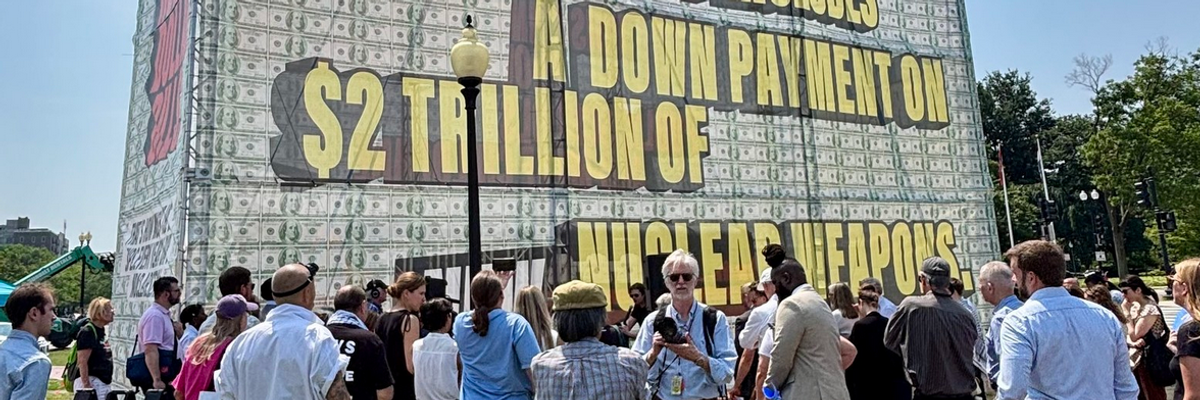
Participants gather for the launch of the Up in Arms campaign against military and nuclear weapons spending on June 12, 2025 in Washington, D.C.
(Photo: Ploughshares)
Brett Wilkins
Jun 14, 2025
COMMON DREAMS
Joined by retired military officers and national security experts, Ben & Jerry's co-founder Ben Cohen on Thursday launched a campaign targeting the nearly $900 billion Pentagon budget and the $100 billion spent on nuclear weapons and "to get our country to start funding the American Dream instead of the death of millions of people."
Standing near Union Station in Washington, D.C. beside a towering sculpture showing what $100 billion looks like, supporters of the Up in Arms campaign—a planned four-year public education and advocacy project "to bring common sense to the Department of Defense and the country's budgetary bottom line"—chanted, "Money for the poor, not nuclear war!"
"There will be no peace, there will be no security, until we start using our resources to provide for the needs of our people at home and around the world," Cohen said at the event. "And we have the money to do it, at no additional taxpayer expense. If we take half the money budgeted for the Pentagon and invested in the things people need and want, the American Dream can become a reality again."
The peace group Ploughshares, which moderated a press conference for the launch of Up in Arms, said that the faux-$100 billion installation could be the tallest protest structure ever erected in Washington, D.C.
"This is a structure that represents the $100 billion that our country spends each year on nuclear weapons," Cohen said while standing in front of the tower and embracing Medea Benjamin, the co-founder of the peace group CodePink. "Fifty percent of that is for a whole new generation of nuclear weapons."
"Ice cream not bombs!" Benjamin said next. "Ice cream not nuclear weapons!"
"Congress could make it easier for Americans to buy homes and save on gas or they could tackle the opioid epidemic–but those are clearly NOT their priorities," Up in Arms says on its website. "We have all the money we need to create a good life for all Americans. For half the money we spend on nuclear bombs, we could stop poisoning kids with lead, provide funding for public schools, and make childcare affordable."
Former U.S. military officers-turned-peace defenders Dennis Laich, Lawrence Wilkerson, Ann Wright, Karen Kwiatkowski, William Astore, and Dennis Fritz, as well as FBI whistleblower Coleen Rowley and former CIA officer Ray McGovern, are taking part in the Up in Arms campaign.
"We're here today to say we don't want our money spent this way, we want our money spent… on things that keep people alive, not on things that kill people," said Wright, a former U.S. Army colonel and current member of the Eisenhower Media Network and Veterans Against Genocide.
"We're up in arms and down on these damn nuclear weapons," she added, "and We the People have to be able to go to each one of these congresspeople and say, 'We don't care how much money you're getting from all of these companies that make a killing out if killing with these nuclear weapons.'"
Laich, a former U.S. Army general also with the Eisenhower Media Network, noted that the U.S. military budget "is larger than the next 10 countries combined, and what do we get for it?"
"Since World War II, we tied in Korea, we lost in Vietnam, we won the first Gulf War, we lost in Iraq, and we lost in Afghanistan," he said. "They always say we have the greatest military on earth; I don't buy it."
President Donald Trump is proposing a record $1 trillion Pentagon budget for fiscal year 2026 while backing legislation that would dramatically slash spending on vital social programs in order to fund a massive tax break that would overwhelmingly benefit the rich and corporations.
On Friday, the International Campaign to Abolish Nuclear Weapons—which earned the 2017 Nobel Peace Prize for spearheading the landmark Treaty on the Prohibition of Nuclear Weapons—published an analysis showing the world's nine nuclear powers spent a combined baseline $100 billion on their arsenals last year, an 11% increase from 2023. The United States alone accounted for well over half of that amount.
Cohen is a longtime anti-war activist. Last month, he was arrested after disrupting a Senate hearing, shouting, "Congress kills poor kids in Gaza by buying bombs and pays for it by kicking kids off Medicaid in the U.S." as he was hauled off by police.
New analysis reveals that global nuclear weapons spending "could feed all of the 345 million people currently facing the most severe levels of hunger globally, including starvation, for nearly two years."
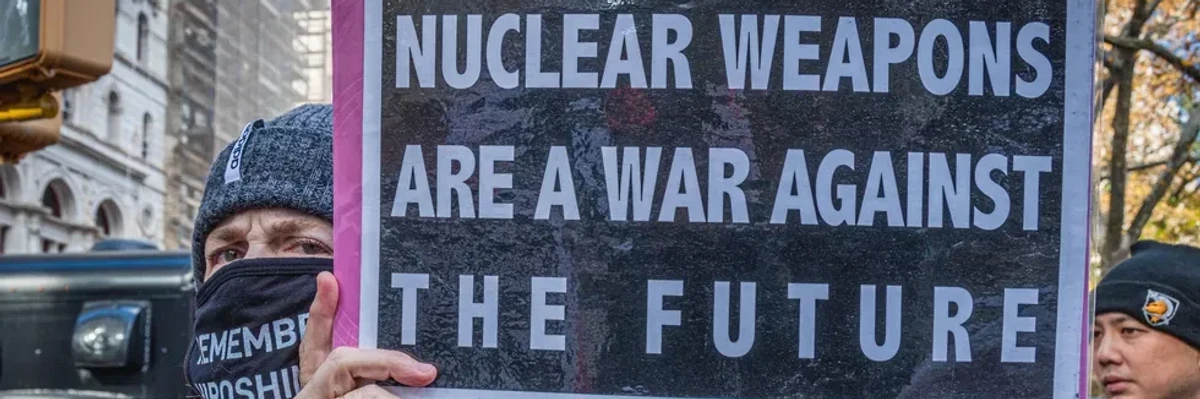
A protester holds a sign reading, "Nuclear weapons are a war against the future" at a demonstration in New York City
(Photo: Erik McGregor/LightRocket via Getty Images)
Brett Wilkins
Jun 13, 2025
COMMON DREAMS
The world's nine nuclear-armed nations spent more than $100 billion on their atomic arsenals last year—up 11% from 2023—with the United States accounting for both the largest share and biggest increase in expenditures, a report published Friday by the International Campaign to Abolish Nuclear Weapons reveals.
The new ICAN analysis identifies a $9.9 billion increase in global nuclear weapons spending in 2024, with the U.S.—the only country to ever carry out a nuclear attack on another nation—spending $56.8 billion, more than the combined expenditures of the eight other countries with nukes. In addition to the U.S., Russia, China, France, the United Kingdom, India, Pakistan, Israel, and North Korea have nuclear arsenals. The $5.3 billion annual spending increase by the U.S. was also more than any other nuclear power.
All that spending on doomsday weapons padded the profits of major arms makers. According to the report:
In 2024, at least twenty-six companies working on nuclear weapons development and maintenance held significant contracts for their work. These companies earned at least $43.5 billion in the year and hold at least $463 billion in outstanding contracts. In 2024, new contracts worth around $20 billion were awarded to these companies. The companies identified in this report paid lobbyists in France and the United States more than $128 million to represent their interests last year. They also had 196 meetings with high-level U.K. officials including 18 with the prime minister's office in 2024.
"Nuclear-armed countries could have paid the United Nations' budget 28 times with what they spent to build and maintain nuclear weapons in 2024," the report states. "They could feed all of the 345 million people currently facing the most severe levels of hunger globally, including starvation, for nearly two years."
Noting that "98 countries have signed, ratified, or acceded" to the Treaty on the Prohibition of Nuclear Weapons (TPNW), ICAN—which was awarded the 2017 Nobel Peace Prize for its work on the landmark accord—asserted that "it is up to each government, and the citizens of that country, to decide which path they will choose."
ICAN asserted that the stakes are higher than at any time in a generation.
"With two major wars involving nuclear-armed states in Ukraine and Gaza, as well as nuclear tensions escalating between India and Pakistan and on the Korean Peninsula, the risk that nuclear weapons could be used in combat is widely regarded as the highest it has been since the Cold War and possibly ever," the group warned Friday in a separate statement. "In response, the nuclear-armed states are clinging to the doctrine of deterrence which is based on brinkmanship and the threat to use nuclear weapons, exacerbating the risk of conflict."
Susi Snyder, ICAN program coordinator and report co-author, said Friday that the global crisis of nuclear proliferation and out-of-control spending can be solved, but that "doing so means understanding the vested interests fiercely defending the option for nine countries to indiscriminately murder civilians."
"The good news," she added, "is a majority are going in another direction. Ninety-eight states, supported by over 700 civil society organizations, have either signed, ratified, or directly acceded to the... TPNW that came into force four years ago."
This year's ICAN report highlighted the "hidden costs" of nuclear weapons.
"It's an affront to democracy that citizens and lawmakers in countries that boast of their democratic credentials are not allowed to know that nuclear weapons from other countries are based on their soil or how much of their taxes is being spent on them," ICAN policy and research coordinator and report co-author Alicia Sanders-Zakre said. "It is time for these democratically elected leaders to heed the call of their people to remove nuclear weapons from their countries and work for their total elimination."
Responding to the report, Oliver Meier, policy and research director at the European Leadership Network, a London-based think tank, said, "At a time when better transparency and accountability of nuclear weapon states range high on the agenda of many non-nuclear weapon states, the absolute secrecy and lack of engagement on the costs of Russian and NATO nuclear sharing arrangements are an anachronism."
"In democratic societies, legislators and other stakeholders must have opportunities to review these arrangements, including relevant expenditure," he added.
The day before ICAN published the report, Ben Cohen, co-founder of Ben & Jerry's ice cream, was joined by retired military officers and national security experts in Washington, D.C. for the launch of Up In Arms, a four-year campaign "to bring common sense to the Department of Defense and the country's budgetary bottom line."
"There will be no peace, there will be no security, until we start using our resources to provide for the needs of our people at home and around the world," said Cohen. "And we have the money to do it, at no additional taxpayer expense. If we take half the money budgeted for the Pentagon and invested in the things people need and want, the American Dream can become a reality again."


No comments:
Post a Comment