China Lashes Out As U.S. Reports Tracking Chinese Research Vessel in Arctic
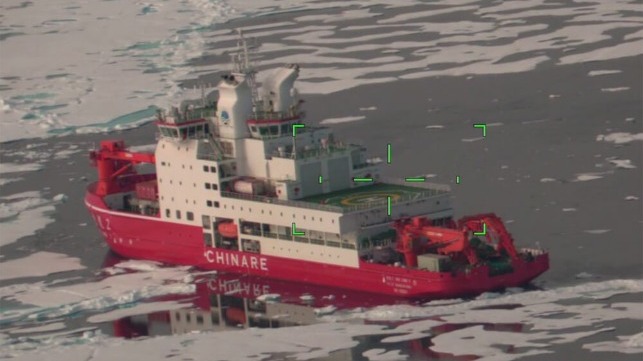
The U.S. Coast Guard reported on July 26 that it has been tracking a Chinese-flagged research vessel that it contends entered U.S. waters in the Arctic, and this came after a similar report from the Canadians. China was quick to respond, through its Global Times newspaper, launching a broad range of accusations at the U.S., which it called a “rule-breaker” and “global troublemaker.”
The vessel Xue Long 2 (12,769 gross tons) was “detected,” the U.S. Coast Guard said in its statement, and that it had responded to the vessel. They reported dispatching a C-130J aircraft to locate and document the Chinese vessel. USCG released photos of the vessel.
The U.S. contends the vessel was on the U.S. Extended Continental Shelf, approximately 290 nautical miles north of Utqiagvik, Alaska. The U.S. said the vessel was 130 nautical miles inside the ECS boundary.
“The U.S. has exclusive rights to conserve and manage the living and non-living resources of its ESC,” wrote the USCG.
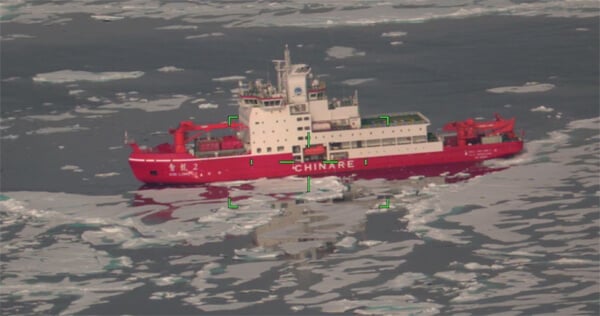
China lashed out at the U.S. reporting of its research vessel in the Arctic (USCG)
The U.S. sighting came days after Canada’s CBC revealed that Canadian forces had also been tracking the vessel as it moved in the Arctic. On July 22, the Canadian military, however, asserted the vessel was not currently in Canadian territorial waters.
According to CBC, the vessel, which was built in 2019, had left Shanghai on July 6, making its way along the western Pacific coastline. The ship, which is operated by the Polar Research Institute of China, is 122.5 meters (approximately 402 feet) in length. China reports it has a 20,000 nautical mile endurance and a capacity of 101 people. It can continuously break through ice of up to 1.5 meters (nearly 5 feet) at a speed of 2 to 3 knots.
In a highly ironic statement, China asserts the vessel is in international waters and accuses the U.S. of making the ECS “a self-drawn area, a unilateral claim of territory.” They claim the U.S. redrew the boundaries in December 2023 and said China opposes any country’s unilateral self-interpretation. They assert the U.S. has a “blatant disregard for international law.”
"China's position on Arctic maritime rights and interests has been made clear that they must be handled in accordance with the United Nations Convention on the Law of the Sea (UNCLOS),” writes the Global Times.
The Chinese statement says that in addition to the U.S., nations including Canada, Denmark, Norway, and Russia have all made sovereign claims over sections of the Arctic seabed. They say it is motivated by the region’s vast resources.
The research vessel Xue Long 2 is on a repeat visit to the Arctic after having conducted a similar visit in 2024. In 2023, the Polar Research Institute highlighted that it was launching its 13th research expedition to the Arctic. They said the 2022 mission had lasted 79 days and covered 14,000 nautical miles. They predicted the 2023 mission would be more comprehensive, covering 15,500 nautical miles.
The Global Times said last weekend’s release by the USCG “is essentially about stoking anti-China sentiment at home and peddling the China threat narrative abroad to create confrontation.” They said it was more rhetoric from the United States.
Chinese Carrier May Invest up to $2.5B in Russia's Port of Arkhangelsk
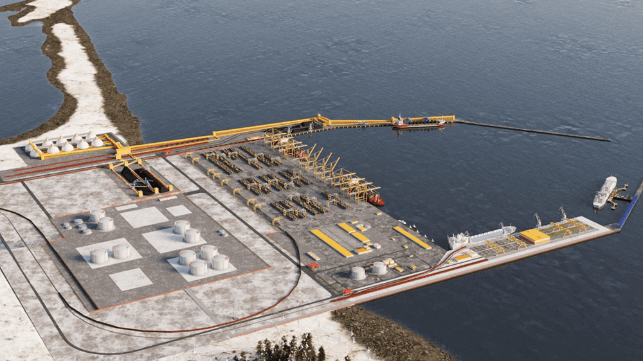
China's NewNew Shipping Line has agreed to pay billions of dollars to support the construction of new port facilities at Arkhangelsk, a key seaport at the western end of the Northern Sea Route, the Russian-administered waterway off Siberia's Arctic coast.
Located near the mouth of the Dvina River on the White Sea, Arkhangelsk is just south of the Arctic Circle and is icebound in winter. In the navigation season, it is a gateway to consumers and industries in western Russia: though the city is itself remote, it is still the NSR's closest deep-sea port to Moscow and St. Petersburg, and the Severnaya Railway connects it with the rest of Russia's rail network.
Last month, regional governor Alexander Tsybulsky told Russian outlet PortNews that planning is under way for a major expansion of Arkhangelsk's seaport. The new terminal will be able to welcome merchant ships with a draft of up to about 48 feet and capacity of 75,000 dwt. The objective is to triple the port's modest throughput by 2040. "Here we work closely with our partners - the state corporation Rosatom, the company Eurosib," he said. "The main investors have been identified, there is interest from foreign companies. In particular, we are actively working with the Chinese NewNew Shipping Line."
Last weekend, in a readout of a meeting with Russian President Vladimir Putin, Tsybulsky elaborated that NewNew is ready to take a 30 percent stake in the port with an investment of up to $2.5 billion - far more than the value of NewNew's fleet.
"We are currently working on technical issues with them, but if you agree, we are ready to continue this work and sign a memorandum with them on the main directions that we would be ready to use in this port," Tsybulsky told Putin.
NewNew Shipping Line started a container route along the NSR in 2023, and it added a round trip service from Shanghai/Ningbo to Arkhangelsk in 2024. Last year's 13 voyages were profitable, and the firm plans to use larger ships in this year's rotation.
In the long term, NewNew is planning a series of Arc7 ice class container ships in cooperation with Russian state nuclear agency Rosatom, operator of Russia's nuclear icebreakers and the managing agency for Northern Sea Route development. The Panamax-sized vessels would be capable of an extended navigation season in the ice-choked eastern stretch of the NSR - just like the Arc7-class icebreaking LNG carriers that serve Novatek's Yamal LNG plant. An expanded deepwater container terminal at Arkhangelsk would reduce these ships' transit times to western Russia by a week (when compared to a voyage to St. Petersburg).
Year-round NSR navigation between Russia and China is a top priority for Putin's administration, in part for supply chain security and in part for the economic benefits of an active trade lane for other projects along Russia's remote northern shore.

No comments:
Post a Comment