Scotland Gives SSE Approval for What Could be the World's Largest Wind Farm
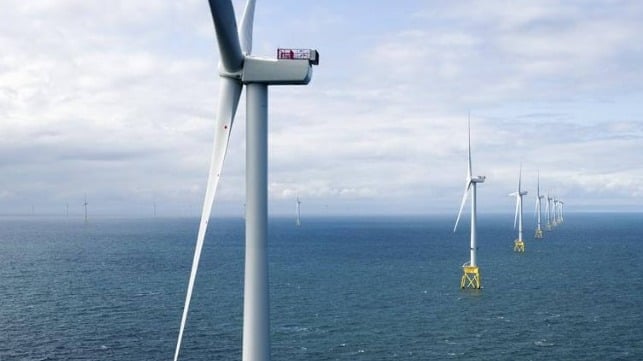
In what is being called a “vital step” for Scotland and the UK’s renewable energy ambitions, the Scottish Government has granted consent for the proposed Berwick Bank offshore wind farm. If the project is developed, it would supply twice the annual needs of Scotland’s households and enough power for around 17 percent of the UK’s households.
The massive project has been more than a decade in the planning highlights SSE and is one step closer to proceeding. The consent from Scotland is the last major approval necessary for the project to proceed. However, it still must win a power contract under the UK’s Contracts for Difference scheme, which will likely launch its next round in September. SSE also needs to reach its final investment decision.
The approval comes just days after Donald Trump admonished Scotland to “Stop the windmills,” during his visit. He told reporters, “You fly over and you see these windmills all over the place, running your beautiful fields, and valleys, and killing your birds, and if they’re stuck in the ocean, ruining your oceans,” reports the BBC. They highlight that Trump began opposing Scottish wind farms because they “would spoil the view from his golf course.”
The UK government, however, is strongly behind renewable energy. Prime Minister Keir Starmer outlined a plan to install up to 50 GW of capacity as part of a mass deployment of offshore wind over the next five years. The government increased the financial package for renewable energy in 2024, and it has been reported that they will further improve the support in the next round.
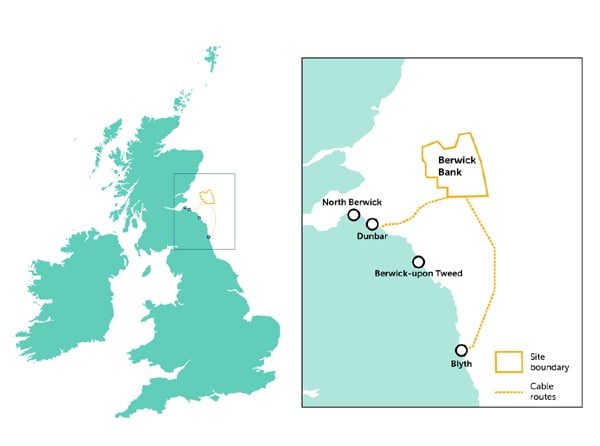
SSE’s plan for Berwick Bank calls for it ultimately to consist of up to 307 turbines. It would be located approximately 23 miles off the east coast of Scotland in the outer Firth of Forth. The company reports a rated capacity of 4.1 GW, which would make it the largest in the world. The UK’s Hornsea 3, which is currently under construction, would be the largest individual wind farm at 2.9 GW, and if all four phases of Hornsea were completed, it would ultimately have reached 6 GW. Ørsted, however, in May said it was discontinuing Hornsea 4 in its current form.
The Berwick Bank project has faced opposition from groups that say it would endanger birds and harm the region’s environment. SSE counters that it would create over 9,000 jobs at peak construction and could inject £8.3 billion of value into the UK economy.
SSE has not provided a target date for the project. The next CfD round is expected to announce results by early 2026.
First-of-its-Kind, Jones Act Cable Lay Barge Operated by Nexans and Crowley
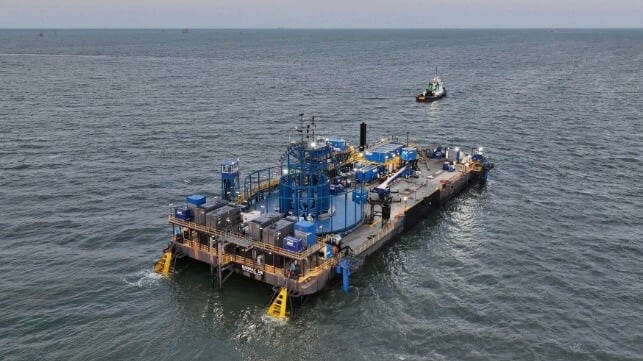
The growth of the U.S. offshore wind energy, telecommunications, and other sectors continues to contribute to the growth of U.S. shipping. Cable manufacturer Nexans and Crowley Wind Services announced a new partnership that will develop and operate a Jones Act-compliant cable lay barge.
The 300-foot, U.S.-flagged barge will be built in Louisiana and tested in the U.S. Gulf to Nexans specifications. Once completed, it will be crewed with U.S. mariners under Crowley’s operation. It is designed to support the installation of subsea transmission lines necessary for offshore wind energy, telecommunications, and other major industrial applications.
"This barge will support our existing fleet of cable laying vessels, the Nexans CLV Aurora, Nexans C/S Skagerrak, and Nexans CLV Electra, and we are pleased to be working with Crowley on developing the capability to lay nearshore subsea cable in the U.S.," said Pascal Radue, executive vice president of Nexans' PWR-Transmission Business Group, highlighting the significance of the partnership.
Among its features, the barge will be the first to have vertical injectors along with a dynamic positioning system and a multiple-anchor positioning system, which allow for accurate and efficient cable placement, even in challenging conditions. The barge has a 3,500-ton capacity carousel to lay and bury subsea cable using burial tools such as a vertical injector, a jet sled, or a jetting ROV, with the potential to be upgraded to 7,000 tons with two carousels for bundle cable lay and burial.
According to the companies, it will play a critical role in laying and burying the subsea cables needed to deliver energy from offshore to the grid onshore. It will provide solutions for the expansion of U.S. energy sources and other industrial uses that require underwater cabling.
The barge is positioned to support Equinor’s Empire Wind offshore wind farm for New York. It can also be configured to lay or repair cable for a multitude of other subsea applications.
“The cable lay barge will provide a productive supply chain solution for offshore energy, telecommunications, and other sectors,” said Graham Tyson, vice president of operations, Crowley Wind Services. “Coupled with our U.S. maritime fleet and mariners providing feedering services and other logistics and project management capabilities, we could not be better equipped to serve the needs of industries seeking subsea cable solutions.”
Crowley, a privately held, U.S.-owned and -operated maritime, energy, and logistics solutions company, formed Wind Services in 2023 as a joint venture with Morgan Stanley Investment Management. It is leading the redevelopment of the port in Salem, Massachusetts and it also ordered a Service Operations Vessel (SOV), which is bing built by Fincantieri Bay Shipbuilding and in partnership with ESVAGT. The vessel is due to go into service in 2026 to support Siemens Gamesa’s service operations on the Dominion Energy Coastal Virginia Offshore Wind project.
Canada Designates First Zones for Offshore Wind Energy off Nova Scotia
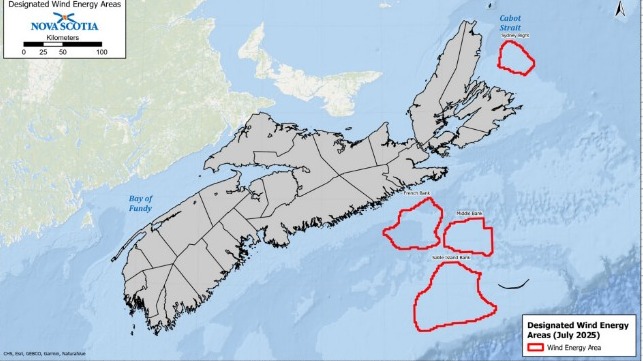
After extensive exploration, the Canadian federal government and the Province of Nova Scotia took the first definitive steps for the development of Canada’s offshore wind energy industry. Calling it a “key step,” the local and federal government jointly presented the first four zones to be made available for development in a call for bids expected by the end of the year.
Nova Scotia’s Premier, Tim Houston, has a bold vision for the industry and creating a new business for Canada’s eastern province. While Nova Scotia currently has peak electrical usage of approximately 2.4 GW of power, Houston wants to make Nova Scotia into an ”energy superpower.” He predicts the industry could grow to a generation capacity of 40 to 50 GW, making it an energy exporter. It might even benefit from Donald Trump’s avowed stance to stop wind power, as there have been reports that Massachusetts might become a power importer from Canada to make up for the loss of its plans for offshore wind power energy.
“With some of the top wind speeds in the world, Nova Scotia has the potential to become a clean energy superpower,” said Premier Tim Houston. “With the right infrastructure, we’ll have the opportunity to send our wind west to power other parts of Canada. By becoming an energy exporter, we can secure long-term prosperity for Nova Scotians.”
A total of four areas were released in today’s plan, three to the east of Nova Scotia and one to the north. Three (Middle Bank, Sable Island Bank, and Sydney Bight) would each be at least 25 kilometers (15 miles) from shore and are at depth for fixed-bottom turbines. The fourth, French Bank, would be closer at 20 kilometers (12.5 miles), and that was done on purpose because the waters are significantly deeper, meaning it could require floating turbines, but the distance is designed to ensure that it remains economical.
Houston told the audience during a press event that the province has great potential and the industry could become an economic driver for Nova Scotia. He noted that some companies are already using Nova Scotia as a staging area for offshore wind projects.
The government said the first call for bids would be for a modest 2.5 GW and would be followed by additional rounds. The goal is to license 5 GW by 2030. After designating the location, the government will now direct the Canada-Nova Scotia Offshore Energy Regulator to begin preparing the bidding process.
After the first round of licenses is awarded, four other areas identified in the January 2025 regional assessment of offshore wind development will be revisited. They include Western/Emerald Bank, which was originally included as the fifth area in the announcement in the spring. Government officials said it has been delayed due to the complexities of the site and feedback during the public comment period.

No comments:
Post a Comment