Trump’s ‘logic is flawed’ – economics professor

We spoke to Nazak Nikakhtar, who served as assistant secretary at the Department of Commerce during Donald Trump’s first presidency and Moshe Lander, who’s a senior lecturer in Economics at Concordia University in Montreal, and an expert in international trade policy.
After a blown deadline, what next for US-Canada trade?
Jessica Murphy
BBC News, Toronto
'In business, indecision is killer' - Canadian firms seek certainty
And while in the US consumer confidence is up and prices there have remained contained, it helps Canada's negotiating position if they can wait for Americans to start feeling the pain of tariffs.
"It's Americans who are going to squawk," said Prof Hampson.
Ms Fortin-Lefaivre predicts US businesses, especially smaller firms that don't have the same resources to withstand them, will be pressuring political leaders.
"So that pressure could play to our advantage," she said.
Canadians also appear willing to give the new prime minister some leeway. Opinion polls suggest they are generally satisfied with his handling of trade.
Carney "understands that doing what's best for the economy right now is actually what's best for him politically", Martha Hall Findlay, director of the University of Calgary's School of Public Policy and a former Liberal MP, told the BBC.
Trump has said he is imposing tariffs to boost domestic manufacturing, open overseas markets and raise money for the government.
He is also using them to push countries like Canada on a range of non-trade issues, including military spending.
In the last few weeks, Ottawa has significantly ramped up its defence spending, boosted security at the shared border and killed a digital tax opposed by American tech firms.
Those moves show Canada is "doing what the Americans wanted us to do", said Ms Fortin-Lefaivre.
She hopes Canadian negotiators are pushing for tariffs to be as low as possible, as well as working to ensure the two deeply integrated supply chains are able to continue working together.
Canada is pressing for relief on the 50% steel and aluminium tariffs, which are squeezing US automakers.
And on Thursday, Treasury Secretary Scott Bessent signalled in an interview with CNBC that is an option on the table.
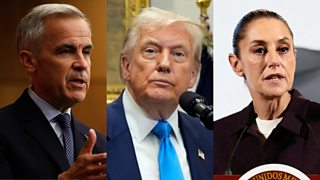
Watch: Why Mexico got a tariff reprieve... and Canada didn't
Trump meanwhile, has raised a number of longstanding trade irritants besides fentanyl, including Canada's protections around its dairy industry.
Ottawa has previously warned of more countermeasures to come if talks collapse, though political appetite for that may be waning.
Retaliatory tariffs "haven't seemed to have had the kind of impact that we would hope for", British Columbia Premier David Eby recently told Bloomberg.
On retaliation, Prof Hampson said: "The Americans have escalation dominance here. So you want to be smart about it."
A spokesperson for Carney declined to say whether more countermeasures remained on the table. Meanwhile, Canadian negotiators have been in Washington most of this week and keep pushing talks forward, with the minister responsible for Canada-US trade saying on Friday an acceptable agreement "was not yet in sight".
"We all crave the certainty of a deal," said Ms Fortin-Lefaivre.
But research by her business group suggests firms are making contingency plans. Almost 40% of goods exporters have already diversified suppliers outside the US, and 28% have diversified buyers.
They are also looking ahead to what may be more challenging talks with CUSMA, which has proven a critical backstop, as it is up for review next year.
It is all part of a wider push by the country to diversify trade away from the US, pull down barriers that have hindered trade between provinces, and press forward more quickly on major projects.
The economic links between the two countries will stay strong - Canada will still be one of the largest trading partners and economic and security allies of the US.
But the irony is that Trump's threats may be "forcing Canada to understand we have to get our own economic house in order," said Ms Hall Findlay.
"It's going to take some really tough decisions. And I do think our current government gets this."
Jessica Murphy
BBC News, Toronto
EPA
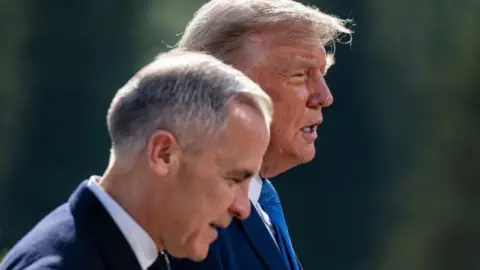
A self-imposed deadline for a new US-Canada trade deal came and went on Friday. So what happens next for these two deeply entwined neighbours?
Canada and the US have been locked in a tariff war for six months and, despite talk of "intense" negotiations in recent weeks, a trade agreement remains elusive.
Both President Donald Trump and Prime Minister Mark Carney have poured cold water on the idea they will reach a quick, and tariff-free, deal. And Trump's open criticism of Canada's move to recognise a Palestinian state dashed hopes for a last minute agreement earlier this week.
The pessimism marks a shift in tone from as recently as June's G7 meeting, when the two leaders set themselves the summer deadline.
Canadian negotiators have come to the conclusion that "it's not the end of the world" if a quick deal isn't reached and "that quality over speed and a rushed agreement matters a lot", said Fen Hampson, a professor of international affairs at Carleton University in Ottawa.
Carney - who has been tight-lipped about the negotiation details - has said as much himself, repeating that just "any deal" won't do.
Still, there are pressures on both sides to give businesses a reprieve.
Conservative leader Pierre Poilievre said on Friday he shares "Canadians' disappointment" that a deal was not reached by the deadline. He urged Carney's Liberals to do more to "take back control of our economic future".
Canada is now facing a 35% tariff rate, though there is a carve out for goods compliant under a current free trade deal. American global tariffs on steel, aluminium, autos and auto parts are hurting, as the US is a top market for those sectors.
The Trump administration has justified those tariffs by claiming a lack of co-operation on stemming the flow of illicit drugs like fentanyl. Canada denies that, noting about 1% of US fentanyl imports originate in Canada. It has also brought in new border protections and a "fentanyl czar" in recent months in an effort to address Trump's concerns.
Threatened tariffs on copper and the expected end of a global tariff exemption used by shoppers of goods under $800 could also pinch.
Canada has responded with C$60bn ($43.3bn; £32.3bn) in counter tariffs on various American goods - the only country along with China to directly retaliate against Trump.
"It comes as no surprise that businesses are craving certainty after months and months of tumultuous announcements," said Catherine Fortin-Lefaivre, vice-president of international policy and global partnership at the Canadian Chamber of Commerce.
"But at the same time, they're not craving certainty at the expense of a really bad deal."
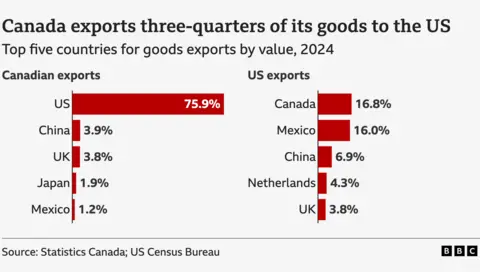
A few factors give Canada some breathing room.
On paper, it looks like the country is facing a severe tariff rate from the US, but trade is currently more free than the levies suggest at first glance.
In March, Trump announced a tariffs reprieve on goods compliant with the Canada–United States–Mexico Agreement, known in Canada as CUSMA and the US as the USMCA.
That deal - negotiated during Trump's first term in office - came into force five years ago.
Almost 90% of Canadian exports to the US are ultimately able to cross the border duty free, if firms file out necessary paperwork, under that agreement.
"That has given us a buffer, no question about it, that other countries don't have right now," said Prof Hampson.
It means Canada is overall paying a much lower tariff rate than many of the deals already inked with the US, like the EU, South Korea and Japan at 15%, or Indonesia and the Philippines at 19%.
Ottawa has also brought in some relief programmes for affected industries and has also collected about C$1.5bn more in import duties than in the same period last year, due to the counter tariffs.
Why Trump's global tariffs 'victory' may well come at a high price
A self-imposed deadline for a new US-Canada trade deal came and went on Friday. So what happens next for these two deeply entwined neighbours?
Canada and the US have been locked in a tariff war for six months and, despite talk of "intense" negotiations in recent weeks, a trade agreement remains elusive.
Both President Donald Trump and Prime Minister Mark Carney have poured cold water on the idea they will reach a quick, and tariff-free, deal. And Trump's open criticism of Canada's move to recognise a Palestinian state dashed hopes for a last minute agreement earlier this week.
The pessimism marks a shift in tone from as recently as June's G7 meeting, when the two leaders set themselves the summer deadline.
Canadian negotiators have come to the conclusion that "it's not the end of the world" if a quick deal isn't reached and "that quality over speed and a rushed agreement matters a lot", said Fen Hampson, a professor of international affairs at Carleton University in Ottawa.
Carney - who has been tight-lipped about the negotiation details - has said as much himself, repeating that just "any deal" won't do.
Still, there are pressures on both sides to give businesses a reprieve.
Conservative leader Pierre Poilievre said on Friday he shares "Canadians' disappointment" that a deal was not reached by the deadline. He urged Carney's Liberals to do more to "take back control of our economic future".
Canada is now facing a 35% tariff rate, though there is a carve out for goods compliant under a current free trade deal. American global tariffs on steel, aluminium, autos and auto parts are hurting, as the US is a top market for those sectors.
The Trump administration has justified those tariffs by claiming a lack of co-operation on stemming the flow of illicit drugs like fentanyl. Canada denies that, noting about 1% of US fentanyl imports originate in Canada. It has also brought in new border protections and a "fentanyl czar" in recent months in an effort to address Trump's concerns.
Threatened tariffs on copper and the expected end of a global tariff exemption used by shoppers of goods under $800 could also pinch.
Canada has responded with C$60bn ($43.3bn; £32.3bn) in counter tariffs on various American goods - the only country along with China to directly retaliate against Trump.
"It comes as no surprise that businesses are craving certainty after months and months of tumultuous announcements," said Catherine Fortin-Lefaivre, vice-president of international policy and global partnership at the Canadian Chamber of Commerce.
"But at the same time, they're not craving certainty at the expense of a really bad deal."
A few factors give Canada some breathing room.
On paper, it looks like the country is facing a severe tariff rate from the US, but trade is currently more free than the levies suggest at first glance.
In March, Trump announced a tariffs reprieve on goods compliant with the Canada–United States–Mexico Agreement, known in Canada as CUSMA and the US as the USMCA.
That deal - negotiated during Trump's first term in office - came into force five years ago.
Almost 90% of Canadian exports to the US are ultimately able to cross the border duty free, if firms file out necessary paperwork, under that agreement.
"That has given us a buffer, no question about it, that other countries don't have right now," said Prof Hampson.
It means Canada is overall paying a much lower tariff rate than many of the deals already inked with the US, like the EU, South Korea and Japan at 15%, or Indonesia and the Philippines at 19%.
Ottawa has also brought in some relief programmes for affected industries and has also collected about C$1.5bn more in import duties than in the same period last year, due to the counter tariffs.
Why Trump's global tariffs 'victory' may well come at a high price
'In business, indecision is killer' - Canadian firms seek certainty
And while in the US consumer confidence is up and prices there have remained contained, it helps Canada's negotiating position if they can wait for Americans to start feeling the pain of tariffs.
"It's Americans who are going to squawk," said Prof Hampson.
Ms Fortin-Lefaivre predicts US businesses, especially smaller firms that don't have the same resources to withstand them, will be pressuring political leaders.
"So that pressure could play to our advantage," she said.
Canadians also appear willing to give the new prime minister some leeway. Opinion polls suggest they are generally satisfied with his handling of trade.
Carney "understands that doing what's best for the economy right now is actually what's best for him politically", Martha Hall Findlay, director of the University of Calgary's School of Public Policy and a former Liberal MP, told the BBC.
Trump has said he is imposing tariffs to boost domestic manufacturing, open overseas markets and raise money for the government.
He is also using them to push countries like Canada on a range of non-trade issues, including military spending.
In the last few weeks, Ottawa has significantly ramped up its defence spending, boosted security at the shared border and killed a digital tax opposed by American tech firms.
Those moves show Canada is "doing what the Americans wanted us to do", said Ms Fortin-Lefaivre.
She hopes Canadian negotiators are pushing for tariffs to be as low as possible, as well as working to ensure the two deeply integrated supply chains are able to continue working together.
Canada is pressing for relief on the 50% steel and aluminium tariffs, which are squeezing US automakers.
And on Thursday, Treasury Secretary Scott Bessent signalled in an interview with CNBC that is an option on the table.
Watch: Why Mexico got a tariff reprieve... and Canada didn't
Trump meanwhile, has raised a number of longstanding trade irritants besides fentanyl, including Canada's protections around its dairy industry.
Ottawa has previously warned of more countermeasures to come if talks collapse, though political appetite for that may be waning.
Retaliatory tariffs "haven't seemed to have had the kind of impact that we would hope for", British Columbia Premier David Eby recently told Bloomberg.
On retaliation, Prof Hampson said: "The Americans have escalation dominance here. So you want to be smart about it."
A spokesperson for Carney declined to say whether more countermeasures remained on the table. Meanwhile, Canadian negotiators have been in Washington most of this week and keep pushing talks forward, with the minister responsible for Canada-US trade saying on Friday an acceptable agreement "was not yet in sight".
"We all crave the certainty of a deal," said Ms Fortin-Lefaivre.
But research by her business group suggests firms are making contingency plans. Almost 40% of goods exporters have already diversified suppliers outside the US, and 28% have diversified buyers.
They are also looking ahead to what may be more challenging talks with CUSMA, which has proven a critical backstop, as it is up for review next year.
It is all part of a wider push by the country to diversify trade away from the US, pull down barriers that have hindered trade between provinces, and press forward more quickly on major projects.
The economic links between the two countries will stay strong - Canada will still be one of the largest trading partners and economic and security allies of the US.
But the irony is that Trump's threats may be "forcing Canada to understand we have to get our own economic house in order," said Ms Hall Findlay.
"It's going to take some really tough decisions. And I do think our current government gets this."
Trump’s chaotic tariff announcement won’t help his poor popularity
Polls show the American public is not happy with Trump's first six months in office


A recent poll by Reuters and Ipsos found his approval was down to 40 per cent, the lowest for his second term. A separate survey by CBS News and YouGov found that 50 per cent of Americans said Trump’s policies were making them worse off financially. With inflation still steadily growing, 62 per cent said Trump’s policies of tariffs were making food and groceries more expensive.
For Democrats seeking to make ground and retake the House of Representatives in the 2026 midterms, this should be an area they hone in on with a laser focus.
Trump bungling the Jeffrey Epstein affair and the 60,000 people killed in Gaza by the US backed Israeli military can dominate media headlines, but it is the economy, the cost of living, and ultimately whether people feel financially secure that have long been shown to be the crucial issues on which voters cast their ballot.
It is especially important because Trump was given a second term in large part because he was seen as the person better equipped to handle the economy. And while the impact of the tariffs may not be fully felt, eventually they will be passed onto US consumers leading to them paying higher prices. In the coming weeks and months Americans can expect to have “sticker shock” on the cost of cars to the price of meat.
Trump came into office with an economy that, if not perfect, was in pretty good shape. Yet because of his desire to rip up the old order, both in terms of trade and strategic alliances, America and the rest of the world are now confronted by a world where nobody appears sure what happens next.
Polls show the American public is not happy with Trump's first six months in office
US President Donald Trump speaks to the press before boarding Marine One on the South Lawn of the White House in Washington (Photo: Andrew Caballero-Reynolds/AFP)
Andrew Buncombe
August 01, 2025 6:37
iNEWS
There’s nothing that disrupts financial markets more than uncertainty. Some surprises, like a lopsided trade deal, can be factored in. But the chaos and doubt created by a global superpower issuing one set of rules only to update them with no warning is too much for even the smartest AI-assisted algorithms.
That is what happened after Donald Trump announced new tariffs on up to 70 countries overnight, ranging from 10 per cent imposed on the UK to 35 per cent for Canada (more than Mexico’s 25 per cent and China’s 30 per cent) and a whopping 50 per cent for Brazil.
The markets have reacted as expected. The Stoxx 600, which is made of European stocks, dropped to 1.3 per cent, its lowest in a month. In the US, all three major indexes – the Dow Jones Industrial Average, the S&P 500, and the Nasdaq – were down sharply.
Andrew Buncombe
August 01, 2025 6:37
iNEWS
There’s nothing that disrupts financial markets more than uncertainty. Some surprises, like a lopsided trade deal, can be factored in. But the chaos and doubt created by a global superpower issuing one set of rules only to update them with no warning is too much for even the smartest AI-assisted algorithms.
That is what happened after Donald Trump announced new tariffs on up to 70 countries overnight, ranging from 10 per cent imposed on the UK to 35 per cent for Canada (more than Mexico’s 25 per cent and China’s 30 per cent) and a whopping 50 per cent for Brazil.
The markets have reacted as expected. The Stoxx 600, which is made of European stocks, dropped to 1.3 per cent, its lowest in a month. In the US, all three major indexes – the Dow Jones Industrial Average, the S&P 500, and the Nasdaq – were down sharply.
A poster depicting Donald Trump bearing devil horns during a protest in Sao Paulo over US tariffs on Brazil (Photo: Nelson Almeida/AFP)
As Jonathan Pingle, a senior US economist at UBS, a major international bank told The Wall Street Journal: “Everyone is trying to understand what direction the economy is taking.”
There appears to be little rhyme or reason behind Trump’s numbers. Brazil’s 50 per cent import tax comes after the nation apparently upset Trump by prosecuting former leader, Jair Bolsonaro, whom he was once fond of, for attempting a coup not entirely dissimilar to the one tried by Trump after he lost to Joe Biden in 2020.
India, whose leader Narendra Modi is claimed to be a friend, was landed with a 25 per cent tariff. One apparent crime committed by Modi is the decision to continue buying oil from Russia in defiance of US wishes, an area where Trump has conveniently ignored the many decades that the US bought petroleum from other autocracies, such as Saudi Arabia.
Syria, a newly fledgling democracy, has also been handed a stinging 41 per cent import tax despite Trump praising its leader Ahmed al-Sharaa after meeting him in the Middle East, proving that very few nations are safe from his wrath, whatever is fuelling it.
As Jonathan Pingle, a senior US economist at UBS, a major international bank told The Wall Street Journal: “Everyone is trying to understand what direction the economy is taking.”
There appears to be little rhyme or reason behind Trump’s numbers. Brazil’s 50 per cent import tax comes after the nation apparently upset Trump by prosecuting former leader, Jair Bolsonaro, whom he was once fond of, for attempting a coup not entirely dissimilar to the one tried by Trump after he lost to Joe Biden in 2020.
India, whose leader Narendra Modi is claimed to be a friend, was landed with a 25 per cent tariff. One apparent crime committed by Modi is the decision to continue buying oil from Russia in defiance of US wishes, an area where Trump has conveniently ignored the many decades that the US bought petroleum from other autocracies, such as Saudi Arabia.
Syria, a newly fledgling democracy, has also been handed a stinging 41 per cent import tax despite Trump praising its leader Ahmed al-Sharaa after meeting him in the Middle East, proving that very few nations are safe from his wrath, whatever is fuelling it.
Trump imposed a 35% tariff on Canada (Photo: AFP)
If there is a secret pattern to all of this, it is that it feels incredibly similar to the ill thought out “liberation day” tariffs announced in April by Trump that felt so chaotic they could have been made up on the spot. On that occasion, the president’s allies announced his actions would see America secure “90 trade deals in 90 days”. That, of course, did not happen.
Even if you include the light-on-detail framework Trump touted with the UK in June (where he said the UK would be safe from further tariffs “because I like them”), the US has managed less than 10 trade deals, the most important of which was announced this week with the EU.
Perhaps most importantly, this news will do nothing for Trump’s popularity in the US. For all his claims to the contrary, polls show the American public is not happy with his first six months in office.
READ NEXT
If there is a secret pattern to all of this, it is that it feels incredibly similar to the ill thought out “liberation day” tariffs announced in April by Trump that felt so chaotic they could have been made up on the spot. On that occasion, the president’s allies announced his actions would see America secure “90 trade deals in 90 days”. That, of course, did not happen.
Even if you include the light-on-detail framework Trump touted with the UK in June (where he said the UK would be safe from further tariffs “because I like them”), the US has managed less than 10 trade deals, the most important of which was announced this week with the EU.
Perhaps most importantly, this news will do nothing for Trump’s popularity in the US. For all his claims to the contrary, polls show the American public is not happy with his first six months in office.
READ NEXT

A recent poll by Reuters and Ipsos found his approval was down to 40 per cent, the lowest for his second term. A separate survey by CBS News and YouGov found that 50 per cent of Americans said Trump’s policies were making them worse off financially. With inflation still steadily growing, 62 per cent said Trump’s policies of tariffs were making food and groceries more expensive.
For Democrats seeking to make ground and retake the House of Representatives in the 2026 midterms, this should be an area they hone in on with a laser focus.
Trump bungling the Jeffrey Epstein affair and the 60,000 people killed in Gaza by the US backed Israeli military can dominate media headlines, but it is the economy, the cost of living, and ultimately whether people feel financially secure that have long been shown to be the crucial issues on which voters cast their ballot.
It is especially important because Trump was given a second term in large part because he was seen as the person better equipped to handle the economy. And while the impact of the tariffs may not be fully felt, eventually they will be passed onto US consumers leading to them paying higher prices. In the coming weeks and months Americans can expect to have “sticker shock” on the cost of cars to the price of meat.
Trump came into office with an economy that, if not perfect, was in pretty good shape. Yet because of his desire to rip up the old order, both in terms of trade and strategic alliances, America and the rest of the world are now confronted by a world where nobody appears sure what happens next.

No comments:
Post a Comment