Global Floods Beckon Noah
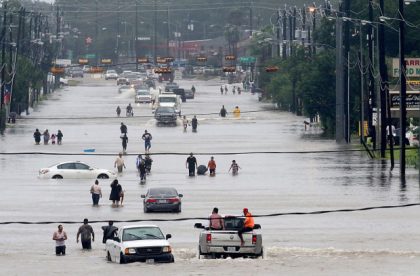 Devastating widespread flooding and flash floods are becoming normal. Try spinning a globe and stop at any continent, other than Antarctica, blindfolded, point a finger, spot a flood. There’s nothing fake about the global warming leviathan absorbing more moisture in a warming atmosphere, much more than ever before, feeding a frenzy of powerful thunderstorms and atmospheric rivers, erupting like waterfalls from the sky. Noah is beckoned.
“Our entire infrastructure and civilization are based around a climate that no longer exists,” John Marsham, professor of atmospheric science, University of Leeds, as numerous locations throughout the world become more difficult to insure against flood damage. (“Flash Floods Are a Worsening Scourge Worldwide — Here’s Why,” Business Insider, October 24, 2024)
Throughout the globe, flooding has turned spectacularly powerfully biblical in scope. In 2025 it’s everywhere all at once. It’s a destroyer of property and a killer of people, and it is intensifying like never before in human history because of the climate change monster, inspired by human activity burning fossil fuels, called global warming. Since 2000, the number of recorded flood-related disasters has risen by 134% compared with the two previous decades. (“Global Assessment Report 2025 Hazards: Floods,” UNDRR)
In America in the month of July alone 1,434 flash flood warnings and 17 flash flood emergencies nationwide, additionally, 2,000 official preliminary flood-related storm reports with the biggest in Texas with nearly two feet of rain in a couple of days. This data is provided by the National Centers for Environmental Information. However, forewarned, future reports will be difficult to find. The Trump administration has already significantly reduced NOAA’s staff, research capacity, and data-sharing capability, including weather forecasts. (“The Lasting Threat of Trump’s Cuts to NOAA and NWS on American Communities,” Center for American Progress, July 16, 2025).
Moreover, “the Trump administration’s 2026 budget appears to be actively working to eliminate the Office of Oceanic and Atmospheric Research (OAR) along with all NOAA weather laboratories and cooperative institutes and laboratories, which provide weather forecasting data and research from 80 universities and work to improve NOAA’s warning and forecast capabilities,” Ibid.
Along those lines, similarly, it’s common knowledge that Orwell’s Nineteen Eighty-Four (publ. 1949) depicts science as a tool manipulated by the Party and not a tool of independent pursuit of knowledge. In fact, 1984’s Newspeak does not have an official word for “science.” Manipulation of truth has no room for objective, empirical science. Like an obedient dog, Trump is honoring the Orwellian tradition. But so what? Who really cares and who really does anything to oppose it tells a despicable story of acquiescence within the confines of a weakened subservient infection-like plague crushing human spirit.
Nevertheless, worldwide flooding carries on, ignoring small minds, powering ahead. So far in 2025, a small sampling of real events: Five entire villages washed away in Baghlan Province Afghanistan; Queensland State 12 inches/24 hours; Kentucky 9 inches few hours; Nepal catastrophic flash flooding; Pakistan deathly relentless flash floods: East Cape Province, huge flood; Texas Hill Country, killer flash flood; Niger State, deadly flash flood; Kenya catastrophic flooding; Columbia widespread flooding; Venezuela enormous flooding; Brazil 127 municipalities displaced; China flood kills 30 in city of Beijing; fatal storms flood south of France, killer torrential rains Buidoso, New Mexico, 1,000-year rainfall Chicago, deadly pounding rain North Carolina, NYC subways under water, Kansas City flooded, etc.
This type of legendary flood destruction in the contemporary world is mysteriously reflected in precious holy writings by several cultures, forewarnings of what happens when the planet is out of kilter, like now: “The Bible (Genesis 6–9) describes a worldwide flood (the Noachian Flood) covering even the highest mountains of the earth and the construction of a huge boat (a rectangular box-like craft) that transported animals, at least two of a kind of all land animals on the earth. The Qur’an (Suras 11 and 71) has almost a duplicate story with a similar huge boat that transported animals and a worldwide flood. In addition, two older stories exist in ancient Babylonian epics that describe a huge flood. One is the Epic of Gilgamesh, describing a flood on the Euphrates River (Academy of Ancient Texts nd). The other is the Epic of Atrahasis, which has a huge flood on the Tigris River (Byers nd).” (“Yes, Noah’s Flood May Have Happened, But Not Over the Whole Earth,” National Center for Science Education, vol. 29, 2009)
What is the signal behind unprecedented flooding, which some claim as god’s message for human wickedness, other than enormous overpowering destructiveness? It’s climate change but not regular ole climate change. This is brand new stuff: Global warming from whacky climate change means more evaporation and more moisture in the atmosphere, which means rainfall intensified sparked by human-driven greenhouse gases. This is basic science 101, and as global warming increases, thanks to excessive levels of fossil fuel burning CO2, Noah will be needed more than anybody can possibly imagine. Flooding has become a pop star on TV news.
Property insurance has become the world’s most conclusive barometer of how climate change affects society, turning into a big nuisance, threatening the basic structure of capitalism: “Insurers are responding to heightened losses by reducing coverage, exiting high-risk markets, and dramatically raising premiums. For many, insurance coverage is unavailable or unaffordable, leaving them unprotected from disaster. As former California Insurance Commissioner Dave Jones has warned, ‘We’re marching steadily toward an uninsurable future.” (“Managing the Climate Change-Fueled Property Insurance Crisis,” Center for American Progress, April 2, 2025)
Radical climate change, that’s well beyond human experience, has become prevalent on the face of the planet with massive storms disrupting nations throughout the world broadcast on TV evening news, making climate deniers appear foolish and childishly ignorant driven by sophomoric minds. Climate denialism, which has spread across the world recently. is suffocated by actual events broadcast on nightly news. Now, the Orwellian crowd is challenged.
There is strong evidence that the public is fed up, pissed-off with climate denialism and baseless destruction of science as television broadcasts the harsh reality of major never-seen-before floods throughout the world, opening public eyes to a climate-change-world they’ve been told is fake. It’s not!
A sweeping nationwide study: “American Attitudes Toward Government Interventions in Science” survey of 31,062 Americans across 50 states is the most comprehensive study in 2025 of public opinion of recent federal efforts to suppress science, as conducted by the University of Rochester, Harvard, Northwestern, and Rutgers: “Across all demographics and political affiliations, disapproval of the administration’s actions outpaces approval by more than two to one.” Only 21% of Americans approve. (“Study: Widespread Disapproval of Federal Interventions in Science, Public Health,” University of Rochester, News Center, July 8, 2025)
Based upon the “polling trend” and highly probable future public exposure to more insane flooding on TV, thereby making climate change appear so very real as to really be real, not fake, it’ll bring disappointment and disapproval at the polls, likely worse than two-to-one against MAGA hollowness by midterm 2026. No science, no vote!
The State of Montana is Failing to Protect the Public’s Water and Fish
Lamar River, Yellowstone. Photo: Jeffrey St. Clair.
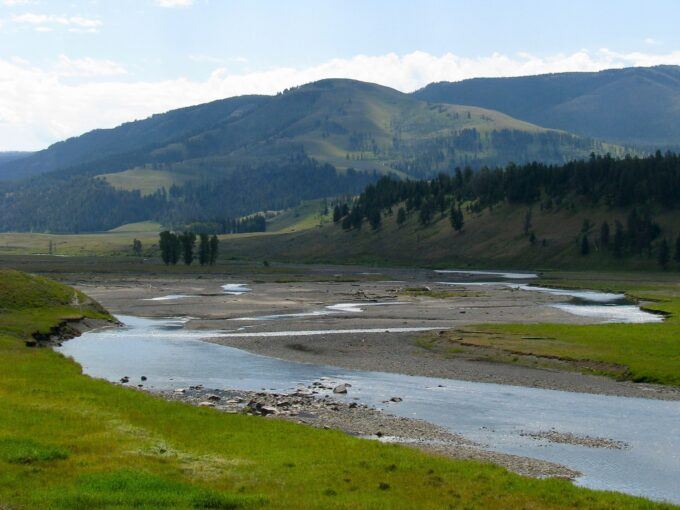
Anyone who drives around the state of Montana right now can see one unassailable truth: our state’ renowned rivers and the prized fish which inhabit them are in big trouble. From east to west, north to south our great rivers have withered to tiny ribbons of water, un-floatable for most recreation and uninhabitable for our native and prized trout species.
When rivers shrink, algae explodes and temperatures soar, as sunlight penetrates the water from top to bottom. As the algae decays, it consumes oxygen, turning what was a perfectly oxygenated, cold-water fish habitat into a hypoxic dead zone, where nothing can survive.
Anyone who has lived in Montana for more than a few seasons can tell: these symptoms are no longer rare events, happening every so often. Now, it seems, this is the new normal. Like many things in nature, the reason for our declining surface water supplies is multifaceted. Climate change is inducing drought, year over year, while demand for water soars as every inch of Montana is bought up and groundwater is given away for new development. Simultaneously, the state is allowing unlimited nutrient pollution through categorical exclusions from water quality protections. Where these political realities meet is at a dead river. Where they began is with Governor Gianforte’s Red Tape Initiative.
So what can the state of Montana do about it? We could start by enforcing the states’ public water rights, which have the exact legal purpose of protecting in-stream flows. That’s right – the state owns water rights and they are a part of the public trust, like our right of stream access. That means the state must protect those interests, above all else, or they violate our constitutional rights. Yet, in pursuit of its political pro-business agenda, the Gianforte administration is refusing to exercise these rights on our behalf. Instead, the very water that is supposed to be left in our rivers, is exploding out of private center pivots everywhere you look.
Since fish can’t sue, the Alliance for the Wild Rockies, Upper Missouri Waterkeeper and Save the Bull Trout are suing for the fish and also for people who recreate on our world class rivers. In Montana, like much of the West, water is property and that property is extremely valuable in our arid climate. Without question, ranchers have a right to use water but so to do the fish and the people of Montana.
The most valuable right the public owns is located where the Blackfoot River joins the Clark Fork River at the site of the former Milltown Dam.
The Montana Power Company was granted 2000 cfs for its water right when the dam was built in 1904 as an instream hydropower right to generate electricity. In 2008, the State of Montana acquired this very senior water right through the Upper Clark Fork River Basin Superfund settlement with the intent that the water right would be used to restore the fishery and recreational uses. Yet, during the hottest and driest period on record, when the famed Blackfoot river has been in the 0% percentile of flows all summer, Montana Fish Wildlife and Parks and Governor Gianforte have not enforced our rights.
This is but one example of the tragedy that is unfolding.
Simply put, our lawsuit alleges that Montana Fish Wildlife and Parks has a duty to enforce and protect its water rights by making a call to support minimum flows designed to protect aquatic life because state held instream flow rights are part of the public trust and thus the agency is constitutionally mandated to utilize them to protect our right to a clean and healthy environment.
Afterall, there is nothing more antithetical to a clean and healthy environment than a dead, dry river.
Please consider joining us to protect our rivers that are world famous, not just for fishing but also for floating and swimming.
Grand Canyon’s Dragon Bravo Megafire Shows the Growing Wildfire Threat to Water Systems
August 19, 2025

A National Park Service worker assesses a split in an exposed section of the Grand Canyon’s fragile water lines in 2014. The water pipeline, installed in the mid-1960s, feeds water from Roaring Springs, located approximately 3,500 feet below the North Rim. Grand Canyon National Park via Flickr
As wildfire crews battled the Dragon Bravo Fire on the Grand Canyon’s North Rim in July 2025, the air turned toxic.
A chlorine gas leak had erupted from the park’s water treatment facility as the building burned, forcing firefighters to pull back. The water treatment facility is part of a system that draws water from a fragile spring. It’s the only water source and system for the park facilities on both rims, including visitor lodging and park service housing.
The fire also damaged some of the area’s water pipes and equipment, leaving fire crews to rely on a fleet of large water trucks to haul in water and raising concerns about contamination risks to the water system itself.
By mid-August, Dragon Bravo was a “megafire,” having burned over 140,000 acres, and was one of the largest fires in Arizona history. It had destroyed more than 70 structures, including the iconic Grand Canyon Lodge, and sent smoke across the region.
Wildfires like this are increasingly affecting water supplies across the U.S. and creating a compounding crisis that experts in water, utilities and emergency management are only beginning to wrestle with.
A pattern across the West
Before 2017, when the Tubbs Fire burned through neighborhoods on the edge of Santa Rosa, California, most research on the nexus of wildfire and water had focused on issues such as drought and how climate change effects ecosystems.
The Tubbs Fire destroyed thousands of buildings and also melted plastic water pipes. After the fire, a resident’s complaint about the taste and odor of tap water led to the discovery that the fire’s damage had introduced contaminants including benzene, a carcinogen, into parts of the public water system.
It quickly became obvious that the damage discovered at the Tubbs Fire was not unique.
Similar damage and pollutants were discovered in another California water system after the 2018 Camp Fire destroyed much of Paradise, a town of over 25,000 people.
The list of incidents goes on.
In southern Oregon, the 2020 Almeda Fire damaged water pipes in buildings, leaving water to flow freely. That contributed to low system pressure just when people fighting the fire needed the water.

Andrew Whelton/Purdue University, CC BY
In Colorado, the 2021 Marshall Fire burned through urban water lines, damaging six public drinking-water systems along with more than 1,000 structures in the Boulder suburbs. All six systems lost power, which in some cases led to a loss of water pressure, hampering firefighting.
As firefighters worked on the Marshall Fire, water system operators raced to keep water flowing and contaminants from being transported into the water systems. But tests still detected chemical contamination, including benzene, in parts of the systems a few weeks later.
Then, in January 2025, the Los Angeles fires supercharged concerns about water and wildfire. As firefighters raced to put out multiple fires, hydrants ran dry in some parts of the region, while others at higher elevations depressurized. Ultimately, over 16,000 structures were damaged, leading to insured losses estimated to be as high as US$45 billion.
Water infrastructure is not merely collateral damage during wildfires – it is now a central concern.
It also raises the question: What can residents, first responders and decision-makers reasonably expect from water systems that weren’t designed with today’s disasters in mind?
Addressing the growing fire and water challenge
While no two water systems or fires are the same, nearly every water system component, ranging from storage tanks to pipelines to treatment plants, is susceptible to damage.
The Grand Canyon’s Roaring Springs system exemplifies the complexity and fragility of older systems. It supplies water to both rims of the park through a decades-old network of gravity-fed pipes and tunnels and includes the water treatment facility where firefighters were forced to retreat because of the chlorine leak.
Many water systems have vulnerable points within or near flammable wildlands, such as exposed pump houses that are crucial for pulling water from lower elevations to where it is needed.
In addition, hazardous materials such as chlorine or ammonia may be stored on-site and require special considerations in high fire risk areas. Staff capacity is often limited; some small utilities depend on a single operator, and budgets may be too constrained to modernize aging infrastructure or implement fire mitigation measures.
As climate change intensifies wildfire seasons, these vulnerabilities can become disaster risks that require making water infrastructure a more integral part of fighting and preparing for wildfires.
Ways to help everyone prepare
As a researcher with Arizona State University’s Julie Ann Wrigley Global Futures Laboratory, I have been working with colleagues and fire and water systems experts on strategies to help communities and fire and water managers prepare.
Here are a few important lessons:
+ Prioritizing fire-resistant construction, better shielding of chemicals and, in some cases, decentralizing water systems can help protect critical facilities, particularly in high-risk zones. Having backup power supplies, mobile treatment systems and alternate water sources are essential to provide more security in the face of a wildfire.
+ Emergency command protocols and interagency coordination are most effective when they include water utilities as essential partners in all phases of emergency response, from planning to response to recovery. Fire crews and water operators can also benefit from joint training in emergency response, especially when system failure could hinder firefighting itself.
+ Longer term, protecting upstream watersheds from severe fire by thinning forests and using controlled burns, along with erosion control measures, can help maintain water quality and reduce water pollution in the aftermath of fires.
+ Smaller and more isolated systems, particularly in tribal or low-income communities, often need assistance to plan or implement new measures. These systems may require technical assistance, and regional support hubs could support communities with additional resources, including personnel and equipment, so they can respond quickly when crises strike.
Looking ahead
The Dragon Bravo Fire isn’t just a wildfire story, it’s also a water story, and it signals a larger, emerging challenge across the West. As fire seasons expand in size and complexity, the overlap between fire and water will only grow.
The Grand Canyon fire offers a stark illustration of how wildfire can escalate into a multifaceted infrastructure crisis: Fire can damage water infrastructure, which in turn limits firefighting capabilities and stresses water supplies.
The question is not whether this will happen again. It’s how prepared communities will be when it does.
This article is republished from The Conversation under a Creative Commons license. Read the original article.

No comments:
Post a Comment