'Plastic pollution really begins when we're making plastics and extracting oil, gas from the ground'
Issued on: 07/08/2025 - FRANCE24
The 184 countries gathering to forge a landmark treaty on combating plastic pollution are seeking a way forward to tackle a global crisis wrecking ecosystems and trashing the oceans. For in-depth analysis and a deeper perspective, FRANCE 24's Eve Irvine welcomes Martin Wagner, Professor in the Department of Biology at NTNU: Norwegian University of Science and Technology.
Video by: Eve IRVINE
Issued on: 07/08/2025 - FRANCE24
The 184 countries gathering to forge a landmark treaty on combating plastic pollution are seeking a way forward to tackle a global crisis wrecking ecosystems and trashing the oceans. For in-depth analysis and a deeper perspective, FRANCE 24's Eve Irvine welcomes Martin Wagner, Professor in the Department of Biology at NTNU: Norwegian University of Science and Technology.
Video by: Eve IRVINE
Geneva (AFP) – Negotiations on a global treaty on plastic pollution are being blocked by oil-producing countries and getting bogged down in a "dialogue of the deaf", sources at the talks told AFP on Thursday.
Issued on: 07/08/2025 - FRANCE24

Plastic waste has been found from the bottom of the seas to the tops of mountains
© LAKRUWAN WANNIARACHCHI / AFP
Ten days of talks on finalising an international, legally-binding accord opened on Tuesday amid optimism from organisers that a deal could be done to tackle the scourge of plastic rubbish and microplastics trashing the planet.
But by Thursday, after countries had staked out their positions, the mood had darkened, negotiating sources said.
"We are in a dialogue of the deaf, with very few landing zones... I don't see progress," said a diplomatic source from a country in a coalition of nations pushing for a strong treaty, including plastic production reduction targets.
"What's worrying is that we have lots of points of disagreement; we're not quibbling about one problem."
The "Like-Minded Countries" (LMC) group, chiefly comprising oil-producing states, is opposed to any targets for limiting plastic production.
In total, 184 nations are taking part in the talks at the United Nations in Geneva.
Technically, the talks are a resumed session of the fifth -- and supposedly final -- round of negotiations, which ended in a flop in Busan, South Korea, in December.
'Hostage situation'
Rather than drifting towards common ground, "positions are crystallising", an observer from a non-governmental organisation told AFP after attending discussion groups, where the technical articles of the treaty are being thrashed out by negotiators.
Ten days of talks on finalising an international, legally-binding accord opened on Tuesday amid optimism from organisers that a deal could be done to tackle the scourge of plastic rubbish and microplastics trashing the planet.
But by Thursday, after countries had staked out their positions, the mood had darkened, negotiating sources said.
"We are in a dialogue of the deaf, with very few landing zones... I don't see progress," said a diplomatic source from a country in a coalition of nations pushing for a strong treaty, including plastic production reduction targets.
"What's worrying is that we have lots of points of disagreement; we're not quibbling about one problem."
The "Like-Minded Countries" (LMC) group, chiefly comprising oil-producing states, is opposed to any targets for limiting plastic production.
In total, 184 nations are taking part in the talks at the United Nations in Geneva.
Technically, the talks are a resumed session of the fifth -- and supposedly final -- round of negotiations, which ended in a flop in Busan, South Korea, in December.
'Hostage situation'
Rather than drifting towards common ground, "positions are crystallising", an observer from a non-governmental organisation told AFP after attending discussion groups, where the technical articles of the treaty are being thrashed out by negotiators.
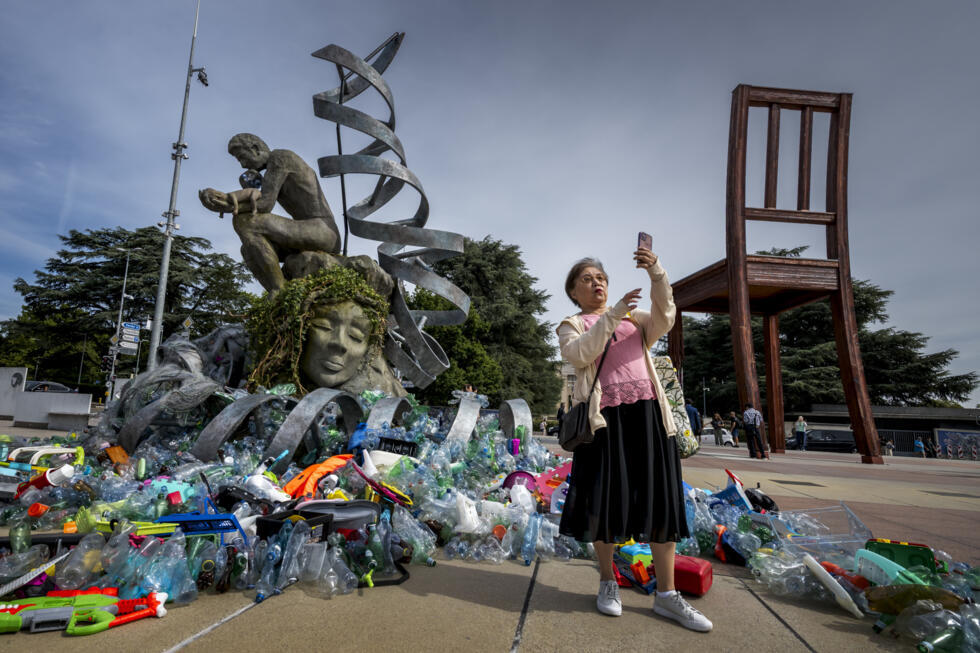
"The Thinker's Burden" statue by Canadian artist Benjamin Von Wong will gradually be covered by plastic waste outside the Geneva negotiations for a UN plastics treaty
© Fabrice COFFRINI / AFP
Written documents submitted by nations to the UN negotiations website, consulted by AFP, confirm that Saudi Arabia, the Arab countries group, Russia, Iran, Kazakhstan and Malaysia reject binding measures on cutting plastic production.
Most of these countries want the petroleum origin of plastic to be left outside the bounds of any eventual treaty, and want the agreement to focus solely on what happens downstream, such as waste collection, sorting, recycling.
However, the initial, universally-adopted resolution establishing negotiations towards a treaty envisaged a deal covering the entire life cycle of plastic.
"If the text is only to help developing countries manage their waste better, we don't need an international treaty to do so," the diplomatic source stressed. "We are in a stand-off with countries quite prepared for there to be no treaty".
Written documents submitted by nations to the UN negotiations website, consulted by AFP, confirm that Saudi Arabia, the Arab countries group, Russia, Iran, Kazakhstan and Malaysia reject binding measures on cutting plastic production.
Most of these countries want the petroleum origin of plastic to be left outside the bounds of any eventual treaty, and want the agreement to focus solely on what happens downstream, such as waste collection, sorting, recycling.
However, the initial, universally-adopted resolution establishing negotiations towards a treaty envisaged a deal covering the entire life cycle of plastic.
"If the text is only to help developing countries manage their waste better, we don't need an international treaty to do so," the diplomatic source stressed. "We are in a stand-off with countries quite prepared for there to be no treaty".
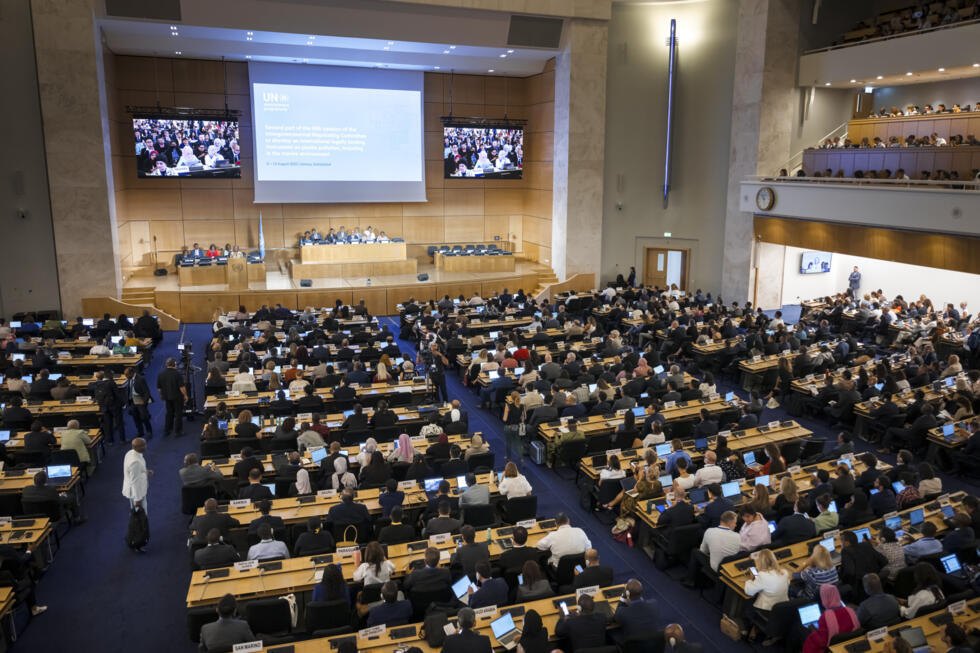
Ten days of talks on finalising an international, legally-binding instrument on plastic pollution opened on with optimism © Fabrice COFFRINI / AFP
The Center for International Environmental Law (CIEL) said that while the most ambitious countries had scaled back some aspirations in a bid to find consensus, the LMC group had not budged, meaning the middle ground was now much lower.
CIEL spokeswoman Cate Bonacini said: "That's not a negotiation; that's a hostage situation, especially when you know you're running out of money, people want to end the process. They're going to try to spend us down and tire us out."
"We heard countries on day one questioning whether this should be a treaty about plastic at all. That's really indicative of where some countries are," she told AFP.
Health risks
No consensus has emerged one an article of the draft text, on creating a list of chemical substances considered potentially hazardous to the environment or human health. The chemical industry has opposed such a list.
The Center for International Environmental Law (CIEL) said that while the most ambitious countries had scaled back some aspirations in a bid to find consensus, the LMC group had not budged, meaning the middle ground was now much lower.
CIEL spokeswoman Cate Bonacini said: "That's not a negotiation; that's a hostage situation, especially when you know you're running out of money, people want to end the process. They're going to try to spend us down and tire us out."
"We heard countries on day one questioning whether this should be a treaty about plastic at all. That's really indicative of where some countries are," she told AFP.
Health risks
No consensus has emerged one an article of the draft text, on creating a list of chemical substances considered potentially hazardous to the environment or human health. The chemical industry has opposed such a list.
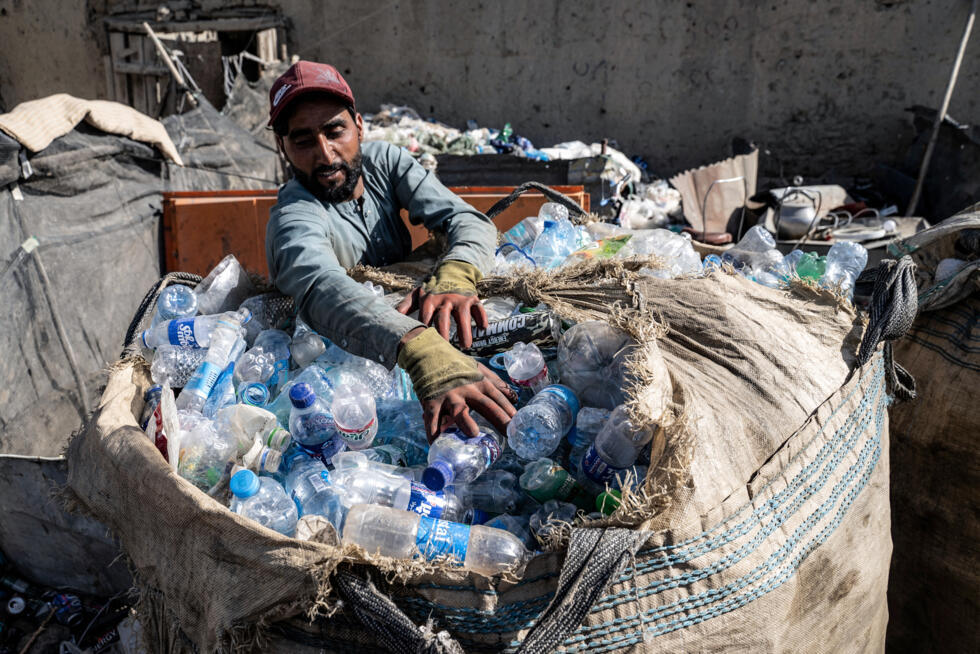
An Afghan worker loads plastic bottles into a sack at a recycling yard in Kabul © Wakil KOHSAR / AFP
The World Health Organization urged countries to ensure the treaty contains enforceable health protection.
"Plastic pollution poses significant and growing risks to human health," WHO chief Tedros Adhanom Ghebreyesus told reporters.
"These risks disproportionately impact vulnerable populations, including workers with occupational exposure... and communities near extraction production and disposal sites.
"Many of the chemicals added to plastic during their manufacture are hazardous, including endocrine disruptors, linked to hormonal imbalance, reproductive disorders, infertility, kidney disease and cancer."
The World Health Organization urged countries to ensure the treaty contains enforceable health protection.
"Plastic pollution poses significant and growing risks to human health," WHO chief Tedros Adhanom Ghebreyesus told reporters.
"These risks disproportionately impact vulnerable populations, including workers with occupational exposure... and communities near extraction production and disposal sites.
"Many of the chemicals added to plastic during their manufacture are hazardous, including endocrine disruptors, linked to hormonal imbalance, reproductive disorders, infertility, kidney disease and cancer."
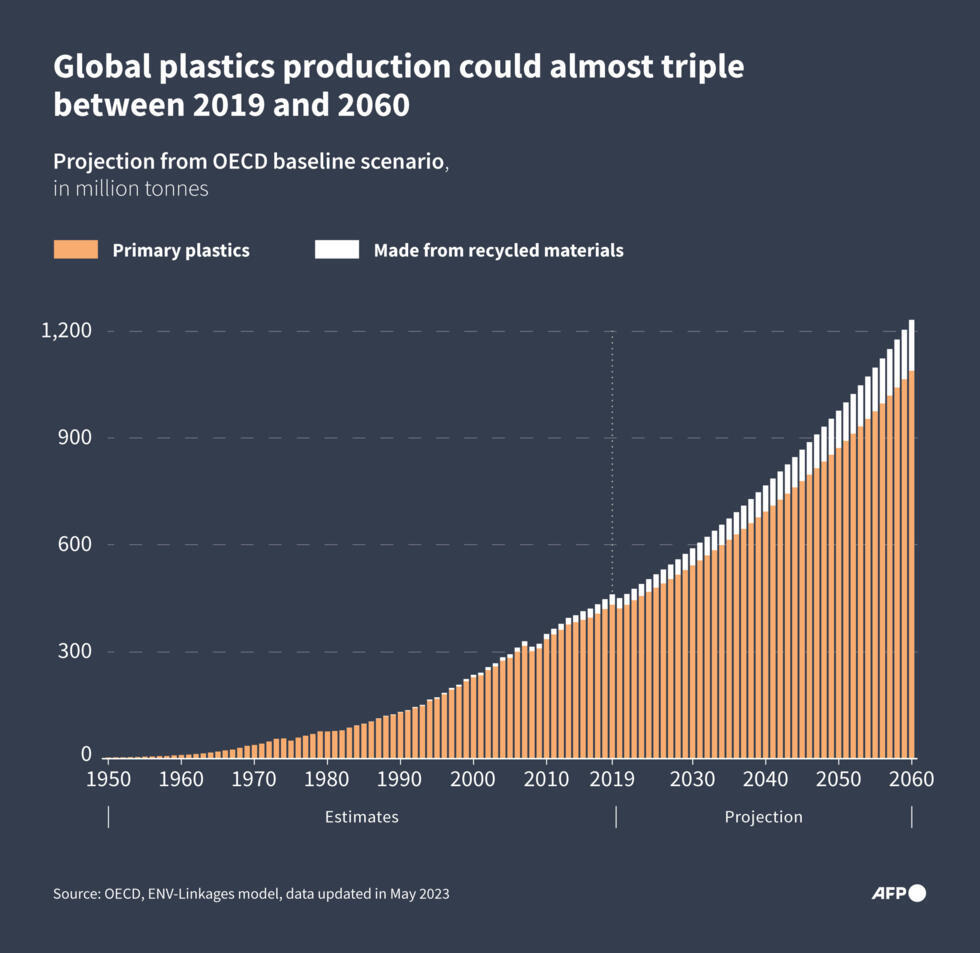
Global plastics production could almost triple between 2019 and 2060 © Sylvie HUSSON, Christophe THALABOT / AFP
Rudiger Krech, the UN health agency's environment chief, added that on plastic and human health, "the more we look the more we find.
"Twenty years ago we didn't know how dangerous it can be.
"We're now looking at the nano-plastics that can be found in many people's brains; we can also see that this is connected to many diseases."
© 2025 AFP
Rudiger Krech, the UN health agency's environment chief, added that on plastic and human health, "the more we look the more we find.
"Twenty years ago we didn't know how dangerous it can be.
"We're now looking at the nano-plastics that can be found in many people's brains; we can also see that this is connected to many diseases."
© 2025 AFP
A French sailor's personal 'Plastic Odyssey'
Paris (AFP) – Simon Bernard's private war on plastic pollution began in 2016.
Issued on: 07/08/2025 -

'Avoid using it'
Bernard secured financial sponsors, starting with a major French cosmetics brand that promoted the partnership as part of its commitment to increase the proportion of recycled plastic in its products.
But he said he was under no illusions: he knows that his initiative has had a modest impact on the global fight against plastic pollution.
He is also aware of earlier projects with similar goals that fell short of their ambitions.
The Ocean Cleanup launch by 18-year-old Dutch inventor Boyan Slat in 2013 – targeting the notorious Great Pacific Garbage Patch between Hawaii and California -- attracted money and attention but was hampered by design flaws and logistical limitations. A recent reboot of the system has shown greater potential for plastic removal at scale.
30 stopovers
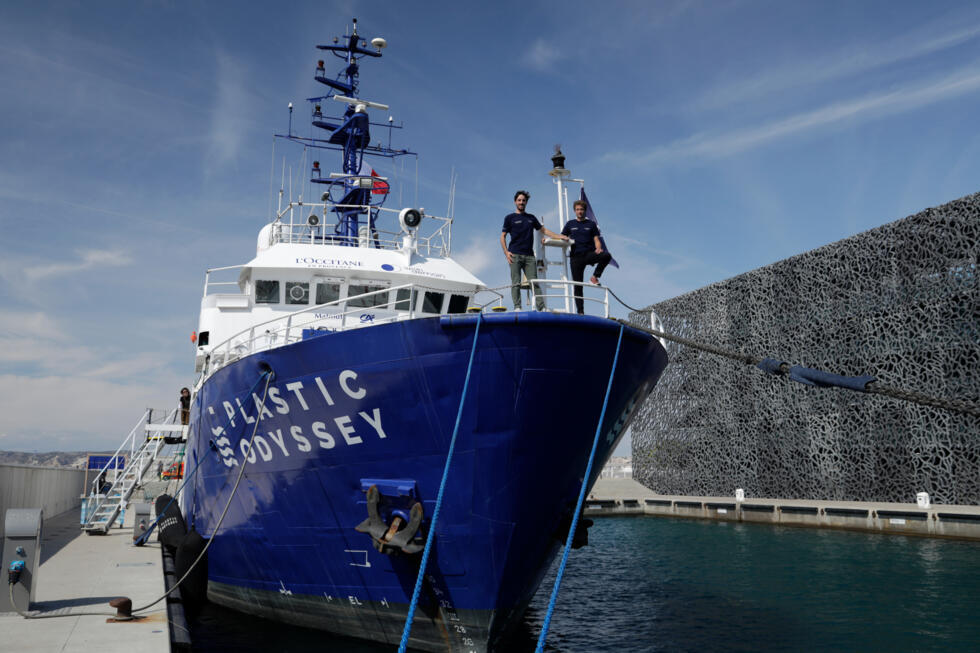
Giving up his dream of piloting ferries off the Normandy coast, Bernard left France on October 1, 2022. He is currently in Mayotte, a French territory in the Indian Ocean, and is nearing the end of his 30 three-week stops in three continents.
Paris (AFP) – Simon Bernard's private war on plastic pollution began in 2016.
Issued on: 07/08/2025 -
Shocked at plastic waste on a once pristine beach, Simon Bernard launched what he called a 'plastic odyssey' © JOEL SAGET / AFP
From the deck of the cargo ship he was working on, Bernard was stunned to discover mountains of rubbish piled up in Hann Bay, once a white sandy beach that had become an open sewer in the Senegalese capital Dakar.
Thickets of rubbish were almost everywhere along the coast, "washing into the sea with the tides and waves," the 34-year-old sailor told AFP in an interview.
It was, he said, a terrible shock. "At sea, you don't see the plastic."
Deeply moved by seeing fishermen pulling tangled webs of plastic from their nets, Bernard -– newly graduated from France's Merchant Navy -– enlisted another engineer, Alexandre Dechelotte, to embark on what he dubbed "Plastic Odyssey".
The plan was to complete a round-the-world expedition aboard a 40-metre (130-foot) laboratory ship to raise awareness at their many ports of call -- especially among children -– about the devastating impact of the 20 tonnes of plastic waste dumped into the oceans every minute of every day.
The three-year expedition, which partnered with local associations along their route, is almost complete.
From the deck of the cargo ship he was working on, Bernard was stunned to discover mountains of rubbish piled up in Hann Bay, once a white sandy beach that had become an open sewer in the Senegalese capital Dakar.
Thickets of rubbish were almost everywhere along the coast, "washing into the sea with the tides and waves," the 34-year-old sailor told AFP in an interview.
It was, he said, a terrible shock. "At sea, you don't see the plastic."
Deeply moved by seeing fishermen pulling tangled webs of plastic from their nets, Bernard -– newly graduated from France's Merchant Navy -– enlisted another engineer, Alexandre Dechelotte, to embark on what he dubbed "Plastic Odyssey".
The plan was to complete a round-the-world expedition aboard a 40-metre (130-foot) laboratory ship to raise awareness at their many ports of call -- especially among children -– about the devastating impact of the 20 tonnes of plastic waste dumped into the oceans every minute of every day.
The three-year expedition, which partnered with local associations along their route, is almost complete.
'Avoid using it'
Bernard secured financial sponsors, starting with a major French cosmetics brand that promoted the partnership as part of its commitment to increase the proportion of recycled plastic in its products.
But he said he was under no illusions: he knows that his initiative has had a modest impact on the global fight against plastic pollution.
He is also aware of earlier projects with similar goals that fell short of their ambitions.
The Ocean Cleanup launch by 18-year-old Dutch inventor Boyan Slat in 2013 – targeting the notorious Great Pacific Garbage Patch between Hawaii and California -- attracted money and attention but was hampered by design flaws and logistical limitations. A recent reboot of the system has shown greater potential for plastic removal at scale.
The three-year expedition partnered with local associations along the route
© Nicolas TUCAT / AFP
Another initiative launched from France in 2018, the SeaCleaners, also reported disappointing yields of plastic pollution, and folded operations last year under the shadow of financial mismanagement.
But Bernard said the cause was too important to ignore, and aimed to prove that even small-scale efforts were critical in striving for a future with less plastic. Plastic Odyssey today has a staff of 35.
"The real solution to plastic pollution is to avoid using it," he said.
Nearly 200 nations are huddled in Geneva this week and next to forge a treaty to tackle the plastics crisis, and one of the most divisive issues on the table is whether to aim for reducing plastics production at the source, rather than simply cleaning up pollution after the fact.
Another initiative launched from France in 2018, the SeaCleaners, also reported disappointing yields of plastic pollution, and folded operations last year under the shadow of financial mismanagement.
But Bernard said the cause was too important to ignore, and aimed to prove that even small-scale efforts were critical in striving for a future with less plastic. Plastic Odyssey today has a staff of 35.
"The real solution to plastic pollution is to avoid using it," he said.
Nearly 200 nations are huddled in Geneva this week and next to forge a treaty to tackle the plastics crisis, and one of the most divisive issues on the table is whether to aim for reducing plastics production at the source, rather than simply cleaning up pollution after the fact.
30 stopovers
Giving up his dream of piloting ferries off the Normandy coast, Bernard left France on October 1, 2022. He is currently in Mayotte, a French territory in the Indian Ocean, and is nearing the end of his 30 three-week stops in three continents.
The Plastic Odyssey has catalogued more than a hundred local solutions for doing without plastic © SEYLLOU / AFP/File
His odyssey has taken him across the Mediterranean Sea as well as the Atlantic, Indian and Pacific oceans.
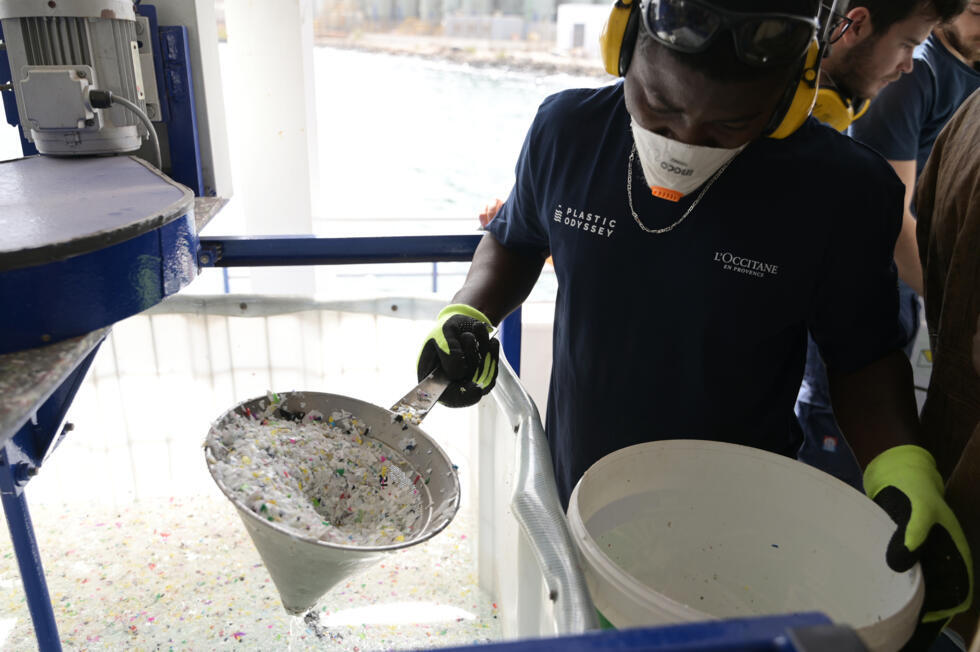
During stops in Marseille, Beirut, Dakar, Recife, Madras (Chennai) and two dozen other ports, he met with local associations, start-ups and companies working to collect, sort or recycle plastic.
He marvels, he said, at the "inventiveness" of the people he met, especially those who have lost everything.
He recalled an entrepreneur in Lebanon who collected recyclable household waste door-to-door from 60,000 people in a country that no longer has a public service for disposing of plastic.
Two and a half years into his adventure Bernard gave up his apartment, and he now lives on the boat.
The Plastic Odyssey has catalogued more than hundred local solutions for doing without plastic, which is derived from petroleum.
Bernard has adopted several of them, including one "that works very well on board the boat" to make water drinkable, eliminating the need for plastic bottles.
"This has saved us 25,000 bottles of water in two years -- almost a tonne of plastic," he calculated.
© 2025 AFP
His odyssey has taken him across the Mediterranean Sea as well as the Atlantic, Indian and Pacific oceans.
During stops in Marseille, Beirut, Dakar, Recife, Madras (Chennai) and two dozen other ports, he met with local associations, start-ups and companies working to collect, sort or recycle plastic.
He marvels, he said, at the "inventiveness" of the people he met, especially those who have lost everything.
He recalled an entrepreneur in Lebanon who collected recyclable household waste door-to-door from 60,000 people in a country that no longer has a public service for disposing of plastic.
Two and a half years into his adventure Bernard gave up his apartment, and he now lives on the boat.
The Plastic Odyssey has catalogued more than hundred local solutions for doing without plastic, which is derived from petroleum.
Bernard has adopted several of them, including one "that works very well on board the boat" to make water drinkable, eliminating the need for plastic bottles.
"This has saved us 25,000 bottles of water in two years -- almost a tonne of plastic," he calculated.
© 2025 AFP

No comments:
Post a Comment