Elon Musk's AI accused of making explicit AI Taylor Swift videos
Imran Rahman-Jones
Technology reporter
Imran Rahman-Jones
Technology reporter
BBC

Getty Images
Elon Musk's AI video generator has been accused of making "a deliberate choice" to create sexually explicit clips of Taylor Swift without prompting, says an expert in online abuse.
"This is not misogyny by accident, it is by design," said Clare McGlynn, a law professor who has helped draft a law which would make pornographic deepfakes illegal.
According to a report by The Verge, Grok Imagine's new "spicy" mode "didn't hesitate to spit out fully uncensored topless videos" of the pop star without being asked to make explicit content.
The report also said proper age verification methods - which became law in July - were not in place.
XAI, the company behind Grok, has been approached for comment.
XAI's own acceptable use policy prohibits "depicting likenesses of persons in a pornographic manner".
"That this content is produced without prompting demonstrates the misogynistic bias of much AI technology," said Prof McGlynn of Durham University.
"Platforms like X could have prevented this if they had chosen to, but they have made a deliberate choice not to," she added.
This is not the first time Taylor Swift's image has been used in this way.
Sexually explicit deepfakes using her face went viral and were viewed millions of times on X and Telegram in January 2024.
Deepfakes are computer-generated images which replace the face of one person with another.
'Completely uncensored, completely exposed'
In testing the guardrails of Grok Imagine, The Verge news writer Jess Weatherbed entered the prompt: "Taylor Swift celebrating Coachella with the boys".
Grok generated still images of Swift wearing a dress with a group of men behind her.
This could then be animated into short video clips under four different settings: "normal", "fun", "custom" or "spicy".
"She ripped [the dress] off immediately, had nothing but a tasselled thong underneath, and started dancing, completely uncensored, completely exposed," Ms Weatherbed told BBC News.
She added: "It was shocking how fast I was just met with it - I in no way asked it to remove her clothing, all I did was select the 'spicy' option."
Gizmodo reported similarly explicit results of famous women, though some searches also returned blurred videos or with a "video moderated" message.
The BBC has been unable to independently verify the results of the AI video generations.
Ms Weatherbed said she signed up to the paid version of Grok Imagine, which cost £30, using a brand new Apple account.
Grok asked for her date of birth but there was no other age verification in place, she said.
Under new UK laws which entered into force at the end of July, platforms which show explicit images must verify users' ages using methods which are "technically accurate, robust, reliable and fair".
"Sites and apps that include Generative AI tools that can generate pornographic material are regulated under the Act," the media regulator Ofcom told BBC News.
"We are aware of the increasing and fast-developing risk GenAI tools may pose in the online space, especially to children, and we are working to ensure platforms put appropriate safeguards in place to mitigate these risks," it said in a statement.
New UK laws
Currently, generating pornographic deepfakes is illegal when used in revenge porn or depicts children.
Prof McGlynn helped draft an amendment to the law which would make generating or requesting all non-consensual pornographic deepfakes illegal.
The government has committed to making this amendment law, but it is yet to come into force.
"Every woman should have the right to choose who owns intimate images of her," said Baroness Owen, who proposed the amendment in the House of Lords.
"It is essential that these models are not used in such a way that violates a woman's right to consent whether she be a celebrity or not," Lady Owen continued in a statement given to BBC News.
"This case is a clear example of why the Government must not delay any further in its implementation of the Lords amendments," she added.
A Ministry of Justice spokesperson said: "Sexually explicit deepfakes created without consent are degrading and harmful.
"We refuse to tolerate the violence against women and girls that stains our society which is why we have passed legislation to ban their creation as quickly as possible."
When pornographic deepfakes using Taylor Swift's face went viral in 2024, X temporarily blocked searches for her name on the platform.
At the time, X said it was "actively removing" the images and taking "appropriate actions" against the accounts involved in spreading them.
Ms Weatherbed said the team at The Verge chose Taylor Swift to test the Grok Imagine feature because of this incident.
"We assumed - wrongly now - that if they had put any kind of safeguards in place to prevent them from emulating the likeness of celebrities, that she would be first on the list, given the issues that they've had," she said.
Taylor Swift's representatives have been contacted for comment.
Elon Musk's AI video generator has been accused of making "a deliberate choice" to create sexually explicit clips of Taylor Swift without prompting, says an expert in online abuse.
"This is not misogyny by accident, it is by design," said Clare McGlynn, a law professor who has helped draft a law which would make pornographic deepfakes illegal.
According to a report by The Verge, Grok Imagine's new "spicy" mode "didn't hesitate to spit out fully uncensored topless videos" of the pop star without being asked to make explicit content.
The report also said proper age verification methods - which became law in July - were not in place.
XAI, the company behind Grok, has been approached for comment.
XAI's own acceptable use policy prohibits "depicting likenesses of persons in a pornographic manner".
"That this content is produced without prompting demonstrates the misogynistic bias of much AI technology," said Prof McGlynn of Durham University.
"Platforms like X could have prevented this if they had chosen to, but they have made a deliberate choice not to," she added.
This is not the first time Taylor Swift's image has been used in this way.
Sexually explicit deepfakes using her face went viral and were viewed millions of times on X and Telegram in January 2024.
Deepfakes are computer-generated images which replace the face of one person with another.
'Completely uncensored, completely exposed'
In testing the guardrails of Grok Imagine, The Verge news writer Jess Weatherbed entered the prompt: "Taylor Swift celebrating Coachella with the boys".
Grok generated still images of Swift wearing a dress with a group of men behind her.
This could then be animated into short video clips under four different settings: "normal", "fun", "custom" or "spicy".
"She ripped [the dress] off immediately, had nothing but a tasselled thong underneath, and started dancing, completely uncensored, completely exposed," Ms Weatherbed told BBC News.
She added: "It was shocking how fast I was just met with it - I in no way asked it to remove her clothing, all I did was select the 'spicy' option."
Gizmodo reported similarly explicit results of famous women, though some searches also returned blurred videos or with a "video moderated" message.
The BBC has been unable to independently verify the results of the AI video generations.
Ms Weatherbed said she signed up to the paid version of Grok Imagine, which cost £30, using a brand new Apple account.
Grok asked for her date of birth but there was no other age verification in place, she said.
Under new UK laws which entered into force at the end of July, platforms which show explicit images must verify users' ages using methods which are "technically accurate, robust, reliable and fair".
"Sites and apps that include Generative AI tools that can generate pornographic material are regulated under the Act," the media regulator Ofcom told BBC News.
"We are aware of the increasing and fast-developing risk GenAI tools may pose in the online space, especially to children, and we are working to ensure platforms put appropriate safeguards in place to mitigate these risks," it said in a statement.
New UK laws
Currently, generating pornographic deepfakes is illegal when used in revenge porn or depicts children.
Prof McGlynn helped draft an amendment to the law which would make generating or requesting all non-consensual pornographic deepfakes illegal.
The government has committed to making this amendment law, but it is yet to come into force.
"Every woman should have the right to choose who owns intimate images of her," said Baroness Owen, who proposed the amendment in the House of Lords.
"It is essential that these models are not used in such a way that violates a woman's right to consent whether she be a celebrity or not," Lady Owen continued in a statement given to BBC News.
"This case is a clear example of why the Government must not delay any further in its implementation of the Lords amendments," she added.
A Ministry of Justice spokesperson said: "Sexually explicit deepfakes created without consent are degrading and harmful.
"We refuse to tolerate the violence against women and girls that stains our society which is why we have passed legislation to ban their creation as quickly as possible."
When pornographic deepfakes using Taylor Swift's face went viral in 2024, X temporarily blocked searches for her name on the platform.
At the time, X said it was "actively removing" the images and taking "appropriate actions" against the accounts involved in spreading them.
Ms Weatherbed said the team at The Verge chose Taylor Swift to test the Grok Imagine feature because of this incident.
"We assumed - wrongly now - that if they had put any kind of safeguards in place to prevent them from emulating the likeness of celebrities, that she would be first on the list, given the issues that they've had," she said.
Taylor Swift's representatives have been contacted for comment.

MISOGYNISTIC TOXIC MASCULINITY
Why are sex toys being thrown during WNBA games?
Ana Faguy
BBC News
Ana Faguy
BBC News
Getty Images
Multiple pro-women's basketball games were interrupted in the past several days after sex toys were thrown onto courts, leaving players and coaches frustrated and fans puzzled.
Two of the instigators are now facing criminal charges and the Women's National Basketball Association (WNBA) has condemned such behaviour.
This week, members of a meme-coin group reportedly claimed responsibility for some of the incidents in which brightly coloured dildos were thrown onto the court or bench area during games.
Players and coaches are concerned about safety, and the meaning and hostility behind the incidents.
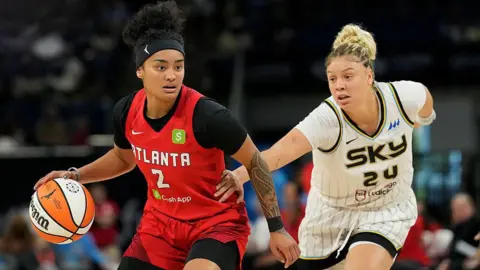
The game between the Atlanta Dream and the Chicago Sky was paused in the closing seconds Thursday night after a purple sex toy was tossed from the stands onto the court.
While individuals in the stands were reportedly questioned, no one was arrested. The WNBA has said any fan caught throwing sex toys onto the court would be banned from the league and would face prosecution.
The exact number of incidents is unclear because in some instances, items are thrown but do not reach the court or the bench.
"It's super disrespectful," Chicago Sky player Elizabeth Williams said after a similar incident last week. "I don't really get the point of it. It's really immature. Whoever is doing it needs to grow up."
Minnesota Lynx Head Coach Cheryl Reeve called the increasing number of incidents a "distraction".
"This has been going on for centuries," she told reporters on Thursday. "The sexualization of women. This is the latest version of that. And it's not funny and it should not be the butt of jokes on radio shows, or in print or any comments."
On Tuesday, as the Indiana Fever played the Los Angeles Sparks, a green sex toy landed on the court near Indiana player Sophie Cunningham.
She had posted on social media days before, asking the culprits to stop throwing the objects saying, "you're going to hurt one of us".
"Everyone's trying to make sure the W is not a joke and it's taken seriously, and then that happens," Cunningham said, on her podcast episode on Tuesday.
So far, two arrests have been made. In Atlanta, Delbert Carver, 23, was arrested and charged with disorderly conduct, public indecency/indecent exposure, and criminal trespass after he was accused of throwing a sex toy at a game on 29 July.
The WNBA responded in a statement: "The safety and well-being of everyone in our arenas is a top priority for our league. Objects of any kind thrown onto the court or in the seating area can pose a safety risk for players, game officials, and fans."
The second arrest was Kaden Lopez, 18, also accused of throwing a sex toy at a 5 August game in Phoenix and hitting a man watching the game on the head.
Since the incidents have increased, community members from a meme-coin called Green Dildo Coin have taken responsibility for some of the disruptions.
A spokesperson for the group told USA Today that members started throwing green sex toys to coincide with the launch of the meme-coin, which was created the day before the first incident. The group wanted to use the "viral stunts" to garner attention, they said.
"We didn't do this because like we dislike women's sports or, like, some of the narratives that are trending right now are ridiculous," the spokesperson said anonymously in a Thursday article.
They added that the two arrested were not associated with the group.
While many of the incidents included green toys, some were other colours, indicating that not all of the incidents were linked to the meme-coin.
Multiple pro-women's basketball games were interrupted in the past several days after sex toys were thrown onto courts, leaving players and coaches frustrated and fans puzzled.
Two of the instigators are now facing criminal charges and the Women's National Basketball Association (WNBA) has condemned such behaviour.
This week, members of a meme-coin group reportedly claimed responsibility for some of the incidents in which brightly coloured dildos were thrown onto the court or bench area during games.
Players and coaches are concerned about safety, and the meaning and hostility behind the incidents.
The game between the Atlanta Dream and the Chicago Sky was paused in the closing seconds Thursday night after a purple sex toy was tossed from the stands onto the court.
While individuals in the stands were reportedly questioned, no one was arrested. The WNBA has said any fan caught throwing sex toys onto the court would be banned from the league and would face prosecution.
The exact number of incidents is unclear because in some instances, items are thrown but do not reach the court or the bench.
"It's super disrespectful," Chicago Sky player Elizabeth Williams said after a similar incident last week. "I don't really get the point of it. It's really immature. Whoever is doing it needs to grow up."
Minnesota Lynx Head Coach Cheryl Reeve called the increasing number of incidents a "distraction".
"This has been going on for centuries," she told reporters on Thursday. "The sexualization of women. This is the latest version of that. And it's not funny and it should not be the butt of jokes on radio shows, or in print or any comments."
On Tuesday, as the Indiana Fever played the Los Angeles Sparks, a green sex toy landed on the court near Indiana player Sophie Cunningham.
She had posted on social media days before, asking the culprits to stop throwing the objects saying, "you're going to hurt one of us".
"Everyone's trying to make sure the W is not a joke and it's taken seriously, and then that happens," Cunningham said, on her podcast episode on Tuesday.
So far, two arrests have been made. In Atlanta, Delbert Carver, 23, was arrested and charged with disorderly conduct, public indecency/indecent exposure, and criminal trespass after he was accused of throwing a sex toy at a game on 29 July.
The WNBA responded in a statement: "The safety and well-being of everyone in our arenas is a top priority for our league. Objects of any kind thrown onto the court or in the seating area can pose a safety risk for players, game officials, and fans."
The second arrest was Kaden Lopez, 18, also accused of throwing a sex toy at a 5 August game in Phoenix and hitting a man watching the game on the head.
Since the incidents have increased, community members from a meme-coin called Green Dildo Coin have taken responsibility for some of the disruptions.
A spokesperson for the group told USA Today that members started throwing green sex toys to coincide with the launch of the meme-coin, which was created the day before the first incident. The group wanted to use the "viral stunts" to garner attention, they said.
"We didn't do this because like we dislike women's sports or, like, some of the narratives that are trending right now are ridiculous," the spokesperson said anonymously in a Thursday article.
They added that the two arrested were not associated with the group.
While many of the incidents included green toys, some were other colours, indicating that not all of the incidents were linked to the meme-coin.

No comments:
Post a Comment