DW
August 7, 2025
Another boat recently capsized in the Bab al-Mandab Strait between Africa and the Arabian Peninsula, killing dozens. Despite all the dangers, many migrants are willing to risk the crossing.
Another boat recently capsized in the Bab al-Mandab Strait between Africa and the Arabian Peninsula, killing dozens. Despite all the dangers, many migrants are willing to risk the crossing.

Image: Karim Sahib/AFP/Getty Images
At least 92 people drowned when a vessel they were using to cross the Bab al-Mandab Strait from Djibouti to Yemen sank last weekend. The International Organization for Migration (IOM) said around 200 people were on board. Most of the deceased and missing are Ethiopians.
Despite the dangers of crossing Bab al-Mandab (meaning the "Gate of Grief"), which connects the Red Sea with the Gulf of Aden, more people are using this so-called Eastern Route every year. In 2023, around 395,000 people attempted to cross, according to the IOM. Last year, it was about 446,000, representing a 13% increase.
From 2023 to 2024, most of the 234,000 migrants using this route were from Ethiopia, with people from Somalia the second-highest number. According to the IOM, 90% of migrants are fleeing economic crises, while most others are escaping armed conflict and persecution. A much smaller portion consists of Yemenis returning to their country after initially fleeing the civil war there, according to Nathalie Peutz, an anthropologist at New York University Abu Dhabi.
Despite the dangers of crossing Bab al-Mandab (meaning the "Gate of Grief"), which connects the Red Sea with the Gulf of Aden, more people are using this so-called Eastern Route every year. In 2023, around 395,000 people attempted to cross, according to the IOM. Last year, it was about 446,000, representing a 13% increase.
From 2023 to 2024, most of the 234,000 migrants using this route were from Ethiopia, with people from Somalia the second-highest number. According to the IOM, 90% of migrants are fleeing economic crises, while most others are escaping armed conflict and persecution. A much smaller portion consists of Yemenis returning to their country after initially fleeing the civil war there, according to Nathalie Peutz, an anthropologist at New York University Abu Dhabi.
Djibouti's dangerous migration route 07:38
Risking rough waters to reach Gulf states
Apart from the constant maritime traffic, strong tides, winds, waves and reefs add to the dangers. "If you don't know the route very well, you can get into real difficulties," said Martin Plaut, a London-based expert on the Horn of Africa who has studied migration trends.
According to Peutz, migrants often use small fishing boats in their attempts to cross. "The passengers are crowded in so much that when the sea becomes rough, the boats sometimes sink," Peutz told DW, adding that when smugglers see that they are overloaded, "they actually force people to jump overboard or throw them overboard."
Most migrants consider Yemen a stopover. From there, they hope to find work in the wealthy Gulf states, particularly Saudi Arabia. Between 2023-2024, the number of arrivals fell by over a third because authorities were intercepting boats off the coast. Those who do reach Yemeni territory face considerable dangers, including detention, extortion and abuse by smugglers, according to the IOM.
At the border between Saudi Arabia and Yemen, Saudi border guards have shot hundreds, if not thousands, of irregular migrants and refugees in the past. Still, the sea crossing is considered the most dangerous part of the Eastern Route. "It is very busy, with huge tankers and other large ships traveling along it," said Plaut.
The strait forms one of the world's most important maritime trade routes. Ships from Asia navigate Bab al-Mandab before entering the Red Sea, the Suez Canal and the Mediterranean. From there, the ships head for the major European ports.
Little chance of rescue
The situation is exacerbated by the absence of an official sea rescue program, similar to those in the Mediterranean. In the Bab al-Mandab, a ship in distress can only hope for help from a passing cargo ship. But after numerous cases of piracy, captains have become wary.
"Of course, they wonder who is in the water," said Plaut. "Pirates have used all sorts of ruses to get on board. And when they board the ship, they produce their weapons and take the crew captive." As a result, many captains are now hesitant to help migrant boats in distress.
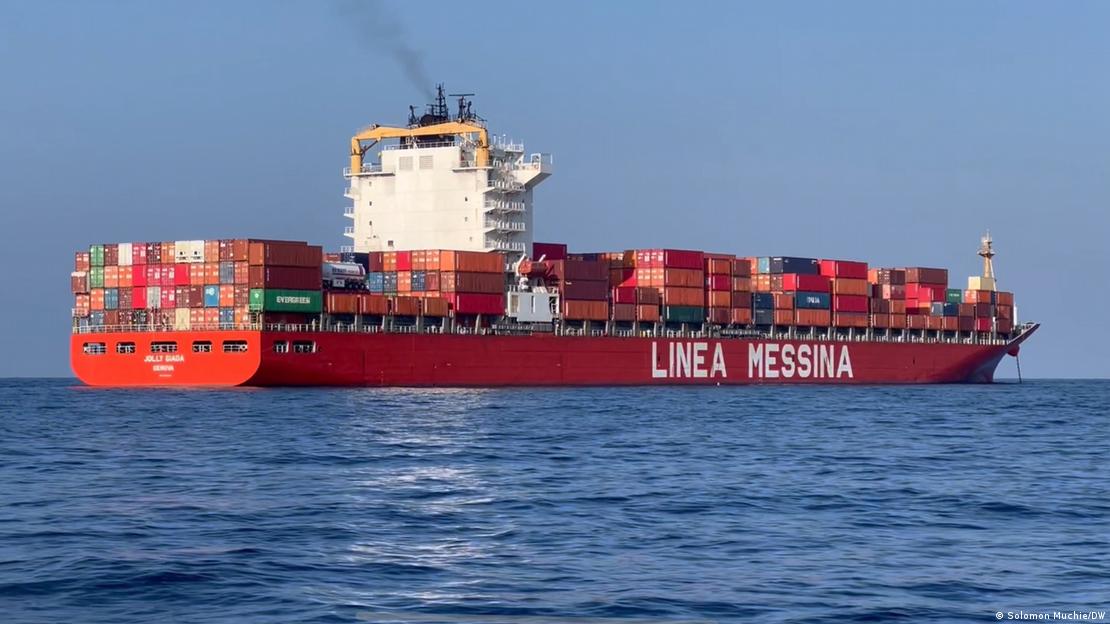
Large container ships in the Red Sea, one of the world's busiest trading routes, are a danger to small vessels crossing the Bab al-Mandab StraitImage: Solomon Muchie/DW
While the US Navy and other militaries are present in the area, Peutz said their priority is to "stop piracy and attacks on oil tankers. But no one is protecting migrationroutes."
Migrants caught between rock and a hard place
Peutz said that despite the risks, there are many reasons migrants still attempt the crossing. Many people, for example, do not have travel documents because obtaining them is expensive and time-consuming.
"A lot of the younger migrants leave on the spur of the moment. Sometimes they don't tell their parents or their family — they know they will be persuaded otherwise," Peutz said.
Some migrants arriving in Saudi Arabia do not want to be officially recognized as such because it limits their prospects.
"If they have a kafeel [local sponsor], they are bound to a contract," Peutz explained.
"Some kafeels have been known to keep their employees' passports, making it difficult for them to leave abusive workplaces. This is particularly true for female workers. Working outside of this system allows greater employment opportunities."
Eshete Bekele contributed to this article, which was originally written in German.
Edited by: Chrispin Mwakideu
While the US Navy and other militaries are present in the area, Peutz said their priority is to "stop piracy and attacks on oil tankers. But no one is protecting migrationroutes."
Migrants caught between rock and a hard place
Peutz said that despite the risks, there are many reasons migrants still attempt the crossing. Many people, for example, do not have travel documents because obtaining them is expensive and time-consuming.
"A lot of the younger migrants leave on the spur of the moment. Sometimes they don't tell their parents or their family — they know they will be persuaded otherwise," Peutz said.
Some migrants arriving in Saudi Arabia do not want to be officially recognized as such because it limits their prospects.
"If they have a kafeel [local sponsor], they are bound to a contract," Peutz explained.
"Some kafeels have been known to keep their employees' passports, making it difficult for them to leave abusive workplaces. This is particularly true for female workers. Working outside of this system allows greater employment opportunities."
Eshete Bekele contributed to this article, which was originally written in German.
Edited by: Chrispin Mwakideu
The death toll from a migrant boat disaster off Yemen has climbed to 96, underscoring the growing human cost of perilous journeys across the Red Sea.
Issued on: 06/08/2025 - RFI

African migrants sit aboard a boat in the southern Yemeni port city of Aden on 26 September 2016. © Saleh Al-Obeidi / AFP
The overcrowded boat, carrying mostly Ethiopian nationals, sank on Sunday while en route to Abyan governorate in southern Yemen – a regular landing site for people-smuggling operations headed for Gulf countries.
Yemeni officials and a source from the International Organisation for Migration (IOM) said two more bodies had been found by Tuesday. Local fishermen had initially buried the bodies after they washed ashore, before the IOM confirmed them as victims.
Earlier, a Yemeni security source and a local official had reported 94 bodies recovered, with many already buried. The official added that more corpses continued to wash up in the days after the sinking.
The overcrowded boat, carrying mostly Ethiopian nationals, sank on Sunday while en route to Abyan governorate in southern Yemen – a regular landing site for people-smuggling operations headed for Gulf countries.
Yemeni officials and a source from the International Organisation for Migration (IOM) said two more bodies had been found by Tuesday. Local fishermen had initially buried the bodies after they washed ashore, before the IOM confirmed them as victims.
Earlier, a Yemeni security source and a local official had reported 94 bodies recovered, with many already buried. The official added that more corpses continued to wash up in the days after the sinking.
Dismantling migrant camps
An AFP journalist who visited the site reported seeing at least two bodies on the beach. Makeshift tents were scattered along the shore, and groups of African migrants were being moved out of the remote coastal area.
Security forces in Abyan province, backed by local authorities, launched a sweep of the shoreline to dismantle migrant camps run by trafficking networks.
Brigadier General Ali Nasser Buzaid, the top security official in Abyan, said the dead included both men and women.
The IOM and local officials estimate that the boat was carrying around 200 people.
On Monday, two Yemeni security sources reported that 32 individuals had been rescued, though dozens remain unaccounted for.
Ethiopia's migrant exodus
Despite the ongoing civil war that has gripped Yemen since 2014, the country continues to serve as a major transit route for irregular migration, particularly from Ethiopia, where many face limited opportunities and instability.
The situation in Ethiopia's Tigray region has added further urgency to the migrant exodus.
The recent resurgence of conflict in the north – marked by reports of violence, displacement, and humanitarian challenges – has pushed more people to seek refuge elsewhere and embark on the perilous journey across the Red Sea.
(with AFP)

No comments:
Post a Comment