America’s Scale Problem – Analysis
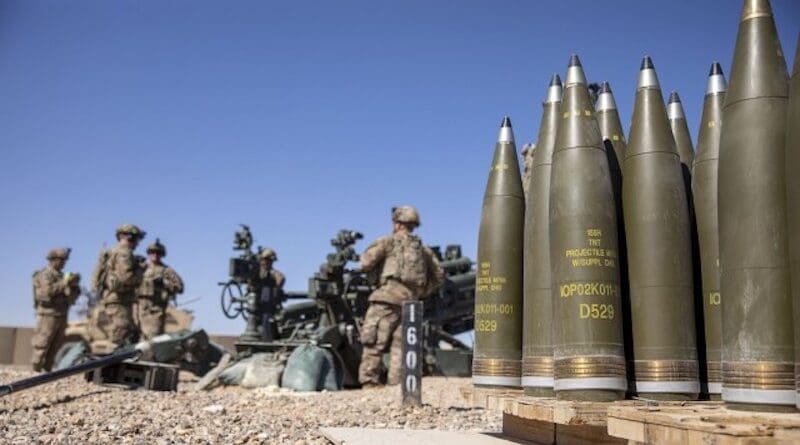
U.S. Soldiers assigned to 1st Platoon, Charlie Battery, 2nd Battalion, 8th Field Artillery Regiment, 1st Stryker Brigade Combat Team, 25th Infantry Division, conduct a live-fire exercise with the M777 towed 155mm howitzer at Al Asad Air Base, Iraq, March 2, 2020. (Photo Credit: U.S. Army photo by Spc. Derek Mustard)
By Published by the Foreign Policy Research Institute
By Mohammed Soliman
(FPRI) — There is a peculiar irony in watching the world’s most technologically advanced military struggle with something as basic as making enough bullets. Yet this is precisely where America finds itself as it attempts to be able to supply two major conflicts simultaneously. The United States, which revolutionized warfare through precision and technological supremacy, has discovered that modern wars still hinge on an ancient principle: The side with more ammunition often wins.
The revelation is both stark and measurable. Ukraine consumes artillery shells at rates that would have seemed fantastical to Pentagon planners just four years ago. A single Ukrainian battery can fire more 155mm rounds in a day than some American units used in months during the Iraq War. Meanwhile, Israel’s sophisticated air defense networks devour interceptor missiles by the dozen during each Iranian strike, each costing millions and taking months to replace.
It’s not simply a supply issue. This is a profound intellectual failure in American strategic thought. For three decades, the United States optimized its defense-industrial base around the assumption that future wars would be brief, technology-dependent affairs. The Pentagon’s planners, intoxicated by the precision strikes of the Gulf War and the technological dominance displayed in Iraq, designed a military for wars that would be decided by superior sensors, communications, and targeted strikes rather than sustained barrages.
The numbers expose this miscalculation with uncomfortable clarity. America currently produces roughly 40,000 artillery shells per month—a rate that represents a 178 percent increase from pre-war levels, yet still falls short of Ukrainian consumption. The Army’s goal of reaching 100,000 shells monthly by mid-2026 sounds impressive until one considers that Ukraine’s forces can fire that quantity in a matter of weeks during intensive operations.
The missile shortage presents some even more sobering arithmetic. Patriot interceptors, essential for defending both Ukraine and Israel, are manufactured at a rate of approximately 740 units annually, with plans to increase production to 1,100 by 2027. Yet Iran’s recent coordinated assault on Israel consumed an estimated $800 million worth of interceptors in 11 days, depleting 15 to 20 percent of America’s global Terminal High Altitude Area Defense (THAAD) missile stockpile. When President Volodymyr Zelensky recently disclosed that promised anti-drone weapons were diverted from Ukraine to the Middle East, he inadvertently highlighted the zero-sum nature of America’s current predicament.
This techno-industrial shortfall reflects a broader philosophical error in how America has conceptualized post-Cold War warfare. The defense establishment, influenced by theorists who promised a “revolution in military affairs,” pivoted toward what military historians have since described as the cult of technology and the precision weapon. The assumption was elegant in its simplicity: Why produce thousands of dumb bombs when a handful of smart ones could achieve superior effect?
The logic was seductive and, within its narrow parameters, correct. American precision weapons could indeed eliminate targets with unprecedented efficiency. But this approach contained a hidden vulnerability. It is assumed that future adversaries would accommodate American preferences for short, decisive wars. Instead, the wars America faces today are characterized by exactly the opposite: extended, attritional campaigns where the ability to sustain fire over months and years matters more than the ability to strike with surgical precision.
The problem is compounded by the techno-industrial ecosystem that emerged from these strategic choices. Defense contractors, operating rationally within the incentive structures created by Pentagon procurement, consolidated around high-margin, low-volume systems. Factories that once produced artillery shells closed or converted to other purposes. Supply chains for basic explosives and propellants atrophied. The skilled workforce that understood how to manufacture large quantities of conventional munitions aged out of the system.
Consider the case of black powder, an essential component in artillery shells. Domestic production capacity has shrunk to the point where it represents a critical bottleneck in ammunition manufacturing. This is not a problem that can be solved by throwing money at it. Rebuilding techno-industrial capacity requires time, expertise, and sustained commitment that spans electoral cycles.
The strategic implications extend far beyond current conflicts. Should tensions with China escalate over Taiwan, the United States would confront an even more demanding scenario across the vast distances of the Pacific. The consumption rates for anti-ship missiles, air defense interceptors, and precision munitions would dwarf current needs. At present production levels, America’s stockpiles would be insufficient within weeks of major combat operations.
This realization has prompted some course correction. Congress has approved $6 billion to expand shell production and modernize factories, while the Army is investing $742 million to increase High Mobility Artillery Rocket System (HIMARS) production. But these efforts, while necessary, highlight the depth of the problem. The lead times for expanding ammunition production are measured in years, not months. Private companies, scarred by previous boom-bust cycles in defense spending, remain reluctant to make major capital investments without guaranteed long-term contracts.
The fundamental challenge is that America designed its defense-industrial base for the wars it wanted to fight rather than the wars it faces. This reflects a broader American tendency to believe that technological superiority can substitute for material superiority—a dangerous assumption in wars where survival depends on outlasting rather than out-innovating the enemy.
History offers sobering reminders of what happens when technologically advanced militaries underestimate the importance of industrial capacity. German forces in World War II possessed superior tanks and aircraft, but they could not match the production rates of their adversaries. The Soviet Union’s ability to churn out T-34 tanks and artillery pieces ultimately mattered more than German engineering superiority.
The solution requires more than increased funding. It demands a fundamental reconceptualization of what military readiness means in an era of great-power competition. The Pentagon must balance its preference for cutting-edge technology with the unglamorous reality that wars are often won by the side that can sustain higher rates of fire longer. This means building surge capacity into peacetime production, maintaining redundant supply chains, and accepting that stockpiling “dumb” munitions is as strategicallyimportant as developing smart ones.
Ukraine and Israel have provided an expensive education in the mathematics of modern warfare. America’s technological edge is a perishable advantage that is not guaranteed to last, making technology itself meaningless if the supply runs dry. As the international order becomes increasingly contested, the United States must confront an uncomfortable truth that military theorists have long understood: In warfare, quantity has a quality all its own. America’s challenge is learning this lesson before it becomes a catastrophic liability.
- About the author: Mohammed Soliman is a Non-Resident Senior Fellow in the National Security Program at the Foreign Policy Research Institute. He is also the director of the Strategic Technologies and Cyber Security Program at the Middle East Institute and a visiting fellow with the National Security Program at Third Way. He can be found on X at @Thisissoliman.
- Source: This article was published by FPRI

Published by the Foreign Policy Research Institute
Founded in 1955, FPRI (http://www.fpri.org/) is a 501(c)(3) non-profit organization devoted to bringing the insights of scholarship to bear on the development of policies that advance U.S. national interests and seeks to add perspective to events by fitting them into the larger historical and cultural context of international politics.

No comments:
Post a Comment