EU Plans to Sanction Providers of False Flags to Russia’s Shadow Fleet

The EU plans to impose sanctions on three companies that have provided false flags to tankers of the Russian shadow fleet, Bloomberg reported on Tuesday, citing documents it has reviewed.
The companies have provided false flags of Aruba, Curacao, and Sint-Maarten to at least eight tankers sanctioned by the EU, according to the documents.
The potential sanctions against the entities enabling the shadow fleet are part of the European Union’s 19th sanctions package, which the EU member states are currently discussing.
Earlier this year, the Netherlands warned the International Maritime Organization (IMO) that companies were providing “fraudulent certificates” on behalf of Sint Maarten, Bloomberg notes.
The sanctions on the suppliers of false flags would come into effect when the EU adopts the whole sanction package, which needs unanimous approval from all 27 member states.
The European Commission’s proposed sanctions package also accelerates the timeline for phasing out Russian LNG imports into the bloc—from the end of 2027 to January 1, 2027, one year earlier than planned.
The sanctions package also removes all remaining exemptions on Russian oil producers Rosneft and Gazprom Neft, and expands sanctions on Russia’s shadow fleet and its enablers, including on 118 new vessels.
European Commission President Ursula von der Leyen said upon proposing the new sanctions package that “Russia's war economy is sustained by revenues from fossil fuels. We want to cut these revenues.”
“It is time to turn off the tap. We are prepared for this. We have been saving energy, diversifying supplies and investing in low-carbon sources of energy like never before,” von der Leyen added.
While the EU debates the sanctions package, some individual member states are tightening controls and inspections to intercept shadow fleet vessels.
Denmark on Monday said it is intensifying inspections on oil tankers passing through its waters, which are the gateway to and from the Baltic Sea, in a move to counter Russia’s shadow fleet movements.
By Michael Kern for Oilprice.com
Denmark Increases Inspections of Shadow Fleet’s “Old and Worthless” Ships
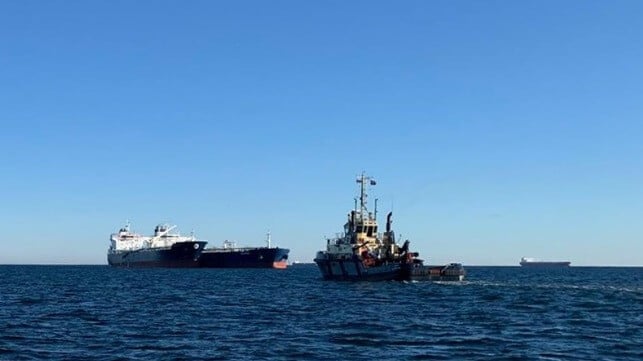
Denmark announced that it will be taking further steps to reduce the dangers from “old and worthless” ships navigating through its busy sea lanes by targeting environmental inspections at one of the key anchorages in the region. It extends Denmark’s previous efforts to monitor high-risk vessels and is part of the emerging effort across the EU to target the shadow tanker fleet.
"We know that there is a lot of traffic consisting of older ships sailing through Danish waters, and they pose a particular risk to our marine environment,” said Environment Minister Magnus Heunicke. “That is why we are now tightening controls with very basic environmental rules so that we can take more effective and consistent action against tankers and the Russian shadow fleet."
Denmark highlights that several thousand ships pass through its waters each year, and a large number of them anchor in an area known as Skagen Red, at the northern tip of Denmark, as the North Sea ends on the passage toward the Baltic. It is one of the largest and busiest anchorages in the Nordic region.
The Danish Maritime Authority, in collaboration with the Danish Environmental Protection Agency, will carry out more environmental inspections of the ships to ensure that they comply with environmental regulations. They will be looking at elements including waste management, scrapping certificates, ballast water management, discharge of scrubber water, and follow fuel requirements.
The report that more ships will be boarded while they are in the anchorage, Environmental inspections will be carried out together with port state controls. The EU has already authorized member countries to inspect documentation and demand proof of insurance from passing vessels.
"We must put an end to Putin's war machine. This also applies to the Russian shadow fleet,” said Minister of Industry and Trade Morten Bødskov. “We are using all tools. We know from our safety checks at Skagen Red that among these ships, there are old and worn-out ships sailing around. That is why our authorities are now intensifying the controls so that we look after Denmark and Danish waters."
Another part of the effort will use the so-called “sniffer” on the Great Belt Bridge. Till en end of the year, they will be measuring sulfur content in the ship’s emissions to ensure compliance with the rules of the IMO-designated SOx (Sulphur Oxide) and NOx (Nitrogen Oxide) Emission Control Area (ECA). In the past, countries in the region worked with the European Maritime Safety Agency for enforcement using sniffer drones.
The new effort follows calls last week by France’s President Emmanuel Macron to interfere with the operations of the shadow fleet. France detained a vessel suspected of operating under a false flag, holding it for nearly a week before it was released.
Russia continues to react strongly to the efforts, calling them piracy. It began escorting tankers in the Gulf of Finland and the Baltic in response to the Baltic countries' efforts to inspect shadow fleet tankers.

No comments:
Post a Comment