“COP30 provides a stark reminder that the answers to the climate crisis do not lie inside the climate talks—they lie with the people and movements leading the way toward a just, equitable, fossil-free future,” one campaigner said.

COP30 President Andre Correa do Lago (C) gestures next to his advisers after the plenary session was interrupted following Colombia’s intervention at the COP30 UN Climate Change Conference in Belém, Para state, Brazil, on November 22, 2025.
(Photo by Pablo Porciuncula/ AFP via Getty Images)
Olivia Rosane
Nov 22, 2025
COMMON DREAMS
The United Nations Climate Change Conference, or COP30, concluded on Saturday in Belém, Brazil with a deal that does not even include the words “fossil fuels”—the burning of which scientists agree is the primary cause of the climate crisis.
Environmental and human rights advocates expressed disappointment in the final Global Mutirão decision, which they say failed to deliver road maps to transition away from oil, gas, and coal and to halt deforestation—another important driver of the rise in global temperatures since the preindustrial era.
“This is an empty deal,” said Nikki Reisch, the Center for International Environmental Law’s (CIEL) director of climate and energy program. “COP30 provides a stark reminder that the answers to the climate crisis do not lie inside the climate talks—they lie with the people and movements leading the way toward a just, equitable, fossil-free future. The science is settled and the law is clear: We must keep fossil fuels in the ground and make polluters pay.”
COP30 was notable in that it was the first international climate conference to which the US did not send a formal delegation, following President Donald Trump’s decision to withdraw the US from the Paris Agreement. Yet, even without a Trump administration presence, observers were disappointed in the power of fossil fuel-producing countries to derail ambition. The final document also failed to heed the warning of a fire that broke out in the final days of the talks, which many saw as a symbol for the rapid heating of the Earth.
“Rich polluting countries that caused this crisis have blocked the breakthrough that we needed at COP30.”
“The venue bursting into flames couldn’t be a more apt metaphor for COP30’s catastrophic failure to take concrete action to implement a funded and fair fossil fuel phaseout,” said Jean Su, energy justice director at the Center for Biological Diversity, in a statement. “Even without the Trump administration there to bully and cajole, petrostates once again shut down meaningful progress at this COP. These negotiations keep hitting a wall because wealthy nations profiting off polluting fossil fuels fail to offer the needed financial support to developing countries and any meaningful commitment to move first.”
The talks on a final deal nearly broke down between Friday and Saturday as a coalition of more than 80 countries who favored more ambitious language faced off against fossil fuel-producing nations like Saudi Arabia, Russia, and India.
During the dispute, Colombia’s delegate said the deal “falls far short of reflecting the magnitude of the challenges that parties—especially the most vulnerable—are confronting on the ground,” according to BBC News.
Finally, a deal was struck around 1:35 pm local time, The Guardian reported. The deal circumvented the fossil fuel debate by affirming the “United Arab Emirates Consensus,” referring to when nations agreed to transition away from fossil fuels at COP28 in the UAE. In addition, COP President André Corrêa do Lago said that stronger language on the fossil fuel transition could be negotiated at an interim COP in six months.
On deforestation, the deal similarly restated the COP26 pledge to halt tree felling by 2030 without making any new plans or commitments.
Climate justice advocates were also disappointed in the finance commitments from Global North to Global South countries. While wealthier countries pledged to triple adaptation funds to $120 billion per year, many saw the amount as insufficient, and the funds were promised by 2035, not 2030 as poorer countries had wanted.
“We must reflect on what was possible, and what is now missing: the road maps to end forest destruction, and fossil fuels, and an ongoing lack of finance,” Greenpeace Brazil executive director Carolina Pasquali told The Guardian. “More than 80 countries supported a transition away from fossil fuels, but they were blocked from agreeing on this change by countries that refused to support this necessary and urgent step. More than 90 countries supported improved protection of forests. That too did not make it into the final agreement. Unfortunately, the text failed to deliver the scale of change needed.”
Climate campaigners did see hope in the final agreement’s strong language on human rights and its commitment to a just transition through the Belém Action Mechanism, which aims to coordinate global cooperation toward protecting workers and shifting to clean energy.
“It’s a big win to have the Belém Action Mechanism established with the strongest-ever COP language around Indigenous and worker rights and biodiversity protection,” Su said. “The BAM agreement is in stark contrast to this COP’s total flameout on implementing a funded and fair fossil fuel phaseout.”
Oxfam Brasil executive director Viviana Santiago struck a similar note, saying: “COP30 offered a spark of hope but far more heartbreak, as the ambition of global leaders continues to fall short of what is needed for a livable planet. People from the Global South arrived in Belém with hope, seeking real progress on adaptation and finance, but rich nations refused to provide crucial adaptation finance. This failure leaves the communities at the frontlines of the climate crisis exposed to the worst impacts and with few options for their survival.”
“The climate movement will be leaving Belém angry at the lack of progress, but with a clear plan to channel that anger into action.”
Romain Ioualalen, global policy lead at Oil Change International, said: “Rich polluting countries that caused this crisis have blocked the breakthrough that we needed at COP30. The EU, UK, Australia, and other wealthy nations are to blame for COP’s failure to adopt a road map on fossil fuels by refusing to commit to phase out first or put real public money on the table for the crisis they have caused. Still, amid this flawed outcome, there are glimmers of real progress. The Belém Action Mechanism is a major win made possible by movements and Global South countries that puts people’s needs and rights at the center of climate action.”
Indigenous leaders applauded language that recognized their land rights and traditional knowledge as climate solutions and recognized people of African descent for the first time. However, they still argued the COP process could do more to enable the full participation of Indigenous communities.
“Despite being referred to as an Indigenous COP and despite the historic achievement in the Just Transition Programme, it became clear that Indigenous Peoples continue to be excluded from the negotiations, and in many cases, we were not given the floor in negotiation rooms. Nor have most of our proposals been incorporated,” said Emil Gualinga of the Kichwa Peoples of Sarayaku, Ecuador. “The militarization of the COP shows that Indigenous Peoples are viewed as threats, and the same happens in our territories: Militarization occurs when Indigenous Peoples defend their rights in the face of oil, mining, and other extractive projects.”
Many campaigners saw hope in the alliances that emerged beyond the purview of the official UN Framework Convention on Climate Change (UNFCCC) process, from a group of 24 countries who have agreed to collaborate on a plan to transition off fossil fuels in line with the Paris goals of limiting temperature increases to 1.5°C to the Indigenous and civil society activists who marched against fossil fuels in Belém.
“The barricade that rich countries built against progress and justice in the COP30 process stands in stark contrast to the momentum building outside the climate talks,” Ioualalen said. “Countries and people from around the world loudly are demanding a fair and funded phaseout, and that is not going to stop. We didn’t win the full justice outcome we need in Belém, but we have new arenas to keep fighting.”
In April 2026, Colombia and the Netherlands will cohost the First International Conference on Fossil Fuel Phaseout. At the same time, 18 countries have signed on in support of a treaty to phase out fossil fuels.
“However big polluters may try to insulate themselves from responsibility or edit out the science, it does not place them above the law,” Reisch said. “That’s why governments committed to tackling the crisis at its source are uniting to move forward outside the UNFCCC—under the leadership of Colombia and Pacific Island states—to phase out fossil fuels rapidly, equitably, and in line with 1.5°C. The international conference on fossil fuel phaseout in Colombia next April is the first stop on the path to a livable future. A Fossil Fuel Treaty is the road map the world needs and leaders failed to deliver in Belém.”
These efforts must contend with the influence not only of fossil fuel-producing nations, but also the fossil fuel industry itself, which sent a record 1,602 lobbyists to COP30.
“COP30 witnessed a record number of lobbyists from the fossil fuel industry and carbon capture sector,” said CIEL fossil economy director Lili Fuhr. “With 531 Carbon Capture and Storage (CCS) lobbyists—surpassing the delegations of 62 nations—and over 1,600 fossil fuel lobbyists making up 1 in every 25 attendees, these industries deeply infiltrated the talks, pushing dangerous distractions like CCS and geoengineering. Yet, this unprecedented corporate capture has met fiercer resistance than ever with people and progressive governments—with science and law on their side—demanding a climate process that protects people and planet over profit.”
Indeed, Jamie Henn of Make Polluters Pay told Common Dreams that the polluting nations and industries overplayed their hand, arguing that Big Oil and “petro states, including the United States, did their best to kill progress at COP30, stripping the final agreement of any mention of fossil fuels. But their opposition may have backfired: More countries than ever are now committed to pursuing a phaseout road map and this April’s conference in Colombia on a potential ‘Fossil Fuel Treaty’ has been thrust into the spotlight, with support from Brazil, the European Union, and others.”
Henn continued: “The COP negotiations are a consensus process, which means it’s nearly impossible to get strong language on fossil fuels past blockers like Saudi Arabia, Russia, and the US, who skipped these talks, but clearly opposed any meaningful action. But you can’t block reality: The transition from fossils to clean energy is accelerating every day.”
“From Indigenous protests to the thunderous rain on the roof of the conference every afternoon, this COP in the heart of the Amazon was forced to confront realities that these negotiations so often try to ignore,” he concluded. “I think the climate movement will be leaving Belém angry at the lack of progress, but with a clear plan to channel that anger into action. Climate has always been a fight against fossil fuels, and that battle is now fully underway.”
By AFP
November 22, 2025

Andre Correa do Lago suspended the talks to consider Colombia's procedural objection. — © AFP Pablo PORCIUNCULA
Issam AHMED
Jabs about greedy children, boos for the Vatican, and a suspension of proceedings lasting more than an hour: the COP30 finale unfolded with the same chaotic energy that defined the summit, exposing the rifts that came close to derailing a deal.
Andre Correa do Lago, the dapper Brazilian diplomat who presided over the two-week affair in Belem, opened the final plenary hours late after nations worked through the night to find a text they could all live with.
Bleary-eyed delegates took their seats, eager to see the marathon talks finally come to an end.
The summit in this rough-around-the-edges Amazonian city had already been interrupted twice by Indigenous protesters last week — once when they broke in, another time when they blocked delegates from entering — before a fierce blaze on Thursday triggered a panicked evacuation.
A round of cheers broke out when Correa do Lago brought down his gavel and announced the adoption of the “Mutirao” text — a Portuguese word of Indigenous origin meaning “collective action” that was also the summit’s slogan.
Early in the session, a representative from the Holy See earned loud boos from NGOs after taking the mic to read out the Vatican’s definition of gender along strict biological lines — a side story at this COP after several governments, from Iran to Argentina, sought to clarify their positions in the gender and climate action plan.
But the drama did not end there.
After a COP defined by a bitter struggle between dozens of nations including the European Union pushing for a “roadmap” to transition away from fossil fuels, and oil producers and emerging economies firmly resisting it, the session saw an unusual procedural clash.
Daniela Duran of Colombia declared that her country had raised a point of order in a side text that was gaveled through, and was now formally objecting.
Rather than brush her aside, Correa do Lago suspended the talks — an uncommon move that underscored Brazil’s determination to show it was handling concerns seriously.
Observers suggested the pause likely reflected Colombia’s deep frustration: the country had been at the forefront of efforts to include a “roadmap,” and was displeased with how the talks concluded.
Diplomats huddled as the suspension dragged on for more than an hour before the plenary finally resumed.
“As many of you, I have not slept, and probably this has not helped, as well as my advanced age,” said Correa do Lago, in his mid-sixties, apologizing as he blamed an honest mistake for missing Colombia’s point of order.
Still, Russia — aligned with Brazil in the BASIC coalition — chose to voice its displeasure, objecting to the objections.
“Refrain from behaving like children who want to get your hands on all the sweets!” scolded Russia’s Sergei Kononuchenko, speaking in Spanish as he accused Colombia and others of trying to “stuff the sweets down your throat until you make yourself sick,” prompting a sharp rebuke from Argentina.
Infrastructure woes had plagued the summit from the start — leaking ceilings, broken air conditioners, toilets running out of water and more.
In a fitting coda, a torrential downpour in the final session — “the wonderful noise of an Amazon rain,” in Correa do Lago’s words — left parts of the carpet soaked.
“We can’t have a deal that fails to deliver what science and the law require on finance, fossil fuels, or forests and call that progress.”
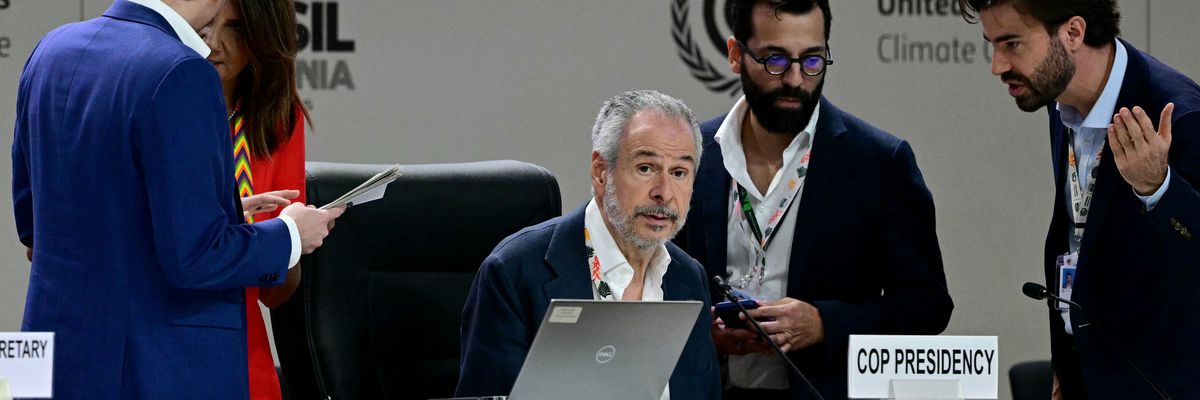
COP30 President Andre Correa do Lago listens to an adviser upon arrival for a plenary session in Belém, Brazil on November 21, 2025.
(Photo by Pablo Porciuncula/AFP via Getty Images)
Jake Johnson
Nov 21, 2025
COMMON DREAMS
Climate advocates voiced alarm and outrage Friday after every mention of fossil fuels was dropped from the latest draft text to emerge from the COP30 summit, high-stakes talks that have been swarmed by a record number of oil and gas lobbyists seeking to derail any progress toward a clean energy transition.
Dozens of nations—including Spain, Vanuatu, the Marshall Islands, Chile, and Germany—are demanding that any final agreement include “a roadmap for implementing a just, orderly, and equitable transition away from fossil fuels” to fulfill world leaders’ previous commitment at COP28.
But a draft document released by COP30 host Brazil on Friday, formally the last day of talks, omits any such roadmap and does not even contain the term “fossil fuels.”
Monique Barbut, France’s environment minister, said Friday that “at this point, even if we don’t have the roadmap, but at least a mention of the fossil fuels, I think we would accept it.”
“But as it stands now, we have nothing left,” Barbut added.
While draft texts are not necessarily a definitive measure of the state of negotiations, the omission was seen as further evidence that United Nations climate talks have been captured by petrostates such as Saudi Arabia and fossil fuel industry influence-peddlers. At COP30, fossil fuel lobbyists outnumber the delegations of every country except Brazil.
The Donald Trump-led United States, the world’s largest oil producer, did not send an official delegation to the summit.
“This is outrageous,” Bronwen Tucker, public finance lead at Oil Change International, said in response to the new draft text. “The presidency has presented a shamefully weak text that fails to mention fossil fuels, fails to deliver accountability towards rich countries’ finance obligations, and only makes vague promises on adaptation.”
“A large group of countries have been vocal in their support for a roadmap to transition away from fossil fuels, but rich parties are still refusing to deliver the debt-free public finance on fair terms that is key to make it happen,” Tucker added. “Until they stop blocking efforts to address the systemic barriers developing countries face to phasing out fossil fuels, any roadmap will be a dead-end.”
“We’re walking a fine line here between survival and climate catastrophe.”
The updated text was released as negotiators raced to strike a consensus deal in the final hours of the summit, which appears likely to head into overtime. Talks were delayed for hours on Thursday after a fire broke out at the summit, an incident that activists viewed as a “potent metaphor” for world leaders’ failure to combat the climate crisis as it wreaks havoc across the globe.
“We’re walking a fine line here between survival and climate catastrophe, and in these final hours I am hoping we can take something back to our communities that indicates that the world considers our homes worth fighting for,” said Fenton Lutunatabua, Pacific team lead at the climate group 350.
Nikki Reisch, director of the Climate and Energy Program at the Center for International Environmental Law, said Friday that the toothless draft text lays bare the need to overhaul the COP process and mitigate the influence of the fossil fuel industry—the primary driver of the climate emergency.
“The world is being sold a bill of lies here at this ‘COP of truth,’” said Reisch. “We can’t have a deal that fails to deliver what science and the law require on finance, fossil fuels, or forests and call that progress. The weakness of the text underscores why the climate talks are sorely in need of reform to allow a majority vote when a handful of countries block consensus.”
Can the coalition supporting a fossil fuel phaseout successfully put their road map back into the text, or will petrostrates like Saudi Arabia, backed up by the Trump administration, kill the deal?
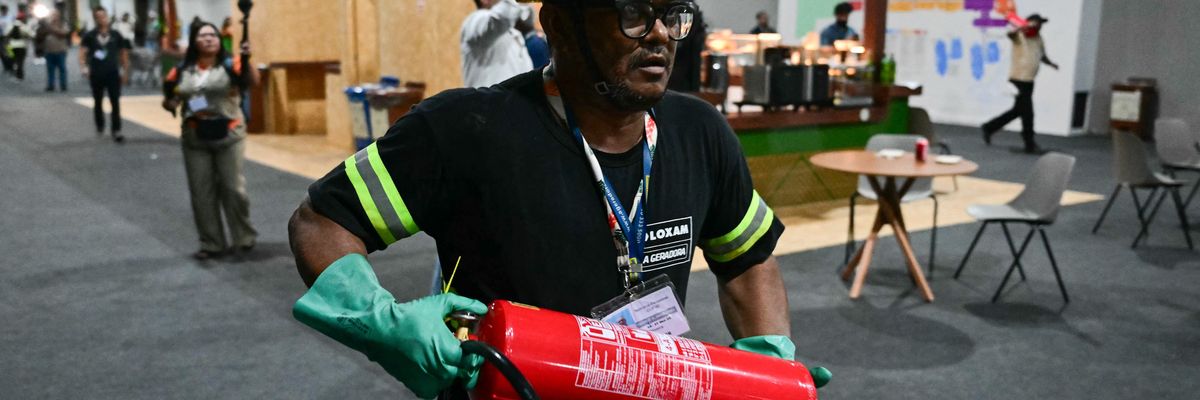
A worker runs carrying a fire extinguisher toward a pavilion after a fire broke out during the COP30 UN Climate Change Conference in Belém, Para state, Brazil on November 20, 2025.
(Photo by Pablo Porciuncula/AFP via Getty Images)
Jamie Henn
Nov 21, 2025
Sometimes the metaphors are just too on the nose: On Thursday, the venue for the COP30 climate talks here in Belém, Brazil literally caught fire as delegates continued to wrestle with how to stop the climate from burning. I was just down the hallway from the blaze and was caught up in the confusion as people started running from the flames and out of the huge tented structure. Thankfully, volunteers and Brazilian firefighters responded before anyone was seriously injured and the fire was put out soon after it began.
If only the rest of the talks could move so quickly. When it comes to the larger climate fires still raging across the planet, some countries seem content to pretend it isn’t happening, while others are teaming up with the fossil fuel industry to gleefully pour more fuel on the flames.
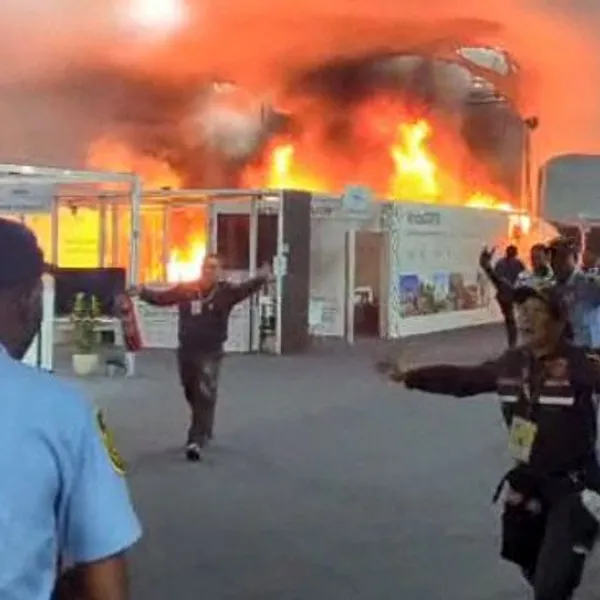
‘Potent Metaphor’: Fire Forces Evacuation of UN Climate Conference
Thursday night, the presidency released a new draft text that removed any mention of a road map to eliminate fossil fuels, something more than 80 countries, including the host country of Brazil, have pledged their support behind. It’s the equivalent of pointing at the flames and smoke filling the conference venue and saying, “What could that possibly be? We certainly don’t want to say the word fire.”
The pushback to the latest text was swift. Later on Thursday night, 29 countries sent a letter to the Brazilian COP presidency threatening to block any agreement that didn’t include the fossil fuel phaseout road map. Then this morning, Colombia hosted a packed press conference with Panama, the Netherlands, Vanuatu, the Marshall Islands, and others to demand COP produce the road map and a just transition plan.
Whether or not countries can agree to a road map to phase out fossil fuels here in Belém, that’s clearly the journey we’re on.
“Not even Orwell could come up with something as absurd as this: something where the truth is edited out because it offends polluters,” said Panama’s lead negotiator Juan Carlos Monterrey to widespread applause.
Colombia also announced that this March it will host the first ever global conference on the phaseout of fossil fuels. The conference is closely connected with the push for a new Fossil Fuel Treaty that would help end the production and distribution of fossil fuels, an effort that 18 countries and thousands of cities, states, and organizations have now endorsed.
We’ll see over the next 24 hours whether the coalition supporting a fossil fuel phaseout, the climate firefighters, can successfully put their road map back into the text, or whether the arsonists, petrostrates like Saudi Arabia, backed up by the Trump administration, can kill the deal.
Having been to a dozen COPs and watched many of these last minute fights, my guess is that we get some weak, compromised language. There will be two ways to look at that outcome, both of them true: On the one hand, it will be an empty promise and pathetic abdication of responsibility, on the other, another step forward in the fight to end fossil fuels, a fight that we’ve always known would take years and a massive global movement to win.
No matter what comes out of the text, I’ve been inspired to see that movement gaining momentum again. The last few years have been tough for the global climate movement. The Covid-19 pandemic squashed much of the energy created by the Global Climate Strikes in 2019. Over the last year, much of civil society has been focused (rightfully) on the genocide in Gaza or the rise of right-wing authoritarianism around the world. With the last three COPs taking place in Egypt, UAE, and Azerbaijan, there’s been little space for demonstrations, let alone mass protests.
And yet, there are green shoots popping up everywhere you look. Last week at COP30, Indigenous leaders marched on the conference center to ensure that their voices and concerns were being heard within the process. Over the weekend, over 70,000 people took the streets of Belém to demand climate justice. Inside the conference venue, there have been dozens of actions, including a big Make Polluters Pay demonstration we helped organize (I got to play a Big Oil CEO and roll around in a sea of dirty money). Back in the US, we saw over 500 events for the Sun Day clean energy day of action this September and millions of people take part in the No Kings demonstrations last month.
Meanwhile, in the real economy, clean energy continues to set records nearly every day. According to the energy think tank Ember, there was no fossil fuel growth in 2025 as clean energy production surged around the world. Whether or not countries can agree to a road map to phase out fossil fuels here in Belém, that’s clearly the journey we’re on.
The question is can we move fast enough. When the COP30 venue caught fire yesterday, I saw people sprinting for the exits while firefighters rushed into action to put out the blaze. We all need that same sense of urgency when it comes to the climate fight ahead. As Greta Thunberg often said, “Act is if your house is on fire.” Maybe seeing the negotiations go up in literal flames will get countries at COP30 to finally take her message to heart.
Our work is licensed under Creative Commons (CC BY-NC-ND 3.0). Feel free to republish and share widely.
Jamie Henn
Jamie Henn is the director of Fossil Free Media and a co-founder of 350.org.
Full Bio >
Declaration of the Peoples’ Summit Towards COP30

We, the Peoples’ Summit, gathered in Belém do Pará, in the Brazilian Amazon, from 12 to 16 November 2025, declare to the peoples of the world what we have accumulated in struggles, debates, studies, exchanges of experiences, cultural activities and testimonies, over several months of preparation and during these days gathered here.
Our process brought together more than 70,000 people who make up local, national, and international movements of indigenous and traditional peoples, peasants, indigenous peoples, quilombolas, fishermen, extractivists (traditional peoples who live from sustainable forest extraction), shellfish gatherers, urban workers, trade unionists, homeless people, babassu coconut breakers, terreiro peoples, women, the LGBTQIAPN+ community, young people, Afro-descendants, the elderly, and peoples from the forest, the countryside, the peripheries, the seas, rivers, lakes, and mangroves. We have taken on the task of building a just and democratic world, with buen vivir/bem viver/good living for all. We are unity in diversity.
The advance of the extreme right, fascism and wars around the world exacerbates the climate crisis and the exploitation of nature and of peoples. The countries of the global North, transnational corporations, and the ruling classes bear the main responsibility for these crises. We salute the resistance and stand in solidarity with all peoples who are being cruelly attacked and threatened by the forces of the US empire, Israel and their allies in Europe. For more than 80 years, the Palestinian people have been victims of genocide perpetrated by the Zionist state of Israel, which has bombed the Gaza Strip, forcibly displaced millions of people and killed tens of thousands of innocent people, mostly children, women and the elderly. We totally repudiate the genocide perpetrated against Palestine. We offer our support and solidarity to the people who bravely resist, and to the Boycott, Divestment and Sanctions (BDS) movement.
At the same time, in the Caribbean Sea, the United States is intensifying its imperial presence. It is doing so by expanding joint operations, agreements and military bases, in collusion with the extreme right, under the pretext of combating drug trafficking and terrorism, as with the recently announced “Southern Spear” operation. Imperialism continues to threaten the sovereignty of peoples, criminalising social movements and legitimising interventions that have historically served private interests in the region. We stand in solidarity with the resistance of peoples under imperialist or resource-grabbing attacks in Venezuela, Cuba, Haiti, Ecuador, Panama, El Salvador, Colombia, the Democratic Republic of Congo, Mozambique, Nigeria, Sudan, and with the emancipatory popular projects of the peoples of the Sahel, Nepal and around the world.
There is no life without nature. There is no life without the ethics and the work of care. That is why feminism is central to our political project. We place the work of reproducing life at the centre, which is what radically differentiates us from those who want to preserve the logic and dynamics of an economic system that prioritises profit and the private accumulation of wealth.
Our worldview is guided by popular internationalism, with exchanges of knowledge and wisdom that build bonds of solidarity, struggle and cooperation among our peoples. True solutions are strengthened by this exchange of experiences, developed in our territories and by many hands. We are committed to stimulating, convening and strengthening these processes. Therefore, we welcome the announcement of the construction of the International Movement of People Affected by Dams, Socio-Environmental Crimes and the Climate Crisis.
We began our People’s Summit by navigating the rivers of the Amazon, which, with their waters, nourish the entire body. Like blood, they sustain life and feed a sea of encounters and hopes. We also recognise the presence of enchanted beings and other fundamental beings in the worldview of indigenous and traditional peoples, whose spiritual strength guides paths, protects territories and inspires struggles for life, memory and a world of good living.
After more than two years of collective construction and holding the People’s Summit, we affirm:
- The capitalist mode of production is the main cause of the growing climate crisis. The main environmental problems of our time are a consequence of the relations of production, circulation, and disposal of goods, under the logic and domination of financial capital and large capitalist corporations.
- Peripheral communities are the most affected by extreme weather events and environmental racism. On the one hand, they face a lack of infrastructure and adaptation policies. On the other hand, they face a lack of justice and reparations, especially for women, young people, impoverished people, and people of colour.
- Transnational corporations, in collusion with governments in the global North, are at the centre of power in the capitalist, racist and patriarchal system, being the actors that most cause and benefit from the multiple crises we face. The mining, energy, arms, agribusiness and Big Tech industries are primarily responsible for the climate catastrophe we are experiencing.
- We oppose any false solutions to the climate crisis, including in climate finance, that perpetuate harmful practices, create unpredictable risks, and divert attention from transformative solutions based on climate justice and the justice of peoples in all biomes and ecosystems. We warn that the TFFF, being a financialised programme, is not an adequate response. All financial projects must be subject to criteria of transparency, democratic access, participation and real benefit for affected populations.
- The failure of the current model of multilateralism is evident. Environmental crimes and extreme weather events that cause death and destruction are becoming increasingly common. This demonstrates the failure of countless global conferences and meetings that promised to solve these problems but never addressed their structural causes.
- The energy transition is being implemented under capitalist logic. Despite the expansion of renewable sources, there has been no reduction in greenhouse gas emissions. The expansion of energy production sources has also become a new space for capital accumulation.
- Finally, we affirm that the privatisation, commodification and financialisation of common goods and public services are directly contrary to the interests of the people. In this context, laws, state institutions and the vast majority of governments have been captured, shaped and subordinated to the pursuit of maximum profit by financial capital and transnational corporations. Public policies are needed to advance the recovery of states and tackle privatisation.
In the face of these challenges, we propose:
- Confronting false market solutions. Air, forests, water, land, minerals, and energy sources cannot remain private property or be appropriated, because they are common goods of the people.
- We demand the participation and leadership of peoples in the construction of climate solutions, recognising ancestral knowledge. The multidiversity of cultures and worldviews carries ancestral wisdom and knowledge that states must recognise as references for solutions to the multiple crises afflicting humanity and Mother Nature.
- We demand the demarcation and protection of the lands and territories of indigenous peoples and other local peoples and communities, as they are the ones who guarantee the survival of the forest. We demand that governments implement zero deforestation, end criminal burning, and adopt state policies for ecological restoration and recovery of areas degraded and affected by the climate crisis.
- We demand the implementation of popular agrarian reform and the promotion of agroecology to guarantee food sovereignty and combat land concentration. Peoples produce healthy food to feed the people, in order to eliminate hunger in the world, based on cooperation and access to techniques and technologies under popular control. This is an example of a real solution to confront the climate crisis. There is no climate justice without land back in the hands of peoples.
- We demand the fight against environmental racism and the construction of fair cities and living peripheries through the implementation of environmental policies and solutions. Housing, sanitation, water access and use, solid waste treatment, afforestation, and access to land and land regularisation programmes must consider integration with nature. We want investment in quality public and collective transport policies with zero fares. These are real alternatives for tackling the climate crisis in peripheral territories around the world, which must be implemented with adequate funding for climate adaptation.
- We advocate direct consultation, participation, and popular management of climate policies in cities to confront real estate corporations that have advanced the commodification of urban life. The city of climate and energy transition should be a city without segregation that embraces diversity. Finally, climate financing should be conditional on protocols that aim at housing permanence and, ultimately, fair compensation for people and communities with guaranteed land and housing, both in the countryside and in cities.
- We demand an end to wars, we demand demilitarisation. That all financial resources allocated to wars and the war industry be redirected to the transformation of this world. That military spending be directed towards the repair and recovery of regions affected by climate disasters. That all necessary measures be taken to prevent and pressure Israel, holding it accountable for the genocide committed against the Palestinian people.
- We demand fair and full compensation for the losses and damages imposed on peoples by destructive investment projects, dams, mining, fossil fuel extraction, and climate disasters. We also demand that those guilty of economic and socio-environmental crimes that affect millions of communities and families around the world be tried and punished.
- The work of reproducing life must be made visible, valued, understood for what it is – work – and shared by society as a whole and with the state. This work is essential for the continuity of human and non-human life on the planet. It also guarantees the autonomy of women, who cannot be held individually responsible for care, but whose contributions must be taken into account: our work sustains the economy. We want a world with feminist justice, autonomy and participation of women.
- We demand a just, sovereign and popular transition that guarantees the rights of all workers, as well as the right to decent working conditions, freedom of association, collective bargaining and social protection. We consider energy to be a common good and advocate for the overcoming of poverty and energy dependence. Neither the energy model nor the transition itself can violate the sovereignty of any country in the world.
- We demand an end to the exploitation of fossil fuels and call on governments to develop mechanisms to ensure the non-proliferation of fossil fuels, aiming for a just, popular and inclusive energy transition with sovereignty, protection and reparation for territories, particularly in the Amazon and other sensitive regions that are essential for life on the planet.
- We fight for public financing and taxation of corporations and the wealthiest individuals. The costs of environmental degradation and losses imposed on populations must be paid by the sectors that benefit most from this model. This includes financial funds, banks, and corporations in agribusiness, hydrobusiness, aquaculture and industrial fishing, energy, and mining. These actors must also bear the necessary investments for a just transition focused on the needs of the people.
- We demand that international climate financing not go through institutions that deepen inequality between North and South, such as the IMF and the World Bank. It must be structured in a fair, transparent, and democratic manner. It is not the peoples and countries of the global South that should continue to pay debts to the dominant powers. It is these countries and their corporations that need to begin to pay off the socio-environmental debt accumulated through centuries of imperialist, colonialist and racist practices, through the appropriation of common goods and through the violence imposed on millions of people who have been killed and enslaved.
- We denounce the ongoing criminalisation of movements, the persecution, murder and disappearance of our leaders who fight in defence of their territories, as well as political prisoners and Palestinian prisoners who fight for national liberation. We demand the expansion of protection for human and socio-environmental rights defenders in the global climate agenda, within the framework of the Escazú Agreement and other regional regulations. When a defender protects the territory and nature, they protect not only an individual, but an entire people, benefiting the entire global community.
- We call for the strengthening of international instruments that defend the rights of peoples, their customary rights and the integrity of ecosystems. We need a legally binding international instrument on human rights and transnational corporations, which is built on the concrete reality of the struggles of communities affected by violations, demanding rights for peoples and rules for corporations. We also affirm that the Declaration on the Rights of Peasants and Other People Working in Rural Areas (UNDROP) should be one of the pillars of climate governance. The full implementation of peasants’ rights returns people to their territories, directly contributing to their food security, soil care and the cooling of the planet.
Finally, we believe that it is time to unite our forces and face our common enemy. If the organisation is strong, the struggle is strong. For this reason, our main political task is to organise the peoples of all countries and continents. Let us root our internationalism in each territory and make each territory a trench in the international struggle. It is time to move forward in a more organised, independent and unified way, to increase our awareness, strength and combativeness. This is the way to resist and win.
“Peoples of the world: Unite”
Researchers warn of the need for Brazil to turn promises into practical actions at COP30
In an article published in a scientific journal, the group emphasizes that Brazil must align its domestic policies with international commitments.
Fundação de Amparo à Pesquisa do Estado de São Paulo
image:
COP30 negotiations room: article is signed by eight researchers, including three from FAPESP’s ARIES RIDC
view moreCredit: Rafa Neddermeyer/COP30
Amid the discussions at COP30, which is being held for the first time in the Amazon, in Belém in the state of Pará, Brazil, a group of Brazilian researchers is warning of the urgent need for Brazil to lead the way in turning promises into practical actions to combat global warming. As host of the 30th United Nations Climate Change Conference, they argue that the country must align its domestic policies with international commitments, emphasizing forest conservation and climate justice.
The scientists emphasize the need to “reverse anti-environmental policies, enforce laws to combat deforestation, and strengthen sustainable development actors to turn promises into concrete actions through legislative reforms, the restoration of environmental licensing, and the protection of indigenous peoples’ rights.” The article was published on October 28 in the scientific journal International Environmental Agreements: Politics, Law and Economics.
Eight researchers signed the article, including three from ARIES (the Antimicrobial Resistance Institute of São Paulo), a Research, Innovation, and Dissemination Center (RIDC) funded by FAPESP and based at the Federal University of São Paulo (UNIFESP). The other signatories are from the University of São Paulo (USP), the Federal University of Alagoas (UFAL), and the Sergio Arouca National School of Public Health (ENSP-FIOCRUZ).
“Brazil has to take advantage of all this international visibility to really put into action what it has committed to do, seeking to limit global warming. And even though it’s a global event, COP is an opportunity for us to bring national proposals, such as the Belém Health Action Plan,” biologist Daniela Debone, the article’s first author, told Agência FAPESP. Debone is a postdoctoral researcher at ARIES and is supported by a FAPESP scholarship.
Brazil presented the action plan with the aim of strengthening the health sector’s adaptation and resilience in the face of climate change. The plan aims to achieve this goal by advancing integrated surveillance and monitoring systems and promoting evidence-based policies and innovation. It is part of the program for the thematic days of COP30, which included health on November 12 and 13.
The theme is one of the approaches of ARIES, which aims to produce research to understand the mechanisms and evolution of antimicrobial resistance, stimulating innovative mitigation measures and promoting changes in public health policies through a One Health approach. The core team consists of researchers from three São Paulo universities, as well as national and international experts from over 20 educational and research institutions.
Antimicrobial resistance (AMR) is also linked to climate change and is considered by the United Nations to be one of the main threats to global public health.
The World Health Organization (WHO) estimates that climate change will be linked to around 250,000 deaths per year between 2030 and 2050 due to malnutrition, infectious diseases, and heat stress. On the other hand, AMR could be responsible for 10 million deaths per year during the same period, in addition to costing health systems USD 1 trillion more, according to the World Bank.
“We scientists have to translate research knowledge and findings for society, contributing to public policy. In this sense, we’re warning that we need to move beyond discourse. We’re relying on a critical mass generated by Brazilian science, which is very important, including researchers at the IPCC [Intergovernmental Panel on Climate Change], such as Professor Paulo Artaxo. We can show ways and give concrete examples of how to move towards more sustainable practices,” says Professor Simone Miraglia, from ARIES and head of the Laboratory of Economics, Health, and Environmental Pollution (LESPA) at UNIFESP. Miraglia and Artaxo also co-authored the paper.
An idea based on reality
According to Debone, the proposal for the article emerged in May when she started participating in a series of events organized by the UNIFESP Commission for COP30.
That same month, the Brazilian Senate approved Bill 2,159/2021, also known as the General Environmental Licensing Law, which was subsequently passed by the Chamber of Deputies and, in August, sanctioned by the Executive Branch with 63 vetoes.
Viewed by some sectors as a way to weaken and undermine licensing rules and by others as a way to streamline the process of approving construction projects, the law is cited in the article. The researchers argue that it could “further aggravate land conflicts, sustain the misleading narrative of ‘green capitalism,’ and undermine the rights of traditional and indigenous peoples,” who are considered responsible for conserving the forest.
Additionally, the scientists point to the construction of a highway in Belém that cleared hectares of forest, the reconstruction of the 408-kilometer central section of the BR-319 highway between the state capitals of Manaus and Porto Velho that affects areas of the Amazon, and discussions about the timeline framework which impact the demarcation of indigenous lands, as anti-environmental measures.
This timeframe is a legal thesis that states indigenous peoples are only entitled to lands they occupied or were disputing on October 5, 1988, the date the Constitution was promulgated. This thesis was established by Law 14,701/2023, which was approved by the National Congress, despite the Federal Supreme Court’s (STF) previous stance.
The Executive vetoed the thesis and other articles, but deputies and senators rejected the vetoes and kept the text in its entirety. The law is under review again by the STF, which has not set a deadline for deciding whether it is unconstitutional.
Conversely, the scientists cite Brazil’s reduction in deforestation and greenhouse gas emissions as progress. Between August 2024 and July 2025, the deforestation rate in the Legal Amazon, an area covering nine Brazilian states where the Amazon biome occurs, reached the third-lowest level since 1988, at 5,796 km² – an 11% reduction.
Due to the decline in deforestation, Brazil recorded its lowest level of greenhouse gas emissions since 2009 in 2024, with a decrease of nearly 17% – 2.145 billion tons of CO₂ equivalent (GtCO₂e).
The Ministry of the Environment, which is involved in the COP discussions, did not comment when contacted through its press office.
“Climate change has been debated for a long time. Now everyone is waiting for feasible actions that will actually be carried out. I hope that this COP will serve as a turning point from a global perspective. That we’ll begin to see actions that change greenhouse gas emissions and the other factors causing these changes,” says Ronan Adler Tavella, a postdoctoral researcher at ARIES and author of the article, as well as a FAPESP scholarship recipient.
Actual scenario
When it comes to addressing the climate emergency, the group points out that global temperatures have already risen by up to 1.6 °C compared to pre-industrial levels, with continental areas recording increases of up to 2.1 °C, “highlighting the acceleration of climate impacts and the critical need for immediate action.”
They write, “Brazil’s stated vision of a prosperous Amazonian bioeconomy, in which the standing forest is worth more than the felled forest, will only gain credibility if the country decisively breaks with the destructive models of the past.”
Tavella highlights a recent study he and Debone led, published in Anthropocene Science, to assess the short- and long-term effects of the extreme rains that devastated several municipalities in the state of Rio Grande do Sul in May 2024.
The results underscore the need to rethink flood management strategies, particularly in urban areas, by incorporating climate projections into planning, bolstering flood control infrastructure, and adopting nature-based solutions to boost resilience.
“In addition to the rains in May, we saw countless other cases of floods and extreme events around the globe throughout last year. This is a reality that’s been intensifying. And it’ll be a constant concern for the whole world,” the researcher adds.
About São Paulo Research Foundation (FAPESP)
The São Paulo Research Foundation (FAPESP) is a public institution with the mission of supporting scientific research in all fields of knowledge by awarding scholarships, fellowships and grants to investigators linked with higher education and research institutions in the State of São Paulo, Brazil. FAPESP is aware that the very best research can only be done by working with the best researchers internationally. Therefore, it has established partnerships with funding agencies, higher education, private companies, and research organizations in other countries known for the quality of their research and has been encouraging scientists funded by its grants to further develop their international collaboration. You can learn more about FAPESP at www.fapesp.br/en and visit FAPESP news agency at www.agencia.fapesp.br/en to keep updated with the latest scientific breakthroughs FAPESP helps achieve through its many programs, awards and research centers. You may also subscribe to FAPESP news agency at http://agencia.fapesp.br/subscribe.
Journal
International Environmental Agreements Politics Law and Economics
Article Title
Brazil’s climate leadership paradox: hosting COP30 amid domestic environmental rollbacks
Cancel fossil fuel extraction contracts to combat climate change
The world must stop exploring more fossil fuels
image:
From left to right, Martí Orta, Fatima Eisam-Eldeen and Gorka Muñoa.
view moreCredit: UNIVERSITY OF BARCELONA
The countries participating in the UN Climate Change Conference (COP30), currently taking place in Brazil, must cancel fossil fuel concessions in order to keep the Paris Agreement alive. This is the main message of a paper published in the journal Nature and signed by experts Martí Orta, Gorka Muñoa and Marcel Llavero, from the Faculty of Biology and the Biodiversity Research Institute (IRBio) of the University of Barcelona, and Guillem Rius, from the Barcelona Institute for Global Health (ISGlobal).
Committing to renewable energy
As the experts point out in Nature magazine, the Paris Agreement requires countries to work to limit global warming to well below 2°C and to make efforts to limit it to 1.5°C, in order to avoid climate tipping points with devastating consequences.
“This latter objective requires drastic action, even if we assume a temporary overshoot 1.5°C and later reduce atmospheric carbon concentrations to lower temperatures, the most optimistic scenario for most climate scientists,” says the team, which also participated in COP29 in 2024, held in Azerbaijan.
To have any chance of achieving the Paris targets, the team urges the nations gathered at COP30 to mobilize massive investments in renewable energy and urgently redefine international legal frameworks so that fossil fuel licences can be revoked.
“The world must stop exploiring more fossil fuels, stop granting licences for new concessions, and cancel most existing oil and gas concessions and coal mines that exist today,” the experts conclude.
A threat to indigenous communities in the Amazon
In a new study published in Energy Research and Social Science, the team warns of the high levels of oil pollution suffered by indigenous communities in the region, as well as the impunity with which transnational companies extract oil in the area. This is one of the most biodiverse areas on the planet and is key to the global fight against climate change.
The study is led by the UB and ISGlobal, in collaboration with the International Institute of Social Studies (ISS) at Erasmus University Rotterdam (Netherlands). It focuses on oil blocks 1AB/192 and 8, in northern Peruvian Amazon and it analyses data on the environmental impacts associated with oil extraction, compiled through indigenous environmental monitoring and records from Peru’s environmental agency between 2008 and 2018
The study documents 1,184 environmental impacts, including oil spills and discharges of polluting production water. Of all recorded impacts, only 17% result in penalties — and even when sanctions are imposed, fines are often reduced or overturned through appeals and lengthy legal proceedings. The conclusions indicate that fines should be proportional to the profits earned by companies, so that operating with low environmental standards is no longer economically advantageous for the industry. The authors also propose revoking licenses in cases of repeat offences. In fact, they go further and question the continuation of global fossil fuel extraction in the current climate emergency, particularly in areas of high ecological and social value.
To curb these abuses, they warn that it is essential to strengthen environmental monitoring, increase resources for public agencies in countries such as Peru, and integrate local indigenous monitoring — which is far more effective and knowledgeable about the territory — into the environmental oversight network.
The world must stop exploiring more fossil fuels and stop granting licences for new concessions.
Credit
UNIVERSITY OF BARCELONA
Journal
Nature
Method of Research
Commentary/editorial
Subject of Research
Not applicable
Article Title
Nations at COP30 must cancel fossil-fuel concessions to keep the Paris agreement in reach
Article Publication Date
18-Nov-2025
By AFP
November 20, 2025

Indigenous people hold signs reading "The answer is us" and "End of fossil fuels, no mining in our territories" during a march on the sidelines of the COP30 UN Climate Change Conference in Belem, Brazil - Copyright AFP/File Mauro PIMENTEL
More than 30 countries have co-signed a letter opposing Brazil’s draft proposal at the UN climate conference because it fails to include a roadmap phasing out fossil fuels, the Colombian delegation told AFP on Thursday.
COP30 is scheduled to end Friday evening, after a dramatic blaze at the venue in Belem brought a premature close to Thursday’s proceedings.
The summit’s leader, Brazilian diplomat Andre Correa do Lago, is under pressure from the nearly 200 countries gathered in the Amazonian city since last week to forge a text capable of achieving consensus, as required under the summit’s rules.
His latest draft, seen Thursday by AFP, makes no mention of fossil fuels — despite President Luiz Inacio Lula da Silva having championed the idea as a signature initiative since the summit began.
“We cannot support an outcome that does not include a roadmap for implementing a just, orderly, and equitable transition away from fossil fuels,” said the letter provided to AFP — with signatories from Europe, Latin America, Asia, and Pacific island nations.
France and Belgium confirmed their signatures.
“We must be honest: in its present form, the proposal does not meet the minimum conditions required for a credible COP outcome,” they letter said.
Momentum for phasing out oil, coal, and gas, which are largely responsible for global warming, re-emerged forcefully in Belem at a moment when the issue appeared all but dormant.
But according to a negotiator who wished to remain anonymous, China, India, Saudi Arabia, Nigeria, and Russia rejected it outright.
UN chief calls for ‘ambitious compromise’ at climate talks
By AFP
November 20, 2025

Antonio Guterres -- the former Portuguese prime minister who, more than any secretary-general before him, has made climate his signature issue -- delivered an urgent message - Copyright AFP Pablo PORCIUNCULA
Issam AHMED
With UN climate talks nearing a close in Belem, the world body’s chief on Thursday urged nations to reach an “ambitious compromise” that keeps alive the goal of limiting long-term planetary warming to the critical 1.5C threshold.
Nearly 200 countries have spent the past two weeks hashing out issues at COP30 — from a “roadmap” to transition away from fossil fuels proposed by host Brazil, to concerns over weak emissions-reduction plans, finance for developing countries, and trade barriers.
Antonio Guterres — the former Portuguese prime minister who has made climate his signature issue — delivered an urgent message.
“The world is watching Belem,” he told reporters during a morning news conference, as nations await a new draft negotiating text before the summit officially closes on Friday evening.
“Communities on the frontlines are watching too — counting flooded homes, failed harvests, lost livelihoods, and asking how much more must we suffer?”
“Please engage in good faith,” he urged, to reach an “ambitious compromise,” adding that “1.5 degrees must be your only red line.”
COP30 comes 10 years after nations agreed in Paris to limit human-caused warming to 1.5C — and at least well below 2C — to avert the worst impacts of climate destabilization.
Evidence now indicates the world will almost certainly overshoot the 1.5C goal, though humanity can still influence how long that overshoot lasts.
– ‘Our islands could disappear’ –
Guterres’ plea came after Brazilian President Luiz Inacio Lula da Silva flew into the northern city, which sits on the edge of the Amazon, on Wednesday, in a bold bid to seal an early deal on the summit’s thorniest issues.
While that effort failed, Lula, who has invested political capital into what he has called his “COP of truth,” once more put his “roadmap” to move away from fossil fuels back at the top of the agenda.
The proposal is supported by a coalition of more than 80 countries but opposed by the oil-producing bloc.
Negotiators are also at odds over pressure from the developing world for developed countries to provide more financing to help vulnerable nations adapt to climate change and deploy renewable energy.
The COP29 summit in Baku last year concluded with developed nations agreeing to provide $300 billion a year in climate finance, a figure criticized by developing countries as woefully insufficient.
The EU, where many countries are facing economic headwinds and soaring debt, has led the opposition to demands for more money.
Vulnerable nations warn that failure to deliver meaningful finance that enables decisive action will have existential consequences.
“The discussions and the negotiations that we’re engaging in could mean that the future of my grandchildren can be secured, or that our islands could disappear,” Steven Victor, Palau’s minister for agriculture, fisheries and the environment, said Thursday.

No comments:
Post a Comment