Why We Must Replace the Global Economic System Built by the 1%

This is not rocket science and the global majority, the 99%, have the answers and are already putting them into practice.
Jenny Ricks
Nov 22, 2025
This year’s G20 Leaders Summit is taking place in Johannesburg, a short distance from Constitution Hill, a former prison complex that once held Nelson Mandela and other South African democracy fighters. As the world’s most powerful leaders meet behind closed doors, this former apartheid prison turned museum will publicly write another page in the history of global economic emancipation.
Movements, workers, activists, thinkers, creatives, artists, and communities from across South Africa, Africa, Asia, and Latin America are gathering for a three-day People’s Summit for Economic Justice — a counter to the G20 — to build the power of the 99 percent. The Constitution Hill’s Old Fort, Women’s Jail, and former men’s prison cells are hosting radical conversations, art, music, and action for the Global Majority to tell their own story, share struggles and solutions, and show that another world isn’t just possible — it’s already being built by communities writing their own future.
RECOMMENDED...
Richest 0.1% Overwhelmingly Guilty of the ‘Climate Plunder’ Wrecking Planet Earth

$70 Trillion in Inherited Wealth Shows Global ‘Inequality Emergency’ Spiraling Out of Control
The G20 member countries account for over 85 percent of the global GDP. Over this forum’s two and half decades of existence, the G20 has failed to use its combined economic weight to steer global financial, trade, development, and fiscal policies to address global economic and environmental challenges. Instead, it has served the interest of the 1 percent: elites, corporations, and billionaires.
As a result, a handful of billionaires and super rich people globally have amassed far more wealth than they need, abusing the power they possess. They are wrecking democracies across the world as they make rules in their favor at the expense of the 99 percent and the planet.
South African President Cyril Ramaphosa appointed an “Extraordinary Committee” of independent experts that published the first-ever G20 global inequality report earlier this month. The report shows that the richest 1 percent has captured 41 percent of all new wealth since 2000, while the bottom half of humanity received just 1 percent. The report notes that one in four people globally now face food insecurity even as the wealth of billionaires reaches levels equivalent to up to 16 percent of global GDP. Those words will not mean much to those on the frontlines of inequality without action, without redistribution.
The International Monetary Fund, the World Bank, and other bodies have also acknowledged that extreme inequalities are thwarting the pace and sustainability of economic growth, eroding social cohesion and trust, and undermining democratic institutions and political stability that is fueling conflict and social unrest. However, they are still part of the problem, not the solution.
Enraged young people from Morocco to Madagascar, Kathmandu to Lima continue to lead street protests worldwide demanding accountability and challenging economic systems because they are not working for them. They are frustrated by poor service delivery, abuse of power concentrated in the hands of a few, unfulfilled promises, economic systems that continue to squeeze the little they earn, unemployment, unjust debt and climate breakdown.
They are drawing a red line against the failed systems and saying loud and clear, “Enough is enough.”
This is a time bomb and a bigger explosion threatens the planet and everyone on it, regardless how fat their bank account is. But we have solutions. This is not rocket science and the global majority, the 99%, have the answers and are already putting them into practice.
Wealth taxes are a progressive solution to address extreme inequalities — far better than the consumption taxes that many governments in the Global South are imposing on their people to service unjust debt and compensate for unpaid taxes by the super-rich. Taxing the super-rich can generate significant recurring revenue and restore public trust. Tax revenues from the super-rich are enough to fund essential services, such as education, healthcare, and social safety nets, which are key drivers of long-term inequality reduction.
Participants in the People’s Summit are also demanding that rich polluters pay for just transitions to clean energy. They are calling for redistributing health care to guarantee reproductive justice and bodily autonomy. And they are demanding protection of civic space and cultural rights by defending the freedom to speak, organize, and create.
The 2025 G20 Leaders Summit taking place not far from the We the 99 Peoples Summit has an opportunity to right the wrongs of the past by listening to the global majority that are gathered at Constitution Hill. Global leaders, including the G20, must stop turning for solutions to the same elites who created and continue to fuel the inequality crisis. Instead, they need to listen to the voices of the 99% – the people who have endured inequality and survived against all odds.
The 99% hold the answers. And the answer is clear: replace the system built by the 1% with a system designed for and by the 99%.
This work is licensed under a Creative Commons Attribution-Share Alike 3.0 License.
Jenny Ricks
Jenny Ricks is the Global Convenor of the Fight Inequality Alliance.
Full Bio >
Deepak Xavier
Deepak Xavier is Global Convener for Fight Inequality Alliance, a co-convener for the We The 99 People’s Summit for Economic Justice.
Full Bio >
“If democracy is to survive, billionaires cannot be allowed to buy elections,” said Sen. Bernie Sanders.
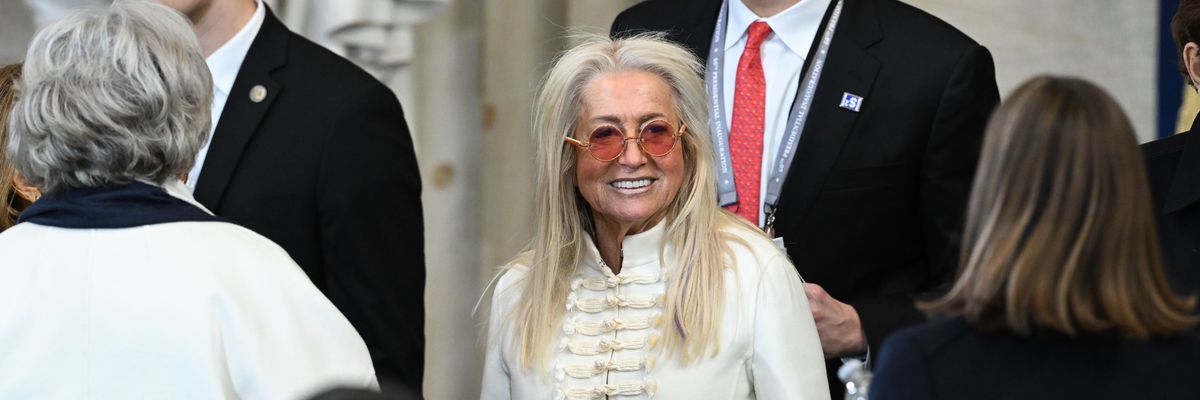
Billionaire Miriam Adelson was pictured arriving at the inauguration of US President Donald Trump on January 20, 2025.
(Photo by Saul Loeb-Pool/Getty Images)
Jake Johnson
Nov 21, 2025
COMMON DREAMS
The Post analysis reveals that the nation’s top 20 billionaire donors pumped close to $5 billion combined into the US political system between 2015 and 2024, attempting to exert influence over both state-level and national elections.
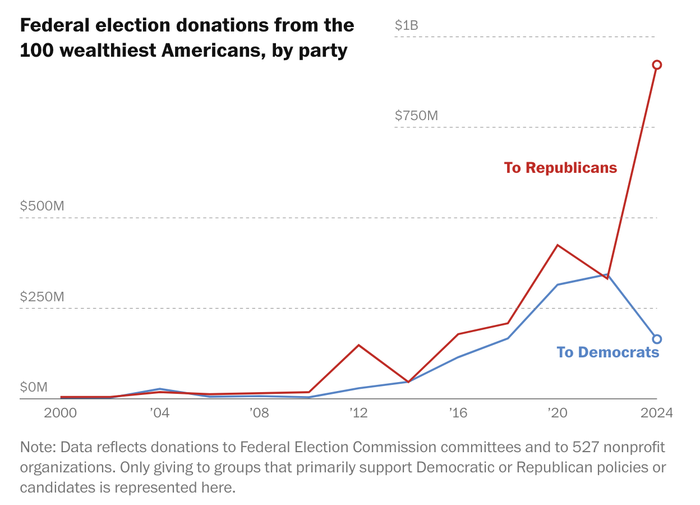
In 2024, the newspaper found, over 80% of federal campaign spending by the 100 richest Americans flowed to Republicans, who delivered once again for rich benefactors by enacting yet another round of highly regressive tax cuts this past summer.
Topping the list of billionaire donors is Miriam Adelson and her late husband Sheldon, who have spent $621 million on federal races and $37 million on state races over the past decade, mostly backing Republican campaigns—including that of President Donald Trump.
Others on the list include former New York City Mayor Michael Bloomberg, shipping magnates Richard and Elizabeth Uihlein, hedge fund manager Ken Griffin, Tesla CEO Elon Musk, and investor George Soros.
“In three landmark decisions, starting with 2010’s Citizens United vs. FEC, federal courts gutted post-Watergate campaign finance restrictions, clearing the way for donors to contribute unlimited money to elections,” the Post observed. “As a result, US politicians are more dependent on the largesse of the billionaire class than ever before, giving one-four-hundredth of 1% of Americans extraordinary influence over which politicians and policies succeed.”
Sen. Sheldon Whitehouse (D-RI) called Citizens United, which spawned the super PACs that many billionaires now use as vehicles for unrestrained election spending, “the original sin.”
“Five Supreme Court Republican appointees, many helped onto the Court by right-wing billionaires, open the floodgates for unlimited political spending,” Whitehouse wrote in a social media post on Friday. “Then they refuse to police anonymous political spending they know is corrupting. This is the result.”
Sen. Bernie Sanders (I-Vt.), who has long decried the corrupting influence of billionaire and corporate money on American politics, said the Post investigation underscores why “we must overturn Citizens United and move to the public funding of elections.”
“A majority of Americans agree: If democracy is to survive, billionaires cannot be allowed to buy elections,” Sanders added.
As part of its probe, the Post conducted a survey aimed at determining how the US public feels about billionaires using a fraction of their immense fortunes—now at a record $8 trillion—to sway elections.
The survey of 2,500 Americans, conducted in September, found that 58% have a negative view of billionaires spending more money on elections. Forty-three percent of Americans, including 62% of Democrats and 21% of Republicans, believe billionaires have a negative impact on society overall.
“I don’t believe there is an ethical way for billionaires to even exist in this country,” Leah Welde, a 29-year-old Democrat and graduate school student in Philadelphia, told the Post. “To be sitting on that amount of money while citizens in this country are unhoused, hungry, and without medical care is abhorrent. I believe in spreading wealth.”

Elites wield huge influence over deepening polarisation –– now we can tell how much
Just a handful of influential voices may be enough to drive dramatic societal rifts, according to new research from Aalto University. The study gives unprecedented insight into the social media mechanics of the partisan divide.
Aalto University
image:
The figure compares alignment across "issue pairings", CLIMATE, IMMIGRATION, ECONOMY, SOCIAL and EDUCATION between the 2019 and 2023 elections in Finland. It shows almost maximum alignment was reached amongst elites in online Twitter debate preceding the 2023 election.
view moreCredit: Ali Salloum / Aalto University
Just a handful of influential voices may be enough to drive dramatic societal rifts, according to new research from Aalto University. The study gives unprecedented insight into the social media mechanics of the partisan divide.
Political systems become polarised when internal unity within groups strengthens and the divide between them deepens. As polarisation intensifies, societal tensions can grow, making it difficult to find compromises. The intensity of polarisation has been measured in research, but until now its structural roots in social media have remained obscure.
Now, researchers from Aalto University used network theory to develop a method for measuring the impact of individuals on societal division. While the method can be applied to any case around which social media data can be gathered, the initial study utilised Twitter data collected before Finland’s 2019 and 2023 parliamentary elections. The results reveal how a relatively small elite can have a disproportionately large influence on shaping polarizing environments.
‘We know that size, or the activity level of a group or groups, don’t necessarily correlate with how divided society is on a particular issue,’ explains network scientist Ali Salloum, a doctoral researcher, and lead author of the study. ‘The method we came up with identifies the elite and the mass entirely through an algorithm –– quantifying how much each contributes to the overall divide.’
The team analysed 12 weeks of Twitter (now X) data preceding both elections, as the platform offers one of the clearest views into Finland’s digital polarisation dynamics. Based on core-periphery theory, hierarchical groups were identified, with participants classified algorithmically as elite or mass. Established community detection techniques were then used to map the location of elites on the political spectrum.
‘Not all thought leaders –– the so-called elite –– are politicians. But even without knowing exactly who they are, we can infer their status from the network’s structure. You don’t end up at the centre by accident,’ Salloum says.
According to the researchers, an elite cluster may include only a few hundred individuals, yet account for a striking share of overall polarisation. The study, recently published in Network Science, is the first to demonstrate this imbalance quantitatively.
The road to deadlock
Another key finding is that the algorithmically identified elite has become increasingly aligned in its views. Alignment refers to the likelihood that a person’s stance on one issue correlates with their opinions on other topics –– for example, in matters of climate or immigration policy.
‘In democracies, it’s healthy –– even desirable –– to disagree sharply on individual issues. But when alignment becomes complete, society splits into just two camps that disagree on absolutely everything –– there’s nothing left in common with the other side,’ says Mikko Kivelä, Professor of Computer Science at Aalto University and co-author of the study.
When hatred and suspicion towards those with different worldviews overshadow the importance of the best argument in political issues, or when interactions between people from different backgrounds dwindle, societal, and even individual well-being can significantly regress.
In the Finnish case study, it was revealed that by 2023 alignment had almost reached its zenith among elites. For example, a progressive stance on climate almost certainly meant a correspondingly progressive view on immigration, and vice versa, while conservative social views almost always paired with conservative opinions on economics. In other words, over four years, thought-leaders had become intractably siloed –– a red flag for a functioning democracy.
‘One of the most serious consequences of polarisation and alignment –– beyond the threat of political violence –– is political gridlock. Legislation slows down and weakens, poor-quality decisions are made, or no decisions are made at all,’ says Salloum.
Political pressure needed to restore access to data
Unfortunately, polarisation data can no longer be studied through X, as owner Elon Musk has restricted researchers’ access to user data. Despite this, the researchers hope to apply the method to other nations and contexts.
‘I have no reason not to assume this is a global phenomenon,’ says Salloum, for whom the next step is to study US and European data from Bluesky. However, ongoing research depends on having access to data, a point that frustrates Salloum.
‘We have seen for decades how important ‘information influence’ data like this is. It gives huge insights into mis- and dis-information, and the state of our democracies generally. Yet, one of the biggest platforms shuts down its APIs and suddenly there’s no access,’ he says.
‘It’s especially frustrating when we already know what’s inside the black box, and the value of all that data that the platforms control. By law, researchers should have access, but it’s not being followed. In my opinion, we don’t have enough political pressure directed at keeping these platforms transparent and open,’ he concludes.
The figure shows the disproportionate contribution of right and left-wing elites to polarising debate across climate, immigration, economics, social and education in the lead up to Finnish national elections in 2019.
The figure shows the disproportionate contribution of right and left-wing elites to polarising debate across climate, immigration, economics, social and education in the lead up to Finnish national elections in 2023.
Credit
Ali Salloum / Aalto University.
Journal
Network Science
Article Title
Anatomy of elite and mass polarization in social networks
Article Publication Date
20-Nov-2025

No comments:
Post a Comment