ANARCHY IS SELF ORGANIZATION
With limited resources, Palestinians in Gaza and in exile are funding community reconstruction efforts amid the absence of international aid. “We have to keep trying to help Gaza rise again,” an organizer with the Sameer Project tells Mondoweiss.
By Noor Alyacoubi
December 24, 2025
MONDOWEISS
MONDOWEISS
LONG READ
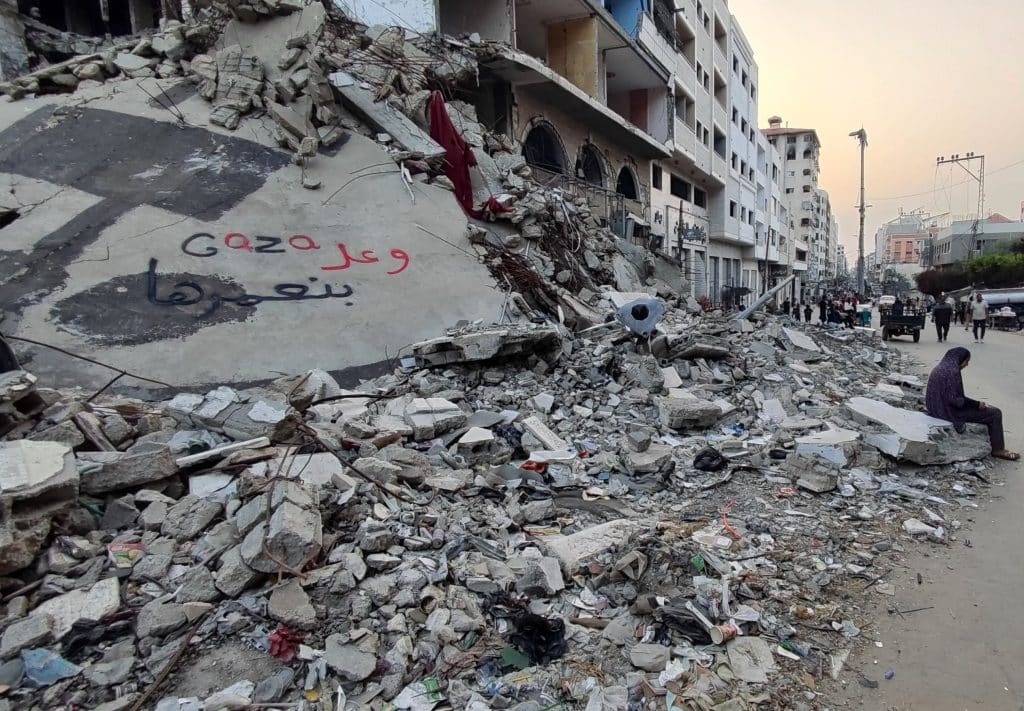
Palestinians walk in front of graffiti written in Arabic: “We will rebuild Gaza” on the wall of a building destroyed during Israeli attacks, as Israeli attacks continue since 7th October in Gaza City, Gaza Strip, on May 29, 2024. Photo by Khaled Daoud apaimages
Abu Ahmad, a displaced resident of northern Gaza, thought he would be living with some sort of roof over his head by now. Instead, he and his family remain exposed to the cold and the rain with only a threadbare tent for shelter.
“When the ceasefire was announced, I believed I would finally be able to rebuild my home, or at least get a caravan to survive the winter,” Abu Ahmad told Mondoweiss. “Instead, we only hear about plans and conferences. Nothing has actually changed.”
Abu Ahmad’s home now lies beyond the so-called Yellow Line, which cuts Gaza in half and has been progressively expanded by the Israeli army to cover larger swathes of land to fall under its control.
Almost two months into the ceasefire, international conferences on Gaza’s reconstruction and frequent promises to rebuild have so far amounted to little. According to UN estimates, 25 hospitals are out of service, nearly 70% of housing units have been partially or completely destroyed, 85% of water and sewage facilities have been damaged, and 95% of schools are reduced to rubble.
Amid these conditions, humanitarian aid and reconstruction materials have entered at rates far below the agreed-upon amounts as part of the ceasefire deal. Gazans have characterized the present humanitarian situation as a “new form of genocide.”
U.S. President Donald Trump has envisioned turning Gaza into a Middle East “Riviera,” while his 20-point “peace” plan would see Gaza run by a foreign “Board of Peace” that amounts to a Mandate-like form of colonial rule over the Strip.
Meanwhile, Egypt plans to host an international conference on Gaza’s reconstruction, estimating that $70 billion would be required to rebuild it. Qatar and other countries have also pledged support. On the ground, however, no tangible reconstruction efforts have begun, widening the gap between political statements and lived reality.
As the first phase of the ceasefire comes to an end and the second phase is supposedly looming, reconstruction remains a vague promise rather than a defined process. The agreement offers no clear mechanisms or timelines for how reconstruction would be implemented, leaving residents with little choice but to take matters into their own hands.
Abu Ahmad, a displaced resident of northern Gaza, thought he would be living with some sort of roof over his head by now. Instead, he and his family remain exposed to the cold and the rain with only a threadbare tent for shelter.
“When the ceasefire was announced, I believed I would finally be able to rebuild my home, or at least get a caravan to survive the winter,” Abu Ahmad told Mondoweiss. “Instead, we only hear about plans and conferences. Nothing has actually changed.”
Abu Ahmad’s home now lies beyond the so-called Yellow Line, which cuts Gaza in half and has been progressively expanded by the Israeli army to cover larger swathes of land to fall under its control.
Almost two months into the ceasefire, international conferences on Gaza’s reconstruction and frequent promises to rebuild have so far amounted to little. According to UN estimates, 25 hospitals are out of service, nearly 70% of housing units have been partially or completely destroyed, 85% of water and sewage facilities have been damaged, and 95% of schools are reduced to rubble.
Amid these conditions, humanitarian aid and reconstruction materials have entered at rates far below the agreed-upon amounts as part of the ceasefire deal. Gazans have characterized the present humanitarian situation as a “new form of genocide.”
U.S. President Donald Trump has envisioned turning Gaza into a Middle East “Riviera,” while his 20-point “peace” plan would see Gaza run by a foreign “Board of Peace” that amounts to a Mandate-like form of colonial rule over the Strip.
Meanwhile, Egypt plans to host an international conference on Gaza’s reconstruction, estimating that $70 billion would be required to rebuild it. Qatar and other countries have also pledged support. On the ground, however, no tangible reconstruction efforts have begun, widening the gap between political statements and lived reality.
As the first phase of the ceasefire comes to an end and the second phase is supposedly looming, reconstruction remains a vague promise rather than a defined process. The agreement offers no clear mechanisms or timelines for how reconstruction would be implemented, leaving residents with little choice but to take matters into their own hands.
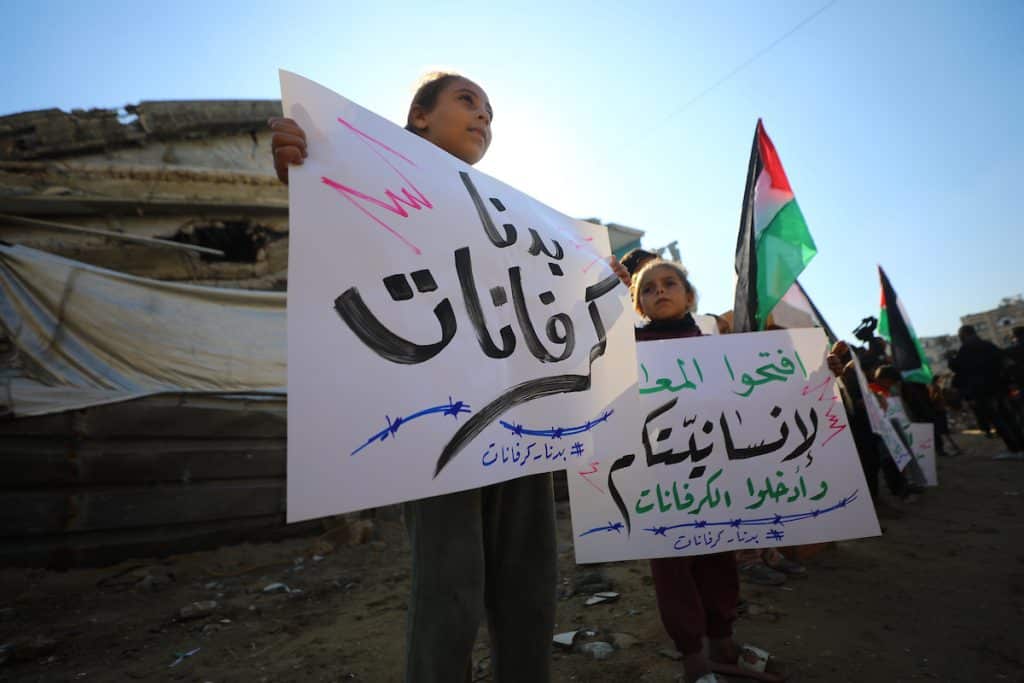
Displaced Palestinians hold a protest in front of a collapsed home in Gaza City, demanding reconstruction efforts be expedited and that mobile homes be provided instead of tents, which are unsuitable for habitation in the face of the severe cold, on December 24, 2025. (Photo: Omar Ashtawy/APA Images)
Helping Gaza rise again
In the absence of meaningful reconstruction efforts, the Municipality of Gaza launched the “We’ll Rebuild It Again” campaign on November 15—marking Palestinian Independence Day—in collaboration with the Civil Organizations Network, the Gaza Chamber of Commerce, and several voluntary youth groups.
“This campaign is part of a broader plan to rebuild Gaza through sanitation, planting, painting, reopening roads, and repairing homes,” said Ahmed Al-Dremly, Head of Public Relations and Media at the Municipality of Gaza. “We support every effort and every initiative that aims to help Gaza rise again from the rubble.”
He added that the campaign also seeks to bring youth initiatives together under one umbrella. “We aim to unite youth programs to harness their skills and energy, replant hope in people’s hearts, and prove that Gaza is still alive,” he said.
The campaign began on Omar al-Mokhtar Street, one of Gaza City’s central streets, where groups of young volunteers cleaned the area using only basic tools—brooms, dustpans, and shovels. The goal was to remove rubble, clean the street, and restore a sense of order and normalcy to the city’s public space despite the limited means available.
Al-Dremly noted that around 85 percent of the municipality’s heavy and medium machinery was damaged during the war. Still, he stressed that the lack of equipment would not halt the initiative. “Gaza will rise again through its people’s spirit and love of life and land,” he said.
In the short term, the Municipality of Gaza plans to continue the campaign on a weekly basis, moving each time to a new location across the city.
We’ll rebuild it
One of the partners in the Gaza Municipality’s “Let’s Rebuild” campaign is the Sameer Project, founded by six Gazans living in the diaspora.
“Living abroad does not mean sitting aside and waiting for the world to decide when to act and help our people in Gaza,” said Hala Sabbah, an official with the project. “We’ve waited for too long. We felt the necessity to act.”
“Gaza needs immediate support,” she added. “As civil society organizations, even simple efforts matter. No one understands Gaza’s pain better than its people. That’s why we initiated this project — because we are Gazans, and we know how Gazans suffer.”
Launched in April 2024, the Sameer Project has continuously adapted its work to meet changing needs. During the famine, the focus was on food aid. During mass displacement, it provided tents and temporary shelters. Following the ceasefire, priorities shifted toward reopening blocked roads and salvaging damaged homes.
Two weeks after the ceasefire began, Sabbah and her team launched the “Hand in Hand, Let’s Rebuild It” campaign, responding to residents’ inability to return to their homes in northern Gaza, where streets and entrances remain buried under the rubble.
“We knew this work required heavy machinery and proper equipment,” Sabbah said. “But that doesn’t mean we do nothing. Any step that relieves people’s pain matters.”
“It’s a drop in the ocean. The level of destruction is beyond anything normal.”Hala Sabbah, the Sameer Project
Using every available resource — shovels, wheelbarrows, a limited number of bulldozers, brooms, and above all, youthful determination — the project mobilized at least 100 volunteers, including engineers, journalists, and students. So far, three main streets in Gaza City, Khan Younis, and the Abu Eskandar area have been cleared and reopened, easing the movement of people and vehicles.
Priority was given to roads that allow access for water trucks and basic services. “Water is a basic need for everyone in Gaza,” Sabbah said. “When we open a road, we make sure water trucks can pass. This alone can ease people’s daily suffering.”
Despite these efforts, Sabbah stressed that what they are doing addresses only a fraction of Gaza’s needs. “It’s a drop in the ocean,” she said. “The level of destruction is beyond anything normal.”
According to the UN Development Programme, rebuilding Gaza would cost around $40 billion, generate 40 million tons of rubble, and take up to 80 years if current Israeli restrictions remain in place.
A major obstacle is the severe lack of equipment. “We can’t operate across the entire Strip,” Sabbah explained. “Most heavy machinery was destroyed during the war.”
Local estimates indicate that Israeli bombardment deliberately targeted bulldozers and other heavy equipment, leaving only a very limited number of functioning machines in Gaza, mostly owned by private companies. In 2025, Israel permitted a limited number of machines to enter the Strip under specific sponsorship arrangements. The Government Media Office estimates that at least 500 heavy and medium machines are needed to support reconstruction efforts.
Fuel shortages further complicate the work. Since the ceasefire, Israel has allowed only 5–6 fuel trucks per day, covering roughly 10% of Gaza’s actual needs, despite pledges to allow 50–60 trucks daily. As a result, fuel prices have soared, with gasoline reaching 120 ILS ($37) per liter and diesel nearly 60 ILS (almost $14).
Alongside road clearance, the Sameer Project works to salvage partially damaged homes and turn them into temporary shelters when possible. “The first step is always checking the foundations,” Sabbah said. “We work with field engineers to make sure homes are safe.”
“So far, at least 62 homes have been cleared of rubble and partially repaired using wooden poles and plastic sheets,” she added. “They’re not ideal, but they’re safer than tents.”
In cases where foundations are unsafe, repairs are refused. Families are instead provided with tents erected beside their homes and warned not to return inside. According to Gaza’s Interior Ministry, at least 12 previously damaged homes collapsed during recent storms, killing eight people, including children.
One volunteer with the Sameer Project lost five family members when their home collapsed during the storm.
Beyond physical reconstruction, the initiative also considers the psychological toll of displacement. “People feel safer when they are close to their homes, even if those homes are destroyed,” Sabbah said. “We want to help them stay connected to their land, neighbours, and communities.”
As winter intensifies, the project has expanded its response to flooded camps. In addition to reopening roads and repairing homes, volunteers have delivered sand trucks to raise tents above ground level and prevent water from flooding shelters.
“So far, at least 35 sand trucks have been provided to stabilize makeshift camps and prevent water accumulation,” Sabbah told Mondoweiss.
Grassroots efforts extend beyond rubble removal. The youth-led “Ele Elna Elak” campaign recently established a desalination plant serving camps in northern Gaza. Commenting on the initiative, content creator Bissan Ouda said, “This achievement, accomplished with almost no resources, is like digging through rock.”
More funds, wider impact
With international funding largely stalled, these initiatives rely almost entirely on online fundraising, informal networks, and community trust. For the Sameer Project, social media platforms — primarily Instagram, X, and TikTok — have become the main channels for raising donations and reaching supporters outside Gaza.
Despite the scale of their work and its direct impact on people’s lives, fundraising has become increasingly difficult. Hala Sabbah told Mondoweiss that donations dropped sharply after the ceasefire, as many outside Gaza assumed the war had ended.
“Donations were reduced by nearly half,” Sabbah said. “That’s why we started posting more urgent content—scenes of daily struggle, flooded tents, and people trying to survive.”
She explained that limited media coverage of Gaza’s post-ceasefire reality has made these efforts even harder. “We were told many times that what we share is not widely shown on social media,” she said, referring to the lack of visibility of continued displacement and worsening living conditions.
This invisibility, she added, sometimes turns into doubt. “Some people even question our transparency,” Sabbah said. “That directly affected donations and slowed our work, especially before the recent storm.”
According to Sabbah, this skepticism stems from a widespread belief outside Gaza that the war is over. “People don’t always believe the scenes we share—families living in torn tents or children chasing food in the streets,” she said.
However, after images of flooded camps circulated during the recent storm, donations increased slightly. “People began to trust what we were showing again,” she added.
Still, Sabbah stressed that the war has not ended, but continues in different forms. “The suffering didn’t stop,” she said. “It only changed shape.”
She renewed her appeal for urgent support. “Despite closed crossings, Israeli restrictions, and the lack of equipment, we can’t stand aside and do nothing,” she said. “We have to keep trying to help Gaza rise again.”
“It won’t return to what it was anytime soon,” she added, “but we can help people regain some dignity and stability.”
Alongside the Sameer Project, other youth-led initiatives face similar challenges. One example is the Samir Foundation, led by Izzeddin Lulu, a medical student from Gaza who lost 20 members of his family, including his father–after whom he named his foundation, and older brother alongside his family.
The foundation depends on online campaigns, partnerships with sponsors, and collaboration with charitable organizations. Lulu maintains a strong presence on social media, sharing his personal experience and the foundation’s humanitarian mission. In addition, a network of ambassadors in several countries organizes awareness and fundraising campaigns in universities and international forums.
Through these efforts, the foundation has built partnerships with regional and international donors to support programs ranging from scholarships and financial aid for medical students to investments in educational and health infrastructure.
In June 2025, the Samir Foundation inaugurated Gaza’s first-of-its-kind medical hub in partnership with Human Smile, a Belgium-based humanitarian organization. The hub provides uninterrupted electricity, high-speed internet, and a stable learning environment—offering students an alternative to studying by candlelight in overcrowded shelters.
Despite global delays and the ongoing stagnation of Gaza’s reconstruction, youth-led and grassroots initiatives continue to turn resilience into action. With limited tools and shrinking resources, people rebuild not because conditions allow it, but because survival leaves them no other choice.

No comments:
Post a Comment