Trump and Congress Just Gifted Big Oil a Multimillion Dollar Stocking Stuffer
By allowing an industry tax toward oil spill prevention and response to expire, GOP leaders are exposing the nation to the unnecessary risk of continued oil pollution, including major disasters like Exxon Valdez and Deepwater Horizon.
By allowing an industry tax toward oil spill prevention and response to expire, GOP leaders are exposing the nation to the unnecessary risk of continued oil pollution, including major disasters like Exxon Valdez and Deepwater Horizon.
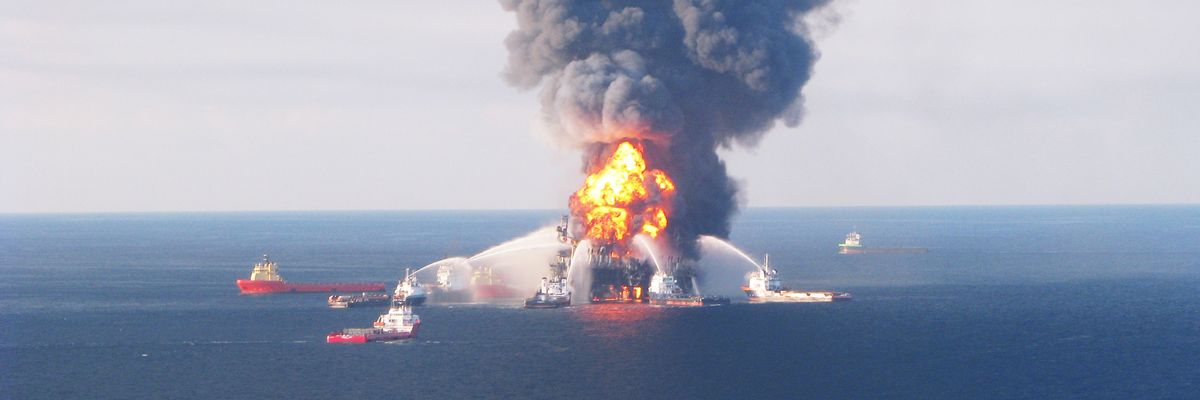
Fire boats battle a fire at the offshore oil rig Deepwater Horizon on April 21, 2010 in the Gulf of Mexico off the coast of Louisiana.
(Photo by US Coast Guard via Getty Images)
Rick Steiner
Dec 19, 2025
Dec 19, 2025
Common Dreams
As Congress recesses this week without reauthorizing the Affordable Care Act subsidies needed by millions of Americans, it also quietly gave the oil industry a multimillion dollar tax break by allowing the 9 cent-per-barrel oil tax (on domestic and imported oil) into the federal Oil Spill Liability Trust Fund to expire as well on December 31. The OSLTF, administered by the Coast Guard’s National Pollution Funds Center, is the nation’s central financial instrument for oil spill prevention and response, earning about $500 million per year from the nominal excise oil tax—about 0.1% of annual US oil industry revenue.
In our current political climate prioritizing industry over public interest, many feared that Congress and the Trump administration might simply allow the oil spill tax to expire, as a “Return on Investment” for industry contributions made to their political campaigns. Congress did just that. As they increase costs for millions of Americans, the Republican congress and administration are decreasing costs for some of the richest companies in the world.
As Congress recesses this week without reauthorizing the Affordable Care Act subsidies needed by millions of Americans, it also quietly gave the oil industry a multimillion dollar tax break by allowing the 9 cent-per-barrel oil tax (on domestic and imported oil) into the federal Oil Spill Liability Trust Fund to expire as well on December 31. The OSLTF, administered by the Coast Guard’s National Pollution Funds Center, is the nation’s central financial instrument for oil spill prevention and response, earning about $500 million per year from the nominal excise oil tax—about 0.1% of annual US oil industry revenue.
In our current political climate prioritizing industry over public interest, many feared that Congress and the Trump administration might simply allow the oil spill tax to expire, as a “Return on Investment” for industry contributions made to their political campaigns. Congress did just that. As they increase costs for millions of Americans, the Republican congress and administration are decreasing costs for some of the richest companies in the world.

‘Radical and Reckless’: House Passes LNG Bill to Jack Up Climate Pollution and Energy Prices
For decades, Congress and the administration have remained stubbornly resistant to using the OSLTF to fund necessary oil spill prevention measures across the nation, and as tax revenue and spill damage recoveries continued to be collected, the fund balance has now grown to over $10 billion. Since the fund’s use for a single oil spill is limited to $1.5 billion, we have long proposed that a substantial portion of the remaining balance be used to better prevent oil pollution across the nation. Instead of just leaving all of this money in the bank, it should be put to work, while saving enough (perhaps $5 billion) for conventional oil spill response activities.
A transcendent lesson learned in all major oil spills around the world is that once oil is spilled, there is precious little that can be done to limit environmental damage. Historically, an average of 2-6% of total spill volume is actually recovered in major marine oil spills (Deepwater Horizon was about 4%, Exxon Valdez about 8%). These multibillion dollar spill responses may look good for oil company and government public relations, but they are virtually irrelevant in limiting environmental harm. Prevention is key to environmental protection.
As a fundamental cause of the 1989 Exxon Valdez and the 2010 Deepwater Horizon disasters was inadequate government oversight, expanding drilling while cutting oversight is as reckless as it gets.
Spill prevention measures across the nation in need of more funding include enhanced Vessel Traffic Systems, escort-rescue tugs to prevent groundings and collisions of tankers and cargo ships in dangerous passages (e.g. the March 2024 cargo ship Dali collision with the Francis Scott Key bridge in Baltimore Harbor), enhanced inspection of oil and liquefied natural gas tankers, and so on. However, the federal government has resisted using the fund for such preventive measures.
With the OSLTF tax expiration approaching this summer, we proposed that the fund’s 9 cent-per-barrel tax on domestic and imported crude oil (less than 0.2% of today’s crude oil price, or less than one cent-per-gallon of gasoline) be fully reauthorized, and that the fund’s use for many oil spill prevention measures be significantly expanded. Congress and the administration were unresponsive, raising suspicions that they intended to allow the oil tax to expire, which they just did.
One proposed use for the fund is to safely cap and decommission the millions of derelict, abandoned oil and gas wells across the nation, both onshore and offshore. Regarding these orphaned and abandoned oil wells, a 2021 scientific paper found that, of the 4,700,000 historic and active oil and gas wells across the US, only 1 in 3 (1,500,000) are considered safely plugged. Leakage from improperly abandoned oil and gas wells causes groundwater and air pollution, ecological damage, risk of explosions, and damage to human health.
Costs for well decommissioning and abandonment have been estimated to range from $10,000-$50,000 to plug old, shallow wells; $300,000 for newer, deeper wells; and up to $1 million for more complex wells. In a 2015 study, the Government Accountability Office (GAO) estimated the cost to securely decommission the thousands of deepwater oil and gas wells in the US Gulf of Mexico (two-thirds of the 5,000 wells in the Gulf of Mexico are in deep water) at $38.2 billion. The GAO study reported that, of the $38.2 billion in decommissioning liabilities, $2.3 billion were not covered by existing financial assurances; and of the remaining $35.9 billion in decommissioning liabilities, the federal government held $2.9 billion in bonds and other assurances, while waiving the remaining $33 billion for companies that passed a “financial strength test.” The GAO expressed concern about such extensive waivers of financial assurances, as this exposes the federal government to substantial future costs.
Clearly, abandoned oil and gas wells present enormous oil pollution risk, public safety hazard, and substantial government financial liability that we as a nation have ignored for too long. We have to do better, and using the OSLTF for this purpose would clearly be in the national interest.
Further, while the Trump administration recently proposed opening virtually the entire US Outer Continental Shelf (more than 1 billion acres of the nation’s offshore waters) to oil and gas drilling, it slashed the budget for the Department of Interior’s Bureau of Safety and Environmental Enforcement (BSEE) by roughly 35%, from $220 million to just $143 million. As a fundamental cause of the 1989 Exxon Valdez and the 2010 Deepwater Horizon disasters was inadequate government oversight, expanding drilling while cutting oversight is as reckless as it gets. Thus, an important use for the federal oil spill fund should be to expand BSEE’s budget, as it is largely focused on preventing catastrophic oil spills from the nation’s several thousand offshore oil rigs. There are countless other cost-effective pollution prevention measures as well that need OSLTF funding.
But with Congress and the Trump administration ignoring these real funding needs, and allowing the oil tax to expire (as a gift to their oil industry contributors), the nation remains exposed to unnecessary risk of continued oil pollution, including small chronic releases, as well as major disasters like the Exxon Valdez and Deepwater Horizon. So much for “government efficiency.” Hopefully Congress will come to its senses in 2026, and fix what it just broke.
11 House Democrats Help GOP Pass ‘Disastrous’ Pro-Polluter Permitting Bill
“The SPEED Act protects corporate interests, not the public, and it should be rejected by any senator who claims to stand with the people,” said one campaigner.

Climate activists march across the Brooklyn Bridge to demand that Democratic New York Gov. Kathy Hochul stop the construction of the Williams Pipeline.
(Photo by Michael Nigro/Pacific Press/LightRocket via Getty Images)
Jessica Corbett
Dec 18, 2025
“The SPEED Act protects corporate interests, not the public, and it should be rejected by any senator who claims to stand with the people,” said one campaigner.
Climate activists march across the Brooklyn Bridge to demand that Democratic New York Gov. Kathy Hochul stop the construction of the Williams Pipeline.
(Photo by Michael Nigro/Pacific Press/LightRocket via Getty Images)
Jessica Corbett
Dec 18, 2025
COMMON DREAMS
Eleven Democrats on Thursday voted with nearly all Republicans in the US House of Representatives to advance a permitting reform bill that climate and frontline organizations warn is a “disastrous” attack on a landmark environmental protection law.
Democratic Reps. Jim Costa (Calif.), Henry Cuellar (Texas), Don Davis (NC), Chris Deluzio (Pa.), Lizzie Fletcher (Texas), Jared Golden (Maine), Vicente Gonzalez (Texas), Adam Gray (Calif.), John Mannion (NY), Marie Gluesenkamp Perez (Wash.), and Marc Veasey (Texas) voted with all Republicans present expect Rep. Brian Fitzpatrick (Pa.) to pass the bill.
The Standardizing Permitting and Expediting Economic Development (SPEED) Act, spearheaded by Golden and House Committee on Natural Resources Chair Bruce Westerman (R-Ark.), would amend the National Environmental Policy Act (NEPA), which “is often called the ‘Magna Carta’ of federal environmental laws.”
In a statement after the vote, Food & Water Watch legal director Tarah Heinzen said that “for decades, NEPA has ensured logical decision-making and community involvement when the federal government considers projects that could harm people and the environment. The SPEED Act would eviscerate NEPA’s protections.”
The group detailed key ways in which the SPEED Act attacks NEPA:Drastically limiting NEPA’s scope of review: Removes many actions from NEPA review altogether, potentially allowing factory farms and coal plants to build and expand without any environmental review or public input;
Limiting agency accountability: Creates unreasonably short deadlines to challenge inadequate reviews, and limits courts’ ability to stop unlawful projects; and
Putting polluter profits above science and the environment: Turns NEPA on its head by requiring agencies to prioritize corporate interests over the public interest and limiting their ability to consider the best science.
“Today’s absurd House vote is yet another handout to corporate polluters at the expense of everyday people who have to live with the real-world impacts of toxic pollution from dirty industries like fossil fuels and factory farms,” Heinzen argued. “This nonsense must be dead on arrival in the Senate.”
Other campaigners also looked to the upper chamber after the vote. Erik Schlenker-Goodrich, executive director of the Western Environmental Law Center, said that “renewable energy and climate advocates in the Senate must hold the line against the SPEED Act’s evisceration of our bedrock environmental and community protection law.”
Allie Rosenbluth, Oil Change International’s US campaign manager, stressed that “our senators must stand up against the SPEED Act’s attempts to undermine democratic decision-making, pollute our communities, and threaten our collective future.”
For a Better Bayou’s James Hiatt similarly said that “the SPEED Act protects corporate interests, not the public, and it should be rejected by any senator who claims to stand with the people.”
Anthony Karefa Rogers-Wright, co-coordinator of Black Alliance for Peace’s Climate, Environment, and Militarism Initiative, warned that the bill “represents yet another assault on the health of frontline, Black, Brown, Indigenous, and poor white communities that have been designated as sacrifice zones by big polluters who bribe lawmakers with big money to continue a culture of extract, slash, burn, and emit at the expense of oppressed and marginalized peoples.”
“Rather than speeding up the approval of dirty projects, Congress should increase funding for federal agencies and grassroots organizations accountable to frontline communities to carry out legally defensible and accurate environmental analyses,” he continued, pointing to the Environmental Justice for All Act, previously led by the late Democratic Congressmen Raúl Grijalva (Ariz.) and Donald McEachin (Va.).
Mar Zepeda Salazar, legislative director at Climate Justice Alliance, also pointed to that alternative: “The SPEED Act fast-tracks harmful fossil fuel and polluting projects, not the community-led clean energy solutions families and Indigenous peoples across the country have long called for. Instead of pushing the SPEED Act—a bill that would strip away what few legal protections communities still have, weaken safeguards for clean air, land, and water near new industrial development, and sidestep meaningful consultation with federally recognized tribal nations—Congress should be advancing real, community-driven permitting reform.”
“Examples include the Environmental Justice for All Act, which lays out meaningful public engagement, strong public health protections, respect for tribal sovereignty and consultation obligations, and serious investments in agencies and staff,” she said.
Representatives from the Institute for Policy Studies, Sacred Places Institute for Indigenous Peoples, and Unitarian Universalists for Social Justice also spoke out against what David Watkins, director of government affairs for the Climate and Energy Program at the Union of Concerned Scientists, condemned as “a sizable holiday gift basket for Big Oil and Gas.” He, too, urged the Senate to “reject this retrograde legislation and stand up to the deep-pocketed, polluting industries lobbying for it.”
Lauren Pagel, policy director at Earthworks, pointed out that passing the SPEED Act wasn’t the only way in which the House on Thursday “chose corporate interests over people, Indigenous Peoples’ rights, and our environment.” It also passed the Mining Regulatory Clarity Act, which “will remove already-scarce protections for natural resources and sacred cultural sites in US mining law.”
“Today’s House votes are a step backwards for our nation, but we continue to stand firm for the rights of the people and places on the frontlines of oil, gas, and mining,” Pagel said. “Communities and ecosystems shouldn’t pay the price while corporations rush to profit off extraction—with a helping hand from our elected officials.”
Along with those two pieces of legislation, Public Citizen pointed to the House’s approval of the Power Plant Reliability Act and Reliable Power Act earlier this week. David Arkush, director of the consumer advocacy group’s Climate Program, said that the bills advancing through Congress “under the guise of ‘bipartisan permitting reform’ are blatant handouts to the fossil fuel and mining industries.”
“We need real action to lower energy bills for American families and combat the climate crisis,” Arkush asserted, calling on congressional Republicans and President Donald Trump “to fast-track a buildout of renewable energy, storage, and transmission—an approach that would not just make energy more affordable and sustainable, but create US jobs and bolster competitiveness with China, which is rapidly outpacing the US on the energy technologies of the future.”
Eleven Democrats on Thursday voted with nearly all Republicans in the US House of Representatives to advance a permitting reform bill that climate and frontline organizations warn is a “disastrous” attack on a landmark environmental protection law.
Democratic Reps. Jim Costa (Calif.), Henry Cuellar (Texas), Don Davis (NC), Chris Deluzio (Pa.), Lizzie Fletcher (Texas), Jared Golden (Maine), Vicente Gonzalez (Texas), Adam Gray (Calif.), John Mannion (NY), Marie Gluesenkamp Perez (Wash.), and Marc Veasey (Texas) voted with all Republicans present expect Rep. Brian Fitzpatrick (Pa.) to pass the bill.
The Standardizing Permitting and Expediting Economic Development (SPEED) Act, spearheaded by Golden and House Committee on Natural Resources Chair Bruce Westerman (R-Ark.), would amend the National Environmental Policy Act (NEPA), which “is often called the ‘Magna Carta’ of federal environmental laws.”
In a statement after the vote, Food & Water Watch legal director Tarah Heinzen said that “for decades, NEPA has ensured logical decision-making and community involvement when the federal government considers projects that could harm people and the environment. The SPEED Act would eviscerate NEPA’s protections.”
The group detailed key ways in which the SPEED Act attacks NEPA:Drastically limiting NEPA’s scope of review: Removes many actions from NEPA review altogether, potentially allowing factory farms and coal plants to build and expand without any environmental review or public input;
Limiting agency accountability: Creates unreasonably short deadlines to challenge inadequate reviews, and limits courts’ ability to stop unlawful projects; and
Putting polluter profits above science and the environment: Turns NEPA on its head by requiring agencies to prioritize corporate interests over the public interest and limiting their ability to consider the best science.
“Today’s absurd House vote is yet another handout to corporate polluters at the expense of everyday people who have to live with the real-world impacts of toxic pollution from dirty industries like fossil fuels and factory farms,” Heinzen argued. “This nonsense must be dead on arrival in the Senate.”
Other campaigners also looked to the upper chamber after the vote. Erik Schlenker-Goodrich, executive director of the Western Environmental Law Center, said that “renewable energy and climate advocates in the Senate must hold the line against the SPEED Act’s evisceration of our bedrock environmental and community protection law.”
Allie Rosenbluth, Oil Change International’s US campaign manager, stressed that “our senators must stand up against the SPEED Act’s attempts to undermine democratic decision-making, pollute our communities, and threaten our collective future.”
For a Better Bayou’s James Hiatt similarly said that “the SPEED Act protects corporate interests, not the public, and it should be rejected by any senator who claims to stand with the people.”
Anthony Karefa Rogers-Wright, co-coordinator of Black Alliance for Peace’s Climate, Environment, and Militarism Initiative, warned that the bill “represents yet another assault on the health of frontline, Black, Brown, Indigenous, and poor white communities that have been designated as sacrifice zones by big polluters who bribe lawmakers with big money to continue a culture of extract, slash, burn, and emit at the expense of oppressed and marginalized peoples.”
“Rather than speeding up the approval of dirty projects, Congress should increase funding for federal agencies and grassroots organizations accountable to frontline communities to carry out legally defensible and accurate environmental analyses,” he continued, pointing to the Environmental Justice for All Act, previously led by the late Democratic Congressmen Raúl Grijalva (Ariz.) and Donald McEachin (Va.).
Mar Zepeda Salazar, legislative director at Climate Justice Alliance, also pointed to that alternative: “The SPEED Act fast-tracks harmful fossil fuel and polluting projects, not the community-led clean energy solutions families and Indigenous peoples across the country have long called for. Instead of pushing the SPEED Act—a bill that would strip away what few legal protections communities still have, weaken safeguards for clean air, land, and water near new industrial development, and sidestep meaningful consultation with federally recognized tribal nations—Congress should be advancing real, community-driven permitting reform.”
“Examples include the Environmental Justice for All Act, which lays out meaningful public engagement, strong public health protections, respect for tribal sovereignty and consultation obligations, and serious investments in agencies and staff,” she said.
Representatives from the Institute for Policy Studies, Sacred Places Institute for Indigenous Peoples, and Unitarian Universalists for Social Justice also spoke out against what David Watkins, director of government affairs for the Climate and Energy Program at the Union of Concerned Scientists, condemned as “a sizable holiday gift basket for Big Oil and Gas.” He, too, urged the Senate to “reject this retrograde legislation and stand up to the deep-pocketed, polluting industries lobbying for it.”
Lauren Pagel, policy director at Earthworks, pointed out that passing the SPEED Act wasn’t the only way in which the House on Thursday “chose corporate interests over people, Indigenous Peoples’ rights, and our environment.” It also passed the Mining Regulatory Clarity Act, which “will remove already-scarce protections for natural resources and sacred cultural sites in US mining law.”
“Today’s House votes are a step backwards for our nation, but we continue to stand firm for the rights of the people and places on the frontlines of oil, gas, and mining,” Pagel said. “Communities and ecosystems shouldn’t pay the price while corporations rush to profit off extraction—with a helping hand from our elected officials.”
Along with those two pieces of legislation, Public Citizen pointed to the House’s approval of the Power Plant Reliability Act and Reliable Power Act earlier this week. David Arkush, director of the consumer advocacy group’s Climate Program, said that the bills advancing through Congress “under the guise of ‘bipartisan permitting reform’ are blatant handouts to the fossil fuel and mining industries.”
“We need real action to lower energy bills for American families and combat the climate crisis,” Arkush asserted, calling on congressional Republicans and President Donald Trump “to fast-track a buildout of renewable energy, storage, and transmission—an approach that would not just make energy more affordable and sustainable, but create US jobs and bolster competitiveness with China, which is rapidly outpacing the US on the energy technologies of the future.”

No comments:
Post a Comment