Vancouver Pushes Forward with Controversial Roberts Bank Terminal 2 Project
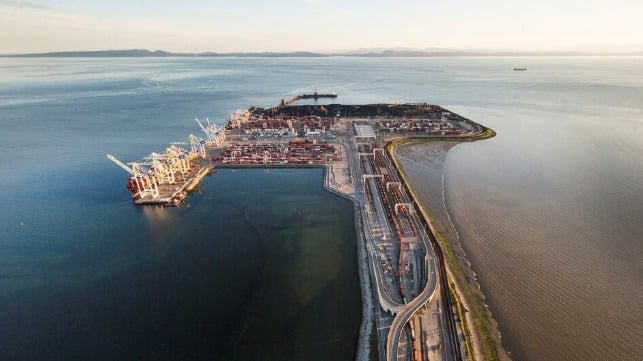
The Vancouver Fraser Port Authority is taking the next key step in its plans to add a major new container terminal to expand Vancouver’s capacity and efficiency. They announced that the search has begun for a contractor for the mega terminal with the goal of selecting a firm with the financial and technical expertise to undertake the massive project by the end of this year.
While the controversial Roberts Bank Terminal 2 (RBT2) project continues to face obstacles, the port authority is pursuing a major step in the implementation of the $3.5 billion project. Implementation of the project has faced unending opposition since its approval by the Canadian government in April 2024.
RBT2 entails the construction of a new man-made island and a three-berth marine container terminal near existing port terminals at Roberts Bank in Delta, B.C. When completed, the terminal is designed to deliver an additional 2.4 million TEU of capacity, ultimately increasing Canada’s west coast container capacity by approximately one-third.
Promoted as a game changer for the port of Vancouver’s long-term growth plans, RBT2 is expected to bolster Canada’s national supply-chain resilience and deliver significant economic benefits. These include more than 18,000 jobs during construction, more than 17,300 ongoing jobs, and support for trade diversification goals by unlocking over $100 billion in new trade capacity and contributing $3 billion in gross domestic product annually.
Since the project was first announced, it has faced opposition from local groups and environmentalists. Last year, several conservationist groups filed a suit opposing its implementation on the basis that it poses adverse risks to endangered species.
Despite the opposition, the port authority is advancing implementation of the massive project that includes the delivery of an approximately 100-hectare marine landmass, a 35-hectare widened causeway, a 1,300-meter wharf structure and berth pocket, and an expanded tug basin. The contract also includes the construction of a marine terminal fish passage to support juvenile salmon migration, and the civil works for onsite habitat enhancement and the South Arm Jetty Tidal Marsh project.
Interested companies have until the end of September to present the bids, with the port authority intending to shortlist three companies before the end of November. They will then be invited to submit a proposal.
“To meet Canada’s needs in today’s quickly evolving trade landscape, we have accelerated our efforts to deliver Roberts Bank Terminal 2, a project that will strengthen Canada’s economic security and deliver trade resilience,” said Victor Pang, Vancouver Fraser Port Authority CFO. “The terminal will be a catalyst for economic transformation nationally, from supporting Prairie grain exports and B.C.’s forestry sector, to communities who depend on reliable and affordable access to essential goods on store shelves.”
Construction of the terminal is planned to begin in 2028 and is expected to be in operation by the mid-2030s. Conceived in 2013, RBT2 has been marketed as a critical infrastructure project addressing challenges as Canadian ports are forecast to hit peak capacity by the early 2030s.
The Port of Vancouver remains Canada's gateway to diverse markets, enabling trade of approximately $300 billion with up to 170 countries annually. This makes the Pacific Gateway the country’s most important trade corridor. Last year, a record 158 million metric tonnes (MMT) of cargo moved through the port, a five percent increase from 150 MMT recorded in 2023.
The West Coast is projected to play an increasing role in Canada’s future trade as it looks to build ties to Asia. Canada looks to build new international opportunities, which kicked off this month with the opening of its first LNG export terminal north of Vancouver and which will be used to supply Asian customers.
Syria's New Rulers Hand Operatorship of Port of Tartus to DP World
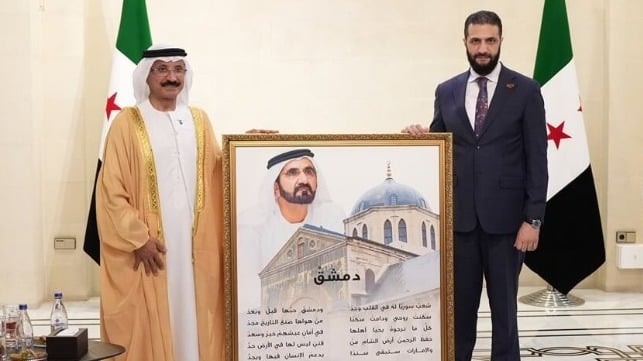
After booting out the previous Russian operator of the port of Tartus, the newly-installed government of Syria has handed its operation to blue-chip ports concessionaire DP World. The announcement follows just five days after the U.S. formally lifted its longstanding Foreign Terrorist Organization (FTO) designation on Syria's current rulers, the former jihadist militia Hay’at Tahrir al-Sham (HTS), also known as al-Nusrah Front.
The new concession agreement between the HTS-led government's port authority and DP world will bring in $800 million in investment in the facility's infrastructure. The country's decade-long civil war and stringent Western sanctions prevented any major revamps under the previous operator, and the fresh support will help modernize the port. According to DP World, it will become a regional trade hub connecting Europe, the Mideast and North Africa.
The deal with DP World is a new high point for Syria's post-revolution economic revival. In early December, the U.S.-designated terror group Hay'at Tahrir al-Sham (HTS) ousted Syrian dictator Bashar al-Assad, along with Assad's Russian and Iranian backers. Under Assad, Syria had awarded a 49-year operating lease for Tartus to Stroytransgaz, an oil and gas construction company based in Moscow; HTS canceled that contract shortly after taking power, and it curtailed the Russian Navy's port access as well.
Ahmed Al-Sharaa, the former al-Qaeda member who led HTS to victory over Assad last year, was present at the signing ceremony with DP World this weekend. Al-Sharaa - who has renounced the global jihadist movement - had previously met in person with President Donald Trump to press the case for normalized relations with Syria; the lifting of the terrorist-group designation on his group was supported by the government of the UAE, which owns DP World.
Hamburg to Invest €1.1B to Expand Port and Modernize Operations for Growth
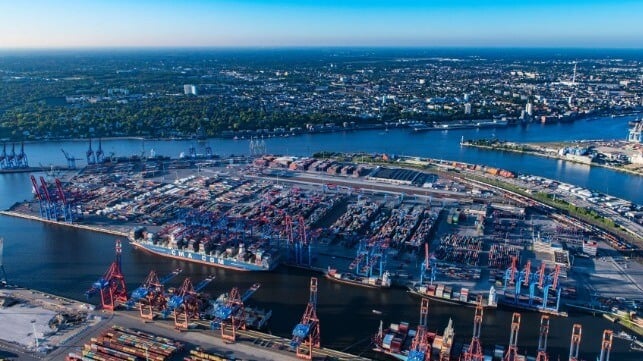
The Port of Hamburg announced a series of new projects that will be undertaken to enhance operations and modernize and expand terminal operations, especially for the largest containerships. It comes as the port continues to experience strong competition and needs to support the growth in the size of containerships.
"Today, we are laying the groundwork to ensure that Hamburg is well-prepared to meet the challenges of tomorrow,” said Hamburg’s Minister for Economic Affairs, Senator Dr Melanie Leonhard. “This infrastructure will help ensure that large vessels will be handled reliably and efficiently in the Port of Hamburg. It also strengthens Hamburg's service capacity and reinforces its role as a key hub on major international shipping routes."
The Elbe approach to the Waltershofer Hafen is to be enhanced to accommodate the largest containerships. The port highlights that around 90 percent of the ultra-large container vessels calling at Hamburg are currently handled at the Waltershofer Hafen.
The turning basin will be widened from its current 480 meters to 600 meters (1,575 feet to 1,968 feet). Port officials explained that vessels will have a larger water surface available for turning maneuvers, ensuring optimal performance and safety. They said it will enhance navigational safety and operational efficiency for current and future vessel sizes at Hamburg’s busiest container throughput area, while improving navigability and resilience along the River Elbe. All berths in the Waltershofer Hafen will benefit from this measure, which is expected to increase throughput efficiency.
Navigation towards the port’s two other large container terminals, Container Terminals Buchardkai (CTB) and Container Terminal Hamburg (CTH), will also be easier and faster.
The creation of additional berths will also improve terminal workflows, the operators noted. They said going forward, processes can be automated and electrified. The project will also provide for additional terminal yards. New land for terminal operations will create additional capacity and enable further modernization of container throughput operations.
"The urgently needed expansion of the turning basin, along with the enlargement and modernization of throughput facilities, are key decisions that will help secure a positive future for the Port of Hamburg,” said Tom Eckelmann, Managing Director of EUROKAI and Chairman of the Group Management Board of EUROGATE. “With the enlargement and modernization, we are initiating the transition from manual operations to an automated terminal concept at the Hamburg site. We will design superstructure, heavy equipment, and IT infrastructure, starting with the existing terminal, to support a fully automated throughput system across the entire terminal, including the expansion area.”
The bulk of the project will be completed with public funding. Preliminary estimates indicate a total cost in the region of EUR 1.1 billion (nearly $1.3 billion). The infrastructure works are to be completed by the Hamburg Port Authority (HPA) by the mid-2030s.
In addition to the public investment, Eurogate has signed a preliminary lease agreement for the new areas and will invest at least EUR 700 million ($820 million) in expanding the existing container terminal, with completion planned within two years of the handover of the newly developed land. It will lease the land from the Hamburg Port Authority, and these areas will be integrated into the road and rail networks. The area will be created by infilling the existing basin along the Bubendey bank.

No comments:
Post a Comment