Saturday, February 08, 2020

Proposed hydropower dams pose threat to Gabon's fishes
Proposed hydropower dams pose threat to Gabon's fishes
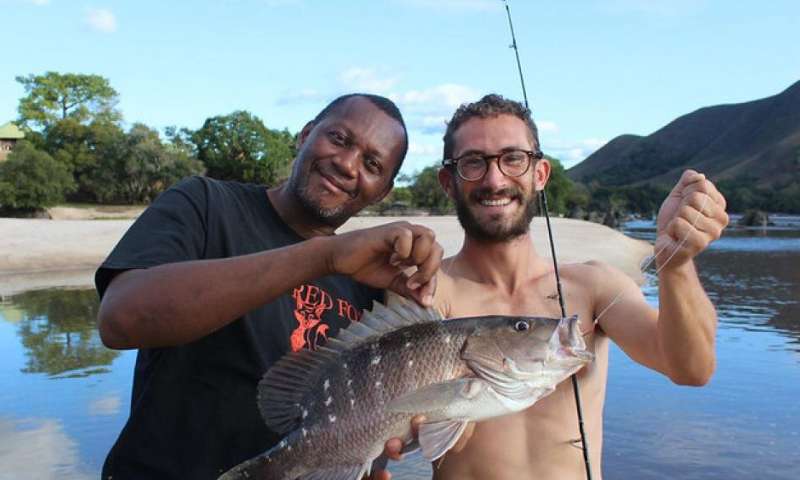
Researcher Joe Cutler (right) poses with a Guinea snapper he collected at Lope National Park in Gabon. This fish was collected farther upstream than any other marine-associated fishes in Gabon. Photo by Megan Sixt.
Proposed hydropower dams in Gabon pose a substantial threat to the African nation's most culturally and economically important fishes, according to a new study.
The study, published today in the journal Ecosphere, is the first of its kind to predict the distribution of fishes throughout central African freshwaters by linking museum records to ecological data. That synthesis allowed the study's authors to infer how the nearly 40 dams planned for construction in Gabon might affect its many .
Many of the culturally and economically important   in Gabon move from the ocean into rivers, with some known to swim up to 250 miles upstream into pure freshwaters.
Gabon has some of the world's most pristine unimpeded river systems and high freshwater biodiversity. The proposed dams will block access to much of the freshwater habitat that is also suitable for  and will impact at least 350 fish species, said Brian Sidlauskas, study co-author and associate professor at Oregon State University.
"Our modeling found that particularly in Gabon's second-largest river, the Nyanga, dam development could cut marine fishes off from 60% of the most suitable freshwater habitats, representing 392 river kilometers," Sidlauskas said.
Previous research shows that freshwater ecosystems are among the most imperiled in the world and approximately 20% of the assessed freshwater fishes are threatened with extinction, and that dams are causing major shifts in species distribution and abundance, including extinctions.
There are three free-flowing rivers at least 500 kilometers in length in Gabon: the Ivindo, the Nyanga, which is currently undammed, and the Ogooué. While the 38 proposed dams in Gabon, including 28 in the Ogooué watershed, can increase energy production, they would fragment and alter relatively pristine river systems, according to the study co-authors.
Potentially impacted fish species include the Giant African threadfin, snappers, croakers, bonga shad, mullets, Atlantic tarpon and tongue soles. Though these fishes are known to enter rivers regularly as adults or as juveniles, most of the 38 potential dam sites have never been scientifically surveyed for their presence, and no previous formal studies of fish movement within Gabon's freshwater ecosystems had been conducted.
For their study, researchers at OSU and University of California, Santa Cruz, compiled records for fresh and brackish water fishes of Gabon and Equatorial Guinea from three databases, and grouped them by guilds. An ecological guild is any group of species that exploits the same resources, or that exploit different resources in similar ways.
The research team used a geographic information system to record river data to create two connectivity scenarios: one under existing dams and one with the proposed dams.
The model used guild data, which included traits and prevalence; topography, including tree canopy cover, waterfalls or steep changes in elevation, and other hydrological information.
The model predicted marine-associated fishes had a high likelihood of occupying the Nyanga and its major tributaries and much of the Ogooué's main channel, as well as portions of its major tributaries.
Construction of all the proposed dams might lead to a loss of access to 7% of highly suitable habitats, or 466 stream kilometers. These losses were largest on the Nyanga, Ogooué, Mvoung, Lolo, Komo and Okano rivers.
Planned hydropower dams threaten fish in the tropics

More information: Joseph S. Cutler et al, Habitat loss due to dam development may affect the distribution of marine‐associated fishes in Gabon, Africa, Ecosphere (2020). DOI: 10.1002/ecs2.3024

Whales coordinate deep dives to evade predators

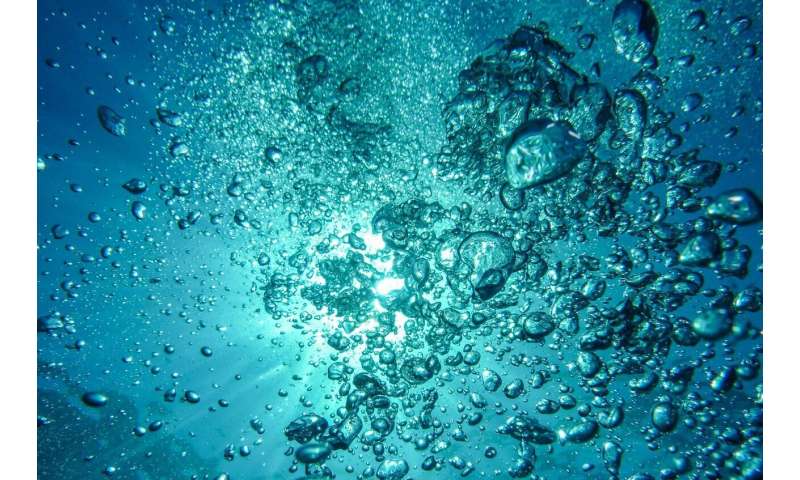
underwater
Credit: CC0 Public Domain
Groups of beaked whales reduce predation risk through extreme diving synchronization, according to a study in Scientific Reports. This behaviour has not been observed in other deep diving whales and the underlying reasons have remained unclear.
Natacha Aguilar de Soto, Mark Johnson and Peter Madsen and colleagues analysed data on 26  carrying sensors that tracked the depths they swam to, the steepness of their dives, and the sounds they made.
The authors observed that the  performed closely coordinated deep dives in order to forage using echolocation (using sounds to search for prey) but limited vocalizations at shallow depths where they are vulnerable to hunting by . Beaked whales began vocalizations at an average depth of 450 metres before searching for food individually. Whales then reunited as a group at an average depth of 750 metres and ascended silently to the surface at a shallow angle covering an average horizontal distance of one kilometre.
The authors suggest that by limiting vocalizations to depths out of the range of killer whale attacks and surfacing at unpredictable locations, beaked whales prevent killer whales from tracking them. However, the authors note that this strategy is costly; long silent ascents from dives lasting more than one hour reduce foraging time by around 35% compared to the diving strategies used by other toothed whales.
The findings suggest that  may have been a strong evolutionary force driving the unique diving and vocal behaviour of beaked whales.
Echolocation found to be cheap for deep-diving whales

More information: Fear of Killer Whales Drives Extreme Synchrony in Deep Diving Beaked Whales, Scientific Reports (2020). DOI: 10.1038/s41598-019-55911-3
Journal information: Scientific Reports 

8 things we do that really confuse our dogs

8 things we do that really confuse our dogs
Credit: Shutterstock
Dog behaviour is extraordinarily flexible—this is why we can keep them in our homes and take them to cafes with us at the weekend.
Nevertheless, there are ways in which evolution has not equipped  for the challenges of living in our world, and puppies must learn how to cope.
These are some of the things we do they struggle to understand.
1. We leave them alone
As born socialites, dogs make friends easily. Puppies are intensely interested in spending time with other dogs, people, and any species willing to interact with them socially. They usually play, rest, explore and travel with company. Yet we often leave dogs alone: at home, in kennels or the vet clinic.
In these situations, naive dogs can't be sure we'll ever return to collect them. Only after experience are they likely to expect a reunion, and even then, their experience depends on the context.
At home, we may try to enforce dog-free zones. Naturally, many dogs protest. How can they stay with their (human) social group when they're separated behind impenetrable barriers (doors)? This explains why dogs so often demand to be let inside when their human family is there, and why those with separation-related distress frequently find some solace in being indoors.
2. We are visually driven
Dogs live in an olfactory world, while ours is chiefly visual. So, while TVs may offer a visual feast for humans, parks and beaches are an olfactory banquet for dogs.
An additional challenge is dogs move while investigating the world, whereas we often sit still. They may not relish the inertia we enjoy in front of a noisy, flashing light-box.
3. We change our shape and smell
Shoes, coats, wallets, briefcases, bags and suitcases: countless smells cling to these items after we take them into shops and workplaces, then back to our dogs. Cleaning products, soaps, deodorants and shampoos also change the scents our dogs are used to.
Towels, hats and bags change our shape when we're using them. And when we're pulling them on, jumpers and coats alter our visual outline and may catch dogs unaware.
Dogs change their coats at least once a year. In contrast, we change our external cladding every day. This means the odours we carry are changing far more than dogs have evolved to expect.
In their olfactory world, it must be puzzling for dogs to encounter our constantly changing smells, especially for a species that uses scent to identify familiar individuals and intruders.
4. We like to hug
How humans use their forelimbs contrasts sharply with how dogs do. We may use them to carry large objects a dog would have to drag, but also to grasp each other and express affection.
Dogs grasp each other loosely when play-wrestling, and also when mating and fighting. Being pinned by another dog hinders a quick escape. How are puppies to know what a hug from a human means, when that behaviour from a dog might be threatening?
5. We don't like to be bitten
Play-fighting is fun for many puppies and helps them bond with other dogs. But they must monitor the behaviour of other dogs in play-fights and know when they've used their tiny, razor-sharp teeth excessively.
Humans are much more susceptible to pain from playful puppy jaws than other dogs are, and so we can react negatively to their attempts to play-fight with us.
Dogs interact with objects almost entirely with their muzzle. And to feed, they use their jaws, teeth and tongue.
Dogs also "mouth" other dogs when playing, expressing affection and communicating everything from "more" to "please don't" to "Back off!". So, naturally, they try to use their mouths when communicating with us, and must be puzzled by how often we take offence.
6. We don't eat food from the bin
Dogs are opportunists who naturally acquire food anywhere they find it. In contrast, we present them with food in dishes of their own.
Puppies must be puzzled by our reaction when we find them snacking from benches and tables, in lunchboxes and kitchen bins. We should not be surprised when dogs unearth food we left somewhere accessible to them.
7. We share territories
We visit the territories of other dogs, bringing back their odours, and allow unfamiliar human and canine visitors to enter our dogs' home. Dogs have not evolved to accept such intrusions and threats to their safety and resources.
We shouldn't be surprised when our dogs treat visitors with suspicion, or when our dogs are treated with hostility when we bring them to the homes of others.
8. We use our hands a lot
Sometimes our hands deliver food, scratches, massages and toys. Other times, they restrain dogs, trim nails, administer ointments or tablets, and groom with brushes and combs that may pull hair.
No wonder some dogs grow to fear the human hand as it moves about them. We can make it easier for dogs to accept many types of hand-related activities if we train them to cooperate with rewards.
But humans often misread their fear and may even greet it with violence which compounds the problem. Hand-shy dogs can easily become defensive and find their way into pounds and shelters, where  for nippers and biters is poor.
On the whole, dogs show a remarkable ability to adapt to the puzzles we throw at them. Their behavioural flexibility offers us lessons in resilience and how to live simply and socially. Our challenge is to understand the absence of guile and malice in everything they do.


Microplastics sticking to Orkney's seagrass beds

seagrass
Credit: CC0 Public Domain
Microplastics are accumulating in Orkney's seagrass beds at much higher rates than in the areas surrounding them. Marine scientists from Heriot-Watt surveyed a 100m transect of a seagrass bed in Orkney and found microplastics on all seagrass blades and in over 94% of all samples collected.
Microplastic pollution is now common in , with areas like rivers and estuaries particularly vulnerable to high levels of pollution.
The scientists measured the presence of microplastics in Orkney's seagrass beds by taking samples of seagrass and the small creatures that live on the blades, like sea snails, shrimp-like amphipods, worms, as well as sediment from the seabed. The team confirmed that the seagrass bed was home to much higher concentrations of microplastics than the adjacent sediment.
Dr. Mark Hartl from Heriot-Watt University in Edinburgh said:
"Seagrasses are very sensitive habitats and perform a number of critical functions. They bind and characterise the shoreline, create habitats for other species and protect them from predators.
"Every blade of seagrass we examined had  flakes, fibres or fragments sticking or adhering to it.
"We did notice that the number of microplastics varied depending on where the  was along the transect line, but this was likely influenced by slight differences in the density of seagrass canopy cover and reflects the generally patchy nature of microplastics contamination."
Increased exposure to microplastics
The research found that the water above the seagrass beds contained more than double the average amount of microplastics in bare sediment, while seagrass blades were around 20% higher. The seagrass sediment was around 40% higher.
The average number of microplastics found in the sea snails and other grazing creatures matched the average number found on the seagrass blades. This suggests that seagrass grazers may be exposed to more microplastics than sediment-dwelling organisms.
The research, published in the Marine Pollution Bulletin, was undertaken as an MSc project within Heriot-Watt's MSc in Marine Science. It was carried out by Dr. Angela Capper, Dr. Mark Hartl, Dr. Mike Bell and MSc student Katherine Jones.
Follow-up study
Dr. Capper is also looking at this issue on a larger scale along the Central Queensland coast of Australia with the Coastal Marine Ecosystems Research Centre (CMERC) at Central Queensland University, to determine the extent and mechanisms involved in microplastic loading in seagrass canopies and potential impacts to grazing organisms.
Dr. Capper, based at Central Queensland University, Australia said:
"The impact of microplastics on marine creatures and environments isn't fully understood.
"It is concerning, however, that such a sensitive habitat is sequestering such high concentrations of microplastics. The species that live in seagrass beds, and in particular the larval and juvenile fish, will be vulnerable to any negative impacts associated with microplastics.
"A follow-up larger-scale study on the microplastics contamination of Orkney seagrass beds is currently being prepared for publication."
Microplastics from ocean fishing can 'hide' in deep sediments

More information: Katherine L. Jones et al. Microplastic accumulation in a Zostera marina L. bed at Deerness Sound, Orkney, Scotland, Marine Pollution Bulletin (2020). DOI: 10.1016/j.marpolbul.2020.110883

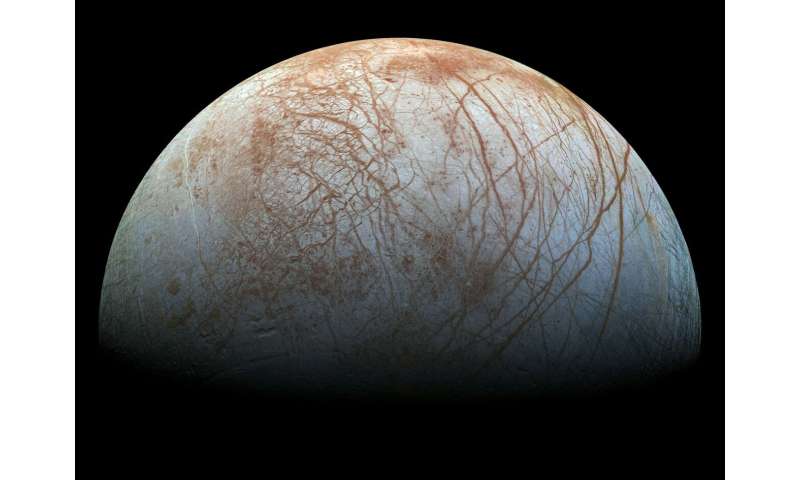
'Racing certainty' there's life on Europa, says leading UK space scientist

'Racing certainty' there's life on Europa and Mars, says leading UK space scientist
Credit: NASA
It's 'almost a racing certainty' there's alien life on Jupiter's moon Europa—and Mars could be hiding primitive microorganisms, too.
That's the view of leading British space scientist Professor Monica Grady, who says the notion of undiscovered life in our galaxy isn't nearly as far-fetched as we might expect.
Professor Grady, a Professor of Planetary and Space Science, says the frigid seas beneath Europa's ice sheets could harbor 'octopus' like creatures.
Meanwhile the deep caverns and caves found on Mars may also hide subterranean life-forms—as they offer shelter from intense solar radiation while also potentially boasting remnants of ice.
Professor Grady was speaking at Liverpool Hope University, where she's just been installed as Chancellor, and revealed: "When it comes to the prospects of life beyond Earth, it's almost a racing certainty that there's life beneath the ice on Europa.
"Elsewhere, if there's going to be life on Mars, it's going to be under the surface of the planet.
"There you're protected from solar radiation. And that means there's the possibility of ice remaining in the pores of the rocks, which could act as a source of water.
"If there is something on Mars, it's likely to be very small—bacteria.
"But I think we've got a better chance of having slightly higher forms of life on Europa, perhaps similar to the intelligence of an octopus."
Professor Grady isn't the first to pinpoint Europa as a potential source of extraterrestrial life.
And the moon—located more than 390 million miles from Earth—has long been the subject of science fiction, too.
Europa, one of Jupiter's 79 known moons, is covered by a layer of ice up to 15 miles deep—and there's likely liquid water beneath where life could dwell.
The ice acts as a protective barrier against both solar radiation and asteroid impact.
Meanwhile, the prospect of hydrothermal vents on the ocean floor—as well sodium chloride in Europa's salty water—also boost the prospects of life.
As for what's beyond the Milky Way, Professor Grady says the environmental conditions that led to life on Earth are 'highly likely' to be replicated elsewhere.
The expert, resident at the Open University and who's also worked with the European Space Agency (ESA), adds: "Our solar system is not a particularly special planetary system, as far as we know, and we still haven't explored all the stars in the galaxy.
"But I think it's highly likely there will be life elsewhere—and I think it's highly likely they'll be made of the same elements.
"Humans evolved from little furry mammals that got the opportunity to evolve because the dinosaurs were killed by an asteroid impact.
"That is probably not going to happen on every planet—but it's at least possible based purely on a statistical argument.
"Whether we will ever be able to contact extraterrestrial life is anyone's guess, purely because the distances are just too huge.
"And as for so-called alien 'signals' received from space, there's been nothing real or credible, I'm afraid."
In summer this year, at least three separate missions will be launched to Mars.
The ExoMars 2020, which launches in July, is a joint project from the European Space Agency (ESA) and the Russian space agency, Roscosmos.
The Mars 2020 mission is NASA's new rover, planned to touch-down on the Red Planet in February 2021.
Meanwhile the Hope Mars Mission is a planned space exploration probe, funded by the United Arab Emirates, which is set to launch in the summer.
And Professor Grady says it's not just Martian 'viruses' being brought back to Earth that are a concern, the prospect of us contaminating the planet with our own bugs is also paramount.
Prof. Grady—a member of the Euro-Cares project designed to curate samples returned from missions to asteroids, Mars, the Moon and comets—reveals: "Space agencies from across the world are working to eventually send humans to Mars.
"But if you want to do that you need to at least have a jolly good shot of bringing them back again. And so one of the big steps in that process is actually to bring a rock back from Mars.
"The NASA mission will collect samples in tubes and leave them on the surface of Mars.
"And then, in 2026, ESA will send another mission to Mars to collect those samples and put them in orbit around the red planet.
"Then, another spacecraft will come and collect that capsule.
"It's about breaking the chain of contact between Mars and the Earth, just in case we bring back some horrendous new virus.
"But we also don't want to contaminate Mars with our own terrestrial bugs.
"And the tricky part will come when we prepare to send the first people to Mars. Currently, we boil all the equipment in acid, or we heat it to very high temperatures, before we send it off.
"But humans are, shall we say, a bit resistant to those treatments!
"All of these protocols for sterilisation have still got to be determined."
Meanwhile Professor Grady says that by looking at the bigger, inter-planetary picture, Earth's own ecological situation is brought into sharp focus.
She says: "We could be all there is in the galaxy. And if there's only us, then we have a duty to protect the planet.
"I'm fairly certain we're all there is at our level of intelligence in this planetary system.
"And even if there are octopuses on Europa, that doesn't give us a reason to destroy our planet."
Professor Grady has also been looking at the bigger picture by focusing on the minutiae—a single grain of rock, the size of a full stop.
This speck was brought to Earth in 2010 by the Japanese "Hayabusa' mission—where a robotic spacecraft was sent to the near-Earth asteroid '25143 Itokawa' in order to collect a sample.
By analyzing this 'world in a grain of sand," she hopes to unlock mysteries of the universe.
She adds: "When we look at this grain, we can see that most of it is made up of silicates, but it's also got little patches of carbon in it—and that carbon is extra-terrestrial, because it also contains nitrogen and hydrogen, which is not a terrestrial signature.
"In this one sample, a few microns in size, we can see that it's been hit by other bits of meteorite, asteroid, and interstellar dust.
"And with modern equipment you can start to untangle, not just a grain, but the little bits inside this tiny grain.
"It's giving us an idea of how complex the record of extra-terrestrial material really is.
"It also tells us the importance of analyzing the tiny things when it comes to the bigger picture."
Researcher makes the heart of Mars speak

Lessons from hurricanes past

Lessons from hurricanes past
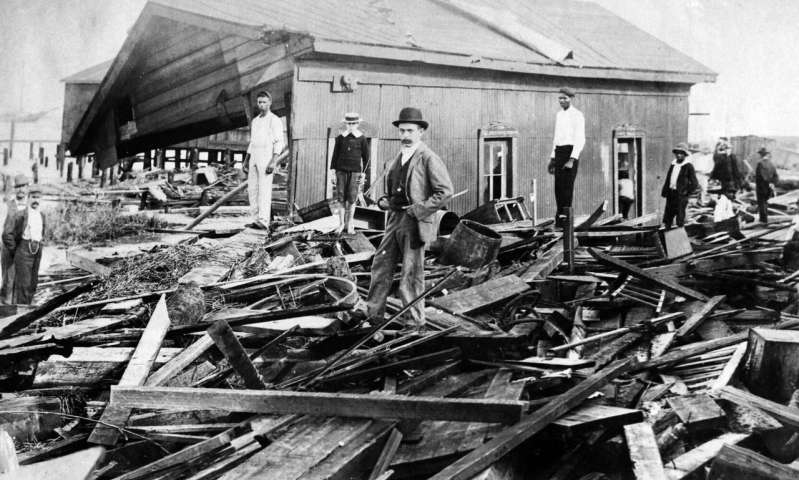
In Fernandina Beach, Florida, an example of the widespread destruction caused by the hurricane of 1896 that devastated Atsena Otie Key. Credit: Florida Memory
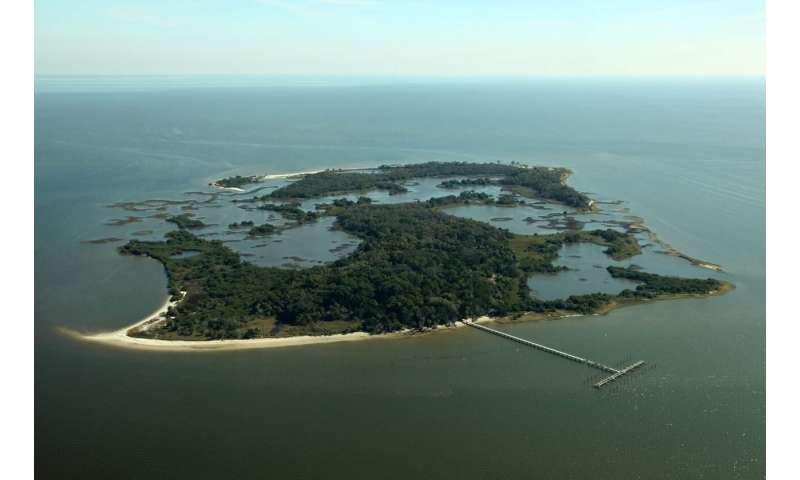
On September 29, 1896, the island of Atsena Otie Key was struck by a powerful hurricane. Located just off the coast of Cedar Key in the Gulf of Mexico, Atsena Otie Key was home to a world-renowned cedar mill and 50 families—until the resulting storm surge destroyed the mill, prompting a steady exodus from the island.
While devastating to industry in the area, it shouldn't have come as much of a surprise. Just 54 years prior (and 26 years before the construction of the mill), the island, then serving as a U.S. Army headquarters, was struck by another . The damage was so severe that the government abandoned the post, considering it unsalvageable.
It raises the question: If there was recent evidence that a location was especially prone to strong hurricanes, why build a center of industry there? How could everyone forget so quickly?
This is an all-too-common problem that UF anthropologist and Hyatt and Cici Brown Professor of Florida Archaeology Kenneth E. Sassaman is trying to solve—with the help of some innovative technology.
A specialist in the Archaic (8,000 to 1,000 BC) and Woodland (1,000 BC to 1000 AD) periods of the American Southeast, Sassaman has always been interested in how he can use history as a tool to guide policy and decision-making in the present.
Specifically, Sassaman wondered if he could use a historical precedent to show how  might affect Florida. To find out, he dug into Florida's history of indigenous coastal dwelling going back more than 13,000 years, when sea-level was down 80 meters and the Gulf Coast lay more than 200 kilometers from its current position.
Lessons from hurricanes past
An aerial view of Atsena Otie Key near Cedar Key, Florida. Credit: Loretta Risley / Alamy Stock Photo
Sassaman hoped to offer insights on how indigenous groups adapted over thousands of years to drastic environmental changes that resembled present-day issues.
Unfortunately, this early history presented one huge problem he couldn't work around.
"No matter how I spin it, no matter what the narrative is, if it's that old, it doesn't resonate with the present," he said. "It's too foreign. And the further back in time we go, the less empathy and connection people have to it."
While venting these frustrations to a colleague one day, Sassaman happened to share the tale of Atsena Otie Key. Riveted, his colleague pointed out that Sassaman had the answer right in front of him.
Here was a wealth of recent information, including oral histories from those that lived through the 1896 hurricane, that would feel much more immediate to a modern audience. Yet there was still a major issue Sassaman knew he would have to contend with: presentation. A book or exhibit on the island's unique past just wouldn't have the impact Sassaman knew he'd need to get his argument across.
Lessons from hurricanes past
UF anthropologist and Hyatt and Cici Brown Professor of Florida Archaeology Kenneth E. Sassaman. Credit: University of Florida
"History is not always accessible to people outside of academia," he said. "It doesn't appeal to their emotions or their visceral sense of personal connection."
To address this, Sassaman formed a partnership with Digital Heritage Interactive, a studio run by UF alumni that specializes in applying digital technologies to cultural resources, to create an interactive walkthrough of Atsena Otie Key. Sassaman ultimately hopes users will be able to navigate the town in  as it appeared in 1896, talk to real people who lived there before the hurricane and see the devastation the storm reaped for themselves.
"Part of this project is to make history sensory, emotional, personal and biographical," Sassaman said. "It's going to be the story of Velma Crevasse at age 11, living on Atsena Otie Key, waking up to the eye of the hurricane thinking the storm was over, only to turn around and see a wall of water approaching her and her house."
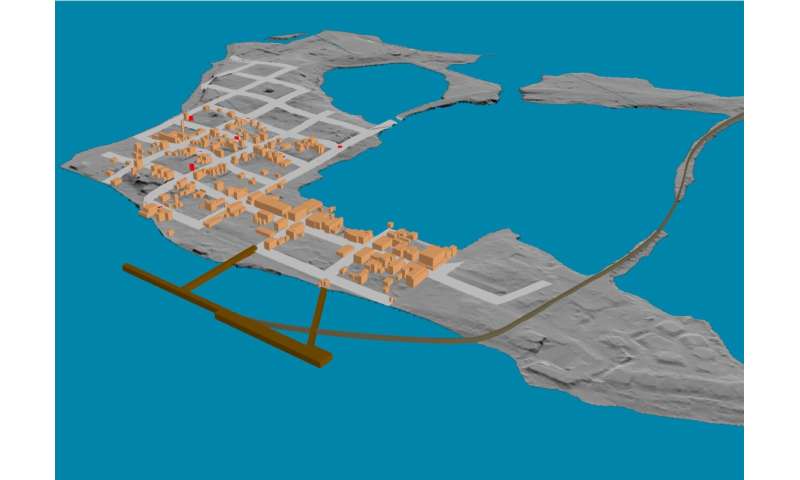
The team is planning to have multiple time periods on the island built out, allowing viewers to move through different eras in a non-linear fashion to show how vulnerable this location was to storm surges and erosion. One minute a user could be in 1896, then suddenly jump to 1842, 1935 or 1950—all years a hurricane struck the area.
"We turn storms into the boogeyman," Sassaman explained, when, in reality, an at-risk area like Atsena Otie Key is what happens when a large storm and a human-made vulnerability crash into each other. Long before 1896, the cedar in the area had been overharvested, increasing the odds a storm surge could wreak havoc on the island. Sassaman hopes that being able to see the firsthand consequences of development in an area that has been destroyed by natural occurrences multiple times might encourage people to think harder before building in such an environment.
His partner, Digital Heritage Interactive, is based in Orlando and run by two like-minded UF alumni with degrees in anthropology, DIANA GONZÁLEZ-TENNANT '11, MA, and her husband EDWARD GONZÁLEZ-TENNANT '11, Ph.D., who have previously developed digital walkthroughs of historic settlements. One of their previous projects, Rosewood, allowed users to explore an African American town in Florida that was destroyed during a 1923 race riot.
Lessons from hurricanes past
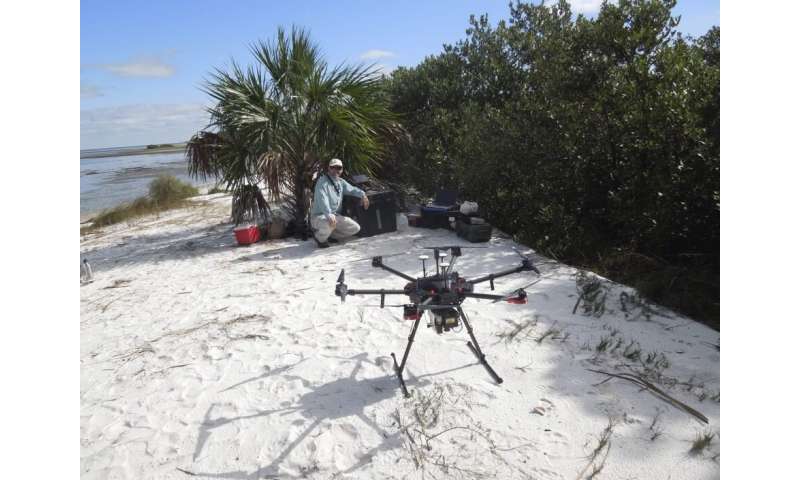
The drone used to scan Atsena Otie Key and operator Eben Broadbent. Credit: Kenneth Sassaman
"Atsena Otie Key and similar projects provide an engaging and interactive method for communicating two things with the public," Edward said. "The first is an accurate picture of the incredible heritage resources located on the island. Second, the virtual reconstruction reveals the growing danger climate change poses for such resources. Once these resources are gone, they're lost forever. This project lets us retrieve them from the dustbin of history."
"The hope is to incite discussions about climate change, both past and present," Diana said. "What made Atsena Otie Key vulnerable was not that the storm wiped it out, but that the storm drove industry away—that's why the town no longer exists."
"Part of this project is to make history sensory, emotional, personal and biographical."
While this project is still in its early stages, some important early steps have already been completed. To re-create Atsena Otie Key, Sassaman and team began by working with the GatorEye Unmanned Flying Laboratory (GatorEye UFL), a drone program run by the Spatial Ecology and Conservation Lab at UF. GatorEye UFL scanned the island, uncovering the original foundations of buildings and allowing the team to match up what remains with historic maps of the town. This high-resolution mapping managed to accomplish in 40 minutes what previously might have taken Sassaman months.
From here, Sassaman's team will move forward with building out the digital re-creation of the island over these various time periods. The plan is to house the initial digital headset that will allow users to navigate the town in the Cedar Key Historical Society's museum, while remote users will be able to access a website to experience the walkthrough themselves.
Lessons from hurricanes past
A 3d projection of Way Key/Cedar Key. Credit: Asa Randall
Sassaman sees the potential for expanding the team's use of technology to make this re-creation of Atsena Otie Key even more interactive, with an augmented reality version of the town built out so that visitors to the island can actually walk around and see what used to be there by just holding up their mobile devices.
While this augmented reality stage is still a while off, the creativity and willingness to engage with the public in such an innovate manner speaks to how important Sassaman feels this history is to our present times.
"History is the archive of human experiences that we use to shape our perception of where we are and where we're going," Sassaman said. "We need to mobilize these experiences and make them available—now."
Drones reveal secrets of ancient Florida village

Researchers revise timing of Easter island's societal collapse

Researchers revise timing of Easter island's societal collapse
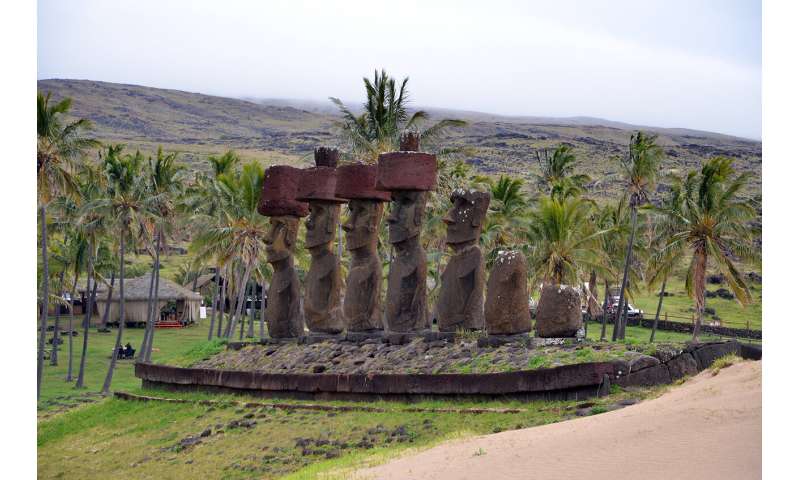
Ahu Nau Nau, a cultural and religious site built by Rapa Nui society on Easter Island's Anakena beach, was among 11 sites where previously gathered data were examined as part of the new study led by University of Oregon doctoral candidate Robert DiNapoli. The site is located on the north shore of the Easter Island. Credit: Robert DiNapoli
The prehistoric collapse of Easter Island's monument-building society did not occur as long thought, according to a fresh look at evidence by researchers at four institutions.
"The general thinking has been that the society that Europeans saw when they first showed up was one that had collapsed," said Robert J. DiNapoli, a doctoral candidate in the University of Oregon's Department of Anthropology who led the analysis. "Our conclusion is that -building and investment were still important parts of their lives when these visitors arrived."
Easter Island, a Chilean territory also known as Rapa Nui, is located about 3,000 kilometers (1,864 miles) from South America and 2,000 kilometers (1,242 miles) from any other inhabited island.
Rapa Nui is believed to have been settled in the 13th century by Polynesian seafarers. They soon began building massive stone platforms stacked with megalithic statues and large, cylindrical stone hats that were used for cultural and religious rituals, including burial and cremation. A widely-held narrative is that monument construction stopped around 1600 after a major societal collapse.
In the new research, detailed online ahead of print in the Journal of Archaeological Science, DiNapoli's team presents a chronology for the statue platform construction by integrating existing radiocarbon dates with the order of assembly required to build the monuments and the written records of Dutch, Spanish and English seafarers who began arriving in 1722.
  • Easter Island society did not collapse prior to European contact, new research shows
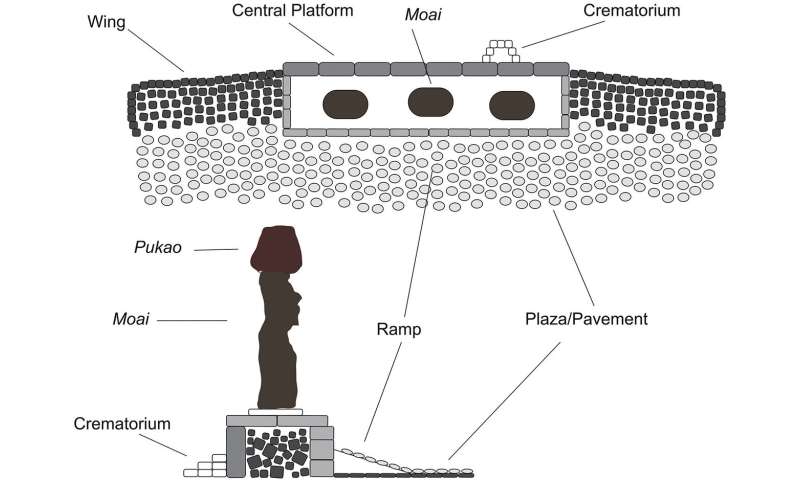
    Schematic of a typical platform ahu showing a plan view (top) and cross-section (bottom). Figure adapted from Martinsson-Wallin (1994) and Skjølsvold (1994). Credit: Journal of Archaeological Science
  • Easter Island society did not collapse prior to European contact, new research shows
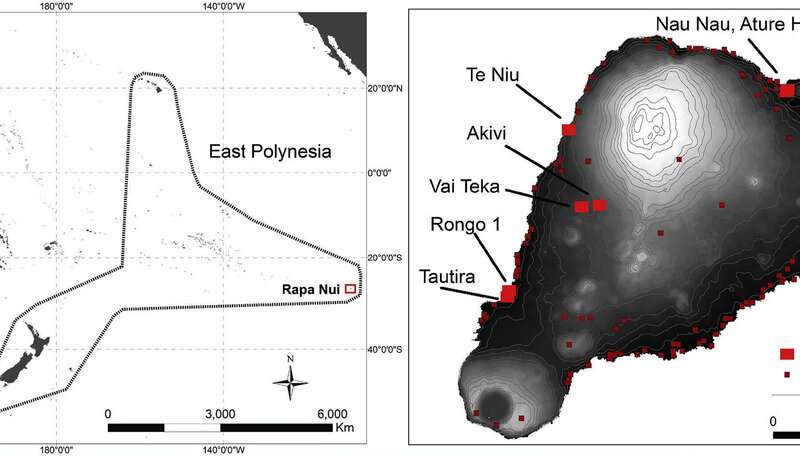
    East Polynesia (left), and Rapa Nui showing the locations of all documented platform ahu as well as those analyzed in this study (right). Credit: Journal of Archaeological Science
  • Easter Island society did not collapse prior to European contact, new research shows
    Schematic of a typical platform ahu showing a plan view (top) and cross-section (bottom). Figure adapted from Martinsson-Wallin (1994) and Skjølsvold (1994). Credit: Journal of Archaeological Science
  • Easter Island society did not collapse prior to European contact, new research shows
    East Polynesia (left), and Rapa Nui showing the locations of all documented platform ahu as well as those analyzed in this study (right). Credit: Journal of Archaeological Science
Taken together, DiNapoli said, the integration of data, using Bayesian statistics, brings clarity to radiocarbon-dating at various sites. Rapa Nui islanders, the researchers concluded, continued to build, maintain and use the monuments for at least 150 years beyond 1600.
The project began as part of DiNapoli's dissertation, which is focused on the process of building the monuments' architecture. Looking at 11 sites, the researchers examined the necessary sequence of construction, beginning with building a central platform and then adding different structures and statues.
That helped make sense of differing  found at various excavation sites. Monument construction, according to the team, began soon after initial Polynesian settlement and increased rapidly, sometime between the early 14th and mid-15th centuries, with a steady rate of construction events that continued well beyond the hypothesized collapse and the European arrival.
When the Dutch arrived in 1722, their written observations reported that the monuments were in use for rituals and showed no evidence for societal decay. The same was reported in 1770, when Spanish seafarers landed on the island.
00:00
01:39
A video summary of Carl Lipo's research on Easter Island, which runs contrary to the claim that the island's society collapsed prior to European contact. Credit: Binghamton University, State University of New York.
"Their stays were short and their descriptions brief and limited," DiNapoli said. "But they provide useful information to help us think about the timing of building and using these structures as part of their cultural and religious lives."
However, when British explorer James Cook arrived four years later, in 1774, he and his crew described an island in crisis, with overturned monuments.
"The way we interpret our results and this sequence of historical accounts is that the notion of a pre-European collapse of monument construction is no longer supported," DiNapoli said.
"Once Europeans arrive on the island, there are many documented tragic events due to disease, murder, slave raiding and other conflicts," said co-author Carl Lipo, an anthropologist at Binghamton University in New York.
"These events are entirely extrinsic to the islanders and have, undoubtedly, devastating effects. Yet, the Rapa Nui people—following practices that provided them great stability and success over hundreds of years—continue their traditions in the face of tremendous odds," he said. "The degree to which their  was passed on—and is still present today through language, arts and cultural practices—is quite notable and impressive. I think this degree of resilience has been overlooked due to the collapse narrative and deserves recognition."
The approach developed for the research, which was funded by the National Science Foundation, may be useful for testing hypotheses of societal collapse at other complex sites around the world where similar debates on timing exist, the researchers noted.

More information: Robert J. DiNapoli et al, A model-based approach to the tempo of "collapse": The case of Rapa Nui (Easter Island), Journal of Archaeological Science (2020). DOI: 10.1016/j.jas.2020.105094