Saturday, February 08, 2020

Wasp nests used to date ancient Kimberley rock art
**Wasp nests used to date ancient Kimberley rock art
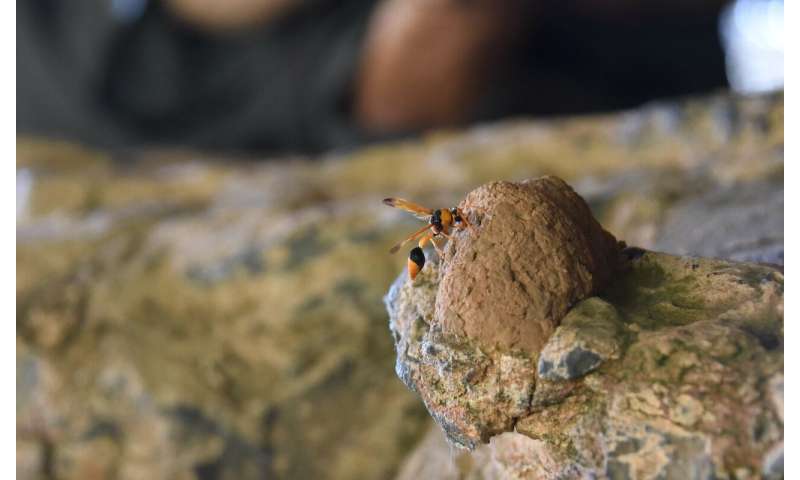
Wasp nests near the paintings have given scientists a major breakthrough on Kimberley rock art. Credit: Damien Finch
Mud wasp nests have helped establish a date for one of the ancient styles of Aboriginal rock art in the Kimberley.
University of Melbourne and ANSTO scientists put the Gwion Gwion art period around 12,000 years old.
"This is the first time we have been able to confidently say Gwion style paintings were created around 12,000 years ago," said Ph.D. student Damien Finch, from the School of Earth Sciences at the University of Melbourne. "No one has been able present the scientific evidence to say that before."
One wasp  date suggested one Gwion  was older than 16,000 years, but the pattern of the other 23 dates is consistent with the Gwion Gwion period being 12,000 years old.
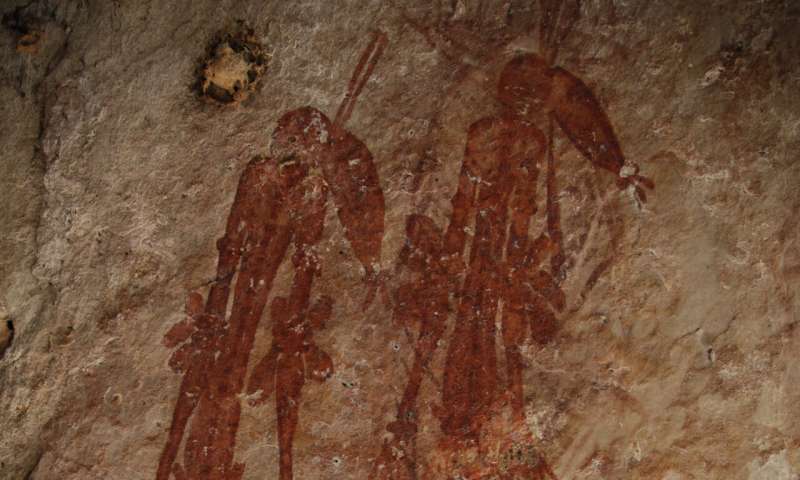
The , more than twice as old as the Giza Pyramids, depict graceful human figures with a wide range of decorations including headdresses, arm bands, and anklets. Some of the paintings are as small as 15cm, others are more than two meters high.
The details of the breakthrough are detailed in the paper 12,000-year-old Aboriginal  art from the Kimberley region, Western Australia, now published in Science Advances.
More than 100 mud wasp nests collected from Kimberley sites, with the permission of the Traditional Owners, were crucial in identifying the age of the unique rock art.
Wasp nests used to date ancient Kimberley rock art
Two classic Gwion human figures with headdresses and arm and waist decorations. Credit: Mark Jones
"A painting beneath a wasp nest must be older than the nest, and a painting on top of a nest must be younger than the nest," Mr Finch said. "If you date enough of the nests, you build up a pattern and can narrow down an age range for paintings in a particular style."
Lack of organic matter in the pigment used to create the art had previously ruled out radiocarbon dating. But the University of Melbourne and ANSTO scientists were able to use dates on 24 mud wasp nests under and over the art to determine both maximum and minimum age constraints for paintings in the Gwion style.
The project was initiated by Professor Andy Gleadow and Professor Janet Hergt, from the School of Earth Sciences, and started in 2014 with funding from the Australian Research Council and the Kimberley Foundation. It is the first time in 20 years scientists have been able to date a range of these ancient artworks.
Wasp nests used to date ancient Kimberley rock art
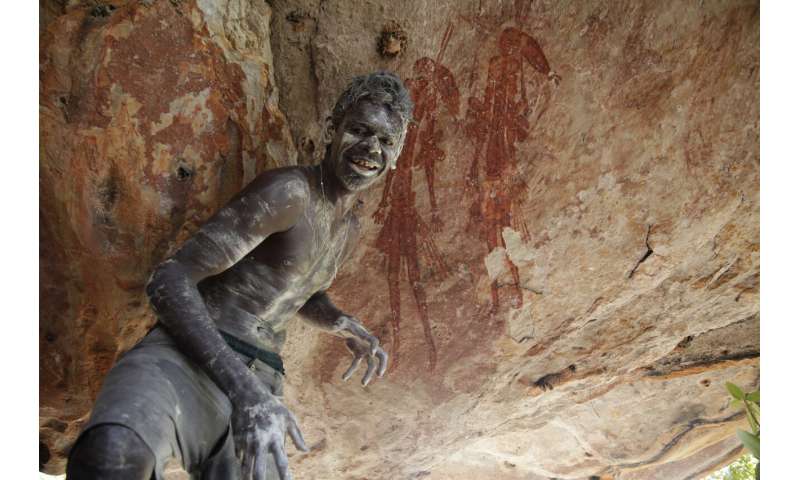
Ado French, from one of the families of local Traditional Owners, in front of a pair of Gwion rock art figures. Credit: Mark Jones
"The Kimberley contains some of the world's most visually spectacular and geographically extensive records of Indigenous rock art, estimated to include tens of thousands of sites, only a small fraction of which have been studied intensively," said Professor Gleadow.
Professor Hergt said being able to estimate the age of Gwion art is important as it can now be placed into the context of what was happening in the environment and what we know from excavations about other human activities at the same time.
00:00
01:42
VIDEO Early morning, on the King George river in the far north Kimberley region of Western Australia. Rock art sites are prolific in the ancient sandstone rock shelters on either side of the river. Credit: Damien Finch
Dr. Vladimir Levchenko, an ANSTO expert in radiocarbon dating and co-author, said rock art is always problematic for dating because the pigment used usually does not contain carbon, the surfaces are exposed to intense weathering and nothing is known about the techniques used thousands of years ago.
00:00
01:46
VIDEO Mud wasp collecting mud, building a nest and provisioning the nest with prey (paralysed caterpillars). Credit: Damien Finch
"Beeswax or resin have also been used—usually on more modern samples," Dr. Levchenko said.
"Although soil is full of carbon, most of it is easily degradable. However, charcoal is more likely to survive for longer periods. There is lots of black carbon in Australian soil because of bushfires."

Explore further
The hi-tech archaeological scientists

More information: Damien Finch et al. 12,000-Year-old Aboriginal rock art from the Kimberley region, Western Australia, Science Advances (2020). DOI: 10.1126/sciadv.aay3922
Journal information: Science Advances 
Provided by University of Melbourne 
141 shares
Feedback to editors


Tropical trees are living time capsules of human history

Trees in the Amazon are time capsules of human history, from culture to colonialism
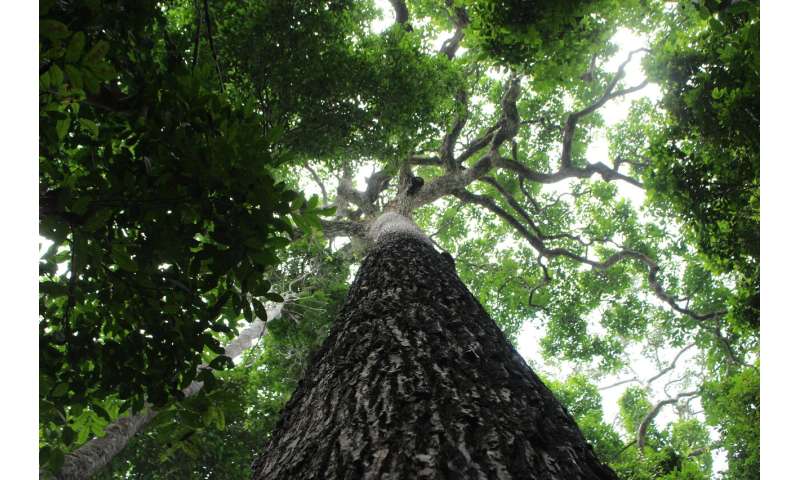
A Brazil nut tree in Jaú National Park. Credit: Victor Caetano-Andrade
In a new article published in Trends in Plant Science, an international team of scientists presents the combined use of dendrochronology, radiocarbon dating and isotopic and genetic analysis as a means of investigating the effects of human activities on forest disturbances and the growth dynamics of tropical tree species. The study presents the potential applicability of these methods for investigating prehistoric, historical and industrial periods in tropical forests around the world and suggests that they have the potential to detect time-transgressive anthropogenic threats, insights that can inform and guide conservation priorities in these rapidly disappearing environments.
Led by scientists from the Max Planck Institute for the Science of Human History and co-authored by leading scientists at the National Institute for Amazonian Research, The Max Planck Institute for Biogeochemisty and the Max Planck Institute for Developmental Biology, the study shows that tropical trees store records of changing human populations and their management practices, including activities that ultimately led to a 'domestication' of tropical landscapes. The study promotes a dialogue between various fields of research to ensure that tropical trees are acknowledged for their role in both cultural and natural ecosystems.
Tropical forests as centers of past human action
Tropical forests, long thought of as barriers to human migration, agricultural experimentation, and dense sedentary populations, have until recently been considered 'Green Deserts' in the context of past human activity. However, the last two decades have seen a wealth of research from various disciplines highlight extensive and diverse evidence of plant and animal domestication, including forest management, landscape alteration, and the deliberate translocation of wild taxa by ancient human societies—including the inhabitants of some of the largest pre-industrial cities on the face of the planet.
Western colonialism and the expansion of global capitalism resulted in new human impacts on these environments, with consumer decisions in Europe driving deforestation and tropical resource exploitation as they do to this day. Understanding how different societies, economic systems, and administrative organizations changed tropical forests is essential if we are to properly develop sustainable conservation policies.
Trees in the Amazon are time capsules of human history, from culture to colonialism
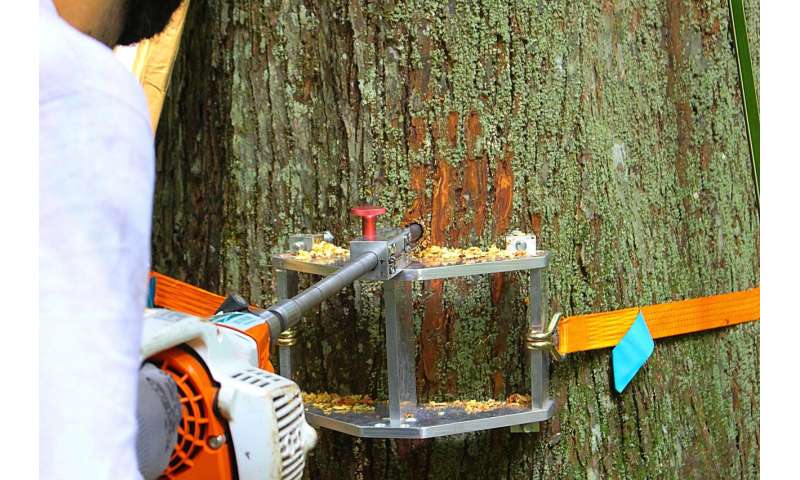
Researchers sampling a Brazil nut tree in Tapirapé-Aquiri National Forest. Credit: Victor Caetano-Andrade
Yet, high-resolution records of human impacts on tropical ecosystems are often difficult to come by. "Amazingly, this whole story has neglected some of the largest, most ancient witnesses tropical forests have to offer: their trees," says Victor Caetano Andrade, lead author of the study at the Max Planck Institute for the Science of Human History. "Archaeological excavation and archaeobotanical analyses has led to great strides in our recognition of past human lives in the tropics, but the trees themselves standing next to the trench have things to say as well," he continues.
Tree rings—a living stratigraphy
The study of tree rings has been frequently used in temperate environments to create a picture of how changing climate and human activities have altered forests. However, such work has been limited in the tropics, due to perceptions that a lack of seasonality meant no rings would be visible. As the authors note, however, it has now been demonstrated that more than 200 tropical tree species form annual rings. This opens up a whole new avenue for the exploration of changing tropical forest conditions in the past.
Counting tree rings can, alongside radiocarbon dating, produce robust, high-resolution chronologies or 'stratigraphies' of the growth of an individual tree. A change in the size of growth rings identified across a number of trees in the same forest can provide an indicator of abrupt changes in environmental conditions. In addition, these rings can be sampled chemically to investigate how climate conditions changed over time and how such changes correlate with tree growth. Where no strong correlation between climate and growth is visible, the door opens to other potential explanations, chief among them being human activity.
Trees in the Amazon are time capsules of human history, from culture to colonialism
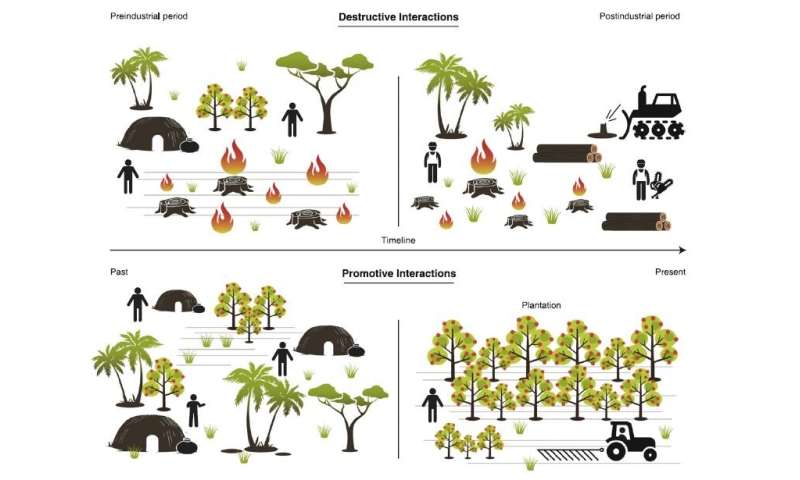
This figure shows how humans promote or suppress trees, past and present. Credit: Caeteno-Adrade et al. / Trends in Plant Science
As Victor Caetano Andrade puts it, "There are some species of special importance for humans, for example as food trees or trees used for a particular purpose. In these cases humans would be likely to undertake forest management practices, such as clearing the understory, opening up the forest, and actively protecting individual trees." By contrast, other species may have been deliberately removed for use as construction material or to make way for settlement. Combining observations of tree growth with local historical and archaeological data allows scientists to look at the relationship between tree communities and past human societies and their economic practices.
Tree genes point to pre-Columbian forest management
DNA analysis of modern trees is commonly used by companies and foresters to select trees with economically desirable traits. However, modern genetic analysis, as well as analysis of preserved specimens, can reveal important insights into how populations of a given species have changed through space and time. Where relevant, this genetic analysis can be used to look at processes of domestication, including the selection for particular traits. The ability to associate patterns of genetic diversity for economically important trees with known archaeological records promises to reveal new insights into the settlement of tropical environments in the past.
The authors' review shows that in many cases in Central and South America, maximum genetic diversity of these species is found in areas with intense pre-Columbian human occupation. However, in addition to investigations of the distant past, the present study also shows that sampling of modern trees such as mahogany can document changes in genetic diversity before and after logging episodes. The authors propose that, given the advance of full genome sequencing, applying such methods to ancient modern trees in a given forest may make it possible to genetically reconstruct past human clearance and management events—particularly where detailed historical and archaeological information is also available.
While the majority of ecological study on the supposedly 'pristine' tropics has focused on how changes in forest structure and tree growth are linked to climate fluctuations and natural disturbances, the present research highlights centuries of human impact. As study co-author Dr. Patrick Roberts states, "The work evaluated here demonstrates two important findings: first, that human societies, from hunter-gatherers to urban dwellers, have played a significant role in tropical tree growth in the past; and second, that this role can be observed in trees that still stand today."
Furthermore, as Victor Caetano Andrade continues, "Multidisciplinary approaches to ancient trees will enable us to look at how forest management changed in the tropics from pre-colonial to post-colonial scenarios, and from pre-industrial to 21st century threats. The resolution available is remarkable and will allow us to get a handle on the legacies of past activities, and how changing practices have placed new pressures on these highly threatened environments". The authors conclude by arguing that it is essential that archaeologists and ecologists work together to preserve not just the natural benefits of tropical trees, but also the records of human cultural heritage and knowledge that span millennia stored within them.
Human history through tree rings: Trees in Amazonia reveal pre-colonial human disturbance

More information: Trends in Plant Science, Caeteno-Adrade et al.: "Tropical trees as time capsules of anthropogenic activity" https://www.cell.com/trends/plant-science/fulltext/S1360-1385(19)30335-8 , DOI: 10.1016/j.tplants.2019.12.010