Saturday, April 11, 2020

Trump's obsession with hydroxychloroquine is an encapsulation of his presidency
Neil J. Young

Illustrated | Getty Images, iStock April 11, 2020

What began primarily as a series of tirades against the media and other perceived enemies in President Trump's daily press briefings about the coronavirus has in recent days devolved into a bizarre and brazen infomercial for hydroxychloroquine, something Trump has touted as a potential miracle cure for COVID-19. "What do you have to lose? Take it," the president said last weekend as he hyped the drug, an anti-malarial medication that lupus patients have long relied on for its anti-inflammatory benefits.


Health experts, including Dr. Anthony Fauci, the National Institute of Allergy and Infectious Diseases director and sometime guest expert at Trump's daily pressers, have consistently pointed out that hydroxychloroquine has not been proven to be safe or effective against COVID-19. But that's not stopping Trump — or the conservative media universe that props up his presidency — from continuing to push the drug. And while reports this week showed the president has a small financial interest in the medicine, Trump has something even more precious to gain than money by promoting hydroxychloroquine: the puffing up of his power and authority through the continued undermining of expert knowledge and dissenting voices.

No doubt, Trump's financial stake in hydroxychloroquine, however small, has surely played some part in his actions. This is a man, after all, who once stole $7 from his charity to pay for his son's Boy Scouts fee.

In plain daylight, Trump has funneled millions of public dollars to his coffers while president, an ongoing violation of the Constitution and a direct assault on the public trust. As both candidate and president, Trump has regularly used the public limelight to shill everything from his line of steaks and winery to his golf resorts and properties. Rather than a national security hawk who has kept America safe, Trump is a smarmy hawker of shoddy products, some of which may threaten the safety of Americans. From the start, Trump understood that the presidency could be a cash cow for himself, and he'll never let the Constitution — or American lives — stand in the way of raking in millions.

Yet Trump also covets power and has an insatiable need for public adoration that has been curtailed by the momentary pause on his public rallies. Clearly out of his depth when it comes to understanding the virus, Trump has latched onto hydroxychloroquine as a way of keeping himself at the center of the story. Like an ignored child who settles for his parents' negative attention by acting out, Trump knows he can keep the spotlight on him by continuing to recklessly promote hydroxychloroquine, something reporters are right to press him on. And all of it has the added benefit of undercutting the actual experts in the room, a move essential to Trump's constant pitch that his gut instinct is superior to expert knowledge.

That's why Trump didn't allow Fauci to answer a question about hydroxychloroquine earlier this week. Fauci's cautious skepticism of the medicine's usefulness for treating COVID-19 importantly demonstrates that experts always make the limits of their knowledge clear, a galling affront to a president who has never let his ignorance keep him from spouting off. Fauci's steady presence also threatens Trump's sense of himself as the final word on all matters, an authoritarian impulse that animates his presidency, especially now.

If hydroxychloroquine turns out to work, Trump can extravagantly boast he had been right all along, the singular genius who "alone could fix" what all those egghead scientists couldn't figure out. That outcome doesn't look likely, as research on hydroxychloroquine's effectiveness for COVID-19 continues to show. But for the meantime, Trump can continue to position himself as the unconventional thinker boldly leading the nation to a solution against all those slow-moving intellectuals who just mess everything up and want to wreck the economy. Such fantasies propelled candidate Trump to the White House; those delusions now keep his base fanatically attached to him, no matter how deadly the consequences.


In the end, Trump's obsession with hydroxychloroquine is an encapsulation of his presidency: a mixture of sham and scam fueled by questionable ideas pushed by fringe outlets, all working to undermine scientific expertise and sow chaos. "So what do I know?" Trump shrugged to reporters last Sunday after he was pressed about hydroxychloroquine's potential harm to patients, especially those with heart issues.

Those five words represent the Trump presidency— and Trump himself— in a nutshell. But rather than a gracious expression of intellectual humility, they are a careless admission of the callousness and indifference at the heart of everything this president says. Nothing matters to Donald Trump but himself. And he'll sacrifice truth, expertise, and even the lives of his own people to satisfy his ego. That's a drug Trump will never put down.

Want more essential commentary and analysis like this delivered straight to your inbox? Sign up for The Week's "Today's best articles" newsletter here.

Woman gives birth standing with trousers on while detained at US-Mexico borderABOLISH US BORDER PATROL 
ABOLISH ICE 

Justin Vallejo, The Independent•April 9, 2020

A woman suffering flu-like symptoms gave birth standing and fully clothed while detained near the Mexican-US border, according to the American Civil Liberties Union.

The Guatemalan woman, 27, was being processed at the Chula Vista Border Patrol Station near San Diego when her complaints of pain and pleas for help were allegedly ignored by agents, according to a complaint filed on Wednesday by the ACLU and Jewish Family Service of San Diego with the US Department of Homeland Security's Office of the Inspector General.

The woman, holding onto a garbage can for support, was repeatedly told to sit and wait to be processed. Her husband, hearing a baby's cries, removed her pants to reveal the newborn's head while their daughters, aged 2 and 12, witnessed the event, according to the ACLU's interviews with the family.

"This horrific case is just the most recent and one of the most egregious examples of this agency's abuse," said ACLU attorney Monika Y. Langarica.

An account of the birth by US Customs and Border Protection (CBP), released a few days after the incident on 16 February, describes a conflicting version of events.

After entering the country illegally, the family was detained but "did not appear to be in distress and did not request any medical attention", the agency said in a statement.

"Thanks to the medical resources available in our stations, this woman and her child were well cared for and received immediate medical attention," said Chief Patrol Agent Aaron Heitke. "Our agents are well trained to manage the unexpected, and I'm proud of the work they did in caring for this mother."

A CBP spokesman told The Independent that after an internal investigation of the complaint, the agency "strongly disagrees with the unsubstantiated allegations against our agents".

"Based on this available information, CBP supports what appear to be nothing short of heroic actions of medical personnel and agents on scene and welcomes the response of [Department of Homeland Security Office of Inspector General]," the spokesman said.

In a letter to Department of Homeland Security Inspector General Joseph Cuffari, Democratic Senator Richard Blumenthal demanded an investigation into the incident, as well as other reported mistreatment of pregnant women in custody.

In the letter, Mr Blumenthal said the woman was not allowed to shower after giving birth and after returning from hospital to the Border Patrol station two days later was refused a blanket for the baby.

"Nobody should be treated this way. But sadly, this woman is not the only one to have experienced inexcusable treatment at CBP's hands," Mr Blumenthal said in the statement.

Trump administration, citing coronavirus, expels 10,000 migrants in less than 3 weeks
Molly O'Toole, LA Times•April 9, 2020

Central American migrants seeking asylum return to Mexico over 

the border bridge between El Paso and Ciudad Juarez on March 21. (Christian Chavez / Associated Press)

The Trump administration has quickly expelled roughly 10,000 migrants to Mexico and other countries in less than three weeks since imposing its most severe immigration restrictions yet in response to the coronavirus outbreak, officials said Thursday.

After the United States and Mexico last month closed their border to "nonessential travel," U.S. officials began rapidly removing almost all migrants arriving at the border, with minimal processing. For the first time, those turned away en masse include people seeking asylum as well as hundreds of lone migrant children, both groups that are protected by U.S. law.

The actions reflect how the administration — in response to the pandemic — is taking steps toward achieving some of President Trump's long-sought goals restricting immigration, in this instance barring asylum seekers and unaccompanied children from entry into the United States, and with an end-run around the laws and bureaucratic requirements.

Administration officials said they were acting to protect U.S. residents according to guidance from the Centers for Disease Control and Prevention.

"This is not about immigration," the acting commissioner of the Customs and Border Protection agency, Mark Morgan, said repeatedly in a call with reporters. "Right now this is purely about infectious disease and public health."

The unprecedented new steps go beyond existing policies such as one known as "Remain in Mexico." Under that policy, more than 60,000 asylum seekers had to wait on the Mexican side of the border for immigration hearings in the U.S. Now, with rare exception, migrants do not get the chance to seek protection in the United States, including those attempting to enter at official entry points.

Officials cited a CDC order on March 21, when Director Robert Redfield suspended travelers from Canada or Mexico for 30 days, based on a law dating to 1944, and wrote that "the existence of a communicable disease in a foreign country or place creates a serious danger."

Morgan said asylum and other humanitarian protections are still available to migrants seeking refuge in the United States. Those who show "an appropriate level of fear," he said, "will be processed on a case-by-case-basis."

The numbers of migrants whom U.S. officials have encountered at the southern border in recent weeks have fallen sharply from a high last spring to among the lowest levels in decades. Morgan said most of the arrivals have been adult males from Mexico, followed by Central America's "Northern Triangle" countries of El Salvador, Honduras and Guatemala.

The danger is potentially greater for them north of the border. The United States is the global epicenter of the pandemic, with more than 460,000 confirmed cases of COVID-19, the disease caused by the coronavirus, as of late Thursday. Mexico and the three Central American nations combined have fewer than 4,000, less than 1% of the U.S. total.

Democrats in Congress have criticized the administration's actions. A group of senators assailed the Department of Homeland Security for a "power grab" at the border "under the guise of a global pandemic response."

"We are deeply concerned that DHS is blatantly misinterpreting its limited authorities" under the CDC order, Democrats on the Senate Judiciary Committee wrote to acting Homeland Security Secretary Chad Wolf on Tuesday. "A public health crisis does not give the Executive Branch a free pass to violate constitutional rights, nor ... operate outside of the law."

Morgan said U.S. officials at the border are acting in ways to minimize contacts with and among the migrants. To avoid transporting and then holding them in facilities not equipped for quarantine or social distancing, as the CDC recommends, Border Patrol agents are instead conducting basic medical assessments and taking biometric information, then immediately returning the migrants to the nearest point of entry, in coordination with Mexican authorities. Those not sent to Mexico are flown to their home countries.

About 80% of migrants are being returned "within just a couple hours," Morgan said. His agency, Customs and Border Protection, has fewer than 100 migrants in its custody, which he called "the intended impact of the CDC order." Last year the agency held roughly 19,000 at the peak, provoking an overcrowding crisis.

Officials on the call declined to provide the total number of children without guardians whom U.S. officials have removed since March 21, but as of April 1, nearly 300 had been expelled, according to Customs and Border Protection spokesman John Mennell. Receiving countries are indicating a dramatic increase. Guatemala received about 100 unaccompanied minors in the first week of April alone, as many as it took in during all of March.

When a migrant arriving at the border claims fear of persecution or torture in their home country, Border Patrol personnel typically refer them to trained asylum officers from the U.S. Citizenship and Immigration Services agency for screening, the first step in the long process of applying for protection in the United States.

Administration officials have not said how Border Patrol agents quickly make that assessment whether to refer a migrant to an asylum officer rather than simply expel them, and Customs and Border Protection declined to share any guidance given to its agents. Asylum officers have yet to receive any direction on the new measures, officials told The Times.

A leaked Border Patrol memo obtained by ProPublica described only one humanitarian exception to expulsion: if the migrant "spontaneously" makes a "reasonably believable" claim to an agent that he fears torture in his home country. That potentially would allow one to stay in the United States under the international Convention Against Torture, but the standard for proof is higher, and it provides a less secure status than asylum for remaining in the United States.

Since March 21, asylum officers have continued to receive referrals of migrants for screenings of their fear claims, meaning the Border Patrol is "letting some people in," according to an employee at Citizenship and Immigration Services who spoke on condition of anonymity to protect against retaliation. But instead of the usual hundreds of referrals a day from detention centers in Georgia, New York, California and Arizona, the daily total is in the single digits.

Administration officials as well as their foreign counterparts initially had suggested that the policy would apply to migrants other than asylum seekers or unaccompanied children, and that Mexico, for example, would not accept noncitizens.

Morgan acknowledged that the coronavirus poses a "serious danger" to migrants as well as Homeland Security personnel and the broader public.

According to an internal report of the Department of Homeland Security obtained by The Times, more than 9,000 employees have been sidelined by COVID-19. More than 600 have tested positive. The department has yet to publicize, to its employees or the public, the total number of confirmed coronavirus cases among its roughly 240,000 employees or 34,000 migrants in its custody.

The detained population has dropped sharply in recent weeks. Immigration judges, lawyers and advocates have called for migrants to be released from often overcrowded, unsanitary facilities that experts describe as "Petri dishes" for the virus. Amid a broader review, as of March 30, Immigration and Customs Enforcement had identified 600 "vulnerable" migrants in detention and released 160.

Separate from immigration enforcement at the border, Morgan said that at airports and seaports, Customs and Border Protection officers have referred more than 268,000 people returning from coronavirus-affected areas to the CDC.

International travel has dropped by almost 98%. At land borders, noncommercial traffic is down more than 70%, and about 75% for pedestrians, accounting for almost 400,000 fewer people entering the United States each day.
Coronavirus stimulus package includes $1.1B going to for-profit colleges

Aarthi Swaminathan Reporter,Yahoo Finance•April 10, 2020

For-profit colleges and universities are estimated to get $1.1 billion in federal funding from the coronavirus stimulus package, despite Democrats and some experts expressing deep reservations about federal dollars flowing to for-profit higher education institutions.

Out of nearly $14 billion provided by the CARES Act, which was designed to support college students and higher education, around 9% was allocated to for-profit schools including Alabama State College of Barber Styling and University of Phoenix, according to new data released on Thursday by the Education Department (ED).

“The for-profits can distribute aid to students, but as for-profit businesses they should be treated like other for-profit businesses,” Bob Shireman, a senior fellow at the Century Foundation and former Education Department official during the Obama administration, told Yahoo Finance. “Aid to a nonprofit or public college is restricted to educational and public purposes, but for-profit corporations have no such restrictions. They should not be getting institutional aid apart from the business assistance available through SBA and other agencies.”


According to analysis of data from ED by Ben Miller at the Center for American Progress, Grand Canyon University received the most federal money out of all for-profit higher education institutions, followed by National University College (NUC) and Pima Medical Institute.

Top 10 for-profits. These are the ones you'd want to ask about what they are doing with the money pic.twitter.com/oE3o4tG3xA
— Ben Miller (@EduBenM) April 9, 2020


The ED said that school allocations were “weighted significantly by the number of full-time students who are Pell-eligible but also takes into consideration the total population of the school and the number of students who were not enrolled full-time online before the coronavirus outbreak.”

In any case, “with respect to the question around the for profit schools, the law does not include proof of precluding those students,” DeVos added on a call with reporters. “This first tranche of funding is intended for direct support to students. And so they are going to institutions across the country of every variety.”

Democrats have long been wary of for-profit colleges, describing them as predatory entities that neither provide high quality education nor help its graduates find solid careers.

Devos, for her part, previously overturned a 2014 rule called borrower defense designed to allow students of defunct for-profit colleges to claim debt relief. Both the House and the GOP-controlled Senate voted to roll back the policy.
U.S. President Donald Trump speaks as Secretary of Education Betsy DeVos 
and Secretary of Agriculture Sonny Perdue look on during a briefing on the 
coronavirus pandemic in the press briefing room of the White House on 
March 27, 2020 in Washington, DC. (Photo: Drew Angerer/Getty Images)More

‘It's clear that Secretary DeVos has chosen to override congressional intent’


One thing is certain: For-profit colleges tend to saddle students with high levels of loan debt.

Data from ED in 2019, which looked at undergraduate enrollment data from 2015 to 2016 for students who went to private for-profit colleges, revealed that 85% of them took out a student loan to pay for school — averaging at around $43,600.

In comparison, only 69% of those who went to a private nonprofit and 65% of those who went to a public institution took out student loans, averaging at about $32,500 and $27,000, respectively.

Consumer advocates — like the Democratic senators — also worried about oversight of the funds.

“It's clear that Secretary DeVos has chosen to override congressional intent,” Student Borrower Protection Center Investigations Lead Tariq Habash told Yahoo Finance. “As for-profit schools receive a significant portion of CARES Act relief funds, there must be strict oversight for how these dollars are being used by an industry that has preyed on the most vulnerable borrowers for too long.”
Coronavirus cases are still on the rise, though the rate of infection seems to be slowing amid social distancing measures. (David Foster/Yahoo Finance)

Habash added that it was ironic that the for-profit college industry, which has “been the subject of dozens of lawsuits in recent years for deceiving borrowers, is now getting emergency relief funds.”

One prominent for-profit colleges receiving the funding — the University of Phoenix — has announced that it will “commit every federal dollar” of $6.58 million to students who were “not exclusively studying online” before the coronavirus pandemic.

“These for-profit institutions should... be restricted in their use of funds,” Ashley Harrington, director of federal advocacy at the Center for Responsible Lending, told Yahoo Finance. “No stimulus dollars should be used for advertising, market, recruitment, CEO salaries, or stock buybacks. For-profit colleges shouldn't use emergency federal COVID-19 funding relief to grow enrollment while neglecting program quality and student needs … The Department must provide oversight to ensure that this funding is actually used to support students struggling to navigate this crisis.”

Harrington added that borrower defense should still be accessible to students who may see their program or college close during this pandemic. Under that rule, students who incur student debt from attending an institution are eligible for debt relief if their school closes and there is the basis that the school had defrauded them.
Everest College, a part of Corinthian Colleges Inc., one of the nation's largest for-profit college chains, shut down in 2015. (Photo by Al Seib / Los Angeles Times via Getty Images)
‘What’s best for students’


As college campuses across the country remain closed with the possibility of a dip in revenue looming, higher education institutions have been eager for some help from the federal government.

On Thursday, the ED released $6.28 billion intended to be distributed “immediately” to “provide direct emergency cash grants to college students” who have been impacted by the coronavirus.

The money can be used for students’ course materials, technology, food, health care and child care, but cannot be used by colleges to refund room and board, despite colleges remaining closed.

“What’s best for students is at the center of every decision we make,” DeVos said in a statement. “That’s why we prioritized getting funding out the door quickly to college students who need it most. We don’t want unmet financial needs due to the coronavirus to derail their learning.”
Students move out of dorm rooms on Harvard Yard on the campus of Harvard University on March 12, 2020 in Cambridge, Massachusetts. (Photo: Maddie Meyer/Getty Images)
The intention was commendable, one expert said.

“I’m still sort of in shock that Congress actually passed emergency aid for students,” Carrie Welton, senior policy consultant at the nonprofit Believe in Students, told Yahoo Finance. “For those of us who have been in this sort of student basic needs, advocating for low income students space for the last five years or so, five years ago, this would have been unheard of. If institutions are thoughtful about how they are targeting students who are at the greatest risk, it could be incredibly impactful.”

While Welton has yet to observe bad actors during this crisis, she noted that there was scope for opportunism.

“The Department of Education is giving institutions pretty broad authority on how they design and implement these emergency aid … [and so] the institution has to complete the certification and go through a couple of steps just to be able to draw down the dollars,” she explained. “Let's say hypothetically an institution has already started doing that, it's probably going to be at least a couple of days before the Department of Education releases funds to them.”

At the same time, the ED gives colleges “one year from the date of this Certification and Agreement” to report how it distributed the funds.

“Within a year says to me that institutions may not apply the proper amount of faith in getting these dollars out, and it might give bad actors ... an opportunity to think about how to game the system in that timeframe,” Welton noted.

Jun 14, 2017 - Betsy DeVos's devotion to school choice is inspired by her husband's gold-plated charter school in Grand Rapids, Mich., but is the Aviation ...
Aug 2, 2018 - Family separation, the Supreme Court on public-sector unions, the ... Those foundations include the Dick and Betsy DeVos Family Foundation (founded by the education ... Betsy and Dick DeVos support free-market conservative ... It backs issues such as school vouchers and criminal justice reform.
Missing: DEVRIES ‎| Must include: DEVRIES
Jan 26, 2017 - And in the case of education secretary nominee Betsy DeVos, filings reveal a ... In her confirmation hearing, DeVos said that her family had likely given around ... But Betsy DeVos owns stakes in a cross-section of American industry even ... Then there are trusts that have interests in the for-profit college ...
Missing: DEVRIES ‎| Must include: DEVRIES
Nov 24, 2016 - Jane Mayer on Donald Trump's decision to nominate Betsy DeVos as his Secretary of Education, and her family's ties to the Koch brothers. ... publications on college campuses; and the secretive Council on National Policy, which ... Her brother Erik founded Blackwater, the private military company that the ..
Mar 24, 2017 - Betsy DeVos was the most (empirically) controversial nomination of president ... For example, he founded Roxbury Preparatory Charter School in ... In 1979, Ms. Prince was entrusted with the DeVos family name by taking ...
Missing: DEVRIES ‎| Must include: DEVRIES
Libertarians debate: How to respond to coronavirus pandemic?
By HILLEL ITALIE


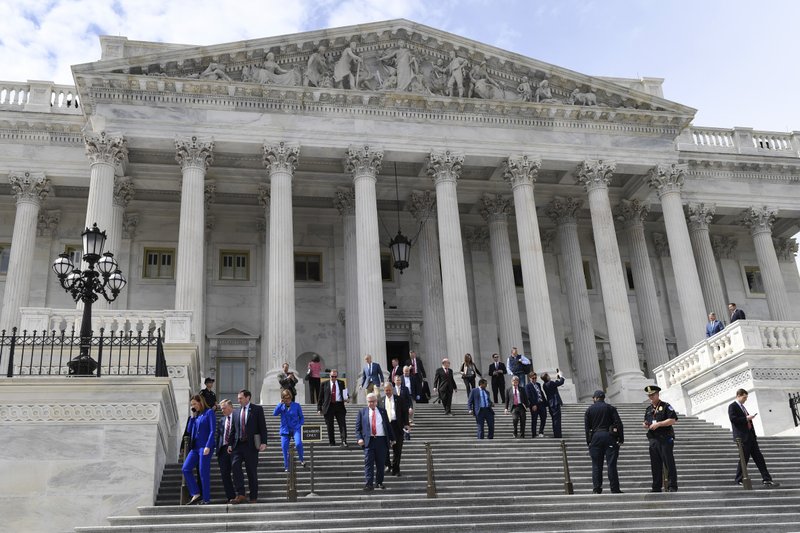
FILE - In this March 27, 2020, file photo, members of the House of Representatives walk down the steps of Capitol Hill in Washington, after passing a coronavirus rescue package. For libertarians the very thought of massive government aid or the enforced closings of businesses is usually indefensible. But those beliefs can change in a time of crisis, like now. The spread of the coronavirus has renewed a long-running debate among libertarians over such core beliefs as private enterprise and individual autonomy. (AP Photo/Susan Walsh, File)


NEW YORK (AP) — Steve Baker, one of the British parliament’s leading libertarians, was nearly in tears as he addressed the House of Commons in support of a bill that once seemed unthinkable: a massive economic aid package in response to the coronavirus pandemic.

“Libertarian though I may be, this is the right thing to do but, my goodness, we ought not to allow this situation to endure one moment longer than is absolutely necessary to save lives and preserve jobs,” he said last month. “We are implementing tonight in this bill at least a dystopian society.”

Libertarian principles of self-reliance and minimal government have been around for centuries. But they are being tested as never before in a time when much of the world, and many of their adherents, see a clear role for government restriction on basic liberties.

FIRST CONCEIVED AS LIBERAL UTILITARIANISM OF WILLIAM GODWIN, THEN THE LIBERAL UTILITARIANISM OF J.S. MILLS, FINALLY ENDING IN THE ANARCHISM
OF PROUDHON AND HIS AMERICAN PROTEGE AND FOUNDER OF AMERICAN LIBERTARIANISM BENJAMIN TUCKER IN THE LATE 19TH CENTURY. LIBERTARIANISM HAS NOTHING TO DO WITH AYN RAND OR REPUBLICANISM.

From trillions of dollars in government aid to the enforced closings of schools and businesses around the world, the spread of the coronavirus has renewed a long-running debate among libertarians over such core beliefs as private enterprise and individual autonomy.

In speeches, blogs and other online postings they ask whether it’s appropriate — and in what ways — for the government to help those who have lost jobs and businesses. They wonder whether, and to what degree, government should regulate business and personal movement in the name of public health.

“Preventing the spread of infectious disease is within the legitimate functions of the minimal state, which most libertarians accept,” says Michael Heumer, a professor of philosophy at the University of Colorado, in Boulder.

“The minimal state’s functions include protecting people from physical threats posed by other people,” Heumer says. “That includes not only behavior that definitely causes physical harm, but also behavior that creates an unreasonable risk of harm to others. Obviously, what is an unreasonable risk is a matter of judgment.”

In Washington, David Boaz, executive vice president of the Cato Institute, a libertarian think tank, says, “I wouldn’t say we have trouble holding on to libertarian principles. We believe in the presumption of liberty. But that presumption can be overcome in particular circumstances. And that’s part of our understanding of liberty.”

Limited government and personal freedom have long held deep appeal among Americans, who in the name of libertarianism have embraced everything from the legalizing of drugs to the withdrawal of U.S. troops from abroad to the abolition of the Internal Revenue Service.


Notable influences on libertarians have included such political figures as the late Arizona Republican Barry Goldwater and the author Ayn Rand, whose novels “The Fountainhead” and “Atlas Shrugged” have been standard reading for libertarians even as she dismissed the movement as “hippies of the right.”

Former New Mexico Governor Gary Johnson received more than 4 million votes as the Libertarian Party presidential candidate in 2016. Rep. Thomas Massie of Kentucky, a Republican with libertarian views, briefly delayed last month’s stimulus bill on constitutional grounds by insisting on an in-person quorum even as his colleagues worried about catching the virus.

More recently, he tweeted: “When Pearl Harbor was attacked, did we pass a bailout or did we declare war on our enemy? Attack the virus not the taxpayers.”

When libertarians weigh in on economic relief, their views are shaped in part by skepticism the government can be relied upon to do anything effectively.

Chris Edwards, director of tax policy studies at the Cato Institute, thinks the direct payments that the U.S. will send to millions of adults are a “total waste of money.” But he does find it “reasonable to try to keep companies afloat, especially small businesses with less resources.” Dan Fishman, executive director of the Libertarian Party, believes the unemployed should not hesitate to collect benefits because that money had been taken out of their paychecks against their will.

Heumer predicts “The stimulus will fail,” in part because he is “skeptical about fiscal stimulus in general.”

But Dan Moller, an associate professor of philosophy at the University of Maryland, is more open to government aid.

“Bailouts and stimulus plans are controversial among libertarians both because they tend to be maladministered and for more principled reasons,” he says. “But there’s a case for them in extreme circumstances like these, when you face what is essentially a giant financial coordination problem.”

If keeping people apart is essential during a pandemic, libertarians disagree on how and when to enforce it. Jim Babka, the libertarian commentator and editor-at-large for the Advocates for Self-Government, believes in and practices “voluntary physical distancing.” But he objects to laws enforcing it, saying “it’s impossible that a monolithic political response can be more resourceful than millions of people acting to protect their families and neighbors.”

Boaz praises the NCAA, the NBA and other organizations for voluntarily cancelling events. He also says that a case can be made for emergency government actions such as shutting down bars and restricting restaurants to take out and delivery, as long as those laws are lifted after the pandemic subsides.

Fishman calls government “coercion” a “slippery slope” and prefers we “try to persuade the heck out of people to do what’s right.”

Moller says that libertarians believe in individual freedom but not at the expense of others, citing a tax on pollution as a legitimate government action. He has a similar defense for preventing carriers of the virus from infecting others.

“What’s weird about a pandemic is that our everyday behavior suddenly puts others at risk — just showing up to work can have huge negative externalities,” Moller says. “So libertarians see restrictions on individual liberty in a pandemic as akin to restrictions on pollution.”

“But we don’t want the government to go too far,” Heumer says. “It’s well-known that when the government gives itself new powers or passes new laws during a crisis, they often keep the new powers long after the crisis is over. So over the long run, the state’s power grows and our freedom shrinks. So we have to continue to watch for that.”

___

Follow AP National Writer Hillel Italie on Twitter at @hitalie.

___

Follow AP coverage of the virus outbreak at https://apnews.com/VirusOutbreak and https://apnews.com/UnderstandingtheOutbreak.
#KAKISTOCRACY TOO
Trump and his trail of unmet promises in coronavirus fight


By CALVIN WOODWARD
4/11/2020
WASHINGTON (AP) — For several months, President Donald Trump and his officials have cast a fog of promises meant to reassure a country in the throes of the coronavirus pandemic. Trump and his team haven’t delivered on critical ones.

They talk numbers. Bewildering numbers about masks on the way. About tests being taken. About ships sailing to the rescue, breathing machines being built and shipped, field hospitals popping up, aircraft laden with supplies from abroad, dollars flowing to crippled businesses.

Piercing that fog is the bottom-line reality that Americans are going without the medical supplies and much of the financial help they most need from the government at the very time they need it most — and were told they would have it.


The U.S. now is at or near the height of COVID-19 sickness and death, experts believe.

There’s no question that on major fronts — masks, gowns, diagnostic tests, ventilators and more —- the federal government is pushing hard now to get up to speed. Impressive numbers are being floated for equipment and testing procedures in the pipeline.

But in large measure they will arrive on the down slope of the pandemic, putting the U.S. in a better position should the same virus strike again but landing too late for this outbreak’s lethal curve.

Concerning ventilators, for example, Trump recently allowed: “A lot of them will be coming at a time when we won’t need them as badly.”

Two weeks ago, Trump brought word of an innovative diagnostic test that can produce results in minutes instead of days or a week. The U.S. testing system, key to containing the spread of infection, has been a failure in the crunch, as public health authorities (but never Trump) acknowledged in March. The rapid test could help change that.

Like other glimmers of hope that may or may not come to something, Trump held out these tests as a “whole new ballgame.” The new machines and testing cartridges are being sent across the country, and may well hold promise. But they are not ready for actual use in large numbers.

New Hampshire, for one, received 15 rapid-test machines but 120 cartridges instead of the 1,500 expected. Only two machines can be used. “I’m banging my head against the wall, I really am,” Republican Gov. Chris Sununu said Wednesday. “We’re going to keep pushing on Washington multiple times a day to get what we need.”


False starts and dead ends are inevitable in any crisis, especially one driven by a virus never seen before. By its nature, a crisis means we’re not on top of it. Desperation is the mother of invention here and officials worldwide are winging it, many more successfully than in the U.S.

But bold promises and florid assurances were made, day after day, from the White House and a zigzagging president who minimized the danger for months and systematically exaggerates what Washington is doing about it.

“We’re getting them tremendous amounts of supplies,” he said of health care workers. “Incredible. It’s a beautiful thing to watch.” This was when Americans were watching something else entirely — doctors wearing garbage bags for makeshift protection.

___

MASKS, GLOVES, GOWNS

In hospitals, masks, gloves and other protective garb come with the territory. But doctors, nurses, flight attendants and other front-line workers have had to go begging for such basics, even before public health leaders flipped and recommended facial coverings for everyone outside the home.

The mere scale of the pandemic stretched supplies even in better prepared countries. Yet the enduring shortages in the U.S. are not just from a lack of foresight, but also from hesitancy as the pandemic started to sicken and kill Americans.

It was not until mid-March, when some hospitals were already treating thousands of infected patients without enough equipment and pleading for help, that the government placed bulk orders for N95 masks and other basic necessities of medical care for its stockpile, The Associated Press reported. Washington dithered on supplies for two months after global alarm bells rang about a coming pandemic in January.

And the Strategic National Stockpile, it turns out, is not the supply fortress you might have thought from its formidable name.

It maxed out days ago, before the pandemic’s peak in the U.S., and never filled its purpose of plugging the most essential and immediate gaps in supplies, though it helped. This past week officials said the stockpile was 90% depleted of its protective equipment, with the remainder to be held back for federal employees only.

Some shipments to states were deficient. The wrong masks were sent to Illinois in a load of 300,000. Michigan got only half of the number that was supposed to be in a shipment of 450,000. When he was trying to get 10,000 ventilators in late March, Democratic Gov. Gavin Newsom of California said he received 170 broken ones from the national stockpile as well as good ones.

When officials in Alabama opened a shipment of medical masks from the stockpile, they found more than 5,000 with rot. They had expired in 2010, officials in the state said, yet been left in place first by the Obama administration and then the Trump administration.

When it became clear that critical shortages weren’t being solved, the self-styled “wartime president,” who had gone to Norfolk, Virginia, to send off the USS Comfort Navy hospital ship to New York City, blamed the states and declared the federal government isn’t a “shipping clerk.”

___

TESTS

“Anybody that needs a test, gets a test,” Trump said on March 6. “They have the tests. And the tests are beautiful.” He said the same day: “Anybody that wants a test can get a test.”

Whether it’s a case of needing a test or only wanting one, his assurance was not true then, it’s not true now and it won’t be true any time soon.

The greatly expanding but still vastly insufficient capacity to test people is steered mostly to those who are already sick or to essential workers at the most risk of exposure.

If you’re sick with presumed COVID-19 but riding it out at home, chances are you haven’t been tested. If you worry that you’ve been exposed and might be carrying and spreading the virus but so far feel fine, you’re generally off the radar as well.

Trump tries to assure people who need to fly that passengers are tested getting on and off flights. He is wrong. Instead, some major airports do screenings, which means asking passengers questions and checking their temperature, not swabbing their nasal passages to find out for sure.

Many people with the virus will never get sick from it. Others who have it will get sick eventually. Both groups are contagious. But there is no capacity in the days of greatest danger to test apparently healthy people in large numbers, so precautionary distancing remains the best defense, like in ancient times.

Within three weeks of China’s New Year’s Eve notification to global health authorities about a mysterious cluster of pneumonia cases, China had sequenced the genetic makeup of the virus, German scientists had developed a test for detecting it and the World Health Organization had adopted the test and was moving toward global distribution.

Ten days behind, officials at the Centers for Disease Control and Prevention bypassed the WHO test and sponsored their own, which was flawed out of the gate. Trump said the WHO test was flawed, but it wasn’t.

Precious time was lost as the U.S. test was corrected, distributed narrowly, then more broadly but still not up to par with the countries most on top of the crisis. Testing most lagged during the critical month of February as the virus took root in the U.S. population.

Germany, in contrast, raced ahead with aggressive testing of a broad segment of the population when it had fewer than 10 cases in January. It has experienced far fewer deaths proportionally than the United States.

“There were many, many opportunities not to end up where we are,” Dr. Ashish K. Jha, director of the Global Health Institute at Harvard, told AP.

Trump told Americans on March 13 that a division of Google’s parent company was coming out with a website that would let people determine online if they should get a test and, if so, swing by a nearby place to get one, a notable shortcut in theory. But a game-changer in practice?

“It’s going to be very quickly done,” he said. The website is up but operational in just four California counties. Drive-through sites that he promised would expedite testing were plagued with shortages and delays in state after state, such that many people with symptoms and a doctor’s order were turned away.

___

VENTILATORS

Trump dusted off the Defense Production Act, empowering him to order manufacturers and shippers to make and deliver what the country needs in the crisis. His move raised expectations that a new wave of emergency supplies generally and ventilators in particular could come to the aid of patients and the people looking after them. He and his advisers inflated those hopes.

Under the president’s “vigorous, swift” order to General Motors, said Peter Navarro, White House point man on the emergency supply chain, new ventilators would be ready in “Trump time, which is to say as fast as possible.”

Yet Trump has held off on using his full powers under the act to command production from private companies. A presidential directive to GM on ventilator manufacturing essentially told the company to do what it was already doing.

While most people get better from COVID-19 without needing medical care, the sickest cannot breathe without a ventilator bridging them to recovery. The ventilator shortfall has been the most frightening deficiency as more people get infected and die by the hour. In the current chaos, the size of the shortfall nationally is not known.

In the absence of what they regard as dependable federal leadership, several states formed a supply consortium to coordinate purchases and boost their buying power. The federal government has pitched in with states and private companies to spur supplies, though not exactly in an atmosphere of trust.

Governors accuse Washington of shortchanging states on machines. Washington accuses some of them of trying to build an unreasonable cushion that deprives other, more desperate states.

According to the scientific model most favored by federal authorities, the country probably needs nearly 17,000 ventilators to be operating for COVID-19 patients alone at the pandemic’s peak, right about now, a figure that exceeds 35,000 under a worst-case scenario.

“We have over 100,000 being built right now or soon to be started,” Trump said a week ago. He acknowledged they won’t come in time.

___

WHERE’S THE MONEY?

“This will deliver urgently needed relief,” Trump said in signing an economic rescue package into law. The need may be urgent but the delivery hasn’t been.

More than two weeks later, Senate Majority Leader Mitch McConnell, R-Ky., said with some exaggeration, but not much, that “no money has gone out the door yet.”

Because of the bureaucracy.

Because of website glitches.

Because of confusion among lenders with the money to farm out and among those who need it to keep their businesses afloat.

So much for Treasury Secretary Steven Mnuchin’s prediction that loans could be turned around and money transferred to businesses’ bank accounts the same day applications were received.

Yet because of the flood of pending loans, Congress is already having to find more money for subsidies to help businesses cover payroll. Only a tiny fraction of loans has been released.

Meantime state officials are slammed as they try to administer jobless benefits that Washington expanded and is paying for but having states try to manage.

Frustration with the virus package is going viral.

In Portland, Maine, a furloughed orthopedic medical assistant, Margaret Heath Carignan, called the unemployment office on a day set aside for people with surnames starting with A through H. And called and called. Altogether, she said. 291 times before she gave up.

___

Associated Press writers Amanda Seitz in Chicago, Matthew Perrone and Michael Biesecker in Washington and Ken Sweet in New York contributed to this report.

___

Follow AP coverage of the virus outbreak at https://apnews.com/VirusOutbreak and https://apnews.com/UnderstandingtheOutbreak
THAT OTHER PLAGUE
New, larger wave of locusts threatens millions in Africa

By RODNEY MUHUMUZAyesterday

In this photo taken Tuesday, March 31, 2020, desert locusts swarm over a tree in Kipsing, near Oldonyiro, in Isiolo county, Kenya. Weeks before the coronavirus spread through much of the world, parts of Africa were already threatened by another kind of plague, the biggest locust outbreak some countries had seen in 70 years, and now the second wave of the voracious insects, some 20 times the size of the first, is arriving. (Sven Torfinn/FAO via AP) MANDATORY CREDIT

In this photo taken Tuesday, March 31, 2020, desert locusts swarm over a tree in Kipsing, near Oldonyiro, in Isiolo county, Kenya. (Sven Torfinn/FAO via AP) MANDATORY CREDIT

KAMPALA, Uganda (AP) — Weeks before the coronavirus spread through much of the world, parts of Africa were already threatened by another kind of plague, the biggest locust outbreak some countries had seen in 70 years.

Now the second wave of the voracious insects, some 20 times the size of the first, is arriving. Billions of the young desert locusts are winging in from breeding grounds in Somalia in search of fresh vegetation springing up with seasonal rains.

Millions of already vulnerable people are at risk. And as they gather to try to combat the locusts, often in vain, they risk spreading the virus — a topic that comes a distant second for many in rural areas.

It is the locusts that “everyone is talking about,” said Yoweri Aboket, a farmer in Uganda. “Once they land in your garden they do total destruction. Some people will even tell you that the locusts are more destructive than the coronavirus. There are even some who don’t believe that the virus will reach here.”
In this photo taken Tuesday, March 31, 2020, a swarm of desert locusts 
flies in Kipsing, near Oldonyiro, in Isiolo county, Kenya.
(Sven Torfinn/FAO via AP) MANDATORY CREDIT
MORE STORIES:
– 'This is huge': Locust swarms in Africa are worst in decades


– "Where it begins": Young hungry locusts bulk up in Somalia

Some farmers in Abokat’s village near the Kenyan border bang metal pans, whistle or throw stones to try to drive the locusts away. But mostly they watch in frustration, largely barred by a coronavirus lockdown from gathering outside their homes.

A failed garden of cassava, a local staple, means hunger. Such worries in the village of some 600 people are reflected across a large part of East Africa, including Kenya, Ethiopia and South Sudan. The locust swarms also have been sighted in Djibouti, Eritrea, Tanzania and Congo.

The U.N. Food and Agriculture Organization has called the locust outbreak, caused in part by climate change, “an unprecedented threat” to food security and livelihoods. Its officials have called this new wave some 20 times the size of the first.

“The current situation in East Africa remains extremely alarming as ... an increasing number of new swarms are forming in Kenya, southern Ethiopia and Somalia,” a new FAO assessment said.

Favorable breeding conditions through May mean there likely will be another new round of swarms in late June and July, coinciding with the start of the harvest season, the agency said.

The U.N. has raised its aid appeal from $76 million to $153 million, saying immediate action is needed before more rainfall fuels further growth in locust numbers. So far the FAO has collected $111 million in cash or pledges.

In this photo taken Wednesday, April 1, 2020, desert locusts sit on 
vegetation in Kipsing, near Oldonyiro, in Isiolo county, Kenya. 
(Sven Torfinn/FAO via AP) MANDATORY CREDIT
The locusts are “invading the Eastern Africa region in exceptionally large swarms like never seen before,” the Nairobi-based Climate Prediction and Application Center said.
The new swarms include “young adults,” voracious bugs “that eat more than the adult ones,” said Kenneth Mwangi, a satellite information analyst at the center.
Mwangi and other officials in Kenya cited difficulties in fighting the infestation as coronavirus-related travel restrictions slow cross-border travel and delay the delivery of pesticides.

The verification work of field officers has been curtailed, making it harder for the center to update regional prediction models, Mwangi said.

In rural Laikipia county, among the worst affected in Kenya, some are calling attention to the threat to commercial farms.

“I think, unfortunately, because of other things going on around the world, people are forgetting about the problem with the locusts. But it’s a very, very real problem,” farmer George Dodds told the FAO.

Aerial spraying is the only effective way to control the locust outbreak. After the locusts crossed into Uganda for the first time since the 1960s, soldiers resorted to using hand-held spray pumps because of difficulties in obtaining the needed aircraft.

In this photo taken Tuesday, March 31, 2020, a motorcyclist rides through a swarm of desert locusts in Kipsing, near Oldonyiro, in Isiolo county, Kenya.  (Sven Torfinn/FAO via AP) MANDATORY CREDIT

Uganda’s agriculture minister said authorities are unable to import enough pesticides from Japan, citing disruptions to international cargo shipments.

The government is yet to meet an additional budget of over $4 million requested for locust control, the minister said.

The sum is substantial in a country where the president has been fundraising from wealthy people to help respond to the virus and its economic disruption. Health workers are threatening to strike over lack of protective gear.

Other countries face similar challenges.

In Ethiopia, where some 6 million people live in areas affected by the locust outbreak, the infestation if unchecked “will cause large-scale crop, pasture and forest-cover loss, worsening food and feed insecurity,” the FAO says.

Bands of immature locusts are forming in areas that include the country’s breadbasket, the Rift Valley region, it said.

Ethiopia’s agriculture minister has said efforts are underway to deploy six helicopters against the infestation that could last until late August.

But ministry spokesman Moges Hailu spoke of an ominous sign: The locust swarms are now appearing in locations where they had not been previously sighted.

___

Elias Meseret in Addis Ababa, Ethiopia contributed.


I EXPERIENCED THE GENERATIONAL GRASSHOPPER PLAGUE THAT HITS ALBERTA AND SASKATCHEWAN ABOUT EVERY 25 TO 50 YEARS.
I WAS AT UNIVERSITY IN LETHBRIDGE AS ARID AS PRE DESERT GETS
AND THE SUMMER OF 79 WAS THE PLAGUE OF GRASSHOPPERS THE SIZE OF YOUR INDEX FINGER.
Analysis: Virus shows benefit of learning from other nations

By JOHN DANISZEWSKI 4/10/2020


John Daniszewski, vice president and editor-at-large for standards at The Associated Press, is a veteran foreign correspondent who has been writing about world affairs for four decades. Follow him on Twitter at http://twitter.com/jdaniszewski

This photo taken sometime between 1910 and 1915 shows Dr. Wu Lien-teh, a Cambridge-educated Chinese physician who pioneered the use of masks during the Manchurian Plague of 1910–11. A modernizer of Chinese medicine, Wu's push to use masks is credited with saving the lives of doctors, nurses, patients and members of the public. (George Grantham Bain Collection/Library of Congress via AP)

In 1910, when a contagious pneumonic plague was ravaging northeastern China, a physician there concluded that the disease traveled through the air. So he adapted something he had seen in England. He began instructing doctors, nurses, patients and members of the public to wear gauze masks.

That pioneering of masks by Dr. Wu Lien-teh, a Cambridge-educated modernizer of Chinese medicine, is credited with saving the lives of those around him. A French physician working with Wu, however, rejected putting on a mask. He perished within days.

More than a century later, now that the new coronavirus has spread across the United States and claimed more than 16,000 lives, some scholars and health system experts are shaking their heads that lessons from other countries were not learned in time to help Americans reduce the toll of the pandemic within their borders.

“No matter how long I live, I don’t think I will ever get over how the U.S., with all its wealth and technological capability and academic prowess, sleepwalked into the disaster that is unfolding,” says Kai Kupferschmidt, a German science writer.

His comment came as the United States was surging past 100,000 confirmed cases of COVID-19, the illness caused by the virus, facing a critical lack of ventilators, masks and testing. Now it is more than 400,000. The Trump administration says its approach has been proactive and, thus far, effective, and has blamed others for any missteps.

South Korea, a country that had its first reported case of the illness at about the same time as the U.S., has had a much lower trajectory of the disease and deaths, numbered in the hundreds not thousands. The United States, on the other hand, has become the global epicenter.

Of course, the United States is a larger, more complex, more heterogeneous country than South Korea, Taiwan or Singapore, the three countries in Asia that seem so far to have managed the pandemic with better results. But when they were reacting quickly to the disease, the United States was acting as if the huge disruptions of life that had happened there would not happen here.


FILE - In this March 1, 2020 file photo, medical staff wearing protective suits take samples from a person with suspected symptoms of the new coronavirus at a drive-thru virus test facility in Goyang, South Korea. When the first cases of the disease showed up in South Korea, they reacted quickly with the use of widespread testing, technology to trace at-risk groups, and strict social quarantines and distancing. (AP Photo/Ahn Young-joon, File)

Should U.S. political leaders and the public have taken cues from other countries victimized by the disease much earlier — including China itself, which, after an initial period of secrecy and confusion, took rapid and draconian measures to slow the virus’s spread?

Those countries tested aggressively to identify and quarantine the first patients and then isolate anyone they might have had contact with. They used technology to trace at-risk groups. They implemented strict social quarantines and distancing — including closing off whole regions. They engaged their entire societies in the fight from the from the beginning, taking temperatures in public places, isolating carriers and adopting the near-universal wearing of face masks, emulating Wu’s still-relevant insight.

Having dealt with other dangerous epidemics including SARS, MERS and the H1N1 virus, the Asian nations arguably were better primed than the U.S. to respond rapidly and know what to do. In the case of China and Singapore, an autocratic system could respond with little concern for public debate and dissent.

To some experts, however, the reluctance of the United States to imitate other countries’ successful behavior reveals a blind spot evidenced by a reluctance to learn from other countries, believing that whatever needs doing can be done best following America’s own precepts. 
“It’s as if these events are happening in a vacuum and Americans think none of these events outside our borders are relevant to them,” says Dr. Mical Raz, a physician and health policy expert at the University of Rochester in upstate New York. “When people were dying in China, it was hard for journalists to get anyone to pay attention. But what is happening here now is very similar to what happened in Wuhan.”

Even in an age of globalization, the slowness of nations to take on board the lessons of others could help to explain why so few in the United States started preparing for the disease outbreak after it blew up in January with lockdowns in China and several Asian countries.

Raz said she thinks such insularity can extend to attitudes inside the country. Inland states in the U.S. tended to view what was happening in New York and other coastal cities as irrelevant until the disease began arriving in their own places, she noted.


Kupferschmidt, who studied as a molecular biologist, said when German scientists developed a test to detect the virus in patients in January and gave it to the WHO, which offered it around the world, that was an opportunity for other countries to get a quick start on aggressive testing. He wonders why the United States did not follow suit. 
Officials at the CDC headquarters in Atlanta decided to develop their own unique test instead, as they have in the past. That effort — delayed and, some say, bungled — cost the United States at least a month of testing. “So many missed opportunities,” Kupferschmidt said.

He sees a pattern with other global problems. “A lot of my colleagues who cover climate say, ‘Welcome to the club.’ Unless it impacts you personally, people just don’t see it.”
The United States might benefit from practicing “cultural humility,” says Daryl Van Tongeren, an associate professor of psychology at Michigan’s Hope College. 
“Cultural humility is this idea that we realize that our way is only one way of seeing the world, and we demonstrate curiosity to learn from others.” 
In his view, “True innovation comes from being open-minded. Countries that become insular are the ones that fail to advance.

“In the past, countries have looked at the discovery of cures and vaccinations as matters of national competition,” says William Johnston, a history professor at Wesleyan University who studies disease and medicine. “The competition between the French and the Germans during the late 19th century was especially marked, over any number of diseases,” he noted.

Sometimes the competition is harmful, he said, but it also can lead to better outcomes by spurring discoveries, such as when France and the United States both raced to discover HIV, the virus that causes AIDS.

National competition vs. cooperation in science waxes and wanes, he says, and right now he believes the world is in one of its more nationalistic periods.

But Johnston questions if American faltering in this crisis so far was actually about an unwillingness to learn from other countries, or if it flowed from another trend — a populist rejection of science and experts in general.

“My take of our failure goes to this bent of questioning science and going to the creation of doubt, starting with lung cancer, acid rain, ozone hole, and so on,” he says. “Whenever there is an economic hit, it has led to the creation of doubt.”

---30---