Wednesday, January 13, 2021

RIGHT WING SCOTUS RULES TWICE ON RIGHT TO LIFE
Supreme Court restores in-person requirement for obtaining abortion pills


The Supreme Court on Tuesday restored an FDA rule requiring people seeking abortion pills to acquire them in-person.
File Photo by Pat Benic/UPI | License Photo

Jan. 12 (UPI) -- The Supreme Court on Tuesday allowed the Trump administration to resume enforcing a rule requiring abortion polls be obtained in person at approved healthcare facilities.

In a 6-3 ruling Tuesday, the court's conservative majority lifted a nationwide injunction that allowed people seeking abortion pills to receive them through mail or delivery due to the COVID-19 pandemic.

Medical and advocacy groups challenged Food and Drug Administration rules requiring patients to obtain the medication -- prescribed for abortions in early pregnancy -- in-person despite the fact that it can be taken at home.

Chief Justice John Roberts wrote that the court should defer to political agencies on such matters.

"The question before us is not whether the requirements for dispensing mifepristone impose an undue burden on a woman's right to an abortion as a general matter. The question is instead whether the District Court properly ordered the Food and Drug Administration to lift those established requirements because of the court's own evaluation of the impact of the COVID-19 pandemic," Roberts wrote.

Justice Sonia Sotomayor wrote a dissenting opinion, joined by Justice Elena Kagan, stating that U.S. laws have "long singled out abortions for more onerous treatment than other medical procedures that carry similar or greater risks."


"Like many of those laws, maintaining the FDA's in-person requirements for mifepristone during the pandemic not only treats abortion exceptionally, it imposes an unnecessary, irrational and unjustifiable undue burden on women seeking to exercise their right to choose," Sotomayor wrote. "One can only hope that the government will reconsider and exhibit greater care and empathy for women seeking some measure of control over their health and reproductive lives in these unsettling times."

RELATED Federal judge again blocks slate of abortion bans in Arkansas

Justice Stephen Breyer also dissented but did not join Sotomayor's opinion.


In October, before Justice Amy Coney Barrett joined the court, the Supreme Court rejected a request to lift the injunction, stating "a more comprehensive record" would aid its review and granting the judge who imposed the ban the opportunity to modify it to make it less restrictive.

Supreme Court clears way for Lisa Montgomery to be executed Thursday

Jan. 12 (UPI) -- The Supreme Court late Tuesday cleared the way for the only woman on federal death row to be executed.

Lisa Montgomery, 52, was scheduled to be executed by lethal injection Tuesday at the U.S. Penitentiary in Terre Haute, Ind., for the 2004 killing of a pregnant woman.

But as the hours tick by, the country's highest court considered appeals in multiple cases -- including two in which Montgomery received stays of execution from lower courts.

Shortly before midnight, the Supreme Court issued two orders vacating those stays, decisions Justices Stephen Breyer, Sonia Sotomayor and Elean Kagan said they would have left in place.

RELATED Ohio Gov. Mike DeWine delays executions again

Kelley Henry, Montgomery's attorney, rebuked the Supreme Court's decision, stating "the craven bloodlust of a failed administration was on full display tonight."

"Everyone who participated in the execution of Lisa Montgomery should feel shame," she said.

Earlier in the day, the U.S. Circuit Court of Appeals for the District of Columbia issued a stay in a case in which her lawyers said the Justice Department violated the Federal Death Penalty Act by rescheduling her execution after she received a stay in November.

RELATED U.S. executions in 2020 fewest in nearly 3 decades despite federal 'spree'

She was originally set for execution on Dec. 8, but two of Montgomery's attorneys who'd filed for clemency were diagnosed with COVID-19, which delayed the execution.

In another ruling by the 7th U.S. Circuit Court of Appeals on Tuesday, a three-judge panel vacated a lower court's stay issued Monday. In that case, her attorneys argued Montgomery wasn't competent to be put to death under the Constitution.

"Mrs. Montgomery has brain damage and severe mental illness that was exacerbated by the lifetime of sexual torture she suffered at the hands of caretakers," Henry said in an emailed statement to UPI last week. "Mrs. Montgomery is mentally deteriorating and we are seeking an opportunity to prove her incompetence."

Montgomery was sentenced to death in 2007 for the 2004 death of Bobbie Jo Stinnett. Prosecutors said Montgomery visited Stinnett's home under the guise of purchasing a puppy. Once there, though, she strangled the woman, who was eight months pregnant, then cut the baby from her body. Montgomery tried to pass the newborn off as her own.

Police later recovered the baby and returned her safe to her father.

Montgomery's supporters said she should be spared the death penalty because she has severe mental illness after experiencing physical, emotional and sexual abuse as a child. They said her mother trafficked her as a teenager.

If executed, Montgomery would be the first person put death in the country this year. She's one of three executions scheduled for this week, including Corey Johnson on Thursday and Dustin Higgs on Friday.

On Tuesday, a federal judge in Washington, D.C., blocked Johnson and Higgs' executions as they are both recovering from COVID-19.

UPI Reader Poll: Death penalty

Do you support the use of the death penalty in the United States?


'If Wall Street Really Believed in Defending Our Democracy,' Says Sanders, It Would End Political Donations... Forever

"The banks and corporations that have annihilated our social fabric, toppled governments, polluted our environment, and exploited us are now trying to get some good PR by pausing their political donations... Don't buy it."


JPMorgan Chase CEO Jamie Dimon speaks at the Fortune Global Forum. (Photo: FORTUNE Global Forum/Flickr/cc)

Sen. Bernie Sanders sent a message late Monday to the Wall Street banks that are temporarily pausing their financial contributions to political campaigns amid public outrage over the role Republican lawmakers played in inciting the violent attack on the U.S. Capitol last week: Make the donation moratoriums permanent.

"If Wall Street really believed in defending our democracy, they would commit to never making another campaign donation—period," the Vermont senator tweeted in response to a Bloomberg report detailing how major U.S. financial institutions—including Morgan Stanley, Bank of America, JPMorgan Chase, Citigroup, and Goldman Sachs—are "reassessing, reducing, and in many cases suspending their campaign contributions."

"Corporations are trying to launder their reputations by temporarily suspending small PAC donations to insurrectionist Republicans—but the real cash fueling the radical right is dark money."
—David Sirota, The Daily Poster

According to Bloomberg, "Morgan Stanley singled out members of Congress who opposed the move to certify President-elect Joe Biden's election win, pausing its contributions to them. Goldman Sachs Group Inc. will probably curtail donations to leaders who tried to block the election result as well. JPMorgan Chase & Co. and Citigroup Inc. took a broader swipe, suspending all their donations for now."

Other large and profitable American corporations have similarly committed to adjusting their political giving in the wake of the mob attack, which was encouraged by Trump and abetted by Republican lawmakers who readily echoed the president's lies about the November election.

The companies' moves were met with skepticism from critics who warned that profit-motivated corporations are simply doing public relations to avoid being connected to seditionist lawmakers, not stepping back from influencing the political system out of genuine concern for the state of U.S. democracy.

"The banks and corporations that have annihilated our social fabric, toppled governments, polluted our environment, and exploited us are now trying to get some good PR by pausing their political donations," tweeted The Gravel Institute, a progressive think tank. "Their evil influence has not stopped in the slightest. Don't buy it."

As the New York Times pointed out Monday, the donation suspensions "coincide with the first quarter after a presidential election, which is typically light on fundraising anyway."

"Efforts by some companies to pause PAC donations to all lawmakers—those who voted to uphold the election as well as those who sought to overturn it—are raising eyebrows," the Times reported. "And companies can still give to 'dark money' groups that don't disclose their donors but often raise far more money than corporate PACs."

Emphasizing that point and outlining steps Democrats can take to curtail dark money, The Daily Poster's Andrew Perez and David Sirota wrote Monday that "if you are a billionaire or a corporation in America today, you can bankroll seditious politicians and the radical right-wing movement that staged last week’s violent insurrection at the U.S. Capitol—and you can do so with impunity."

"Right now, an increasing portion of resources flooding into politics is going into dark money groups that do not have to disclose their donors," Sirota and Perez noted. "OpenSecrets estimated that dark money groups injected more than $750 million into the 2020 elections—and that does not account for other dark money that funds propaganda, misinformation, and astroturf organizing."

While some companies provided specific timelines for their donation pauses, many did not specify how long the suspensions will last, leaving an opening for a quiet return to political giving in the near future.

"What would probably prove more significant for American elections would be if these donation bans become more permanent, or if corporations dissolve their PACs entirely."
—Theodore Schleifer, Recode

As Popular Information reported earlier this week, Dow Inc. vowed that its pause of "all corporate and employee political action committee (PAC) contributions to any member of Congress who voted to object to the certification of the presidential election" will "remain in place for a period of one election cycle (two years for House members; up to six years for senators)."

JPMorgan Chase, meanwhile, said its suspension of donations to both Republicans and Democrats in Congress will only last six months. Citigroup's pause of all political contributions will last only until the end of the current quarter.

Theodore Schleifer, money and influence reporter for Recodeargued Monday that "beyond the symbolism, the impact of these corporations' decisions could prove relatively minor."

"What would probably prove more significant for American elections," Schleifer wrote, "would be if these donation bans become more permanent, or if corporations dissolve their PACs entirely; if companies' billionaire executives and board members pledge to follow their corporate policies in their own disclosed and undisclosed personal giving; or if they fundamentally reshaped their lobbying strategies to not engage with GOP legislators or the entire Republican Party in Washington."

"Last week could serve as a broader reset in how big business approaches Washington," added Schleifer. "But the pause in corporate PAC giving would just be the beginning."

Facebook, Amazon, others halt political spending after Capitol riot


Marriott halted donations to Republican officials, such as Sen. Ted Cruz, R-Texas, (C) who voted last week against certifying President-Joe Biden's victory. Photo by Pat Benic/UPI | License Photo

Jan. 11 (UPI) -- Facebook and Amazon are among the companies that have halted political donations in the wake of Wednesday's deadly U.S. Capitol riot.

A mob of supporters of President Donald Trump stormed the U.S. Capitol on Wednesday, delaying the count of the Electoral College votes to certify the election results. The count was completed by early Thursday morning, affirming President-elect Joe Biden's win. The insurrection left five people dead, including Capitol Police Officer Brian Sicknick.

"Following last week's awful violence in D.C., we are pausing all of our PAC contributions for at least the current quarter, while we review our polices," Facebook spokesperson Andy Stone said in a statement to Politico.

Axios first reported on Facebook halting political action committee contributions and reviewing its practices following the U.S. Capitol attack.


Amazon went a step further by announcing the company would no longer contribute to U.S. Congress members who voted to try to stop President-elect Joe Biden's confirmation of victory by Congress after rioters stormed the Capitol.

"The Amazon PAC gives to congressional candidates on a bipartisan basis based upon the interest of our customers and our employees," an Amazon spokeswoman said Monday. "Given the unacceptable attempt to undermine a legitimate democratic process, the Amazon PAC has suspended contributions to any Member of Congress who voted to override the results of the US Presidential election. We intend to discuss our concerns directly with those Members we have previously supported and will evaluate their responses as we consider future PAC contributions."

Marriott also announced a pause in donations to 147 Republican U.S. representatives and senators who voted against certifying Biden's win.

The halt was prompted by "the destructive event at the Capitol to undermine a legitimate and fair election," Marriott said.

The Blue Cross Blue Shield Association similarly said it would end contributions "to those lawmakers who voted to undermine our democracy."

American Express said in a memo to employees Monday, it would halt contributions to lawmakers who voted "to subvert the presidential election results and disrupt the peaceful transition of power."

Hallmark's political action committee asked for Sen. Josh Hawley, R-Mo., and Sen. Roger Marshall, R-Kan., to return their donations. The Hallmark PAC contributed $7,000 to Hawley's campaign and $5,000 to Marshall's over the last two years.

"Hallmark believes the peaceful transition of power is part of the bedrock of our democratic system, and we abhor violence of any kind," Hallmark spokesman JiaoJiao Shen said in a statement Monday. "The recent actions of Senators Josh Hawley and Roger Marshall do not reflect our company's values."

Similar to Facebook, Microsoft said in a statement Monday it would freeze all political contributions "until after it assesses the implications of last week's events."

Microsoft said it's common for it to halt "its donations in the first quarter of a new Congress, but it will take additional steps this year to consider these recent events and consult with employees."

According to Politico, other corporate giants have also recently announced they will halt all PAC contributions, including Goldman Sachs, JPMorgan Chase and Citigroup.

Tech companies in particular have faced criticism from Democratic lawmakers as Wednesday's riot at the U.S. Capitol was organized across online platforms and live streamed by rioters repeating Trump's baseless election fraud allegations.

Facebook and Instagram on Thursday banned Trump "indefinitely and for at least the next two weeks" until the "peaceful transition of power," to Biden is complete.

Twitter permanently suspended Trump's personal account Friday "due to the risk of further incitement of violence."

Parler, a social media site popular with Trump supporters, went offline early Monday following Amazon removing it from its web hosting service at midnight Sunday. Over the weekend, Google and Apple removed the Parler app from their application stores over failure to moderate posts inciting violence in the wake of the U.S. Capitol riot.

upi.com/7066895


PGA ends agreement to hold championship 
at Trump golf course


The PGA of America has announced it is canceling an agreement to hold its 2020 championship at a property owned by President Donald J. Trump, who is an avid golfer. Photo by Ken Cedeno/UPI | License Photo

Jan. 11 (UPI) -- PGA of America announced it has canceled its plans to hold the 2022 PGA Championship at outgoing President Donald Trump's New Jersey golf course after his supporters stormed the Capitol last week.

In a statement, PGA of America President Jim Richerson said the board Sunday night decided to "exercise its right" to terminate its agreement to hold the 2020 PGA Championship at Trump Bedminster.

"It's become clear that conducting the PGA Championship at Trump Bedminster would be detrimental to the PGA of America brand, it would put at risk the PGA's ability to deliver our many programs and sustain the longevity of our mission," Richerson said in a video statement. "It was a decision made to ensure the PGA of America and the PGA professionals can continue to lead and grow our great game for decades to come."

The decision to pull Trump Bedminster as its hosting site followed the president's supporters storming the Capitol building on Wednesday, resulting in at least five deaths, including that of Capitol Police Officer Brian D. Sicknick, who died of injuries sustained in the assault, and of Ashli Babbit, a woman who was shot and killed by authorities after breaching the building.

In response, a spokesperson for the Trump Organization told ABC News that the PGA board was breaching its agreement, which has "no right to terminate."

"As an organization we have invested many, many millions of dollars in the 2022 PGA Championship at Trump National Golf Club, Bedminster," the spokesperson said. "We will continue to promote the game of golf on every level and remain focused on operating the finest golf courses anywhere in the world."

The decision by the PGA of America is not the first time a major golfing event was relocated from a property own by Trump, who is an avid golfer.

In 2016, the PGA Tour moved its World Golf Championship from Florida's Trump National Doral to Mexico City after the presidential candidate made inflammatory comments about Mexicans and immigrants.


Human rights report says Israel an 'apartheid state,' not a democracy

Palestinians and Israeli activists protest a plan by the Israeli government to annex parts of the West Bank, at the Almog Junction near Jericho in the West Bank on June 27, 2020.
 File Photo by Debbie Hill/UPI | License Photo

Jan. 12 (UPI) -- A human rights group said in a new analysis Tuesday that the Israeli government is not a parliamentary democracy, but rather practices an apartheid system that suppresses minority groups like Palestinians.

B'Tselem, which documents human rights abuses in Israel, argues in its report that the Israeli government is responsible for laws and practices designed to establish Jewish supremacy and sponsors violence against Palestinians.

It's the first time in its 32-year-history that B'Tselem has labeled Israel an "apartheid state."


The report, titled "This is Apartheid," criticizes Israel for governing Jewish and Palestinian territories differently.

"The Israeli regime has divided the area into several units that it defines and governs differently, according Palestinians different rights in each," it states. "This division is relevant to Palestinians only.

"The geographic space, which is contiguous for Jews, is a fragmented mosaic for Palestinians."

"This paper analyzes how the Israeli regime works to advance its goals in the entire area under its control," the report added.

"This document presents the principles that guide the regime, demonstrates how it implements them and points to the conclusion that emerges from all of this as to how the regime should be defined and what that means for human rights."

The report also accuses Israel of undermining Palestinians in occupied territories who wish to continue living in their native lands.

"Israel is not a democracy that has a temporary occupation attached to it," B'Tselem Executive Director Hagai El-Ad said. "It is one regime between the Jordan River to the Mediterranean Sea, and we must look at the full picture and see it for what it is: apartheid."

El-Ad added that connecting Israel with apartheid grew in part because of its 2018 Nation State Law, which sought to solidify Israel's identity as an ethnic national Jewish state that provides a homeland for Jewish people.

Critics, however, say the law has helped institutionalize discrimination against minority populations.

Eugene Kontorovich, head of the Kohelet Policy Forum's International Law Department, said the apartheid claim is similar to an antisemitic "blood libel." ZIONIST BULLSHIT

"Apartheid is an extraordinary accusation because there is an international crime called the crime of apartheid and an international treaty against the crime of apartheid," he told The Jerusalem Post.

Kontorovich noted that no nation, other than South Africa, has ever been labeled by the international community as an apartheid state.

upi.com/7067045

Israel unveils plan for 800 more settlements in disputed West Bank


Israeli settlements are seen in the West Bank on February 13. Israeli leader Benjamin Netanyahu said Monday plans will go forward to build hundreds more in the occupied territory. File Photo by Debbie Hill/UPI | License Photo

Jan. 11 (UPI) -- Israeli Prime Minister Benjamin Netanyahu on Monday announced new plans to build close to 1,000 new settlements in the occupied West Bank -- a highly contentious issue that is expected to meet U.S. opposition once President-elect Joe Biden takes office.

Netanyahu's office said there will be about 800 new settlements built in the West Bank, which Israel claimed in 1967 -- including about 100 in an area where a woman was killed only last month by a Palestinian attacker.

Netanyahu and defense minister Benny Gantz support the new construction.

Palestinians have long opposed Israel's claim to the territory in the West Bank and years of building new settlements there. The land is part of territory Palestinians claim for a future state.


U.S. President Donald Trump's administration has supported new Israeli settlements and annexation efforts in the West Bank, but the incoming Biden administration is expected to follow many Western allies in opposing the new construction.

"This is an irresponsible step," Yair Lapid, head of Israel's Yesh Atid Party, said, warning that the new settlements could create early tensions with the new U.S. leadership.

"The Biden administration has not yet taken office and the government is already leading us into an unnecessary confrontation," he said.

Gantz's defense ministry is expected to approve the settlement plans before Biden's inauguration next week.


Most of the international community considers the Israeli settlements in the West Bank to be illegal.


COVID-19 hospitalization rates for children
 rise in U.S., study finds

Children are being hospitalized with COVID-19 at an increasing rate, a new study has found. Photo by John Angelillo/UPI | License Photo


Jan. 11 (UPI) -- The COVID-19 hospitalization rate for children across the United States increased by 800% over the course of six months between mid-May and mid-November of last year, according to a study published Monday by JAMA Pediatrics.

The analysis of data from 22 U.S. states revealed that trends in hospitalization rates for children infected with the new coronavirus nationally typically mirrored those of older adults, the researchers said.

However, while children are far less likely to be hospitalized compared to all adults, the trends are "concerning," given that much of the focus on the potential for severe illness from COVID-19 has been on the risks for seniors, they said.

"While children are at very low risk for severe illness from COVID-19, there is a misperception that there is no risk," study co-author Pinar Karaca-Mandic told UPI.

RELATED Doctors' group says open schools, with proper COVID-19 measures

"This study demonstrates that [the virus] has the potential to cause serious illness in children," said Karaca-Mandic, professor of healthcare risk management at the University of Minnesota in Minneapolis.


Although children, teens and young adults have accounted for about one-fifth of the 22.4 million COVID-19 cases nationally, these age groups have made up a fraction of all hospitalizations and deaths, at least so far, according to the U.S. Centers for Disease Control and Prevention.

Fewer than 1% of all virus-related hospitalizations and deaths across the country involve people 24 years old and younger, the agency estimates.

RELATED
Study: Face masks on adults have limited impact on kids' socialization

More than 129,000 people in the United States are hospitalized with the virus and more than 374,000 have died since the start of the pandemic, according to the COVID Tracking Project.

For this study, Karaca-Mandic and her colleagues analyzed data on more than 300,000 COVID-19-related hospitalizations in 22 states between May 15 and Nov. 15.

Just over 5,300 of these hospitalizations involved children, the researchers said.

RELATED Two-thirds of parents worry about long-term impact of pandemic on kids

However, although children continue to account for relatively few of those with severe illness from the virus, they were hospitalized at a rate of 17.2 per 100,000 children in the general population by Nov. 15, up from two per 100,000 six months earlier, according to the researchers.

In mid-November, South Dakota and Arizona had the highest rates of pediatric hospitalizations due to COVID-19 at 33.7 per 100,000 children in the general population and 32.8 per 100,000, the researchers said.

"Our study was not designed to analyze whether children fueled the spread of COVID-19," Karaca-Mandic said.

"However, in 19 of 21 states where we could make a comparison, the rate of growth in cumulative pediatric hospitalization rates was higher than the corresponding rate of growth in adult hospitalization," she said.

upi.com/7066828

Cancer deaths in U.S. down by nearly one-third in last 20 years, analysis finds


Improved diagnosis and treatment approaches have helped reduce cancer deaths in the United States, according to a new analysis.
Photo by klbz/Pixabay

Jan. 12 (UPI) -- Deaths from cancer in the United States fell 31% between 1991 and 2018, according to an analysis published Tuesday by the American Cancer Society.

However, the report estimates that this year, nearly 1.9 million people will be diagnosed cancer and more than 600,000 will die from the disease.

The estimates are based on currently available data on cancer incidence and mortality from 2018 and do not account for the impact of the COVID-19 pandemic, the society said.

"The impact of COVID-19 on cancer diagnoses and outcomes at the population level will be unknown for several years because of the time necessary for data collection, compilation, quality control and dissemination, report co-author Rebecca Siegel said in a statement.

RELATED For many cancer patients, diagnosis carries psychological 'silver lining'

"We anticipate that disruptions in access to cancer care in 2020 will lead to downstream increases in advanced stage diagnoses that may impede progress in reducing cancer mortality rates in the years to come," she said.

Cancer remains the second-leading cause of death in the United States, even though an estimated 3.2 million deaths have been averted from since 1991 thanks to reductions in smoking, earlier diagnosis and enhanced treatment, according to the report.

Significant gains have been made in four of the deadliest and most common cancer, namely lung, breast, colorectal and prostate, the report found.

RELATED Study: Coffee reduces risk for prostate cancer

Although lung cancer is still the most common cause of cancer death nationally, death rates for the disease fell 2.4% annually between 2009 and 2013 and 5% annually between 2014 and 2018, the data showed.

As a result, lung cancer accounted for 46% of the overall decline in cancer mortality between 2014 and 2018 and spurred a record single-year drop of 2.4% between 2017 and 2018, Siegel and her colleagues found.

The reductions likely reflect better treatment for the most common subtype non-small cell lung cancer, which has seen survival rates improve by up to 25% since 2010.

RELATED Oral sex frequency, number of partners linked to HPV-related cancer risk in study

For all stages combined, survival is the highest for prostate cancer, at 98%; melanoma, 93%; and female breast cancer, 90%, the report found.

Survival is lowest for pancreatic cancer, at 10%; liver cancer, 20%; cancer of the esophagus, 20%; and lung cancer, 21%, the data showed.

Colorectal cancer overtook leukemia in 2018 as the second-leading cause of cancer death in men age 20 to 39.

In addition, about 11 people per day died of cervical cancer in 2018, roughly half of whom were 60 or younger, the data showed.

Cancer is the leading cause of death in Hispanic, Asian American and Alaska Native persons, the researchers said.

Although the Black-White disparity in overall cancer death has declined, the five-year survival rate for all cancers combined between 2010 and 2016 was 68% in White patients versus 63% in Black patients.

Survival rates are lower for Black people than for White people for every cancer type except pancreas, researchers said.

"It is concerning to see the persistent racial ... disparities for highly preventable cancers," Dr. William G. Cance, the American Cancer Society's chief medical and scientific officer, said in a statement.

"There is a continued need for increased investment in ... clinical research to create more advanced treatment options to help accelerate progress in the fight against cancer," he said.

U.S. has biggest drop in emissions since WWII due to COVID-19


COVID-19-related restrictions periodically left some normally crowded streets free of traffic throughout 2020. File Photo by John Angelillo/UPI | License Photo

Jan. 12 (UPI) -- Reduced travel in response to the COVID-19 pandemic last year resulted in the lowest level of greenhouse gas emissions in the United States in three decades, according to a preliminary analysis released Tuesday.

The Rhodium Group, an independent economics and policy research provider, said mitigation efforts to slow the spread of the novel coronavirus caused a "historic shock" to economic activity and ultimately caused a 10.3% drop in greenhouse gas emissions.

Most states issued stay-at-home orders early in 2020, banning non-essential businesses from being open to the public and encouraging work-from-home arrangements. With far fewer vehicles on the road for much of last year, far less greenhouse gas was expelled into the atmosphere.

Last year, the United States experienced the largest drop in emissions since just after World War II, bringing U.S. greenhouse gas emissions down to below 1990 levels. The next biggest drop since the 1940s was during the Great Recession of 2009, when emissions fell 6.3%.

RELATED 2020 ties for hottest year ever

The analysis determined that U.S. emissions in 2020 were 21% below 2005 levels, meaning the country's expected to exceed the Copenhagen Accord target of reducing emissions by 17% below 2005.

"However, 2020 should not in any way be considered a down payment toward the U.S. meeting its 2025 Paris Agreement target of 26-28% below 2005 levels," the Rhodium Group said.

"But without meaningful structural changes in the carbon intensity of the U.S. economy, emissions will likely rise again as well," the Rhodium Group said.

The analysis said that though there's been "significant economic damage and human suffering" associated with the ongoing pandemic, economic activity will pick back up in 2021 with the distribution of the COVID-19 vaccine.

Tuesday, January 12, 2021

China’s factories must be ‘armed with automation’, as coronavirus gives boost to machines in manufacturing

Trade war with US saw many companies relocate outside China, but orders came back last year as Chinese production rapidly rebounded from the coronavirus

Beijing has splashed out huge subsidies on the robotics industry, seeing it as a key element in its push to upgrade the nation’s manufacturing industry


He Huifeng in Guangdong
Published: 10 Jan, 2021

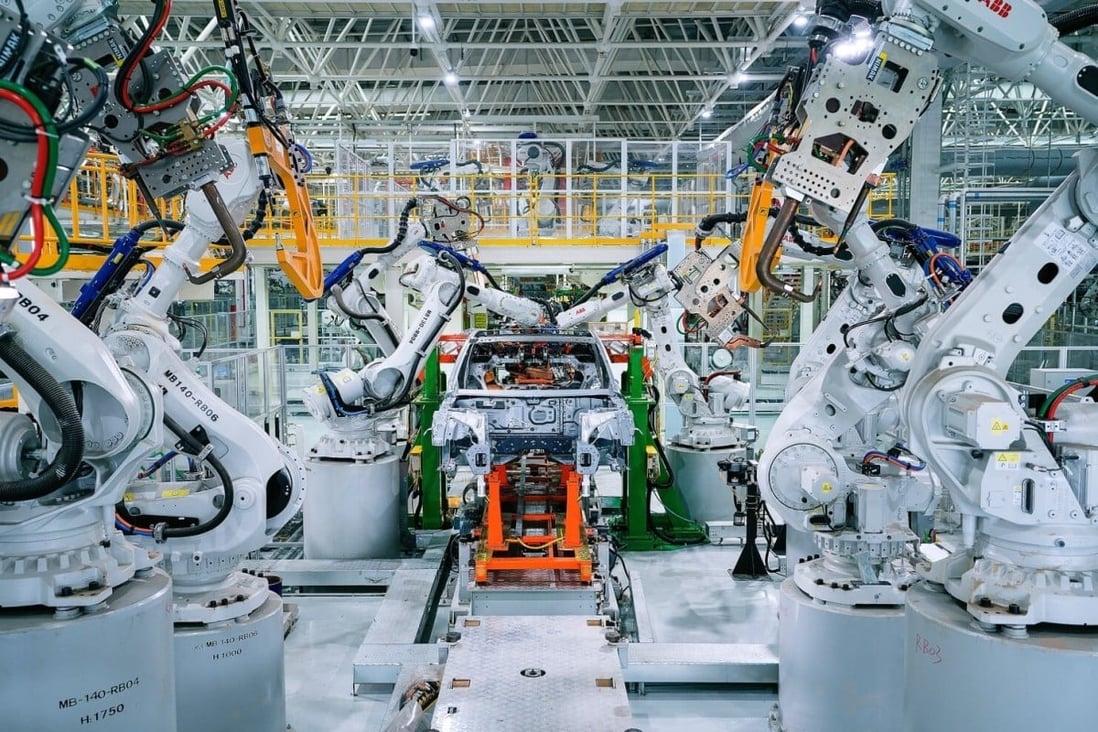
Xpeng’s factory, in the southern Chinese city of Zhaoqing, touts 100 per cent automation in the installation of car bodies at its welding workshops, with more than 200 robotic arms.
\ Photo: Handout

The US-China trade war weakened demand for automation on Chinese assembly lines from 2018-19, but a shortage of manpower during the pandemic reversed that trend last year, and analysts expect manufacturers to further embrace robots in 2021.

“The impact of the pandemic on the global industrial supply chain has been a major stimulus, forcing a huge number of orders to return to China,” said Peng Biao, an analyst with Fashionprint.com, which monitors the fashion industry. “Last year was like a roller-coaster ride for Chinese manufacturers, from huge drops in revenue at the beginning of the year to a huge rebound later that year. And now there is a growing shortage of manpower everywhere, so medium- and large-sized companies are now, again, having to step up the replacement [of workers] with robots.

“For example, among garment printers that survived last year, it can be said that 80 per cent of them have plans this year to invest in automation. Otherwise, it will be difficult to survive in the future, because they would be eaten up by the soaring cost of labour and materials.”

After the trade war with the United States kicked off in July 2018, many Chinese companies – particularly in the Pearl River Delta and Yangtze River Delta manufacturing bases – said they were relocating production lines out of China, fearing the knock-on effect of trade tariffs.

But now, with China being the only major economy to fully resume production amid the coronavirus, domestic manufacturers and overseas buyers are re-evaluating the need for relocation and the importance of maintaining production capacity in China, according to Luo Jun, CEO of the International Robotics and Intelligent Equipment Industry Alliance, a government-backed think tank on smart manufacturing.

China’s manufacturers embrace ‘smart shops’
1 Nov 2020


And if the pandemic continues to impact the production capacity in other major economies in the coming year, there will be a steady and considerable flow of orders coming to Chinese manufacturing, resulting in a robotics boom, he predicted.

Robotics was one of the 10 cutting-edge industries singled out in Beijing’s “Made in China 2025” industrial policy initiative that sparked international controversy and stood at the heart of the Sino-US trade war. While the plan has since been sidelined, Beijing has still splashed out huge subsidies on the robotics industry, seeing it as a key element in its push to upgrade the nation’s manufacturing industry and provide a solution to soaring labour costs amid a shrinking labour force.

In 2018, the number of newly installed industrial robots in China fell 1 per cent, to around 154,000 units. The market continued to shrink in 2019, dripping 8.6 per cent from a year earlier to 144,000 units, according to figures from China Robot Industry Alliance and the International Federation of Robotics.

But there was a sharp rebound in the latter part of 2020.

Even though China’s industrial robot production plunged 19.4 per cent from a year earlier in January and February at the height of the coronavirus outbreak, total year-on-year output jumped 22.2 per cent in the first 11 months of 2020, indicated a swell in demand as the nation’s overall economy rebounded, according to China’s National Bureau of Statistics.

The GG Robotics Research Institute, based in Guangdong province, estimates that there were more than 169,000 new industrial robot installations last year. That total would represent a 17.4 per cent increase over the 2019 figure of 144,000 units given by the China Robot Industry Alliance and the International Federation of Robotics.


And business is looking up for this year.

Dongguan-based Topstar Technology, one of China’s leading intelligent manufacturing integrated service providers, said it expects to add 5,000 clients this year to the 10,000 it had in 2020. According to the firm, it invested 5 per cent of its 2019 revenue into research and development.

China had a “robot density” of 187 units per 10,000 workers in 2019, according to the latest figures from the International Federation of Robotics, up from 140 in 2018 and 68 in 2016. Globally, there were 113 installed industrial robots per 10,000 employees, on average, in the manufacturing sector in 2019, the figures showed.

Government-backed incentives and funding are still the main engines driving Chinese manufacturers to replace humans with robots in industries including pharmaceuticals, medical devices, new infrastructure projects and food processing.

Robotics-enabled automation is the solution to rising labour costs, said Pink Zhang, manufacturing director of TROX Air Conditioning Components (Suzhou), which invested more than 10 million yuan (US$1.55 million) last year to upgrade its automated production lines.

The company’s sales pitch is ambitious, with Zhang saying TROX aims to achieve annual sales growth in the domestic market of 30 per cent starting this year by providing tailored air conditioning solutions for hundreds of hospitals, institutes, airports and commercial buildings across China.

“We understand the importance of automation in fulfilling our goal, especially after seeing the sudden, huge impact of p
andemic-induced [transport] lockdowns on freezing staff mobility,” he said. The company is planning to invest at least three per cent of its annual revenue in replacing human labour with robots in the coming years.

An automation boom is also expected in the food-processing sector after Beijing’s call to ensure food security and eliminate food waste.

China’s food security requires local Communist Party members to step up, minister says
7 Jan 2021


“About 20 per cent of the 7,600 rice-processing factories in China have been partially automated so far. The rest all need to be armed with automation in the near future,” said Zhou Ying, chairman of the board at Hunan Hailian Grain and Oil Technology, which produces “flexible polishing devices” for rice processing.

“In the 2000s, my father sent me to study in Europe to prepare to take over the family business. At that time, all rice-colour sorting machines and packing machines were made and imported from the UK, Italy and Japan. Now, domestic suppliers account for over 80 per cent of the market,” Zhou said.

Beijing’s domestically focused economic strategy is proving to be a golden opportunity for Chinese tech firms of their kind, she said.

Financial support for robotics manufacturers and automation businesses at various levels of government – in the form of subsidies, low-interest-rate loans, tax relief, or land rental incentives – is still considerable. Nonetheless, China remains heavily reliant on imports of core robotic parts from Japan and the European Union, according to Luo at the International Robotics and Intelligent Equipment Industry Alliance.

The goal, he said, is to gradually reduce that dependency in the coming years, and that could be expedited “if global demand remains strong and continues to rely on Chinese production capacity”.

This article appeared in the South China Morning Post print edition as: Pandemic boosts use of factory robots
As China’s coronavirus rebound gathers steam, export-oriented manufacturers struggle to find worker

Factories in China’s south and east are struggling to find enough workers to fill surging export orders thanks to strong demand in Western countries

The uptick in orders is proving a double-edged sword for many manufacturers, driving up wages and in some case forcing them to delay shipments


Chinese factory owners scrambling to find enough workers to keep pace with overseas orders. Photo: Xinhua

A sharp rebound in China’s manufacturing in recent months, spurred on by surging demand for exports in the West, has caused labour shortages in the country’s south and east, with many factory owners scrambling to keep pace with overseas orders.

Employers are offering higher wages to entice migrant workers back from their hometowns, but analysts say the shortfall in employees is likely to last well into next year.

China’s exports surged at the fastest pace in almost three years in November, the sixth consecutive month of growth, with manufacturers continuing to capitalise on coronavirus restrictions elsewhere in the world.

Exports grew by 21.1 per cent last month from a year earlier, as China continued to ship medical equipment to combat the virus and electronic goods for people stuck at home.

The export growth has underlined China’s strong recovery from the pandemic, with the
economy growing 4.9 per cent year on year in the third quarter and the official survey-based unemployment rate falling to 5.2 per cent last month, the same level as December 2019.


But amid a tight labour market, the rapid uptick in orders is proving a double-edged sword for many factory owners.

“Factories that have recently received new orders are paying a high price to recruit short-term workers,” said Lu Zhou, an operations director at a foreign-invested medical equipment maker in Taicang, a city in the eastern province of Jiangsu.

“The industrial zones in Taicang and [nearby] Suzhou are full of recruitment ads and labour agencies asking for 300 yuan for introducing a worker, and the price is still rising.”

Some factory owners have increased wages to about 22 to 24 yuan (US$3.60) per hour, Lu said, although most small and medium-sized businesses prefer to hire temporary workers due to the uncertain global economic outlook.

News that skilled workers are now earning up to 10,000 yuan (US$,1528) a month has spread like wildfire among China’s army of 290 million migrant workers, many of whom have been out of work for part of the year due to factory closures and lockdowns.

After months of living under lockdown in Hubei province, the epicentre of China’s coronavirus outbreak, Cao Jin has bounced from province to province, picking up work on the night shift at a factory in Foshan, Guangdong province, before heading west to Xinjiang province to work in construction.

The labour market will further tighten, and there may be a relatively strong labour shortage problem next year   Liu Ligang

But the 39-year-old is now eyeing a return to one of China’s export-oriented manufacturing hubs, like Guangdong or Zhejiang, after hearing he could be earning 20 per cent more than in 2019.

“My [old] boss welcomes me to join anytime because the factory is short on labour and he estimates there are enough orders for employees to work on rotating [12-hour] shifts until next October,” said Cao, who spent years working in Guandong factories.

“In the middle of the year, the boss was worried the factory would close down. But output is now 20 per cent higher than last year.”

China’s factories get a Christmas boost from disrupted supply chains
25 Dec 2020


Liu Ligang, chief China economist at Citigroup, said the labour market will further tighten, and there may be a relatively strong problem next year.

“Many workers stayed at home because of the pandemic ... As more go back to work after the economy recovers and quarantine rules are lifted, that could help curb labor shortage,” he said.

China GDP: economy grew by 4.9 per cent in third quarter of 2020

Not even rising wages are enough to lure all migrant labourers back to work, particularly those in younger generations.

“Earning 8,000 yuan a month sounds good, but it’s actually exhausting work,” said Li Dian, who is in her 20s, from Hunan province. “It’s a lot of pressure working 12 hours per day, 6 days per week, with only half an hour for meals and no rest during the shift.”

Li worked for an electronics factory in Dongguan, a manufacturing hub in Guangdong province, before quitting in the summer and returning to her hometown, where she now earns between 3,500 yuan and 5,000 yuan a month at a local factory.

For employers, the unstable global recovery from the pandemic is still a concern.

“In October and November, there were many new orders, but in December we suddenly saw an obvious drop,” said Wang Jie, who runs a footwear factory in Dongguan.

“We have heard that the pandemic is becoming even worse [outside China] … we are actually very scared.

“We could not survive another round of cancellations and postponements of orders.”

In late February, Wang took orders for more than 90,000 pairs of shoes, but 80,000 were cancelled in late March, when the outbreak began to gather pace around the world and many countries started to seal their borders.

“Many payments have also been delayed, and I still haven’t got the payments I should have in summer,” he said.

Shanghai General Sports, a motorcycle and bicycle manufacturer, has had a good year as bicycle sales boomed this year in the United States, its primary export market.

But general manager Ge Lei said a shortage of workers had forced it to delay delivery for most of the year and orders are already lined up until June 2020.

At the same time, an appreciating Chinese yuan and little room for price negotiation with foreign clients has not made business particularly profitable.
The yuan has steadily appreciated against the US dollar this year and many economists believe it could strengthen further.

“Our payment period is normally three months. It’s OK when we start delivering goods. But when we get payments, there is a foreign exchange loss,” Ge said.
China sees outpouring of support for workers laid low by Beijing coronavirus outbreak, and online censors have stepped in

Beijing has gone into ‘emergency response mode’ after detection of first local infections in five months

Travel records of some infected individuals are casting a spotlight on how difficult it can be to make a living in the nation’s capital


Sidney Leng and Jane Cai in Beijing
Published:  28 Dec, 2020

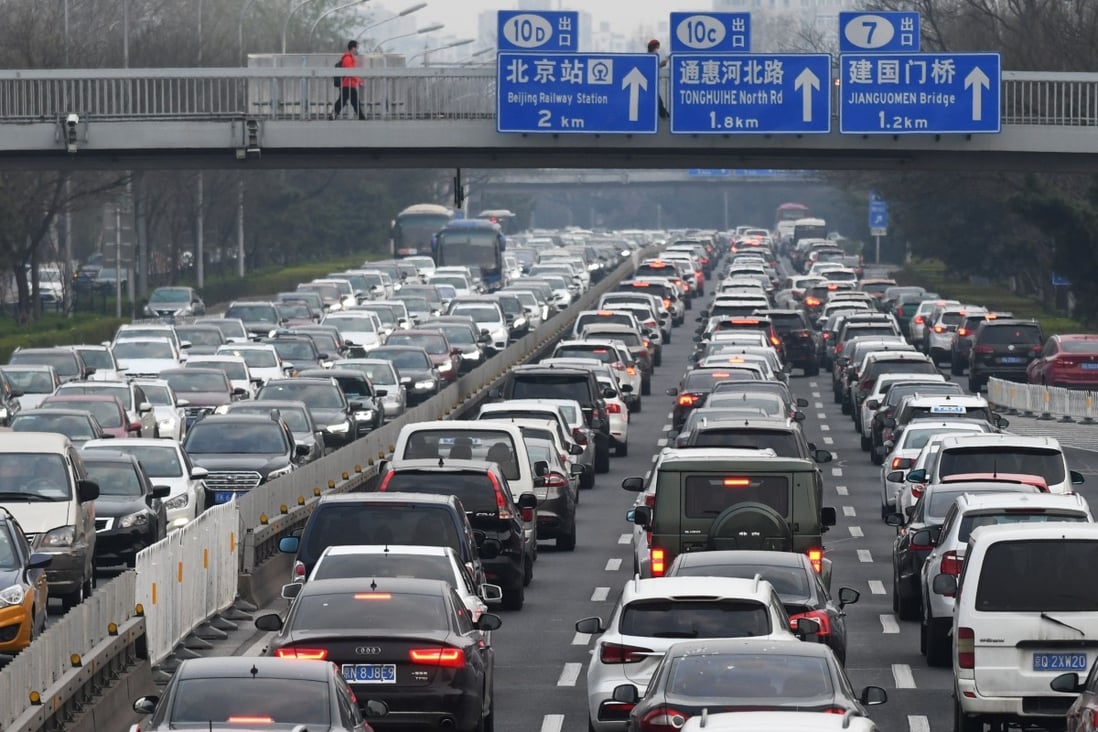
Commute times in Beijing are among the worst in China, with many residents sitting in traffic for hours every day.
Photo: AFP

As Beijing braces for a rise in coronavirus infections during the winter months, Chinese citizens are lamenting the hardships facing infected workers in the nation’s capital, based on newly disclosed descriptions of their circumstances.

Beijing went into “emergency response mode” on Wednesday after 13 cases were detected in the capital city in 10 days, including the first local infections in 152 days. Beijing has reported nine local cases in less than a week.

Among the five confirmed cases and one asymptomatic infection reported over the weekend, all are migrant workers living in Nanfaxin township, in the city’s northeastern Shunyi district near Beijing Capital International Airport.

The district has more than a million residents, nearly half of whom are not locals. Most have blue-collar jobs.

China urged to ‘expand job market’, provide support for university graduates and migrant workers in 2021
18 Dec 2020


The latest wave of local infections began when a 34-year-old man in Shunyi, surnamed Fu, tested positive for the virus. When his test results came back early on Wednesday morning, Fu was on a business trip to Ningbo, nearly 1,400km (870 miles) from home – and just three days before he was due to take his graduate school exam, according to his travel records released by the Beijing government.

The details of Fu’s travails struck a chord with many people, particularly those living in Beijing, by casting a spotlight on the hard life of a typical working father in the city.

Fu spends at least three hours every day making the 50km (31-mile) round trip between his home and office, accompanies his child to early education classes and shopping on his weekends, and uses his evenings to prepare for his graduate school exam.

On Tuesday, he took a coronavirus test, as required for every exam taker, and flew to Ningbo in the afternoon before he was confirmed to have been infected.

During the latest outbreak in Beijing, what’s being disclosed is not just itineraries [of confirmed cases], but also the lives of ordinary people in BeijingWeibo comment

“This is typical life in Beijing,” said a netizen on Weibo, China’s Twitter-like microblogging service. “While it is common to work hard for a better life, the long commuting time is unbearable. That’s why I left Beijing two years ago.”

Other shared itineraries also offered glimpses into the working lives of men and women in Beijing. A 31-year-old man living in Shunyi, whose infection was confirmed on Saturday, spent his days working at a trading company while also holding down a night shift at a delivery transfer station for courier firm SF Express.

“During the latest outbreak in Beijing, what’s being disclosed is not just itineraries [of confirmed cases], but also the lives of ordinary people in Beijing,” said one popular Weibo comment.

“Life is so hard. These are the real lives of contemporary workmen, especially in first-tier cities,” another said.

A 32-year-old woman, whose infection was also confirmed on Saturday, was working full-time at an electric-vehicle firm during the day, then part-time at a delivery station from 10pm to 2am on five of the 14 days before her hospitalisation.

And a 40-year-old male patient had been driving for a ride-hailing company in the city for 17 hours a day in 11 out of the 14 days surveyed, from 6am to 11pm, to make ends meet.

“Beijing’s cases always tell people what survival looks like,” another Weibo commenter said. “In a city where it takes more than 45 minutes to commute , many people even spend three or four hours commuting every day. It is difficult for you to feel the breath of life in such a city most of the time.”

Many such postings on Chinese social media have been removed by censors. On Monday, a popular Weibo hashtag referring to the “hard life in Beijing’s coronavirus cases” generated zero results.


As China’s capital, Beijing has one of the highest costs of living among cities in China, and in the world. According to an annual survey by asset management firm Mercer, Beijing ranked 10th this year on its list of the most expensive cities for expatriates to live in, with Shanghai coming in seventh place and Hong Kong ranked first.

Beijing also has the longest commuting distances and times among all Chinese cities, with an average journey of 12.4km and 56 minutes, according to a 2019 report by the Beijing Transport Development and Research Centre.

This year, young people in Beijing are spending an average of 5,100 yuan (US$782) a month on rent – the highest average among China’s four largest cities, including Shanghai, Guangzhou and Shenzhen, according to a report published by the Beijing-based real estate brokerage platform Beike.

Steamed buns and cheap noodles comprise most meals of the working class, according to the report.

Life is so hard. I cannot help sighing. We live in the same city and are under similar pressure Douban user

“While ‘low-end workers’ may be unwelcome in the capital city, the pandemic survey shows they work hard and deserve our respect,” a Weibo post said.

Beijing’s population stood at 21.5 million at the end of last year, with around 34 per cent of residents being migrants from other provinces, official data showed.

Tens of thousands of migrant workers were forced out of their homes in Beijing amid a citywide clean-up campaign in the aftermath of 
a blaze killed 19 people in 2017. The Beijing government has denied that it was aiming to evict lower-class segments, but there are widespread concerns that ordinary workers have become unwelcome in Beijing’s urbanisation and industrial upgrading drives.

“Life is so hard,” said a user on Douban, a social-networking platform. “I cannot help sighing. We live in the same city and are under similar pressure.”

This article appeared in the South China Morning Post print edition as: New cases expose misery of Beijing’s working class