Sunday, October 24, 2021

FEATURE

Shining a light on one of Judaism’s most enigmatic scholars

Documents obtained by the National Library of Israel grant a rare glimpse into the mind of “Monsieur Chouchani,” who taught many of the 20th century’s Jewish cultural and intellectual figures, including Elie Wiesel.

BY ELAD NEVO

Monsieur Chouchani taught many of the 20th century's Jewish scholars. 
Archive Photograph: No credit.


(October 24, 2021 / Israel Hayom) For Israeli Philosophy Professor Shalom Rosenberg, the world is divided into two kinds of people: those who had the privilege of meeting Monsieur Choucani and those who did not.

An enigmatic scholar, Choucani taught many distinguished students in Europe, Israel and South America after World War II. Besides Rosenberg, his disciples were French Jewish philosopher Emmanuel Levinas, Holocaust survivor and Nobel laureate Elie Wiesel, and more.

Although not much is known about Choucani, including his real name, recent documents obtained by the National Library of Israel shed light on his genius.
Fifty notebooks handwritten by Choucani were donated to the library by Rosenberg, who met the scholar in South America. The papers were studied, deciphered and organized by the National Library and are now available to the public.

According to archivists, the notebooks are full of ideas on Jewish thought, memory exercises and mathematical formulas that were incredibly difficult to decipher.

“Choucani’s notebooks are a gold mine,” said Yoel Finkelman, curator at the National Library. “His works are exceptionally challenging to decipher because he did not write orderly paragraphs. He put down parts of sentences, mathematical equations, and acronyms in which he encrypted his ideas,” added Finkelman.
Subscribe to The JNS Daily Syndicate by email and never miss our top stories

“Moreover, he had his own kind of vocabulary, and only through tracking down a word as it appears throughout the rest of the text can one begin to understand its meaning,” he said.


A page from one of Choucanii’s notebooks. Credit: National Library of Israel.


According to Finkelman, the library worked on deciphering Choucani’s works in order to “understand what he knew, how he thought and how he formulated his religious and educational views.” He also said the library considered it “of paramount importance to bring to the public’s attention the story of one of the most mysterious and influential figures in twentieth-century Jewish thought.”

David Lang, an archivist at the National Library, said another aspect that made the process of deciphering Choucani’s notebooks complex was how diverse his knowledge was.

“The notebooks cover all subjects in Judaism—Torah, Talmud, Jewish law, rabbinic literature, philosophy, Kabbalah, ethics and Hassidism,” said Lang. “He also spent a great deal of time on mathematics and physics, and Choucani’s interest in the history of science is also evident,” he added.

According to Lang, Choucani had a photographic memory and was able to recall and cite the entire Bible, Talmud and various Jewish texts from memory, and had also mastered several languages.


A portrait of Nobel laureate Elie Wiesel. Photo by Miriam Alster/Flash90.

Wiesel, who greatly admired his teacher, wrote that Choucani “mastered some thirty ancient and modern languages, including Hindi and Hungarian. His French was pure, his English perfect, and his Yiddish harmonized with the accent of whatever person he was speaking with. The Vedas and the Zohar he could recite by heart. A wandering Jew, he felt at home in every culture.”

For Rosenberg, who was born in Buenos Aires in 1935 and moved to Israel in 1963, meeting Choucani was a dream.

“Shalom spoke about Choucani all the time, and so in 1967, I surprised him with a gift—a trip to Montevideo, Uruguay, to meet him,” said his wife Rina. Despite the limited amount of time they spent together, Choucani left a tremendous impression on Rosenberg, as well as on the rest of his students.
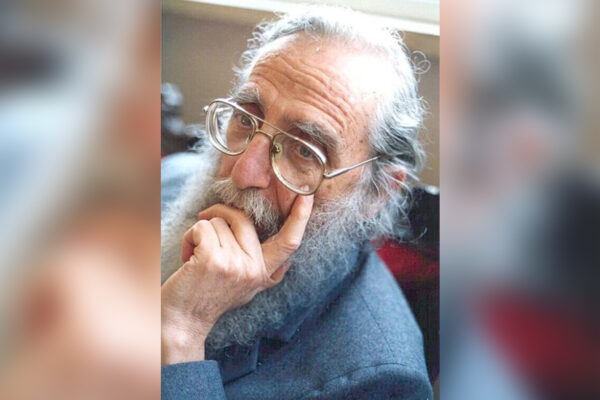

Philosophy professor Shalom Rosenberg. Credit: Wikimedia Commons.

Choucani arrived in Uruguay after spending several years in Israel, Algeria and France. While in Israel, he studied with renowned Rabbi Abraham Isaac Kook, who was the first Ashkenazi chief rabbi of British Mandatory Palestine.

Kook called Choucani “one of the most excellent young people … sharp, knowledgeable, complete and multi-minded.”

His comprehensive knowledge even helped him escape the horrors of the Holocaust. When arrested by Nazi officers in France, he claimed he was a Muslim. Doubting whether that was true, officials summoned the chief mufti of France at the time, who, after a three-hour conversation with Choucani, declared he was “a holy Muslim.”

The Jewish scholar eventually made his way to Uruguay, where he died unexpectedly in 1968.

“He felt that Uruguay was so far away, the war would never spread to there,” said Rina Rosenberg. In 1968, she and her husband participated in a Jewish teachers’ seminary in the South American country, which Choucani also attended.

“He used to always sit in his room and teach,” she said. “He never came to the dining hall, but only ate in his room. He was charismatic and impressive. Shalom told me Chouchani told him he preferred to teach women because he said their heads had not been tainted by yeshivas.”

Choucani passed away during that same seminar.

“One Saturday night he suddenly fell ill,” Rosenberg recalled. “Shalom and a few others took him to a local hospital, where he died. Shalom was devastated. He thought Choucani could have been saved, but the hospital didn’t even have oxygen to give him.”

Rosenberg, who is the former chair of Jewish Thought at the Hebrew University of Jerusalem, has spent many years deciphering Choucani’s work. He asserts that Choucani’s real name was most likely Hillel Perlman, and that he was born in the Belarusian town of Brisk.

A few years ago, he was joined by his student Hodaya Har-Shefi, who wrote a thesis on Choucani and is now writing a doctorate.

By studying Chouchani’s work, she learned that “he gave a lot of attention to the teacher-student relationship. It is also interesting to see his attitude towards the sages, how he criticized their work, but at the same time, deeply respected them.

According to the National Library, Choucani challenged his students with difficult questions and encouraged them to improve and progress, and especially to think in unexpected ways.

“Choucani did not want his works to be published in his lifetime,” Har-Shefi continued. “He also did not like students taking notes and summarizing his lessons. He had tremendous respect and caution for the written word.

“He wanted people to teach and learn the right way, and he tried to pass on these tools to his students to make sure Jewish tradition continues.”

Professor Hanoch Ben-Pazi, who walked Har-Shefi through her thesis work, says Choucani’s personal experience mirrored that of European Jewry who moved to the West in the first half of the 20th century.

“Choucani belongs to the same group of young people from Eastern Europe who came to the West and admired the Enlightenment and the vast knowledge that was now available to them,” he said. “The same thing happened to Rabbi [Joseph] Soloveitchik, Abraham Joshua Heschel and the Lubavitcher Rebbe [Menachem Mendel Schneerson.]”

Soloveitchik, Heschel and Schneerson were all born in Eastern Europe, but immigrated to the United States in their youth and went on to become the greatest Jewish leaders of the 20th century.

“They all tried to preserve the Torah world, but still wanted to be part of the enlightened world,” Ben-Pazi continued. “This is a complicated task. In the end, each of them had their own journey.”

Ben-Pazi has also spent a great deal of time deciphering Choucani’s works.

“It is clear that from a historical and biographical point of view that Chocani’s is a classic Jewish story,” he said. “On the other hand, seeing how his teachings affected his students and where it led them, we see that his influence on Western thought, albeit indirect, is much greater than one would assume.”

This article first appeared in Israel Hayom.
A young, gay Russian Jew navigates ’80s New York in ‘Minyan,’ a new film set in Brighton Beach

BY ANDREW LAPIN OCTOBER 22, 2021 

Ron Rifkin, Samuel H. Levine and Christopher McCann in "Minyan." (Strand Releasing)

(JTA) — A gay Russian Jewish teenager comes of age in Brighton Beach in the touching new independent film “Minyan,” a subtle and sensitive drama that tells an unexpected story about the Brooklyn neighborhood’s large immigrant Jewish community.

Based on a short story by David Bezmozgis, an author who has long grappled with Russian Jewish identity in meticulous and probing ways, Eric Steel’s film finds a unique way to highlight its queer themes through the prism of an Orthodox Jewish culture that heavily prizes manhood, and strength in numbers. If 10 men gathering in prayer is a holy act, the film posits, then surely two men gathering in love must have some degree of holiness to it, as well.

Samuel H. Levine, who riveted Broadway audiences in “The Inheritance,” turns in a fully lived-in lead performance as David, the only son to a family of Soviet Jewish immigrants in 1986. David, whom Levine plays with a quiet, subdued curiosity, feels little affection for his parents: His mother (Brooke Bloom), insistent on sending him to a yeshiva where he is routinely bullied, seems blind to his true needs, while his abusive, philandering father seems to be imparting the wrong ideas about masculinity. To discipline his son for getting into a fight with another yeshiva student who mocks him for being Russian, David’s father sucker-punches him in the face.

Instead, David gravitates to his grandfather Josef (Ron Rifkin), whose calm, matter-of-fact rituals bring him comfort. As the film opens, Josef has decided to seek out a new apartment for himself after the death of his wife. Here we see why the film is called “Minyan”: Josef is only able to secure a fixed-income apartment in a synagogue building once David agrees to join him, because together they give the congregation the requisite 10 men it needs to pray.

This story is part of JTA's coverage of New York through the New York Jewish Week. To read more stories like this, sign up for our daily New York newsletter here.

In all these buildings full of Jews dealing with repressed generational trauma (the Holocaust and the Soviet Jewish purges are both frequently invoked), David finally discovers a little piece of himself. His neighbors in the synagogue are two elderly men who live together; they have a storyline that explains their arrangement, which the community accepts, but it’s clear they find more comfort in this open secret than they ever could have in the USSR. Soon after meeting them, David begins to explore a local gay bar, and loses his virginity to a brooding bartender (Alex Hurt) who, at the height of the AIDS epidemic, seems shocked by his new lover’s youth and ignorance of the disease — and how David, having already avoided one life of misery at the grace of his parents, is unaware he may now be dooming himself to another.

As David quietly, tentatively tries to navigate his environment (partially with the help of James Baldwin’s books, which are invoked as holy texts on par with anything in the Talmud), “Minyan” finds meaningful ways to frame his maturity alongside his growth in Jewish thought. Aided by David Krakauer and Kathleen Tagg’s klezmer score, the film spotlights the moments when its hero comes into his own: leading a Mourner’s Kaddish prayer, advocating for a fellow Jew’s living conditions or simply listening to his mother describe her relief that she could give him a new life where he wouldn’t be targeted for his Judaism.

Little in Steel’s prior filmography — his most notable previous directing credit was the controversial 2006 documentary “The Bridge,” which secretly filmed a year’s worth of suicides off the Golden Gate Bridge — indicated that he aimed to tackle a story as delicate and human as “Minyan.” But Steel himself grew up gay and Jewish in the 1980s, and he’s smartly fused Bezmozgis’ source material with his own memories to create a film with a personal touch. The movie even feels in league with works by Ira Sachs and Andrew Haigh, the reigning kings of layered, nuanced stories about gay communities, while also being deeply Jewish. “Minyan” is an intimate story of outcasts in many forms.

“Minyan” opens today at the IFC Center in New York and expands to Los Angeles and on-demand rental Oct. 29.
QatarEnergy signs deal with ExxonMobil Canada on farm-in exploration license


FILE PHOTO: A sign is seen in front of the Exxonmobil Baton Rouge Refinery in Baton Rouge, Louisiana.


Andrew Mills
Sun, October 24, 2021

DUBAI (Reuters) - QatarEnergy has signed a deal for a 40% stake in one of ExxonMobil’s major offshore explorations in Canada, the Qatar state-owned oil and gas firm said on Sunday.

The deal marks QatarEnergy’s first foray into offshore exploration in Canada, the company said in a statement.

The agreement will give QatarEnergy a farm-in exploration license for EL 1165A, currently held by ExxonMobil Canada.

The Hampden exploration well activities are planned in deep water, 450 km off the coast of Newfoundland and Labrador. ExxonMobil Canada will retain the remaining interest in the exploration.


Over the past two years, Qatar Energy has expanded internationally, gaining stakes in oil and gas projects around the world by signing deals with major energy companies, including ExxonMobil.

Qatar is the world's largest supplier of liquefied natural gas and aims to expand production to 127 million tonnes annually by 2027 from the current 77 million tonnes.

(Reporting by Andrew Mills; Editing by Hugh Lawson)
TOXIC CHEM FIRE
Tug fights container fire on cargo ship off British Columbia

By Kevin Light
 October 24, 2021

Container ship Zim Kingston evacuated due to a fire on board near Victoria

Victoria, BRITISH COLUMBIA (Reuters) -A tug boat spent the night fighting a container fire that broke out on Saturday on a cargo ship carrying mining chemicals off British Columbia, the Canadian Coast Guard said on Sunday, adding that it would continue to monitor the situation.

Sixteen crew members were evacuated from the MV Zim Kingston on Saturday, while five remained onboard to fight the fire.

“Overnight the tug Seaspan Raven has cooled the hull of the M/V #ZimKingston by spraying the hull with cold water,” the coast guard said on Twitter. “Due to the nature of chemicals onboard the container ship, applying water directly to the fire is not an option.”

Images captured by Reuters on Sunday showed two tug boats spraying water toward the ship.

The coast guard warned that there was an emergency zone around the ship, telling all vessels to stay at least two nautical miles away, and the Transport Ministry restricted all aircraft, including drones, from flying within two nautical miles or below 2,000 feet over the ship.

Earlier on Sunday Danaos Shipping Co, the company that manages the container ship, said in a statement that no injuries had been reported.

The fire “appears to have been contained,” and a salvage and fire extinguishing agency was brought in to ensure the safe return of the vessel’s crew, Danaos said.

The mishap comes as more bad weather is expected to hit the area on Sunday and amid a global shipping traffic jam that has held up deliveries all over the world.

On Saturday, Canada’s coast guard said the ship itself was not on fire and only 10 containers were burning.

Canada’s coast guard said it has been working with its U.S. counterpart to track 40 containers that had previously fallen overboard when Zim Kingston encountered bad weather, saying they posed a significant risk to mariners.

The company did not immediately respond when asked if the lost containers were linked to the fire.

“Mariners are advised to stay clear of the area. Currently there is no safety risk to people on shore, however the situation will continue to be monitored,” the coast guard said on Saturday, when video obtained by Reuters showed fire cascading down from the deck of the ship into the water.

“This is extremely concerning. The ship and containers are very close to Victoria, BC, and a big storm is forecast to hit tonight. We … are worried this may be yet another environmental disaster,” said David Boudinot, president of Surfrider Foundation Canada, an environmental organization.

(Reporting by Bhargav Acharya, Chris Helgren and Nur-Azna Sanusi; Additional reporting by Aishwarya Nair in Bengaluru; Editing by Edwina Gibbs, Frances Kerry and Mark Porter)

The container ship Zim Kingston burns from a fire off the coast of Victoria
Fire cascades down from the deck of the container ship ZIM Kingston into the waters off the coast of Victoria, British Columbia, Canada
Container ship Zim Kingston evacuated due to a fire on board near Victoria
Obama attacks GOP candidate’s ‘phony, trumped-up culture wars’ during Virginia rally

 Published: Oct. 24, 2021

Former President Barack Obama, left, campaigns with Democratic gubernatorial candidate, former Virginia Gov. Terry McAuliffe at Virginia Commonwealth University on Saturday, Oct. 23, 2021, in Richmond, Virginia. The Virginia gubernatorial election, pitting McAuliffe against Republican candidate Glenn Youngkin, is November 2.
 (Win McNamee/Getty Images/TNS)TNS


By Tribune News Service

WASHINGTON — Former President Barack Obama waded into VirginIa’s gubernatorial race, criticizing Republican candidate Glenn Youngkin for supporting “phony, trumped-up culture wars” in his bid to flip the state.

Speaking at a rally in Richmond for Democrat Terry McAuliffe, Obama said Youngkin was seeking to win by signaling support for baseless claims about fraud in the 2020 election that led to the attack on the Capitol on Jan. 6.

“Either he actually believes in the same conspiracy theories that resulted in a mob, or he doesn’t believe them but he’s willing to go along with them, to say or do anything to get elected,” Obama said of the former Carlyle Group co-CEO on Saturday. “And maybe that’s worse, because that says something about character.”

The rally was one of several early-voting drives held by McAuliffe’s campaign hosted by high-profile guests such as Vice President Kamala Harris and former Georgia gubernatorial candidate Stacey Abrams. With national attention focused on the contest ahead of next year’s midterm elections, a rally with President Joe Biden is slated for next week.

Saturday’s event in front of a library at Virginia Commonwealth University attracted about 2,000 supporters. They were repeatedly encouraged to turn in mail-in ballots or go to one of the city’s early-voting sites, the closest of which was about a mile away.

Obama praised McAuliffe as an energetic former governor who could hit the ground running on jobs and education. But like other speakers at the two-hour rally, he spent much of his speech arguing that Youngkin — whom he never specifically named — and Republican lawmakers would roll back expanded voting options, access to abortion and public health measures on the coronavirus pandemic.

He highlighted a recent pro-Youngkin rally in which attendees recited the Pledge of Allegiance to a flag from the Jan. 6 riot.

While Youngkin was not involved in planning the event and later said the pledge was “weird and wrong,” he has given mixed signals about former President Donald Trump’s claims of election fraud, calling for an audit of the state’s voting machines and appearing at an “election integrity” event at Liberty University in the state.

McAuliffe’s lead has steadily shrunk from this summer. One recent poll showed him tied with Youngkin.

Republicans say the Virginia race could show a path to recapturing some of the suburban voters they lost during the Trump administration. Democrats are seeking to generate enough enthusiasm to maintain control of a state Biden won by 10 points last year.

Ryan Teague Beckwith of Bloomberg News wrote this story.

©2021 Bloomberg L.P. Visit bloomberg.com. Distributed by Tribune Content Agency, LLC.
EXPLAINER: What the metaverse is and how it will work

By KELVIN CHAN and MATT O'BRIEN


FILE - In this Oct. 12, 2021 file photo, Hadrien Gurnel, software engineer EPFL's Laboratory for Experimental Museology (eM+) explores with a virtual reality helmet the most detailed 3D map of the universe with the virtual reality software VIRUP, Virtual Reality Universe Project developed by Swiss Federal Institute of Technology, in St-Sulpice near Lausanne, Switzerland. The term metaverse seems to be everywhere. Facebook is hiring thousands of engineers in Europe to work on it, while video game companies are outlining their long-term visions for what some consider the next big thing on the internet. Essentially, it’s a world of endless, interconnected virtual communities where people can meet, work and play. You can go to a virtual concert, take a trip online and try on digital clothing. But tech companies still have to figure out how to connect their online platforms.(Laurent Gillieron/Keystone via AP)


LONDON (AP) — The term “metaverse” seems to be everywhere. Facebook is hiring thousands of engineers in Europe to work on it, while video game companies are outlining their long-term visions for what some consider the next big thing online.

The metaverse, which could spring up again when Facebook releases earnings Monday, is the latest buzzword to capture the tech industry’s imagination.

It could be the future, or it could be the latest grandiose vision by Facebook CEO Mark Zuckerberg that doesn’t turn out as expected or isn’t widely adopted for years — if at all.

Plus, many have concerns about a new online world tied to a social media giant that could get access to even more personal data and is accused of failing to stop harmful content.

Here’s what this online world is all about:

WHAT IS THE METAVERSE?

Think of it as the internet brought to life, or at least rendered in 3D. Zuckerberg has described it as a “virtual environment” you can go inside of — instead of just looking at on a screen. Essentially, it’s a world of endless, interconnected virtual communities where people can meet, work and play, using virtual reality headsets, augmented reality glasses, smartphone apps or other devices.

It also will incorporate other aspects of online life such as shopping and social media, according to Victoria Petrock, an analyst who follows emerging technologies.

“It’s the next evolution of connectivity where all of those things start to come together in a seamless, doppelganger universe, so you’re living your virtual life the same way you’re living your physical life,” she said.

But keep in mind that “it’s hard to define a label to something that hasn’t been created,” said Tuong Nguyen, an analyst who tracks immersive technologies for research firm Gartner.

Facebook warned it would take 10 to 15 years to develop responsible products for the metaverse, a term coined by writer Neal Stephenson for his 1992 science fiction novel “Snow Crash.”

WHAT WILL I BE ABLE TO DO IN THE METAVERSE?

Things like go to a virtual concert, take a trip online, and buy and try on digital clothing.

The metaverse also could be a game-changer for the work-from-home shift amid the coronavirus pandemic. Instead of seeing co-workers on a video call grid, employees could see them virtually.

Facebook has launched meeting software for companies, called Horizon Workrooms, to use with its Oculus VR headsets, though early reviews have not been great. The headsets cost $300 or more, putting the metaverse’s most cutting-edge experiences out of reach for many.

For those who can afford it, users would be able, through their avatars, to flit between virtual worlds created by different companies.

“A lot of the metaverse experience is going to be around being able to teleport from one experience to another,” Zuckerberg says.

Tech companies still have to figure out how to connect their online platforms to each other. Making it work will require competing technology platforms to agree on a set of standards, so there aren’t “people in the Facebook metaverse and other people in the Microsoft metaverse,” Petrock said.

IS FACEBOOK GOING ALL IN ON THE METAVERSE?

Indeed, Zuckerberg is going big on what he sees as the next generation of the internet because he thinks it’s going to be a big part of the digital economy. He expects people to start seeing Facebook as a metaverse company in coming years rather than a social media company.

A report by tech news site The Verge said Zuckerberg is looking at using Facebook’s annual virtual reality conference this coming week to announce a corporate name change, putting legacy apps like Facebook and Instagram under a metaverse-focused parent company. Facebook hasn’t commented on the report.

Critics wonder if the potential pivot could be an effort to distract from the company’s crises, including antitrust crackdowns, testimony by whistleblowing former employees and concerns about its handling of misinformation.

Former employee Frances Haugen, who accused Facebook’s platforms of harming children and inciting political violence, plans to testify Monday before a United Kingdom parliamentary committee looking to pass online safety legislation.


 In this Thursday, May 13, 2021 file photo, a view of a Gucci advertisement campaign selected for an exhibition to celebrate the vision of Gucci's creative director Alessandro Michele at the Gucci Garden Archetypes, in Florence, Italy.The term metaverse seems to be everywhere. Facebook is hiring thousands of engineers in Europe to work on it, while video game companies are outlining their long-term visions for what some consider the next big thing on the internet. Essentially, it’s a world of endless, interconnected virtual communities where people can meet, work and play. You can go to a virtual concert, take a trip online and try on digital clothing. But tech companies still have to figure out how to connect their online platforms. (AP Photo/Antonio Calanni, File)
IS THE METAVERSE JUST A FACEBOOK PROJECT?

No. Zuckerberg has acknowledged that “no one company” will build the metaverse by itself.

Just because Facebook is making a big deal about the metaverse doesn’t mean that it or another tech giant will dominate the space, Nguyen said.

“There are also a lot of startups that could be potential competitors,” he said. “There are new technologies and trends and applications that we’ve yet to discover.”

Video game companies also are taking a leading role. Epic Games, the company behind the popular Fortnite video game, has raised $1 billion from investors to help with its long-term plans for building the metaverse. Game platform Roblox is another big player, outlining its vision of the metaverse as a place where “people can come together within millions of 3D experiences to learn, work, play, create and socialize.”

Consumer brands are getting in on it, too. Italian fashion house Gucci collaborated in June with Roblox to sell a collection of digital-only accessories. Coca-Cola and Clinique have sold digital tokens pitched as a stepping stone to the metaverse.

Zuckerberg’s embrace of the metaverse in some ways contradicts a central tenet of its biggest enthusiasts. They envision the metaverse as online culture’s liberation from tech platforms like Facebook that assumed ownership of people’s accounts, photos, posts and playlists and traded off what they gleaned from that data.

“We want to be able to move around the internet with ease, but we also want to be able to move around the internet in a way we’re not tracked and monitored,” said venture capitalist Steve Jang, a managing partner at Kindred Ventures who focuses on cryptocurrency technology.

WILL THIS BE ANOTHER WAY TO GET MORE OF MY DATA?

It seems clear that Facebook wants to carry its business model, which is based on using personal data to sell targeted advertising, into the metaverse.

“Ads are going to continue being an important part of the strategy across the social media parts of what we do, and it will probably be a meaningful part of the metaverse, too,” Zuckerberg said in the company’s most recent earnings call.

That raises fresh privacy concerns, Nguyen said, involving “all the issues that we have today, and then some we’ve yet to discover because we’re still figuring out what the metaverse will do.”

Petrock she said she’s concerned about Facebook trying to lead the way into a virtual world that could require even more personal data and offer greater potential for abuse and misinformation when it hasn’t fixed those problems in its current platforms.

“I don’t think they fully thought through all the pitfalls,” she said. “I worry they’re not necessarily thinking through all the privacy implications of the metaverse.”

___

O’Brien reported from Providence, Rhode Island.

___

See AP’s complete technology coverage at https://apnews.com/hub/technology
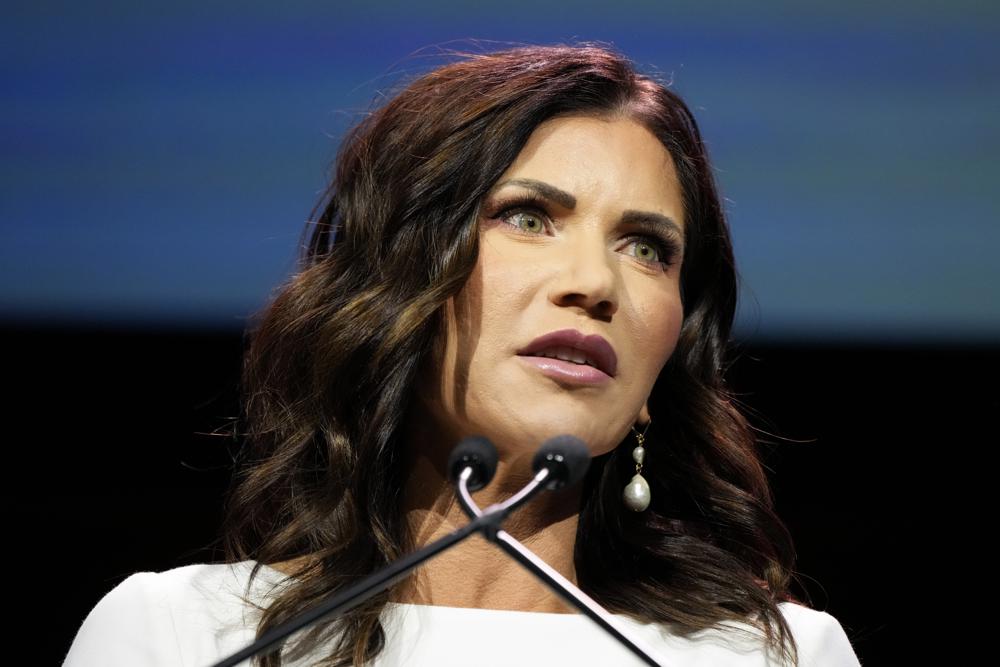
EXPLAINER: Will lawmakers dig into Kristi Noem, appraisers?

 South Dakota Gov. Kristi Noem speaks during the Family Leadership Summit in this July 16, 2021, file photo in Des Moines, Iowa. South Dakota lawmakers will be taking a look at a state agency that has been at the center of questions about whether Gov. Kristi Noem used her influence to aid her daughter's application for a real estate appraiser license.
(AP Photo/Charlie Neibergall, file)

SIOUX FALLS, S.D. (AP) — South Dakota lawmakers will be taking a look at a state agency that has been at the center of questions about whether Gov. Kristi Noem used her influence to aid her daughter’s application for a real estate appraiser license.

At first glance, the first item of business for the Legislature’s Government Operations and Audit Committee on Thursday appears routine: “Department of Labor and Regulation to discuss the Appraiser Certification Program.”

But it could have a big impact for the Republican governor, who has generated speculation about a possible 2024 White House bid. Noem has come under scrutiny after The Associated Press reported that she held a meeting in her office last year that included her daughter, Kassidy Peters, and the director of the Appraiser Certification Program, which had moved days earlier to deny Peters’ application for a license. Peters received her certification four months later.

WHO WILL BE SPEAKING?

Lawmakers have carved out a few hours in a packed schedule to hear from four people.

One is the Appraiser Certification Program’s former director, Sherry Bren. She was called into the July 2020 meeting in the governor’s office and was pressured to retire shortly after Peters received her license that November.

Another official slated to speak is Secretary of Labor and Regulation Marcia Hultman. She was also in the meeting and later pressured Bren to retire. Hultman has defended her actions by saying there have been positive changes at the agency since Bren left.

Lawmakers have also called the president of the state’s professional appraiser association, Sandra Gresh. She has raised concerns about the new direction of the state program.

The director of the state’s Office of Risk Management, Craig Ambach, also is expected to appear. His office helped negotiate a $200,000 payment to Bren for her to retire and withdraw an age discrimination complaint. Both Bren and Hultman are bound by a clause in that settlement that bans them from disparaging each other.

WHAT EXACTLY HAPPENED AT THE MEETING IN NOEM’S OFFICE?

It is not entirely clear. The governor hasn’t answered detailed questions about the meeting. Bren told the AP it covered the procedures for appraiser certification and that she was presented with a letter from Peters’ supervisor that criticized the agency’s decision to deny the license.

Noem has said she didn’t ask for special treatment for her daughter. She has cast the episode as yet another way she has “cut the red tape” to solve a shortage of appraisers and smooth the homebuying process.

In a YouTube video responding to the AP’s report, Noem pointed out that Bren had been in her position for decades, and she charged that the system “was designed to benefit those who were already certified and to keep others out.”

IS THERE A SHORTAGE OF APPRAISERS?

Yes. Industry experts have long said that’s a problem, especially in rural states. In South Dakota, many experienced appraisers are nearing retirement age.

However, the governor’s ability to “streamline” requirements for a license would be limited because they are mostly set at the federal level.

As governor, Noem has worked to ease licensing requirements for an array of professions. She said she had been working on appraiser regulations for years.

Asked for examples of that work prior to last year, her spokesman Ian Fury pointed out that Noem, during her eight years in Congress, twice signed onto GOP-sponsored bills that would have, among other financial reforms, adjusted federal appraiser regulations.

HOW CAN THE SHORTAGE BE SOLVED?

Since Bren’s departure, Noem’s administration has moved to waive certification requirements that go beyond the federal standards, such as an exam for entry-level appraisers.

But the leadership of the Professional Appraisers Association of South Dakota has raised concerns about those moves. The group says the biggest barrier to becoming an appraiser is a lack of supervisors who can train new appraisers.

Before Bren left her job, she was working to launch a first-of-its-kind program that would allow appraiser trainees to take hands-on courses and avoid the traditional apprenticeship model that has become a bottleneck. Bren helped the state win a $120,000 annual federal grant and later testified in the Legislature in support of a bill to create the training program. Noem signed it into law this year.

WHAT WILL THE COMMITTEE DO?

It’s not clear. Republican lawmakers said they will start by asking about the state agency and why there are difficulties to becoming an appraiser. But they also acknowledged that the meeting was an opportunity to question the governor’s conduct. Just two Democrats sit on the 10-person committee.

If lawmakers are satisfied, they could move on from the issue.

They also could decide to delve deeper. The committee has the power to subpoena witnesses and records, but that would require approval from the Executive Board, a ranking committee of top legislators.

Kathleen Clark, a law professor who specializes in government ethics at Washington University in St. Louis, said she would not be satisfied with the governor’s explanation that she was simply trying to “cut the red tape.”

“It is conceivable that the agency processes needed improvement,” she said. “But the presence of the daughter and the timing of the meeting suggest that this was not a meeting aimed at improving processes in general, but instead aimed at pressuring the agency to change its mind.”
French sexual abuse victims denounce police mistreatment

By SYLVIE CORBET and ARNO PEDRAM


 Thousands of French women have denounced in a new online campaign the shocking response of police officers victim-blaming them or mishandling their complaints as they were reporting sexual abuse. (AP Photo/Remy de la Mauviniere, File)

PARIS (AP) — One rape victim was asked by Paris police what she wore that day, and why she didn’t struggle more. Another woman was forced to fondle herself to demonstrate a sexual assault to a skeptical police officer.

They are among thousands of French women who have denounced in a new online campaign the shocking response of police officers victim-blaming them or mishandling their complaints as they reported sexual abuse.

The hashtag #DoublePeine (#DoubleSentencing) was launched last month by Anna Toumazoff after she learned that a 19-year-old woman who filed a rape complaint in the southern city of Montpellier was asked by police in graphic terms whether she experienced pleasure during the assault.

The hashtag quickly went viral, with women describing similar experiences in Montpellier and other police stations across France. French women’s rights group NousToutes counted at least 30,000 accounts of mistreatment in tweets and other messages sent on social media and on a specific website.

Despite recent training programs for French police and growing awareness around violence against women, activists say authorities must do more to face up to the gravity of sex crimes, and to eradicate discrimination against victims.

Addressing the national issue last week, Interior Minister Gerald Darmanin said “there are questions that cannot be asked to women when they come to file a complaint.”

“It’s not up to the police officer to say whether there was domestic violence or not, that’s up to the judge to do it,” he added.

He also announced an internal investigation at the Montpellier police station.

The prefect of the region of Montpellier had previously condemned in a statement what he called “defamatory comments” against officers. He denounced “false information” and “lies” aiming at discrediting police action.

Toumazoff denied launching an anti-police campaign, saying the hashtag aims at urging the government to take action.

“By letting incompetent and dangerous officers working in police stations, (authorities) expose the whole profession to shame,” she told The Associated Press. She said the victim mentioned in her initial tweet does not wish to speak publicly while her rape complaint is under investigation.

The Montpellier regional branch of powerful police union Alliance argued that officers are just doing their jobs. “While police officers understand the victims’ distress, the establishment of the truth requires us to ask ‘embarrassing’ questions,” it said.

A 37-year-old Parisian woman told the AP about her experience at a police station after she was assaulted this year by a man living near her home, who had previously harassed her in the street.

Once, he blocked her path and pressed her against a wall, touching her belly and her breast and threatening to kill her, she recalled.

The woman described arriving scared and crying at the police station, where officers welcomed her “very kindly.”

But then, she said, the officer in charge of filing the complaint did not write down her description of the assault, so she refused to sign the document.

“I had to tell it all again,” she said. The officer asked if she was certain that the abuser wanted to touch her breast.

“I had to make the gesture so that he sees that it was not another part of the body,” she said. “Making me repeat and ... mime the gesture in front of a wall, that’s humiliating. I found it very degrading. I felt I was like a puppet.”

The case is still ongoing. Police suggested a change of apartment to move away from her abuser, she said.


FILE - In this March 8, 2021 file photo, women react during a march to mark International Women's Day, in Paris. Despite recent French training programs for police and growing awareness around violence against women, activists say authorities must do more to face up to the gravity of sex crimes, and to eradicate discrimination against victims. (AP Photo/Francois Mori, File)

Another Parisian woman, aged 25, said she was left “traumatized” by the police treatment after she had been raped by her ex-boyfriend in 2016.

When she filed her initial complaint, the police officer, who had received special training, “explained to me why he was asking all these questions, he was in a spirit of kindness,” she remembers. “I felt rather safe and that he believed me.”

Months later she was summoned to another police station, located in the same street where her attacker was living. Feeling very anxious at the idea of potentially seeing him, she said she was talked to as if she was “stupid” and “a liar.”

Police asked what she was wearing that day, why it was different from when she was having consensual sex with him, how she could argue she was surprised if he was wearing a condom, she recalled. An officer told her, “I don’t understand why you did not struggle more.”

The complaint was closed without follow-up due to lack of evidence. The young woman described the police response as very difficult to live through, with a “huge impact” on her private life and almost leading her to giving up her studies.

The Associated Press typically does not name people who say they are victims of sexual assault.

Speaking to lawmakers at the National Assembly, the interior minister acknowledged things “can still be improved” on the matter across France.

The government has set the goal to have at least one specially trained officer in each police station for dealing with domestic violence and sexual abuse. An annual survey led by national statistics institute INSEE shows that currently only 10% of victims in these cases file a formal complaint.

The #doublepeine movement comes after the shocking killing earlier this year of a woman who was shot and set on fire in the street by her estranged husband. One of the officers who had taken her domestic abuse complaint a few months earlier had recently been convicted for domestic violence himself.

Darmanin promised that officers definitively convicted for such acts won’t be allowed to be in contact with the public anymore.

Women have been raising the alarm for years, Toumazoff said, denouncing announcements by politicians not followed by action.

“When there are urgent situations, like terror attacks, they can do things because it’s urgent,” she said. “It’s the same here. Women’s lives are at stake. It’s urgent every day.”

AP PHOTOS: Sufi religious order finally able to gather again


By MOSA'AB ELSHAMY

PHOTO ESSAY 1 of 17

Members of the Sufi Karkariya order reach out to kiss the hands of their leader during a religious celebration of the prophet Muhammed's birthday, in Aroui, near Nador, eastern Morocco, Monday, Oct. 18, 2021. It was the first such gathering since the pandemic. The order, the Karkariya, follows a mystical form of Islam recognizable by its unique dress code: A modest yet colorful patchwork robe. (AP Photo/Mosa'ab Elshamy)


RABAT, Morocco (AP) — Followers of a Sufi religious order convened on a Moroccan village near the city of Nador for the birthday of the Prophet Muhammad in the first such gathering since the pandemic.

A few hundred faithful, known as Fuqaras, from France, Tunisia, Ivory Coast and other countries, met for the weeklong Islamic holiday celebration.

The order, the Karkariya, follows a mystical form of Islam recognizable by its unique dress code: A modest yet colorful patchwork robe.

In the rituals, they surrounded their order’s leader and founder, Sheikh Mohamed Fawzi al Karkari, kissing his hand and pledging religious allegiance to him as they prayed and chanted. Later in the night, the faithful formed circles and danced in fervent movements that symbolize verses from the Quran according to believers.

From March 2020 until July 2021, large religious gatherings in Morocco were banned because of the pandemic. Mosques and thousands of Sufi shrines were also closed for sporadic periods.

The Karkariya Sufi order was founded relatively recently, in the are where they are now meeting.

The term Sufi is broad and includes hundreds of movements spread all over the world. Each Sufi order is defined by its leader or its books. Morocco has hundreds of Sufi orders and the kingdom encourages and supports their presence as a moderate form of religious devotion, as well as maintaining soft power with Sufi orders across West and North Africa.

As the order spread beyond Morocco, it ruffled feathers. In 2017, Algerian media and some religious figures criticized the Karkariya order for the perception that the Morocco-founded order was infringing on Algeria in a “religious invasion.”

Yet Algerian members were still able to travel to Morocco, up until this year when relations took a nose dive and Algeria severed diplomatic ties with its neighbor.

Khaled El Jidoui, a Tunisian member who studies computer science at Stanford University and became a member alongside his brother and father, says joining the order was “the best decision of my life,” pointing to the impact it had on the social and practical aspects of his life.

Asked about the colorful outfit, he describes the mosaic as his “identity,” where every patch represents different facets of his life aiming to “merge together into one white.”

Imad Ali Saeed, a Yemeni researcher and scholar described the pride he felt at being one of Sheikh Al Karkari’s students, noting that he learned about the order during his time researching Sufi sects in Morocco it was the “superiority” of knowledge of the leader that convinced him to join.

Mohammed Shaibani, a businessman from Mauritania, described a 30-year search across West and North Africa for a mentor and his happiness to have gathered again after the pandemic with his fellow members.


A cat rests as members of the Sufi Karkariya order pray during a religious celebration of the birthday of the prophet Muhammed, in Aroui, near Nador, eastern Morocco, Monday, Oct. 18, 2021. 
(AP Photo/Mosa'ab Elshamy)


Let computers do it: Film set tragedy spurs call to ban guns

By JOCELYN NOVECK

FILE - A large crowd of movie industry workers and New Mexico residents attend a candlelight vigil to honor cinematographer Halyna Hutchins in downtown Albuquerque, N.M. Saturday, Oct. 23, 2021. Hutchins was killed when Alec Baldwin fired a weapon on a film set that a crew member told him was safe. The tragedy has led to calls for fundamental change in Hollywood: the banning of real guns on sets. (AP Photo/Andres Leighton, file)


NEW YORK (AP) — With computer-generated imagery, it seems the sky’s the limit in the magic Hollywood can produce: elaborate dystopian universes. Trips to outer space, for those neither astronauts nor billionaires. Immersive journeys to the future, or back to bygone eras.

But as a shocked and saddened industry was reminded this week, many productions still use guns — real guns — when filming. And despite rules and regulations, people can get killed, as happened last week when Alec Baldwin fatally shot cinematographer Halyna Hutchins after he was handed a weapon and told it was safe.

The tragedy has led some in Hollywood, along with incredulous observers, to ask: Why are real guns ever used on set, when computers can create gunshots in post-production? Isn’t even the smallest risk unacceptable?


Movie industry worker Hailey Josselyn, wearing a t-shirt of the International Alliance of Theatrical Stage Employees (IATSA), holds a candle during a vigil to honor cinematographer Halyna Hutchins in Albuquerque, N.M., Saturday, Oct. 23, 2021. Hutchins was killed when actor Alec Baldwin fired a weapon on a film set that a crew member told him was safe. The tragedy has led to calls for fundamental change in Hollywood: the banning of real guns on sets. (AP Photo/Andres Leighton, file)


For Alexi Hawley, it is. “Any risk is too much risk,” the executive producer of ABC’s police drama “The Rookie” announced in a staff memo Friday, saying the events in New Mexico had “shaken us all.”

There “will be no more ‘live’ weapons on the show,” he wrote in a note, first reported by The Hollywood Reporter and confirmed by The Associated Press.

Instead, he said, the policy would be to use replica guns, which use pellets and not bullets, with muzzle flashes added in post-production.

The director of the popular Kate Winslet drama “Mare of Easttown,” Craig Zobel, called for the entire industry to follow suit and said gunshots on that show were added after filming, even though on previous productions he has used live rounds.

“There’s no reason to have guns loaded with blanks or anything on set anymore,” Zobel wrote on Twitter. “Should just be fully outlawed. There’s computers now. The gunshots on ‘Mare of Easttown’ are all digital. You can probably tell, but who cares? It’s an unnecessary risk.”

Bill Dill — a cinematographer who taught Hutchins, a rising star in her field, at the American Film Institute — expressed disgust in an interview over the “archaic practice of using real guns with blanks in them, when we have readily available and inexpensive computer graphics.”

Dill, whose credits include “The Five Heartbeats” and “Dancing in September,” said there was added danger from real guns because “people are working long hours” on films and “are exhausted.”

“There’s no excuse for using live weapons,” he said.

A petition was launched over the weekend on change.org for real guns to be banned from production sets.

“There is no excuse for something like this to happen in the 21st century,” it said of the tragedy. “This isn’t the early 90′s, when Brandon Lee was killed in the same manner. Change needs to happen before additional talented lives are lost.” Lee, the actor son of martial arts legend Bruce Lee, was killed in 1993 by a makeshift bullet left in a prop gun after a previous scene.

The petition appealed to Baldwin directly “to use his power and influence” in the industry and promote “Halyna’s Law,” which would ban the use of real firearms on set. As it stands, the U.S. federal workplace safety agency is silent on the issue and most of the preferred states for productions take a largely hands-off approach.

Hutchins, 42, died and director Joel Souza was wounded Thursday on the set of the Western “Rust” when Baldwin fired a prop gun that a crew member unwittingly told him was “cold” or not loaded with live rounds, according to court documents made public Friday.

Souza was later released from the hospital.

The tragedy came after some workers had walked off the job to protest safety conditions and other production issues on the film, of which Baldwin is the star and a producer.

In an interview, British cinematographer Steven Hall noted that he worked on a production this year in Madrid that involved “lots of firearms.”

“We were encouraged not to use blanks, but to rely on visual effects in post (production) to create whatever effect we wanted from a particular firearm, with the actor miming the recoil from the gun, and it works very well,” he said.

He noted, though, that special effects add costs to a production’s budget. “So it’s easier and perhaps more economic to actually discharge your weapon on set using a blank,” said Hall, a veteran cinematographer who has worked on films like “Fury” and “Thor: The Dark World.” But, he said, “the problem with blanks is, of course … something is emitted from the gun.”

Besides financial concerns, why else would real guns be seen as preferable? “There are advantages to using blanks on set that some people want to get,” said Sam Dormer, a British “armorer,” or firearms specialist. “For instance, you get a (better) reaction from the actor.”

Still, Dormer said, the movie industry is likely moving away from real guns, albeit slowly.

The term “prop gun” can apply to anything from a rubber toy to a real firearm that can fire a projectile. If it’s used for firing, even blanks, it’s considered a real gun. A blank is a cartridge that contains gunpowder but no bullet. Still, it can hurt or even kill someone who is close by, according to the Actors’ Equity Association.

That’s why many are calling to ban blanks as well, and use disabled or replica guns.

“Really there is no good reason in this day to have blanks on set,” director Liz Garbus wrote on Twitter. “CGI can make the gun seem ‘real,’ and if you don’t have the budget for the CGI, then don’t shoot the scene.”

Megan Griffiths, a Seattle-based filmmaker, wrote that she often gets pushback when demanding disabled, non-firing weapons on set.

“But this is why,” she said on Twitter. “Mistakes happen, and when they involve guns, mistakes kill. ... Muzzle flashes are the easiest & cheapest visual effect.”

“Why are we still doing this?”


___

Associated Press writers Lindsey Bahr, Lynn Elber in Los Angeles, Hillel Italie in New York and Lizzie Knight in London contributed to this report.