It’s possible that I shall make an ass of myself. But in that case one can always get out of it with a little dialectic. I have, of course, so worded my proposition as to be right either way (K.Marx, Letter to F.Engels on the Indian Mutiny)
Sunday, November 14, 2021
NASA video shows you what it’s like to plunge through Venus’ atmosphere
NASA is planning its first robotic explorers to Venus in over 30 years, with the announcement this summer of the DAVINCI+ and VERITAS missions. Now, NASA has shown what one of those missions will be facing with the release of a video visualization of the DAVINCI probe plunging through the Venusian atmosphere.
Set to launch in 2029, DAVINCI will investigate the origin and development of Venus and why it diverged from Earth. It will begin its mission with two gravity assist flybys of the planet, during which it will study the tops of Venus’s thick clouds and look at the heat which emanates from the side of the planet facing away from the sun.
A visualization of the atmosphere and surface of Venus, where the DAVINCI probe will be sent to explore.NASA's Goddard Space Flight Center Conceptual Image Lab
With two flybys completed, the craft will release its atmospheric descent probe which will drop through the atmosphere, collecting data and taking pictures as it goes. The atmosphere of Venus is an inhospitable place, with high temperatures, crushing pressures, and clouds of sulfuric acid to contend with, so the probe will measure all of these factors plus others like winds and atmospheric composition. Learning more about the composition of the atmosphere can help researchers learn about Venus’s history, and perhaps even find evidence of ancient water.
As the probe approaches the surface it will capture images of a region called the Alpha Regio tessera, snapping pictures of the rock formations to find out what they are made of and whether water once flowed across the planet’s surface. All of this may be able to tell us whether Venus was ever habitable.
“Venus is a ‘Rosetta stone’ for reading the record books of climate change, the evolution of habitability, and what happens when a planet loses a long period of surface oceans,” said James Garvin, principal investigator for DAVINCI+ at NASA’s Goddard Space Flight Center, when the mission was first announced. “But Venus is ‘hard’ since every clue is hidden behind the curtain of a massive opaque atmosphere with inhospitable conditions for surface exploration, so we have to be clever and bring our best ‘tools of science’ to Venus in innovative ways with missions like DAVINCI+.
“That is why we named our mission ‘DAVINCI+’ after Leonardo da Vinci’s inspired and visionary Renaissance thinking that went beyond science to connect to engineering, technology, and even art.”
Hubble Captures the Unusual Shredded Remains of a Massive Cosmic Explosion
ByNASA'S GODDARD SPACE FLIGHT CENTERNOVEMBER 12, 2021
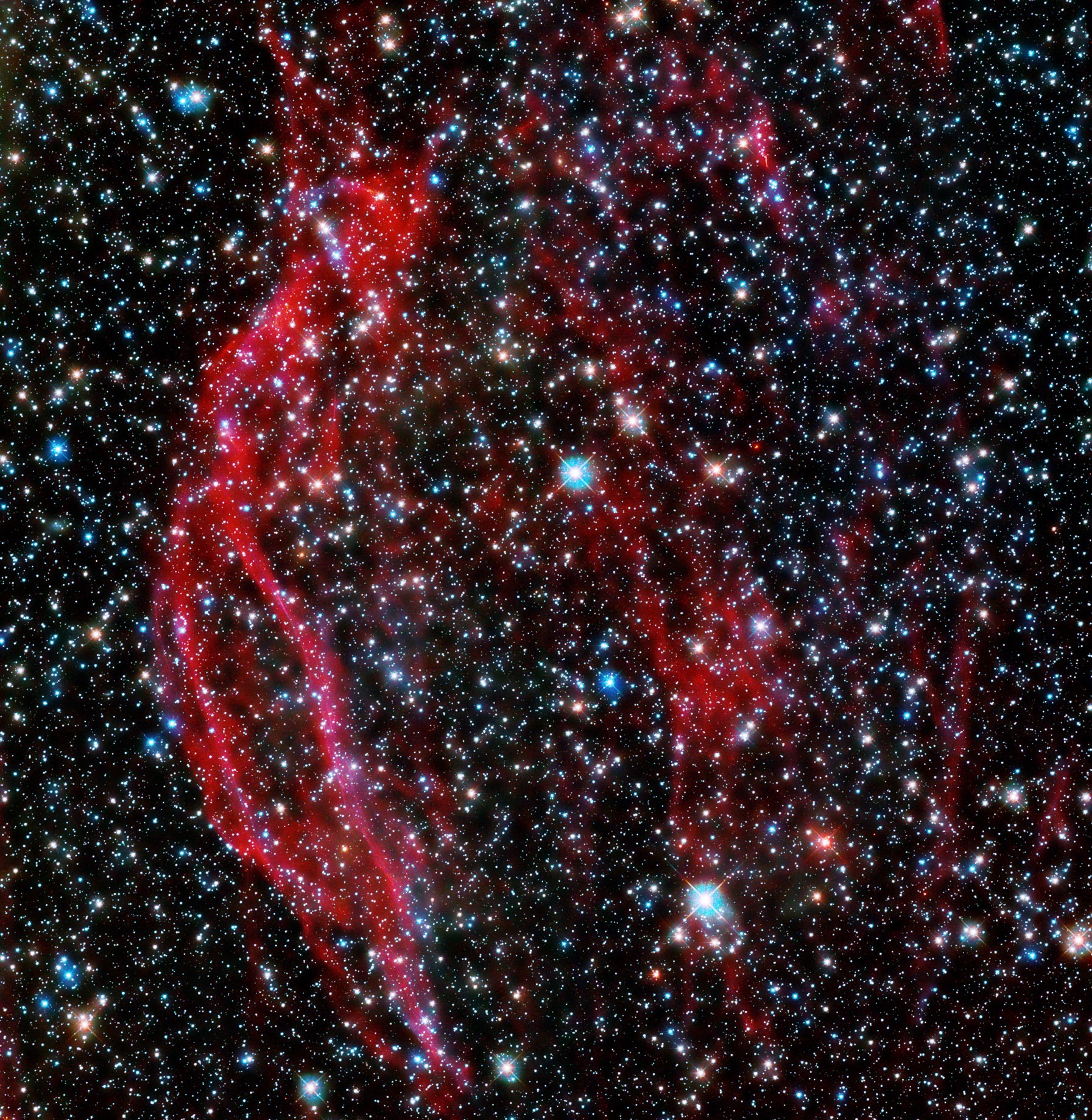
Hubble Space Telescope image of DEM L249, thought to be the remnant of a Type 1a supernova. Credit: NASA, ESA, and Y. Chou (Academia Sinica, Institute of Astronomy and Astrophysics); Processing: Gladys Kober (NASA/Catholic University of America)
These cosmic ribbons of gas have been left behind by a titanic stellar explosion called a supernova. DEM L249 is thought to be the remnant of a Type 1a supernova, the death of a white dwarf star. White dwarf stars are usually stable, but in a binary system – two stars orbiting each other – a white dwarf can gravitationally pull so much matter from its companion that it reaches critical mass and explodes.
DEM L249, located in the Large Magellanic Cloud, is an unusual supernova remnant. Astronomers using NASA’s Chandra X-ray Observatory and the European Space Agency’s XMM-Newton found its gas was hotter and shone brighter in the X-rays than the remnant of a typical Type 1a supernova. Astronomers suspect DEM L249’s white dwarf star was more massive than expected – heavier stars expel more gas – which also means it would have died earlier in its lifecycle.
Hubble took this image while searching for surviving companions of white dwarf stars that went supernova in the Large Magellanic Cloud.
Black Hole Discovered Lurking in Star Cluster Outside Our Galaxy
ByEUROPEAN SOUTHERN OBSERVATORYNOVEMBER 11, 2021
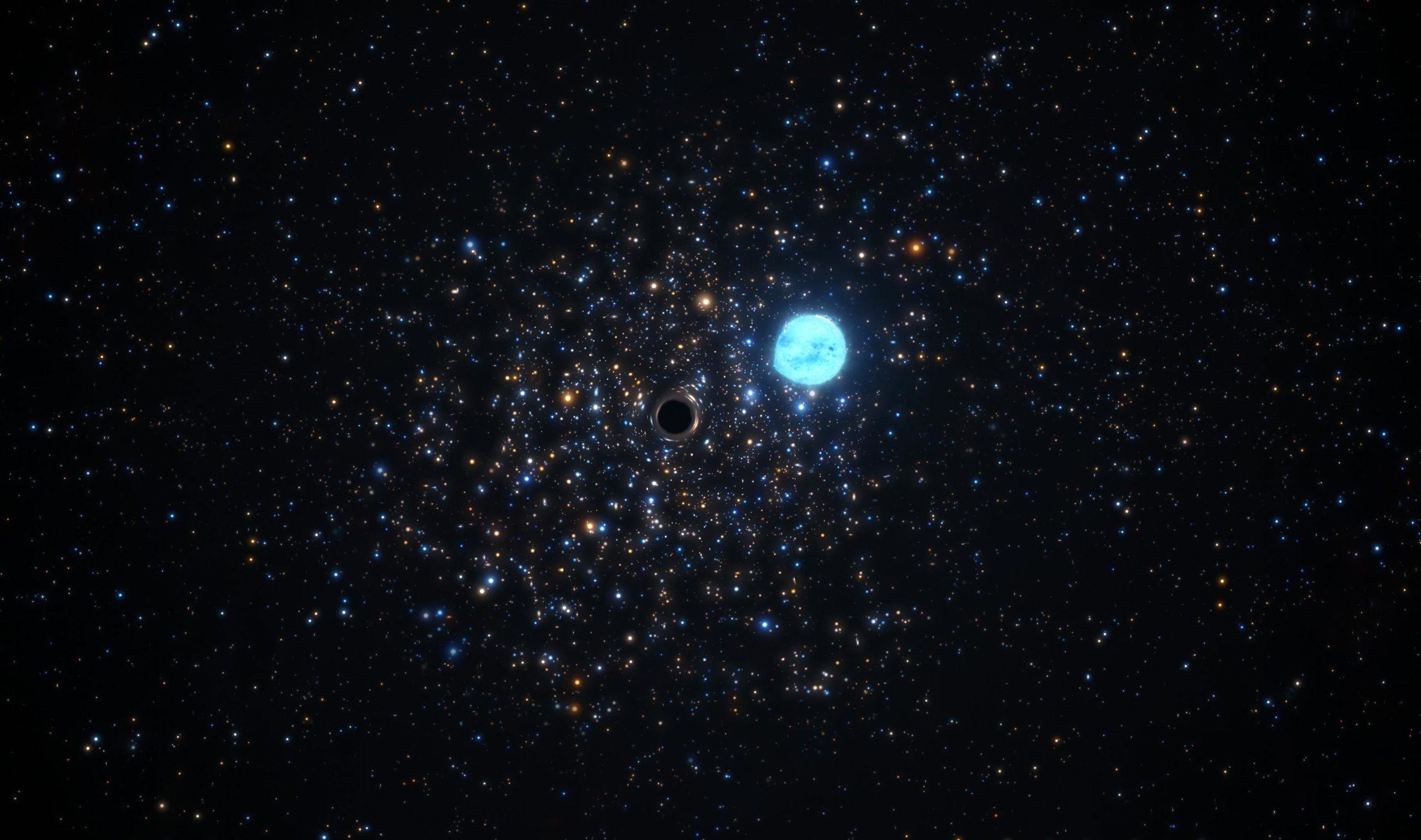
This artist’s impression shows a compact black hole 11 times as massive as the Sun and the five-solar-mass star orbiting it. The two objects are located in NGC 1850, a cluster of thousands of stars roughly 160,000 light-years away in the Large Magellanic Cloud, a Milky Way neighbor. The distortion of the star’s shape is due to the strong gravitational force exerted by the black hole. Not only does the black hole’s gravitational force distort the shape of the star, but it also influences its orbit. By looking at these subtle orbital effects, a team of astronomers was able to infer the presence of the black hole, making it the first small black hole outside of our galaxy to be found this way. For this discovery, the team used the Multi Unit Spectroscopic Explorer (MUSE) instrument at ESO’s Very Large Telescope in Chile. Credit: ESO/M. Kornmesser
Using the European Southern Observatory’s Very Large Telescope (ESO’s VLT), astronomers have discovered a small black hole outside the Milky Way by looking at how it influences the motion of a star in its close vicinity. This is the first time this detection method has been used to reveal the presence of a black hole outside of our galaxy. The method could be key to unveiling hidden black holes in the Milky Way and nearby galaxies, and to help shed light on how these mysterious objects form and evolve.
The newly found black hole was spotted lurking in NGC 1850, a cluster of thousands of stars roughly 160,000 light-years away in the Large Magellanic Cloud, a neighbor galaxy of the Milky Way.
“Similar to Sherlock Holmes tracking down a criminal gang from their missteps, we are looking at every single star in this cluster with a magnifying glass in one hand trying to find some evidence for the presence of black holes but without seeing them directly,” says Sara Saracino from the Astrophysics Research Institute of Liverpool John Moores University in the UK, who led the research now accepted for publication in Monthly Notices of the Royal Astronomical Society. “The result shown here represents just one of the wanted criminals, but when you have found one, you are well on your way to discovering many others, in different clusters.”
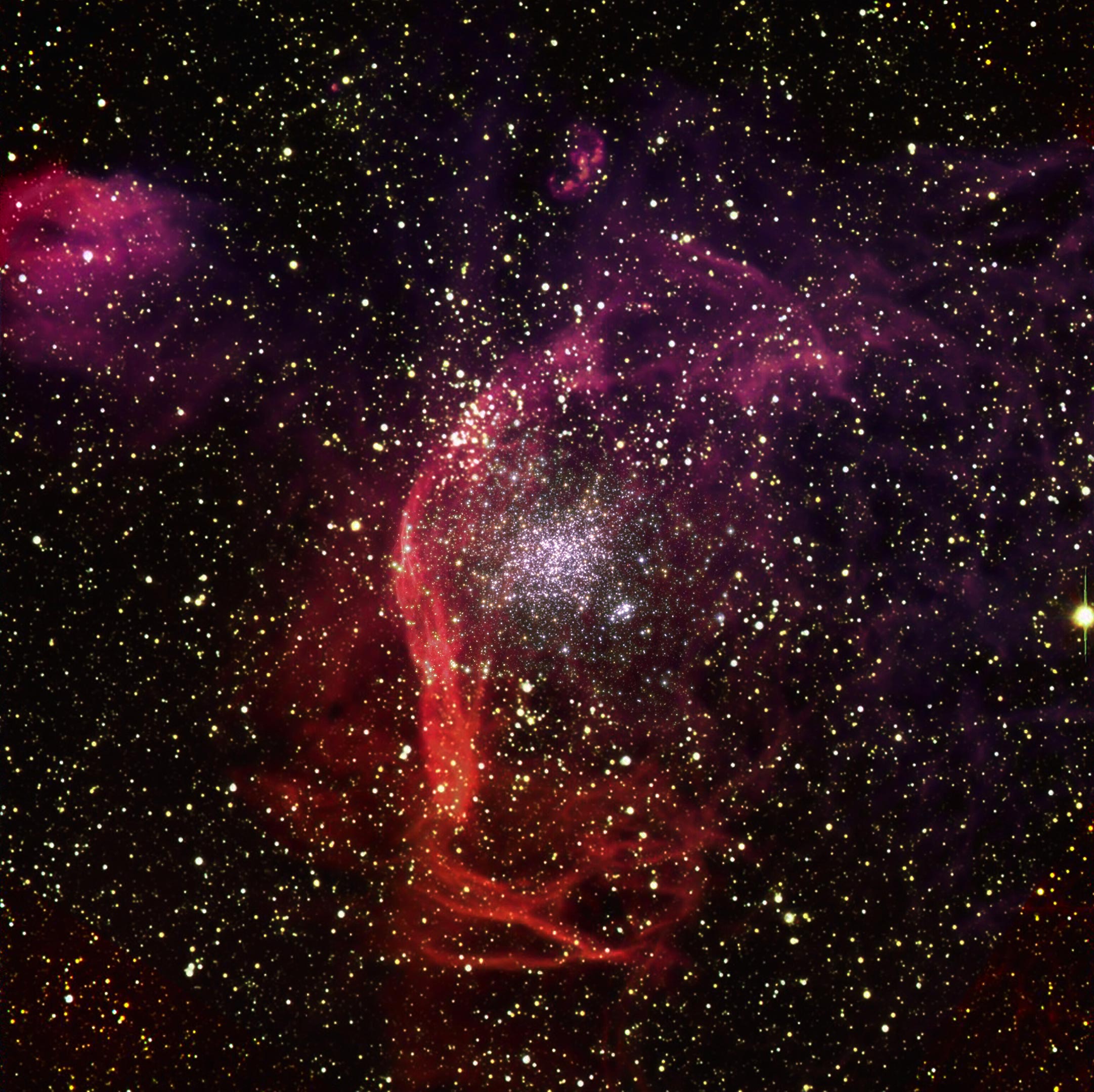
This image shows NGC1850, a cluster of thousands of stars roughly 160,000 light-years away in the Large Magellanic Cloud, a Milky Way neighbor. The reddish filaments surrounding the cluster, made of vast clouds of hydrogen, are believed to be the remnants of supernova explosions. The image is an overlay of observations conducted in visible light with ESO’s Very Large Telescope (VLT) and NASA/ESA’s Hubble Space Telescope (HST). The VLT captured the wide field of the image and the filaments, while the central cluster was imaged by the HST. Among many stars, this cluster is home to a black hole 11 times as massive as the Sun and to a five-solar-mass star orbiting it. By looking at the star’s orbit, a team of astronomers was able to infer the presence of the black hole, making it the first small black hole outside of our galaxy to be found this way. For this discovery, the team used the Multi Unit Spectroscopic Explorer (MUSE) instrument at the VLT. Credit: ESO, NASA/ESA/M. Romaniello
This first “criminal” tracked down by the team turned out to be roughly 11 times as massive as our Sun. The smoking gun that put the astronomers on the trail of this black hole was its gravitational influence on the five-solar-mass star orbiting it.
Astronomers have previously spotted such small, “stellar-mass” black holes in other galaxies by picking up the X-ray glow emitted as they swallow matter, or from the gravitational waves generated as black holes collide with one another or with neutron stars.
However, most stellar-mass black holes don’t give away their presence through X-rays or gravitational waves. “The vast majority can only be unveiled dynamically,” says Stefan Dreizler, a team member based at the University of Göttingen in Germany. “When they form a system with a star, they will affect its motion in a subtle but detectable way, so we can find them with sophisticated instruments.”
This dynamical method used by Saracino and her team could allow astronomers to find many more black holes and help unlock their mysteries. “Every single detection we make will be important for our future understanding of stellar clusters and the black holes in them,” says study co-author Mark Gieles from the University of Barcelona, Spain.
The detection in NGC 1850 marks the first time a black hole has been found in a young cluster of stars (the cluster is only around 100 million years old, a blink of an eye on astronomical scales). Using their dynamical method in similar star clusters could unveil even more young black holes and shed new light on how they evolve. By comparing them with larger, more mature black holes in older clusters, astronomers would be able to understand how these objects grow by feeding on stars or merging with other black holes. Furthermore, charting the demographics of black holes in star clusters improves our understanding of the origin of gravitational wave sources.
To carry out their search, the team used data collected over two years with the Multi Unit Spectroscopic Explorer (MUSE) mounted at ESO’s VLT, located in the Chilean Atacama Desert. “MUSE allowed us to observe very crowded areas, like the innermost regions of stellar clusters, analyzing the light of every single star in the vicinity. The net result is information about thousands of stars in one shot, at least 10 times more than with any other instrument,” says co-author Sebastian Kamann, a long-time MUSE expert based at Liverpool’s Astrophysics Research Institute. This allowed the team to spot the odd star out whose peculiar motion signaled the presence of the black hole. Data from the University of Warsaw’s Optical Gravitational Lensing Experiment and from the NASA/ESA Hubble Space Telescope enabled them to measure the mass of the black hole and confirm their findings.
ESO’s VISTA telescope reveals a remarkable image of the Large Magellanic Cloud, one of our nearest galactic neighbors. VISTA has been surveying this galaxy and its sibling the Small Magellanic Cloud, as well as their surroundings, in unprecedented detail. This survey allows astronomers to observe a large number of stars, opening up new opportunities to study stellar evolution, galactic dynamics, and variable stars. Credit: ESO/VMC Survey
ESO’s Extremely Large Telescope in Chile, set to start operating later this decade, will allow astronomers to find even more hidden black holes. “The ELT will definitely revolutionize this field,” says Saracino. “It will allow us to observe stars considerably fainter in the same field of view, as well as to look for black holes in globular clusters located at much greater distances.”
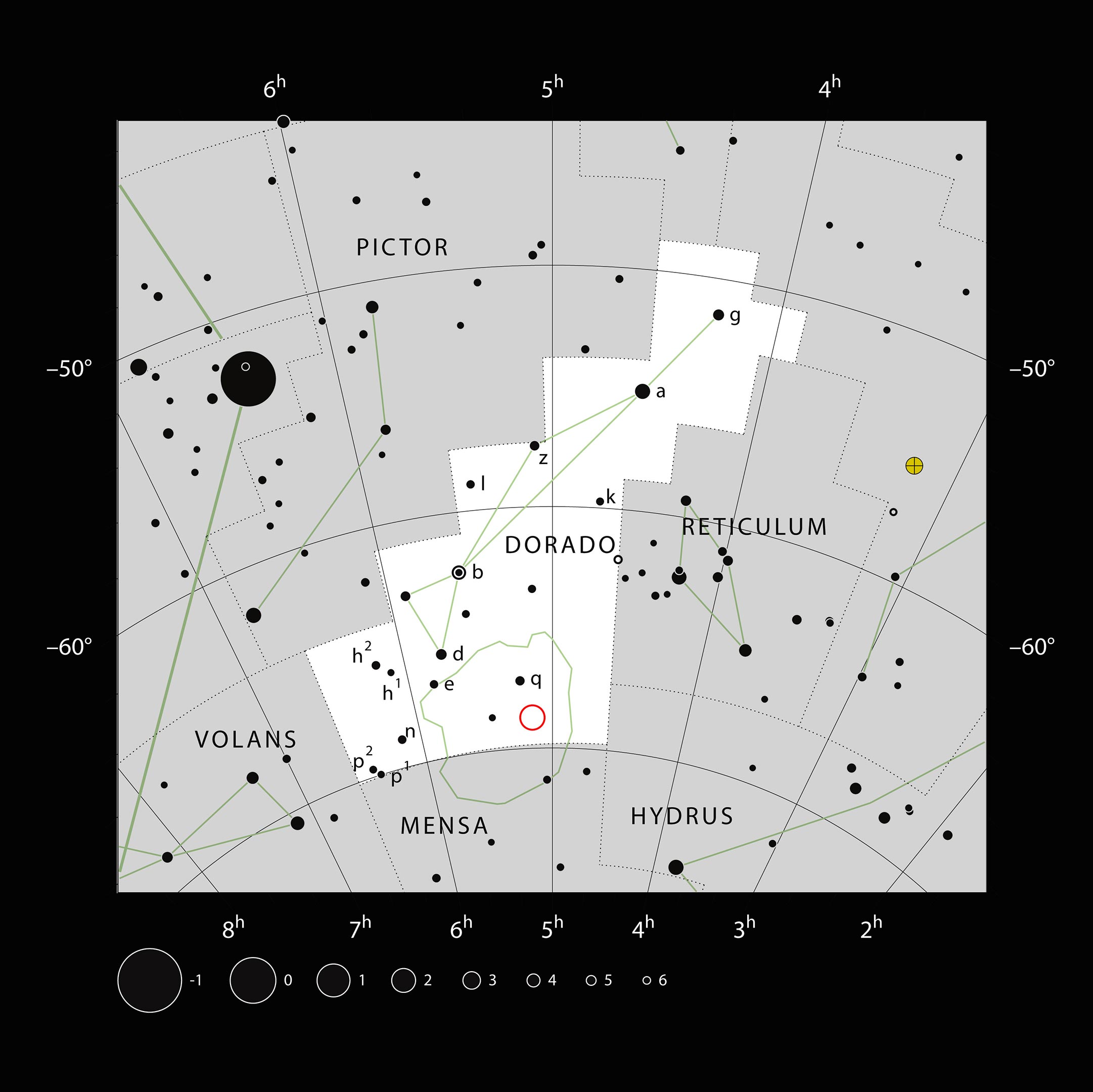
This chart maps the southern constellation Dorado and showcases other stars in that region of the sky, most of which can be seen with the naked eye on a clear dark night. NGC 1850 — a cluster of thousands of stars roughly 160,000 light-years away in the Large Magellanic Cloud, a Milky Way neighbor — is marked with a red circle. Credit: ESO, IAU and Sky & Telescope
Reference: “A black hole detected in the young massive LMC cluster NGC 1850” by S. Saracino, S. Kamann, M. G. Guarcello, C. Usher, N. Bastian, I. Cabrera-Ziri, M. Gieles, S. Dreizler, G. S. Da Costa, T.-O. Husser and V. Hénault-Brunet, 11 November 2021, Monthly Notices of the Royal Astronomical Society. DOI: 10.1093/mnras/stab3159
More information
This research was presented in a paper to appear in Monthly Notices of the Royal Astronomical Society.
The team is composed of S. Saracino (Astrophysics Research Institute, Liverpool John Moores University, UK [LJMU]), S. Kamann (LJMU), M. G. Guarcello (Osservatorio Astronomico di Palermo, Palermo, Italy), C. Usher (Department of Astronomy, Oskar Klein Centre, Stockholm University, Stockholm, Sweden), N. Bastian (Donostia International Physics Center, Donostia-San Sebastián, Spain, Basque Foundation for Science, Bilbao, Spain & LJMU), I. Cabrera-Ziri (Astronomisches Rechen-Institut, Zentrum für Astronomie der Universität Heidelberg, Heidelberg, Germany), M. Gieles (ICREA, Barcelona, Spain and Institut de Ciències del Cosmos, Universitat de Barcelona, Barcelona, Spain), S. Dreizler (Institute for Astrophysics, University of Göttingen, Göttingen, Germany [GAUG]), G. S. Da Costa (Research School of Astronomy and Astrophysics, Australian National University, Canberra, Australia), T.-O. Husser (GAUG) and V. Hénault-Brunet (Department of Astronomy and Physics, Saint Mary’s University, Halifax, Canada).
The European Southern Observatory (ESO) enables scientists worldwide to discover the secrets of the Universe for the benefit of all. We design, build and operate world-class observatories on the ground — which astronomers use to tackle exciting questions and spread the fascination of astronomy — and promote international collaboration in astronomy. Established as an intergovernmental organization in 1962, today ESO is supported by 16 Member States (Austria, Belgium, the Czech Republic, Denmark, France, Finland, Germany, Ireland, Italy, the Netherlands, Poland, Portugal, Spain, Sweden, Switzerland, and the United Kingdom), along with the host state of Chile and with Australia as a Strategic Partner. ESO’s headquarters and its visitor center and planetarium, the ESO Supernova, are located close to Munich in Germany, while the Chilean Atacama Desert, a marvelous place with unique conditions to observe the sky, hosts our telescopes. ESO operates three observing sites: La Silla, Paranal, and Chajnantor. At Paranal, ESO operates the Very Large Telescope and its Very Large Telescope Interferometer, as well as two survey telescopes, VISTA working in the infrared and the visible-light VLT Survey Telescope. Also at Paranal ESO will host and operate the Cherenkov Telescope Array South, the world’s largest and most sensitive gamma-ray observatory. Together with international partners, ESO operates APEX and ALMA on Chajnantor, two facilities that observe the skies in the millimeter and submillimeter range. At Cerro Armazones, near Paranal, we are building “the world’s biggest eye on the sky” — ESO’s Extremely Large Telescope. From our offices in Santiago, Chile we support our operations in the country and engage with Chilean partners and society.
Dark Matter Birthed More of Itself From Regular Matter, Claims Wild New Paper
David Nield
There's a lot we still don't know about dark matter – that mysterious, invisible mass that could make up as much as 85 percent of everything around us – but a new paper outlines a rather unusual hypothesis about the very creation of the stuff.
In short: dark matter creates dark matter. The idea is that at some point in the early stages of the Universe, dark matter particles were able to create more dark matter particles out of particles of regular matter, which would go some way to explaining why there's now so much of the stuff about.
The new research builds on earlier proposals of a 'thermal bath', where regular matter in the form of plasma produced the first bits of dark matter – initial particles which could then have had the power to transform heat bath particles into more dark matter.
"This leads to an exponential growth of the dark matter number density in close analogy to other familiar exponential growth processes in nature," the international team of physicists, led by Torsten Bringmann from the University of Oslo in Norway, write in their newly published paper.
There are some unanswered questions about this new hypothesis, as is normal for anything to do with dark matter, but importantly it fits with the observations of dark matter we have today via the cosmic microwave background (CMB).
While we can't actually see dark matter directly, the behavior of the Universe, together with the electromagnetic radiation that makes up the CMB, strongly suggests that dark matter is out there somewhere – and in seriously large amounts.
There's a variety of scenarios attempting to explain conditions that could constrain the proportions of dark matter we see. One, called a freeze-in scenario, proposes that however dark matter might have appeared in the hot bath of early plasma, nothing cancelled it out. As the Universe expanded, its gradual generation simply ceased, forever locking in a certain amount.
By contrast, a freeze-out model suggests dark matter appeared as rapidly as normal matter, but reached an equilibrium once antiparticles cancelled some out. Once again, the cooling of the expanding Universe chilled its generation but also its ability to quickly annihilate, leaving us with a set amount.
This new study proposes yet another possibility – more or less in between the two extremes. If it's right, it would mean the amount of dark matter grew very quickly as the Universe expanded, with this growth slowing and eventually stopping as the expansion of the Universe has slowed down.
With regular matter and dark matter becoming more spaced out from one another over time, this dark matter production line has petered out. What's more, according to the researchers, somewhere out there in the CMB there should be proof that this theory is correct, so the next job is to find it.
We have hugely sensitive dark matter detectors monitoring the cosmos, so it might not be too long before we hear more about this new approach to understanding dark matter production – in turn, teaching us more about the creation and the growth of the Universe.
"Our mechanism complements both freeze-in and freeze-out thermal production scenarios in a generic way," write the researchers. "Further, and detailed, exploration of this new way of producing dark matter from the thermal bath thus appears highly warranted."
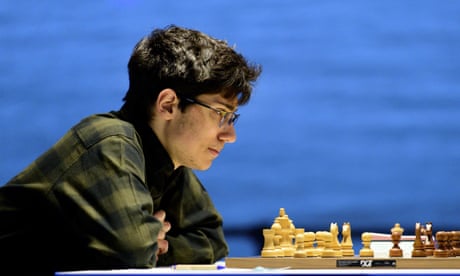
SPORTS Chess: Teenager Alireza Firouzja aiming to be youngest ever world champion The Iran-born 18-year-old, who now represents France, is the third youngest Candidate after Magnus Carlsen and Bobby Fischer and has Garry Kasparov’s 1985 record in his sights
Alireza Firouzja qualified for the 2022 Candidates by scoring 8/11 at the Grand Swiss in Riga and has a chance to become world champion next year.
Alireza Firouzja, the Iran-born 18-year-old who emigrated to France due to Tehran’s punishments for playing Israeli opponents, has become the third youngest Candidate in chess history, with a chance of a glittering prize, the youngest ever world champion.
Firouzja scored 8/11 in the Grand Swiss in Riga to earn a place in the eight-player 2022 Candidates, whose winner will play for the global crown later next year. He reached his target two months younger than Boris Spassky at Gothenburg 1955, and is the third youngest Candidate qualifier, behind only Magnus Carlsen at 15 at the 2005 World Cup and Bobby Fischer at 15 and a half at the 1958 Portoroz interzonal.
Garry Kasparov was the youngest world champion at 22 years and six months when he defeated Anatoly Karpov in their 24th and final game in 1985. Carlsen was also 22, but five months older, when he beat Vishy Anand in 2013. Could Firouzja eclipse Kasparov’s record by winning the Candidates then capturing the title?
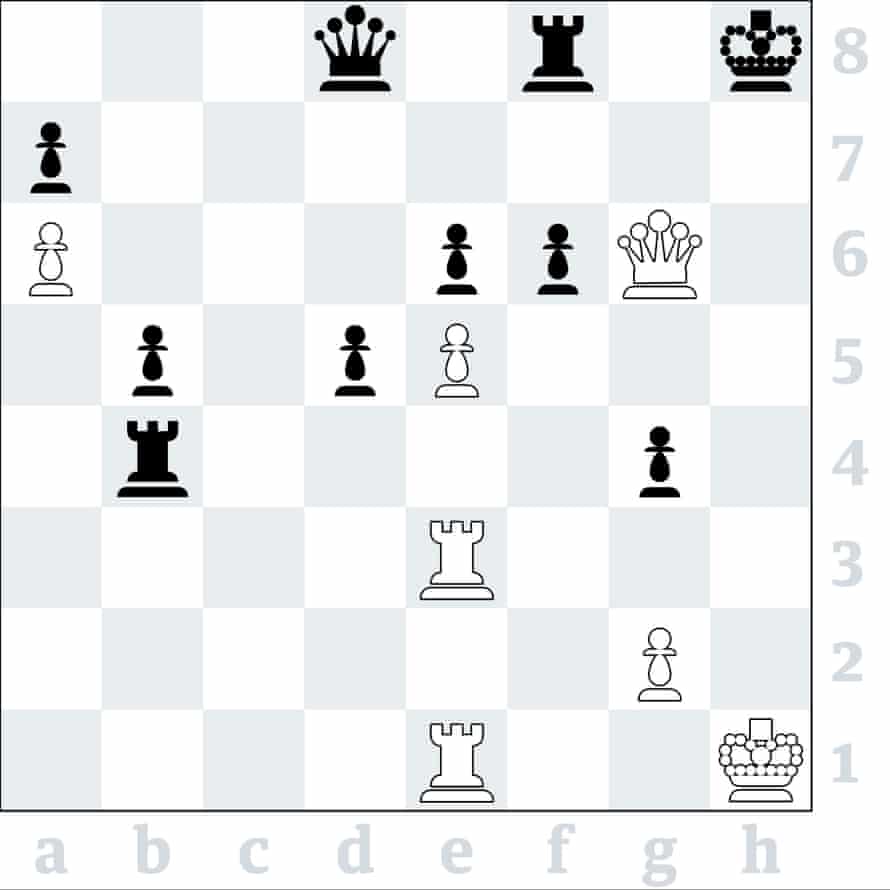
3789: Willy Hendricks v Jeroen Bosch, Bundesliga 2007. What is White’s winning move? In the game White drew by Qh6+ and Qg6+ and Dutch legend Jan Timman agreed. Later they found the subtle winner.
Historical parallels suggest that this challenge may be a bridge too far for a teenager. Spassky and Carlsen won the Candidates at their second try, Fischer only at his third. There were also championship cycles for the trio where they did not compete or were eliminated before the Candidates.
Spassky was favourite against Tigran Petrosian, yet succeeded only at his second attempt, while Fischer and Carlsen were odds on to beat Spassky and Anand respectively. Firouzja would probably face Carlsen in 2022 and would be expected to lose at his first try, although it might well be different at a second attempt in 2024 when he would still be younger than Kasparov in 1985.
Firouzja also broke through to the top of the world rankings last week, ending up No 5 after briefly touching No 3 before his loss to Fabiano Caruana at Riga. His latest surge seems to have been helped by a conscious change of direction.
Up to a few months ago he was one of the recognised top three, along with Carlsen and Hikaru Nakamura, in one-minute bullet chess. Lately he seems to have cut down on or even abandoned bullet, and he also withdrew from the current chess.comspeed championship, where most of the top GMs are competing.
Instead, his games at Riga showed a notably greater all-round theoretical knowledge and an improvement in his endgames, which used to be his major weakness. The daring and mazy tactical style which was his hallmark has sobered down in favour of a more flexible style waiting for the opponent to allow an opportunity.
This weekend Firouzja makes his debut for France in the European championship at Catez, Slovenia (live and free to watch online, 2pm Friday start), with the extra incentive that a high scoring performance could advance his ranking all the way up to world No 2.
France’s squad, which also includes the world No 10, Maxime Vachier-Lagrave, is seeded No 3 behind Russia and Azerbaijan, with Poland No 4 and England No 5. England’s team is David Howell, Michael Adams, Luke McShane, Gawain Jones and Ravi Haria.
Firouzja won his opening round game against Austria’s Markus Ragger and advanced to No 4 in the live ratings, but England had a poor day. The open team lost 1.5-2.5 to Norway as Jones won, Haria drew but McShane and Howell lost, while England women lost 0-4 to Spain.
Howell shared the lead with two rounds to go at Riga, but fell back after his penultimate round loss to Firouzja and finished in a multiple tie for fourth, but ninth on tiebreak, on 7/11. Places 3-8 qualified for the 24-player Grand Prix in Berlin next spring, where the top two will earn Candidates places. Unlucky …
It would have been a career-best performance for the three-time British champion from Seaford in Sussex, who turns 31 on Sunday, to qualify for the Grand Prix. It could still happen if a player withdraws or, less likely, if he is awarded either the Fide or the organiser wildcard. Realistically, though, the Fide wildcard is likely to go to China’s world No 2, Ding Liren, who due to the pandemic has played too few games for an automatic place, while the organiser choice will probably be a German or a regular participant in a Bundesliga team.
Eleven Grand Prix spots go to the top players on the December 2021 Fide rating list who are not otherwise qualified, and this may create an unexpected opportunity for Michael Adams. Unofficial calculations claim that the Cornishman, a seven-time British champion who turns 50 next Wednesday, would be second reserve for the 11 Grand Prix rating places. Chess: Inspired David Howell joins Firouzja and Caruana in three-way lead in Riga
Adams, whose best career performances have come in world title competitions, is only two rating points behind the lowest qualifier, Russia’s Andrey Esipenko, on the unofficial live ratings and so has a big incentive to turn back the years, perform well in the nine-round European Teams, and gain crucial points for the December rating list.
Meanwhile, Carlsen continues to relax with one-minute bullet games on Lichess as he prepares for his $2m, 14-game world title defence against Russia’s Ian Nepomniachtchi starting in Dubai on 26 November.
Following last week’s 10-0 against the speed expert GM Andrew Tang Carlsen, also known as Dr Nykterstein, won 10-0 again, this time against the Belarus GM Sergei Zhigalko, but found it harder against 21-year-old Nikolas Theodoru.
The little-known Greek GM, though losing heavily overall in a marathon series of around 100 games spread over two or three days, actually checkmated the world champion on at least six occasions.
Guardian reader Peter Ballard points out that Firouzja is the fourth, not third, youngest Candidate. Vlad Kramnik, the 2000-2007 world champion, qualified as a Candidate at 18 years and one month at the 1993 Biel interzonal.
3789 1 Rg1! threatens 2 Rh3+! gxh3 3 Qh6+ Kg8 4 gxh3+ winning. The best Black can do is 1...Qd7 2 Rh3+ gxh3 3 Qh6+ Kg8 4 gxh3+ Kf7 5 Rg7+ Ke8 6 Rxd7 Kxd7 7 Qxf8 Rb1+ 8 Kg2 fxe5 9 Qg7+ Kd6 10 Qxa7 and the a6 pawn wins.
Green groups greet climate deal with hope, frustration after last-minute compromise
A last-minute deal reached at the United Nations climate talks Saturday drew a mix of discouragement and determination from environmental groups and politicians in Canada.
Almost 200 countries accepted the contentious climate compromise aimed at preserving a key target in the fight against global warming, which contained a final change that watered down crucial language about coal.
Several countries, including small island states, said Saturday they were deeply disappointed by the edit promoted by India to "phase down" rather than "phase out" coal power, the single biggest source of greenhouse gas emissions.
Environment Minister Steven Guilbeault said Canada was able to set an example for other large, oil-producing nations at the conference, but that "we haven't and won't be able to win every single battle in the fight against climate change."
"We know we need to do more and the world needs to do more. Canadians gave us a mandate to go further and faster in our fight against climate change and there's no doubt we have our work cut out for us," he said in a statement posted to Twitter.
The Sierra Club's Canadian chapter, meanwhile, said the deal marks a "disappointing end" to the two-week conference in Glasgow, Scotland, known as COP26.
"This final agreement is a small step but not the leap we need," representatives said in a statement, calling the compromise "on trend with the divisive summit."
"In the words of David Attenborough ... 'our motivation should not be fear but hope.'"
They and others cited the international goal to limit global warming to 1.5 C above pre-industrial times.
Climate Action Network Canada, which was also in attendance, warned Canadian politicians they will be held to the deal's pledges.
"We leave Glasgow with renewed conviction that we must fight back against every fraction of a degree of warming, to protect the people and the places we love," the network said in a Twitter post.
Green Party MP Elizabeth May said in tweet from Scotland that the diluted language on coal marks a move to appease India, China and others.
"The hope of holding to 1.5 degrees is barely alive. But hope is not lost," she wrote.
The advocates' views reflected those of many states, as nation after nation complained on the final day of the U.N. talks the agreement did not go far or fast enough. They said, however, that it was better than nothing and provided incremental progress, if not success.
Kathryn Harrison, a political science professor the University of British Columbia specializing in environmental and climate change policy, said the commitments show progress but that the globe remains on track for 2.4 C of warming this century.
Nonetheless, the call for more ambitious near-term targets at next year's conference is "encouraging," she said.
"It’s also increasingly clear that greater climate finance for developing countries from wealthy, developed countries like Canada will be essential in achieving needed progress," she said in an email.
The meeting has also sent a strong signal to Canada's fossil-fuel industry, whose exports Harrison warned are bound to decline after 2030 if countries keep their word on temperature goals.
"COP26 finally called out the elephant in the room with more focus than at any previous COP on fossil fuels as the main cause of climate change," she said, pointing to oil and gas as well as coal.
Canada has joined more than 20 countries in promising to end subsidies for fossil fuels projects overseas. And the deal itself calls for an eventual end of some coal power and of fossil fuel subsidies.
Negotiators from Switzerland and Mexico deemed the coal language change against the rules because it came so late. However, they said they had no choice but to hold their noses and go along with it.
"Our fragile planet is hanging by a thread,'' United Nations Secretary-General Antonio Guterres said in a statement. "We are still knocking on the door of climate catastrophe."
Many other nations and climate campaigners pointed at India for making demands that weakened the final agreement.
"India's last-minute change to the language to phase down but not phase out coal Is quite shocking," said Australian climate scientist Bill Hare, who tracks world emission pledges for the science-based Climate Action Tracker. "India has long been a blocker on climate action, but I have never seen it done so publicly."
Others approached the deal from a more positive perspective. In addition to the revised coal language, the Glasgow Climate Pact included enough financial incentives to almost satisfy poorer nations and solved a long-standing problem to pave the way for carbon trading.
The agreement also says big carbon polluting nations have to come back and submit stronger emission cutting pledges by the end of 2022.
"It's a good deal for the world," U.S. climate envoy John Kerry told The Associated Press. "It's got a few problems, but it's all in all a very good deal."
This report by The Canadian Press was first published Nov. 13, 2021.
—With files from The Associated Press
Christopher Reynolds, The Canadian Press
Interview Historian Timothy Snyder: ‘It turns out that people really like democracy’
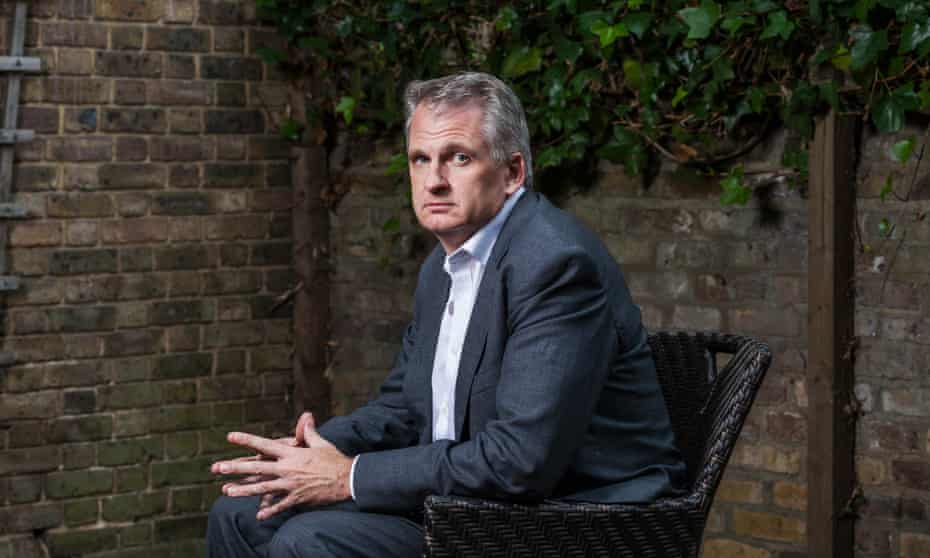
Timothy Snyder: ‘One of our big problems is that we find it hard to imagine a viable future.’
Photograph: Andrea Artz/Laif/Camera Press
The author of On Tyranny on the lack of historical literacy, how local news has been replaced by Facebook, and why novels matter to him
Timothy Snyder is a professor of history at Yale University and the author of books about the 20th-century history of central Europe, including Bloodlands, which examined the devastating consequence of Hitler and Stalin’s simultaneous reign of terror over civilian populations, and won the 2013 Hannah Arendt prize for political thought. In 2016, after the election of Donald Trump, Snyder wrote a short book, On Tyranny, which provided 20 brief lessons – “Defend Institutions”, “Remember Professional Ethics”, “Read Books” – from the 20th century that might help readers protect democracy against dictatorship. It topped the New York Times bestseller list for nonfiction in 2017. A new edition of the book, with illustrations by the German-American Nora Krug, whose graphic memoir Belonging confronted Germany’s Nazi past, has just been published.
What prompted you to want to make this graphic version of On Tyranny?
It came out originally in this extremely simple, accessible form. I always had the idea that it could take a different form, but that only became concrete once I read Nora Krug’s Belonging. I cold-called her and said: “Could you please do this?” Part of it was also to renew it. I changed the text a little bit, removed some of the stuff that was specific to 2016 and added some lines that recall what happened in 2020.
You wrote the original in the immediate aftermath of Donald Trump’s inauguration. Was it intended as a call to arms for yourself as well as to others?
Yes, it was like something snapped in me where I thought we should all do the things that we can. In writing the book I was putting myself out there, so it was something I had to live by. I’m glad I did that. As a writer, you have to make yourself vulnerable sometimes.
'It is never enough to accept the world as it is and just comment on it'
Looking back, it seemed important to say that being outraged on social media about Trump probably wasn’t going to be enough?
Exactly. I think the lesson that maybe people reacted to the most is number 12: “make eye contact and talk to people” in the corporeal world. And then number 13, which was to actively get involved in politics, to get our physical bodies into unfamiliar situations. The book is a frontal attack on that idea that it is never enough to accept the world as it is and just comment on it
One of the things that the book is alarmed by is a lack of historical literacy. The fact that terms suc as “America first” or, in the UK, “enemies of the people” could be employed with so few alarm bells ringing among people about their history in fascism.
Do you still see that kind of illiteracy even in some of your students?
History has been seriously devalued in the US, I would say, since 1989 and that very unfortunate idea [“the end of history”] that history was now over. “America first” and “enemies of the people” are words that are consciously applied by people who wish to destroy democracy. If people don’t know how those words have been applied in the past, then that is dangerous. Part of the backwash of the Trump coup attempt is all of these laws in various states are designed to make history uncontroversial – which, let’s be clear, means: uncontroversial for white people.
At the time you wrote the book, people were being criticised for making comparisons with what was happening in 2016 and the 1930s. Did you feel any trepidation about doing that?
I don’t remember having that feeling. When people refuse to make comparisons with events that have happened before, what they are really saying is: “I don’t want to look at either the past or the present.”
You grew up in Dayton, Ohio. How much did that firsthand knowledge of the midwest and those declining industrial heartlands inform your understanding of the forces that produced Trump?
It certainly affected it. In 2016, I spent some time going door to door there and talking to people about the forthcoming presidential election. That helped me to see how important social media was. I asked one guy a question and he went back and checked Facebook before answering. Where my parents are from and still live had become entirely Trumpland.
I think a lack of local news may be the single greatest source of the problem. Most American counties are now news deserts; they have no reporters covering local politicians at all. People have no way of being active citizens; they go on reading but the stuff they read drives them upwards to national politics, into obsession and conspiracy. They bring the trust they had for local news to Facebook.
One of your antidotes to that is “read books”; who have been the writers that you’ve turned to most in the past five years?
I always go back to Roger Penrose, the physicist. He is important to me because he has a view about unpredictability in quantum mechanics, which has implications for politics. And then some of the people who confronted these questions in the last century in different ways: Hannah Arendt, Václav Havel, Victor Klemperer. In addition to that, it’s really important to me to read novels, because they prepare you for scenes in the real world you haven’t yet confronted. I’ve just started rereading Les Liaisons Dangerouses. But I also get excited when I hear Julian Barnes has a new novel out.
It seems to me that the opposite of tyranny is not freedom, but something more active: creativity, engagement. Do you think artists and writers have lately stepped up to that challenge?
I think it’s true that freedom cannot be the opposite of anything. But I’m not going to criticise artists and writers – the main problem is often the way that their work has trouble getting viewed. One of our big problems at the moment is that we find it hard to imagine a viable future. Art and literature enable us to flex those imaginative muscles.
Where do you place your optimism?
I prefer hope to optimism. One thing is, it turns out that people really like democracy. It has been heartening to see that so many people care enough about democracy to take personal risks to defend it.
On Tyranny Graphic Edition by Timothy Snyder, illustrated by Nora Krug, is published by Vintage (£16.99).
‘Terrifying for American democracy’: is Trump planning for a 2024 coup?
Ed Pilkington
THE GUARDIAN
11/14/21
LONG READ
At 1.35pm on 6 January, the top Republican in the US Senate, Mitch McConnell, stood before his party and delivered a dire warning.
If they overruled the will of 81 million voters by blocking Joe Biden’s certification as president in a bid to snatch re-election for the defeated candidate, Donald Trump, “it would damage our Republic forever”.
Five minutes beforehe started speaking, hundreds of Trump supporters incited by the then president’s false claim that the 2020 election had been stolen broke through Capitol police lines and were storming the building. McConnell’s next remark has been forgotten in thecatastrophe that followed – the inner sanctums of America’s democracy defiled, five people dead, and 138 police officers injured.
He said: “If this election were overturned by mere allegations from the losing side, our democracy would enter a death spiral. We’d never see the whole nation accept an election again. Every four years would be a scramble for power at any cost.”
Eleven months on, McConnell’s words sound eerily portentous. What could be construed as an anti-democratic scramble for power at any cost is taking place right now in jurisdictions across the country.
Republican leaders loyal to Trump are vying to control election administrations in key states in ways that could drastically distort the outcome of the presidential race in 2024. With the former president hinting strongly that he may stand again, his followers are busily manoeuvring themselves into critical positions of control across the US – from which they could launch a far more sophisticated attempt at an electoral coup than Trump’s effort to hang on to power in 2020.
Trump holds a rally in Perry, Georgia, in September.
Photograph: Sean Rayford/Getty Images
The machinations are unfolding right across the US at all levels of government, from the local precinct, through counties and states, to the national stage of Congress. The stage is being set for a spectacle that could, in 2024, make last year’s unprecedented assault on American democracy look like a dress rehearsal.
The Guardian has spoken to leading Republican election experts, specialists in voting practices, democracy advocates and election officials in swing states, all of whom fear that McConnell’s warning is coming true.
“In 2020 Donald Trump put a huge strain on the fabric of this democracy, on the country,” said Ben Ginsberg, a leading election lawyer who represented four of the last six Republican presidential nominees. “In 2024 the strain on the fabric could turn into a tear.”
•••
Since Joe Biden was inaugurated on 20 January, Trump has dug himself deeper into his big lie about the “rigged election” that was stolen from him. Far from cooling on the subject, he has continued to amplify the false claim in ever more brazen terms.
Initially he condemned the violence at the US Capitol on 6 January. But in recent months Trump has emerged as an unashamed champion of the insurrectionists, calling them “great people” and a “loving crowd”, and lamenting that they are now being “persecuted so unfairly”.
Trump recorded a video last month praising Ashli Babbitt, the woman shot dead by a police officer as she tried to break into the speaker’s lobby, where Congress members were hiding in fear of their lives. Babbitt was a “truly incredible person”, he said.
Michael Waldman, who as president of the Brennan Center is one of the country’s authorities on US elections, told the Guardian that Trump was normalizing the anti-democratic fury that erupted that day.
“He has gone from being embarrassed to treating 6 January as one of the high points of his presidency. Ashli Babbitt is now being lionized as this noble martyr as opposed to a violent insurrectionist trying to break into the House of Representatives chamber.”
Over the past year Trump has spread the stolen election lie far and wide, telling supporters at his regular presidential campaign-style rallies that 2020 was “the most corrupt election in the history of our country”. He has used his iron grip over the Republican party to cajole officials in Arizona, Pennsylvania, Texas, Wisconsin and other states to conduct “audits” of the 2020 election count in further vain searches for fraud.
Texas lawmakers at the state capitol in September.
Photograph: Tamir Kalifa/Getty Images
One of the most eccentric of these “audits” (or “fraudits”, as they have been called) was carried out in Arizona by a company called Cyber Ninjas, which had virtually no experience in elections and whose owner supported the “Stop the Steal” movement. Paradoxically, even this effort concluded that Biden had indeed won the state, recording an even bigger margin for the Democratic candidate than the official count.
The idea of the stolen election continues to spread like an airborne contagion.
A poll released this week by the Public Religion Research Institute found that two-thirds of Republicans still believe the myth that Trump won. More chilling still, almost a third of Republicans agree with the contention that American patriots may have to resort to violence “in order to save our country”.
Waldman said the big lie is now ubiquitous. “The louder Trump yelled the more his supporters thought he was telling the truth. Increasingly the institutional machinery of the Republican party is organized around fealty to the big lie and the willingness to steal the next election, and that is terrifying for the future of American democracy.”
Ned Foley, a constitutional law professor at Ohio State University, said the current moment is “unique in American history”. He called it “electoral McCarthyism”.
Foley sees parallels between Trump and the anticommunist panic or “red scare” whipped up by senator from Wisconsin Joe McCarthy in the 1950s. “What’s unique about Trump and about what he’s trying to do in 2024 is that he’s applying McCarthy-like tactics to voting, and that’s never happened before.”
•••
Electoral McCarthyism is being felt most acutely at state level. In several of the battlegrounds where the 2024 contest largely will be fought and won, a clear pattern is emerging.
Trump has endorsed a number of Republican candidates for key state election positions who share a common feature: they all avidly embrace the myth of the stolen election and the lie that Biden is an impostor in the White House.
The candidates are being aggressively promoted for secretary of state positions – the top official that oversees elections in US states. Should any one of them succeed, they would hold enormous sway over the running of the 2024 presidential election in their state, including how the votes would be counted.
To get into these positions of power, the candidates are challenging incumbent election officials who were seminal in thwarting Trump’s bid to overturn the 2020 election result. This is most evident in the critical state of Georgia. Brad Raffensperger, the secretary of state, resisted the sitting president’s demand, made during a phone call, that he “find 11,780 votes” for Trump – one more vote than Biden’s margin of victory.
Raffensperger is now facing a tough fight against Jody Hice, a US Congress member boosted by Trump’s backing. Hice was among the 147 Republicans in Congress who voted on 6 January (hours after the insurrection) to overturn election results, falsely claiming widespread irregularities.
In Arizona, another critical swing state, many Trump allies are running for secretary of state, including Shawna Bolick.
She was the architect of a bill introduced to the Arizona state legislature that would have given lawmakers the ability to overturn the will of voters and impose their own choice for president. Under Bolick’s bill, legislators would be able to overrule the official count and put forward an alternate slate of electors in the name of the loser by dint of a simple majority vote, no explanation needed.
Had that provision been in place in 2020 it would have allowed the legislature’s 47 Republicans to override 1.7 million Arizonans who had voted for Biden and send their own alternate slate of Trump electors to Congress instead.
Bolick’s bill did not pass. But it gave a clear indication of Trump acolytes’ thinking as they inject themselves into the election process.
Competing against Bolick to be the next secretary of state of Arizona is Mark Finchem, who Trump has also endorsed. Finchem was at the Stop the Steal rally in Washington on 6 January that turned into the Capitol insurrection.
Finchem, a former police officer, has links to the far-right extremist group the Oath Keepers, which federal prosecutors allege was involved in planning the violence. On 6 January he posted a photograph of the ransacked Capitol building with the comment: “What happens when the People feel they have been ignored, and Congress refuses to acknowledge rampant fraud.”
If Finchem were to become secretary of state he would have a central role over certifying – or not – the results in Arizona.
In Michigan, another battleground state which Biden won by 154,000 votes in 2020, Trump has endorsed Kristina Karamo for secretary of state. A self-styled “whistleblower” and Fox News favourite, Karamo filed lawsuits in 2020 seeking to block Biden’s certification on spurious grounds of mass fraud.
The list goes on. Reuters analysed the records of 15 Republican candidates running for secretary of state in five battleground states, finding that 10 of them are avid “stop the stealers”.
The pattern of Trump loyalists agitating to take control of elections can be seen even at the hyper-local level. Steve Bannon, Trump’s former White House senior adviser, has used his War Room podcast megaphone to call on supporters to take over the reins of election administration “precinct by precinct”.
Boards of canvassers, normally unsung panels of local administrators operating at county level, are also being targeted. In Michigan, Republican stop the stealers are moving to oust seasoned election officials from the boards in many of the state’s largest counties, with possible ramifications for how future election results are certified.
Leading authorities on US elections watch these rapidly shifting tectonic plates with mounting alarm. Rick Hasen, a legal scholar who writes the Election Law Blog, told the Guardian that he is worried about what might happen should Raffensperger and other officials who stood firm against Trump’s electoral coup attempt in 2020 be cast aside.
“It took the courage of Republican elected officials who refused to do Trump’s bidding and overturn the election result to save us from a political and constitutional crisis. With those people removed from office, it’s harder to have confidence that the next presidential election is going to be run fairly.”
Chris Krebs led the federal cybersecurity agency Cisa in charge of protecting the integrity of the 2020 election until he was fired by Trump. He fears that the conspiracy theory of the stolen election has spread so rapidly that it is now beyond control.
“There’s a part of me that thinks perhaps we’re too far gone,” he said. “The stop the steal movement has metastasized into a broad base that is more powerful than any individual, even Trump.”
•••
Democracy experts have focused their energies in recent years on the resurgence of voter suppression, the form of anti-democratic politics that arose out of the Jim Crow era of the 20th century. Those techniques have been on ample display this past year. The Brennan Center recorded that in the first six months of this year alone at least 30 new laws were enacted in 18 states making it harder for Americans to vote.
But now voter suppression has been joined by a new, and possibly even more sinister, antidemocratic threat: election subversion. The trusted outcome of a presidential election, which every four years Americans took for granted as the bedrock of their democratic way of life, appears at risk of being willfully distorted or even overturned.
“The largest concern I have right now is the potential for election subversion,” Hasen said. “That’s something I never expected to worry about in the United States.”
The nonpartisan group Protect Democracy and its partner organisation States United Democracy Center have recorded 216 bills introduced this year in 41 states that politicize, criminalize or interfere with election administration. Many of the bills seek to increase the power of Republican-controlled state legislatures over the election process, stripping powers from impartial election officials and handing them to radically partisan lawmakers.
The largest concentration of bills fall in exactly those states that were most closely contested in 2020 and where the outcome of the 2024 presidential election is likely to be decided – Arizona, Georgia, Michigan, Wisconsin and the increasingly competitive state of Texas.
“We know that some of these bills have been part of a coordinated effort,” Jessica Marsden, a lawyer with Protect Democracy, said. “We see similar measures pop up in a number of different states, so there is significant evidence that there is at least the beginnings of some sort of plan.”
So far 24 of the bills have been passed into law. They include a new voting law in Georgia that came into effect in August which the New York Times described as “a breathtaking assertion of partisan power in elections”.
The law tightens the grip of Republican lawmakers over the election board that oversees the vote count. It removes Raffensperger from his seat as chair of the board, which means that even if he survives next year’s challenge by Hice he will still have his wings clipped.
Under the law, the newly Republican-dominated election board gains the power to suspend county election officials. That is being seen as a thinly disguised power grab over the election processes of Fulton county, an area covering the heavily Democratic and majority-Black city of Atlanta.
Fulton county was seminal in handing victory to Biden. It also gave the edge to Jon Ossoff and Raphael Warnock, in senatorial races that swung control of the US Senate to the Democratic party.
“Late at night during the passing of the voter bill in Georgia, Republicans snuck in a provision that could have the most devastating impact,” Waldman said. “It changes the rules of who gets to count the votes, taking away the power of the secretary of state and taking over county election processes on very flimsy grounds.”
•••
For the past year Katie Hobbs, Arizona’s Democratic secretary of state, has been at the centre of the storm unleashed by Trump’s big lie. Attacks on Hobbs and her staff began straight after the November 2020 election and have continued unabated ever since.
Biden’s narrow victory in Arizona – by fewer than 11,000 votes – was vital in securing him the presidency. The controversial decision by Fox News to call the state for Biden as early as 11.20pm on election night provoked fury from Trump and his devotees that still reverberates in Arizona to this day.
An Arizona Ranger watches as officials working for Cyber Ninjas examine and recount ballots from the election.
Photograph: Courtney Pedroza/Getty Images
Hobbs was one of those to feel their wrath. “We have been the target of a barrage of constant attacks. There have been threats, harassment and vitriol, not just against our election staff but to every department where people can find a phone extension to call,” she said.
Days after the presidential election, armed stop the stealers gathered outside Hobbs’ home. In May she and her family were assigned a security detail after she received three separate death threats in a single day and was chased outside her office by a man working for the conspiracy theory website Gateway Pundit.
“Security is certainly not something I expected as part of this job,” she said. Asked why she thought she was such a hate figure for Trump supporters, she said: “These folks think I’m going to be arrested, that I belong in Gitmo and deserve to be tried for treason – and they are reminding me of this every single day, without any evidence.”
Threats of violence are not the only challenge Hobbs has faced. In June, Republican lawmakers in the state legislature stripped her of powers to defend election laws in court, handing the critical function to the state attorney general, a Republican.
The move was later blocked by a judge on constitutional grounds. But Republican lawmakers have successfully weakened her role by barring her access to legal counsel, which severely curtails her ability to carry out her duties as the protector of Arizona democracy.
“They’ve tied my hands, and that’s been par for the course in terms of partisan retaliation throughout my term in office,” Hobbs said.
The Brennan Center reported in the summer that one in three election officials in the US felt unsafe in their jobs. One in six had received threats.
David Becker, executive director of the nonpartisan Center for Election Innovation and Research in Washington, said that professional election officials were increasingly stepping down, or preparing to do so, in the face of unbearable hostility.
“I have talked to election officials who have received threats containing the names of their children and schools they go to. These people are true public servants who are asking themselves is it worth it, because they are suffering. I’m talking about hundreds to thousands of election officials around the country who worry every night that they might be attacked as they go home.”
For every impartial election official who departs, there is a Trump loyalist waiting in the wings. “And they apparently view their oath not to the US constitution, but to a single individual,” Becker said.
•••
And it doesn’t end there. Were the Republicans to regain control of the House of Representatives in 2024, Kevin McCarthy, the minority Republican leader, would have considerable sway as Speaker over how the outcome of the presidential election would be certified.
If a state legislature were to send an alternate slate of electors to Congress in an attempt to overturn the will of voters then McCarthy would be a pivotal player. His word would carry weight in determining whether to allow those alternate electors, potentially turning the result of the election on its head.
McCarthy was one of the 147 Republican rebels who on 6 January – hours after the storming of the Capitol – objected to the certification of Biden.
“Here’s one of my big concerns,” Hasen said. “The House of Representatives headed by Kevin McCarthy accepts alternate slates of electors and overcomes the will of the people, making the loser the winner.”
Such a move would undoubtedly trigger a constitutional crisis, which in turn would inevitably end up before the US supreme court. Here, too, there are reasons to be apprehensive.
In the runup to the 2020 election, four of the nine justices expressed some degree of support for the theory that state legislatures have the power to put forward their own alternate electors should they decide the official count somehow had failed. Trump nominated three new conservative justices during his time in the White House, tipping the balance on the court sharply to the right and increasing the likelihood that the conservative majority looks favourably on this highly questionable legal ruse.
“There could be five or six justices who could go along with it, given the right case,” Hasen said.
With 2024 on the horizon, democracy experts have identified several ways in which disaster could be averted. Rick Hasen wants new federal guardrails put in place to prevent state legislatures from interfering in elections for purely partisan reasons. Chris Krebs wants a more robust system of post-election audits to act as a legitimate counterpoint to the sham audits promulgated by Trump.
All the authorities on American democracy who spoke to the Guardian were united about the urgency of the moment. New protections need to be put in place, right now, or else the nation will enter the 2024 presidential election cycle with its democratic structures already bloodied and vulnerable to further attack.
Waldman looks to Washington for signs that the peril has been recognised, and that appropriate action is in train. He sees neither.
“The leadership of the federal government doesn’t appear to be treating this as the emergency it is. This is one of the great clashes in American political history. Where is the alarm?”