Sunday, November 14, 2021

CERB WAS NOT #UBI
Documents detail impacts of federal aid on benefits for seniors, families

OTTAWA — Internal government documents are providing the clearest picture yet of the impact that emergency aid is having on federal support to low-income seniors and families.


Thousands of benefit recipients have seen a decline in the value of payments because they received the Canada Emergency Response Benefit or its successor, the Canada Recovery Benefit, last year.

Documents show low-income families were expected to see the sharpest drops in support through the Canada Child Benefit, and federal officials say about 83,000 low-income seniors have lost out on the guaranteed income supplement.


The documents obtained by The Canadian Press under the access to information law provide a window into the early warnings around how the financial help offered by the pandemic recovery benefits last year now claws back payments relied on by millions of Canadian households.

The reason is because the CERB and a trio of other government recovery benefits — the CRB for unemployed workers, a caregiving benefit for anyone who stayed home to care for a child or loved one, and a sickness benefit for ill workers — were counted as income for the purposes of calculating benefit amounts. As incomes rose, benefit values dropped.

In a May presentation about the impact on child benefit payments, officials at Employment and Social Development Canada wrote that about 15 per cent of aid recipients received the CCB, compared to 12 per cent of the general population.

The presentation estimated that among those expected to see a drop in child benefit amounts, almost three in 10 had total incomes under $20,000 and the value of their benefits would drop more compared to higher-earning recipients.

Meanwhile, the emergency aid provided reduced GIS payments for 183,417 low-income seniors, who on average lost about $3,500 this year, which is less than they would have received in pandemic-related benefits last year because supplement payments are clawed back $1 for every $2 of net income.

GIS recipients can petition the government to calculate their benefits on current year income, not the previous year as is generally the case. Some 5,000 applications had come in by early July, and officials wrote in a briefing note to the minister's office to expect "the volume of requests will significantly increase."


In the end, Employment and Social Development Canada said about 83,000 seniors who received the CERB or one of the three federal recovery benefits were pushed above the income threshold to qualify for GIS. That figure is just over half of the 157,208 seniors who exceeded the maximum income amount, above which someone no longer qualifies for the GIS, referenced in one of the documents.

"Every year thousands of seniors’ GIS is adjusted to reflect changes in their net income so that it targets those who need it most," Seniors Minister Kamal Khera's office said in a statement.

"We appreciate that the adjustment has been difficult for some seniors. We continue to look at how to support those trying to make ends meet."

There were also more than 130,000 seniors who had their payments suspended because they failed to file income taxes on time, a number that has since dropped to 35,580 after Service Canada made thousands of calls to get the missing information.

New Democrat Jenny Kwan said many seniors in her Vancouver riding are worried about paying the rent, and those facing language barriers have issues getting information on why their payments have been slashed.

"It is so stressful for these seniors," Kwan said. "I have no doubt in my mind if the government doesn't take action, these seniors will wind up being homeless."

This report by The Canadian Press was first published Nov. 13, 2021.

Jordan Press and Erika Ibrahim, The Canadian Press
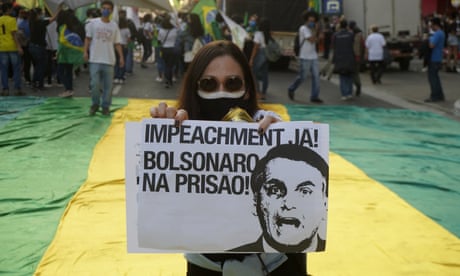
Amazon Deforestation Records Reveal The Truth About Bolsonaro


Extinction Rebellion activists protest against the destruction of the Amazon, U.K., Nov. 12, 2021. | Photo: Twitter/ @AmplifyXR

Published 12 November 2021

Since Jair Bolsonaro came to power, deforestation rates have skyrocketed. Brazilian net emissions of carbon dioxide equivalent increased from 1,970 million tons in 2019 to 2,160 million tons in 2020.

Amid the United Nations Climate Change Conference (COP26), Greenpeace and other international organizations denounced that the Brazilian Amazon's deforestation grew by 5 percent during the last year, a figure that seriously questions the statements of the President Jair Bolsonaro's delegates.

On Thursday, the Brazilian National Institute for Space Research (INPE) published data showing that the world's largest rainforest lost 877 square kilometers in October. This figure represents an increase of 5 percent compared to the loss of 836 square kilometers recorded in October 2020.

In the last two years, some 8,000 kilometers of forest have been lost in the first 10 months of each year as a result of business activities carried out in the Amazon. These unfortunate figures were denounced to the international community on the day in which world leaders seek to reach an agreement to limit global warming to 1.5 degrees during this century.

Despite the evidence, Brazilian officials vow the Bolsonaro administration has lowered deforestation rates through control and surveillance campaigns. They also dared to argue that Brazil will eliminate illegal deforestation by 2028 and reduce its greenhouse gas emissions by 50 percent in 2030.


The tweet reads, "Txai Surui, the 24-year-old Indigenous law student from Rondonia, who was brutally insulted by Bolsonaro for representing the Amazonian peoples at COP26 in Glasgow, has lived under threat ever since. She replied, 'Indigenous peoples live like this, threatened'."

"Emission reductions happen on the forest floor, not in Glasgow plenaries," Climate Observatory Secretary Marcio Astrini said outraged at claims from a government which has given free rein to land grabbers, loggers, and miners.

"While the Bolsonaro administration tries to sell Brazil as a 'green superpower' at COP26, October deforestation broke another record, which has been driven by anti-environmental policies promoted by the President and the Environmental Ministry with the support of Congress," the Greenpeace Amazon Campaign spokesperson, Roberto Batista, pointed out and recalled the violence that the far-right politician deploys against Indigenous peoples.

Since Bolsonaro came to power in January 2019, deforestation rates in the Brazilian Amazon have skyrocketed towards levels not seen since 2002. Brazilian net emissions of carbon dioxide equivalent (CO2e) increased from 1,970 million tons in 2019 to 2,160 million tons in 2020. The former Capitan, however, defends resource depletion arguing his country needs economic growth.

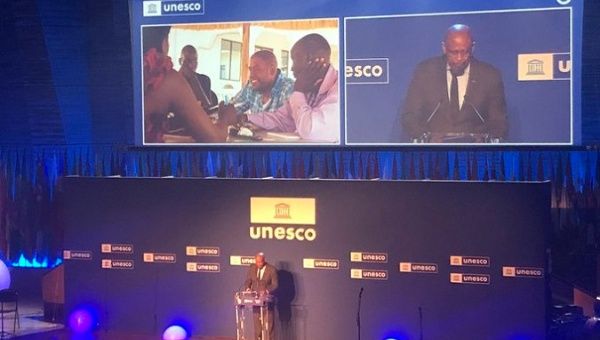
UNESCO Marks Anniversary In Defense of Solidarity and Culture


Forest Whitaker: "Today, I had the privilege to speak at UNESCO's 75th anniversary ceremony. Its purpose to build the defenses of peace in the minds of people is a universal mission that can speak to the heart of every human being."
| Photo: Twitter/@ForestWhitaker

Published 12 November 2021

UNESCO's General Assembly addresses the challenges of global education in the wake of the impact of the pandemic and other issues of global concern.

This Friday, UNESCO commemorated 75 years of its foundation and did so with the participation of at least 25 leaders in an official ceremony. The event was organized for this purpose at its headquarters in Paris, France, to celebrate the achievements and projections of the multilateral organization.

Unesco Designates New World Heritage Sites in 5 Latam Countries

The event was part of the 41st General Conference, one of its governance bodies, which is in session from November 9 to 24, with topics on the agenda such as the challenges of education after the scourge of COVID-19, the strengthening of education, ethics in Artificial Intelligence and the promotion of the concept of Open Science.


The recently re-elected Director-General, Audrey Azoulay, stressed in her speech that UNESCO emerged on the moral and material ruins of the Second World War (1939-1945).

She stressed that the birth of the organization took place under the premise that peace should be established on foundations such as the “intellectual and moral solidarity of mankind."

The organization, 75 years after its creation, defends pillars that are still necessary and ever critical in the present day, such as solidarity, the defense of the right to education, the preservation of humanity's shared treasures and the contribution of an ethical compass to technology.

UNESCO has spearheaded revolutionary concepts such as the Universal Copyright Convention, the conservation, and protection of World Heritage sites, the creation of Biosphere Reserves and international cooperation in these and other areas, said the director of Communication and Public Information of the international organization, Matthieu Guével.

He added that the multilateral organization continues its tireless work in favor of culture and the integration of people in order to build peace and progress.


OPINION
Premier Scott Moe wants Saskatchewan to have nationhood status. Yes, it’s as bizarre as it sounds


GARY MASON
GLOBE AND MAIL
NATIONAL AFFAIRS COLUMNIST
 NOVEMBER 11, 2021
Saskatchewan Premier Scott Moe speaks during the Saskatchewan Party 2021 Convention,
 in Saskatoon, on Nov. 6.

That rumbling sound you heard this week was the very foundation of the country being shaken by calls from Saskatchewan Premier Scott Moe for nationhood status within Confederation.

And the populace responded with a collective: say what?


Well, slough off this threat at your peril my friends. Saskatchewan may not have been one of the three founding nations of Canada. And it doesn’t have a language separate from the rest of the country. But people were surely curling there long before it became fashionable in the rest of the country.

And if being a fan of the Saskatchewan Roughriders doesn’t make you unique, what does? And then there’s bunny hugs. If you have to ask then clearly you haven’t been to the province. I could go on. Well, actually I couldn’t. But surely there’s enough there to make the case that Saskatchewan is as culturally distinct as one of its delicious berry pies.

This week on the Roy Green radio show, Mr. Moe made this very case, suggesting his province deserved to have special status within Confederation because, well, it deserved it. Now one could take this statement seriously or recognize it for what it is: preposterous pandering to a party base that hasn’t exactly been thrilled with the Premier’s performance of late.

It’s Mr. Moe creating yet another distraction from his government’s gross mishandling of the fourth wave of the pandemic. And the way you deal with that is you talk about “independence” instead.

“We’re going to flex our autonomy,” Mr. Moe told Mr. Green’s radio audience. “Flex our provincial muscle, if you will, within the nation of Canada.”

Go ahead and flex, Mr. Premier.

Mr. Moe said he wasn’t proposing separation (phew!), but rather greater autonomy from a federal government that is working “against the best interests of the country.”

If the Premier honestly believes his province will be further ahead with its own police force, taxation regime, immigration program, then start the talks. If being more like Quebec is what Saskatchewan – 

My strong suspicion is this is not a priority for most of the good folks who live there. Rather, it’s a means for Mr. Moe to take a few cheap whacks at Prime Minister Justin Trudeau, which is always good politics in a part of the Prairies where that last name can still incite red faces and strong language.

Mr. Moe said he is upset with the federal government’s plan to cap oil and gas emissions as part of its commitment to reducing the country’s CO2 output by 40 per cent by 2030. Although, he admitted to a recent party convention, he wasn’t sure what impact, if any, this policy would have on the province.

The Premier lamented the fact that Mr. Trudeau didn’t go to the COP26 conference in Glasgow and tout the benefits of Saskatchewan energy, which he said was the most sustainable anywhere on the planet. This would be news to environmentalists who have long lamented the province’s environmental record.

Methane leakage from gas wells in Saskatchewan has been a huge problem for ages, yet the gas helps generate more than 40 per cent of the province’s electricity. Another 40 per cent is produced using coal. I’m not sure Mr. Moe wants anyone going to international conferences singing the praises of Saskatchewan’s environmental record because this fantasy would be exposed in a hurry.

The fact is, what Mr. Moe, and his BFF next door, Alberta Premier Jason Kenney, specialize in these days is corrosive and divisive grievance politics. Everything is the fault of the big, bad Liberal government in Ottawa that is allegedly singling out the two provinces through its energy plan and other policies.


Mr. Trudeau would never implement something like a cap on oil and gas emissions against Ontario’s car manufacturing sector, they complain. No, the Liberals would just impose a carbon tax that will soar to $170 a tonne by the end of the decade instead – a levy that is partially designed to get people out of their cars. The same Liberals that also plan to bring in a zero-emission mandate for new vehicles.

Mr. Moe’s “nation within a nation” gambit this week is embarrassing. As I say, it’s a nonsensical ploy to get people to look somewhere other than at his government’s dismal handling of the pandemic.

The Premier’s complaint of regional bias against Saskatchewan and the West by the federal government became boring a long time ago. If he thinks wanting to be like Quebec is the answer to all that ails his province, he’s sadly mistaken.
New Brunswick reaches tentative deal with striking CUPE workers, ending strike

FREDERICTON — The New Brunswick government and the union representing thousands of striking public sector workers reached a tentative agreement Saturday they say will put an immediate end to a strike that's lasted for more than two weeks.

 
© Provided by The Canadian Press

The Canadian Union of Public Employees said workers will return to their jobs while members of the seven bargaining units that negotiate directly with the province vote on the proposed deal.

"Our workers are going back to work to serve the province of New Brunswick, the job they love doing, so it's a very good day indeed," said Steve Drost, CUPE New Brunswick's president. "It's a relief to them and all of us involved for sure."

Public servants, including education sector employees, workers in transportation, corrections and the community college system, have been on strike since Oct. 29.

The province said schools -- which shifted to remote learning after the government locked out workers including custodians and educational assistants -- would reopen in the coming week.

"Details about the reopening of schools are being finalized and will be announced Sunday," a government release said.

Both the province and the union agreed not to share details of the tentative agreement publicly until it was ratified, but Drost said the proposal sees wages rise "above the cost of living" -- meeting what he described as CUPE's principal demand.

He said the deal left him "humbled and grateful" after a particularly tough round of bargaining.

"It was kind of David and Goliath, in the sense that they were taking on a very strong government," Drost said.

The government last week ordered striking health-care workers back to work in a move the union planned to challenge in court Monday.

The province threatened fines up to $20,400 per day for health-care workers who refused to return to their jobs, while CUPE was threatened with a minimum fine of $100,000 for each day that a worker failed to comply with the order.

Attorney General Hugh Flemming has said the emergency order for health workers was necessary because there was a risk of medical treatment not being provided and loss of life if the strike continued.

This report by The Canadian Press was first published Nov. 13, 2021.

The Canadian Press
Cuba braces for unrest as playwright turned activist rallies protesters

The Communist party has banned the planned string of pro-democracy marches, saying they are an overthrow attempt

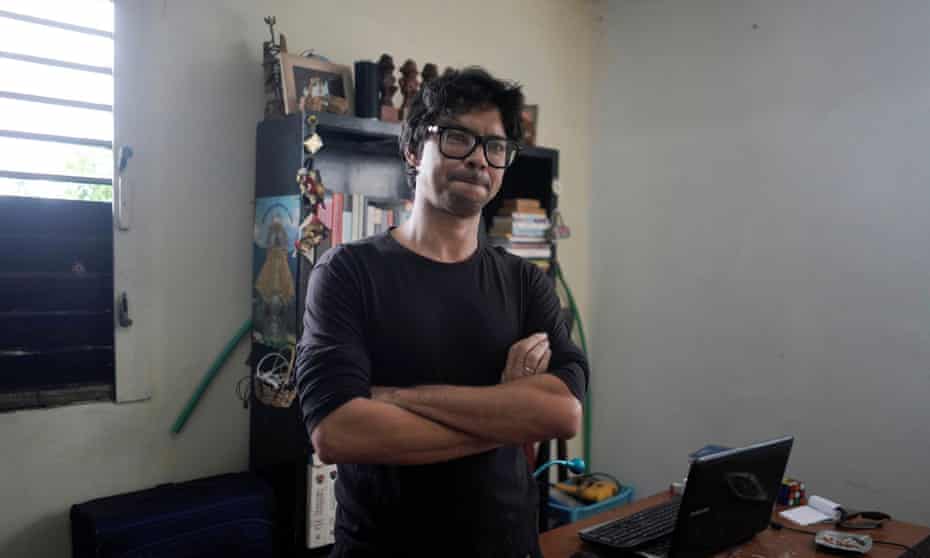
Yunior García, actor, playwright, and leader of Archipelago, an opposition group planning a string of pro-democracy marches across Cuba. 
Photograph: Alexandre Meneghini/Reuters


Ed Augustin in Havana
Fri 12 Nov 2021 

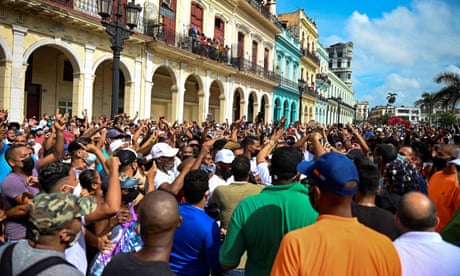
The Cuban playwright Yunior García has shot to fame over the past year, but not because of his art. The 39-year old has become the face of Archipelago, a largely online opposition group which is planning a string of pro-democracy marches across the island on Monday.

The Communist party has banned the protests – which coincide with the reopening of the country after 20 months of coronavirus lockdowns – arguing that they are a US-backed attempt to overthrow the government.


‘New wave of volatility’: Covid stirs up grievances in Latin America


García and other organisers say the protest is simply to demand basic rights for all Cubans. Over syrupy black coffee and strong cigarettes in the living room of his Havana home, García said he hoped to channel the “peaceful rebelliousness” that he believes all Cubans have inside them.

“I believe in a diverse country and I think we have to completely do away with the one-party system which limits too many individual rights,” he said.

Such talk is anathema to Cuba’s rulers who are already struggling to contain a simmering social crisis which earlier this year triggered the largest anti-government protests for decades.
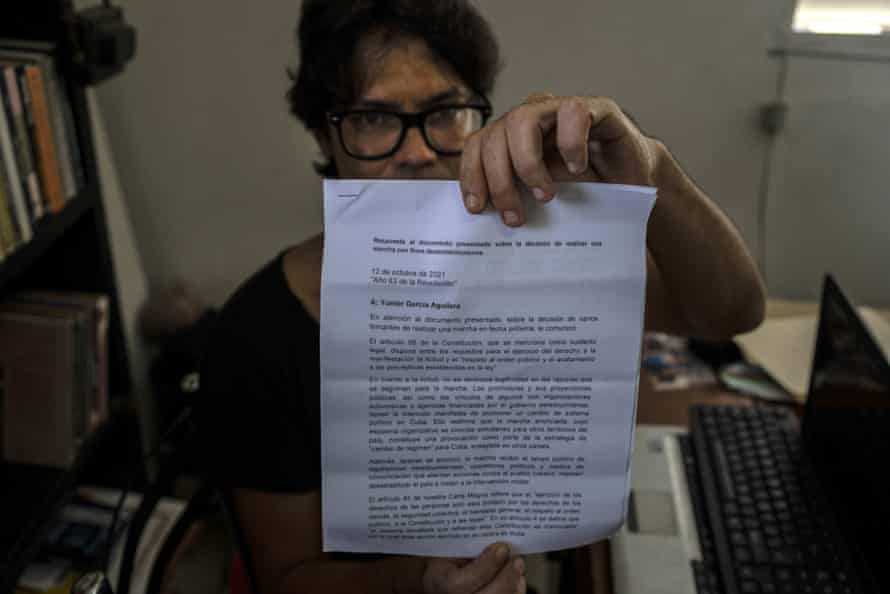
Yunior García shows a response letter from the government denying Archipelago permission to march. 
Photograph: Ramón Espinosa/AP

Supercharged US sanctions, the coronavirus pandemic, a surge in social media use and a younger generation hungry for change have left the Communist party reeling.The Biden administration has continued with Trump’s “maximum pressure” policy, which since 2017 has hammered the island with more than 200 sanctions aimed at choking hard currency inflows.

The result has been an economic crisis that rivals the so-called Special Period, after the collapse of the Soviet Union.

“The Special Period was a piece of cake compared to this,” said Umberto Molina, 71, waiting in line outside a pharmacy. “There was medicine and you didn’t have these never-ending queues.”

In July, mounting frustrations exploded on to the streets in an unprecedented rash of protests – and a hardening of positions. Cuban special forces beat demonstrators and hundreds were imprisoned. Washington responded by imposing new sanctions.


Why have Cuba’s simmering tensions boiled over on to the streets?


“When the Cuban government feels more threatened by the US, its tolerance for internal dissidence goes down,” said William LeoGrande, professor of government at American University in Washington DC.

“All governments, when they feel under attack, become less tolerant of internal opposition,” he added, pointing to the US Patriot Act following 9/11.

This week, the foreign minister, Bruno Rodríguez, vowed that the protests would not go ahead. “We will not allow it,” he said. “We will use our laws, our constitution and the strictest adherence to the principles of our socialist state of law and social justice.”

On Thursday, García, said that he would march in silence and holding a white rose on Sunday, but it was not clear if this amounted to a scaling back of Monday’s protests.
Advertisement

“We are not willing to have a single drop of blood spilled, on either side of this conflict,” García said in a Facebook post.

In his interview, García, 39, said he was well aware of the risks he was facing.

“History is full of people who have gone to prison for struggling for their rights,” García said, offering José Martí, the 19th-century Cuban intellectual and independence fighter, as an example.

Like Martí, García says he opposes “foreign interference” in Cuban affairs. But while Martí saw the US as a “monster” to be kept at bay, García takes a different tack.

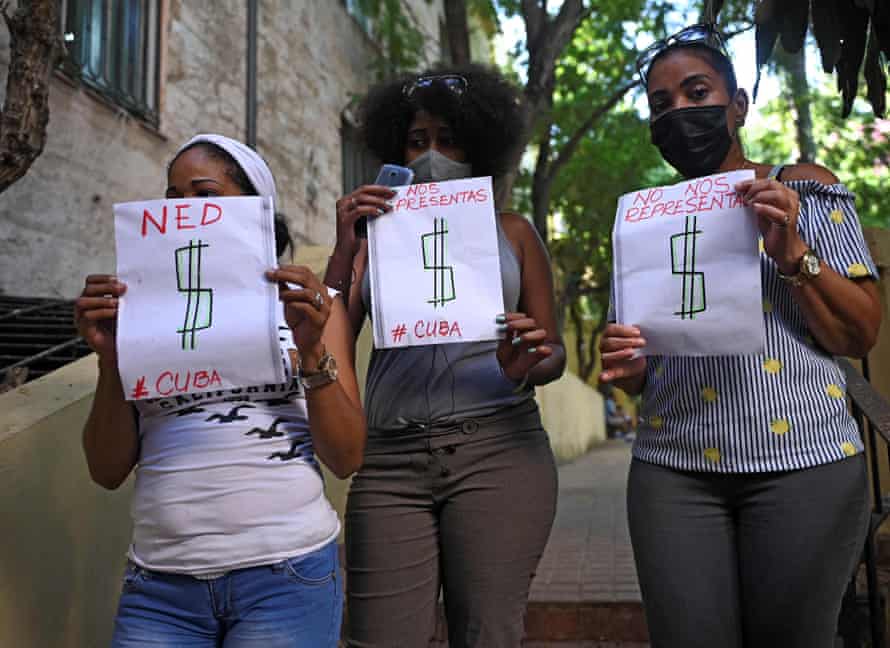
After he met with the head of the US embassy in Havana and a former US army captain, the Communist party released video of the encounter, and labelled García a “political operative”.

García said he discussed censorship on the island and the US embargo (which he opposes), but he denied taking advice. Nobody in Archipelago, he said, takes so much as “a cent” from foreign governments.Tolerance of dissent on the island, which increased under Obama years, is nosediving. Activists say more than 600 are still in prison.

Pro-government demonstrators hold signs outside the municipal assembly headquarters in Old Havana, where Yunior García was speaking to press. 
Photograph: Yamil Lage/AFP/Getty Images

A gamut of strategies have been employed to prevent Archipelago activists from organising: García’s mobile phone line has been cut, two coordinators have been fired from their state jobs, and activists’ families have been interrogated by state security.

That the protests are scheduled for the very day that Cuba is supposed to go back to normal after a long lockdown, with tourists returning and schools opening, has only heightened the stakes.

The government has planned a “National Defence Day” for later next week, and menacing photos have emerged of government supporters wielding batons in preparation.

“There is a quite properly widespread desire … that Cuba should move steadily and quickly, and as soon as possible, towards a true democratic system, and that the rights of peaceful protest and full freedom of expression be finally and properly respected by the state,” said Hal Klepak, professor emeritus of history and strategy at the Royal Military College of Canada.


From Cuba to Palestine, when revolutionaries end up as dictators, the people pay the 


“However, it is simply unrealistic and contrary to all logic, to think that the Cuban state, besieged, attacked and under quite savage economic warfare conducted by the greatest power in the history of the world … can allow such rights to flourish.

“As San Ignacio de Loyola, echoing the same conclusion as Machiavelli in such circumstances, said: ‘In a besieged city, all dissent is treason.’”


Such realism is little solace for young activists yearning for the democracy.

Daniela Rojo, a single mother with two young children , said she was raised to “speak softly and avoid problems”.

But after being jailed for 27 days following the July’s protest, she said she was determined to march on Monday for her children’s sake.

“I want them to grow up in a country where they can express themselves freely,” she said.
Hong Kong denies visa to Economist journalist in latest media blow


Sue-lin Wong becomes latest foreign journalist to be forced out of the city as concerns about press access and freedoms grow


The Foreign Correspondents’ Club of Hong Kong last year reported ‘highly unusual’ delays in visa approval for multiple media outlets. 
Photograph: Anthony Wallace/AFP/Getty Images

Guardian staff with agencies
Sat 13 Nov 2021 

Hong Kong has refused to renew the visa of an Australian correspondent from the Economist, the newspaper’s chief editor said, amid a crackdown on free speech and dissent in the city.

Sue-lin Wong is one of several foreign journalists working in Hong Kong to be forced out in recent years.

Press freedoms in the once-outspoken city have been reined in as China remoulds Hong Kong, following huge democracy protests in 2019 and Beijing’s imposition of a strict national security law last year.

Wong, who is not currently in Hong Kong, was refused permission to return to work in the city, the paper’s editor, Zanny Minton Beddoes, said in a statement.

“We regret their decision, which was given without explanation,” she said.

“We urge the government of Hong Kong to maintain access for the foreign press, which is vital to the territory’s standing as an international city,” she added.

The Hong Kong government and immigration department did not immediately respond to requests from Reuters for comment.


‘They can’t speak freely’: Hong Kong a year after the national security law


Since Beijing imposed a national security law on Hong Kong last year, democracy activists, newspaper editors and journalists have been arrested. Critics of the legislation say it is being used to crush dissent in the city – claims the Hong Kong and Beijing authorities reject.

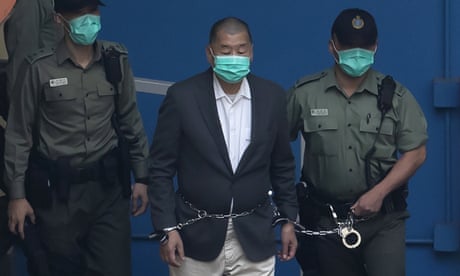
Fears over freedom of the press in the former British colony are increasing, months after the city’s most vocal pro-democracy newspaper, Apple Daily, was forced to shut after its tycoon owner, Jimmy Lai, and other staff were arrested under the national security law.

In 2018, the visa of the Financial Times’ Asia editor, Victor Mallet, was not renewed by Hong Kong after he moderated a speech by a pro-independence activist at an event hosted by the Foreign Correspondents’ Club in the city. The move alarmed some diplomats and business groups in Hong Kong.

The Foreign Correspondents’ Club of Hong Kong last year reported “highly unusual” delays in visa approval for multiple media outlets.

On the authoritarian Chinese mainland, where the press is heavily controlled and censored, foreign journalists must apply for specific visas and face routine harassment. Reporters only need a regular business visa to work in Hong Kong, however.

As of April, 628 foreign employees working for overseas media held work visas in Hong Kong, according to the Chinese foreign ministry.

Hong Kong is guaranteed freedom of speech and the press under article 27 of the Basic Law, the mini-constitution agreed by China when it took back control of Hong Kong in 1997.

Hong Kong’s leader, Carrie Lam, has denied the security legislation would curtail media freedom, saying that “freedom of expression, freedom of protest, freedom of journalism, will stay”.

Reuters and Agence France-Presse contributed to this report.
What Really Made Astroworld So Deadly

Accounts from the night are disturbing and may not have a clear, single cause.

BY ZACHARY SIEGEL
SLATE
NOV 10, 2021
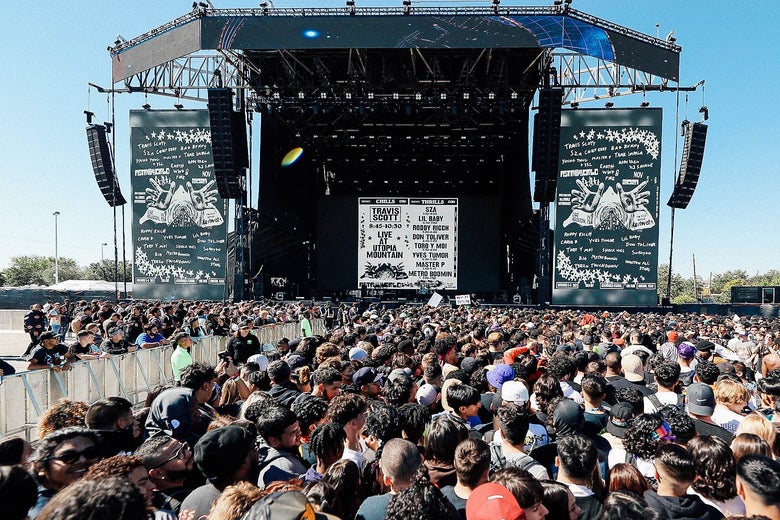
Astroworld in Houston 
Omar Vega/FilmMagic


As a giant clock ticked down the time to Travis Scott’s performance at Astroworld, the crowd gradually became more and more dense as thousands of fans rushed the stage. That’s when 20-year-old Ian Hoskins said people compressed all around him. It couldn’t have been more than 50 degrees outside on that November night in Houston, but Hoskins was drenched in sweat from the heat of bodies crammed against him. “I had a gut feeling that this was not right,” he said. “This is dangerous. I should leave.”

But there was no way out. “Everyone is trying to get out as an individual, but you’re moving as a whole,” Hoskins said, referring to the force of the crowd “moving as one” as a powerful ocean. Standing tall at 6-foot-1 and 260 pounds, Hoskins became a human life preserver, desperate to keep those around him from being swallowed by the tide. “I was having people grab my arms and shoulders. At one point I had five or six people grabbing on to me to stay above the crowd.” If someone fell, they’d get trampled.

Live Nation, the organizer of the festival, stopped the show early, but still 40 minutes after city officials said a “mass casualty event” was underway. At least eight people died at Astroworld, hundreds more were injured, and several more remain in critical care.

It will take some time for investigators to determine exactly what conditions made Astroworld become so dangerous and deadly, and it could be several weeks to determine the cause of death for those who died. Lawsuits accusing rapper Travis Scott of “encouragement of violence” and negligence are piling up. Scott is no stranger to the law, having pleaded guilty to disorderly conduct in 2017 after a show in Rogers, Arkansas, ended in chaos and injuries. Clearly, the performer’s shows fit a pattern of dangerous and crammed crowds.

But in the immediate aftermath of the chaotic event, the police and the media floated a bizarre story about a possible culprit. TMZ reported that a mystery assailant wielding a syringe loaded with drugs was injecting people, causing some to unwittingly overdose. Somehow, this alleged assailant is thought to have set off a panic that triggered a stampede among a crowd of over 50,000 people. This theory purported to explain what sparked the chaos and how otherwise healthy young adults suffered cardiac arrest and died at a music festival.

The needle-stabbing rumor didn’t stay in the celebrity gossip pages. Hours later, at a press conference, Houston police Chief Troy Finner perpetuated the theory, saying that “one of the narratives” being investigated was that “some individual was injecting other people with drugs.”

The waters became even muddier when CBS News, NBC News, Fox News, the New York Post, and numerous other local outlets amplified and broadcasted that the police chief “confirmed” the needle-prick theory. To be sure, the police chief did no such thing. Rather, he recklessly repeated a rumor that was floating around. It took days before the police chief cleared up the theory he himself spread: On Wednesday, he said that the security guard in question was struck in the head and that “no one injected drugs in 

But the needle-prick story should never have been reported as news. In addition to a lack of evidence—there was no toxicology report verifying the claim—it just doesn’t make basic sense. I’ve been a journalist on the drug beat for several years, and I’ve never talked to a drug user who’s eager to give their drugs away for free to people who don’t want it. It also takes time and concentration to dilute drugs and load them in a syringe, a task that could be quite difficult to do in a dark and crowded space like Astroworld. Then, there’s the matter of actually injecting a moving target square in the neck, unless maybe the assailant is Showtime’s Dexter. In reality, it’s incredibly difficult to inject someone in the neck, especially “stealthily,” said Dr. Ryan Marino, who specializes in addiction and overdose. The needle theory didn’t make sense to Hoskins either, who was in the pit at the concert. “There was no way you could prick somebody with a needle and inject them—you couldn’t even move your arms,” he said. It wouldn’t even explain the fact that some concertgoers went to the hospital for cardiac arrest, as opioid overdoses mostly involve severe respiratory depression. As for what explains the health complications and injuries of Astroworld attendees, Marino told me that young people could easily experience cardiac arrest and asphyxiation due to crowd crush.

Crowd crush, otherwise known as “crowd surge,” is a horrifying phenomenon that occurs when people are jammed so tight together that they can’t breathe, leading to injury and possible death by compressive asphyxia. In crowd crush, people don’t need to be in an altered state of mind to trample other people to death (not that drugs cause one to do that, anyway). It’s happened before: A gruesome case of crowd crush at Hillsborough stadium in 1989 killed 97 people. “Crowd crush is not a very intuitive thing,” said Claire Zagorski, a paramedic and addiction researcher at the University of Texas at Austin. “When I started paramedic school, I didn’t understand how trampling was deadly. But it’s completely plausible that young, perfectly healthy people could die from it.”

Zagorski described crowd crush as a critical mass of bodies being compressed until their airways are constricted. “It gets to a point where you no longer have control over your body and it’s no longer up to you where you go, and quickly becomes no longer up to you if you can breathe.” An attorney representing the family of a 21-year-old who died at Astroworld revealed the cause of death to be compressive asphyxiation. “The air was literally slowly squeezed out of him,” the family’s lawyer said, adding that the young man collapsed from cardiac arrest and was trampled.

So why was the narrative of rogue injectors so appealing and spreadable? One Astroworld attendee told Rolling Stone that she thought authorities were “trying to blame drugs” for a massive disaster and failure of planning. The experts I interviewed also expressed frustration at how the police and media handled the needle-prick story. A needle-wielding stabber triggering chaos at Astroworld was widely believed because it fit neatly into existing drug panics, they said, which center drug users as dangerous and unpredictable.

When it comes to raising the specter of drugs, multiple experts said police have neither a credible or trustworthy track record. In the midst of an unprecedented overdose crisis, misinformation about drugs—especially opioids like fentanyl—is rampant among law enforcement. For instance, many police officers still believe that touching fentanyl or simply standing near it is deadly and causes officers at the scene of drug busts to “overdose” from mere exposure to the substance. That’s highly unlikely—it’s been thoroughly debunked multiple times by Slate alone—yet police and local news outlets continue to run the same dubious story. “Police really love their fantastical drug narratives that are just really implausible,” Zagorski said.

Rather than the cause of the chaos being some crazed assailant wielding a syringe, it’s likely that the event organizers were overwhelmed by the crowd and failed to implement crowd control safety measures; this could be out of sheer incompetence or cutting corners to save costs or maybe both. Astroworld was organized and managed by Live Nation, the world’s largest live-events company, which has been linked to hundreds of deaths and injuries and is also being sued for negligence. Hoskins noted that there were only two free water stations, and that lines for everything from water to merch were hours long, indicating there were not enough staff. One security guard at the show said they were woefully understaffed, received little to no training, and when chaos broke out, they stopped working, took off their gear, and disappeared into the crowd.

The media and police were looking for a bad guy to blame. It’s understandable to reach for a clear cause and source of blame in the aftermath of an unthinkable tragedy; on TikTok, conspiracy theorists suggested that the concert was some kind of satanic ritual led by Scott. But by its very nature, crowd crush is irreducible to a single individual or a few bad apples. It’s a mass phenomenon that occurs when large crowds collide with systemic failures, like poor design and incompetent event management. In some ways, it’s scarier than the drug theory: “The worst thing about this [crowd crush] phenomenon is if you’re looking at the crowd from a safe position, it doesn’t look like anything dangerous is even happening,” he said. “It just looks like people dancing and moving. But if you’re in there, you’re fighting for your life.”

For more on the Astroworld tragedy, listen to this episode of What Next.

Illuminating dark matter in human DNA

dna
Credit: Pixabay/CC0 Public Domain

Researchers at University of California San Diego have produced a single-cell chromatin atlas for the human genome. Chromatin is a complex of DNA and protein found in eukaryotic cells; regions of chromatin at key gene regulatory elements appear in open configurations within certain cell nuclei. Precisely delineating these accessible chromatin regions in cells of different human tissue types would be a major step toward understanding the role of gene regulatory elements (non-coding DNA) in human health or disease.

The findings are published online in the November 12, 2021, issue of Cell.

For scientists, the human genome, popularly called the "book of life," is mostly unwritten. Or at least unread. While science has famously put an (approximate) number to all of the protein-coding genes required to build a human being, approximately 20,000+, that estimation does not really begin to explain how exactly the construction process works or, in the case of disease, it might go awry.

"The human genome was sequenced 20 years ago, but interpreting the meaning of this book of life continues to be challenging," said Bing Ren, Ph.D., director of the Center for Epigenomics, professor of cellular and molecular medicine at UC San Diego School of Medicine and a member of the Ludwig Institute for Cancer Research at UC San Diego.

"A major reason is that the majority of the human DNA sequence, more than 98 percent, is non-protein-coding, and we do not yet have a genetic code book to unlock the information embedded in these sequences."

Put another way, it's a bit like knowing chapter titles but with the rest of the pages still blank.

Efforts to fill in the blanks are broadly captured in an ongoing international effort called the Encyclopedia of DNA Elements (ENCODE), and include the work of Ren and colleagues. In particular, they have investigated the role and function of , a complex of DNA and proteins that form chromosomes within the nuclei of .

DNA carries the cell's genetic instructions. The major proteins in chromatin, called histones, help tightly package the DNA in a compact form that fits within the cell nucleus. (There are roughly six feet of DNA tucked into each cell nucleus and approximately 10 billion miles in each human body.) Changes in how chromatin bundles up DNA are associated with DNA replication and gene expression.

After working with mice, Ren and collaborators turned their attention to a single-cell atlas of chromatin in the human genome.

They applied assays to more than 600,000 human  sampled from 30 adult human tissue types from multiple donors, then integrated that information with similar data from 15 fetal tissue types to reveal the status of chromatin at approximately 1.2 million candidate cis- in 222 distinct cell types.

"One of the initial challenges was identifying the best experimental conditions for such a diverse set of sample types, particularly given each tissue's unique makeup and sensitivity to homogenization," said study co-author Sebastian Preissl, Ph.D., associate director for Single Cell Genomics at UC San Diego Center for Epigenomics, a collaborative research center that carried out the assays.

Cis-regulatory elements are regions of non-coding DNA that regulate transcription (copying a segment of DNA into RNA) of neighboring genes. Transcription is the essential process that converts genetic information into action.

"Studies in the last decade have established that sequence variations in non-coding DNA are a key driver in multi-genic traits and diseases in human populations, such as diabetes, Alzheimer's' disease and autoimmune diseases," said study co-author Kyle J. Gaulton, Ph.D., assistant professor in the Department of Pediatrics at UC San Diego School of Medicine.

"A new paradigm that helps explain how these noncoding variants contribute to diseases posits that these sequence alterations disrupt function of transcriptional regulatory elements and lead to dysregulation of gene expression in disease-relevant cell types, such as neurons, immune cells or epithelial cells," said co-first author Kai Zhang, Ph.D., a postdoctoral fellow in the Department of Cellular and Molecular Medicine. "A major barrier to unlocking the function of noncoding risk variants, however, is the lack of cell-type-specific maps of transcriptional regulatory elements in the ."

Ren said the new findings identify disease-trait-relevant cell types for 240 multi-genic traits and diseases, and annotate the risk of noncoding variants.

"We believe that this resource will greatly facilitate the study of mechanism across a broad spectrum of human diseases for many years to come."

Preissl said the chromatin atlas will also allow the scientific community to unravel tissue environment-specific differences of cell types that reside in multiple tissues, such as fibroblasts, immune cells or endothelial cells.Cell-type-specific insight into the function of risk factors in coronary artery disease

More information: Kai Zhang et al, A single-cell atlas of chromatin accessibility in the human genome, Cell (2021). DOI: 10.1016/j.cell.2021.10.024

Journal information: Cell 

Provided by University of California - San Diego 

Lab details conditions to decontaminate disposable masks

Rice lab details conditions to decontaminate disposable masks
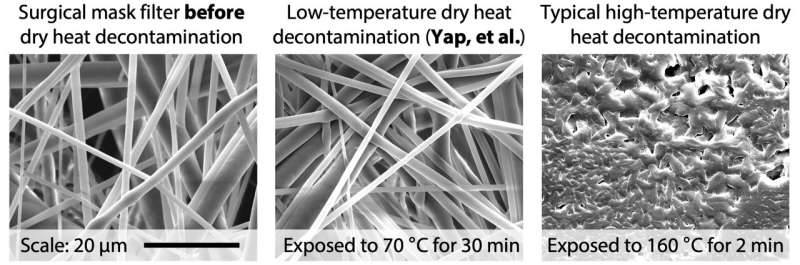
Scanning electron microscope images by Rice University engineers show the effects of
 heat on the filter layer of a surgical facemask. The center image shows the polymer filter
 after decontamination at 70 degrees Celsius for 30 minutes. The right image shows the 
melted layer after exposure to 160 C for two minutes. The research team determined that 
a disposable mask can be decontaminated for reuse after five minutes at 70 C. 
Credit: Faye Yap / Rice University

Here's the recipe to decontaminate a disposable facemask: Heat it at 160 degrees Fahrenheit in an oven for five minutes. You can use your own oven.

The science now bears that out, according to engineers at Rice University, who through extensive experimentation and modeling, determined that proper heating will eliminate the virus that causes COVID-19 from a standard disposable surgical mask without degrading the mask itself. 

The work by mechanical engineer Daniel Preston of Rice's George R. Brown School of Engineering, Rice graduate student Faye Yap and collaborators at the University of Texas Medical Branch (UTMB), Galveston, shows masks can be decontaminated and reused multiple times before degrading. 

Best of all, heating to 70 degrees Celsius (approximately 160 F) killed more than 99.9% of SARS-CoV-2 and other viruses they tested, meeting FDA guidelines for decontamination. That shows promise for adapting the protocol to handle future outbreaks where personal protective equipment (PPE) is at a premium.

The research is detailed in the Journal of Hazardous Materials.

The paper is the third in a series prompted by the COVID-19 pandemic and supported by a National Science Foundation Rapid Response Research grant. The first paper in August 2020 suggested a thermal approach to decontamination would be viable. The second paper, which appeared this May, compared the effects of ambient temperature ranges on the virus in several U.S. locations. 

Rice lab details conditions to decontaminate disposable masks
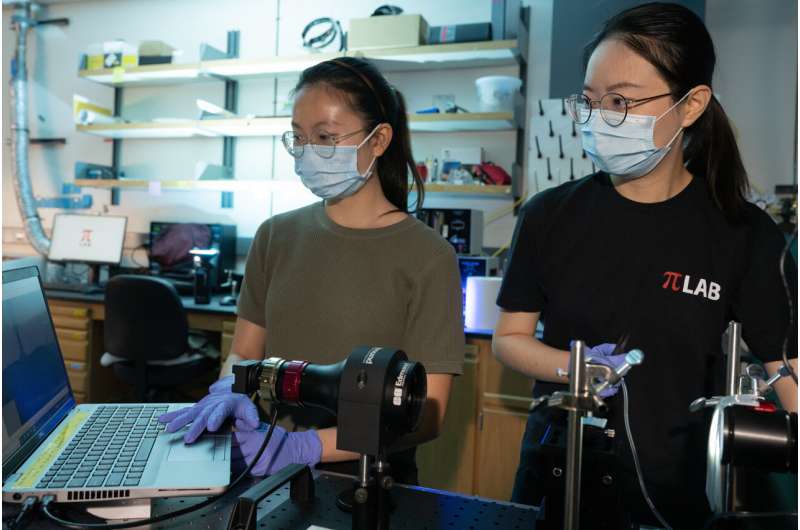
Rice University graduate students Faye Yap, left, and Zhen Liu characterize a mask sample. Researchers at Rice and the University of Texas Medical Branch, Galveston, have established a framework for properly decontaminating disposable facemasks. They determined that heating a mask in a 160-degrees-Fahrenheit oven for five minutes kills more than 99.9% of the viruses they tested, including SARS-CoV-2. Credit: Jeff Fitlow / Rice University

The current study introduces a modeling framework researchers can use to determine just how much  one needs, and for how long, to kill a particular virus. Preston pointed out the framework applies not only to airborne viruses like SARS-CoV-2, but also to viruses that live on surfaces and transmit primarily by touch.

In describing their strategy, study authors Yap and Preston detailed decontamination methods that have been tried but only work to a degree: Exposure to ultraviolet light, because it doesn't reach into folds or crevices common to masks; steam, because it can compromise the structure of a mask; or chemical disinfectants that can leave harmful residues and may also degrade the material.

"In general, it's been shown that  is pretty effective, especially for flat or smooth surfaces," said Preston, an assistant professor of mechanical engineering. "There's a lot of good work out there, but not everyone has access to UV, and heat overcomes the issues presented by crevices or folds in fabrics."

When Preston realized little had been done to create a modeling framework for decontaminating PPE, he decided his lab was right for the job, along with collaborators in Galveston who performed most of the heating experiments.

"We really didn't find anything in the literature that clearly described the effect of temperature on decontamination of viruses," he recalled. "At least nothing that could be applied to the pandemic. That got us into this even before we applied for the grant.

"Ultimately, what we hypothesized and have now found to be true is that the thermal inactivation of the virus can be easily explained by a combination of two fundamental relationships," he said. "One of them is the Arrhenius equation, which relates the reaction parameters to temperature. And the other is the rate law, which uses those reaction parameters to tell you how fast a reaction occurs. In this case, the reaction is inactivation of the  itself."

Lab details conditions to decontaminate disposable masks
Researchers at Rice University and the University of Texas Medical Branch, Galveston, inoculated pieces of standard surgical masks with droplets containing active viruses to determine the best method to decontaminate masks with dry heat. Credit: Jeff Fitlow/Rice University

It's important to ensure the mask heats through, Yap said. Because masks are thin, that's not as much of an issue as decontaminating larger objects, a topic of future study by the Preston lab. Heating to 70 C should work equally well for cloth masks, as long as all layers reach the required temperature for five full minutes. 

She noted that if the heat is too high, the polymer fibers that make up most masks will melt, as they saw in microscope images of their samples. "At about 125 C, the (middle) filter layer in the mask starts to deform, and at 160 C it melts," Yap said. "There's a fine line when you start to approach the material's melting point."

But where the decontamination protocol does work, it works very well. "If you can get the entire mass to heat up to the proper temperature, 70 degrees C, then you will still inactivate the viruses within five minutes," Yap said. Even heating masks to the proper temperature for up to 30 minutes did not significantly degrade them, she said.

While COVID-19 is hopefully fading in the West, Preston said a shortage of PPE remains a problem in many parts of the world. A simple and effective method to decontaminate masks could help many. However, the ability to reuse  is not the be-all and end-all of staying safe during a pandemic.

"I don't want to claim that thermal inactivation of viruses stabilized on surfaces is going to be the main contributor to preventing the spread of COVID-19," he said. "Viruses are still going to spread through aerosolized droplets that transmit from one person to another. Masks can prevent that, and decontamination represents a secondary precaution to limit spread."

Jason Hsu of UTMB is co-lead author of the paper. Co-authors are Rice graduate student Zhen Liu and research scientist Kempaiah Rayavara, graduate student Vivian Tat and Chien-Te Tseng, a professor of microbiology and immunology, at UTMBRice engineer wins grant to study temperature and coronavirus

More information: Te Faye Yap et al, Efficacy and Self-Similarity of SARS-CoV-2 Thermal Decontamination, Journal of Hazardous Materials (2021). DOI: 10.1016/j.jhazmat.2021.127709

Journal information: Journal of Hazardous Materials 

Provided by Rice University