Sunday, November 14, 2021

BHP gets Australian shareholder support for climate plan

Reuters | November 11, 2021 | 

Image: BHP Group

BHP Group said it had won approval for its climate roadmap on Thursday, overcoming a protest vote on concerns that some of the long-term plans lacked detail, with Australia-based shareholder proxies voting 86% in favour.


The world’s biggest listed miner aims for net zero emissions by 2050 for its customers, including the heavily polluting steel industry. But BHP has stopped short of setting a target, in view of uncertainty over how technology will develop.

“BHP’s climate action transition plans are well developed and … have been strongly endorsed by our shareholders,” Chairman Ken MacKenzie said after the results of the poll were released at its annual general meeting.

“We have clear goals and targets in place.”

BHP expected to spend $2 billion to $4 billion on the initiative by 2030, he added.

Australia-based shareholders make up 58% of BHP’s register, which is split between London and Sydney.

Proxy advisers Glass Lewis, and London’s Local Authority Pension Fund Forum (LAPFF) had recommended that investors vote against the plan, with the first saying BHP was not specific enough about disclosures of customer emissions.

“Just three weeks after Rio Tinto committed to cutting its operational emissions by 50% by 2030, BHP shareholders have rubber stamped a 2030 target that is sorely lacking in ambition … and leaves BHP lagging behind nearly all of its global mining peers,” Dan Gocher, climate director for the Australasian Centre for Corporate Responsibility, said.

BHP’s climate transition plan commits it to at least a 30% cut on its direct and indirect emissions by 2030 on 2020 levels.

Raising the stakes for its peers, Fortescue Metals Group last month set a 2040 target to achieve net zero customer emissions.

About 83% of BHP Plc’s investors voted in favour of the resolution at its annual general meeting in London last month.

BHP has also been reshaping its portfolio to better match its climate targets, saying this week it would sell a stake in BHP Mitsui Coal (BMC), a metallurgical coal joint venture in the northeastern state of Queensland.

However, it has proved tougher to shift its New South Wales energy coal business, which is now halfway through a two-year sale process, MacKenzie said.

“Cards on the table it’s challenging,” he said, in response to a question whether BHP could hold on to, and responsibly wind down, the Australian unit. “All options remain on the table.”

(By Melanie Burton; Editing by Clarence Fernandez and Alexander Smith)
Fertilizer prices rocket to all-time high on tightening supplies

Bloomberg News | November 12, 2021 | 

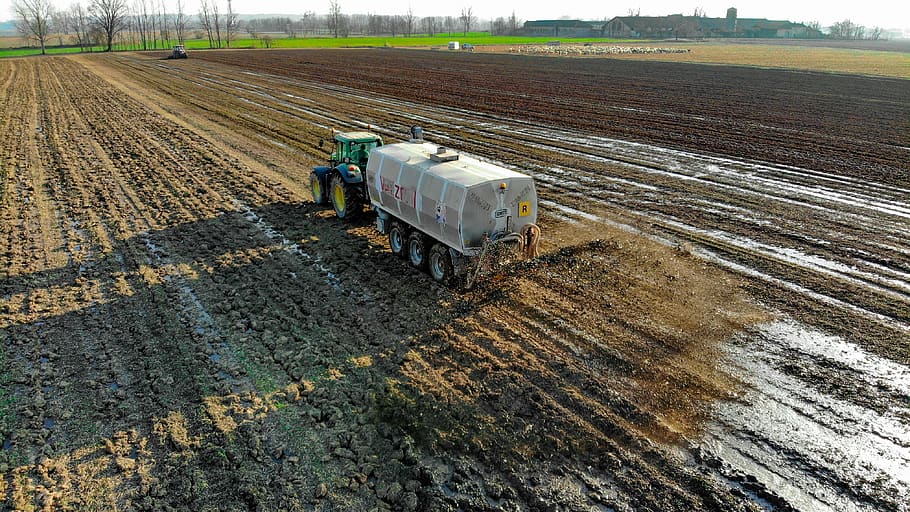
Stock image.

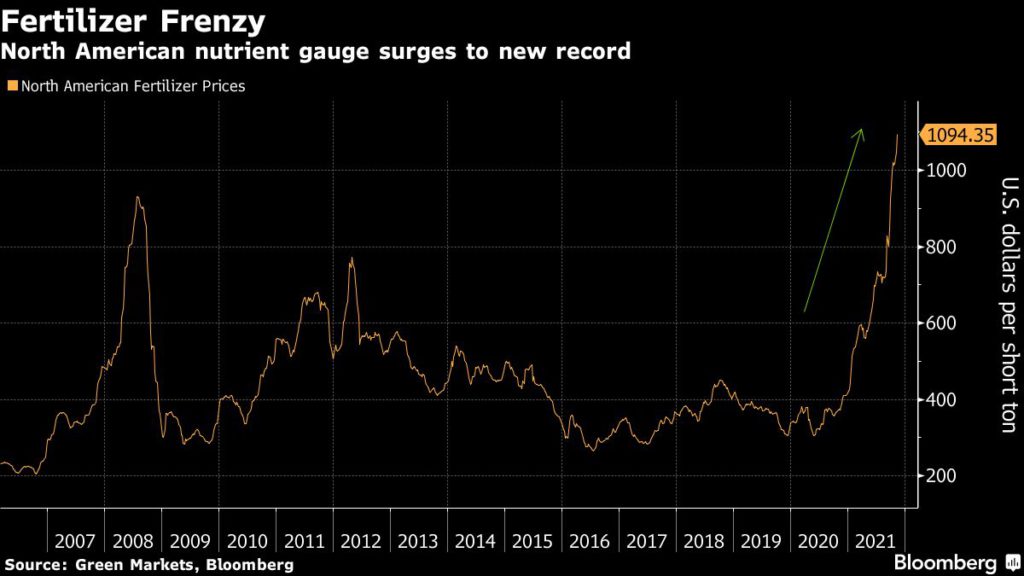
Fertilizer prices keep soaring to unprecedented heights, signaling escalating costs for farmers and consumers around the world.


The Green Markets North American Fertilizer Price Index rose 4.4% to $1,094.35 per short ton on Friday, surpassing a record set a week earlier. Prices for New Orleans urea, a popular nitrogen fertilizer, jumped 8.3% to $812 per short ton as major producer CF Industries Holdings Inc. warned of continued shortages.

Crop-nutrient prices have been soaring as an energy pinch in Europe makes natural gas, the main feedstock for most nitrogen fertilizer, more costly. China and Russia are restricting nutrient exports to ensure sufficient domestic supplies. U.S. consumers already are seeing the steepest inflation since 1990
.


The U.S. is a major importer of farm nutrients, sourcing 20% of its urea and 40% of its ammonium nitrate from Russia alone.


Crop markets from grains to coffee are getting a boost from the fertilizer rally as traders brace for potential supply shortages, with the surging input costs threatening to curb yields across the board.

As fertilizer and other input costs rise, Bloomberg’s Green Markets anticipates American farmers next year will switch 2.5 million acres from corn to soybeans, which is less fertilizer-intensive.

“Warning signs on demand are growing as farmers are unable or unwilling to absorb ammonia’s 65% increase in value since September,” Green Markets analyst Alexis Maxwell said in a note.

(By Elizabeth Elkin)

BELARUS HOLDS A MONOPOLY ON 'RUSSIAN' POTASH WHICH IS WHY IT HAS NOT BEEN SANCTIONED OVER IT LEAVING IT FREE TO SUPPLY THE WORLD MARKET

Endangered rockhopper penguin successfully hatched at Montreal Biodôme

Biodome has largest colony of rockhopper penguins in

 North America

The rockhopper chick was born on Oct. 28 at the Montreal Biodôme. (Submitted by Space for Life)

A rockhopper penguin chick has emerged from its shell in the Montreal Biodôme, and it's being well cared for by its parents and a team of experts.

"I'm always extremely excited about chicks," said Emiko Wong, head of the Biodôme's living collections department.

"I'm a true true sucker for chicks. They're just adorable in all kinds of ways and even more so when it's a penguin."

The baby bird, an endangered species, was born on Oct. 28. The last successful birth was two years ago. In 2016, three chicks were born at the Biodôme.

Among zoological institutions in North America that keep the rockhopper penguin, the Biodôme has the largest colony and is the only one successfully breeding the species, according to the Space For Life Museum — the umbrella organization that manages sites like the Insectarium, Planetarium and Botanical Garden.

"When we have larger colonies, we have more potential for mates to find each other because there's a bond," said Wong, noting rockhoppers are monogamous.

The penguins live in the Biodôme habitat that replicates the tip of South America, where there are rocky islands in a subantarctic zone.

​​WATCH | Montreal ​​​​Biodôme's rockhopper colony has new addition: 

​​Montreal ​​​​Biodôme welcomes ​newborn ​Rockhopper penguin chick

2 days ago
1:46
​Encouraging ​the colony to breed is challenging, but crucial because the ​Rockhopper penguin species is endangered. 1:46

Hopping from rock to rock, or swimming in the Antarctic Ocean, the rockhopper penguin lives 10 to 15 years in the wild. But it can live about 30 years in captivity.

They weigh two to two and a half kilograms. The males and females are identical, with a yellow line above their eyes and a crown of long yellow and black feathers.

The female lays one clutch with two eggs per year, one of them smaller than the other. Only one of the young, generally the one hatched from the larger egg, survives in the wild.

The male and female take turns caring for the eggs and young. In this case, Biodôme staff put the eggs in an incubator. 

"And we actually see the chick moving in the eggs," said Wong. "A few days before the pipping and the chipping and the hatching, we put it back under the parents."

The new rockhopper chick is safely tucked under its parent in the centre of the photo. Male and female rockhoppers are identical and can only be distinguished by a DNA test. (Kwabena Oduro/CBC)

At the Biodôme there are seven other rockhopper penguin couples, and many have already laid two eggs. 

"All these seven couples have found their nest," she said.

In 2013, about 240,000 northern rockhopper pairs were counted in the wild, and the International Union for Conservation of Nature and Natural Resources (IUCN) found the population had declined by 57 percent over the last four decades.

Climate change is thought to be one the main reasons for the decline as temperature variations affect the bird's ability to breed and limits food sources. Rockhoppers eat mostly krill, but also cephalopods.

Humans also play a role in the decline, with intense fishing and oil drilling affecting penguins' environment, the Biodôme says on its website.

For now, the Biodôme's new chick doesn't have a name. In fact, because males and females look so much alike, it's impossible to know its gender without a DNA test. That will be done later, when the chick is a bit older, Wong said.

And now with seven couples nesting in the Biodôme, Wong said she hopes there will be a few more rockhoppers swimming in the habitat next year.

Barking up the wrong tree in old-growth controversy?


Careful forest management can have important role in climate change fight, experts say

By Nelson Bennett | November 11 2021
BUSINESS IN VANCOUVER

The value of young forests compared with old growth is understated, say some experts  | stockstudioX/iStock/Getty Images Plus

In the lead-up to last week’s announcement that the B.C. government will defer logging on 2.6 million hectares of old-growth forest, the conversation was sometimes muddied with invocations of “deforestation” and climate change as reasons to halt logging of old-growth forests in B.C.

Whereas the argument 20 years ago was that West Coast old-growth and primary boreal forests in Eastern Canada should be spared from logging for biodiversity reasons, climate change and the role forests play as carbon sinks has increasingly been cited by environmentalists as a reason to make old-growth and primary forests off limits to logging.

While there are good scientifically grounded arguments for preserving as much old growth as possible (keeping carbon in the bank), there are equally sound arguments that younger, sustainably managed working forests are better carbon sinks over the longer term.

Bigger concerns from a climate change perspective are forest fires, which can turn a forest from a carbon sink to a carbon source overnight, and the amount of wood debris that is wasted in logging operations.

When Canada last week signed a pledge to end deforestation by 2030 at COP26, environmental groups like Stand.earth were quick to point to the pledge in demanding that B.C. deliver on its promise to halt old-growth logging.

But cutting down trees to make wood products and replanting the trees that were cut is not deforestation. Quite the opposite: sustainable forestry has the potential to increase forest carbon sinks, according to the Intergovernmental Panel on Climate Change (IPCC).

“A sustainable forest management strategy aimed at maintaining or increasing forest carbon stocks, while producing an annual sustained yield of timber, fibre or energy from the forest, will generate the largest sustained mitigation benefit,” the IPCC Working Group 3 said in its section on forests.

Deforestation is the permanent removal of trees – either through illegal logging or to clear land for development or agriculture – the consequences of which are the permanent loss of carbon sinks. But logging per se is not deforestation if the trees that are cut down are replanted, which is what happens in Canada’s managed forests.

One of the benefits of forestry, from a climate change perspective, is that when trees are turned into products like lumber, furniture and engineered wood products, the carbon is sequestered for decades. And as a building material, wood has much lower emissions intensity than concrete and steel. Fuels or products (bioplastics, for example) that are made from wood waste have a much lower carbon intensity than those made from fossil fuels.

When it comes to the sequestration of carbon in living trees, there are good arguments to be made that old-growth forests already contain massive stores of carbon, are more resistant to the forest fires and therefore should be left alone.

But there are also good arguments to be made in favour of working forests – forests managed to actively generate revenue from multiple sources – because younger, faster-growing trees can do a better job of soaking up CO2.

Like a retiree who has money in the bank but is no longer earning an income, an old-growth tree has a lot of carbon in the bank but may no longer be absorbing as much CO2 as younger, faster-growing trees.

“The fundamental scientific finding that the uptake of carbon in old forests is much lower than in young and middle-aged forests is not disputed,” said Werner Kurz, one of Canada’s leading authorities on forestry carbon accounting and eight-time contributor to IPCC assessments.

He is quick to point out, however, that that isn’t an argument for converting all older forests to secondary forests. Old and younger forests each have a role to play in natural climate solutions.

“Young forests have less carbon stock,” Kurz said. “So, they are smaller trees, there’s less carbon in them, but the trees are growing much faster than old forests. So young forests are much larger carbon sinks than old forests. But it is also true that if you cut an old forest, you may be releasing some carbon into the atmosphere.”

One genuine concern about forestry from a carbon accounting perspective is the amount of wood that is wasted, which means squandered sequestration potential. This is forestry’s equivalent of the natural gas sector’s fugitive methane problem.

Hadi Dowlatabadi, a University of British Columbia physicist specializing in climate change statistical modelling and an IPCC contributor, said about half of the carbon stored in a tree is above ground. The rest is stored in the soil and roots, some of which is lost when trees are cut down. It takes several years before regrowing trees make up the deficit.

Dowlatabadi said as much as 25% of the carbon in a tree may be wasted in the form of leaves, branches, bark and stumps left on the forest floor after logging, where it either decays or is burned.

“In North America, the leaves and branches are left at the harvest site, and that is 50% of the harvest itself,” Dowlatabadi said. “So we only use 25% of the carbon in whatever use we have for it.

“The rest, depending on moisture conditions and slash-burning regimes, turns to methane and has a really high GHG-forcing effect, and then to CO2 or to CO2 directly. Tree-cutting is a major source of carbon release.”

Better management practices aimed at recovering more of that wood debris for use in pulp mills or bioenergy would reduce the amount of sequestered carbon that is wasted.

“That’s one of the biggest areas of opportunity.… Can we collect that forest residue and put it to a better use instead of burning it in a slash pile?” said Kate Lindsay, senior vice-president of the Forest Products Association of Canada.

Done right, sustainable forestry may do a better job of carbon sequestration than conservation.

“Nordic countries such as Sweden or Finland, where forests have been managed intensively for decades, have demonstrated that management can increase their forest carbon stocks while at the same time harvesting large volumes of wood to support a bio-economy,” Kurz said.

“Even managing a small portion of B.C.’s forests (less than 10%) more intensively could greatly enhance forest sinks and remove more carbon from the atmosphere.”

According to updated estimates by B.C.’s Old Growth Technical Advisory Panel, 31.5% of old growth in B.C. is already protected. Of the 7.7 million hectares of old growth containing big, ancient and rare trees, 2.6 million hectares (34%) is protected. Deferrals announced last week would double the amount of old tree, big tree and ancient tree old growth that would be protected.

Ideally, a natural climate solutions plan for forests and forestry would see as much old-growth forest preserved as possible (keeping carbon in the bank), with forestry occurring mostly in second-growth forests.

The reality is that there’s not enough second growth in the coastal forest sector to support the forest industry as it is currently constituted. About half of the annual allowable cut for the coastal forest sector is old growth. So doubling the amount of old-growth protection will have huge economic costs for B.C., especially coastal communities dependent on forestry.

Ultimately, how much old growth is made off-limits to logging in B.C. may depend on what First Nations have to say about it.

Some, like the Huu-ay-aht, are involved in forestry and are invoking treaty rights and the United Nations Declaration on the Rights of Indigenous Peoples in asserting their authority within their territories when it comes to land management and environmental stewardship. •

Breaking News: Fusion Recedes Into Far Future For The 57th Time

Fusion has an amazing future as a source of energy. In space craft beyond the orbit of Jupiter sometime in the next two centuries.


Image courtesy Oak Ridge National Laboratory

ByMichael Barnard

Fusion has an amazing future as a source of energy. Which is to say, in space craft beyond the orbit of Jupiter, sometime in the next two centuries. Here on Earth? Not so much. At least, that’s my opinion.

Nuclear electrical generation has 2.5 paths. The first is nuclear fission, the part that is the major electrical generation source that provides about 10% of the electricity in the world today. The 0.5 is radioisotope thermoelectric generator, where a tiny chunk of decaying radioactive material is used with a thermocouple to provide electricity to space probes. If you read or saw The Martian, that’s what he dug out of the pit and put in his jury-rigged long-distance Mars buggy.


And then there’s fusion. Where fission splits atoms, fusion merges them. Instead of radioactive fuel, there’s a lot of radioactive emissions from the merging of things like hydrogen-3, deuterium, and tritium that irradiates the containment structures. Lower radioactive waste that doesn’t last as long, but still radioactive waste for those who think that’s a concern.

Compared to CO2e emissions causing global warming, I don’t consider a few thousand tons of radioactive waste to be significant. Among other things, I spent enough time with epidemiologists building the world’s most sophisticated communicable disease and pandemic management solution that I ended up with a much better appreciation of the statistics of radiation and health. It’s not a big concern compared to coal or global warming.

But fusion generation of electricity, as opposed to big honking nuclear weapons using fusion, is a perpetual source of interest. When Lewis Strauss, then chairman of the United States Atomic Energy Commission, talked about nuclear being “too cheap to meter” in 1954, he was talking about fusion, not fission. Like everyone since the mid-1950s, he assumed that fusion would be generating power in 20 years.

And so here we are, 67 years later. How is fusion doing?

Let’s start with the only credible fusion project on the planet, the ITER Tokamak project. It’s been around for decades. It planted its roots in 1985 with Gorbachev and Reagan. 35 countries are involved. Oddly, ITER isn’t an acronym, it’s Latin for “The Way,” a typically optimistic and indeed somewhat arrogant assumption about its place in the universe.

It’s supposed to light up around 2040. That’s so far away I hadn’t bothered to think much about it, as we have to decarbonize well over 50% of our economy long before that. As a result, I had a lazy read on it. I had assumed, as most press and indeed pretty much everyone involved with it asserted, that it would be generating more energy than it consumed, when it finally lit up.

It’s pretty easy to get that assumption when all of their press material and statements stay that they’ll put in 50 MW of heat and get out 500 MW of heat, or 10x the power. They’ve been saying that for at least 30 years, after all. I assumed that they would have excess energy, and could bolt a steam generator onto the very expensive tech and produce electricity if they wanted to. I didn’t assume that the million components and hundreds of kilometers of wrapped, very expensive, exotic material wires in the electromagnets would be remotely economical, but I did assume that they were going to have excess energy.

And they’ve managed to make plasma, if not run a fusion reaction.

However, something crossed my desk today that made me sit up and challenge my assumptions. There’s an obsessive guy named Steven B. Krivit who seems to spend most of his time looking at various alternative nuclear generation technologies, including debunking cold fusion. His piece from November 3rd, 2021 asserted that he’d identified in 2017 that ITER wouldn’t be generating more energy than was put in, and that ITER finally admitted it to a press outlet.

Really? This project that will end up costing somewhere between $18 and $45 billion isn’t intended to generate extra energy? That seemed unlikely.

So I poked around. Krivit’s numbers didn’t add up for me, as his diagrams were clearly showing MW at various stages of the process, and not net MWh. But other parts of his story were clearer, and other participants in ITER were clearer still. I found a page from the JT-60SA project. It’s a project devoted to “the early realization of fusion energy by addressing key physics issues for ITER and DEMO.” It’s an ITER sub-project. And it agrees with Krivit, but in the right units.


What it amounts to is that ITER will require about 200 MW of energy input in total running as it creates 500 MW of heat. But the exergy of heat means that if it were tapped, it would only return about 200 MW of electricity. So it might be a perpetual motion machine, but one that wouldn’t do anything more than keep its lights running as long as you fed it tritium, about $140 million worth of the stuff a year.

And it gets worse. ITER is planning at the end of this process to maintain this for less than 3000 seconds at a time. That’s 50 minutes. This is at the end of the process. As they build up to less than an hour, mostly they’ll be working on fusion that lasts five minutes, several times a day. It’s a very expensive physics experiment that will not produce climate-friendly energy. It’s going to teach us a bunch, which I completely respect, but it’s not going to help us deal with climate change.

I expected more from ITER. Not much more. I mean, it is a million-component fission reactor expected to light up in 2040 and not generate any electricity at that point. But I had assumed based on all the press that it would generate more electricity than it used to operate if you bolted a boiler and some turbines to it, even if it were grossly expensive. Apparently not. Just grossly expensive, no net new electricity.

As a side note, Krivit asserts that a former ITER spokesman admitted this to Le Canard Enchainé, a French newspaper. Having become, briefly, conversational in French, something seemed off to me. Why would a paper be called The Chained Duck? It turns out that it’s in a tradition of semi-serious, semi-satirical journalistic outlets that both get good juicy quotes, leaks, and gossip from governmental insiders, but also acted as the Onion of the day, just with actual real news mixed in with the satire. Still going, it seems. The combination appears to mean that the former ITER representative did say what he said, that Krivit was right, but he said it to an outlet that only occasionally gets taken seriously, and it wasn’t taken up by any media that were serious most of the time.

However, ITER is not the only fusion reactor in the game. There are startups! And we all know startups make no promises that they can’t keep and are excellent at disclosure.

Like Helion. They have a photo-shopped peanut asserting it’s a 6th prototype with regenerative power creation that’s never achieved fusion that is backed by Peter Thiel! It just received $500 million more of VC funding, with an option to get up to $2.2 billion if they hit their targets!

I’m not sure if I could have made up a paragraph less likely to make me think that there was some there there.

The website is likely intentionally lacking in anything approaching detail. It’s low-information and VC friendly, which in the energy space is Thiel’s jam. He’s the guy who, despite being partnered with Elon Musk, has never realized that electrical generation was already being disrupted by wind and solar. His acolytes in startups disrupting energy crashed and burned, because he and they never bothered to do the hard work of understanding how electricity actually works at grid scale. At least Musk was solid on solar, although he got the wrong end of it and hasn’t quite figured that out yet.

While Helion has achieved 100 million degrees Celsius, it’s with a high-energy laser pulse — not new ideas, in fact 1950s ideas, just easier now — and they are incredibly coy about duration. The assumption to be taken is that it lasts for a picosecond at a time. They talk about their prototype having worked for months, but that means it’s maintaining a vacuum and occasionally creating plasma, a precursor to fueled fusion. Many years and tens of millions of dollars in, they are promising the moon, and soon. And to be clear, they are well behind on their initial schedule.

Unlike ITER, at least they are proposing fuels — Helium-3 and deuterium — which aren’t absurdly difficult and expensive to get. But still, Helium-3 isn’t terribly common. Lots of lunar mining proposals related to it. So they are going to manufacture helium-3 apparently.

And they promise to create electricity directly. It’s not heat-generating steam or powering thermocouples.

“The FRC plasmas in our device are high-beta and, due to their internal electrical current, produce their own magnetic field, which push on the magnetic field from the coils around the machine. The FRCs collide in the fusion chamber and are compressed by magnets around the machine. That compression causes the plasma to become denser and hotter, initiating fusion reactions that cause the plasma to expand, resulting in a change in the plasma’s magnetic flux. This change in magnetic flux interacts with the magnets around the machine, increasing their magnetic flux, initiating a flow of newly generated electricity through the coils. This process is explained by Faraday’s Law of Induction.”

Sure. They create intense magnetic fields and then create plasmas which generate their own magnetic field, and the combination generates electricity. I will be fascinated to read third-party assessments of their results.

There were no published results that I was able to find. No third party assessments that I was able to find. Undoubtedly their NDA and legal documents are things of beauty. Nothing except their assertion that they had found a way to create electricity incredibly cheaply, something that fusion researchers have been claiming for 67 years. They are asserting that their end price of electricity will be $0.01 cents per kWh. Unlikely.

I’m disappointed about ITER. I think Helion is likely to be a less well known and publicized Theranos, without in any way asserting that the principals are Elizabeth Holmes as much as just optimistic about timelines by decades, and far too enamored of their own, pulsing technology.

And fusion generating electricity appears to be as far away as ever.

Featured image courtesy Oak Ridge National Laboratory


'MAYBE' TECH
Reverse combustion is preparing for takeoff

Where burning hydrocarbons is unavoidable, creating them from atmospheric carbon is a promising option


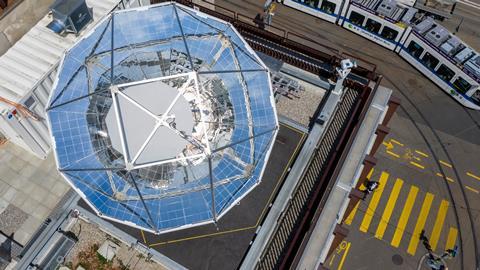
SOURCE: © ETH ZÜRICH/ALESSANDRO DELLA BELLA

OPINION
BY DEREK LOWE
11 NOVEMBER 2021

Earlier this year, I wrote in this column about the possibilities of ‘reverse combustion’, the idea of producing fuels and chemical feedstocks out of carbon dioxide. Thermodynamically, that process is going to have to take energy. The question then comes down to making it as efficient as possible and sourcing those energy inputs in the least harmful way.

A paper from Aldo Steinfeld’s team at ETH Zurich in Switzerland describes a project aimed exactly at this problem. The team has been looking for some years now at producing fuels such as methanol and/or kerosene from ambient carbon dioxide. We already know how to make such things on an industrial scale from syngas – mixtures of hydrogen and carbon monoxide, often with some percentage of carbon dioxide. But as it stands, we generally produce syngas from fossil hydrocarbon feedstocks (steam reforming of natural gas, coal gasification etc), which makes it a way to convert between hydrocarbon fuels (gas, liquid, and solid) with an associated energy cost. Producing syngas from the carbon dioxide and water vapour in the air would be a welcome new variation – and compared to the water-based photovoltaic routes to synthetic fuels, it’s more direct and has fewer steps.


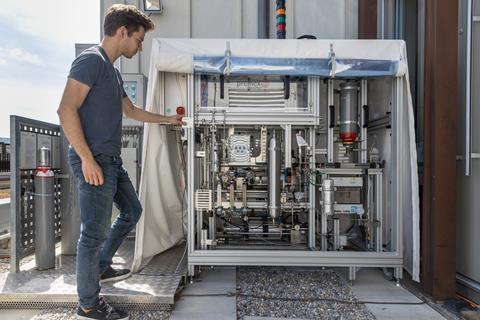
Source: © ETH Zürich/Alessandro Della Bella

The research plant produces syngas, which can be processed into liquid hydrocarbon fuels through conventional methanol or Fischer–Tropsch synthesis

That’s what this latest work demonstrates. The water and carbon dioxide are adsorbed from the air, then pumped into a reactor zone using reticulated ceria (cerium oxide) as the catalyst. This is heated only by concentrated sunlight to yield a syngas mixture, and depending on the amount of carbon dioxide present (which can be adjusted) this can be sent into further catalytic columns for either methanol synthesis or hydrocarbon fuel via the Fischer–Tropsch process. One interesting advantage of using ambient gases as feedstocks is the absence of typical impurities, which keep the catalysts from fouling, and produce very clean products from an emissions standpoint – no sulfur, no poorly-burning aromatics, and so on.


The properties of liquid fuels are very hard to replicate for some applications, and airplane fuel leads the list

Now, this technology is not going to start delivering millions of tons of hydrocarbons any time soon. But the fact that it works at all is a demonstration of some potentially disruptive forces: fuels could be produced wherever there is sufficient sunlight, without regard to existing hydrocarbon deposits. Deserts would in fact be ideal locations. Engineering work that has already gone into solar-concentration power plants (and of course, the processes for conversion of syngas) would be directly applicable to much of this production as well. There’s also the big advantage of making ‘drop-in’ products, since the methanol and jet fuel can be used as is with the existing infrastructure.

But as the authors point out, such fuel is going to be more expensive for some time to come, and very much more expensive at first. They hope for some sort of policy support to encourage aviation fuel production via this route, which will allow the technology to gradually scale up and for engineers and chemists to improve it along the way. Every process of this sort benefits from the lessons of scale-up in the real world. Right now, for example, one of the biggest problems with the overall efficiency is the loss of heat during the back-and-forth swing between different temperatures needed. Using this more efficiently, along with new ideas for the ceria catalyst surface, better sunlight tracking and more, could eventually make this the preferred pathway for carbon dioxide extraction. And that in turn could start making a large fuel production sector carbon-neutral.

One objection is that it would be better to put such resources into finding ways not to burn hydrocarbons at all. But the properties of liquid fuels – transport, energy density, storage – are very hard to replicate for some applications, and airplane fuel leads the list. We absolutely need (some) jet transport in the world economy, so the opportunity to defang it from a pollution and climate standpoint seems too good to miss.

Another objection is that all such technological schemes to ameliorate these problems are somehow tainted. But I have never been able to subscribe to that viewpoint. Chemist that I am, I think that we invented our way into these problems, and that inventiveness should be helping us back out of them!


Canada, U.S. call to end fossil fuel subsidies as COP26 draft called 'weasel words'

Climate deal: 'weasel words'

Canada's environment minister fended off accusations Friday that UN climate negotiators are resorting to "weasel words" on addressing fossil fuel subsidies.

As United Nations negotiators wrestled over a final text in the closing hours of the Glasgow climate talks, Environment Minister Steven Guilbeault reiterated the Canadian view that subsidies should be phased out.

"Canada is in favour of having a text that states that we need to eliminate fossil fuel subsidies, and we would agree that … a timeline should be put in there," Guilbeault said at his closing press conference at the climate talks, known as COP26.

But he acknowledged that "not all parties part of these negotiations necessarily agree with that."

The minister, who is a former environmental activist, was addressing sharp criticism of a draft text addressing fossil fuels that contained language calling for phasing out "unabated" coal power and "inefficient" fossil fuel subsidies.

"We have sadly seen the hand of fossil fuel interests interfering with that text to water it down with weasel words, like unabated and inefficient," Catherine Abreu, a member of Canada's net-zero advisory body and the executive director of Destination Zero, said at a separate press conference in Glasgow on Friday.

"This language 'unabated coal,' 'inefficient fossil fuel subsidies' — we've seen it before. We've seen it in the G20 for 12 years — 'inefficient fossil fuel subsidies' — it means nothing."

The dispute largely arises between those who argue science dictates all fossil fuel production and use must be phased out to save the planet from catastrophic warming, and those, largely in oil- and gas-producing nations, who see room for continued production and use as long as emissions are reduced or captured.

Eliminating subsidies that help make fossil fuels more affordable is one key part of the process, environmental advocates say.

Abreu called for "some decent language" in the final COP26 declaration to address the need to move more quickly towards a transition to renewable energy.

She said governments need to show more courage and admit the "need to phase out all new production of fossil fuels as soon as possible, including the billions of dollars that world governments spend on fossil fuel subsidies."

Guilbeault said he heard the criticism but that it was premature to judge what will be in the final text.

"Someone earlier this week said, 'Oh, my goodness, there's nothing in the text about fossil fuel subsidies.' And then we saw yesterday a version where there was language," said Guilbeault. "There's another version today."

Canada has been promising to phase out fossil fuel subsidies since 2009, when it was first referenced by the G20 in a communiqué. Now, Canada is part of a G20 peer review process that is overdue reporting back on what subsidies exist in Canada and how they can be eliminated.

Prime Minister Justin Trudeau promised during the recent federal election to phase out subsidies by the end of 2023. But he didn't identify what subsidies he meant, and in Canada there is no agreement yet on what constitutes such a subsidy.

Guilbeault touted the backing of his American counterpart, John Kerry, who denounced the continued subsidies as the "definition of insanity."

Guilbeault said Canadians could take some quiet pride in what they have accomplished in the fight against climate change over the past few years. But he said they still have their work cut out for them to make their commitments a reality.

The minister referenced his background as an activist, saying there were high expectations coming into COP26 but that is because everyone recognizes that the stakes are high.

Guilbeault plans to travel by train across Canada in early 2022 to meet Canadians and discuss ways to implement the Trudeau government's environmental agenda.

COP26 is seen as critical to global co-operation in the effort to limit global warming to no more than 1.5 C by the end of this century, with the final rules for implementing the 2015 Paris climate accord being discussed, and a push for all countries to come to the table with more plans to curb the greenhouse gas emissions that cause global warming.

"We either find a way of agreeing or we risk blowing it," said Prime Minister Boris Johnson of Britain, the COP26 host government, as the quest for a final declaration continued and overtime loomed late Friday.

"If they can have the courage to do this deal ... then we will have a road map that will enable us to go forward and start to remove the threat of anthropogenic climate change."

'WASHABLE PAINT'
Red hand prints placed on Environment Canada building during climate rally, 3 people arrested
Red handprints, in washable paint, were placed on the facade of the Environment Canada building in downtown Vancouver on Friday, Nov. 12, 2021. (CTV News Vancouver)

Ben Nesbit
CTV News Vancouver Multi-Media Journalist
Follow | Contact
Published Nov. 13, 2021 

VANCOUVER -

Three people were arrested at a climate rally in downtown Vancouver Friday evening.

A few hundred people gathered for what organizers described as a march for action on climate change in front the Environment and Climate Change Canada building on Burrard Street.

The event began as a peaceful demonstration with multiple speakers taking to the podium.

Then, it escalated after some people placed red handprints on the building façade.

"We were getting ready to go for our march but some young people put washable paint with hand marks on the building and the police decided to escalate," said event organizer Thomas Davies.

The red paint could be seen all over the front of the building.

Police quickly enclosed on the group and detained three people, causing protestors to push back and demand they be released.

Eventually police escorted the individuals into police wagons and took them away.

In a release Vancouver police said A 20-year-old man and two women, aged 18 and 16, were taken to Vancouver Jail. They have since been released pending their next appearance in court.


Global consensus needed to develop climate risk disclosures for companies

climate
Credit: CC0 Public Domain

As the United Nations Climate Change Conference in Glasgow ends today, the United States and other G7 countries need to continue to consider adoption of a global framework for mandatory climate risk disclosure by companies.

But making disclosures mandatory globally is challenging when there are two different corporate governance systems practiced in the world's economies, said Paul Griffin, professor in the Graduate School of Management at the University of California, Davis, and lead author of an article published today in Nature Energy.

"Most fundamentally, the borderless nature of carbon emissions and financial capital requires that any mandatory climate risk discourse framework will also have to be global to be effective," Griffin said in the article.

The article, "Challenges for a climate risk  mandate," is co-authored by Amy Myers Jaffe of the Climate Policy Lab, Tufts University.

Two basic systems

U.S. shareholders, for example, have strong shareholder rights with a high level of disclosure required by firms. Other economies, such as in Asia and the European Union, traditionally operate in a blockholder system, whereby blockholders exert governance through direct intervention in a firm's operations. No single corporate governance model exists that has wide-scale acceptance, Griffin said.

Meanwhile,  throughout the world this past summer have created a new sense of urgency to achieve a net-zero , researchers suggest in the article. Asset managers and large asset owners have made efforts to force energy firms to align with global climate goals; investors are demanding climate-friendly environmental, social and governance stocks; President Biden has issued an executive order calling for mandatory climate risk disclosures by firms; and Congress has passed legislation calling for the same.

Regulators should work at a global level, Griffin said, to fashion a  that addresses climate risk and climate risk disclosure in a manner that strengthens shareholder rights to press for  disclosure, but aligns with the longer term perspective of a blockholder system.

"Rapid convergence of  systems into a hybrid global model is essential, given the pressing need for a timely transition to net-zero business principles and to hold global temperatures to a 1.5-degree C rise compared with pre-industrial levels," he said.Increase in shareholder activism around environmental, social and governance issues

More information: Paul Griffin et al, Challenges for a climate risk disclosure mandate, Nature Energy (2021). DOI: 10.1038/s41560-021-00929-z

Journal information: Nature Energy 

Provided by UC Davis 

Turkey generates record high daily wind power

BY ANADOLU AGENCY ANKARA
  ENERGY
NOV 11, 2021 

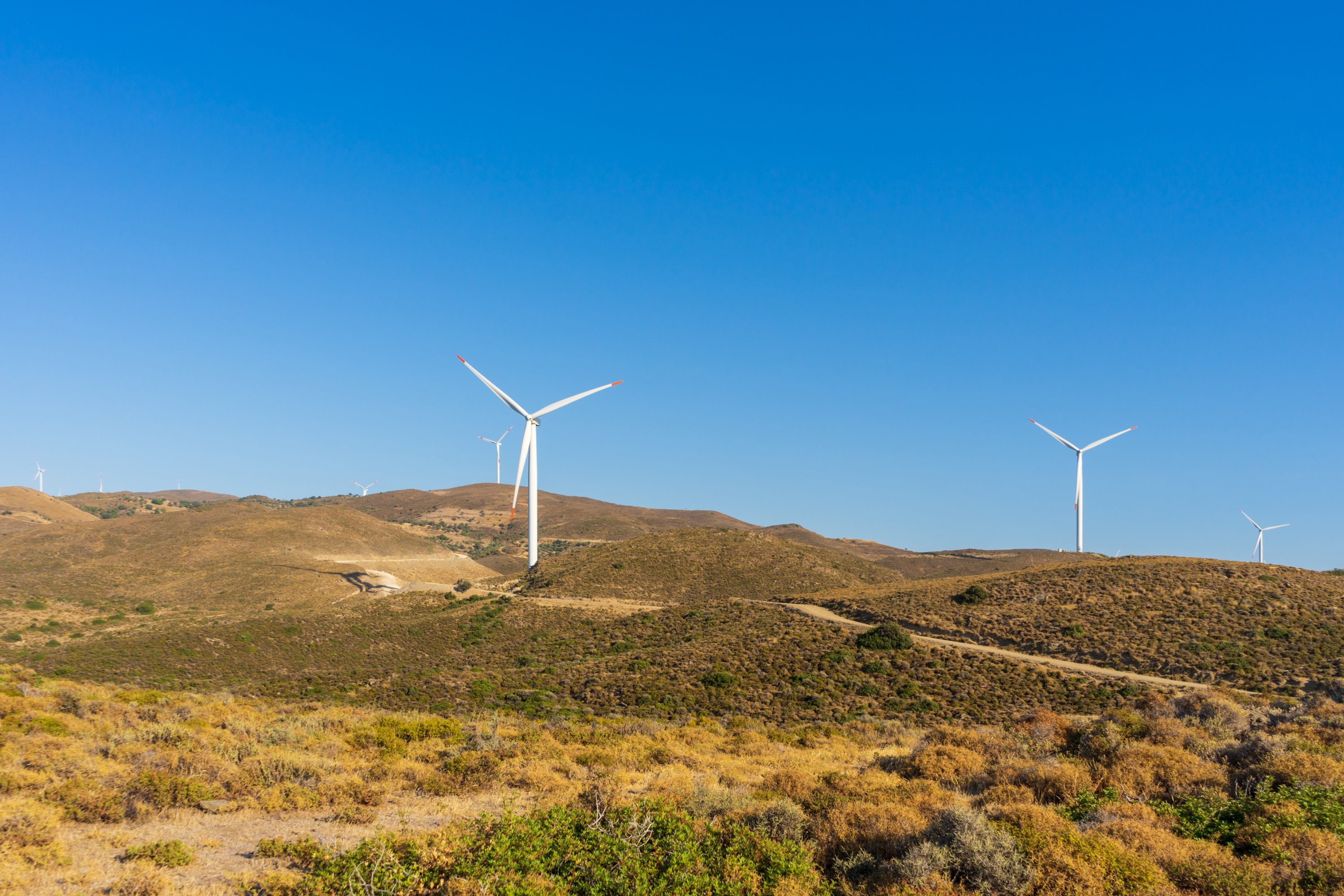
Wind turbines in the mountains in Karaburun district of İzmir, western Turkey, Aug. 7, 2021. (Shutterstock Photo)


Electricity production from wind power in Turkey hit a daily record on Wednesday, generating 20.1% of total power, according to data from Turkey's Electricity Transmission Corporation (TEIAŞ) on Thursday.

The country produced 181,249 megawatt-hours (MWh) of electricity from wind farms on Wednesday, according to data provided by TEIAŞ.

This record placed wind power as the first-largest energy source after imported coal, which produced 194,900 MWh of electricity, marking a 21.6% share. Natural gas followed with 180,585 MWh with a 20% share.

Total electricity production amounted to 901,841 megawatt-hours on Wednesday, marking a 2.56% increase compared to Tuesday.

Daily electricity consumption in the country also increased by 2.55% totaling 902,334 megawatt-hours on Wednesday compared to the previous day.

Hourly power consumption peaked at 42,642 megawatt-hours at 12 p.m. local time (9 a.m. GMT), data from TEIAŞ showed. The country's electricity usage dropped to the lowest level of 30,334 megawatt-hours at 5 a.m. local time (2 a.m. GMT).

On Wednesday, Turkey's electricity exports amounted to 7,429 megawatt-hours and imports totaled 6,419 megawatt-hours.