Sunday, November 14, 2021

MONOPOLY CAPITALI$M

The Real Source of Inflation? Consolidated Corporate Power and Greed

This structural problem is amenable to only one thing: the aggressive use of antitrust law.


P&G faces very little competition. According to a report released this month from the Roosevelt Institute, "The lion's share of the market for diapers," for example, "is controlled by just two companies (P&G and Kimberly-Clark), limiting competition for cheaper options." 
(Photo Illustration by Thiago Prudencio/SOPA Images/LightRocket via Getty Images)


ROBERT REICH
November 12, 2021
 by RobertReich.org

The biggest culprit for rising prices that's not being talked about is the increasing economic concentration of the American economy in the hands of a relative few giant big corporations with the power to raise prices.

If markets were competitive, companies would seek to keep their prices down in order to maintain customer loyalty and demand. When the prices of their supplies rose, they'd cut their profits before they raised prices to their customers, for fear that otherwise a competitor would grab those customers away.

The underlying structural problem isn't that government is over-stimulating the economy. It's that big corporations are under competitive.

But strange enough, this isn't happening. In fact, even in the face of supply constraints, corporations are raking in record profits. More than 80 percent of big (S&P 500) companies that have reported results this season have topped analysts' earnings forecasts, according to Refinitiv.

Obviously, supply constraints have not eroded these profits. Corporations are simply passing the added costs on to their customers. Many are raising their prices even further, and pocketing even more.

How can this be? For a simple and obvious reason: Most don't have to worry about competitors grabbing their customers away. They have so much market power they can relax and continue to rake in big money.

The underlying structural problem isn't that government is over-stimulating the economy. It's that big corporations are under competitive.

Corporations are using the excuse of inflation to raise prices and make fatter profits. The result is a transfer of wealth from consumers to corporate executives and major investors.

This has nothing to do with inflation, folks. It has everything to do with the concentration of market power in a relatively few hands.

It's called "oligopoly," where two or three companies roughly coordinate their prices and output.

Judd Legum provides some good examples in his newsletter. He points to two firms that are giants in household staples: Procter & Gamble and Kimberly Clark. In April, Procter & Gamble announced it would start charging more for everything from diapers to toilet paper, citing "rising costs for raw materials, such as resin and pulp, and higher expenses to transport goods."

Baloney. P&G is raking in huge profits. In the quarter ending September 30, after some of its price increases went into effect, it reported a whopping 24.7% profit margin. Oh, and it spent $3 billion in the quarter buying its own stock.

How can this be? Because P&G faces very little competition. According to a report released this month from the Roosevelt Institute, "The lion's share of the market for diapers," for example, "is controlled by just two companies (P&G and Kimberly-Clark), limiting competition for cheaper options."

So it wasn't exactly a coincidence that Kimberly-Clark announced similar price increases at the same time as P&G. Both corporations are doing wonderfully well. But American consumers are paying more.

Or consider another major consumer product oligopoly: PepsiCo (the parent company of Frito-Lay, Gatorade, Quaker, Tropicana, and other brands), and Coca Cola. In April, PepsiCo announced it was increasing prices, blaming "higher costs for some ingredients, freight and labor."

Rubbish. The company recorded $3 billion in operating profits and increased its projections for the rest of the year, and expects to send $5.8 billion in dividends to shareholders in 2021.

If PepsiCo faced tough competition it could never have gotten away with this. But it doesn't. In fact, it appears to have colluded with its chief competitor, Coca-Cola—which, oddly, announced price increases at about the same time as PepsiCo, and has increased its profit margins to 28.9%.

And on it goes around the entire consumer sector of the American economy.

You can see a similar pattern in energy prices. Once it became clear that demand was growing, energy producers could have quickly ramped up production to create more supply. But they didn't.

Why not? Industry experts say oil and gas companies (and their CEOs and major investors) saw bigger money in letting prices run higher before producing more supply.

They can get away with this because big oil and gas producers don't face much competition. They're powerful oligopolies.

Again, inflation isn't driving most of these price increases. Corporate power is driving them.

Since the 1980s, when the federal government all but abandoned antitrust enforcement, two-thirds of all American industries have become more concentrated.

Monsanto now sets the prices for most of the nation's seed corn.

The government green-lighted Wall Street's consolidation into five giant banks, of which JPMorgan is the largest.

It okayed airline mergers, bringing the total number of American carriers down from twelve in 1980 to four today, which now control 80 percent of domestic seating capacity.

It let Boeing and McDonnell Douglas merge, leaving America with just one major producer of civilian aircraft, Boeing.

Three giant cable companies dominate broadband [Comcast, AT&T, Verizon].

A handful of drug companies control the pharmaceutical industry [Pfizer, Eli Lilly, Johnson & Johnson, Bristol-Myers Squibb, Merck].

So what's the appropriate response to the latest round of inflation? The Federal Reserve has signaled it won't raise interest rates for the time being, believing that the inflation is being driven by temporary supply bottlenecks.

Meanwhile, Biden Administration officials have been consulting with the oil industry in an effort to stem rising gas prices, trying to make it simpler to issue commercial driver's licenses (to help reduce the shortage of truck drivers), and seeking to unclog over-crowded container ports.

But none of this responds to the deeper structural issue—of which price inflation is symptom: the increasing consolidation of the economy in a relative handful of big corporations with enough power to raise prices and increase profits.

This structural problem is amenable to only one thing: the aggressive use of antitrust law.
This work is licensed under a Creative Commons Attribution-Share Alike 3.0 License.


Robert Reich, is the Chancellor’s Professor of Public Policy at the University of California, Berkeley, and a senior fellow at the Blum Center for Developing Economies. He served as secretary of labor in the Clinton administration, for which Time magazine named him one of the 10 most effective cabinet secretaries of the twentieth century. His book include: "Aftershock" (2011), "The Work of Nations" (1992), "Beyond Outrage" (2012) and, "Saving Capitalism" (2016). He is also a founding editor of The American Prospect magazine, former chairman of Common Cause, a member of the American Academy of Arts and Sciences, and co-creator of the award-winning documentary, "Inequality For All." Reich's newest book is "The Common Good" (2019). He's co-creator of the Netflix original documentary "Saving Capitalism," which is streaming now.


SEE


#ABOLISHICE
We Need to Shut Down ICE's Mass Immigration Detention Machine

Effective oversight and transparency are not enough.


SELF REGULATION FAILS, OF COURSE
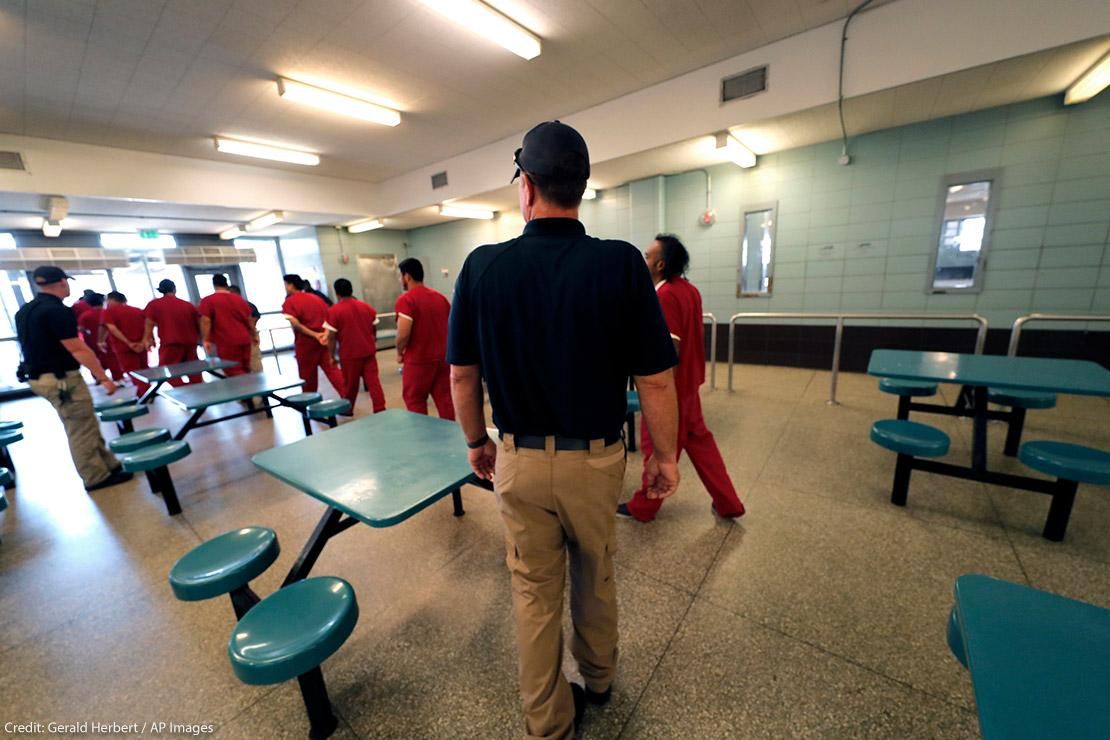
An ACLU analysis found that ICE's inspection system remains ineffective at identifying violations by detention facilities and ensuring compliance with detention standards. (Photo: Gerald Herbert/AP Images)

EUNICE CHO, PATRICK TAUREL, ADITI SHAH
November 14, 2021 by Speak Freely / ACLU

Every day, ICE locks up over 20,000 people in a sprawling nationwide network of more than 200 detention facilities. The ACLU believes that this system of mass incarceration of immigrants should be dismantled—it's unnecessary and inhumane. For as long as ICE maintains its detention network, though, it has a responsibility to create an oversight system that is actually effective at detecting, addressing, and deterring abuse of detained people. Our analysis of recent ICE inspection documents shows that ICE's inspection system remains ineffective at identifying violations by detention facilities and ensuring compliance with detention standards, allowing facilities with clear records of poor conditions, including some of the deadliest facilities, such as the Stewart Detention Facility in Georgia, to evade accountability.

Even facilities that are deficient in 30 or more components receive a rating of "meets standards."

Virtually all detention facilities are required to adhere to detention standards that establish consistent conditions of confinement and ensure minimum standards of care for people who are detained by ICE. ICE currently monitors compliance with these standards primarily through external audits performed by a private contractor called the Nakamoto Group. Nakamoto's fitness to serve as ICE's auditor has been called into question by multiple oversight bodies. In 2018, the Department of Homeland Security Office of Inspector General (OIG) found that Nakamoto's "inspection practices are not consistently thorough."

ICE employees in the field and managers at headquarters told OIG that Nakamoto inspectors "breeze by the [detention] standards" and do not "have enough time to see if the [facility] is actually implementing the policies." They also described Nakamoto inspections as being "very, very, very difficult to fail." One ICE official suggested these inspections are "useless." The House Homeland Security Committee issued a similarly scathing critique of Nakamoto. In September 2020, the committee's majority staff reported that Nakamoto "has demonstrated a lack of credibility and competence."

We reviewed every inspection report that Nakamoto issued in 2021 and found that little has changed. The same problems identified by OIG and the House Homeland Security Committee continue to plague Nakamoto's inspections.

First, virtually no facility fails their inspections. Even facilities that are deficient in 30 or more components receive a rating of "meets standards." Moreover, we found that inspections fail to account for clear indications of poor conditions. For example, Nakamoto's inspection of the Stewart Detention Center in Georgia found that the facility "meets standards," identified only one deficient component in the standard of "Correspondence and Other Mail," and stated that "there were no areas of concern or significant observation." Yet more detained people have died at Stewart than any other ICE facility in the last four years; since May 2017, eight people have died in custody at Stewart. Felipe Montes, a 57-year-old man from Mexico, died there only a few weeks before Nakamoto's inspection. Yet Nakamoto's inspection failed to note any concerns about the provision of medical or mental health care or COVID-19 protocols at the facility.

Second, Nakamoto continues to conduct only pre-announced inspections, often remotely or partially remotely, making a meaningful audit all but impossible. Pre-announced inspections permit facilities to temporarily cure or mask deficiencies to pass inspection. (This is on ICE though, because they are the ones that put this requirement into Nakamoto's contract.)

Third, Nakamoto's detainee interviews remain flawed, often occurring in nonconfidential settings where detainees will feel less free to speak their mind about detention conditions. We also found that detainee complaints are rarely taken seriously.

A meaningful inspection and monitoring system requires rigorous inspections of facilities and a commitment from the agency to impose sanctions.

Finally, Nakamoto inspectors appear to continue to trust, rather than verify, the representations of jailers and ICE officers. For example, at the Prairieland Detention Center in Texas, one detainee housed in the Special Management Unit (SMU), which is how ICE refers to segregation or solitary confinement, "stated he had not seen an ICE officer while housed in the SMU." Nakamoto accepted the facility's documentation that "ICE officers routinely visit the SMU," even though "[d]ocumentation that an ICE officer had visited this particular detainee was not available."

These and other examples make clear that Nakamoto's inspections lack integrity. As appropriators in Congress have indicated, it's past time for DHS to terminate its contract with Nakamoto.

ICE's detention oversight problem is ultimately bigger than Nakamoto. ICE must ensure that it holds facilities accountable for violating ICE's own standards. A meaningful inspection and monitoring system requires rigorous inspections of facilities and a commitment from the agency to impose sanctions, including contract termination, for facilities that do not pass inspection. And the public deserves transparency. We need to know which standards detention facilities are failing to comply with, and what consequences, if any, ICE imposes on them.

Effective oversight and transparency, though, are not enough. When the Immigration and Naturalization Service—ICE's precursor agency—first rolled out its detention standards, the then-head of the agency told the New York Times that the goal was to "provide safe, secure, and humane conditions of detention." That goal is based on the flawed premise that detention can be safe and humane. It cannot. ICE's record of abuse, neglect, and death proves that point. Ultimately, ICE must shut down its mass immigration detention machine.

© 2021 ACLU


Eunice Cho is Senior Staff Attorney at the American Civil Liberties Union.

Patrick Taurel is a senior staff attorney at the ACLU's National Prison Project.


Aditi Shah is the Borchard Fellow in the ACLU's National Prison Project, where she litigates cases challenging unlawful immigration detention conditions and pursues strategic litigation and advocacy to increase access to counsel at immigration detention facilities, with a focus on addressing the needs of older adults in detention. Aditi holds a B.A. in history and health: science, society, and policy from Brandeis University and a J.D. from Harvard Law School, where she was a student attorney at the Harvard Immigration and Refugee Clinic and a research assistant to Professor William B. Rubenstein. Following graduation, she clerked for the Hon. Richard C. Wesley of the U.S. Court of Appeals for the Second Circuit.
Rights Group Says Israel Uses Settler Violence Against Palestinians to Take Over West Bank Land

"Settler violence is a form of government policy, permitted and aided by official state authorities with their active participation," according to a report from the Israeli group B'Tselem.


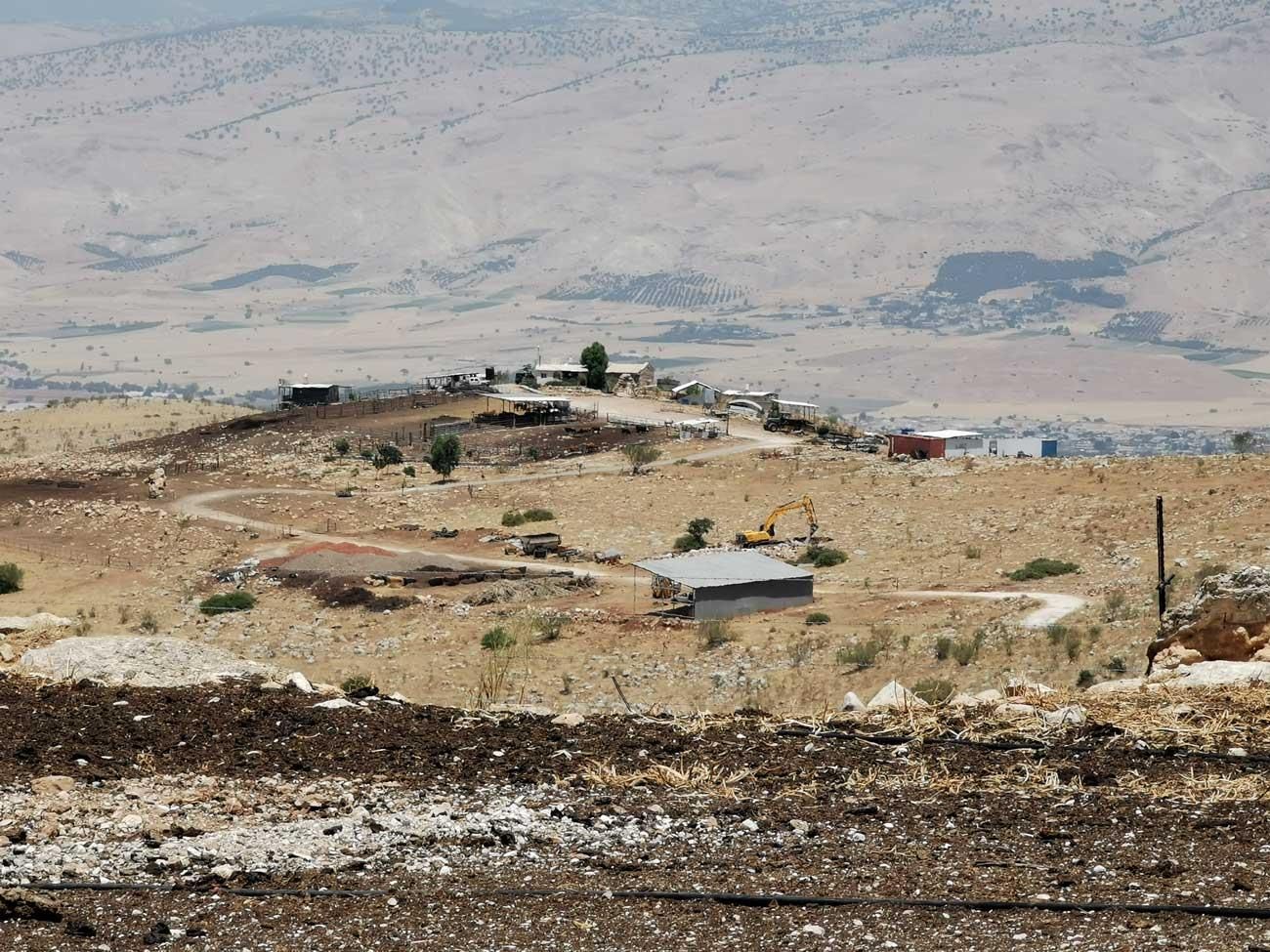
The Um Zuqa farm is one of six "farms" set up by settlers in the northern Jordan Valley in the past five years. It was built in 2016 on a site that housed the Palestinian village of Khirbet al-Mzoqah, which Israel demolished after occupying the West Bank. (Photo: Eyal Hareuveni, B'Tselem)


JESSICA CORBETT
November 14, 2021

The Jerusalem-based rights group B'Tselem released a report Sunday that accuses Israel's "​​apartheid regime" of using settler-colonist violence to take control of Palestinian farmland and pastureland, focusing on nearly 11 square miles in the illegally occupied West Bank.

"The settlers are not defying the state; they are doing its bidding."

"Settler violence against Palestinians serves as a major informal tool at the hands of the state to take over more and more West Bank land," says the report. "The state fully supports and assists these acts of violence, and its agents sometimes participate in them directly."

B'Tselem released its report—entitled State Business: Israel's misappropriation of land in the West Bank through settler violence—amid a recent rise in anti-Palestinian attacks enabled by what Haaretz called a "hands-off" approach of the Israel Defense Forces (IDF).

During the first half of 2021, there were at least 416 anti-Palestinian incidents in the West Bank, more than double the figure for the same period the previous year, and more than all of the 363 known incidents from 2019, the Israeli newspaper reported last month.

The new B'Tselem report says that "state violence—official and otherwise—is part and parcel of Israel's apartheid regime, which aims to create a Jewish-only space between the Jordan River and the Mediterranean Sea."

Israel, which has illegally occupied the West Bank since 1967, "treats land as a resource designed to serve the Jewish public, and accordingly uses it almost exclusively to develop and expand existing Jewish residential communities and to build new ones," the report continues. "At the same time, the regime fragments Palestinian space, dispossesses Palestinians of their land, and relegates them to living in small, over-populated enclaves."

State Business specifically details how Israel "has misappropriated land from Palestinian shepherding and farming communities in the West Bank through systemic, ongoing violence perpetrated by settlers living near them, with the full support of state authorities." B'Tselem collected testimonies from several Palestinians and, in its report, presents five case studies.


Muhammad 'Abiyat, a 63-year-old resident of Um Safa and father of 10, told B'Tselem that "over the last two years, settlers have showed up and chased me whenever I've tried to reach my olive groves. We haven't harvested the olives and have lost two years of income."

In August 2019, settlers from the Zvi Bar Yosef farm "attacked me and ran after me, throwing stones," he said. In October 2020, "again they threw stones at me, chased me with sticks, and threatened me with firearms."

Nisrin Harini, a 37-year-old mother of seven, told the group how the establishment of the Havat Ma'on outpost "changed our lives completely," describing a "life full of fear and daily anxiety" that she called "hell."

"Over the last year, the settler attacks have intensified. A year ago, settlers attacked our sheep and ran over my brother-in-law's son, Hussein al-Harini, with an ATV. They broke his leg," Harini said. "Settlers watch our every move. It's become a routine. They attack the sheep and the shepherds, and call the military. Then the soldiers come and chase after the shepherds, and sometimes even arrest them."

"The military does not confront violent settlers. It does not prevent the attacks, and in some cases, soldiers even participate in them."

B'Tselem spokesperson Dror Sadot told The Times of Israel that the group did not contact Israeli security forces about its findings because "we understood they do nothing about our accusations." The newspaper noted that the IDF did not respond to a request for comment about the report.

In the report, B'Tselem takes direct aim at both the Israeli government and IDF, saying that settler attacks on Palestinians "are not perpetrated by 'bands of outlaws' or 'bad seeds,' nor are they simply 'violent outbursts' or 'unusual incidents."

Instead, such attacks "are a strategy employed by the Israeli apartheid regime, which seeks to advance and complete its misappropriation of more and more Palestinian land," State Business says. "As such, settler violence is a form of government policy, permitted and aided by official state authorities with their active participation."

The Israeli state, the report explains, not only "allows settlers to live, farm, and graze livestock on land from which Palestinians have been violently ejected, and to that end pays for security, paves roads, provides infrastructure, and supports financial enterprises in these outposts through various government ministries," it also "gives settlers free rein to commit violent acts against Palestinians."

"The military does not confront violent settlers," according to the report. "It does not prevent the attacks, and in some cases, soldiers even participate in them. The Israeli law enforcement system does not take action against settlers who harm Palestinians after the fact and whitewashes the few cases it is called upon to address."


Reporting on B'Tselem's findings, the Associated Press pointed out that "last month, Israeli Defense Minister Benny Gantz called on the military to combat rising settler attacks against Palestinians and Israeli troops in the West Bank to react 'systematically, aggressively, and uncompromisingly' to such behavior."

The rights group's report says that "the combination of state violence and nominally unofficial violence allows Israel to have it both ways: maintain plausible deniability and blame the violence on settlers rather than on the military, the courts or the Civil Administration while advancing Palestinian dispossession."

"The facts, however, blow plausible deniability out of the water: When the violence occurs with permission and assistance from the Israeli authorities and under its auspices, it is state violence," the report adds. "The settlers are not defying the state; they are doing its bidding."
Our work is licensed under Creative Commons (CC BY-NC-ND 3.0). Feel free to republish and share widely.
OH THE IRONY
'All faiths deserve respect': Group rallies on Parliament Hill to support Bangladeshi minorities HINDUS

"The situation of minorities in Bangladesh is less well known … We want to create awareness about it."

Author of the article:Matthew Lapierre
Publishing date:Nov 13, 2021 • 

A group gathered on Parliament Hill on Saturday for a solidarity walk to draw attention to the situation facing minorities in Bangladesh. 
PHOTO BY ASHLEY FRASER /Postmedia

Dozens of people marched on Parliament Hill on Saturday to decry increasing communal violence in Bangladesh.

The group of more than 60 people carried signs, some English, some French, some Bengali, that read “save Bangladeshi minorities,” “Protect Hindu Temples,” and “Stop Religious Extremism.”

“All faiths deserve respect,” said Ria Paul-Chowdhury, whose aunt and cousins live in Bangladesh. Her relatives are Hindu, a minority in the predominantly Muslim country. In recent weeks, Hindus have been the target of a rising wave of violence.

“I’m really scared,” Paul-Chowdhury said. “I’m anxious for them. My aunt has been telling me that she’s scared to go out when the sun sets because they’re scared for their own safety.”

Ria Paul-Chowdhury, middle, has an aunt and cousins who live in Bangladesh. Her relatives are Hindu. PHOTO BY ASHLEY FRASER /Postmedia

The recent violence began in October, during a large Hindu religious festival called Durga Puja, when allegations spread on social media that a Quran, the Muslim holy book, was disrespected inside a Hindu temple. Local media reported that groups of Muslims attacked Hindu temples.

The government reacted with a paramilitary response and the police clashed with mobs in several cities. The clashes left at least seven people dead and more than 100 wounded, according to reports in The Washington Post and The New York Times.

But the roots of the conflict go back much further, according to Hasan Mahmud Tipu, a researcher who has studied the situation in Bangladesh and who attended Saturday’s march in Ottawa. He said the conflict had its roots in the 1980s, when a military government took power in Bangladesh and changed the country’s secular constitution, establishing Islam as the state religion

.
Hasan Mahmud Tipu, a researcher who attended Saturday’s march in Ottawa says the conflict in Bangladesh has its roots in the 1980s, when a military government took power and changed the country’s secular constitution, establishing Islam as the state religion. PHOTO BY ASHLEY FRASER /Postmedia

“Religion in the constitution — the state religion being Islam — is implying power to the majority,” Mahmud Tipu said. He attended the demonstration even though his family in Bangladesh are Muslim and are largely unaffected by the violence. “Everyone has the same rights,” he said. “There should not be any discrimination regarding religion, regarding customs, regarding anything.”

There are nearly 13 million Hindus in Bangladesh, a country with a total population of more than 164 million people. They make up approximately eight per cent of the population, but that number used to be higher.

“Over the years, it has gone down,” Paul-Chowdhury said. “Almost 200,000 Hindus migrate out of Bangladesh every year because of unsettlement or because of being too scared to stay.”

Saturday’s demonstration in Ottawa followed others in cities across Canada, including Toronto, Calgary, and Winnipeg. The purpose of these marches, according to a man named Subrata, who came to Parliament Hill, but preferred to only be identified by his first name because he feared professional reprisals for speaking out on a sensitive topic, was to raise awareness about the situation in Bangladesh.

“If you think of the condition of minorities, you see a lot of coverage of minorities in many places,” he said. “The situation of minorities in Bangladesh is less well known … We want to create awareness about it.”

A group gathered on Parliament Hill on Saturday for a solidarity walk to draw attention to the situation facing minorities in Bangladesh. PHOTO BY ASHLEY FRASER /Postmedia

It was not only Hindus who needed support in Bangladesh, Subrata said. The signs he and his fellow demonstrators carried highlighted how Buddhists and other minorities, including some smaller Muslim sects, had long faced discrimination and violence.

“It’s a question of making an alliance of secularists everywhere and standing up for the minorities,” he said. “The most important thing is that 20 million people (Bangladeshi minorities) will feel at home. They won’t feel like second-class citizens in their own homeland.”


The support of the global community could go a long way towards helping Hindus and other minorities inside Bangladesh, according to Sanjay Dash, a demonstrator who also has family in Bangladesh.

“Canada has a big partnership with Bangladesh,” he said. “We want Canada to be vocal about this. Then they can demand justice and security for these minorities.”

IN HINDU DOMINATED INDIA MUSLIMS AND OTHER RELIGIOUS MINORITIES ARE PERSECUTED FOR THAT SAME REASON INDIA EXPROPRIATED MUSLIM KASHMIR AND PASSED AN ANTI MUSLIM RELIGIOUS MINORITIES LAW


As Climate Emergency Worsens, Freak Storm Sends Snow, Scorpion Plague on Egypt's Aswan

Egyptian climate scientists have no doubt that the Aswan storm was a manifestation of human-driven climate change, and they say that the old Egypt people grew up with is being altered.


In November 2021, high winds blew the deadly Egyptian black, fat-tailed scorpions from the surrounding desert into the city of Aswan. The scorpions killed three persons with their venom and left hundreds sickened. (Photo: Speedphi/Wikimedia Commons/cc)


JUAN COLE
November 14, 2021
 by Informed Comment

How freakish and biblical our climate emergency could become was illustrated this week in the Upper Egyptian city of Aswan, which was struck in November by rolling lightning storms, downpours, snow, and a plague of scorpions. High winds blew the deadly Egyptian black, fat-tailed scorpions from the surrounding desert into the city and into people’s homes. The scorpions killed three persons with their venom and left hundreds sickened, as Egyptian rescue crews tried to distribute the antidote.


Egypt is going to be one of the countries worst hit by the freakish changes in climate we are causing.

The Egyptian fat-tailed or black scorpion is one of the deadliest of its species.

Snow and scorpions and downpours. In November. In Upper Egypt.

The average high in November in Egypt is 86°F. with an average low of 61°F. Not really what you would call snow weather. The average rainfall in November in Aswan is 0.0 millimeters. That is, none, zero, zilch, nada.

I lived in Egypt for about four years of my life in total. I was rained on very briefly about three times. The ancient Greek historian Herodotus called Egypt the "gift of the Nile" for this reason. It is just a big desert and only the Nile River running through it from southeastern African down to the Mediterranean allows the country to have its present population of over 100 million (equal to 2.5 Californias).

Egypt is going to be one of the countries worst hit by the freakish changes in climate we are causing by heating and providing electricity to our homes with coal and by driving gasoline-powered automobiles. Egypt has been becoming hotter and drier on average, but also more vulnerable to abrupt downpours that cause flash flooding. You really wouldn't want Upper Egypt to be hotter than it is in the summer, when it already reaches 120°F. And as noted above, you wouldn't want it to be drier. Scientific projections show that Egypt will in fact become hotter and drier while at the same time suffering more severe, if brief, storms with the capacity to cause flash floods.

Egyptian climate scientists have no doubt that the Aswan storm was a manifestation of human-driven climate change, and they say that the old Egypt people grew up with is being altered.

Aswan has seen freak storms before, as in January 2010, when according to Egyptian scientists: "A severe hurricane thrashed the province of Aswan on the evening of 17th January, 2010, and was followed by half an hour of a continuous torrential downpour. The storm resulted in bringing down 50 high voltage electricity pylons, cutting power to Aswan province. After that, rains which had accumulated in the mountains turned into a torrent and swept away houses and people, leaving behind hundreds of destroyed properties."

This sort of thing is rare but perhaps becoming more common. They add that the "deluge was accompanied by dust storms, thunderstorm, cyclonic rain, and frequent floods in the years 1980, 1987, 2005, and 2010."

The Encyclopedia Britannica observes that Aswan
faces the island of Elephantine (modern Jazīrat Aswān), on which stand the ruins of the ancient city of Yeb. Aswān was the southern frontier of pharaonic Egypt. Its local quarries supplied granite for many ancient Egyptian monuments and are still operated. On the Nile's eastern bank was the site of the ancient city of Swen (ancient Egyptian: "the Mart"), whence came the Greek Syene and the Arabic Aswān. Aswān later served as a frontier garrison post for the Romans, the Turks, and the British.

The city's current population is about 1.5 million, i.e., about the size of Philadelphia inside city limits.

This tragedy underlines the ways in which climate change-driven superstorms and other severe weather drive wild creatures into human spaces, where they can spread exotic viruses or simply attack.

© 2021 Juan Cole


Juan Cole teaches Middle Eastern and South Asian history at the University of Michigan. His newest book, "Muhammad: Prophet of Peace Amid the Clash of Empires" was published in 2020. He is also the author of "The New Arabs: How the Millennial Generation Is Changing the Middle East" (2015) and "Napoleon's Egypt: Invading the Middle East" (2008). He has appeared widely on television, radio, and on op-ed pages as a commentator on Middle East affairs, and has a regular column at Salon.com. He has written, edited, or translated 14 books and has authored 60 journal articles.

Completion of Khmelnitsky 3 'begins' in Ukraine

09 November 2021


Work has already started to complete Ukraine's Khmelnitsky 3 using AP1000 technology. Engineers from Westinghouse are at the site, taking stock and considering how to complete the unique project, according to plant owner Energoatom.

Energoatom head Petro Kotin (centre) leads the inspection of Khmelnitsky 3 (Image: Energoatom)

"The purpose of the visit is a detailed inspection of the third power unit of the station to determine the possibilities and measures for its further completion," said Energoatom. The engineering mission was headed by Westinghouse's First Vice President of Commercial Activities Elias Gideon and vice president of the company for construction of new nuclear power plant Joel Iker.

"We have done a lot of work to prepare the documentation, now two teams of our engineers from the US and Europe have arrived, who will work hard with Energoatom next week, explore the site and exchange the necessary information," said Gideon.

Westinghouse inspected the site on 7 November and will "conduct a gap analysis" that leads to suggestions on ways to successfully implement the construction.

Khmelnitsky 3 was originally intended to be a VVER-1000 but construction stalled in 1990 at around 75% completion. The foundation and much of the containment structure are present, as is some heavy equipment in storage on site. At the same time, Energoatom and Westinghouse have an opportunity to use AP1000 components and modules intended for the cancelled Summer project in the USA and kept in storage there.

On 8 November, a meeting between the two companies heard their preliminary conclusions and assessment of the site. "Today we begin practical work on the construction of new nuclear facilities," said Energoatom head Petro Kotin.

Ukraine has wanted to complete Khmelnitsky units 3 and 4 for many years. Kotin noted that procedures under the Espoo Convention have already been completed, there has been a positive conclusion by the Ministry of Environment, and "a bill on completion of Khmelnitsky 3 and 4 has been submitted to the government, and we expect its approval and submission to the Verkhovna Rada (parliament) of Ukraine in the near future."

Gideon said, "In parallel, we are working with financial institutions to finance the project, in particular with the US EXIM Bank. We hope to sign a number of agreements in the near future."

Researched and written by World Nuclear News

CHINA EXPORTS NUKE TECH INSTEAD OF COAL

Hot functional tests completed at Karachi 3

11 November 2021


Hot functional testing of Karachi 3 in Pakistan was completed ahead of schedule on 4 November, China National Nuclear Corporation (CNNC) announced today. This means the second overseas Hualong One unit has entered the "fuel loading stage", the company said.

The Karachi site (Image: CNNC)

Hot functional tests simulate the temperatures and pressures that the reactor systems will be subjected to during normal operation and are carried out before loading nuclear fuel. They involve increasing the temperature of the reactor coolant system and carrying out comprehensive tests to ensure that coolant circuits and safety systems are operating as they should. China Zhongyuan Engineering Corporation - CNNC's general contractor for Karachi 2 and 3 - previously announced that the tests at Karachi 3 began on 13 September.

Like Karachi 2, which entered commercial operation in May, Karachi 3 is a 1100 MW Hualong One unit supplied by CNNC. The two units are the first exports of the Hualong One, which is also promoted on the international market as HPR1000. The first example of the Hualong One - Fuqing 5 in China's Fujian province - was commissioned at the beginning of this year. Eight nuclear power units using Hualong One technology are under construction or in operation at home and abroad, CNNC said.

The construction of the Karachi units has boosted the development of Pakistan's economy by providing over 10,000 direct jobs for Pakistan citizens, and a further 40,000 indirect jobs through the value chain, it added.

Researched and written by World Nuclear News

Fuel loading under way at Fuqing 6

08 November 2021


The process of loading the 177 fuel assemblies into the core of unit 6 at the Fuqing nuclear power plant began on 6 November, China National Nuclear Corporation (CNNC) announced. The unit - the second of two demonstration Hualong One reactors at the site in China's Fujian province - is scheduled to begin operations by the end of this year.

Fuel loading operations at Fuqing 6 (Image: CNNC)
"The first fuel loading has officially started, marking the unit has entered the nuclear commissioning stage of the main system, and has taken an important step towards completion and commissioning," CNNC said today.

China's State Council gave final approval for construction of Fuqing units 5 and 6 in April 2015. The pouring of first concrete for Fuqing 5 began in May 2015, marking the official start of construction of the unit. Construction of unit 6 began in December the same year. Unit 5 was connected to the grid on 27 November last year, having achieved first criticality on 21 October, and entered commercial operation on 30 January this year.

Construction of two demonstration Hualong One (HPR1000) units is also under way at China General Nuclear's Fangchenggang plant in the Guangxi Autonomous Region. Those units are expected to start up in 2022. CNNC has also started construction of two Hualong One units at the Zhangzhou plant in Fujian province, plus the first of two units at Taipingling in Guangdong.

Two HPR1000 units are under construction at Pakistan's Karachi nuclear power plant. Construction began on Karachi unit 2 in 2015 and unit 3 in 2016; the units are planned to enter commercial operation in this year and next, respectively. Karachi 2 was connected to the grid in March after the completion of commissioning tests.

"At present, two Hualong One units have been put into commercial operation, and a total of eight nuclear power units using China National Nuclear Corporation's Hualong One technology are under construction and operation at home and abroad," CNNC said.

Researched and written by World Nuclear News

Deforestation Harms Vulnerable Communities

Temperature rise driven by climate breakdown and deforestation increasing heat-related deaths in rural communities in Indonesia.


An illegal Amazon logging operation on land belonging to the Pirititi Indigenous people in Roraima state, Brazil, seen in an aerial photograph taken on May 8, 2018.
 (Photo: Felipe Werneck/flickr/cc)

CATHERINE EARLY
November 13, 2021 by The Ecologist

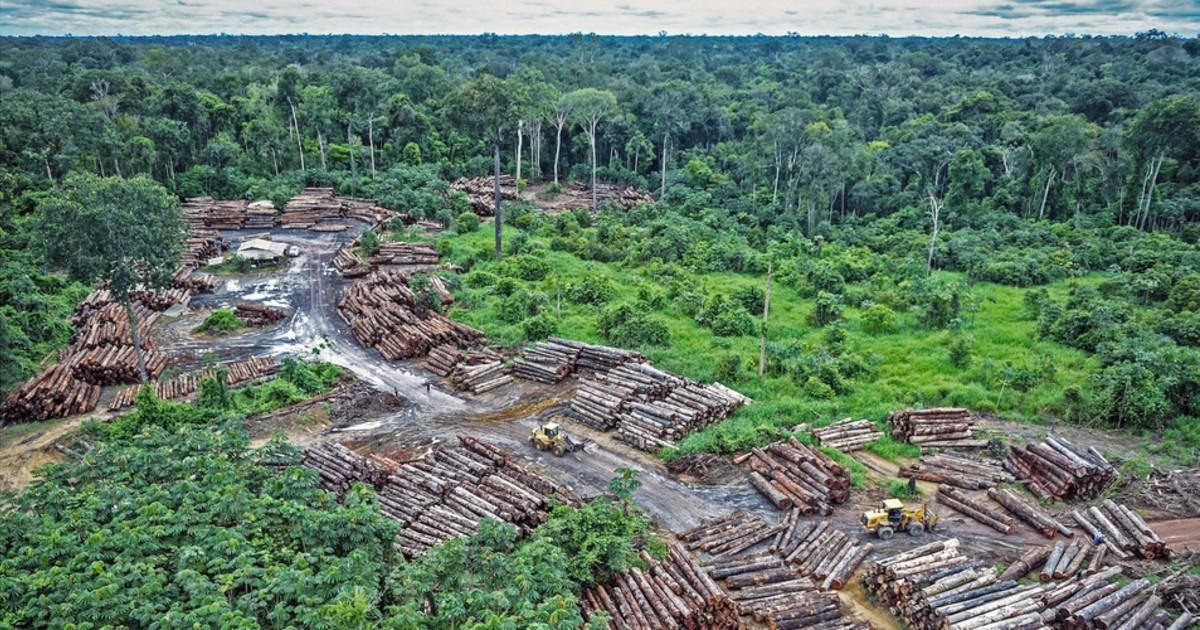
Heat-related deaths in a vulnerable community in Indonesia have been linked directly to nearby deforestation by new research published in The Lancet.

The research by US-based The Nature Conservancy (TNC) and scientists from the University of Washington and Indonesia’s Mulawaran University focused on the Berau region of East Kalimantan in Indonesia, where 4375 km² of forested land was cleared between 2002 and 2018, the equivalent of 17 percent of the whole area.

The researchers used data from satellite monitoring of forest cover, temperature, and population, alongside intelligence from The Lancet’s Global Burden of Disease reports to estimate the impacts of deforestation and climate change on deaths due to heat exposure, and the effects of deforestation and climate change on unsafe work conditions.

Labourers


Local deforestation, combined with climate change, had already caused mean daily maximum temperatures to increase by 0.95°C, they found, which in turn had led to an eight percent increase in mortality between 2002 and 2018.

Researchers projected that the region could ultimately experience an estimated 17-20 percent increase in deaths, and up to five hours a day where temperatures are unsafe to work in by 2100, compared with 2018, if temperatures rise by 3°C compared with pre-industrial levels.

A 2019 study in the same region found that outdoor labourers worked, on average, 6.5 hours a day, and are already shifting work schedules to avoid the hottest times of the day.

Vulnerable

The study is significant because it is believed to be one of the first-ever studies to reveal how temperature rises driven by climate change and local deforestation are already increasing heat-related deaths among rural communities in a tropical country.

A growing body of research indicates that in tropical countries, both climate change and deforestation are increasing temperatures and heat exposure, but the combined risks of these changes have so far been underappreciated, according to the study.

The wider implications for human health and livelihoods are worrying and definitely justify further research to find solutions.
For example, forest clearing in tropical countries can cause immediate increases in local temperatures of up to 8°C and exacerbate daytime temperature variation. Studies have also shown that the amount of warming increases when deforested patches are greater than 100 km², and that the effects of warming can extend up to 50km beyond deforested sites.

Worrying

However, little is known about how warming associated with deforestation affects human health at geographical scales of more than 10,000 km²), or how these risks are likely to change in the future.

Deforestation is driven largely by outdoor labour-intensive industries, such as mining, farming, and palm oil production, leaving many people in the area with no choice but to work outdoors.

The temperature rise experienced in just 16 years in Berau was equivalent to that seen in the wider world in 150, lead author Dr Nicholas Wolff of The Nature Conservancy pointed out.

“The wider implications for human health and livelihoods are worrying and definitely justify further research to find solutions,” he said.
© 2021 The Ecologist


CATHERINE EARLY  is chief reporter for The Ecologist and a freelance environmental journalist. She tweets at @Cat_Early76
Litigation from fossil fuel companies threatens climate action

BY FRENCH PRESS AGENCY - AFP GLASGOW, SCOTLAND ENERGY
NOV 12, 2021

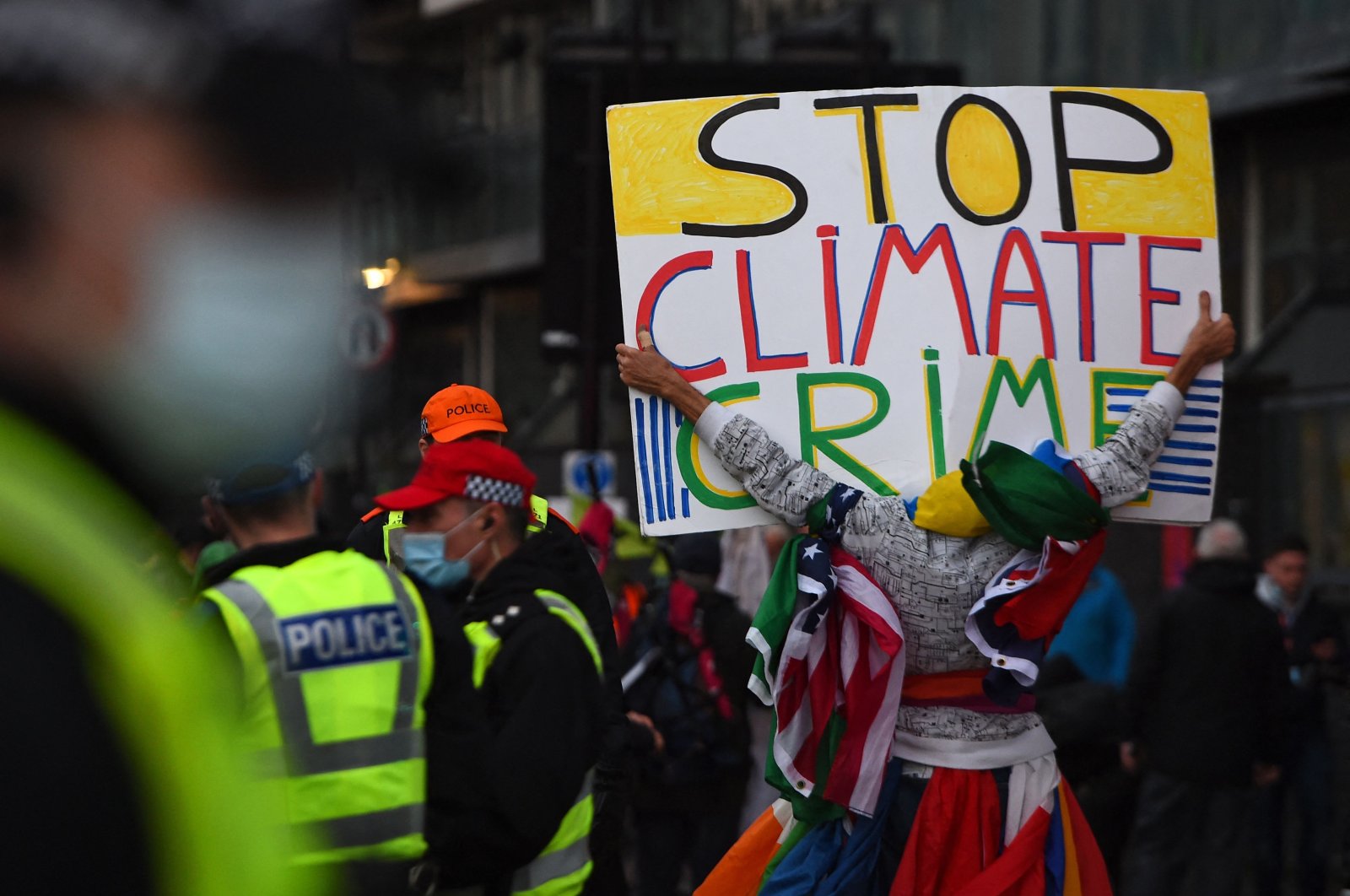
A protester holds a placard displaying a "Stop Climate Crime" slogan during a climate change demonstration outside of the COP26 Climate Change Conference in Glasgow, Scotland on Nov. 12, 2021. (AFP)


RECOMMENDED

Syria, UAE sign deal for construction of solar power plant

Governments seeking to cut emissions could face trillion-dollar lawsuits from fossil fuel companies looking to regain stranded assets or lost revenue, a hidden cost of climate action that threatens to "make a mockery" of commitments made at the recent COP26 summit.

Energy experts predict that more ambitious climate action from world leaders will significantly increase companies' use of a tribunal mechanism that has already awarded billions to heavy industry.

Trade agreements such as the Energy Charter Treaty and NAFTA contain investor arbitration clauses, known as investor-state dispute settlement (ISDS), that allow foreign companies to sue governments over actions they say hit profits or investments.

Campaigners say that energy companies are increasingly turning to this type of arbitration to recoup investments as governments accelerate the shift away from fossil fuels.

Jean Blaylock, trade campaigner at Global Justice Now, tells Agence France-Presse (AFP) these corporate courts – "the global trade system's dirty little secret" – could "make a mockery" of commitments generated at the COP26 summit.

"We're seeing the fossil fuel sector use investor-state dispute settlement to hold climate action to ransom," she says.

"These companies have made unfathomable profits from fueling the climate crisis, we cannot let them demand even bigger pay-outs."

AFP has obtained excerpts from a presentation given at a September trade event by consultancy firm Berkeley Research Group (BRG), which predicted that climate legislation would lead to a rise in private lawsuits.

"Increased climate policy ambition (e.g. CAT Ratings) will drive the policies behind climate-related disputes," said an excerpt.

CAT refers to Climate Action Tracker, which ranks national emissions plans on their compatibility with the Paris climate deal.

The presentation suggested that the "scale of energy transition policy" could "unleash a wave of international investment and/or commercial arbitration to adjudicate claims."

Responding to a request to comment, Christopher Goncalves, chair of BRG's Energy and Climate practice, told AFP that dispute resolution was "likely to remain a critical component of the energy transition process."

"It is not possible to make any generic conclusion as to whether such legal disputes accelerate or impede the energy transition," he added.
History of awards

The BRG presentation said if governments legislate to limit heating to 2C by 2050, $3.3-6.5 trillion in upstream fossil fuel assets would be at risk, as well as $650-700 billion in coal power assets and $900 billion in oil reserve write-offs in a 1.5C scenario.

Blaylock said $9 trillion in upstream fossil fuel and oil reserve write-offs are at risk of litigation – a little over a tenth of the global economy.

Energy and mining firms have a long history in winning large settlements. In 2006, Occidental Energy sued the government of Ecuador for terminating an oil contract. It was awarded $1.77 billion, which was later reduced to $1bn.

In 2012 Tethyan Copper sued the government of Pakistan over a gold mine, and in 2019 was awarded $5.9 billion – roughly 2% of the country's GDP.

ISDS decisions are internationally binding and courts have in the past ordered the seizure of state assets when countries have refused to pay.

Five current cases, brought by energy firms identified by Global Justice Now, are seeking $18 billion from governments.

These include a dispute involving the cancellation of the Keystone Pipeline in North America, where the complainant, TC Energy, is seeking a reported $15 billion in lost revenue.

A TC Energy spokesperson told AFP that it would "not comment on speculative claims."

German energy firm Uniper is one of two companies reportedly seeking more than $1 billion from the Netherlands after it decided to phase out coal.

A Uniper spokesperson did not comment on the amount in question but said government policy had cut 15 years off the lifespan of its MPP3 power plant near Rotterdam, "however understandable that change in itself may be."
'Ordinary people will pay'

British company Rockhopper is suing Italy for a reported $324 million over a ban on offshore oil drilling close to the country's coast. Italy signed the Energy Charter Treaty (ECT) but then withdrew in 2016.

Companies can resort to ISDS for 20 years after a country leaves the ECT.

A spokesperson for Rockhopper rejected the idea that the suit was linked to climate change.

"The Italian government issued licenses and encouraged significant investment in oil and gas exploration, based on this platform. Clearly it is not equitable to change the rules halfway through," she told AFP.

Most of the governments wrapping up COP26 plan to slash their emissions to net-zero by 2050.

That will cost the global economy as much as $100 trillion, according to International Energy Agency estimates.

Nations are also pledging billions to help countries adapt to climate-driven extreme weather and crop failures.

Campaigners say that litigation represents a looming, hidden cost of climate action.

"The science is clear. The vast majority of fossil fuels must stay in the ground to avoid catastrophic global heating," Leah Sullivan, trade campaigner at the War on Want pressure group, told AFP.

Since ISDS awards are taken from public money, "It's ordinary people who will have to pay for this," she said.
Auto industry’s challenges hold up net-zero progress despite growing EV sales

Bloomberg News 

Stock image.

Picture James Bond strapped to a doomsday device while a countdown clock ticks toward zero. That’s the situation the Earth faces when it comes to climate change, according to U.K. Prime Minister Boris Johnson.


“The tragedy is that this is not a movie and the doomsday device is real,” Johnson said Monday in Glasgow at the 26th COP climate conference, the annual meeting that’s supposed to set out plans to rein in global warming.

The transport sector is a big part of the problem. It accounts for about 10% of global greenhouse gas emissions and will face special scrutiny at COP26 because of how much it pollutes. The European Union in July proposed that member states stop selling combustion cars no later than 2035 as the region tries to cut transport emissions that have climbed by a third since 1990.

The auto industry may well be phasing out the internal combustion engine and EV sales are taking off, but that doesn’t mean the path to zero-emission driving will be easy. There are a few key roadblocks holding up progress that are likely to come up at the conference over the coming days:

Dirty production

Building an EV emits significantly more carbon dioxide than producing combustion models, researchers have found. That’s mainly because EVs are made with a resource-intensive battery and greater amounts of aluminum. Battery metals including lithium, cobalt and nickel are mined in Australia, South America and Africa and then shipped around the world for refining, resulting in massive carbon emissions. Carmakers are acutely aware of the issue’s potential to cause PR problems and have started exploring alternative sourcing methods, but the projects are still in their infancy.

Clean electricity


While EVs are dirtier than regular cars coming out of the factory, they’re supposed to make up for that big time during their driving years because they have no tailpipe emissions. Another factor in this equation, though, is the juice that powers the battery. The problem is that the world still produces electricity mostly from fossil-fired sources, with coal and natural gas accounting for almost 60% of the global power mix in 2020, according to International Energy Agency data. In China, where EV sales are surging, coal — the dirtiest fossil fuel — remains the dominant electricity source by far.

Charger anxiety

Numerous people I know are open to buying an EV but are put off by what they perceive as sub-par charging convenience. A Sky News colleague driving an electric SUV from London to the COP venue in Glasgow struggled with some patchy charging infrastructure along the way. Carmakers and politicians have identified a lack of charging spots as a key hurdle to wider EV adoption. In China, where EV adoption is outpacing infrastructure upgrades, the issues may well fuel buyer’s remorse after drivers there had to queue for hours to recharge their vehicle during last month’s Golden Week holiday. Europe has billions of euros earmarked for more charging spots, but especially in larger cities — where people tend to live in apartment buildings instead of free-standing homes — coming up with convenient charging options will remain a challenge.

Transitioning trucks


While passenger cars are fairly well on their way toward electrification, trucks are still far off from meeting the EU’s net-zero climate target for 2050, according to a new report from Transport & Environment. The Brussels-based NGO says the EU’s CO2 emission standards for trucks, introduced in 2019, should be tightened because they lack the ambition to spur real change. Almost 98% of the roughly 170,000 trucks and vans registered in Europe between July 2019 and June 2020 had a diesel engine, according to the report.

“The European Commission is addressing car emissions with plans to phase out petrol and diesel cars, yet it is still miles away from bringing trucking in line with its Green Deal ambition,” said Lucien Mathieu, acting director for freight at T&E. “With trade rebounding, now is the time to raise the ambition for truck emissions targets.”

(By Stefan Nicola)

Toyota, Yamaha, Mazda, Subaru to develop alternate fuels for combustion engines

FILE PHOTO: A Toyota logo is displayed at the 89th Geneva International Motor Show in Geneva, Switzerland. (REUTERS)

 Updated: 14 Nov 2021, 10:10 AM ISTHT Auto Desk

Toyota currently has plans to develop 15 EV models by 2025 and is investing $13.5 billion over the next decade to expand battery production capacity.
Meanwhile, it is also working on developing vehicles powered by hydrogen.

Toyota Motor Corp has announced that will partner with four other Japanese vehicle makers to explore the feasibility of developing alternative green motor fuels for internal combustion engine such as hydrogen fuel and synthetic fuels derived from biomass.

The companies that Toyota is partnering with include Mazda, Subaru, Yamaha Motor and Kawasaki Heavy Industries.

All the five companies made the announcement of partnership at a race track in Okayama, western Japan.

Toyota is of the belief that though transforming internal combustion engines to green fuels such as hydrogen is technologically difficult, but achieving this goal would allow the companies to support ages-old existing supply chain systems. These include hundreds of thousands of workers who may otherwise have to leave their jobs as the industry switches to producing electric vehicles (EV).


As countries around the world tighten environmental regulations in order to cut down carbon emissions, various automakers including Toyota are working on ramping up the production of EVs. Toyota is also under pressure as the Japan government has said that it aims to be a carbon neutral nation by 2050 and is also promoting the use of hydrogen fuel.

Toyota currently has plans to develop 15 EV models by 2025 and is investing $13.5 billion over the next decade to expand battery production capacity. Meanwhile, it is also working on developing vehicles powered by hydrogen.


Toyota president Akio Toyoda spent the weekend swerving around the racetrack in western Japan in a Toyota Corolla. The version he drove was equipped with in-house hydrogen engine, which propels the vehicle by burning the fuel much like traditional engines use gasoline.

The company also showcased other vehicles running on carbon-neutral propellants in a three-hour road race, along with Mazda. "The enemy is carbon, not internal combustion engines," Toyoda said.


(with inputs from Reuters)


Global carmakers now target $515 billion for EVs, batteries

Reuters | November 10, 2021 

Stock image.

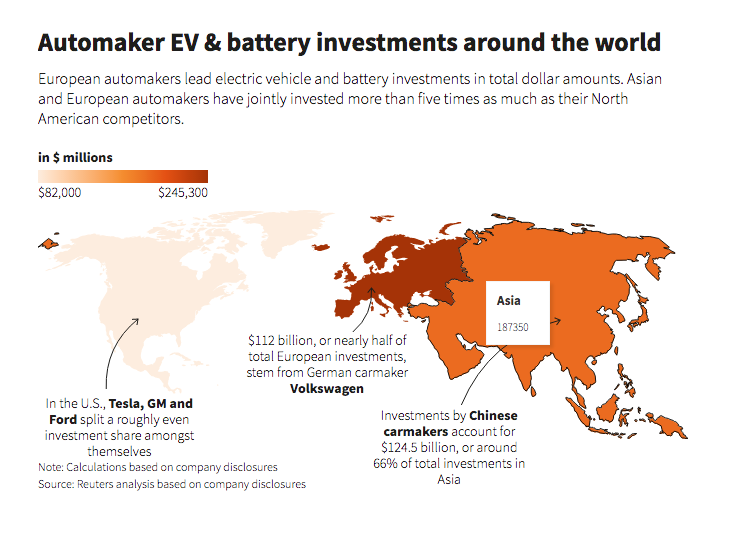
Global automakers are planning to spend more than half a trillion dollars on electric vehicles and batteries through 2030, according to a Reuters analysis, amping up investments aimed at weaning car buyers away from fossil fuels and meeting increasingly tough decarbonization targets.


Less than three years ago, a similar analysis by Reuters found car companies planned to spend $300 billion on EVs and related technologies. But looming zero-carbon mandates in cities such as London and Paris and countries from Norway to China have lent additional urgency to the industry’s EV-related investment commitments.

The most recent analysis shows carmakers planning to spend an estimated $515 billion over the next five to 10 years to develop and build new battery-powered vehicles and shift away from combustion engines.
Source: Reuters

But industry executives and forecasters remain concerned that consumer demand for EVs could fall well short of aggressive targets without substantial additional incentives and even greater spending on charging infrastructure and grid capacity.

Brian Maxim, head of global powertrain forecasting at AutoForecast Solutions, likens the growing investment commitments in vehicle electrification to the Cold War: “Once a few manufacturers announced EV programs, everyone else had to announce their own or be viewed as being left behind.”

However, he added, “this leaves a lot of vehicle manufacturers planning significant volumes for a vehicle category that has unknown consumer acceptance, and will have minimal to no profit” for years.

Reuters compiled the investment data from company statements, investor presentations and regulatory filings.

Other surveys have come up with different spending projections. In June, consulting firm AlixPartners said auto industry investments in electric vehicles would reach $330 billion by 2025. In 2020, all global automakers combined spent nearly $225 billion on capital expenditures and research and development, according to AlixPartners.

Tesla Inc, the world’s largest EV manufacturer, appears to be the one company that is selling virtually every vehicle it can build and is readying new multibillion-dollar “gigafactories” near Berlin and Austin that will significantly boost its annual production capacity. In early November, the company was valued at $1.2 trillion, more than twice the combined value of Volkswagen AG, Toyota Motor Corp, Ford Motor Co and General Motors Co.

Meanwhile, political and regulatory pressure is building on the world’s carmakers to begin phasing out production of fossil-fueled vehicles, including gasoline-electric hybrids, over the next 10-15 years, while ramping up output of full electric models.

A number of countries, from Singapore to Sweden, have said they will ban sales of new combustion engine vehicles by 2030. U.S. President Joseph Biden has said he wants 40% to 50% of sales to be electric vehicles by 2030.

Germany’s VW Group, which is still recovering financially from the 2016 Dieselgate emissions cheating scandal, continues to lead the rest of the industry, with more than $110 billion in EV and battery investment commitments through 2030. Those commitments, which represent more than 20% of the industry total, underpin VW’s aggressive rollout plans for millions of EVs in Europe, China and North America over the next decade.

VW’s investments, like those of many of its rivals, are aimed at improving the range and performance of batteries and lowering the cost of EVs, as well as expanding battery and EV production across the globe, according to public data released by the companies.

VW and fellow German automakers Daimler AG and BMW AG are planning to spend a combined $185 billion through 2030, while U.S. automakers GM and Ford expect to spend nearly $60 billion through 2025.

Chinese automakers, led by VW and GM local partner SAIC Motor, have announced well over $100 billion in investment targets over the next decade. Japanese automakers lag far behind, with Honda Motor, Toyota Motor and Nissan Motor so far publicly committing less than $40 billion combined.

These investments do not include the tens of billions of dollars being invested in additional production capacity by the world’s largest battery companies, many in cooperation with their automaker partners.

(By Paul Lienert and Tina Bellon; Editing by Dan Grebler)

The race to produce higher performing batteries

Bloomberg News | November 9, 2021 

Credit: Solid Power

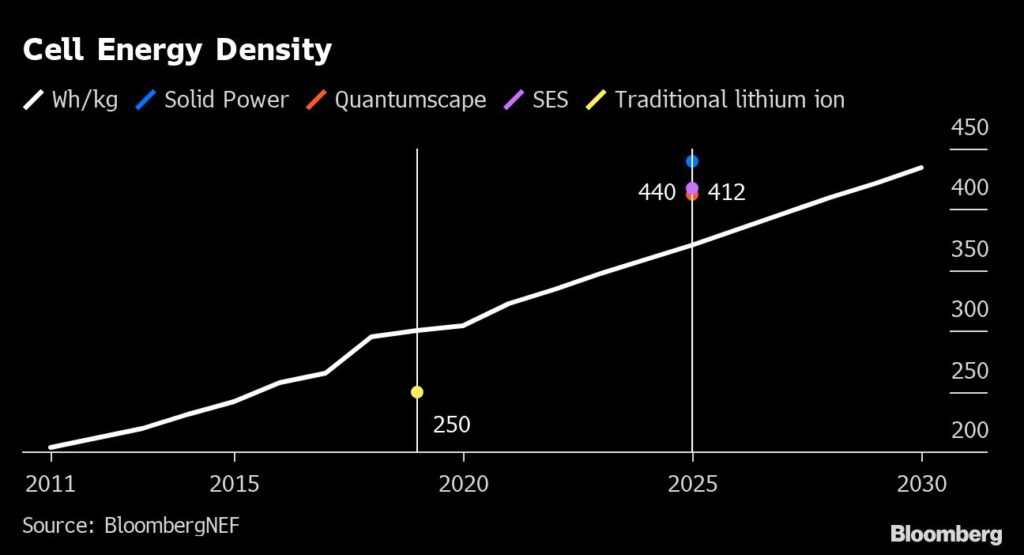
Last week battery startup SES announced it had developed the world’s largest lithium metal cell. The cell itself is still a prototype, but the company expects to be producing them commercially for use in EVs by 2025. Off the back of this announcement, I want to talk about batteries using lithium metal anodes, and the differences between SES and its peers QuantumScape and Solid Power.


Lithium metal anodes are sought after in the battery industry, because they promise to create lightweight cells enabling EVs with longer driving ranges. Not only are companies trying to improve performance, they also are trying to make batteries safer and with a lower price tag. But they are taking different approaches to achieve this, the benefits and drawbacks of which can be understandably difficult to pick apart.

There are three key components in a lithium battery: two electrodes — the anode and the cathode — which are separated by an electrolyte. The batteries in your cell phone or EV today use a graphite for the anode and a liquid electrolyte. These are the components that most startups are working to improve, as they haven’t really changed in 30 years. Cathode development is less of a focus, as these materials have experienced steady but gradual improvements over the last decade.


Taking a step back, SES’s announcement is big news because it’s the first demonstration of a battery that could be used in an EV using a lithium metal anode with a liquid electrolyte. Using a liquid electrolyte with a lithium metal is exciting because it could almost be a ‘drop-in’ process that utilizes existing manufacturing facilities. This could lead to quick scale up and a high market penetration, while also preserving the billions of dollars of investment in current manufacturing plants.

In the past it hasn’t been possible to use lithium metal anodes with liquid electrolytes because it leads to a low-cycle life – the number of times the battery can be charged and discharged – and can cause failures leading to battery fires. SES’s secret sauce is in getting these two critical components to work together. It has achieved this by adding so much salt to its electrolyte that the properties of the liquids change, from flammable to a substance that won’t catch fire. By using a liquid SES creates good contact between all of the layers in the battery – this is essential to having a battery that can perform lots of cycles.


By sticking to a liquid-based electrolyte, SES’ approach differs from its peers Solid Power and QuantumScape. In contrast, Solid Power and QuantumScape have been targeting the use of lithium metal anodes in combination with a solid electrolytes, in place of liquids, to create solid-state batteries. Solid electrolytes have been the main focus of companies developing cells that use lithium metal anodes as it is easier to control the reactions between the two components, and removes the liquid electrolyte as a possible accelerant in the event of a fire.

Solid Power uses an electrolyte material called lithium sulfide, which promises to be relatively easy to integrate with existing manufacturing processes. As its cells only use solid components it is important to make sure all of the layers have good contact to ensure high performance over the lifetime of the system. Before it commercializes batteries with lithium metal anodes, Solid Power is also aiming to develop a cell with a silicon anode. But we’ll leave silicon anodes for a future column.

QuantumScape on the other hand will use a ceramic material for its cells. These will require the company to develop new manufacturing processes and equipment. However, its technology has the advantage of not using lithium metal, which is difficult to handle, during the manufacturing process. Instead, QuantumScape forms its lithium metal anode in-situ in the manufactured cell. It also adds a little gel electrolyte to help maintain contact between the cathode material and the solid electrolyte.

The eventual performance of each company’s cells promises to be fairly similar, all should be safer and with a higher energy density, but the routes to getting there are markedly different. Each company has its own unique set of challenges when it comes to scaling the production of the technology, but nothing that appears insurmountable. From an industry perspective, the more routes we have to achieving high performing cells the better, as it creates more resiliency and makes me confident safer high performance batteries are just around the corner.

(By James Frith)