Monday, November 15, 2021

Just 124 people own most of England’s deep peat – its largest carbon store

New report says burning and draining of peatland by grouse moor estates and others adding to climate disaster
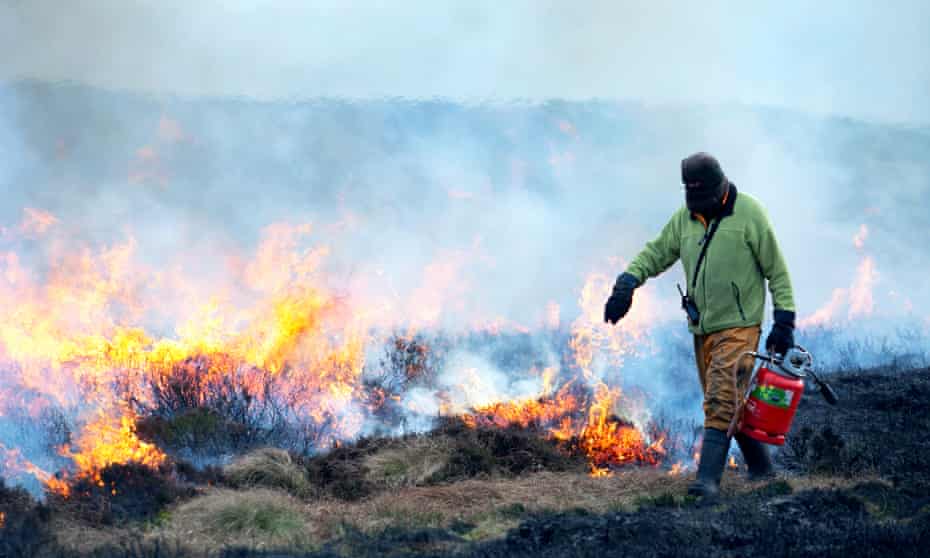

A gamekeeper burning peatland in West Yorkshire in March. 
The Moorland Association has defended controlled burning
Photograph: Richard Saker/The Observer


Patrick Greenfield
Mon 15 Nov 2021

Just 124 landowners own the majority of England’s deep peat – its single largest carbon store – new analysis has found.

From the low-lying wetlands of the Fens, to the bogs of the North York Moors, 450,000 hectares (1m acres) of peat soils store 584m tonnes of carbon, according to Natural England, equivalent to the annual emissions from 540 coal-fired power stations in the US.

England’s peatlands emit around 11m tonnes of CO2 into the atmosphere every year because of degradation and draining. Improving their management and encouraging their restoration are part of the UK’s net zero strategy, and the government is aiming to restore 280,000 hectares of peatland in England by the middle of the century.


‘It has become them and us’: the battle to burn England’s moorlands


A new report by Guy Shrubsole, environmental campaigner and author of Who Owns England?, has revealed that 60% of England’s peatlands are owned by a small group of people. In the uplands, 249,000 hectares of peat are owned by 101 grouse moor estates, while 20 landowners oversee 43,706 hectares of lowland peat in the Fens, about one-third of the total, according to the analysis.

Alongside large areas owned by the Duchy of Cornwall, Forestry Commission and the Ministry of Defence, just 124 landowners control more than 450,000 hectares of England’s peat.

Shrubsole, who also has a separate position as policy and campaigns coordinator with Rewilding Britain, said: “England’s single largest carbon store is owned by a vanishingly small number of landowners, whose mismanagement of this ecosystem by burning and draining it is currently adding to the climate disaster.

“The public urgently needs to challenge these landowners to protect and restore our peatlands, so that they help fix climate breakdown rather than making it worse. And the UK government must tighten its peatland-burning legislation, so that landowners can no longer set fire to our carbon.”
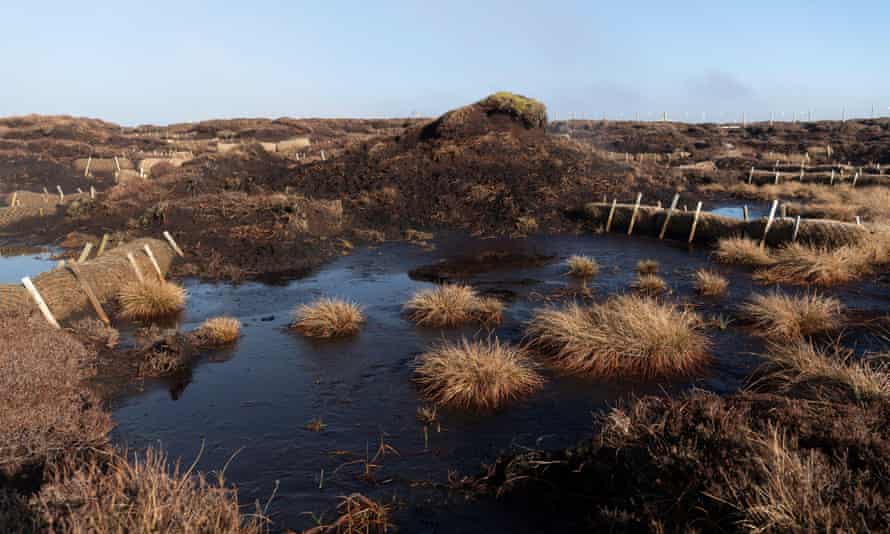
A peat bog restoration programme in North Yorkshire, UK, using coconut fibre to slow erosion. Peat soils in England store 584m tonnes of carbon. 
Photograph: Wayne Hutchinson/Alamy

Last week, the John Muir Trust, a charity set up to protect wild places in Britain, said taxing deer and grouse estates for failing to ensure their land properly locked up carbon dioxide could play a crucial role in fighting the climate crisis.

In response to the analysis, the Moorland Association, which represents grouse moor owners in England, said its members protected, restored and enhanced deep peat on their land, which required careful management for sustainable grouse shooting.

It defended burning, saying: “Controlled burning in the winter is a crucial tactic for moorland management which removes excess vegetation but does not affect the underlying peat. Managed burning helps prevent and limit the spread of wildfires through the creation of firebreaks and reducing the burnable fuel loads.”

A Defra spokesperson said it had been clear about the need to phase out rotational burning of protected blanket bog and had brought forward protective legislation, while supporting landowners with restoration.
Major European carmakers will hit emissions targets too easily, research shows

Report suggests weak targets could push firms to make millions more of the much more profitable petrol and diesel cars

VW is charging ahead with its EV plans but critics think weak emissions targets may incentivise other carmakers to make more of the more profitable petrol or diesel vehicles. 
Photograph: Simon Maina/AFP/Getty Images


Jasper Jolly
THE GUARDIAN
Mon 15 Nov 2021 

Weak EU vehicle emissions targets could allow Europe’s biggest carmakers to produce millions more petrol and diesel cars than necessary up to 2030 in a “wasted decade” for cutting carbon pollution, according to a report.

Analysis of car industry sales plans for electric vehicles shared exclusively with the Guardian by Transport and Environment (T&E), a thinktank and campaign group, showed that manufacturers could hit their 2030 EU carbon emissions targets with four years to spare.

However, the report warned that manufacturers could stick closely to their minimum requirements, as has been the case in recent years – opening up the potential for the industry to sell their more profitable petrol and diesel marques.

Based on the car industry’s publicly stated commitments for EV production, the study showed there was a gap between what could be achieved and where sales volumes would be if they are kept in line with the EU emissions rules.

Some vehicle makers could wholeheartedly embrace an electric revolution. But T&E said leaving the rules unchanged would jeopardise the sale of 18m battery-powered models and result in 55m extra tonnes of CO2 pollution – more than the annual emissions of all the cars in Spain.

T&E said carmakers got easier targets if they sold heavier vehicles, driving up sales of high-emitting SUVs and plug-in hybrid models, which – when not charged – could pollute more than fossil fuel engines.

The surge in SUV sales has meant that average engine emissions from three carmakers are actually higher than they were five years ago – even as they simultaneously green their fleets by making new electric cars. They were: Jaguar Land Rover, Volvo and Mercedes-Benz owner Daimler – all of which last week signed a pledge at Cop 26 to only sell zero-emissions cars by 2040.

Alex Keynes, the clean vehicles manager of T&E, said: “The electric vehicle boom has been driven by EU clean car rules but will falter unless lawmakers step in. Now is the time to set properly ambitious targets if we are to avoid a wasted decade in the race to decarbonise cars.”

Under the existing rules, carmakers must reduce emissions relative to 2021 levels by 15% by 2025, and by a proposed 55% by 2030 – a bigger cut than previously planned. However, T&E argued that the 55% cut is still too lenient, arguing that emissions should fall by 80% by 2030 – a level that would force carmakers to accelerate from their current plans.

The European Automobile Manufacturers’ Association (ACEA) has said that even the 55% carbon reduction target would be “very challenging” and warned that bans on “a single technology” would not be rational, in part because of meagre electric charger provision in some countries.

The emissions rules do not include the UK, where carmakers must report emissions separately following Brexit. However, the UK has copied nearly identical rules that came into force on 1 January, and about half of all cars built in UK factories are exported to the EU.

A spokesman for Daimler said Mercedes-Benz would be ready to go all electric at the end of the decade, where market conditions allowed. He added that the UK had seen “an increase in customer demand for SUVs in recent years”.

A spokesman for Jaguar Land Rover said electrification was at the heart of its new “electric-first” strategy, with battery versions of all models available by 2030.

Volvo said emissions data showed it was “one of the industry leaders in reducing CO2 emissions from the cars it sells” because of growing electric and plug-in hybrid sales. The carmaker plans to only sell electric cars by 2030 and to be “climate-neutral” by 2040.

Sign up to the daily Business Today email or follow Guardian Business on Twitter at @BusinessDesk

A spokesperson for ACEA said manufacturers were fully committed to bringing CO2 emissions down to zero and supporting the EU’s goal of reaching climate neutrality by 2050.

They said that car industry investment in EVs was outpacing funding for charging infrastructure, warning that failure to increase spending on the network could lead to electric car uptake stalling.

“The auto industry’s efforts must be met with the same level of ambition by the EU and its member states. It is essential that all players work together to create the right supportive framework that will drive consumers towards cleaner mobility options, and thus achieve our common goal of reaching climate neutrality in Europe.”

Sask. researcher says filters made of agricultural residue can reduce arsenic levels in water

Filtration system reduced 1,000 micrograms of arsenic per litre of water to less than 10 micrograms per litre

Arsenic levels in some Saskatchewan water sources are higher than what Health Canada deems acceptable. A PhD candidate at the University of Saskatchewan says he has found a way to reduce those levels by using agricultural residue. (Ivanoh Demers/CBC)

A chemical engineering graduate student at the University of Saskatchewan is developing a way to lower arsenic levels in drinking water by using agricultural residue.

Some of those levels in Saskatchewan are higher than what Health Canada deems acceptable, but Khaled Zoroufchi Benis is using wheat and canola straw as a filter.

Zoroufchi Benis told CBC Radio's The Afternoon Edition host Garth Materie that other methods used for the removal of contaminants from water, such as coagulation or reverse osmosis, can be expensive and difficult to operate.

"Agricultural residues have high strength and their environmental benign nature and low cost make them available everywhere," he said.

"And also, they are reusable. So we take this advantage and make inexpensive and sustainable material to make filtration systems."

The filtration system was able to reduce 1,000 micrograms of arsenic per litre of water to less than 10 micrograms per litre, he said.

LISTEN | Some Saskatchewan drinking water may contain arsenic:

Khaled Zoroufchi Benis is a chemical engineering graduate student at the University of Saskatchewan. He joins Afternoon Edition host Garth Materie to explain he's using wheat and canola straw as a filter to get rid of arsenic. 7:43

He said any concentration that is higher than 10 micrograms per litre is toxic for humans.

Arsenic is a known carcinogen that can lead to skin, lung and bladder cancer, as well as other diseases. 

According to a Government of Saskatchewan fact sheet, it is a natural element widely found in soil, bedrock and water. Rocks and soil release arsenic into the groundwater.

Arsenic is also released into the environment through the manufacturing of pesticides and the burning of fossil fuels. It is also a byproduct of copper smelting, mining and coal burning, and may enter water supplies through the discharge of industrial wastewater and agricultural pollution.

Arsenic testing in Sask.

According to the Water Security Agency's annual report on the state of drinking water quality in Saskatchewan, there were 32 instances of arsenic exceedances in the province in 2020-21 that were found in samples from 15 human consumptive systems.

It said these cases were discovered through regular required sampling. Additional voluntary arsenic testing was done in 10 human consumptive municipal systems, resulting in 66 additional exceedances, it said.

Zoroufchi Benis said in more than 70 countries, including Canada, about 200 million people are in danger of drinking water with high arsenic concentrations.

He said using ag residue for filtration can also be used for other pollutants, whether they be organic or inorganic.

"Nowadays, we are hearing a lot about chemicals of emerging concern like pharmaceuticals and personal care products that we use every day," he said. "And we are releasing this material to water and wastewater."

He said they activate the agricultural residues by applying a physical and chemical treatment that is contaminant-oriented — meaning that by changing the treatment, the ag residues can absorb other contaminants from water, such as selenium, which is also toxic in higher concentrations.

But he said it will be another five or six years before this research can be applied in industrial or municipal settings for water and wastewater treatment.

One of Ohio's most infamous cold cases solved after 52 years

From the Northern Ohio Violent Fugitive Task Force, Special to Ashland Source


CLEVELAND – On Friday July 11, 1969, Theodore John Conrad walked into his job at the Society National Bank at 127 Public Square in Cleveland as an ordinary bank teller. He walked out at the end of the day with $215,000 (equivalent to over $1.7 million in 2021) in a paper bag and vanished.

Conrad, age 20, pulled off one of the biggest bank robberies in Cleveland, Ohio history. It was not until the following Monday morning when Conrad failed to report to work, that the bank checked their vault only to find the missing money along with their missing employee.

From there Conrad, and the money he stole, had a two-day head start on law enforcement.

“This is a case I know all too well. My father, John K. Elliott, was a dedicated career Deputy United States Marshal in Cleveland from 1969 until his retirement in 1990," said Peter J. Elliott, United States Marshal for Northern Ohio. "My father took an interest in this case early because Conrad lived and worked near us in the late 1960s."

A year before the Cleveland bank robbery, Conrad became obsessed with the 1968 Steve McQueen film “The Thomas Crown Affair.” The movie was based on the bank robbery for sport by a millionaire businessman. Conrad saw it more than a half dozen times.

From there he bragged to his friends about how easy it would be to take money from the bank and even told them he planned to do so.

The fugitive investigation into Theodore ‘Ted’ Conrad perplexed many investigators over the past 50 years. Conrad was featured on America’s Most Wanted and Unsolved Mysteries.

Investigators chased leads across the country, including Washington D.C., Inglewood, California, western Texas, Oregon, and Honolulu, Hawaii.

The case remained cold until this past week when United States Marshals from Cleveland traveled to Boston, Massachusetts and positively identified Thomas Randele of Lynnfield, Massachusetts as the fictitious name of Theodore J. Conrad.

He had been living an unassuming life in the Boston suburb since 1970. Ironically, he moved to Boston near the location where the original Thomas Crown Affair movie was filmed.

United States Marshals investigators from Cleveland were able match documents that Conrad completed in the 1960s with documents Randele completed, including documents from when Randele filed for Bankruptcy in Boston Federal Court in 2014.

Additional investigative information led Marshals to positively identifying Thomas Randele as Theodore J. Conrad. Thomas Randele died of lung cancer in May of 2021 in Lynnfield, Massachusetts using a date of birth as July 10, 1947.

His real date of birth was July 10, 1949, and Conrad would have been 71 at the time of his death.

"My father never stopped searching for Conrad and always wanted closure up until his death in 2020," Elliott said. "We were able to match some of the documents that my father uncovered from Conrad’s college days in the 1960s with documents from Randele that led to his identification.

"I hope my father is resting a little easier today knowing his investigation and his United States Marshals Service brought closure to this decades-long mystery. Everything in real life doesn’t always end like in the movies.”
CALGARY
Lilydale chicken plant to fly the coop out of Ramsay


The impetus for the relocation came alongside planning for the Green Line LRT, which is slated to have a stop between Ramsay and Inglewood

Author of the article: Jason Herring
Publishing date: Nov 14, 2021 •
The Lilydale plant, owned by Sofina Foods Inc., located in the SE. Photo taken on Thursday, April 23, 2020. 
PHOTO BY BRENDAN MILLER/POSTMEDIA

Calgary’s inner-city community of Ramsay is saying farewell to a chicken plant that’s been there for the better part of a century, and the city councillor representing the area couldn’t be happier.

Gian-Carlo Carra said the Lilydale plant flying the coop from its current home at the corner of 21st Avenue and 11th Street S.E. to the Dufferin North Industrial Park is good news for Ramsay residents.

“I spent almost 10 years figuring out how we could possibly get Lilydale moved out of their archaic, falling-apart, bad-for-the–neighbourhood, bad-for-the-environment space,” said Carra, councillor for Ward 9.

“The big question was, how do we get them to move?”

The impetus for the relocation came alongside planning for the Green Line LRT, which is slated to have a stop between Ramsay and Inglewood. The city bought out the factory, Carra said, then sold the company land for their new home.

At 304,000 square feet, that new facility, which the provincial government has said cost $200 million, is a significant upgrade over the Ramsay site and comes with a 50 per cent increase in plant capacity. An existing 500 jobs will be transferred to the site and 50 new jobs will be created.

In a statement from Sofina Foods, which owns Lilydale, the company said it is currently in the process of transitioning to the new manufacturing facility in the city’s southeast, expecting to be done in early 2022.

“We are excited about the move to our new facility and look forward to transitioning our current employees over to the new site as they continue their important work feeding Canadians,” Sofina Foods said.

Conversations around finding a new home for the poultry plant date back decades, to Joe Ceci’s time as Ward 9 alderman in the 1990s and 2000s. Back then, it was owned by Pinecrest Foods, and a deal couldn’t be reached for a move.

Ceci said he’s pleased to see the departure of a community mainstay that had already long outstayed its welcome even at that time.

“Over time, the impact was greater and greater on the residential communities, particularly things like smells during warm parts of the year, chicken parts being stolen by magpies or other birds and winding up in people’s backyards, and truck traffic,” he said.

“It became clear to everyone that the plant would be better suited somewhere in an industrial area.”

Carra was optimistic the closure and eventual demolition of the plant combined with the Green Line development can help revitalize the Ramsay area.

“We’ve kept the jobs and the tax base inside city limits, we’re doing better for the environment and we’re freeing up one of the most awful remainders of Ramsay’s industrial past,” he said.

“It creates the opportunity to connect to the future main street of 11th Street, to create a higher-density edge in Ramsay that creates the kind of density we need to rationalize the investment of the Green Line without significantly impacting the lower-density heritage character of the existing neighbourhood.

“It’s a win-win-win all around.”

The Calgary Police Service will make use of the plant as a training facility before the building’s demolition, Carra said.
Chretien's opened a can of worms with his residential schools denial

Author of the article:Andrew Bear Robe
Publishing date:Nov 13, 2021 • 
Jean Chretien, the minister of Indian affairs, speaks during a dramatic meeting with the entire federal cabinet and a delegation of about 200 Indigenous leaders representing most provinces on Parliament Hill in Ottawa on June 4, 1970. 
PHOTO BY R. MAC /The Canadian Press file
Article content

Jean Chretien was minister of Indian affairs from 1968 to 1974 and prime minister from 1993 to 2003. Incredibly, he denied any knowledge of the legacy of federal Indian residential schools while he was the minister in charge of those child abusive schools. In doing so, he opened a can of worms.

Those so-called schools were actually chambers of horrors for Indigenous children that operated within Canada from 1883 until that last one that closed in 1996. A total of 139 residential schools and residences were in operation across Canada and an estimated 150,000 Indigenous children, some as young as six years old, passed through that system.

The Final Report of the Truth and Reconciliation Commission of Canada in 2015 concluded, “For over a century, the central goals of Canada’s Aboriginal policy were to eliminate Aboriginal governments; ignore Aboriginal rights; terminate the treaties; and, through a process of assimilation, cause Aboriginal peoples to cease to exist as distinct legal, social, cultural, religious and racial entities in Canada. The establishment and operation of residential schools were a central element of this policy, which can best be described as cultural genocide .”

Chretien could have intervened as the minister in charge of Indian residential schools but instead ignored the issue. He simply chose to carry on with the official Indian policy of eradicating Indigenous existentialism via assimilation, enfranchisement and benign neglect. Duncan Campbell Scott, deputy superintendent of Indian Affairs (1913-1932), said, “I want to get rid of the Indian problem. Our objective is to continue until there is not a single Indian in Canada that has not been absorbed into the body politic and there is no Indian Question and no Indian Department.”

There has been a long history of abusive treatment of Indigenous peoples at the hands of the government of Canada, starting with the Gradual Civilization Act of 1857, which was incorporated into the Indian Act of 1876. Thenceforth, government policy has always been marked by the denial of Indigenous rights, dispossession of Indigenous territories and domination by foreign federal and provincial laws.

Together with former prime minister Pierre Elliott Trudeau, Chretien crafted the infamous federal Indian Policy of 1969, which sought to unilaterally terminate the sacred treaties made with the British Crown; unilaterally terminate the Indian Act (which is not a bad idea); unilaterally terminate special Indian constitutional status; unilaterally turn Indian reserve lands into individual land ownership; and unilaterally make status Indians into second-class provincial citizens.

Did Trudeau and Chretien consult First Nation peoples about the said federal policy? NO! Did they seek the input of First Nation peoples into the said policy? NO! Did they consult with the provinces concerning First Nation peoples becoming provincial citizens and adding to provincial burdens? NO! Chretien’s line of thinking and attitude pervades governments and other public institutions to this day. Call it systemic racism, which has been denied by government officials especially in Quebec, New Brunswick and by Nova Scotia fishermen.

Currently, Canadian governments are reluctant in fulfilling their sacred treaty obligations towards Indigenous nations and continue to treat them as wards of the government and not as treaty partners. Basically, Canada and the western provinces continue to look upon the Victorian Treaties (1871-1921) as land surrender agreements, whereas Indigenous nations do not. On the contrary, Indian nations look upon the treaties as securing their future livelihoods via reciprocity, mutual benefit and peaceful co-existence with the European settlers. If reconciliation is going to work, we collectively need to re-examine the basic purpose of those treaties, that is sharing the land and natural resources.


As treaty partners, there must be joint stewardship of the land and everything else that sustains the earth. There should be no more land and resource development without the input and consent of Indigenous peoples. The economic and industrial business leaders cannot be trusted with that public and moral responsibility because their sole focus is to create more individual wealth for their shareholders at the expense of the majority. Protecting the fragile natural environment and climate is a distant secondary priority for them. It is ironic that the wealthiest citizens pay the least taxes. Indigenous peoples pay all sorts of taxes.

As a minister of the Crown who signed legally binding treaties with Indian nations, Chretien failed miserably to uphold the Crown’s legal obligations. Neither he nor Trudeau understood the basic principles of peaceful co-existence with Indigenous peoples based on bilateral treaties, which are referred to as the Magna Carta of Indian Rights together with the Royal Proclamation of 1763.

As members of the federal cabinet, both men were primarily preoccupied with securing the privileged position of Quebec within Confederation as a distinct society or as a nation and it continues to receive a disproportionate share of the federal fiscal equalization transfers at 48.6 per cent in 2013-2014 and have remained at that level since. While Alberta, as a net contributor to the equalization program, contributes 50 per cent of its resource revenues into the fiscal transfers. That’s how Alberta pays Quebec’s bills. Such payments should legitimately be made to First Nations under the treaties as “Trusts” and “Interests” pursuant to Section 109 of the Canadian Constitution. Such revenues received would establish Indigenous economies, build infrastructure and housing within Alberta’s 138 impoverished Indian reserves. Alberta’s resource revenues must assist fiscally challenged Albertans first, especially First Nations as treaty partners.

We must be cognizant of the fact that the Victorian Treaties, which cover about 50 per cent of the Canadian landmass, are not settled issues. It is only a matter of time before First Nations will claim their just portions of the land and resources. Indigenous peoples should not have to litigate such entitlements. We can settle such matters via good faith negotiations as treaty partners.

We can all learn from the Manitoba Liberals who recently adopted a “land back” policy that would return land owed to First Nations as well as establishing natural resource revenue-sharing. Such policies were adopted at their two-day general meeting in October as part of its “single greatest priority” to Indigenous reconciliation. That would be the preferred option for all governments, instead of always going through the courts to seek delayed justice for Indigenous peoples.

After all, the Victorian Treaties involve 4.1 million square kilometres of resource-rich Indigenous territories that Indian nations agreed to share with European settlers to foster the latter’s development and prosperity. It is now payback time for Indigenous nations after waiting for 154 years for the fulfillment of their legal entitlements pursuant to the Victorian Treaties and as part of true and meaningful reconciliation.

Andrew Bear Robe, a member of the Siksika Nation, is an Indigenization consultant at Mount Royal University’s Bissett School of Business.
In British Politics, Pro-Palestinian Activism Is Now Considered Criminal

When British students demonstrated this week against a far-right Israeli politician, Tzipi Hotovely, the country’s politicians lined up to denounce them as violent antisemites. Keir Starmer’s Labour Party has added its voice to this authoritarian chorus.

Current Israeli ambassador to the UK Tzipi Hotovely gives a press conference in 2015 as Israeli foreign deputy minister.
(Menahem Kahana / AFP via Getty Images)

JACOBIN
11.14.2021

Britain’s Conservative government is currently facing several overlapping crises, from the ongoing pandemic to a fresh standoff with the European Union and a self-inflicted controversy about political sleaze. Boris Johnson himself is right at the center of all these controversies, supplying his opponents with plenty of ammunition to use against him. A parliamentary report on Britain’s pandemic response published in October this year found that Johnson’s negligence was responsible for “many thousands of deaths which could have been avoided.”

At a moment like this, you might expect Britain’s main opposition party to have a laser-like focus on the government and its many failings. But this is Keir Starmer and his allies that we are talking about, after all. With the Tories looking vulnerable, Starmer’s front-bench team still found the time to link arms with senior Conservatives in defense of Tzipi Hotovely, a far-right Israeli politician whose anti-Palestinian views are well documented.

Starmer, Labour’s shadow foreign secretary Lisa Nandy, and its shadow home secretary Nick Thomas-Symonds bitterly denounced protests against Hotovely at the London School of Economics (LSE). Some Labour MPs even called for the protesters to be arrested.

The obsession of Britain’s frontline political class with demonstrating its commitment to anti-Palestinian racism is both staggering and sinister. The current Labour leadership is fully complicit in enforcing this bigotry as part of the mainstream political consensus. It is no exaggeration to say that you will find more critical commentary about politicians like Hotovely in Israel itself than in British public life.

“All of It Is Ours”

First of all, let’s discuss Hotovely’s particular track record, which made her appointment as Israel’s ambassador to the UK so controversial. She has repeatedly said that Israeli should never permit a Palestinian state to come into being, no matter how truncated it might be in size or sovereignty. When Benjamin Netanyahu appointed her as his deputy foreign minister back in 2015, she laid claim to the whole of the occupied Palestinian territories:

We need to return to the basic truth of our rights to this country. This land is ours. All of it is ours. . . . We expect as a matter of principle of the international community to recognize Israel’s right to build homes for Jews in their homeland, everywhere.

Yoel Hasson, an opposition MP from the Zionist Union coalition, urged Netanyahu to sack Hotovely after she said it was “my dream to see the Israeli flag flying on the Temple Mount.” Hasson depicted her as a threat to Israel’s own security: “The messianic deputy minister continues to inflame the entire Middle East.”The obsession of Britain’s frontline political class with demonstrating its commitment to anti-Palestinian racism is both staggering and sinister.

Hotovely’s prejudice also extends to Jewish people outside Israel. In 2017, she launched a bitter attack on American Jews for not giving her government enough support. Hotovely described Jewish Americans as people who lead “quite convenient lives” and “never send their children to fight for their country” — the kind of rhetoric that we usually hear from the ultranationalist, antisemitic right.

In 2019, Hotovely denounced the Board of Deputies of British Jews (BOD). The BOD had declared its support for a “secure Israel alongside a viable Palestinian state” in a manifesto. This is the kind of diplomatic bromide that pro-Israel groups in Europe and North America often come out with. In practice, such groups usually oppose the application of any pressure on Israel that might oblige it to withdraw from the occupied territories, and the BOD is certainly no exception to that rule.

However, the mere mention of a Palestinian state by an impeccably pro-Israel organization like the BOD was enough to send Hotovely into a splenetic rage. She accused the Board of “working against Israeli interests”:
There was no prior consultation regarding this document with the government of Israel’s Ministry of Foreign Affairs, nor with our ambassador, nor with any other political authority. In every meeting between Jewish organizations around the world and politicians — the prime minister, foreign minister, or myself — we emphasize that the idea of a Palestinian state is one that the state of Israel completely opposes. We have a rule regarding international election campaigns, and it’s that we do not take a stand on the domestic affairs of the Jewish community. But an organization that supports the establishment of a Palestinian state is clearly working against Israeli interests. It is important to say explicitly: a Palestinian state is a danger to the state of Israel.

Hotovely’s opinions and rhetoric are so extreme that even the conservative pundit Melanie Phillips criticized her appointment as Israel’s UK ambassador in 2020. For those unfamiliar with her work, Phillips is right-wing in much the same way that Jupiter is large or Pluto is cold. But she thought that Hotovely’s presence on the British stage might prove disastrous, since she would be “laden with divisive political baggage” and could not make the case for Israel in a way that a British audience would find convincing.

Made-up Stories


The Board of Deputies still invited Hotovely to address its members in December 2020, despite her vitriolic attacks on its manifesto. She took the opportunity to describe the Palestinian Nakba as “a very strong and very popular Arab lie” and “a made-up story.”

Hotovely then received another invitation from a student debating society at the LSE to speak at an event last week titled “Perspectives on Israel and Palestine.” The circumstances of the protest against her presence on campus have already been the subject of wild fabrications in the British press. This was the account of the protest issued by the Community Security Trust (CST):

The ambassador spoke without significant disruption, completed her talk and left the event as scheduled. The students who attended all left safely. Contrary to some claims, the ambassador was not forced out of LSE, chased away or prevented from speaking.

The CST went on to claim that some of those protesting outside the event had engaged in “extremist chanting” and “created an atmosphere of unacceptable intimidation,” without saying what those “extremist” chants were or why they should be considered intimidating. Earlier this year, the CST described the chant “from the river to the sea, Palestine will be free” as “genocidal” and associated it with Osama bin Laden and Saddam Hussein, which gives us a fair indication of what the group deems extremist. In any case, there was clearly no physical violence at the protest — just a group of people verbally registering their disgust at an attempt to normalize Hotovely and her views.Across the full spectrum of mainstream opinion in British politics and media, there appears to be a consensus that it is fundamentally illegitimate to protest against a figure like Tzipi Hotovely.

This did not stop the Jewish Chronicle from publishing an editorial with the headline “On the anniversary of Kristallnacht, a Jew hunting mob on the streets of London,” which claimed that Hotovely had been targeted by “violent racists on the hunt for a Jew to attack.” The only morally appropriate response to this editorial should be uncompromising fury at its trivialization of Nazi crimes. Instead, Britain’s leading politicians lined up to denounce the protesters on the basis of the Chronicle’s fairy tale.

It was hardly surprising that the Conservative home secretary Priti Patel called for a police investigation while casually defaming the protesters as antisemites. As well as being a deeply authoritarian figure, Patel is an unusually strong supporter of Israel. In 2017, Theresa May sacked her as a minister for holding unauthorized meetings with Israeli representatives in a bid to shift British foreign policy. Other members of Boris Johnson’s cabinet issued similar statements attacking the protest.

The Labour front-bench team was not willing to let Patel and her colleagues steal a march on them. Keir Starmer, Lisa Nandy, and Nick Thomas-Symonds all weighed in. Starmer claimed that the protest was “totally unacceptable” and had been characterized by “intimidation and threats of violence.” Nandy also said that it was “completely unacceptable.” Thomas-Symonds echoed Patel’s call for police action, conflated protest against a far-right Israeli politician with anti-Jewish bigotry, and doffed his hat to Hotovely — all in a single tweet:
A backbench Labour MP, Diana Johnson, added her two cents: “This is absolutely appalling and I hope that arrests are made.” Johnson did not explain what crime she imagined the protesters to have committed.

Tzipi Hotovely has since embarked on a tour of Britain’s right-wing media, with publications like the Spectator and the Mail claiming that she was “barracked,” “intimidated,” or even “attacked.” Also in the Spectator, the Jewish Chronicle’s deputy editor Jake Wallis Simons presented the student protesters as tools of the Iranian government and doubled down on the Kristallnacht analogy.

For its part, the Guardian published a lengthy report on the protest which foregrounded Priti Patel’s call for a police investigation. It also quoted from an Israeli embassy statement referring to “the violence we witnessed” without clarifying that no such violence had taken place. The article did not supply any information about Hotovely’s extensive back catalog of anti-Palestinian outbursts, even though the journalists would only have needed to check their own archive for confirmation. If the Guardian was reporting on protests against Matteo Salvini or Marine Le Pen, it would presumably include some basic information about their respective political histories. Hotovely, on the other hand, gets the kid-glove treatment.

Across the full spectrum of mainstream opinion in British politics and media, there appears to be a consensus that it is fundamentally illegitimate to protest against a figure like Hotovely. The Israeli journalist Anshel Pfeffer has described Hotovely as “an unabashed Islamophobe and religious fundamentalist who denies the existence of the Palestinian people” and “embodies much of what is ugly and distressing about Israeli politics at this time in its history.” But the gatekeepers of Britain’s public sphere couldn’t care less about that. There’s only one thing that concerns them in relation to Hotovely: her ability to deliver a speech whenever she likes without having to worry about the distant echo of hostile chanting.

The reckless and abusive conflation of support for Palestinian rights with hostility to Jewish people is hardly unique to Britain. Also this week, the CEO of the Anti-Defamation League, Jonathan Greenblatt, claimed that “left-wing antisemitism” was rising in the United States and compared it to the climate crisis. His examples of antisemitism included Sally Rooney’s support for the Boycott, Divestment, and Sanctions movement and the refusal of some left-wing Democrats in Congress to support additional military aid to Israel.

However, the British variety of anti-Palestinian racism is especially virulent and pervasive, for reasons that have far more to do with domestic political concerns than anything that happens in the Middle East. Many of those most active in propagating and enforcing such racism don’t particularly care about Israel — they just see it as a convenient stick with which to beat their left-wing opponents. But the effect, so far as Palestinians are concerned, is just the same as if these cynical opportunists wholeheartedly shared all of Tzipi Hotovely’s opinions. There is absolutely no excuse for anyone to deny the reality of what is staring them in the face.

ABOUT THE AUTHOR
Daniel Finn is the features editor at Jacobin. He is the author of One Man’s Terrorist: A Political History of the IRA.
Kaiser Permanente strike off after deal between unions and healthcare giant

32,000 employees, most in California, threatened walkout

Deal ‘protects patients, safe staffing and fair wages’


The Kaiser Permanente San Diego Medical Center, in California. 
Photograph: Mike Blake/Reuters


Associated Press in Los Angeles
Sun 14 Nov 2021

An alliance of unions representing 50,000 Kaiser Permanente workers in California, Oregon and six other states called off strike set for Monday, after reaching a tentative labor deal with the healthcare network.

The Alliance of Health Care Unions and Kaiser Permanente jointly announced the agreement, staving off a potentially crippling strike in which 32,000 employees, most of them in southern California, threatened to walk off the job to protest understaffing and wage cuts for new hires.

Additional members of the alliance, comprised of 21 local unions, authorized a one-day “sympathy strike” on 18 November.

Agreement on the four-year contract includes annual wage increases, while maintaining health benefits for employees, and new staffing language to continue to protect employees and patients, the statement said.
Advertisement

“This agreement will mean patients will continue to receive the best care and Alliance members will have the best jobs,” said Hal Ruddick, executive director of the alliance.

“This contract protects our patients, provides safe staffing, and guarantees fair wages and benefits for every Alliance member.”

Christian Meisner, chief human resources officer at Kaiser Permanente, said the agreement “underscores our unwavering commitment to our employees by maintaining industry-leading wages and benefits”.

Bargaining continues with the local units representing Kaiser pharmacists in Northern California and the Pacific north west, as well as a group of engineers.

“We hope to reach agreements very soon,” Kaiser spokesman Steve Shivinsky said.

The alliance said it has more than 35,000 member employees in California; 6,300 in Oregon and Washington; 2,100 in Colorado; 2,300 in Maryland, Washington, DC and northern Virginia; 3,000 in Georgia; and 1,900 in Hawaii.
Flooding and Nuclear Waste Eat Away at a Tribe’s Ancestral Home

The federal government allowed a stockpile of spent fuel on a Minnesota reservation to balloon even as a dam project whittled down the amount of livable land.


The state of Minnesota and the federal government ignored warnings about potential issues from flooding and nuclear waste posed to put the Prairie Island Indian Community in danger.
Credit...Laylah Amatullah Barrayn for The New York Times

By Mark Walker
Nov. 13, 2021

For decades, chronic flooding and nuclear waste have encroached on the ancestral lands in southeastern Minnesota that the Prairie Island Indian Community calls home, whittling them to about a third of their original size.

Two years after the tribe received federal recognition in 1936, the Army Corps of Engineers installed a lock-and-dam system just to the south along the Mississippi River. It repeatedly flooded the tribe’s land, including burial mounds, leaving members with only 300 livable acres.

Decades later, a stockpile of nuclear waste from a power plant next to the reservation, which the federal government reneged on a promise to remove in the 1990s, has tripled in size. It comes within 600 yards of some residents’ homes.

With no room to develop more housing on the reservation, more than 150 tribal members who are eager to live in their ancestral home are on a waiting list.

Cody Whitebear, 33, who serves as the tribe’s federal government relations specialist, is among those waiting. He hopes he can inherit his grandmother’s house, which is on the road closest to the power plant.

“I never had the opportunity to live on the reservation, be part of the community,” said Mr. Whitebear, who began connecting with his heritage after the birth of his son, Cayden. “In my mid-20s I had the desire to learn about my people and who I am and who we are.”

With no remedy in sight, the tribal community is asking Congress to put into trust about 1,200 acres of nearby land that it purchased near Pine Island, Minn., about 35 miles away, in 2018. That would allow the tribe to preserve its future by adding land farther away from the power plant to its reservation. In return, the tribe says it would give up the right to sue the government over flooding caused by the dam.

Tribes exercise jurisdiction over land held in trust, including civil regulatory control. Certain federal laws and programs are intended to benefit tribal trust or reservation land.

“Putting this land into trust for our tribe is crucial to righting the historical and current wrongs committed against our people,” said Shelley Buck, president of the Prairie Island Tribal Council. “The federal government put our tribe in this dangerous and untenable position, and it is the government’s responsibility to address the harm it has caused. The trust land would provide a safer alternative location for our members to live and work. The importance of that can’t be understated.”

Interviews and documents obtained by The New York Times show how the state of Minnesota and the federal government ignored warnings about potential dangers posed to the tribe as they kept allowing the amount of waste stored on the reservation to expand and did little to address annual flooding that harms the tribe’s economy.

“I mean, this is a classic environmental justice fact pattern,” said Heather Sibbison, chair of Dentons Native American law and policy practice at Dentons Law Firm. “We have a minority community, a disadvantaged community, bearing the brunt of two huge infrastructure projects that serve other people.”

The tribal community is home to descendants of the Mdewakanton Band of Eastern Dakota, who lived in the southern half of Minnesota. Unkept promises by white settlers led to the Dakota War of 1862. That year, the U.S. government hanged 38 Dakota men in Mankato, Minn., invalidated a land treaty and banished the Dakota from the region.

In 1934, the federal government recognized Prairie Island Indian Community as a reservation after members of the Mdewakanton Band spent decades returning to the region and buying parcels of land.

Today, much of the land that the government gave the tribe is underwater. But the tribe’s greatest fear is a nuclear plant disaster or toxic train derailment that would require evacuation, said Jon Priem, who oversees the small law enforcement and emergency service agencies on the island where the reservation sits. There is only one road in and out.

“We would be no match for anything of that magnitude,” Mr. Priem said. “Trying to get aid in here would be nearly impossible.”

Sign Up for On Politics A guide to the political news cycle, cutting through the spin and delivering clarity from the chaos. Get it sent to your inbox.

As part of a temporary agreement that has become more permanent, waste from the power plant is stored within the borders of the Prairie Island Indian Community.

The waste is stored in pools before being transferred into massive steel canisters. Each one is eight and a half feet wide and weighs 122 tons when fully loaded. Forty-seven canisters are being stored on the island while the community waits for the federal government to transport them away.

Xcel Energy runs the Prairie Island nuclear plant near the reservation and has stored 47 canisters of nuclear waste close to the homes of tribe members.
Credit...Laylah Amatullah Barrayn for The New York Times


A judge in the 1990s opposed putting nuclear waste on Prairie Island because of the government’s history of failing to find a permanent storage facility and record of broken promises to tribal communities. The state and the federal government allowed it anyway.

Documents show that in 1992, Judge Allan Klein recommended that the Minnesota Public Utilities Commission deny an application brought by Northern States Power Company, which later became Xcel Energy, to allow the waste to be stored on lands belonging to the Prairie Island Indian Community.

“Once the casks are in place, the path of least resistance is to leave them there indefinitely,” the judge stated in the documents.

Despite the judge’s caution, the Minnesota Public Utility Commission ruled that the power company could store the waste on the reservation. It capped the number of storage casks at 17, but in 2003 the cap was lifted.

Chris Clark, who oversees Xcel Energy’s Minnesota operations, said the nuclear waste was “an issue that we and the Prairie Island Indian Community have worked on together, obviously pushing the federal government to live up to their responsibilities to take that fuel and move it off the island.”

The Nuclear Waste Policy Act of 1982 assigned the responsibility of providing a permanent repository for spent nuclear fuel to the federal government. The government came to focus on a possible storage site at Yucca Mountain, in Nevada, but the plan is on hold.

Speaking of the residents who live 600 yards from the canisters, Mr. Clark said, “We know they’ve described themselves as the community who’s living closest to used fuel in the nation,” adding, “I have no basis to disagree with that and certainly, it is close.”

The government came to focus on a possible storage site at Yucca Mountain, in Nevada, but the plan is on hold. 
Credit...John Locher/Associated Press

Xcel Energy pays the tribe for the land it uses, and together they lobby the federal government to fulfill its responsibility.

In 2003, as a condition of expanding the waste storage limits at Xcel Energy’s Prairie Island nuclear power plant, the State of Minnesota and Xcel Energy signed an agreement with the tribe to address some of its concerns.

It provided annual payments to the tribe of $2.25 million a year to, in part, help the tribe purchase up to 1,500 acres of new land within a 50-mile radius of the reservation to be taken into trust. The payments fell to $1.45 million in 2012, as the plant neared its original end-of-license dates, but rose again, to $2.5 million, when Xcel Energy’s operating licenses were extended and storage limits were increased.

The tribe used the money to purchase the second parcel of land for $15.5 million.

When Lu Taylor steps outside her home, the first things she sees are tall power lines and high-voltage electrical towers. Behind the towers is the nuclear power plant, which Ms. Taylor, 62, said has been the tribe’s top concern for generations. She grew up next to the plant; so did her children, and she believes her grandchildren will as well.

The state of Minnesota and Xcel Energy signed an agreement with the tribe that provided annual payments of $2.25 million a year to, in part, help the tribe purchase up to 1,500 acres of new land within a 50-mile radius of the reservation to be taken into trust.
Credit...Laylah Amatullah Barrayn for The New York Times

Members of Congress in 2019 introduced the Prairie Island Indian Community Land Claim Settlement Act, which would put into trust the nearby land that the tribe purchased, but the legislation has not moved.

A spokesman for the Department of the Interior said the agency is committed to working toward environmental justice in Indian Country and ensuring that tribal communities have the land they need to provide a safe home for their citizens.

In the meantime, though, Ms. Taylor, the tribe’s vice president, said the flooding and the stockpile of nuclear waste raised the risk of an accident taking everything away from them.

“It is a danger zone that can keep families away from their homes and keep us from our way of life,” she said. “It’s unthinkable.”

Mark Walker is the FOIA coordinator in the Washington bureau of The New York Times. He was raised in Savannah and graduated from Fort Valley State University. Previously, he was an investigative reporter at the Argus Leader in South Dakota. @bymarkwalker
Lukashenko is a handy villain to mask the cruelty of Fortress Europe

European Union policies have turned migrants into a resource to be exploited

A boy stands at the entrance of a tent at an improvised camp near the Bosnia-Croatia border. Photograph: Elvis Barukcic/AFP/Getty


Kenan Malik
Sun 14 Nov 2021 


A company of men in dark uniforms and balaclavas, all carrying clubs. They are battering a group of people, repeatedly clubbing them on their arms, legs and backs. They push them into a river that marks the boundary of the European Union. “Go,” they yell. “Go.”

It’s not an incident on the border between Belarus and Poland, the latest migrant flashpoint on the EU border, and one now dominating the news. It happened 1,000 miles to the south, between Croatia and Bosnia-Herzegovina. And it’s been happening for months, but with much less publicity or scrutiny than that afforded the events in Belarus.

The uniforms worn by the men in black on the Croatia-Bosnia border carried no insignias. An investigation by a consortium of European newspapers, broadcasters and NGOs has exposed them as members of special Croatian and Greek police units. Their job? To use violence to force undocumented migrants out of the EU and into non-EU states.

The operations are deemed “pushbacks”, a euphemism for illegal, violent expulsion. They happen all along the EU’s south-east border. Not just on land but at sea, too. Men from elite units in the Greek coastguard, again all dressed in black, wearing balaclavas and with no identity markings, regularly seize migrants, put them on orange life rafts, provided by the EU, push them out to sea towards Turkey and leave them to their fate.
Warsaw has imposed a state of emergency, denying migrants food, water or medical aid

To put in context the current events on the Belarus-Poland border, it is important to understand not just the nature of the Belarusian government but also the wider scope of EU migration policy. Belarus is a brutal, unforgiving regime, its president, Alexander Lukashenko, a butcher whose security forces have beaten all protesters into submission and tortured and imprisoned any opposition figures. Lukashenko’s use of migrants to put pressure on the EU has left some 2,000 undocumented people trapped on the border with Poland.

However odious Lukashenko’s actions, the humanitarian disaster on the border is not the result simply of one nation’s actions. Polish forces, too, have trapped the migrants. Warsaw has imposed a state of emergency, denying migrants food, water or medical aid and refusing journalists access. New laws allow police to ignore asylum requests. Officially, eight people have died in sub-zero temperatures; the true figure is likely to be much higher.

In her state of the union speech in September, the EU president, Ursula von der Leyen, condemned the regime in Minsk for having “instrumentalised human beings”, a claim echoed last week by the US and European delegates to the UN.

It’s true that Lukashenko is using migrants as pawns in a cynical diplomatic manoeuvre. But “instrumentalising human beings” is exactly what EU migration policy has been practising, too, for the past three decades. “Fortress Europe” has been created by turning people into instruments of policy, viewing migrants not as living, breathing human beings, but as flotsam and jetsam to be swept away from Europe’s beaches and borders.


'We are stranded': man describes hardship on Poland-Belarus border as crisis deepens – video report

To maintain Fortress Europe, the EU has funded a huge kidnap and detention industry right across Africa from the Atlantic to the Red Sea, from the Mediterranean to beyond the Sahara. The “Khartoum process” is a deal the EU stitched together with countries in the north and east of Africa to detain migrants before they can reach the Mediterranean. States involved include Ethiopia, Eritrea, Sudan and South Sudan, all countries facing civil war and mass famine. The EU has given money to Omar al-Bashir, the former leader of Sudan indicted by the international criminal court for war crimes, and to Isaias Afwerki, the Eritrean dictator whose viciousness outstrips that of Lukashenko. The Janjaweed, a militia that pursued genocidal violence in Darfur, now calls itself the “Rapid Support Forces” and hunts down migrants for the EU rather than rebels for Bashir. Europe’s policies have turned migrants into a resource to be exploited.

Even worse is the situation in Libya, where the EU funds and trains coastguard units whose job is to capture and detain migrants fleeing in boats. Many are militias rebadged to win access to EU money.

The number of migrants held captive in Libya is impossible to ascertain. In one week alone in October, 5,000 were arrested and detained. All are imprisoned in the most degrading of conditions, many subject to torture, sexual abuse and extortion, practices of which European governments are fully aware and in which they are complicit.
These trials are designed to send a message – 'this is what will happen if you come to Europe'

The EU has long instrumentalised people by using aid as a weapon to enforce its migration policies. Countries that agree to detain anyone thought to be aiming for Europe receive money. Those that refuse to accept deportees lose funding. Niger has become the EU’s biggest recipient per capita of aid, not because it is the poorest nation in the world but because it is “Europe’s migration laboratory”, in which domestic policies are defined by the EU’s migration aims. The consequence has been a distorted economy, the flourishing of armed groups and the introduction of border checks on locals in their own country, because Europe demands it.

Meanwhile, in Europe, undocumented migrants are treated as vicious criminals, even mass murderers. In Greece last week, the trial began of two survivors of a boat that capsized in the Aegean. The two were among 24 people fleeing Afghanistan. One, N, lost his six-year-old son in the disaster. The other helped steer the boat in a desperate attempt to save it. N is charged with “endangering the life of his child” and faces 10 years in prison. Hasan could be jailed for 230 years for the “transportation of 24 people into Greek territory”. Earlier this year, another migrant received a 142-year sentence in similar circumstances.

These are not trials to exact justice. They are designed purely to send a message – “this is what will happen if you come to Europe”. As much as Lukashenko, the EU exploits people as instruments to pursue a cruel policy.

From balaclava-wearing thugs beating people up to show trials to instil fear, Europe’s migration policies might receive an admiring glance from Lukashenko. The Belarus dictator is a vicious tyrant whose actions are unconscionable. We should not, however, allow the EU to use his immoral actions to whitewash its own, equally cynical, equally brutal, policies.

Kenan Malik is an Observer columnist