Wednesday, December 01, 2021

[Editorial] Chun Doo-hwan: Gone but never to be forgiven

Efforts to rehabilitate Chun must not be tolerated
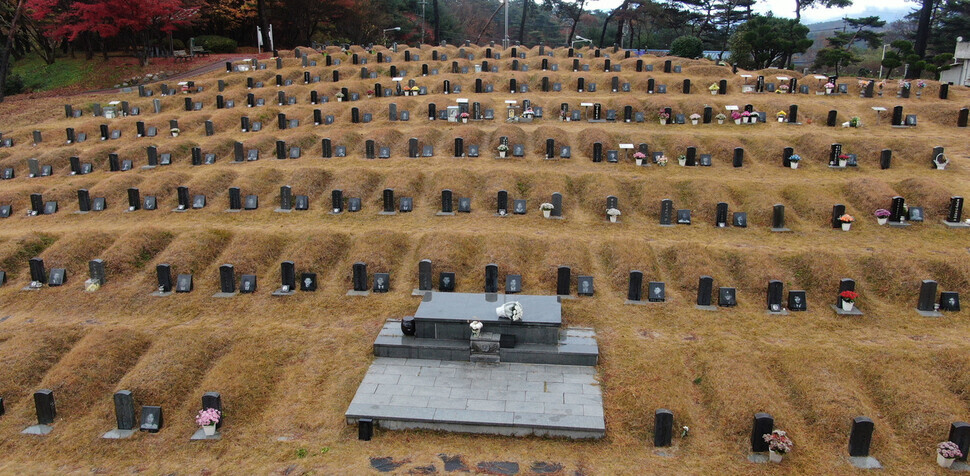

Rain drizzles on the Mangwol ceremony, the burial site of many of those killed during the 1980 massacre, on Tuesday, the day Chun Doo-hwan died. (Kim Hye-yun/The Hankyoreh)

Posted on : Nov.24,2021 17:25 KST Modified on : Nov.24,2021 17:25 KST

Chun Doo-hwan, who was responsible for the massacre in Gwangju in May 1980, died at his home in the Yeonhui neighborhood of Seoul on Nov. 23, unapologetic and unremorseful until the very end. While it’s our practice and inclination to be somewhat magnanimous to the deceased, no sympathy can be felt for the death of the ringleader of a rebellion who seized power through a coup and butchered Koreans who tried to resist.

Chun’s junta, which took power in a coup on Dec. 12, 1979, smashed the “spring of democratization” in 1980 and crushed a movement for democracy in Gwangju that May with military force. Chun slaughtered innocent civilians to satisfy his lust for power. He committed crimes that history will never erase. Even after seizing power, he persisted in his pitiless tyranny, violating democracy and human rights and inflicting grievous pain on the public. He also kept cozy ties with Korea’s chaebol — family-owned conglomerates — and pocketed huge bribes from them.

Chun had several opportunities to repent before his death. But he continued making audacious excuses for his crimes and indulging in self-justification until his death. Not once did he exhibit the slightest trace of remorse.

When he was put on trial for sedition and for his role in the Gwangju massacre during the presidency of Kim Young-sam, he said that the Gwangju democracy movement had been “a scheme hatched by leftist groups” and he described the movement as an “insurrection” in his memoir, which was published in 2017. Chun slandered late Catholic priest Cho Pius — who testified to seeing government troops shooting at protesters from helicopters during the uprising — as being “Satan in disguise” and “a shameless liar.”

Chun is often compared to Roh Tae-woo, who passed away a month ago. But at least Roh offered an apology through his surviving family members, who reported that he’d “asked for forgiveness for his mistakes.”

Another point of contrast with Roh is that Chun didn’t pay the restitution he owed the government for 25 years. The prosecutors managed to seize 124.9 billion won (US$105.01 million) of his assets, but Chun still owed almost just as much — 95.6 billion won (US$80 million). When the prosecutors placed Chun’s home in Yeonhui neighborhood up for auction in an attempt to collect the rest of the money, Chun’s family members brazenly sued to stop the auction.

Chun’s wife, Lee Soon-ja, has earned her own share of public scorn. She claimed in her autobiography in 2017 that Chun’s responsibility for the massacre in Gwangju was a “political distortion of history” and made the wild claim prior to attending a court hearing in 2019 that “my husband is the father of democracy in the Republic of Korea.”

Throughout his life and until its very end, Chun committed crimes against the Korean people and history itself. It would be extremely inappropriate for government officials or politicians to convey their condolences or attend his wake, not to mention holding a state funeral for the man.

It’s regrettable that the Blue House nevertheless said on Tuesday, “We express our condolences for Chun Doo-hwan and express our sympathy to his bereaved family.” Officials added that there were “no plans to send flowers or pay respects at his wake” given Chun’s failure to offer “a sincere apology.” Even so, we consider the Blue House’s comments unfit for a butcher like Chun. The people who deserve our sympathy are the victims of the massacre in Gwangju and their bereaved family members, who never received a single word of apology from Chun.

There have recently been some regressive efforts to rehabilitate Chun. That apparently prompted Yoon Seok-youl, presidential candidate for the People Power Party (PPP), to remark that “many people say that Chun Doo-hwan was really good at politics aside from the coup and the events of May 1980” — a remark for which Yoon eventually apologized.

We must be cautious and alert about such efforts and must not tolerate them. Undeniably, the democratization of Korean society has continued since the protests of 1987 while surmounting a number of obstacles.

The PPP decided not to release an official statement on Chun’s death. Its cowardly silence is presumably motivated by concern for public opinion and its own hardcore supporters on the far right. Political groups that don’t fear history are no more than special interest groups representing their supporters. The essence of a conservative party is prioritizing public safety above all else. With its current attitude, the PPP won’t be able to break out of the confines of a reactionary party.

With the consecutive deaths of Roh Tae-woo and Chun Doo-hwan, the era of military dictatorship in Korea has at last receded into the past. In effect, Korea has turned a page in its history.

Even so, we must keep trying to learn the full truth about the massacre in Gwangju. That includes determining who ordered the martial law troops to fire the first shots at Gwangju Station at 10:30 pm on May 20, 1980, and to fire the first volleys in front of South Jeolla Provincial Office at 1 pm on May 21, as well as identifying the missing people whose fate remains unknown and finding and recovering the bodies of the victims.

Our failure to uncover more about what happened on that day 41 years ago should have us hang our heads in compunction before Gwangju’s victims, before those like Park Jong-chul and Lee Han-yeol who died in the struggle for democracy, and before history itself. In the tribunal of history, there is no statute of limitations.

Please direct questions or comments to [english@hani.co.kr]

Witness to history and survivor of Gwangju Uprising dies on same day as Chun Doo-hwan


Lee Gwang-yeong dedicated his life to uncovering the truth of the Gwangju Uprising and its brutal suppression, and took the witness stand in 2019 in the case against Chun for defaming the dead
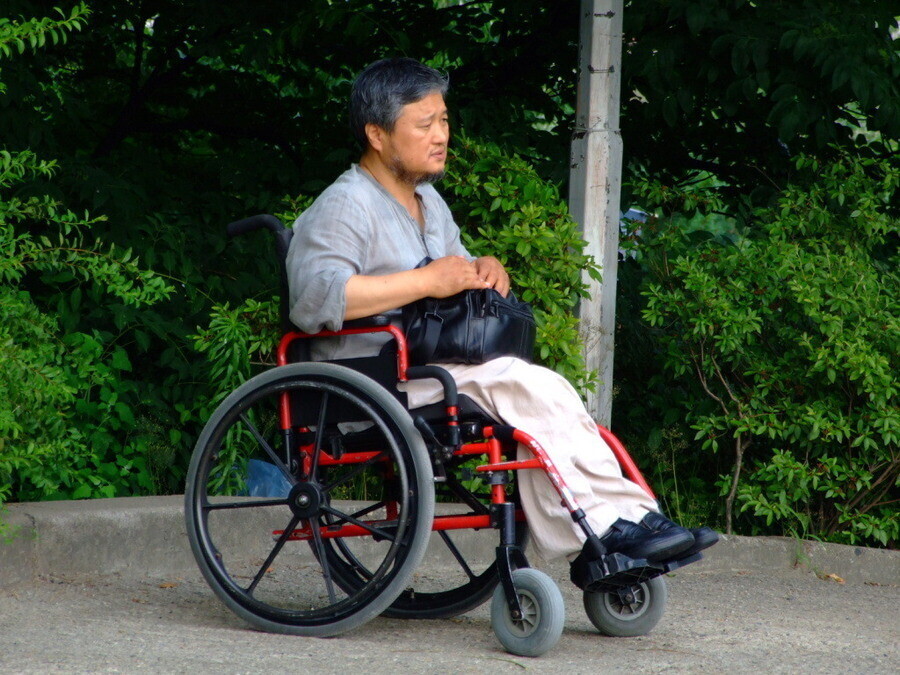

Lee Gwang-yeong, pictured here, testified to witnessing a military helicopter opening fire on civilians during the democratic popular uprising in Gwangju, May 1980. (Hankyoreh archive photo)

Posted on : Nov.25,2021 

Sighs of disbelief could be heard among those gathered at the wake of Lee Gwang-yeong, 68, in the Buk District of Gwangju on Wednesday.

“He’d fought his whole life against Chun Doo-hwan, and now he’s left us. God only knows how hard that was,” one of the visitors said.

Lee’s body had been found the day before in a reservoir in Gangjin County, South Jeolla Province, the place where he’d been born. Before his death, he wrote a short note on a piece of paper in his home in Iksan, North Jeolla Province. Considering that Lee drove himself to Gangjin, the police concluded that he had died by suicide.

Lee had been paralyzed from the waist down — the result of being shot in the spine by government troops sent to suppress the Gwangju Uprising in 1980.

“The last time we spoke on the phone was a week ago, so I was really shocked to hear the news yesterday. He’d always been in a lot of physical and mental pain, and then this,” said Lee Ji-hyeon, inaugural chairperson of an association for people injured in the Gwangju massacre.

“My brother had been in so much pain [recently] that he’d become dependent on painkillers,” said Lee Gwang-seong, 61-year-old younger brother to Gwang-yeong. “I think he went down this path because of his personality — he never wanted to be a burden on others.”

It’s presumed that Lee Gwang-yeong passed away around midnight on Tuesday. After Chun Doo-hwan died at 9 am that very morning, survivors of the Gwangju massacre drew attention to the tragic fate connecting the two.


Lee, then a Buddhist monk who went by Jingak, was on his way to Jeungsim Temple, near Gwangju, on May 19, 1980, when he took part in the uprising. He was helping transport injured people to the hospital on May 21 when he was struck in the spine by a bullet fired by the martial law troops.
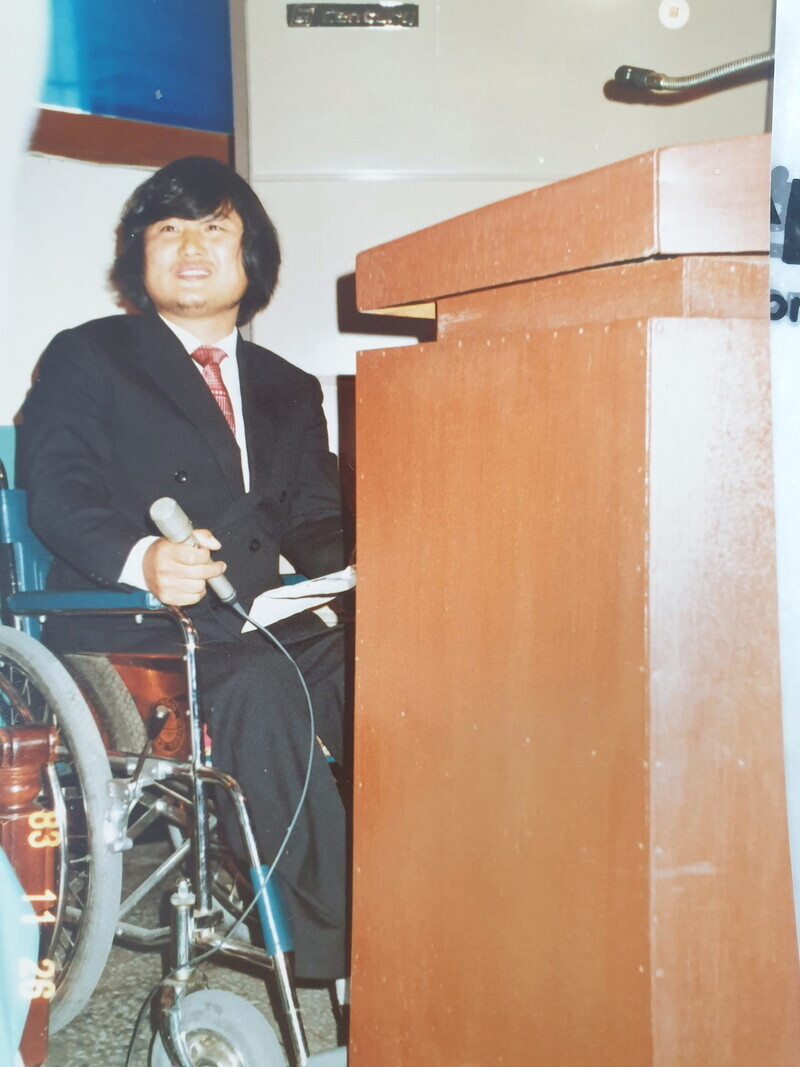

Lee Gwang-yeong emceed the wedding of Lee Ji-hyeon, the inaugural president of an association of those injured during the Gwangju Uprising, in 1983. (provided by Lee Ji-hyeon)

During his hospital stay, Lee returned to secular life and started a family. He ran a comic book shop and supplied food to schools.

Lee played an active role in bringing to light the truth of the Gwangju Uprising and the slaughter of protesters. He helped set up the association for the injured in 1982 and testified in the Gwangju hearings at the National Assembly in 1988.

Along with late Catholic priest Rev. Cho Pius, Lee was one of the major figures who testified that martial law troops had fired on protesters from helicopters during the massacre. He was the first witness to testify in Chun’s first trial on charges of defaming the dead in May 2019.

“I was riding in a military jeep around 2 pm on May 21, 1980, when I witnessed helicopter gunfire while we were passing the roundabout at the Wolsan neighborhood in the Nam District of Gwangju,” he said.

Kang Seong-won, 59, one of the founding members of the association for the injured, had been close to Lee over the years. “He threw himself into the cause of uncovering the truth of the massacre and of bringing democracy [to Korea]. It’s so unfair to think he left us because he couldn’t bear the pain while Chun got to pass so peacefully.”

Almost every year, more massacre survivors end their lives, a troubling indication of the physical pain and psychological trauma they have suffered. Chung Byeong-gyun, who had been living alone, was found dead in September 2020.

According to a paper published in June by Kim Myeong-hee, a professor of sociology at Gyeongsang National University, 46 massacre survivors died by suicide between 1980 and 2019.

By By Kim Yong-hee, Gwangju correspondent
Please direct questions or comments to [english@hani.co.kr]


“It tears me up inside”: Mother of teen gone missing in Gwangju massacre reflects on death of Chun Doo-hwan

The city of Gwangju has recognized 84 people as having gone missing during the events of May 1980 in Gwangju
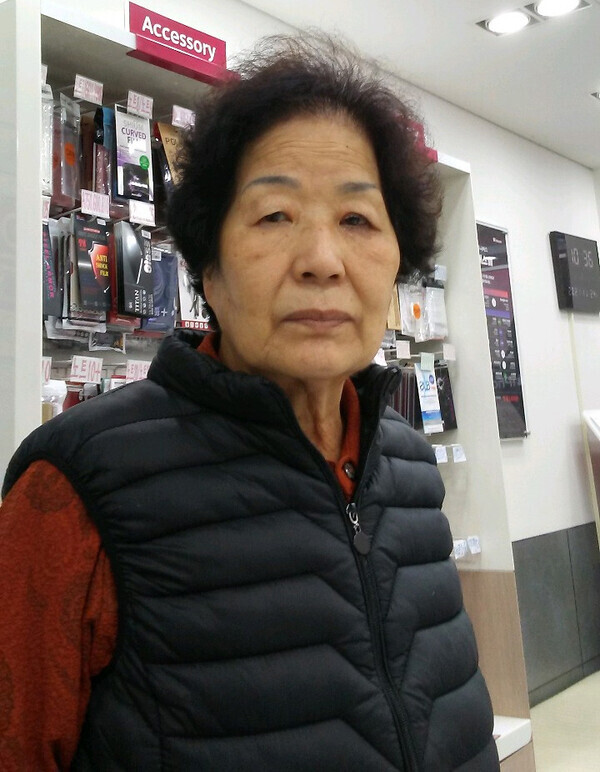

Kim Jin-deok, whose son went missing during the Gwangju Uprising. (provided by Kim Jin-deok)

Posted on : Nov.25,2021 

“My only wish is to find even a sliver of my son’s bones before I die… It tears me up inside to think that that man, Chun Doo-hwan, could just croak on us like that without so much as a single word.”

Kim Jin-deok, 77, who lives in Goheung County, South Jeolla Province, sighed with exasperation during a phone conversation with the Hankyoreh on Wednesday.

Kim’s son, Im Ok-hwan, set out from the temple where he’d been staying with friends to return to his home in Goheung in May 1980, while the Gwangju Uprising and its bloody suppression was underway. Im, who was a 17-year-old student in his second year of high school at the time, was never heard from again.

“After hearing about the trouble in Gwangju in May of 1980, I would speak on the phone with Ok-hwan every day. On the evening of May 19, Ok-hwan said to me, ‘Mom, I’m fine — don’t worry about me.’ That was our last phone call,” she recalled.

No longer able to reach her son on the phone, Kim headed to Gwangju on May 22. The bus only took her as far as Hwasun County, meaning she had to walk the rest of the way.

When she reached the temple where Im had been staying, Kim was told her son had left on May 21, apparently headed home. Upon hearing that, Kim collapsed on the spot.

Kim roamed through the hill behind Chosun University, the direction her son would have been heading, but she couldn’t find any traces of him. She walked around Gwangju until her feet were blistered, stopping by Chonnam National University Hospital and Chosun University Hospital, but her son was nowhere to be seen.

Assuming that Im was dead, the family prepared burial garments for him and returned to Gwangju on June 2. Neighbors joined the family in searching for him. They visited the Sangmugwan army gymnasium near the old South Jeolla Provincial Office where the bodies of the dead had been stored, but by the time they arrived, the bodies had already been moved elsewhere.
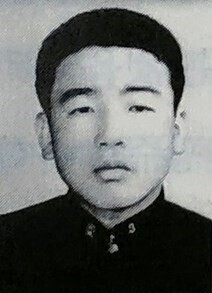
Im Ok-hwan, who went missing during the Gwangju Uprising in May of 1980
 (provided by the May 18th National Cemetery)

The family and friends returned to the slopes of the hill behind Chosun University. The troops enforcing martial law refused to give them permission to access the area, but the police let them in after learning the circumstances. They found items left behind by the troops — including soju bottles, bread wrappers, and truncheons — but nothing that could tell them what had become of Im. They tried digging with their bare hands, wondering if the teenager had been given a shallow burial, but failed to find anything.

Later, one of Im’s friends who had been staying at the temple told Kim that they’d been crossing the hill when they heard gunshots. The group had scattered at that point, and that was the last they saw of Im.

Im’s father, Im Jun-bae, became president of a group of family members of those who disappeared in the massacre in Gwangju, and Kim’s family members traveled to Gwangju, Seoul, and other areas along with bereaved families of massacre victims asking people to help find Kim’s son. But each time, a township official who was assigned to monitor Kim’s family stopped her from going. In Kim’s eyes, that official was just as bad as Chun Doo-hwan himself.

Researchers of the Gwangju Uprising think that Im’s disappearance may be linked to the 7th Airborne Brigade, which was deployed to Gwangju to suppress the uprising. When civic resistance stiffened after troops fired into a crowd of protesters in front of the old South Jeolla Provincial Office on May 21, 1980, government troops drew a cordon around the city to isolate it from the outside world.

On the afternoon that Im went missing, the 872 enlisted soldiers and officers in the 7th Airborne Brigade, which had been stationed at Chosun University, moved across the hill behind the university to Neoritjae, a hill on the boundary between Gwangju and Hwasun. That overlapped with the route presumably taken by Im as he headed toward Hwasun on foot.

Kim says that all she wants is to find her son’s remains and bury them in a sunny spot. “My husband often laments that he probably won’t even find Ok-hwan’s bones before he dies. It makes me furious to think that powerless people like us are living with such pain while Chun Doo-hwan gets to die in comfort.”

The city of Gwangju recognized a total of 84 people as having disappeared during the Gwangju massacre. Six of them were identified when the bodies of victims were moved to a different cemetery in 2001, but the whereabouts of the other 78 remain unknown. For those who went missing without friends or family, hardly any information has yet to be ucovered.

By Kim Yong-hee, Gwangju correspondent
Please direct questions or comments to [english@hani.co.kr]

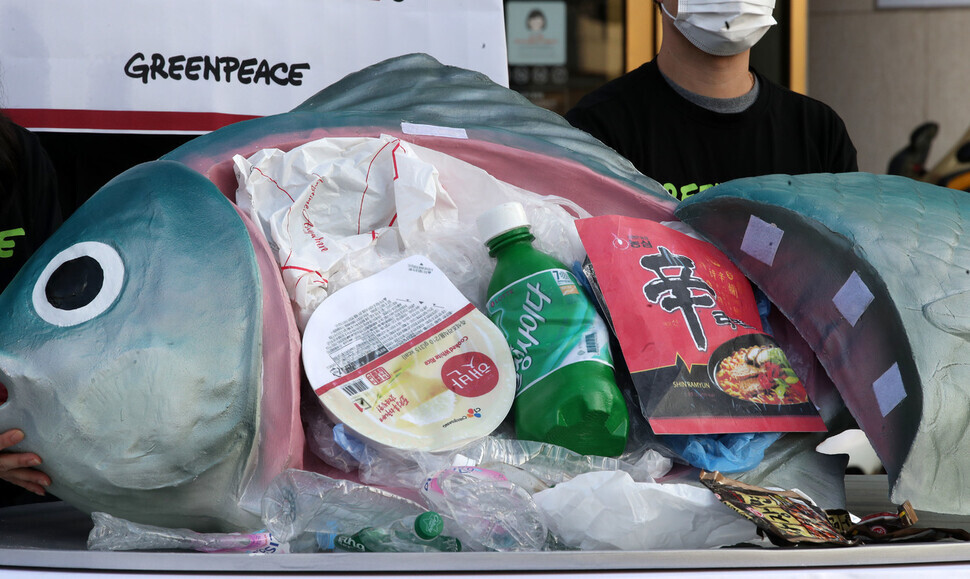


[Photo] A belly full of plastic

Members of Greenpeace Korea staged a protest Thursday calling on food manufacturers to reduce their use of plastic


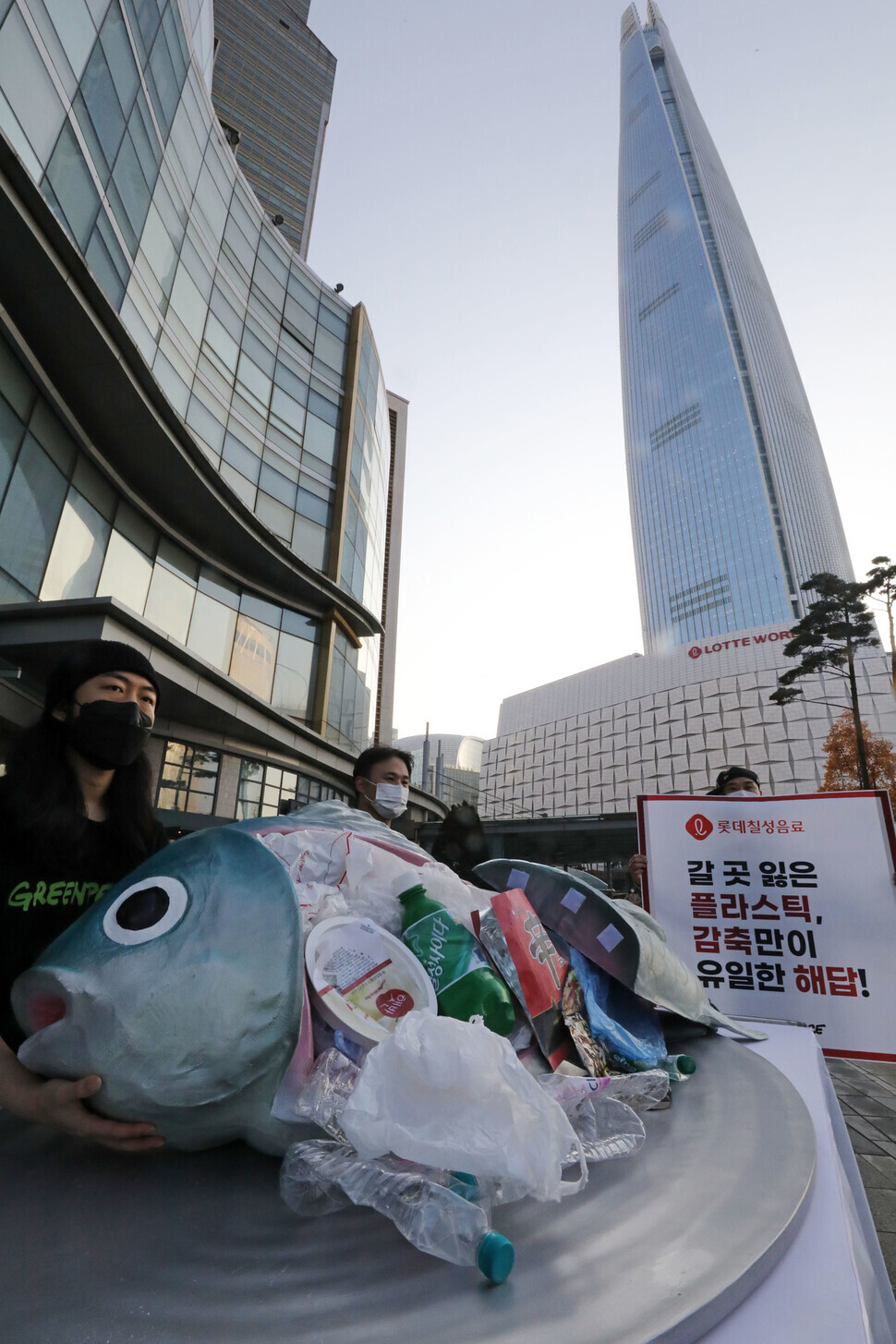
Activists with Greenpeace Korea stage a protest in front of the offices of Lotte Chilsung Beverage in Seoul’s Songpa District on Thursday, calling on food manufacturers to cut their use of plastic packaging.
(Kim Hye-yun/The Hankyoreh)

Posted on : Nov.25,2021 

The environmental advocacy group Greenpeace Korea staged a protest in front of the offices of several food manufacturers on Thursday, calling on the companies to reduce the amount of plastic they use.


Activists with Greenpeace Korea stage a protest in front of the offices of Lotte Chilsung Beverage in Seoul’s Songpa District on Thursday, calling on food manufacturers to cut their use of plastic packaging.
(Kim Hye-yun/The Hankyoreh)

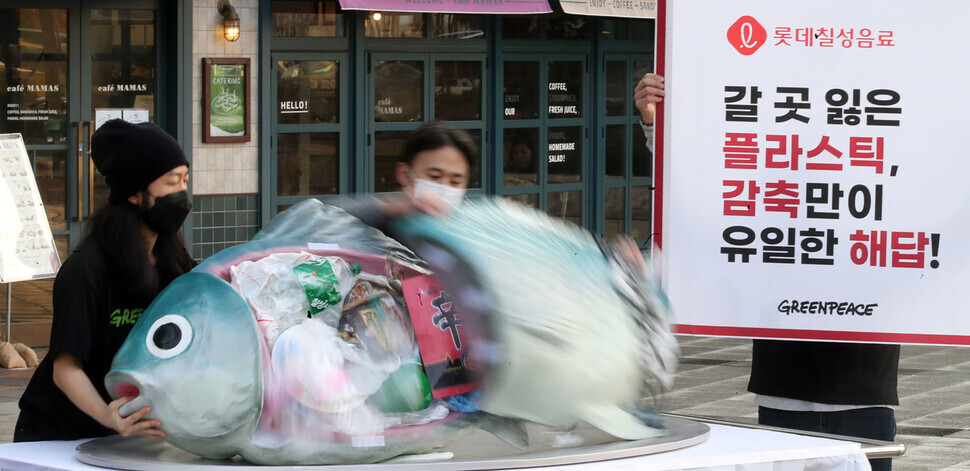
The protest took place in front of the offices of Lotte Chilsung Beverage in Seoul’s Songpa District. To illustrate the gravity of plastic pollution, protesters cut open a model of a fish to reveal that it was full of various plastic bottles, instant food containers, and a variety of other single-use disposable items. One protester held up a placard reading, “With nowhere else to go, the only answer for plastic is to reduce its use.”

The protesters said that as food manufacturers continue to contribute to the mass production and consumption of single-use plastic packaging, plastic continues to make its way into the ground and water, where it pollutes ecosystems.


Greenpeace Korea activists open up a large model fish to reveal its stomach full of plastic waste.
 (Kim Hye-yun/The Hankyoreh)

By Kim Hye-yun, staff reporter
Please direct questions or comments to [english@hani.co.kr]
BTS makes history as first Asian act to win top honor at AMAs

The K-pop juggernaut walked away from Sunday’s awards with trophies for Artist of the Year, Favorite Pop Song and Favorite Pop Duo/Group

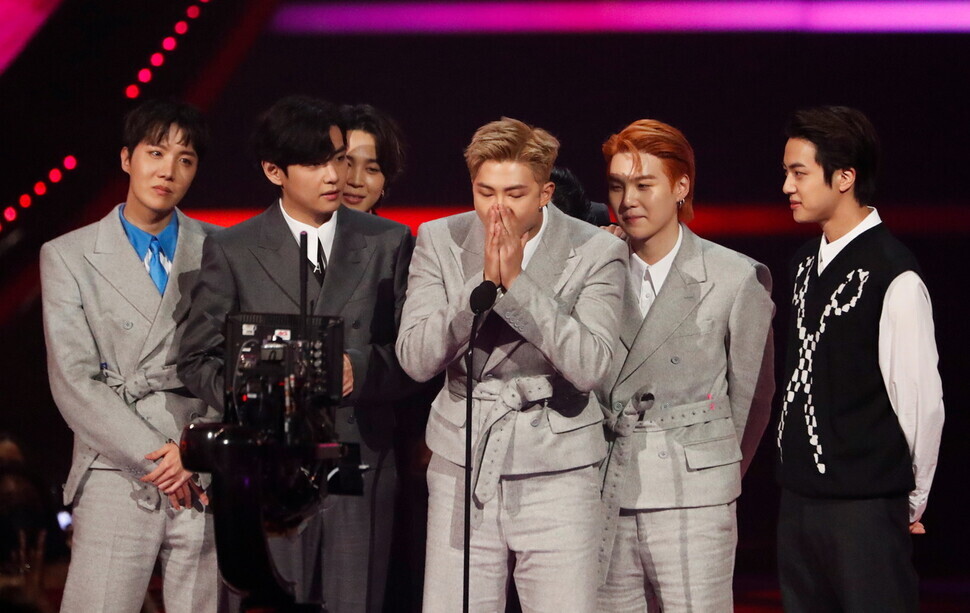
BTS takes the stage at the 2021 American Music Awards on Sunday in Los Angeles after winning Artist of the Year. (Reuters/Yonhap News)

Posted on : Nov.23,2021 

“Four years ago, we gave this first-time ever TV live performance on this stage, the AMAs [American Music Awards],” said BTS leader RM on Sunday evening as the group became the first Asian act in history to receive the Artist of the Year prize at the 2021 American Music Awards (AMAs) during this year’s ceremony in Los Angeles

“It was [a performance of the song] ‘DNA.’ We were, like, too excited and nervous at the time. It’s been a long and amazing ride since then, but nobody could have ever bet on the odds of us standing here receiving this award — except y’all, Army,” he continued.

BTS captured three of the top awards at the ceremony that evening, including Favorite Pop Song and Favorite Pop Duo/Group in addition to Artist of the Year. The AMAs are considered one of the US’ top three popular music award ceremonies, alongside the Grammys and Billboard Music Awards.

The competition for Artist of the Year was as fierce as it has ever been. To win the honor, BTS beat out US pop star Taylor Swift — the most honored artist in the history of the awards with 32 prizes to date — along with such big names as Ariana Grande, Olivia Rodrigo, Drake and The Weeknd.

“We just wanted to make people happy with our music,” BTS member Jungkook said in his acceptance speech.

“We believe that this opens up the beginning of our new chapter. In the past few years, we learned that each and every moment is precious.”


BTS poses for photos with the three trophies they won during the 2021 AMAs, in Los Angeles on Sunday. (Reuters/Yonhap News)


BTS has now won awards at four straight AMAs dating back to 2018. The group has won the Favorite Pop Duo/Group award for three years running. It has also set a record by winning in every category where it has been nominated to date.

As RM indicated in his acceptance speech, the AMAs were where BTS made its US television debut. The group introduced itself to US viewers with a performance of their song “DNA” at the ceremony in 2017.

It was the same year that BTS made its debut on the Billboard Hot 100 singles chart with the same track, which peaked at No. 67.

Four years later in 2021, BTS topped the chart for 10 weeks with its song “Butter” and reached the top spot with its follow-up “Permission to Dance” and their collaboration with Coldplay, “My Universe.”

With the AMAs victory, the group has finally snagged a top prize at one of the top three popular music award ceremonies four years after its US debut. Analysts see this as a sign that BTS hasn’t just succeeded in the world’s pop capital — it has established itself as the world’s top pop act.

“Over the past few years, the US music industry has been trying to use BTS to invigorate the industry as a whole, and now BTS has become the very face of the US music industry,” said popular music critic Kim Young-dae.

“This award marks the zenith of the 20-year history of ‘global K-pop,’” he said.


Since 2006, the AMAs have selected winners by popular vote rather than expert ballots. This year’s results appear to be an especially strong reflection of Gen Z members voting by way of TikTok, one of the most popular social media platforms in the US today.


“The AMAs select [winners] entirely through fan voting, so this award is very symbolic in terms of popular appeal,” Kim said.


BTS performs with Coldplay on Sunday evening in Los Angeles at the 2021 AMAs. (Reuters/Yonhap News)

Park Sun-hwa, who operates a YouTube channel out of the US, said, “The fact that a Korean act won a top award at one of the US’ top three awards ceremonies in the US itself— the toughest music industry around — is a source of great strength and courage to us Koreans.”

“They won the ‘hat trick of hope,’ giving us a sense of pride in Korean DNA,” she added.

Park also said, “While the award itself is important, it’s also very symbolic that [BTS] broke the glass ceiling in a powerful country like the US.”

“BTS shows that if you have the talent, you can overcome [barriers of] race and nationality,” Park said.

Lee Jeong-yoon, a senior at the University of California, Los Angeles, said, “It’s amazing that a Korean act is producing notable results at major award ceremonies, but it also feels like something we’re getting more and more used to.”

“It felt like a lot of my US friends liked BTS, but this trifecta of awards really drives home how popular K-pop is,” Lee said.

The AMAs are also seen as something of a dry run for the 64th Grammy Awards, which take place on Jan. 31 of next year. Grammy nominees are scheduled to be announced Tuesday.

At the 2020 Grammys in March, BTS became the first Korean act nominated in the category of Best Pop Duo/Group Performance, although it did not end up winning.

Kim Young-dae said, “It looks possible that [BTS] could be nominated for one of the top four Grammys, and it may well win in the genre category of Best Pop Duo/Group Performance.”

By Jung Hyuk-june, staff reporter
Please direct questions or comments to [english@hani.co.kr]
Former US special envoy calls 30 years of US policy on N. Korea a failure

The comment came during a session at the 17th Hankyoreh-Busan International Symposium 


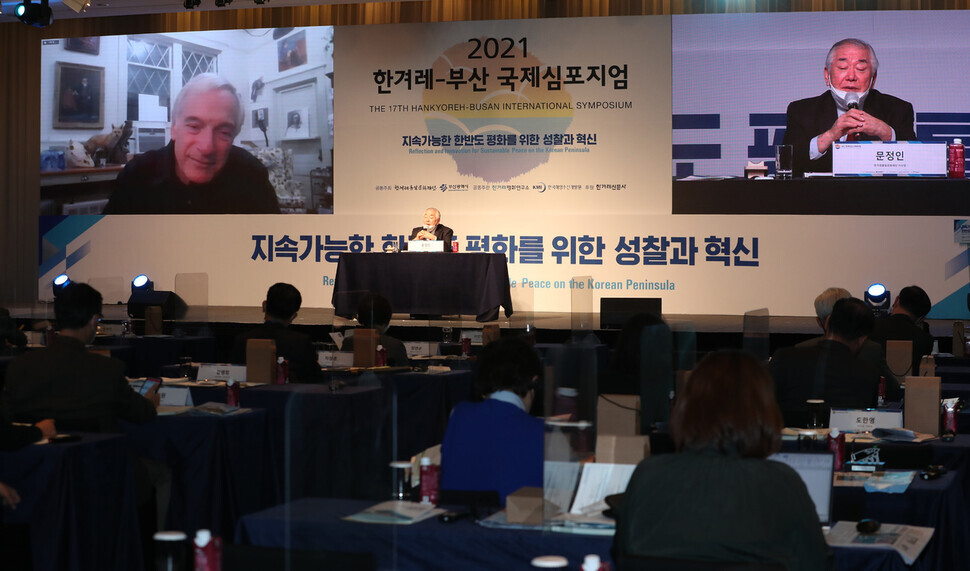
Chairman of the Hankyoreh Foundation for Reunification and Culture Moon Chung-in (center and right) speaks with former US special envoy for the North Korean nuclear issue Robert Gallucci on Wednesday at the 17th Hankyoreh-Busan International Symposium held at Westin Josun Busan Hotel in Busan’s Haeundae District. (Kang Chang-kwang/The Hankyoreh)

Posted on : Nov.18,2021 

The 17th Hankyoreh-Busan International Symposium, organized under the title “Reflection and Innovation for Sustainable Peace on the Korean Peninsula,” kicked off Wednesday at the Westin Josun Busan Hotel in Busan’s Haeundae District.

The two-day event is jointly organized by Busan Metropolitan City and the Hankyoreh Foundation for Reunification and Culture. Participants focused their attention on examining why the progress seemingly made with peace on the peninsula has been repeatedly frustrated, while exploring avenues for future change.

Robert Gallucci, a former US State Department special envoy on the North Korean nuclear issue, took part via videoconference to deliver a keynote presentation and take part in a special conversation with Moon Chung-in, chairman of the Hankyoreh Foundation for Reunification and Culture.


In his remarks, Gallucci described the last 30 years of US policy on North Korea as a failure, adding that the US’ insistence on North Korea’s complete, verifiable, irreversible denuclearization was realistically unfeasible.

He also stressed the need for the US to understand North Korea’s motives for developing nuclear weapons and to pursue negotiations with patience.

Moon attributed the failure of the US’ North Korea policies to a “failure to properly motivate North Korea.”

“The assumption in Washington that North Korea ‘possesses nuclear weapons for the purpose of a communist reunification [of the Korean Peninsula] is a faulty analysis,” he said.


In a welcome address Wednesday, Busan Mayor Park Heong-joon said he looked forward to the symposium as “an occasion for seeking out ideas for Busan to play a role in and work together on peace and shared prosperity as a base for Eurasian cooperation and business, while focusing attention on the bid for Busan to host the Expo 2030 world fair.”

In a congratulatory address, South Korean Minister of Unification Lee In-young referred to a declaration officially ending the Korean War as a “wise solution that would be both a driving force for real peace on the Korean Peninsula and a catalyst for dialogue among South and North Korea and the US.”

Sin Sang-hae, chairperson of the Busan Metropolitan Council, stressed that peace on the Korean Peninsula and in East Asia was a “matter of intense interest for Busan, which has lofty dreams of serving as a gateway to the Eurasian continent.”

In a congratulatory address, CEO of the Hankyoreh newspaper Kim Hyun-dae said that the newspaper would “open up a forum for public discussion toward a world of peace.”

The first session of the symposium that day focused on the topic “Trio of Discontent: Why Peace Hasn’t Come to the Korean Peninsula.” It featured presentations by Li Tingting, professor at Peking University; Chin Hee-gwan, professor at Inje University; and Jenny Town, director of the 38 North website.

The symposium’s second session focused on the topic “A Triangle of Hope: How to Achieve Peace on the Korean Peninsula.” Participants included co-director of Foreign Policy in Focus at the Institute for Policy Studies John Feffer and Suh Jae-jung, professor of political science and international relations at the International Christian University in Tokyo.

By Kwon Hyuk-chul, staff reporter
Please direct questions or comments to [english@hani.co.kr]
What the US, China mean by maintaining the status quo on Taiwan

Maintaining the status quo on Taiwan is a win-win for the US and China, so why are they continuing to fight over it?


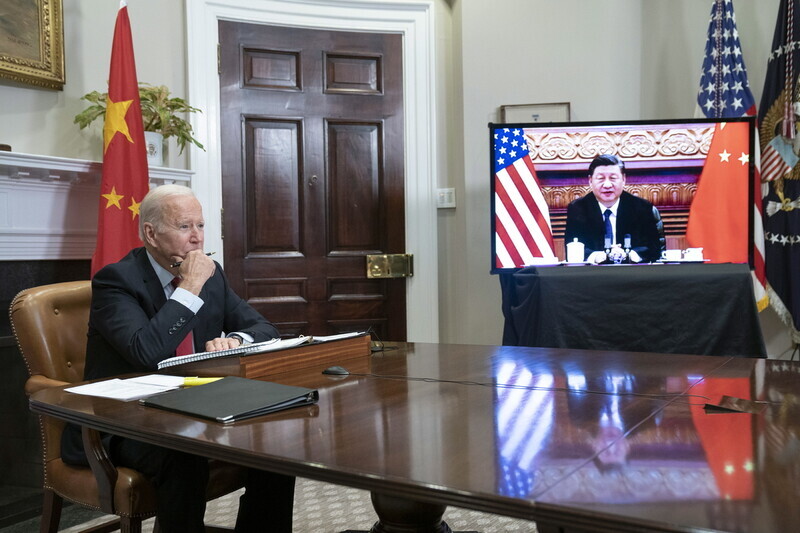
US President Joe Biden and Chinese President Xi Jinping discuss Taiwan during a virtual summit held on Nov. 15. (EPA/Yonhap News)

Posted on : Nov.28,2021 

Despite being a hotspot in today’s rivalry between the US and China, Taiwan was the last territory to be incorporated into China. The island officially came under the rule of the Qing Dynasty in 1683, after the complete suppression of Koxinga, who ruled one of the last remnants of Ming China. Koxinga — the better-known moniker of Zheng Chenggong — launched his resistance against Qing invaders on China’s southeastern coast. He eventually moved to Taiwan and established a fiefdom that was later subjugated by armies sent by the Qing.

Until that time, Taiwan had never even been given a formal name in China. The island’s incorporation into China at the hands of Koxinga and its subsequent arrival on the stage of world history is tied to the Western powers’ encroachment upon Asia that began in the 15th century. Early on, the Ming Dynasty launched treasure voyages under Adm. Zheng He that had gone as far as the eastern coast of Africa, but China abruptly halted those journeys and instituted a “sea ban” on maritime activities

A refuge for defeated forces


That effectively left the seas of East Asia without an owner. When the Portuguese opened a sea route to Asia around the Cape of Good Hope, therefore, they managed to travel as far as Japan within 50 years and began to gain maritime supremacy. When the Portuguese stumbled upon Taiwan en route to Japan, they named it Formosa — a name that stuck in the West until World War II. Later, the Dutch East India Company established and administered a colony on the coast of Taiwan until they were pushed out by Koxinga.

Koxinga’s forces were among the various non-state powers to operate in the waters of East Asia after the Ming Dynasty surrendered supremacy with its ban on maritime activities. A substantial portion of the wealth of the southeastern coast of China — which had been the center of the Chinese economy since the Song Dynasty — had been based in sea trade. These non-state maritime powers collaborated with the Wokou pirates from Japan to dominate smuggling and other kinds of informal maritime trade.

The Japanese invasions of Korea in the late 16th century, during the fading days of the Ming Dynasty, showcased how Japan had been strengthened by its trade with the European powers. The Wokou emerged as a byproduct of that. While these pirates were the epitome of a non-state maritime power, Koxinga was their apotheosis. The nature of those forces was illustrated by the fact that Koxinga himself was born to a Japanese woman and grew up in Japan.

Now China faced another geopolitical challenge in addition to unifying and stabilizing the Central Plains, inhabited by the Han people, and creating a buffer region in the areas to the west and north — Xinjiang, Mongolia, Manchuria and Tibet — that were home to peoples who had threatened the security of the Central Plains since long ago. The latest challenge was cordoning off the southeastern coast. Over time, that became China’s most critical geopolitical challenge, with Taiwan at its heart.

After Japan completed its partial colonization of China with its victory in the First Sino-Japanese War, it made a point of forcing China to cede Taiwan to it.

The leadership of the US navy — including Adm. Chester Nimitz, who led the US to victory in the Battle of Midway and tipped the scales toward US victory in the Pacific War — called for advancing as far as Okinawa after the adoption of the “island-hopping” strategy that aimed to circumvent Japanese forces stationed throughout the Pacific Ocean. They selected Taiwan as the staging ground for the assault on the Japanese home islands that would be launched from Okinawa.

In contrast, the US army under Gen. Douglas MacArthur was determined to push north against the Japanese military and retake the Philippines. That was a matter of personal honor for MacArthur since the Japanese had pushed the US Army Forces in the Far East out of the Philippines and all the way to Australia. MacArthur gained control of the American war machine toward the end of the war, meaning the US military didn’t station troops in Taiwan.

In an echo of history, the Chinese Nationalists, also known as the Kuomintang, retreated to Taiwan, just as Koxinga had done long before, following their defeat on the mainland by the Communists in the Chinese Civil War. If American troops had been stationed in Taiwan at the time, it would likely have added a disturbing wrinkle to subsequent conflict in East Asia. Consider that when MacArthur’s troops were being pushed back by the Chinese in the Korean War, he advocated not only bombing Manchuria but also mobilizing Taiwanese forces to invade southeastern China.

After the US and Taiwan signed a mutual defense treaty in 1954, following the Korean War, mainland China continued to incite crises in the Taiwan Strait that have occasionally flared up until the present. In the First Taiwan Strait Crisis, China drove ROC troops from the Tachen Islands, off the coast of China, and repeatedly bombarded the Kinmen and Matsu islands.

China provoked the Second Taiwan Strait Crisis in 1958 by again bombarding the Kinmen Islands. That crisis could have led to all-out war: the US threatened to drop the A-bomb on China and deployed the US Navy’s Seventh Fleet to the region.

China regularly shelled Kinmen until establishing diplomatic relations with the US in 1979, with the action becoming a kind of military ritual. When Lee Teng-hui, an advocate for Taiwanese independence, was elected president of Taiwan in 1996 — at a time when the US and China were on good terms — China brought about the Third Taiwan Strait Crisis by test-launching missiles in the strait.

Through that military ritual, China reasserted its sovereignty over Taiwan and indicated its willingness to wage all-out war. China’s military ritual has recently evolved into incursions into Taiwan’s air defense identification zone. Chinese jet fighters have made nearly 200 such incursions this year alone.

If the shelling of Kinmen symbolized China’s ground forces, the incursions into Taiwan’s air defense zone showcase China’s air and sea power and its maritime supremacy.

Taiwan was a key point of contention when the US and China were establishing diplomatic relations. One reason the process took so long was because of China’s claims about the status of Taiwan. When Richard Nixon abruptly visited China in 1972, Mao Zedong dodged questions about Taiwan, saying the issue could be discussed “in a hundred years.”

That’s how the US and China were able to agree to the “status quo” approach of maintaining Taiwan’s current status while the US also agreed to the principle of “One China,” which defines Taiwan as being part of China.

Maintaining status quo on Taiwan means different things to US, China

Taiwan currently plays a key role in the supply chain for China, which is the workshop of the world.

Foxconn, which manufactures iPhones, and TSMC, the world’s largest chipmaker, are Taiwanese companies that largely operate in the Chinese market. The major distribution companies operating in China are based in Taiwan, too.

Maintaining the status quo in Taiwan is essential for the international community — including China, Taiwan and the US.

While Biden and Xi did not mince words regarding their positions on Taiwan during their first virtual summit on Nov. 15, they basically emphasized maintaining the status quo in Taiwan. Biden said the US holds to the principle of “One China” and firmly opposes unilateral action that would change the status quo in the Taiwan Strait.

Xi responded that China will patiently strive for “peaceful reunification” but will be forced to take “resolute measures” if Taiwanese independence forces provoke China or “cross the red line.”

The US and China were warning each other not to upset the status quo on Taiwan. “We need to establish some commonsense guardrails,” Biden said.

The White House explained that a guardrail would be set up to preserve responsible competition. The guardrail between the US and China means maintaining Taiwan’s de facto independence under the “One China” principle.

Considering that maintaining the status quo on Taiwan is a win-win game for everyone, conflict over Taiwan would seem irrational. But history shows that countries often disobey the dictates of reason.

While confrontation between the US and China may be inevitable, the two countries need to maintain the guardrail and avoid crossing each other’s red lines. The reason they’re wrangling over Taiwan even while both talk about maintaining the status quo there is because of Taiwan’s great geopolitical value.


By Jung E-gil, senior staff writer
Please direct questions or comments to [english@hani.co.kr]

S. Koreans over 60 are living in deficit, pointing to more people delaying retirement


Figures published by Statistics Korea show that Koreans start to earn more than they spend at age 28, but that by age 60, they were back in the red


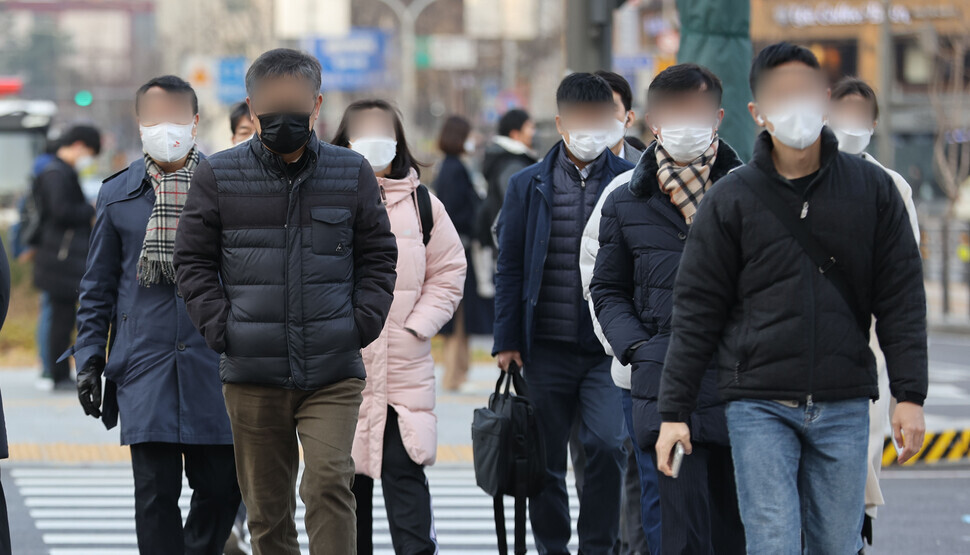
People make their way across a crosswalk in central Seoul’s Gwanghwamun on Thursday morning. (Yonhap News)

Posted on : Nov.26,2021

South Koreans start living in the black at the age of 28, peaking at age 41, then fall back into the red at 60, government figures show.

The 2019 national transfer accounts, published by Statistics Korea on Thursday, show that in terms of per capita life cycle, spending exceeded labor income for Koreans from birth to age 27. There was a large deficit between the ages of 6 and 17 because of educational expenses, with the biggest deficit occurring at 17 (34.37 million won).

At the age of 28, labor income begins to overtake spending, with Koreans making the most labor income at the age of 41 (36.38 million won, or US$30,500) and reporting the biggest livelihood surplus at the age of 44 (15.94 million won).

Spending regains the lead over income once individuals reach the age of 60. Individuals’ livelihood deficit is around 15 million won in the 70s and nears 20 million won in the 80s. As people gradually push back retirement, the age when surplus switches to deficit was also delayed one year, from 59 in 2018.

National transfer accounts form a dataset of age-based spending and labor income for all Koreans that is used to identify the surplus and deficit structure of economic activity for each age group. The national transfer accounts were first published in January 2019, reflecting 2015 data, with the 2016 data coming out that December. The 2017 data was released in December 2020, and now the 2018 and 2019 datasets have been released together.

In 2018, the livelihood surplus period lasted from the age of 27 to 58, with both labor income and livelihood surplus maxing out at the age of 45.

In 2019, the life cycle deficit amounted to a total of 132.9 trillion won (US$111 billion). That figure is found by subtracting labor income (969.8 trillion won) from spending (1.1 quadrillion won) over the life cycle. Labor income (4.9%) increased more than spending (4.6%) year over year. Among different categories of labor income, wage income rose 5.4%, to 928.06 trillion, while labor income among the self-employed decreased 6.0%, to 41.77 trillion won.

By age group, the working age population (aged 15 to 64) had a net outflow of 131.7 trillion won because labor income earners are the ones who shoulder the burden of taxes and contributions to social security programs. Children (aged 14 and below) and the elderly (aged 65 and above) had a net inflow of 147.5 trillion won and 117.1 trillion won, respectively, given the child subsidies, educational services, and basic pension they receive.

Private sector transfers, including gifts and inheritance, amounted to a net outflow of 99.9 trillion for the working age population and a net inflow of 77.5 trillion won for children and 16.5 trillion won for the elderly. Private sector transfers to children (77.5 trillion won) were greater than public sector transfers (71.3 trillion won).

In contrast, the elderly received more in public sector transfers (76.1 trillion won) than in private sector transfers (16.5 trillion won). That’s because government welfare programs play a bigger role in elder care than families and the private sector, Statistics Korea explained.


By Lee Jeong-hun, staff reporter
Please direct questions or comments to [english@hani.co.kr]
Hot on TSMC’s heels, Samsung Electronics picks Taylor, Texas, for new foundry location

Samsung Electronics will be investing US$17 billion into the new foundry, which is set to open in 2024


Samsung Electronics’ corporate offices in Seoul’s Seocho District. (Hankyoreh archive photo)

Posted on : Nov.25,2021 

Samsung Electronics has selected Taylor, Texas, as the site of its new semiconductor fabrication plant. Samsung will be pouring US$17 billion into the factory to help strengthen its foundry division, which has long been regarded as a weak point at the company.

Four reasons for choosing Taylor


Samsung announced the decision in a press conference at the Texas governor’s mansion on Tuesday that was attended by Gov. Greg Abbott, US Senator John Cornyn, and Samsung Electronics Vice Chairman and CEO Kim Ki-nam. Work will begin on the new factory in the first half of next year with the goal of beginning operations in the second half of 2024. The factory will be used to manufacture system semiconductors in 5G, high-performance computing and artificial intelligence (AI).

Along with Taylor, the city of Austin was Samsung’s other major contender for the factory site. The main reason the company mentioned for choosing Taylor was synergy with other facilities. The lot in Taylor, which covers close to 2 square miles, is about 15 miles away from another Samsung plant in Austin, Texas. In effect, the two factories will be linked by a drive of 20-30 minutes.

“The decision to invest in Taylor was based on multiple factors, including the local semiconductor ecosystem, infrastructure stability, local government support and community development opportunities,” the company said, adding that “the proximity to Samsung’s current manufacturing site in Austin [. . .] allows the two locations to share the necessary infrastructure and resources.”

Another major consideration for Samsung was the fact that several major buyers of system semiconductors, including Tesla, Dell and AT&T, are also based in Texas. Since system semiconductors tend to be produced in small-quantity batches, communication with clients is a big part of a company’s competitiveness. The proximity of Texas Tech University will also help the company recruit talented workers.

Samsung’s selection of the factory site was also influenced by the benefits offered by the city government. “Taylor had offered incentives that include the equivalent of property-tax breaks of up to 92.5% for the first 10 years,” The Wall Street Journal reported the day before.


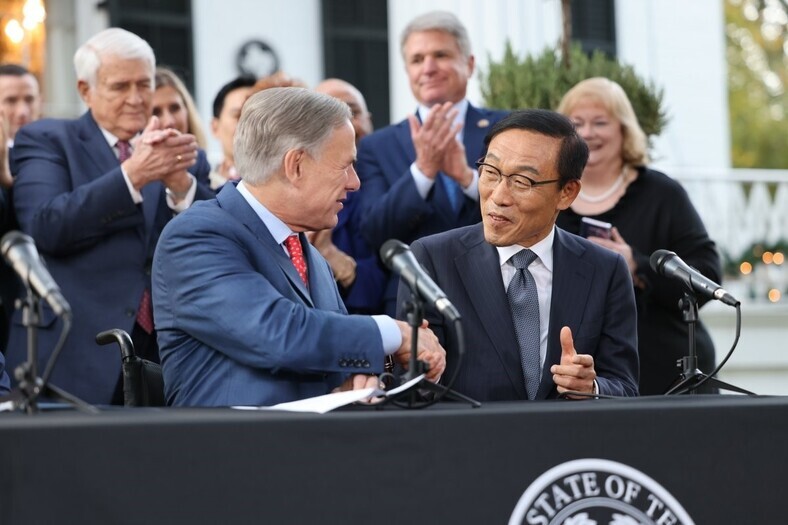
Texas Gov. Greg Abbott (left) and Samsung Electronics Vice Chairman Kim Ki-nam (right) shake hands at a press conference held at the governor’s residence in Texas on Tuesday. (provided by Samsung Electronics)

In pursuit of TSMC


Samsung Electronics’ new factory will give it a leg up in the foundry market, where the company has been seen as underperforming. Once the third line is completed in Pyeongtaek in the second half of next year and the new factory in Taylor goes online in 2024, Samsung will have gained the production capacity to compete for supremacy with Taiwan Semiconductor Manufacturing Company Ltd. As of the second quarter, TSMC was the No. 1 firm in the industry, with a 52.9% market share, while Samsung Electronics was at 17.3%.

In effect, these calculations were what Lee Jae-yong had in mind when he promised to make Samsung the global leader in the foundry sector by 2030 while announcing the company’s “Semiconductor Vision 2030” in April 2019.

In a similar context, Samsung Electronics and TSMC are locked in a fierce battle for technological supremacy. Samsung announced in the Samsung Foundry Forum 2021 last month that it will be introducing a 3-nanometer production line based on gate-all-around (GAA) technology in the first half of next year. Industry analysts said that Samsung was seeking to emphasize that it has as much as a six-month technological advantage over TSMC, which plans to launch a 3-nanometer production line based on current FinFET technology in the second half of next year.

Meanwhile, TSMC is currently spending US$12 billion on a new factory in Arizona that’s supposed to open in 2024. The Taiwanese company also plans to set up a joint venture with Sony and invest US$7 billion on the construction of a production facility in Kumamoto Prefecture with enthusiastic support from the Japanese government.


By Sun Dam-eun, staff reporter
Please direct questions or comments to [english@hani.co.kr]
SOUTH KOREA
[Editorial] Until vaccine inequity is addressed, none of us is safe


The Omicron variant is a reminder of the immense difficulty of responding to a global crisis at the level of individual countries

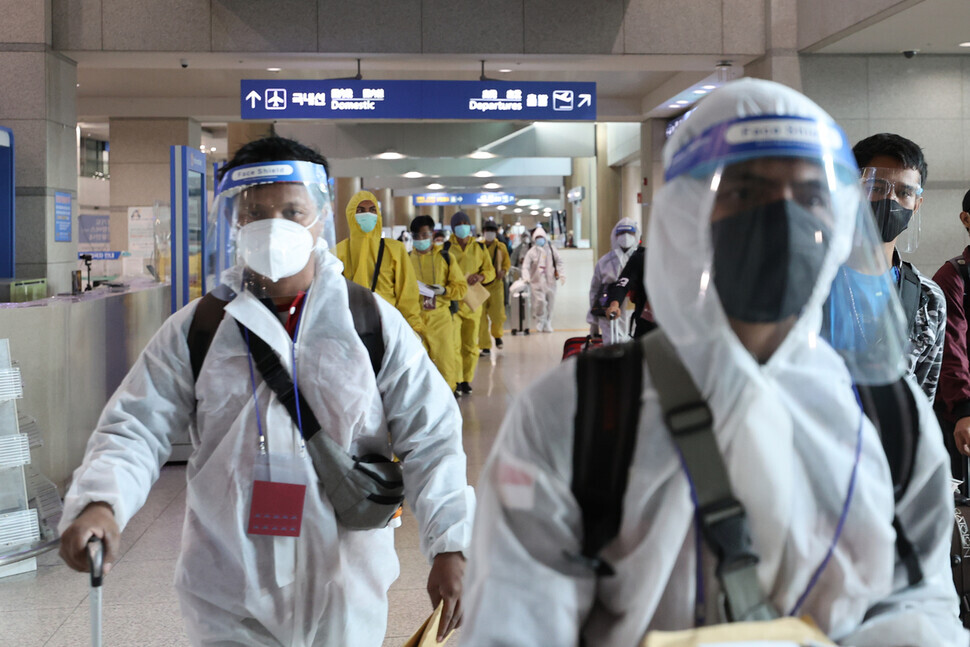
Travelers wearing personal protective clothing arrive at Incheon International Airport on Monday morning. (Yonhap News)

Posted on : Nov.30,2021

The world is under attack from Omicron, the 13th major variant of the COVID-19 virus and the fifth to be designated as a “variant of concern” by the World Health Organization (WHO). While Korea and other countries have hurried to place travel restrictions on the country where Omicron was discovered and its neighbors, the variant had already spread to 13 countries in five continents as of Monday — not even three weeks since it was first reported on Nov. 11.

The variant’s rapid transmission means it’s probably only a matter of time before it spreads around the entire world. This is a fresh and vivid reminder of the immense difficulty of responding to a global pandemic at the level of individual countries.

Just as with the other viral variants, Omicron first appeared in a low-income country: Botswana, in southern Africa. Low-income countries have less access to COVID-19 vaccines. While high-income countries have reached a full vaccination rate of more than 60% and are already moving on to booster shots, the full vaccination rate in the entirety of Africa has barely reached 7%. The partial vaccination rate – which includes those who’ve only received one vaccine dose — isn’t much higher, at 11%. The WHO and other groups have warned for some time now that these largely unvaccinated low-income countries are breeding grounds for viral variants and will become the epicenter of the global COVID-19 crisis.

In that sense, it’s no exaggeration to say that the Omicron crisis is the result of disregarding vaccine inequity. This crisis is due to major countries’ overemphasis on their economic interests and their selfish hoarding of vaccines in the face of something that not only appeals to our sense of universal togetherness but could also endanger us all — wealthy or otherwise — at any time.

This past September, the top health officials of G20 member countries signed the “Rome Pact” that called for developing countries to receive a fair supply of COVID-19 vaccines. But such declarations of “vaccine equity” are belied by the fact that vaccines supplied through the COVAX Facility, a collective vaccine purchasing project for developing countries, haven’t even reached 70% of its goal.

Global stock markets have been rattled by Omicron, even as the stocks of Pfizer and other vaccine makers have spiked. That’s an example of how untrammeled economic logic can backfire on the economy, as well as how pharmaceutical firms’ monopoly on profit can clash with the interests of the economic ecosystem as a whole.

Intellectuals across the world have called for temporarily suspending patents on COVID-19 vaccines. In July 2020, South Korean President Moon Jae-in and seven other world leaders ran an opinion piece in the Washington Post that began with the message, “None of us is safe until all of us are safe.” The time has come for our leaders to put words into action with bold decision-making.

Omicron variant emerges at worst moment, a consequence of vaccine inequity

The new variant, coupled with the onset of winter and waning vaccine effectiveness, is prompting concerns over increased spread


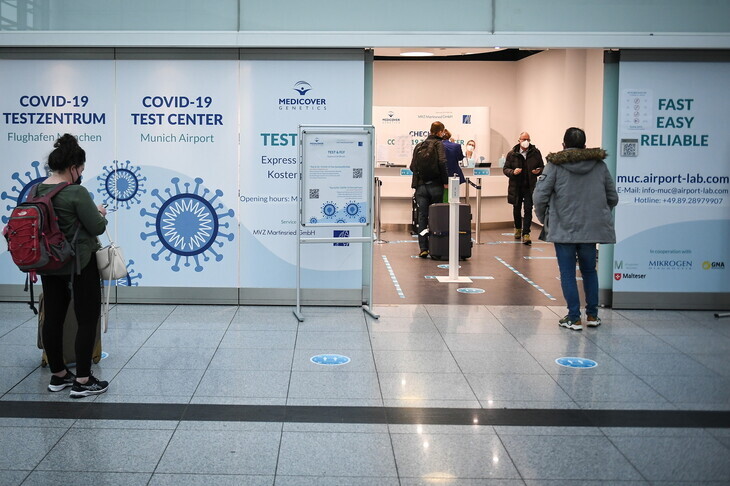
As countries tighten restrictions in order to block the spread of the Omicron variant, travelers wait to be tested for COVID-19 at Munich Airport on Saturday. (EPA/Yonhap News)

Posted on : Nov.29,2021 

The Omicron variant of the coronavirus, which was first detected in southern Africa, has now been spotted in European countries including the UK and Germany, prompting a global panic over the new viral strain. This turn of events is fueling criticisms that the world won’t be rid of the COVID-19 pandemic until developing countries receive their fair share of vaccines.

While it’s still unclear how dangerous Omicron will be, the variant has cropped up at a very bad time. Europe was already dealing with its worst wave of COVID-19, and people in the Northern Hemisphere are staying indoors as winter sets in. In addition, around six months have passed since the world’s major countries vaccinated their populations, meaning that vaccine efficacy may be waning. That’s raising the risk that the world will enter another phase of lockdowns.

Experts say that unless vaccine inequity in developing countries is addressed, variants could continue to emerge and place the whole world at risk.

The new variant’s spread

After being detected for the first time in Botswana, South Africa and Hong Kong on Thursday, the Omicron variant was also identified in Israel and Belgium on Friday. The next set of countries to spot the variant included the UK, Germany and Israel, Reuters reported on Saturday.

UK Health Secretary Sajid Javid said on Saturday that two people who had entered the country from southern Africa were infected with Omicron. The public health authority of the German state of Bavaria also said it had detected the variant in two people who had arrived from southern Africa on Wednesday.]

The Italian authorities identified Omicron in a tourist visiting Milan from Mozambique, and in the Czech Republic, a tourist from Namibia tested positive for the variant.

Thus far, almost all cases of the Omicron variant in areas outside of southern Africa have been in travelers arriving from there except for cases in Hong Kong. The variant has been detected in two people in Hong Kong: a tourist who was apparently infected while visiting South Africa and a tourist from another region who had been in quarantine at the same hotel. This second tourist may have been infected with Omicron through the air of the hotel, Hong Kong disease control officials were quoted as saying by Bloomberg.


People in Johannesburg, South Africa, where the Omicron variant of COVID-19 has been detected the most, wait to be tested for COVID-19 on Saturday. (AP/Yonhap News)

Back to stricter countermeasures


The UK and Israel were the first of many countries to ban travelers coming from southern Africa and stiffen disease control restrictions at home. The UK, where many had assumed they’d be spending a normal Christmas holiday season, issued a mask mandate on Saturday. Starting next week, masks will be mandatory for shoppers and transit riders, and all tourists arriving from overseas will have to be tested for COVID-19, the BBC reported.

Israel, which had already slapped a travel ban on southern Africa, said it will be barring all foreign tourists for the next two weeks, Reuters reported on Sunday. That makes Israel the first country to close its national borders to keep Omicron at bay. So far, most countries are only placing restrictions on southern Africa, but border controls are expected to be tightened if the number of Omicron cases increases.

The worst time for a new variant to emerge

It’s still unclear how much danger Omicron presents compared to other COVID-19 viral variants, including Delta. Angelique Coetzee, the South African doctor who first warned public health authorities about the Omicron variant, told British daily newspaper the Telegraph in an interview on Saturday that the symptoms of patients with Omicron “were so different and so mild from those I had treated before.”

Coetzee noted that one young person had reported extreme fatigue and that a six-year-old had dealt with a fever and a high pulse rate, but was much better after two days.

The problem is that Omicron has appeared at the worst possible time. A new wave of COVID-19 that began in eastern Europe has blazed across the continent to Germany, Austria and the Netherlands, driving Austria to implement a full lockdown on Nov. 22. The situation in Europe is serious, with citizens in the Netherlands and other places launching violent protests against the tougher disease control restrictions.

The fact that the number of cases is once again on the rise as the Northern Hemisphere enters winter — when more activities take place indoors — is another reason that Omicron is prompting concern. According to figures from the World Health Organization, the weekly global caseload in early October was over 2.82 million, which was the lowest since late June. But by the middle of November, the weekly caseload had increased 34% to over 3.78 million.

Another troubling factor is that four to six months have passed since many countries inoculated much of their populations this summer, suggesting that immunity may now be diminishing. According to Our World in Data, an international statistics website, the daily vaccination uptake rate around the world increased steadily to 0.54 per 100 population on July 27. The rate then faltered a little until rising to a similar level at the end of August. But since then, inoculations have slowed once again, with the rate falling to 0.37 on Friday.

Vaccine inequity rears its head


The fact that Omicron appeared in southern Africa, with its low vaccination rate, is prompting more criticism about advanced countries’ monopoly on vaccines. Critics point out that developing countries’ worsening public health environment and inability to gain immunity to COVID-19 because of a vaccine shortage engender conditions in which new viral variants will continue to emerge.

“While we still need to know more about Omicron, we do know that as long as large portions of the world’s population are unvaccinated, variants will continue to appear, and the pandemic will continue to be prolonged,” Seth Berkley, CEO of Gavi, the Vaccine Alliance, said in a statement quoted by Reuters.

“We will only prevent variants from emerging if we are able to protect all of the world’s population, not just the wealthy parts.”

An AP report quoted Michael Head, a senior research fellow in global health at the UK’s University of Southampton, as saying, “This is one of the consequences of the inequity in vaccine rollouts and why the grabbing of surplus vaccines by richer countries will inevitably rebound on us all at some point.”

That’s what happened with the Delta variant, which was first detected in India. Delta built up momentum as it created the worst COVID-19 wave that India had seen in April and May before becoming a global juggernaut.

As of Wednesday, Botswana — where Omicron is believed to have first appeared — had only vaccinated 19.6% of its population. In neighboring South Africa, where Omicron is currently spreading, just 23.7% of the population have been fully vaccinated.

In the case of South Africa, at least, some note that the low vaccination rate is due more to vaccine hesitancy than to a shortage of vaccines. Public hesitancy prompted the South African government to ask Pfizer to delay its supply of vaccines on Wednesday, Reuters reported.

By Shin Gi-sub, senior staff writer
Please direct questions or comments to [english@hani.co.kr]
“Happiness is a beautiful sentence”: Arundhati Roy discusses the pandemic, activism and writing

Posted on : Dec.1,2021 

The lauded author sat down with Park Hye-young, a professor of English literature at Inha University, while Roy was in Korea to collect her Lee Hochul Literary Prize for Peace


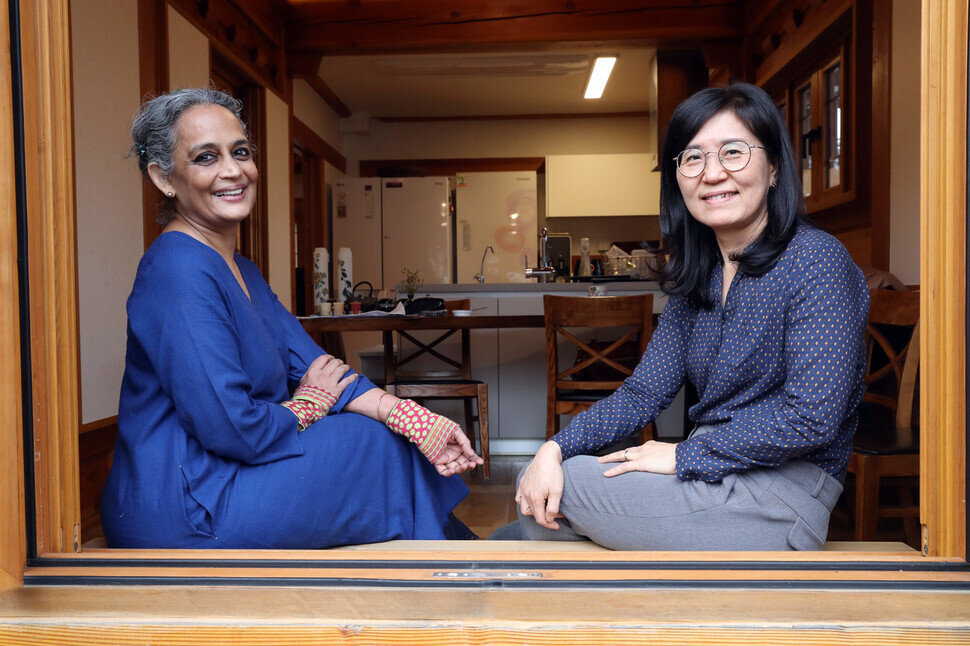
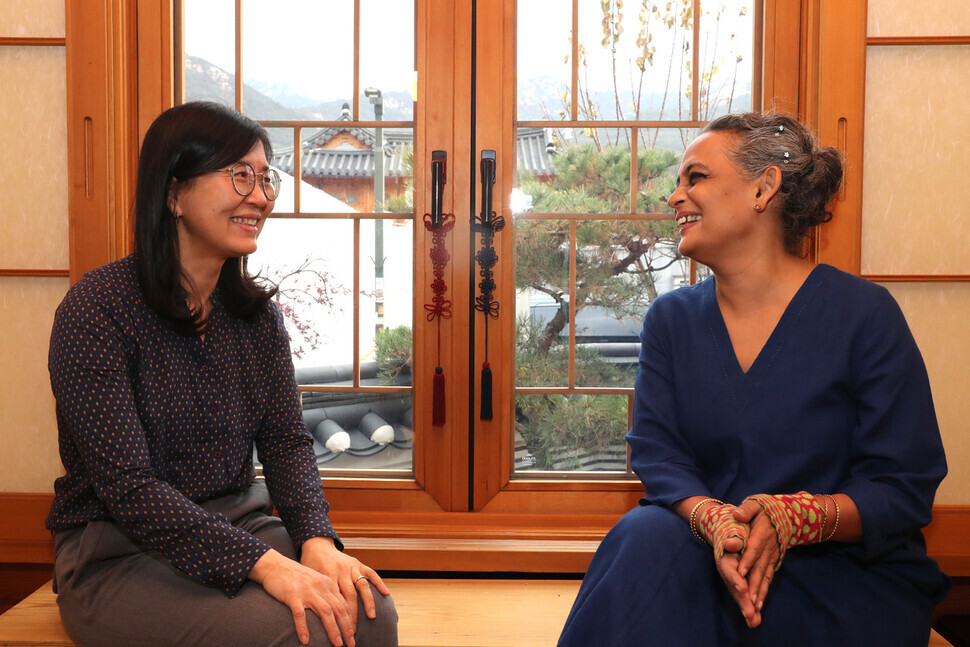
Writer Arundhati Roy (left) and Park Hye-young (right), a professor at Inha University, pose for a photo at a guest house in Eunpyeong Hanok Village on Nov. 24. (Kim Tae-hyeong/The Hankyoreh)

Arundhati Roy, the Indian writer who rose to global fame when her 1997 debut novel “The God of Small Things” was awarded the Booker Prize — one of the top literary honors in the Anglophone world — recently paid her first-ever visit to Korea.

The Hankyoreh sat down for an exclusive conversation with Roy, who was in Korea to receive the Lee Hochul Literary Prize for Peace, for which she became the fourth Grand Prize Laureate.

Speaking to Roy was Park Hye-young, an Inha University professor and scholar of English literature who previously translated Roy’s essay “Come September.” The conversation took place on Wednesday afternoon at a guest house in Eunpyeong Hanok Village, a complex of traditional Korean homes in Seoul where Roy was staying for the duration of her trip.

Park: It’s an honor to have Arundhati Roy, a leading writer and activist and the winner of last year’s Lee Hochul Literary Prize for Peace. And she has earned numerous honors so far, including the Booker Prize, the Lannan Cultural Freedom Prize, the Sydney Peace Prize, the Norman Mailer Prize, and last year she finally received the Lee Hochul Literary Prize for Peace.

She has also published two important novels, the first being Booker Prize-winner “The God of Small Things,” published in 1997. After 20 years, she finally published her second novel, “The Ministry of the Utmost Happiness” in 2017. In between, she has published many essays with themes on politics, global politics, globalization, displacement, the push to privatize public goods and more. Her novels are very touching and intelligent, and at the same time, humorous and revolutionary; not to mention her political essays and nonfiction. It's amazing that those two seemingly different genres have a very strong connection in terms of the topic and subject.

I'd like to start our interview with a question regarding the COVID-19 pandemic in India. As you know, India is a kind of a special country for many Korean people because some Koreans choose India as their final destination for a spiritual journey in search of their own identity. At the same time, you come across different sides of India in the news, such as the gang rape of a college-aged woman in front of her boyfriend on a bus. In this way, I think that India is a very big mixture of bright and dark sides.

In terms of the COVID-19 pandemic in India, a lot of people have lost their jobs, family members and loved ones. A lot of working people in India, in particular, had to migrate from cosmopolitan cities like New Delhi to their own rural countryside homes because they were sacked from their jobs and could not afford to stay in the city. This was because of Modi’s very abrupt and unexpected policy of lockdown, for which he didn't give people enough time to prepare. So, it seems there are a lot of problems in India. What do you think of the situation then and now in India?

Roy: The idea of people go to India to seek spiritual enlightenment or peace — not just from Korea, but all over the world — you know, it's a cliche. This is interesting, because I think what brings people peace somehow is the chaos of India and the fact that it seems to be not regulated in a way Western worlds or Korean societies are. Actually, what brought tears to your eyes in “The God of Small Things” is very much a part of what is supposed to be Indian spirituality. The caste system is a part of Hinduism and it is a most brutal form of social hierarchy practice. So the inside is the spirituality that outsiders seek — for insiders it's a very strict social hierarchy. India has always been a very violent place. Some of us say that the reason that people talk so much about Gandhi and nonviolence is because it's such a violent society. To keep the caste system in place, even today, requires a lot of violence. The threat of violence as well as the application of violence — to keep women in their place requires a lot of violence. The feudal traditional culture contains within it violence against women while the women that are modernizing are also being punished. Anyway, it's a very contradictory society. But today the very spiritualism that you are talking about has been politically harnessed to create Hindu nationalism.

When we use the word India, sometimes I want to ask: “What do you mean? What is the India you know?” India is like, let's say, the Soviet Union used to be — it has so many sub-nationalities, 28 official languages, 30 languages that want to be called official, and 3000 dialects. Hinduism is not a word that Hindus used to use to describe themselves. It was a word that first the Moguls and then the British used to describe people who lived east of the Indus River. But Hindus would always describe themselves according to their caste: “I'm a Brahmin,” “I'm a Dalit,” “I'm an ‘untouchable.’” So today you have a country that has thousands of different castes, thousands of languages, hundreds of religions, sub ethnicities and the Hindu nationalist government. He [Modi] is saying one language, one religion, one country — that is like trying to create a nuclear explosion in a very complex society. It's like taking an ocean and turning it into a glass of water. It's a very violent churning that's happening. So that's the background. Now to talk about the pandemic.


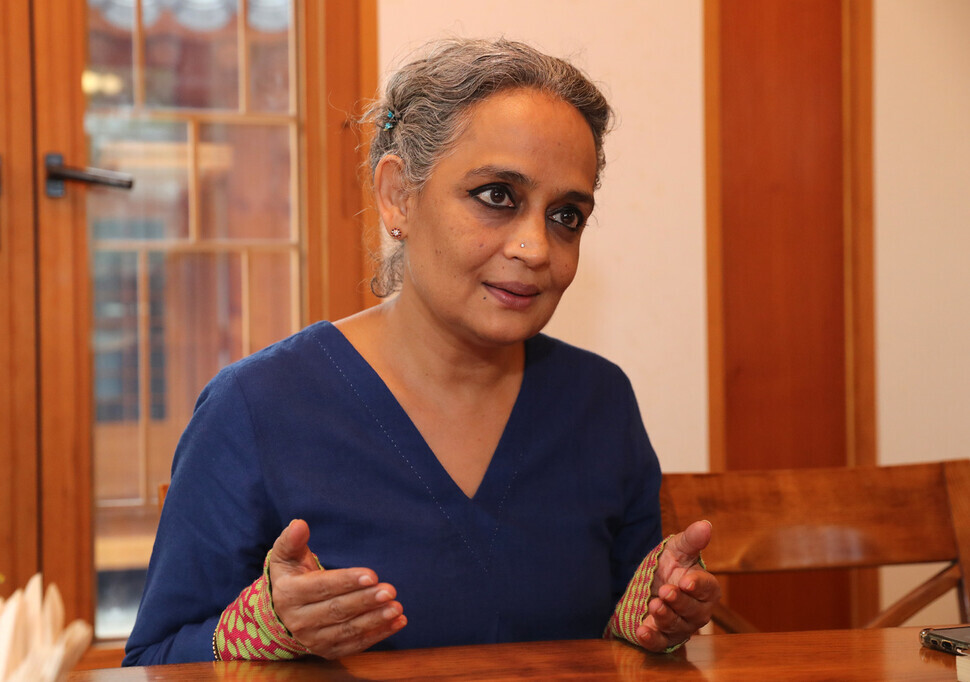
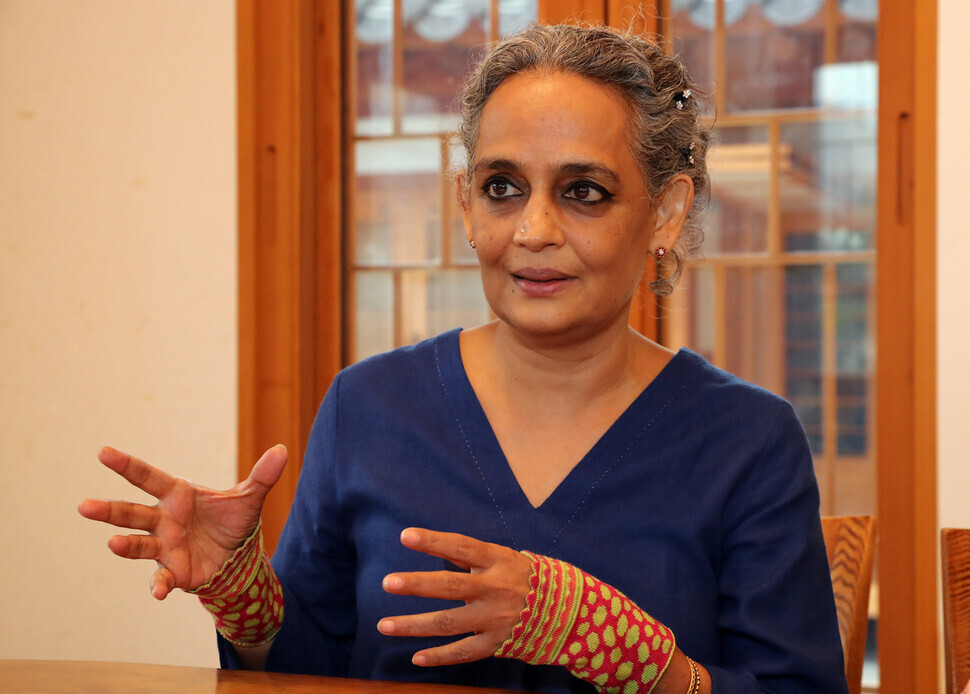
Writer Arundhati Roy speaks with Inha University professor Park Hye-young on Nov. 24 at a guest house in Eunpyeong Hanok Village.
(Kim Tae-hyeong/The Hankyoreh)

When the pandemic first broke out in Europe and then in the US, the Indian government pretended that it didn’t have anything to do with us. The World Health Organization had already declared it [a pandemic on March 11, 2020], but the Indian government was not interested. There were two things happening at the time: one was that they had just passed a new citizenship law — a new anti-Muslim citizenship law. With this new citizenship law, the government asked citizens to produce a certain set of documents, but none of us have those documents. I think the last time somebody tried to do this was Nazi Germany's Nuremberg Laws, by which the state would decide, according to a set of documents, and approve whether you are a citizen or not. In the state of Assam, in northeastern India, that's already happened and some 2 million people have been made stateless. There were huge protests which started late in 2019 and 2020. While other countries are dealing with refugees, India is trying to manufacture refugees — it's trying to take away citizenship from millions of people. Then, in February, Donald Trump visited India, during which time there was a massacre of Muslims in Delhi. And then he left, and the COVID cases started building, the protesters were in the streets. In March, Modi, overnight — like an ambush — called a lockdown with four hours’ notice. I was in Delhi the next day and saw millions of people in the streets of the city. It was like an ambush, like the people of the country were the prime minister's enemies — we were shocked and surprised. 1.38 billion people under lockdown with just four hours’ notice. It's like the prime minister had no idea what country he’s the prime minister of. There are millions of non-formal workers working in cities in unbelievable conditions, and suddenly, because of this lockdown, they appeared on the streets. They had no money, they had no jobs, they had no shelter — so they began to walk thousands of kilometers home to their villages. It was like a biblical exodus. On the way, they were beaten, they were sprayed with insecticides. They ordered a lockdown to enforce social distancing in India. But in India, lockdown is a social physical compression: everyone is locked into their buses, locked into trains.


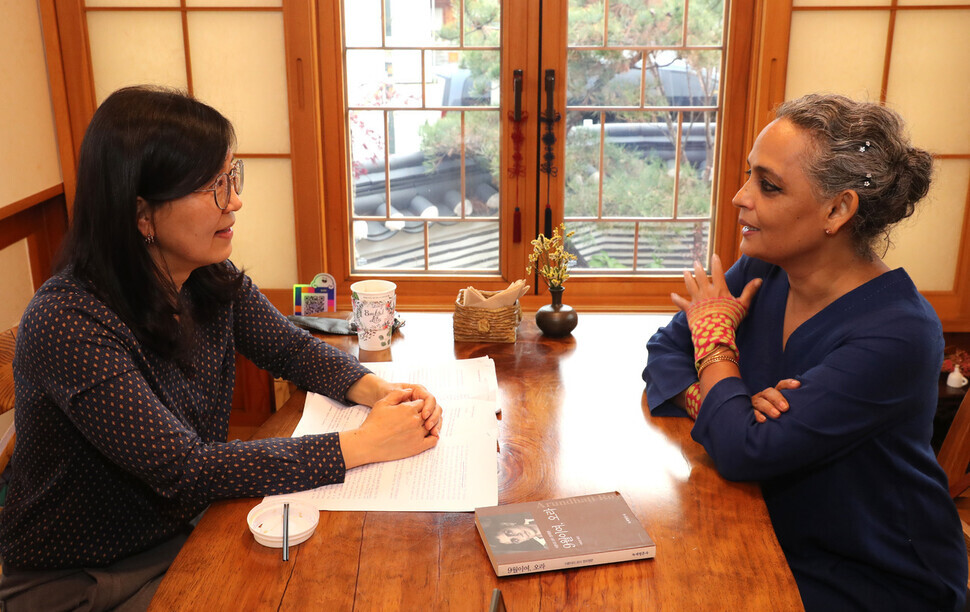
Writer Arundhati Roy speaks with Inha University professor Park Hye-young on Nov. 24 at a guest house in Eunpyeong Hanok Village
(Kim Tae-hyeong/The Hankyoreh)

Park: In that sense, do you think social distancing in India has a different meaning and significance in comparison with Western countries?

Roy: Because India is a country that practices caste, when you say social distancing, it has a very terrible connotation, you know.

After the first wave, Modi came out saying, “India is fine, we are an example to the rest of the world,” then the second wave hit, in which 400,000 people died in Delhi. That’s the official number, but the unofficial figure is supposed to be 10 times more. People were dying on the streets, people were dying in parking lots and hospitals. There was no firewood to burn in the crematoriums, there was no place to bury them. Bodies were floating down the river. Everyone was desperate. And the minute that wave ended, there were posters all over Delhi saying “Thank you, Modi, for free vaccination” — which were not free. During all this, the media — which is very pro-Modi and very pro-corporate — started demonizing Muslims, saying, “Muslims are causing COVID-19. Muslims are deliberately spreading COVID-19.” Again, it was like the Nazi propaganda about Jews that said they were spreading typhus. The pandemic, and Hindu nationalism — which we should call Hindu fascism or Hindu nationalist fascism — became, again, something used to demonize minorities.

Park: In your essay, “The Pandemic is a Portal,” you say that which way we go is entirely up to us — we can choose this way or we can choose to leave something behind for a better society and humanity. So I wonder what kind of lessons we can learn, or whether we can take away anything positive from the catastrophic situation of a pandemic.

Roy: Well, there was this moment when the whole world was locked down and although it was a very terrifying display of discipline, you saw even powerful states coming to their knees. You saw how states that have some kind of community or medical welfare for their citizens, unlike the US, were doing much better. You saw how this kind of modern world and its lines of injustice were amplified in the pandemic. It was an X-ray, so I thought if you can see through the X-ray you can come up with a proper diagnosis. A sudden shock like that can make human beings and the people who run human society think. Like how if you have a near-death experience, you live your life differently.

Park: I found that in your political essays around 2010, you had very critical stances on topics such as American imperialism and the invasion of Iraq and Afghanistan. Nowadays I find that your concerns have moved more domestic. You very strongly criticize the Modi government. You do this because you find that Modi’s power is growing, and you are, as far as I know, always on the side of the “small,” the grassroots people. However, when it comes to India’s Muslim population, in a demographic sense, isn’t it important in order to win elections? By implementing the citizenship amendment act, most Muslims would become disenfranchised. Are Muslim votes not important for winning elections?

Roy
: If you look at the way representative democracy works in India, you don't need to have a huge majority of people voting for you in order to win a huge majority of seats. Let's say you have five or 10 different parties and it's not a two-party system — even if you win 20 percent of the vote in so many constituencies, you may win 80 percent of the seats in the parliament, by winning 20 percent of the vote. In 2014 and 2019, Modi’s ruling party demonstrated that you do not need the Muslim vote.

The divide in India is unlike European fascism, unlike German Nazism where Hitler, when he came to power in Germany, first, resurrected the post-war German economy then the war came and smashed it. Whereas Modi has just smashed the economy without any resurrection. Now the big debate is between whether the people who have supported him are also supporting their own economic destruction. I have an example: Just outside my house, there's a little tea shop. There's a man who used to be a big supporter of Modi and he would not listen to anybody criticizing him. When the demonetization came [in 2016] he lost his money and his job, when the lockdown happened he lost everything. Then, one afternoon, he went and hung himself, never having criticized the person who destroyed his life.


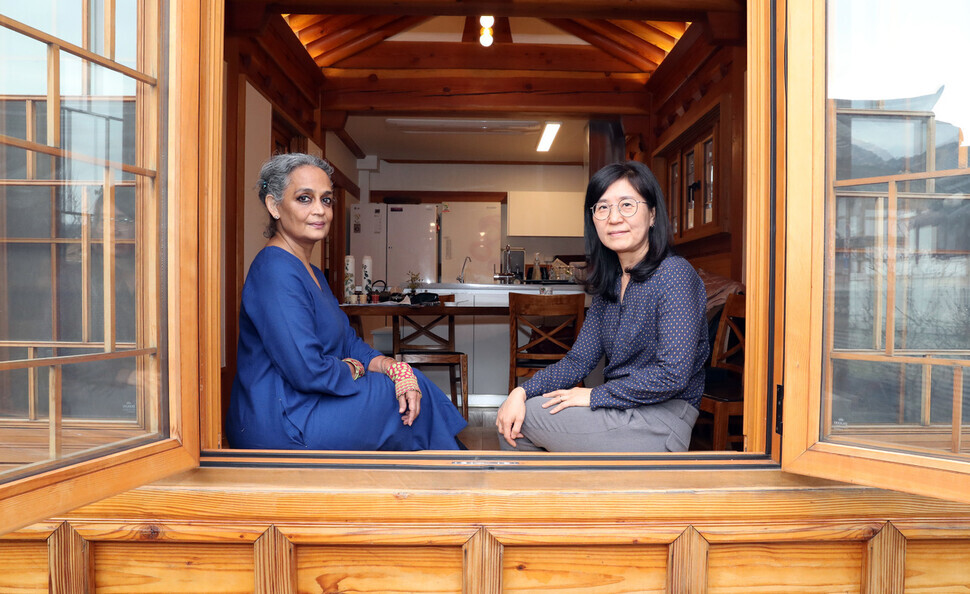
Writer Arundhati Roy speaks with Inha University professor Park Hye-young on Nov. 24 at a guest house in Eunpyeong Hanok Village. (Kim Tae-hyeong/The Hankyoreh)

Park: You are continuously on the side of small and protest against bigger entities like institutions, legislation, courts, the media, corporations and so on. I was wondering, is it okay for you in terms of your security? Have you ever received any threats of arrest or detainment?

Roy: Well, I spent time in jail in 2002. The thing is, it's a very fluid situation. So people who are being put into jail, perhaps they are not as well known internationally as I am. So I'm protected a little because of being well known, but also I'm attacked because I’m well known. It doesn't matter if you've done something or you haven't done something — they decide to put you in jail because they don't want you out there. They make the story. Sometimes they’ll say, “She’s not in jail, so we must be a democracy.” It’s a dance. I don’t know how long it’ll be like this. Everything is a calculation.

Park: You’ve said there is a lot of oppression of the press in India. But still, you are one of the strongest critics of the Modi government. Could this be evidence that still your country has freedom of speech?

Roy
: But if you look at it in the other way, I don't write and I don't speak on Indian TV. I don't write in Indian mainstream media, you know. Whatever I write, it's online or it's outside of India [such as in The Guardian].

Park: Let's go back to “The Ministry of Utmost Happiness.” I was wondering whether is there a special meaning or idea behind the character of Saddam Hussein. He’s born a Dalit, a kind of “untouchable,” and after his father dies, he converts to Islam. Can you explain what kind of ideas you had when you described such a direct grassroots, oppressed person, who converts to Islam by his own will, and how he found his own paradise in Anjum’s guest house?

Roy: Let's say that caste in India is the political engine that drives politics, as well as society, as well as it affects every single social interaction today. Less than one percent of Indians will marry outside their caste. Caste is everything there now. For centuries, Dalit — a newer word for those populations of people who were known as “untouchables” — converted to escape from caste. They converted to Islam, they converted to Sikhism, they converted to Christianity. In “The Ministry of Utmost Happiness,” it's a militant declaration by the Dalit man who converts to Islam.

There are two kinds of graveyards in the book. One is a Muslim graveyard outside of the old city of Delhi. Obviously, in India, most graveyards are Muslim graveyards because Hindus cremate their dead. So in that graveyard where Anjum lives, she slowly builds a guest house encircling the tombs of her family. And Saddam comes and then Tilottama comes, so and then they build the Jannat Guest House — meaning “paradise guest house.” Then the other part of the story, you have Kashmir which is in postcards known as Jannat, paradise. So you have in Delhi a graveyard covered with the paradise guest house and in Kashmir you have a paradise covered with graveyards from the war. If you look at the stories of the people who live in Anjum’s guest house, what happened to them, how they live, who has died, who says the prayers, you see that it's actually a revolution. Everybody there is from India, people who refuse this political notion of turning this ocean into a test tube of water.

Park: So maybe in that sense, that their gender identity — Anjum, she is a hijra, a kind of a non-binary person, did you maybe want to describe a kind of border identity? For those who are excluded from not only this world but also the other world?

Roy:
For me, Anjum is Anjum. For me she's like Tilottama, anybody else, you know. Nobody in “The Ministry of Utmost Happiness” really has a single identity, you know? Every character changes their name or changes into somebody else at some point. Anjum, of course, but also Tilottama, Saddam — everybody has all kinds of borderline identities. Anjum is interesting because she actually gets caught up in the violence of the Gujarat massacre. Because she is a Muslim, and she has gone to Gujarat for something, and she gets caught up with along with Zakir Mian in the massacre. He gets killed but she escapes because she's a hijra. Which is her more dangerous identity? In fact, the Muslim identity is a more dangerous identity for her than the identity of being a hijra — which, a place is made for traditionally in Indian society, but still a lot of violence takes place because of that identity. But in this story, in her case, her Muslim identity almost gets her killed. The fact that she is a hijra meant she was saved, because people believe that it's bad luck to kill the hijra.


Writer Arundhati Roy speaks with Inha University professor Park Hye-young on Nov. 24 at a guest house in Eunpyeong Hanok Village
. (Kim Tae-hyeong/The Hankyoreh)

Park: In your previous work, “The God of Small Things,” you pulled your major characters from the private and rather personal experiences of your family, your relatives, your own home and places of work. Where did you get such amazingly wonderful and different ideas for borderline identities, such as a trans character?

Roy: Some people think “The God of Small Things” is a personal story, while some think it’s an imaginary story. The characters are not people I know, but they are people who are inspired by people and things that are known and walked to it and breathed and eaten and smoked. I always say that “Utmost Happiness” is like a city. You can drive through a city on highways and think you know it. But to really know it, you have to walk through it, to get a bit lost. To me, it is important to sit down and have a cigarette with all the minor characters. People in India, especially because of the caste system, are not named, but known as their class — a cobbler, a tailor, so on. But in “Utmost Happiness,” even the minor characters all have names and stories, and sometimes it's confusing. But after a time, you understand the pattern of what it is.

Park: So what do you think happiness is exactly? Since you've finished your work, “The Ministry of Utmost Happiness.” What kind of happiness do you want in your life?

Roy:
While ”The God of Small Things” is about a traditional family with a broken heart at its middle, “The Ministry of Utmost Happiness” starts out with the smashed heart and then makes a non-conventional mended heart in a graveyard.

I think for writers, happiness is a beautiful sentence. Happiness is just thinking about some new novel coming over the mountains over there and saying, “Hello, I'm coming.” [Laugh.] One does not think about happiness or hope as some kind of thing you can find on Google Maps. It comes and goes, like sun and shade.


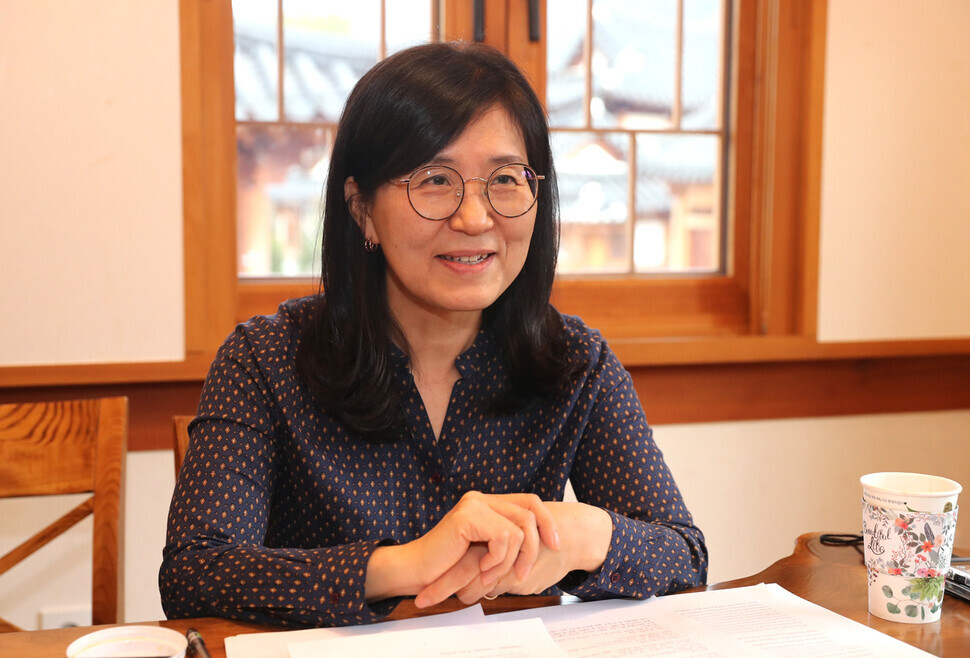
Inha University professor Park Hye-young speaks with writer Arundhati Roy on Nov. 24 at a guest house in Eunpyeong Hanok Village. (Kim Tae-hyeong/The Hankyoreh)

Park: Korea fought dictatorship and authoritarianism to achieve its democracy. At the present, even after democratization, we are finding that we are very unhappy. There is a huge gap between the rich and the poor, and many people have been evicted from their own farmlands or homes for the sake of development.

Roy: A democracy combined with the free market can't remain a democracy. There used to be a joke in India, that to create a good business climate one must kill people, push them off their lands. Therefore, at some point, a democracy has to become a police state in this guise. But it continues to have the elections and all that, meanwhile having laws that you cannot possibly call yourself a democracy while upholding.

Park: Despite Korea’s economic achievement, young generations still feel totally completely alienated from such affluence. They feel themselves to be poor, comparatively, and refuse to get married and have children or start families. Meanwhile, the suicide rate and poverty rate among older people are increasing.

Roy: If you don't actually address the problem of free-market capitalism, that's the natural consequence.

Park: Can you find any kind of hope while capitalism continues to grow stronger?

Roy
: I think it's getting stronger, but I think, like you're saying, young people everywhere are beginning to understand the issue. In the US, I remember around 15 years ago you couldn't use the words “capitalism” or “class.” I wrote an essay called “Capitalism: A Ghost Story” about how these corporations have even taken over the pedagogy and certain kinds of imagination.

Writer Arundhati Roy (left) and Park Hye-young (right), a professor at Inha University, pose for a photo at a guest house in Eunpyeong Hanok Village on Nov. 24.
(Kim Tae-hyeong/The Hankyoreh)

Park: To shift topics, I was a bit surprised at your comments on Mahatma Gandhi.

Roy: That’s in part because there is so much dishonesty attached to how that story has been built and it has been told. If you read, “The Doctor and the Saint,” it's about Gandhi and caste and race. That does not mean that everything about Gandhi is terrible, but his views on caste, on race, and on women were terrible. We are allowed to walk and chew gum at the same time — you can talk about views of his which we found visionary, but also call what was terrible, terrible. We can complicate him. We don't have to put a halo on his head. Doing so has caused a lot of damage in India.


Park: Whenever I read your essays or novel, I find that the way you use the English language amazing. It's not only excellent in using the language but also very rhythmic. Sometimes you use rhyme schemes like those found in poetry. I understand that you learned English at school. But some view English is a kind of legacy of British imperialism.

Roy: In India, you have this goddess called Kali who has many arms, and I say my Kali has fewer arms but many tongues. It’s not their English, it’s my English. I think it is a very Indian language. In India, it's the only language that binds the whole country. One imperial historian said to me, “The fact that your novel is written in English is a compliment to the British Empire.” Then, is jazz a compliment to slavery?

Park: You published your second novel after twenty years. Did you feel stressed during that time?

Roy: If I were a person who was expecting approval from people, I would not be writing these political essays I know everyone's going to attack me for. Writing is such an internal process to me.

Introduced and edited for clarity by Choi Jae-bong, senior staff writer

Transcribed by Chae Jin
“They’re taking us for idiots”: in coal mine’s shadow, quarrelling Czechs and Poles fear for their futures


NOV 16, 2021
By André Kapsas

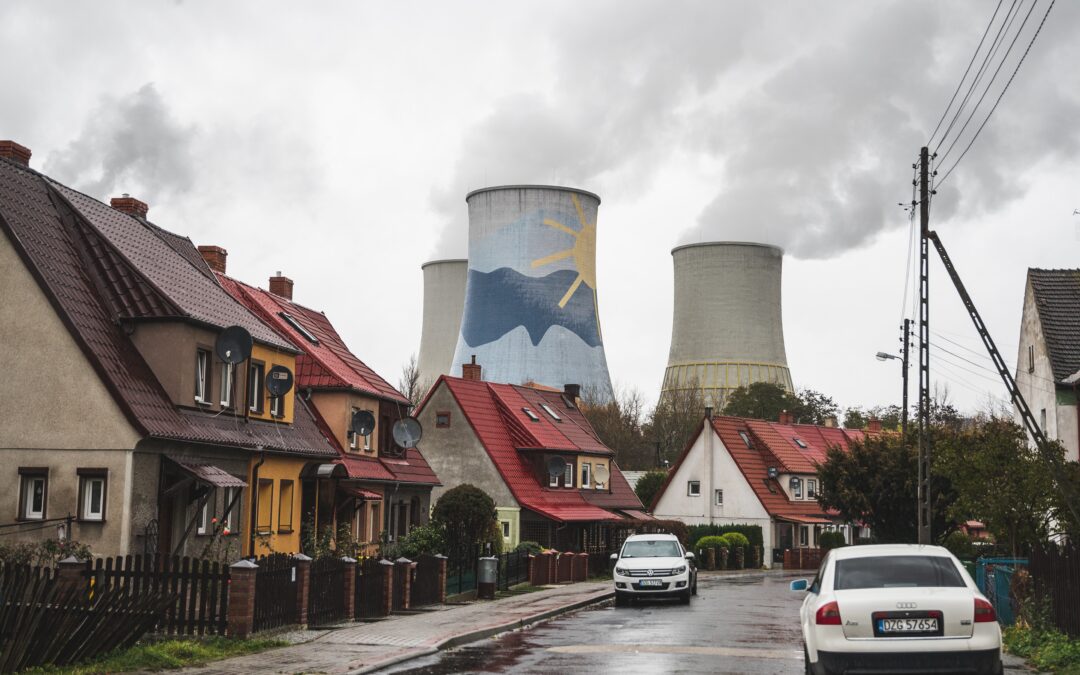
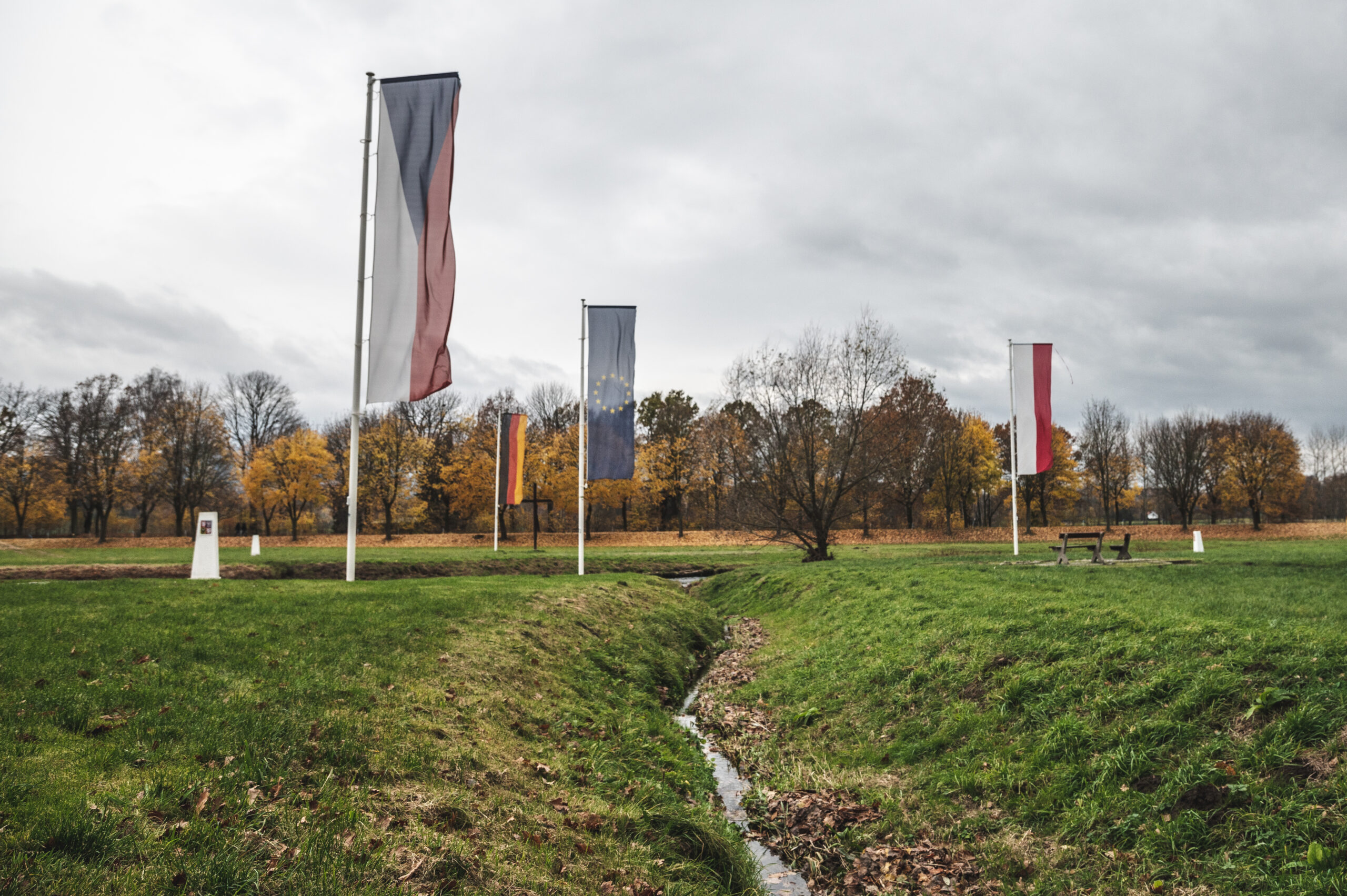
Turów, Poland – While the Czech and Polish governments negotiate a settlement to their dispute over the Turów mine, residents on both sides of the border remain stuck between a rock and a hard place, facing the environmental fallout of coal mining and the potentially painful social and economic impact of a green transition.
All-too-different fears around a rare Czech-Polish border dispute

After ordering a temporary halt to mining activities in May and ordering Poland to pay a half-million euro daily fine for failing to do so in September, the Court of Justice of the European Union (CJEU) last week held its opening session on the case opposing the two neighbouring countries.

According to the Czech government, Poland did not respect EU rules on environmental impact assessment before prolonging the open-pit lignite mine’s exploitation permit in 2020 despite the threat it poses to underground water supplies on the Czech side.

At the border, the international dispute has sparked tensions between inhabitants, with Poles fearing for their jobs and livelihood and Czechs worried about their water and public health. While most of the people interviewed understand the need to move away from coal, they starkly differ on the speed and scope of the transition.

“Ecology, yes. But people are more important. They need to work. If not, where will they go?” asks Danuta in the streets of Trzciniec, located in the shadow of the electric power plant’s enormous smoking chimneys. The pensioner, who worked 30 years in the power plant, struggles to envision a future for the region without the mine.

Marek DoÅ‚kowski in his office, with his yellow jacket reading “Hands off Turow”. 
Photo: Roman Koziel

“In some families, the husband works at the mine and the wife at the power plant; losing their jobs would be catastrophic for them,” comments the vice-president of the Solidarity miners’ union, Marek DoÅ‚kowski. He explains that most of the factories in the region collapsed after the fall of communism, making the mine, which is run by state-owned power company PGE, one of the only remaining stable employers.

In the union’s office, DoÅ‚kowski, seated in front of a banner of Poland’s white eagle and a picture of Pope John Paul II, rails against the “madness of the EU’s Green Deal”, and questions the possibility of transforming the local economy, quoting colleagues from a nearby private mine which recently shut down.

“People were supposed to find work in solar energy infrastructure, but only several of them did. Once you install the solar panels, just a few people stay to maintain them. So long for the others!” he says.

The mayor of Bogatynia, the main town adjacent to the mine, Wojciech DobroÅ‚owicz, does not mince his words about the European court’s decision, calling it “inhumane”, “an attack on us inhabitants, condemning us to destruction and death.” The politician, a member of the nationally ruling Law and Justice (PiS) party, claims the mine and power plant employ directly or indirectly 5,500 people (the true figure is probably slightly lower), and that each of these workers sustains four additional jobs in the region.
“We’re all for clean air”

Highlighting the town’s current dire social problems – from alcohol and drug abuse to crime and insecurity – DobroÅ‚owicz fears a domino effect if the mine closes: “The most resourceful people will leave while the other ones will fall even lower, and the region will die out.”

“We’re all for clean air and good living conditions, but it has to take place through respect for people,” he pleads, arguing that Poland’s historical woes justify giving the country until 2049 to transition away from coal.

While he acknowledges that Bogatynia has to date done little to prepare any future after coal mining, he adds that he only took office in September 2020. He lauds his party’s achievements in the energy transition since coming to power in 2015, citing record investments in renewable energy. Lacking a clear vision for his town’s future, he nevertheless mentions plans to use municipal land to attract investors in new sectors, such as electric cars or solar panels. “We have a huge human potential in Turów’s workers, they could be re-qualified,” he argues.

Wojciech DobroÅ‚owicz in his office at the Bogatynia municipal hall. 
Photo: Roman Koziel

Driving us to the nearby Czech border, the taxi driver evidently holds no illusion about the town’s future. “I bet the mine will close in 2030 because it makes no sense financially and technologically,” he says. Having worked 15 years there, he does not believe in a smooth transition, and nor does he see any future for the region without coal. “Young people are already leaving,” he notes.

The Czech side is only a few metres away from the road running alongside the mine, and the small village of Uhelná perched on a hill offers a direct view on the pit and power plant. From his garden, Daniel Gabryš complains that the mine is creeping towards the Czech border, bringing more noise, dust, and light pollution from night-time works.

But the worst remains the threat to water reserves. “The water is gone from all the small wells and now we all depend on one single common well for Uhelná and some neighbouring villages,” says GabryÅ¡. He dismisses Polish arguments denying that the mine is affecting water supplies on the Czech side, citing hydrogeological measurements and common sense.

“They are taking us for idiots; they have to pump a lot of water from the mine every day and the mine is almost entirely surrounded by two neighbouring countries, so where is that water coming from?” he asks rhetorically. On the other hand, the Polish side has no problem with water, since the water pumped out of the mine is treated and distributed across its territory.

In the neighbouring village of Václavice, Michal Kopecký also blames the mine for drying up his well over the past summers. “Of course, this loss of water is caused by the mine, and not only by climate change, to which the electric power plant, by the way, is also contributing”, he says. Like other locals, he is sceptical of the underground wall being built by PGE to protect underground water, noting that its design and position seem faulty.

The Turow mine is located close to the Polish-German-Czech border. 
Photo: Roman Koziel

Water and jobs: Two equally rare commodities?

Kopecký understands Poles who fear for their jobs and agrees that the transition cannot take place overnight, but he believes it is not right to accuse Czechs of wanting to get people fired or of being in it just for the money. He thinks that the transition could provide many jobs and blames the Polish government for its inaction: “It’s a cheap shot by PiS, which knows that the mine cannot last forever, but doesn’t prepare people for that, and neither does PGE”.

Along the road running through Václavice, Jan Štverák takes a break from working in his garden to comment on the situation. He is bitter about the violent reactions from the Polish side and how some Poles, last May, blocked the border crossing, while some Bogatynia businesses warned they would not serve Czech clients following the preliminary court ruling.

Å tverák also shows understanding for Polish fears, but thinks that water problems should trump employment concerns. “If you lose water, you have a much more fundamental problem than if you lose your job. It’s also a problem, but it can be solved, right? You can find another job or start your own business.”

He believes Poles should look toward the future and take matters into their own hands: “Coal is not a renewable resource so it will run out anyway. Now or in fifty years, it doesn’t matter. You’ll have to settle this issue.”

Michal Kopecký pictured next to his well’s pump. 
Photo: Roman Koziel

While the two governments seem close to an agreement that will put an end to the EU court’s proceedings, it will not settle the local conundrum. Anna Kšírová, a green activist from the neighbouring city of Liberec, supports locals from the border regions, but insists the problem is wider. “It’s not just about the mine; the electric power plant has negative health impacts on the whole Liberec region,” she explains.

Citing a recent study by the Centre for Research on Energy and Clean Air (CREA), she enumerates the yearly casualties caused by the power plant: 120 premature deaths, thousands of asthma attacks, and several cases of chronic bronchitis. Most of those cases affect German and Czech citizens who live in the regions next to the power plant, meaning Turów could continue poisoning international relations for years and decades to come.

For the Polish state, a deal with Prague on Turów would probably be celebrated as a victory, but the dire perspectives for coal mining and burning remain unchanged. The Polish energy mix heavily reliant on coal (producing about 70% of electricity) cannot survive unchanged in a time of fight against climate change and rising CO2 emission permit prices.

Moreover, the transition risks are particularly painful for local communities if Warsaw continues to postpone taking tough but necessary decisions, potentially losing billions of euros earmarked in the EU’s Just Transition Fund.

Underlining that she does not wish to see the emergence of a desolated region on the Polish side of the border, Kšírová laments the illusions entertained by the government and the energy company. “People are not being told that coal burning has no future, that it is not going to be profitable. I fear the mine and power plant will crash overnight, just like in the Ostrava region [north-eastern Czech Republic], and people will be thrown under the bus.”

“The workers are the most endangered ones here. Their future is being taken away, not just because of public health risks, but because they are being lied to about the perspectives of mining until 2044”.

The article is published in cooperation with Kafkadesk.

Main image credit: Roman Koziel
André Kapsas is a Prague-based correspondent, a Central Europe and former Eastern bloc specialist, who studied political science and European affairs at the School of Slavonic and East European Studies in London, at Charles University in Prague and the College of Europe in Warsaw.