Wednesday, December 01, 2021

Feds shortchanging First Nations on operating cash for water systems, PBO says

OTTAWA — The parliamentary budget officer has put a price tag on providing clean drinking water in First Nations, saying in a new report that the federal government still has a shortfall to make up

.
© Provided by The Canadian Press

Yves Giroux’s report on Wednesday said the government has set aside more than enough money to meet the expected capital costs to build water and wastewater systems over the next five years.

Where the government falls short is on financial help to First Nations to operate the systems, which Giroux's office estimates would need $138 million more annually in federal funding.

Indigenous Services Minister Patty Hajdu said the government intends to close that gap and is working with First Nations to understand what is standing in the way after the Liberals promised to fund all operating costs.

The budget officer's report warns that not spending enough, and not spending it on time, could increase the bill to provide water and wastewater services on reserves comparable to non-First Nations communities of the same size.

The report said "a low investment rate or a significant delay in the investment completion" could mean systems deteriorate faster than expected, "costing more money and risking service disruption."

The Liberals had promised in their successful 2015 election campaign to end all boil-water advisories in First Nations within five years of taking office, a timeline that was supposed to be met this year.

But the government last year said the target wouldn't be met, pointing to the pandemic among a variety of other factors in its way.

Hajdu didn't set a new deadline when asked on Wednesday.

"We'll be working with First Nations communities to understand how we can make sure that we expedite the work and give them the tools that they need to move forward in this planning," she said outside the House of Commons.

"This isn't something the government unilaterally can impose on a community. This is something that we do together with communities."

The latest federal figures show that 119 long-term drinking water advisories have been lifted since November 2015, with 43 remaining in 31 communities with federally supported systems.

The government says many of those remaining should be lifted over the next 12 months based on plans in place for each community. Hajdu's office said some project scopes have changed or construction schedules have been complicated by pandemic measures that shifted timelines.

"We have to be truthful with our timelines to Canadians who are looking for answers," said Crown-Indigenous Relations Minister Marc Miller. "But behind all that is the resolve of this government to continue investing in essential water and essential assets in communities."

He also said homegrown solutions to train local Indigenous people to run water plants and working with First Nations on plans are as important as funding.

The PBO report also noted that the share of water systems deemed to be "high" or "medium" risk — meaning they are unlikely to manage through any problems — has remained virtually the same since 2015 despite annual federal spending more than doubling during that time.

The government says it takes time to improve systems, years in some cases to plan, design and build them, so changes to levels of risk may be more gradual than dramatic.

Jamie Schmale, the Conservative critic on the file, said the government should look at all solutions and alternative ideas to end long-term drinking water advisories, although his statement didn't provide any specifics.

"Success isn't measured by funding announcements and election promises, it's measured by outcomes," Schmale said.

This report by The Canadian Press was first published Dec. 1, 2021.

— With files from Erika Ibrahim

Jordan Press and Stephanie Taylor, The Canadian Press


Program aims to train First Nations water treatment operators

When Jerome McDonald flew south to help provide safe drinking water for his community, he left his newborn behind.

This year, McDonald left his life and family in Fond du Lac to join the kanātan nipīy (the water is clean/clean water) program at Saskatchewan Polytechnic in Saskatoon.

"Being away from them was hard. It was our first time," he said.

He's one of the First Nations students who joined the program’s inaugural run to ensure clean waters in their home communities.

That's not taken for granted. Last year, Fond du Lac was stuck dealing with a malfunctioning water treatment plant while grappling with new COVID-19 cases.

The kanātan nipīy program is a joint effort between the City of Saskatoon, Gabriel Dumont Institute, Radius Community Centre, Saskatchewan Polytechnic and Saskatoon Tribal Council.

It aims to train people to operate and maintain water and waste systems to provide clean drinking water needed in Saskatoon and First Nations across Saskatchewan, a news release said.

“As First Nations people, we are all protectors of water, and this training program provides the opportunity for our people to carry out this important work," STC Chief Marc Arcand said in a news release.

The program has already been renewed for another year, said Gerry Youzwa, academic chair for the Saskatchewan Polytechnic's School of Continuing Education.

The first year hosted 16 students; 12 are enrolled for the upcoming year.

Federal and provincial grants mean incoming students' tuition will be free, she noted, adding that graduates have an 80 per cent employment rate so far.

Youzwa said a placement at the City of Saskatoon's water treatment facilities contributes to those employment rates.

"There's not a lot of employment in (the field), and so it's fairly specialized," said Brendan Lemke, director of water and waste for the City of Saskatoon.

"This gives people a chance to be part of that."

Indigenous students can leverage their experience for work anywhere in the province.

McDonald hopes to put that into practice in his home community.

He started work at Orano around the same time the program began, so he spent his spare time during two weeks of full-time work studying for the program's exams.

That effort took a toll on him, but completing the program was rewarding, he said.

Now back in Fond du Lac, he hopes he can put his water treatment skills to work for his community.

His cousin works at the treatment plant at Fond du Lac; McDonald plans to join him one day.

"It opened quite a few doors for me," he said. "Getting noticed — it feels pretty good, actually."

Nick Pearce, Local Journalism Initiative Reporter, The StarPhoenix

American Library Association sounds alarm on hundreds of right-wing campaigns aimed at censoring books
RAW STORY
November 30, 2021

Shutterstock

On Tuesday, CNN reported that the American Library Association is sounding the alarm over right-wing efforts around the country to censor LGBTQ and racial content from books in libraries

"Since June 1, the ALA's Office for Intellectual Freedom has tracked 155 incidents across the country and has provided support and consultation in 120 of those cases, the association said," reported Nicole Chavez. "In a statement, the group's executive board said a few organizations have pushed the idea that 'the voices of the marginalized have no place on library shelves' by falsely claiming some books are subversive, immoral and induce people to 'to abandon constitutional principles, ignore the rule of law, and disregard individual rights.'"

The report goes on to document how many of the incidents are in states where Republican governors have made campaigning against teaching critical race theory a major culture war issue.

READ MORE: Conservative school board members propose public burning of 'sexually explicit' library books

"The group's statement comes after numerous schools in Texas, Florida and several other states have received complaints involving certain books," said the report. "The trend emerged from the critical race theory debate and the panic over how history, race and queer themes are being taught to children. In Texas, Gov. Greg Abbott has called on the state's school boards to remove books he described as 'pornography' after at least two state lawmakers asked officials to investigate books in schools."

This issue also emerged in the closely watched Virginia governor's race earlier this year, when Republican Glenn Youngkin promoted a right-wing activist who has tried to have Toni Morrison's "Beloved" removed from school libraries on the grounds of obscenity. In Tennessee, a group called "Moms for Liberty" wants to remove books about Martin Luther King Jr., and even pictures of seahorses they consider too "sexy."

In some parts of the country, students themselves are fighting back, with one effort to remove an LGBTQ book in a Chicago public school library thwarted when kids showed up to protest the effort.
Renewables accelerating, but must go faster to meet net zero: IEA

Global growth in renewable electricity production is set to accelerate but needs to speed up even more to meet targets to reach net zero carbon emission targets, the IEA said Wednesday
.

© Kenzo TRIBOUILLARD Renewable electricity capacity is expected to equal that of fossil fuels and nuclear combined within five years

In its latest report on the sector, the International Energy Agency said that the installation of new renewable electricity generation capacity is expected to hit a record 290 gigawatts (GW) this year.

Over the next five years, renewable capacity is expected to be added at a rate 50 percent higher than in the 2015-2020 period.

In five years time global renewable electricity capacity is expected to have increased by 60 percent from 2020 levels to 4,800 GW, the IEA said.

For comparison, this is the equivalent to the current total global power capacity of fossil fuels and nuclear combined, it added.

However, the IEA, which advises industrialised nations on energy policy, said that "even this faster deployment would still fall well short of what would be needed in a global pathway to net zero emissions by mid-century."

Nations are aiming to reach net zero carbon emissions in order have a chance to keep the rise in global temperatures well under two percent as set by the 2015 Paris climate accord.

It said to meet this goal renewable power capacity capacity would have to grow at almost twice as fast as it expects.

The IEA said governments could further accelerate the growth of renewables by facilitating permitting, integration into the grid, and access to finance.

Rising commodity prices are a double-edged sword for renewables.

"The high commodity and energy prices we are seeing today pose new challenges for the renewable industry, but elevated fossil fuel prices also make renewables even more competitive," IEA executive director Fatih Birol said in a statement.

rl/lth

AFP
JOSEPHINE BAKER
France celebrates the legacy of the American-born artist
Issued on: 01/12/2021 
 Josephine Baker honoured: Jennifer Boittin speaks to France 24
 
Nita Wiggins: "Josephine Baker decided to control her own narrative"


Black artist Josephine Baker honored at France's Pantheon

PARIS (AP) — Josephine Baker — the U.S.-born entertainer, anti-Nazi spy and civil rights activist — was inducted into France's Pantheon on Tuesday, becoming the first Black woman to receive the nation’s highest honor
.
© Provided by The Canadian Press

Baker's voice resonated through streets of Paris' famed Left Bank as recordings from her extraordinary career kicked off an elaborate ceremony at the domed Pantheon monument. Baker joined other French luminaries honored at the site, including philosopher Voltaire, scientist Marie Curie and writer Victor Hugo.

Military officers from the Air Force carried her cenotaph along a red carpet that stretched for four blocks of cobblestoned streets from the Luxembourg Gardens to the Pantheon. Baker’s military medals lay atop the cenotaph, which was draped in the French tricolor flag and contained soil from her birthplace in Missouri, from France, and from her final resting place in Monaco. Her body stayed in Monaco at the request of her family.

French President Emmanuel Macron paid tribute to "a war hero, fighter, dancer, singer; a Black woman defending Black people but first of all, a woman defending humankind. American and French. Josephine Baker fought so many battles with lightness, freedom, joy.”

“Josephine Baker, you are entering into the Pantheon because, (despite) born American, there is no greater French (woman) than you,” he said.

Baker was also the first American-born citizen and the first performer to be immortalized into the Pantheon.

She is not only praised for her world-renowned artistic career but also for her active role in the French Resistance during World War II, her actions as a civil rights activist and her humanist values, which she displayed through the adoption of her 12 children from all over the world. Nine of them attended Tuesday's ceremony among the 2,000 guests.

“Mum would have been very happy,” Akio Bouillon, Baker's son, said after the ceremony. “Mum would not have accepted to enter into the Pantheon if that was not as the symbol of all the forgotten people of history, the minorities.”

Bouillon added that what moved him the most were the people who gathered along the street in front of the Pantheon to watch.

“They were her public, people who really loved her,” he said.

The tribute ceremony started with Baker’s song “Me revoilà Paris” (“Paris, I’m Back”). The French army choir sang the French Resistance song, prompting strong applause from the public. Her signature song “J’ai deux amours” (“Two Loves”) was then played by an orchestra accompanying Baker’s voice on the Pantheon plaza.

During a light show displayed on the monument, Baker could be heard saying "I think I am a person who has been adopted by France. It especially developed my humanist values, and that's the most important thing in my life.”

The homage included Martin Luther King's famed “I have a dream" speech. Baker was the only woman to speak before him at the 1963 March on Washington.

Born in St. Louis, Missouri, Baker became a megastar in the 1930s, especially in France, where she moved in 1925 as she sought to flee racism and segregation in the United States.

“The simple fact to have a Black woman entering the pantheon is historic,” Black French scholar Pap Ndiaye, an expert on U.S. minority rights movements, told The Associated Press.

“When she arrived, she was first surprised like so many African Americans who settled in Paris at the same time ... at the absence of institutional racism. There was no segregation ... no lynching. (There was) the possibility to sit at a cafe and be served by a white waiter, the possibility to talk to white people, to (have a) romance with white people,” Ndiaye said.

“It does not mean that racism did not exist in France. But French racism has often been more subtle, not as brutal as the American forms of racism,” he added.

Baker was among several prominent Black Americans, especially artists and writers, who found refuge in France after the two World Wars, including famed writer and intellectual James Baldwin.

They were "aware of the French empire and the brutalities of French colonization, for sure. But they were also having a better life overall than the one they had left behind in the United States,” Ndiaye, who also directs France’s state-run immigration museum, told The Associated Press.

Baker quickly became famous for her banana-skirt dance routines and wowed audiences at Paris theater halls. Her shows were controversial, Ndiaye stressed, because many activists believed she was "the propaganda for colonization, singing the song that the French wanted her to sing.”

Baker knew well about “the stereotypes that Black women had to face,” he said. “She also distanced herself from these stereotypes with her facial expressions."

“But let’s not forget that when she arrived in France she was only 19, she was almost illiterate ... She had to build her political and racial consciousness,” he said.

Baker became a French citizen after her marriage to industrialist Jean Lion in 1937. The same year, she settled in southwestern France, in the castle of Castelnaud-la-Chapelle.

“Josephine Baker can be considered to be the first Black superstar. She’s like the Rihanna of the 1920s,” said Rosemary Phillips, a Barbados-born performer and co-owner of Baker’s park in southwestern France.

Phillips said one of the ladies who grew up in the castle and met with Baker said: "Can you imagine a Black woman in the 1930s in a chauffeur-driven car — a white chauffeur — who turns up and says, ‘I’d like to buy the 1,000 acres here?'”

In 1938, Baker joined what is today called LICRA, a prominent antiracist league. The next year, she started to work for France's counter-intelligence services against Nazis, notably collecting information from German officials who she met at parties. She then joined the French Resistance, using her performances as a cover for spying activities during World War II.

In 1944, Baker became second-lieutenant in a female group in the Air Force of the French Liberation Army of Gen. Charles De Gaulle.

After the war, she got involved in anti-racist politics and the civil rights struggle, both in France and in the United States.

Toward the end of her life, she ran into financial trouble, was evicted and lost her properties. She received support from Princess Grace of Monaco, who offered Baker a place for her and her children to live. Baker died in Paris in 1975 at age 68.

___

AP journalists Jamey Keaten and Arno Pedram in Castelnaud-la-Chapelle, France, and Bishr Eltouni in Monaco contributed.

Sylvie Corbet And Jeffrey Schaeffer, The Associated Press

Death of bullied Utah girl draws anger over suicides, racism


1 of 5
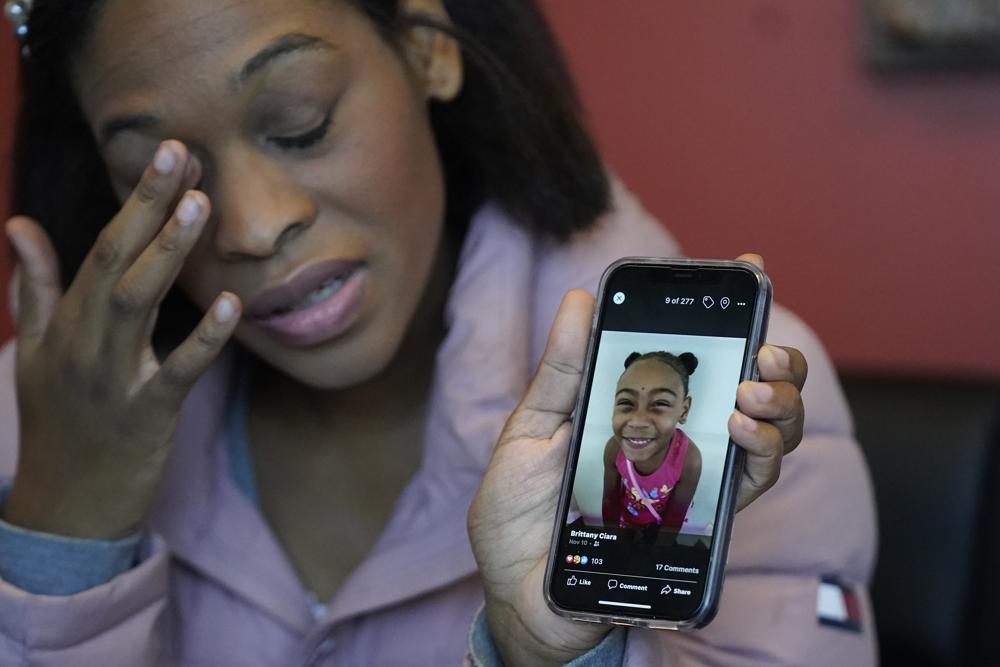
Brittany Tichenor-Cox, holds a photo of her daughter, Isabella "Izzy" Tichenor, during an interview Monday, Nov. 29, 2021, in Draper, Utah. Tichenor-Cox said her 10-year-old daughter died by suicide after she was harassed for being Black and autistic at school. She is speaking out about the school not doing enough to stop the bullying. (AP Photo/Rick Bowmer)


DRAPER, Utah (AP) — When her 10-year-old daughter tried spraying air freshener on herself before school one morning, Brittany Tichenor-Cox suspected something was wrong with the sweet little girl whose beaming smile had gone dormant after she started the fifth grade.

She coaxed out of Isabella “Izzy” Tichenor that a boy in her class told her she stank after their teacher instructed the class that they needed to shower. It was the latest in a series of bullying episodes that targeted Izzy, who was autistic and the only Black student in class. Other incidents included harassment about her skin color, eyebrows and a beauty mark on her forehead, her mother said.

Tichenor-Cox informed the teacher, the school and the district about the bullying. She said nothing was done to improve the situation. Then on Nov. 6, at their home near Salt Lake City, Izzy died by suicide.

Her shocking death triggered an outpouring of anger about youth suicides, racism in the classroom and the treatment of children with autism — issues that have been highlighted by the nation’s racial reckoning and a renewed emphasis on student mental health during the COVID-19 pandemic.

In Utah, the suicide also intensified questions about the Davis School District, which was recently reprimanded by the Justice Department for failing to address widespread racial discrimination.

The district, where Black and Asian American students account for roughly 1% of the approximately 73,000 students, initially defended its handling of the bullying allegations but later launched an outside investigation that is ongoing.

“When I was crying out for help for somebody to do something, nobody even showed up for her,” Tichenor-Cox said this week in an interview with The Associated Press. ”It just hurts to know that my baby was bullied all day throughout school — from the time I dropped her off to the time I picked her up.”

Being autistic made it difficult for Izzy to find words to express what she was feeling, but her mother sensed her daughter was internalizing the messages from school. She asked her mother to get rid of the beauty mark and shave her unibrow. Her mother told her those features made her different and beautiful. She told her mother her teacher didn’t like her and wouldn’t say hi or help with schoolwork.

Izzy’s mother, 31, blames the teacher for allowing the bullying to happen. Prior to this year, she said, Izzy and two of her other children liked the school.

Tichenor-Cox has also called out deep-rooted racism in the predominantly white state of Utah, where she said the N-word that kids called her when she was a child in the 1990s is still hurled at her children three decades later.

But she doesn’t want fury to be her only message. She vows to make Izzy’s life matter by speaking out about bullying, racism and the importance of understanding autism so that no other parent has to suffer like she is.


As she looked at a picture on her cellphone of Izzy smiling with fresh braids in her hair last May, Tichenor-Cox teared up as she realized that was her last birthday with her dear daughter who dreamed of being a professional dancer.

“No parent should have to bury their 10-year old,” she said. “I’m still in shock. ... This pushes me to get this out there like this. Mommy is pushing to make sure that this don’t happen to nobody else.”


Davis School District spokesman Christopher Williams declined to provide an exact timeline on the investigation, reveal the employment status of Izzy’s teacher or respond to any direct accusations.

He did say in a statement Wednesday that an independent investigative team is working “urgently” and that findings will be released when finished. In a previous statement from last month, when the district pledged to do an outside investigation, it said it would review its “handling of critical issues, such as bullying, to provide a safe and welcoming environment for all.”

The Justice Department investigation uncovered hundreds of documented uses of the N-word and other racial epithets over the last five years in the district. The probe also found physical assaults, derogatory racial comments and harsher discipline for students of color.

Black students throughout the district told investigators about people referring to them as monkeys or apes and saying that their skin was dirty or looked like feces. Students also made monkey noises at their Black peers, repeatedly referenced slavery and lynching and told Black students to “go pick cotton” and “you are my slave,” according to the department’s findings.

The district has agreed to take several steps as part of a settlement agreement, including establishing a new department to handle complaints, offering more training and collecting data.

Tichenor-Cox told the AP she doesn’t trust the district’s investigation and said the district has zero credibility. Instead, her attorney, Tyler Ayres, hired a private investigator to do their own probe as Tichenor-Cox considers possible legal action.

She and Ayres also said the Justice Department is looking into what happened with Izzy. The agency would not say if it’s investigating what happened to Izzy at the school but said in a statement Wednesday that it is saddened by her death and aware of reports she was harassed because of her race and “disability.” The department said it is committed to ensuring the school district follows through on the plan established in the settlement agreement.

Youth suicides in Utah have leveled off in recent years after an alarming spike from 2011 to 2015, but the rate remains sharply higher than the national average. The state’s 2020 per capita rate was 8.85 suicides among 10- to 17-year-olds per 100,000, compared with 2.3 suicides per 100,000 nationally in 2019, the latest year with data available.

Tributes to Izzy are scattered on social media under #standforizzy. The Utah Jazz basketball team honored her at a recent game, and players Donovan Mitchell and Joe Ingles, who has an autistic son, both expressed dismay over what happened, calling it “disgusting.” Other parents from the school district have sent letters to the school board calling out the district’s “dismissive actions.”

Tichenor-Cox and her husband, Charles Cox, have five other children to focus on, so they’re doing all they can to handle the grief while trying to remember the sparkle Izzy brought to their lives for a decade.

“I want her to be remembered of how kind she was, how beautiful she was, how brilliant she was and intelligent she was,” Tichenor-Cox said. “Because if I keep thinking of what happened, it’s just going to put me back, and I’m trying to be strong for her.”
Deer seen wandering Alberta town with antlers full of Christmas lights

Dec. 1 (UPI) -- Wildlife officials in Alberta said a deer spotted wandering with Christmas lights wrapped around its antlers doesn't appear to be in any immediate distress.

Residents of Okotoks said the deer has been wandering around the town with the strand of lights wrapped around its antlers since at least Nov. 3.

Alberta Fish and Wildlife said officers investigated the reports and determined the deer was still able to forage and find food and water, so they decided not to take any action.

"In order to safely remove the wire, officers would have to physically restrain the deer and/or tranquilize it, which could cause unnecessary physical and mental stress," Alberta Fish and Wildlife spokeswoman Ina Lucila said in a statement to CTV News. "Officers will continue to monitor the situation and take additional steps if needed for public safety or the deer's well-being."

Officials warned residents not to attempt to help the deer themselves, as the animal could become defensive and cause harm to itself or its would-be rescuers.

Even T. Rex had to deal with bone disease, fossil study shows

By HealthDay News

Tyrannosaurus rex could suffer from bone disease, just like humans and other animals, according to new research.
File Photo by John Angelillo/UPI | License Photo

They once ruled the planet, but even the mighty Tyrannosaurus rex could suffer from bone disease, new research shows.

Scientists used imaging to examine the lower left jaw of a fossilized T. rex skeleton discovered in Montana in 2010.

The skeleton, which is about 68 million years old and one of the most complete skeletons of the carnivorous dinosaur ever found, is at the Museum für Naturkunde Berlin in Germany.

"While this is a proof-of-concept study, noninvasive DECT imaging that provides structural and molecular information on unique fossil objects has the potential to address an unmet need in paleontology, avoiding defragmentation or destruction," said Dr. Charlie Hamm, a radiologist at Charité University Hospital in Berlin, who led the study.

Hamm's team did a visual inspection and used noninvasive dual-energy computed tomography, or DECT, to examine the skeleton.

DECT uses X-rays at two different energy levels to provide information about tissue composition and disease processes that can't be obtained with single-energy CT scan.

The research team found thickening and a mass on the jaw's surface that extended to the root of one tooth.

RELATED Billions of T. rexes walked on North America during the Age of the Dinosaurs

DECT detected a significant build-up of the element fluorine in the mass, which is associated with areas of decreased bone density.

The mass and fluorine accumulation support the diagnosis that the T. rex had a bone infection called tumefactive osteomyelitis, according to the researchers.

The team presented their findings Wednesday in Chicago at the annual meeting of the Radiological Society of North America.

Research presented at meetings should be considered preliminary until published in a peer-reviewed journal.

Oliver Hampe, senior scientist and vertebrate paleontologist at Museum für Naturkunde Berlin, said the DECT approach has promise in other paleontological applications, including determining age and differentiating actual bone from replicas.

"The experimental design, including the use of a clinical CT scanner, will allow for broad applications," Hampe added in an RSNA news release.

More information

The U.S. National Library of Medicine has more on bone infections.

Copyright © 2021 HealthDay. All rights reserved.

Isotope analysis of paint in Dutch art points to specific historical periods

Researchers dated lead-based white paints used in several paintings -- including The Cattle Ferry, pictured, a 1655 painting by Nicolaes Pietersz Berchem -- to more closely determine the dates and locations of their creation. Image courtesy of Rijksmuseum Netherlands

Dec. 1 (UPI) -- A new isotope analysis of 77 paintings created by 27 Dutch artists has revealed subtle differences in a common white pigment that are directly tied to supply routes altered by historical conflicts, researchers said Wednesday.

With the new technique, researchers identified a change in supply of lead-based paint coinciding with the English Civil War in the mid-1640s and the end of the Eighty Years' War around the same time in what is now the Netherlands, Belgium and Luxembourg.

White paint used in the 77 paintings had higher variation of isotopic values, which are used to measure lead levels, between 1648 and 1680, the data showed.

These changes could be related to rising tensions and wars during this period, which impacted where lead was sourced for paint and other uses, the researchers wrote in an article published Wednesday by the journal Science Advances.

"We identify a significant change in the lead isotopic composition of lead white in the period 1642 to 1647 [and] this change coincided with some important socio-economic events that, most probably, altered the supply chain of lead," co-author Paolo D'Imporzano told UPI in an email.

"The differences in lead isotope ratios found in paintings made in different decades, especially before and after the transition, can ... help art researchers to answer some questions about debated paintings," said D'Imporzano, a research associate at Vrije University in Amsterdam.

The English Civil War, a series of conflicts fought between 1642 and 1651, was a battle between people who supported the establishment of a republic and those who favored the monarchy as the head of state.

The Eighty Years' War, or Dutch War of Independence, was a revolt within regions of present-day Netherlands, Belgium and Luxembourg against Philip II of Spain.


Both conflicts led to rising tensions throughout Europe and disrupted the flow of goods across the continent, according to historians.

Lead was used in the production of paint for centuries, and lead isotope analysis, which measures lead levels in paints, has been used to date works of art since the 1960s.

RELATED Two bronze statues might be attributed to Michelangelo

The technique has been used to examine differences in pigment production, establishing, for example, clear differences between lead white paint produced in northern and southern Europe.

For the analysis, D'Imporzano and his colleagues used paintings with known production dates to calibrate an international database used to help attribute and authenticate other works of art across Europe.

They tested lead levels in white paint samples from Dutch paintings created between 1588 and 1700, four of which dated to periods when the artists were known to have traveled outside the Netherlands.

Based on variations in lead isotope ratios for the paintings, there were two clusters centered around the periods from 1588 to 1642 and from 1648 to 1680.

The first group points to a lead supply chain used to produce lead white paint that remained constant for at least four decades, according to the researchers.

A transition to higher lead isotope ratio index values occurred, however, between 1642 and 1647, indicating a change in the source of the lead supply coinciding with the two conflicts, they said.

The wars, and the corresponding demand for weapons, led to a constant increase in the demand for lead during that period.


"England was the major lead producer and underwent an expansion in production leading to the exhaustion of parts of some mines and the opening of new ones," D'Imporzano said.

"These developments likely caused changes in the average lead isotope ratios of the product added to the market," he said.

Similarly, the conclusion of the Eighty Years' War, which led to the independence of the Dutch Republic, resulted in new trading agreements and, thus, potential changes in lead supplies, according to D'Imporzano.

In a case study in the Science Advances paper, the painting Cimon and Pero by Dutch artist Willem Drost, which was thought to have been created in Venice, in 1657, was found to have lead white with isotope values consistent with those found in the Netherlands around 1650.

"Performing lead isotope analysis on lead white now can help to better locate in time 17th Century Dutch paintings and this information can then be used to help to understand when a painting is made," D'Imporzano told UPI.

"By combining this information with other data, such as an artist's travels, it is possible to make more precise attributions" on paintings for which the artist is currently unknown, he said.
Let’s not pretend the anti-mask babies would have lasted a minute in the blitz

It’s funny that so many of those who bang on about the ‘war effort’ seem unable to do something minor for the public good


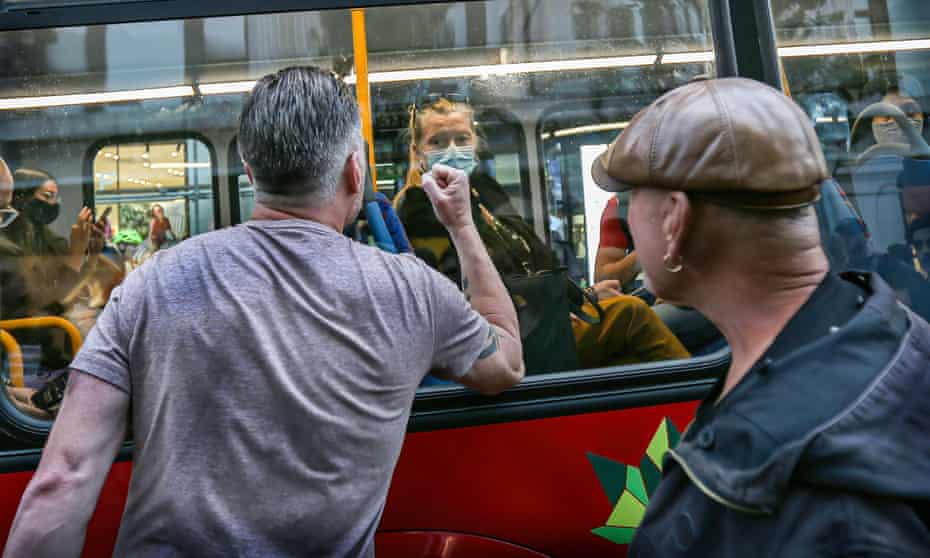
‘For all their big talk, you can’t help thinking those unable to bring themselves to wear a mask wouldn’t make the first sacrifice for their fellow humans, let alone the ultimate one.’
Photograph: Martin Pope/SOPA Images/REX/Shutterstock


Marina Hyde
Tue 30 Nov 2021

While the scientists work out how bad the Omicron variant is or isn’t, the government has reimposed mask-wearing in shops and on public transport for at least the next three weeks. Consequently, a number of prams have been swiftly emptied of all toys. Across the airwaves – and up and down the train carriages and the supermarket aisles – you can find multiple refuseniks who suffer from the pandemic version of that old sexual problem: being “too big for condoms”.

To those who have reacted to the precautionary mask-wearing mandate with histrionics and aggression, I think we have to say, very clearly: DO BUCK UP. This really isn’t the attitude that won us the war.

As for mentioning the war, forgive me. Around 70,000 Britons died in second world war bombing raids, most of them in the blitz, while 145,000 have thus far perished from Covid. Yet somehow there does seem to be a large intersection between the Venn diagram sets “People who bang on endlessly about WW2” and “People who cannot cope with having to take a relatively minor public health measure for the greater good”.

Of course, in London, both positions have links with the tube. In December 1940, you’d have been snatching a couple of hours’ troubled sleep on the underground platform while Hitler blew up your house. In December 2021, you’d be on your way to Oxford Street on the Central line to sample the pre-Christmas enticements of JD Sports. Yet still, somehow, managing to see a few minutes of mask-wearing in a non-ventilated space as an outrageous imposition on your personage, with which you – a stone-cold hero – simply shouldn’t be involved.

But why? It’s really not that bad, is it, to have to wear a mask in limited settings, if it might help other people, even a bit? For all their big talk, you can’t help thinking those unable to bring themselves to do it wouldn’t make the first sacrifice for their fellow humans, let alone the ultimate one.

As they shout – or type in capitals – the words “THE BRITISH PEOPLE HAVE HAD ENOUGH”, it’s intriguing to remember that chaps like this really fancy their chances at having been able to cope with the blitz. Picture this person, this person who wets their pants and goes full online Braveheart over being asked to wear a mask between Liverpool Street and Holborn. Assuming they didn’t think air raid sirens were part of some “great reset” and ignored them (fatally), try to imagine this person trudging out of the tube station after the air raid. Try to imagine them discovering they didn’t have a street any more, having to remake their lives and those of their family in an anguished instant, by migrating somewhere else in the country in the clothes they stood in. Or try to imagine them having been taken in by friends or relatives, and turning straight back up to the bomb site with a broom to assist in clearing the rubble. I don’t want to be a bitch, but if you lose your mind over being asked to pop on a face covering in Boots, I honestly don’t think you’d be up to a whole lot of the above.


Covid: as rules on mask wearing in England return, what exactly is the law?

Admittedly, I appreciate that many people would prefer to hear public safety advice from Winston Churchill rather than Boris Johnson. But let’s not kid ourselves the advice would have been massively different, once adjusted for circumstance. For all their constant bleating about the government trying to control them, it’s a shame the poppy-shaggers and online warriors have absolutely zero understanding of how deeply embedded in people’s lives government was in the last world war, in the interests of the wider public good. How would these people have coped with rationing, for years and years on end? Being told by the state how many ounces of basic ingredients you were allowed per week feels a bit more of a pisser than being told to wear a mask while you load up your trolley with pounds and pounds of the stuff in Asda. (I know it’s kilos these days, but I didn’t want to send them really off the dial.)

Then again, maybe I’m wrong. Maybe there was a whole section of British society in 1941 that was convinced the war was not actually real or happening, but was merely part of some great reset cooked up by various international powers. There were certainly enough profiteers at work to make elements of conspiracy theorising understandable, if not remotely excusable.

And maybe that’s also the case in our own day and age. You can see where at least some of the suspicion has crept in. In the first days of the pandemic, when retailers were selling £3 hand sanitiser for £40, and bumping up the price of essentials just because they could, Johnson declared in parliament that there should be laws against this kind of thing. There weren’t any in the end. But we now know that another deeply distasteful type of profit-seeking was in fact directly licensed by the government – and that it resists scrutiny of it to this day.

As well it might. Contracts for PPE were handed out to friends, donors, cronies, firms Owen Paterson worked for, Tory councillors, Matt Hancock’s publican … the list goes on. Much of this happened via VIP lanes and WhatsApps that have now mysteriously disappeared. Billions in taxpayers’ money were spent – but many of those billions were wasted. Individuals made staggering profits, often on items that ended up being unusable. Yet instead of being regarded as social pariahs, these people sail on regardless. Some of them are even in the House of Lords.

It’s not a huge stretch to see how this kind of naked opportunism – some of which was straight profiteering – is a big part of why many ordinary people now feel they too can opt out of the idea of even minimal national effort. Pulling together should come from the top. If our overlords are so obviously out for themselves, how can we really all be in it together?


Marina Hyde is a Guardian columnist
UK
Couple discover ferret hiding in their bed as animal flees Storm Arwen gales

A "large" ferret, nicknamed "Snoozy" for his love of sleeping, snuggled into the bed of a Bristol couple on Friday as Storm Arwen wreaked havoc on Friday


'Snoozy' the ferret slipped out of his owner's home last week and went missing

By
Tristan Cork
Ryan Fahey
News Reporter
30 Nov 2021

An escaped ferret has been reunited with its owners after Storm Arwen drove it into a random couple's bed

The creature slipped out of its owner's home in Whitchurch, Bristol last week, sparking a missing ferret appeal.


But on Friday night, the "quite a large chap for a ferret" snuck in and snuggled up in the bed of a Bristol couple as the storm battered the city outside.

And since being found, he's been nicknamed "Snoozy" by those caring for him because he's done nothing but sleep, Bristol Live reports.

When the baffled couple realised there was a furry animal in their bed, they called the local vets.

Highcroft Vets checked him over on Saturday, and christened him "Stinky Pete" after the character in Toy Story.

But his perpetual dozing led to a renaming when he was transferred to the Bristol Animal Rescue Centre.

"Snoozy", who is described as "quite a large chap for a ferret", was driven into his owner's bed by Storm Arwen
The storm passed over Bristol Friday and Saturday, leaving a trail of destruction

Highcroft Vets said they have been swarmed with ferret-related calls after putting pictures of "Snoozy" on Facebook.

They have asked people to stop calling.

“It must have been quite a shock for the couple,” said a spokesperson for Bristol ARC.

“Ferrets are really clever and love to escape, and they are terrific diggers, so it’s actually quite hard to keep them contained sometimes.

“Obviously he’s got out but found himself at night in the big, cold winter storm so has found a catflap and gone inside to get warm and dry.

Storm Arwen: Body count rises as hundreds of sea creatures wash up on Scottish beach

The death toll of sea life killed by deadly Storm Arwen continues to mount up as hundreds of starfish and other creatures wash up on a beach on the north-east coast of Scotland.

By Ilona Amos
Wednesday, 1st December 2021

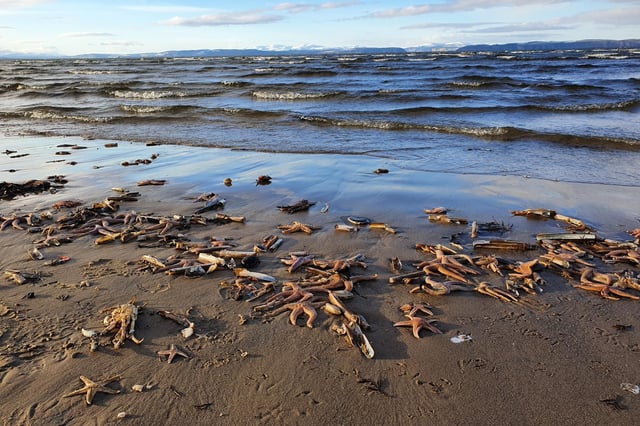
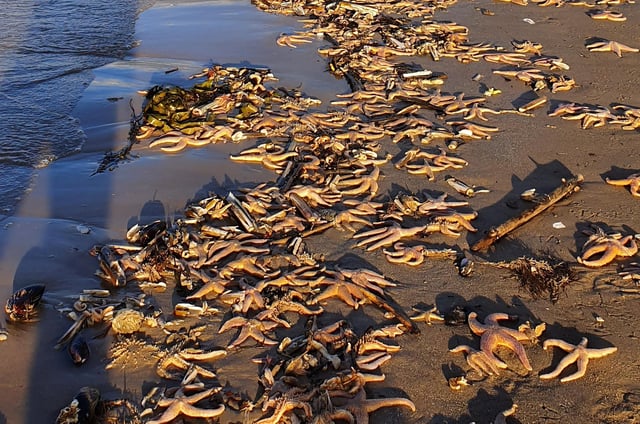
Shocking pictures taken near Nairn, on the Moray Firth, show piles of stranded starfish, crabs and shellfish flung up along a large area of the shoreline in the aftermath of last weekend’s extreme weather.

The photographs were taken by Charlie Maciejewski, from Inverness, during a walk at Culbin Sands.

He said the washed-up creatures covered a 100m stretch of sand on the beach.

It is not known if any survived the stranding.

The weekend’s harsh weather, which saw winds of nearly 100mph and massive waves battering the coastline during Storm Arwen – the first official storm of the season – has been blamed.

The discovery comes following the death of more than 800 grey seal pups at a nature reserve in the Scottish Borders.

Read MoreHundreds of seal pups killed after Storm Arwen batters nature reserve on Scottis..

Charlie Maciejewski, from Inverness, was out walking at Culbin Sands when he discovered the stranded sea creatures - which stretched across a 100m expanse of sand on the Moray Firth coast

Hundreds of bodies were discovered in the water in a small area of bay at Pettico Wick, at St Abb’s Head, with many more washing up on the shore.

It is thought around 40 per cent of all the young in the colony perished during Storm Arwen, which struck at the height of pupping season for the species.

Rangers at the National Trust for Scotland, which manages the reserve, said the scale of the devastation was unprecedented.

Ciaran Hatsell, who works at the site, said the storm had left a "pretty grim scene" in its wake.
Hundreds of starfish and other sea creatures were washed up on the beach at Culbin Sands, a nature reserve about five miles east of Nairn, in the aftermath of Storm Arwen. Picture: Charlie Maciejewski

"To see piles of dead pups in the water – just bodies floating – was really hard to see,” he said.

Winds nearing 100mph and massive waves battered the east coast of Scotland during Storm Arwen, leaving a trail of devastation and dead wildlife in its wake - including countless sea creatures and shellfish in the Moray Firth and more than 800 seal pups at a nature reserve at in the Scottish Borders. Picture: Charlie Maciejewski