Thursday, January 06, 2022

One year after Jan. 6 — a Jewish look back

Arno Rosenfeld, Jacob Kornbluh and Mira Fox
January 5, 2022Photo-illustration by Mira Fox

In the hours leading up to the storming of the U.S. Capitol one year ago today, antisemitic rhetoric swirled through the crowds that had gathered in D.C. in an attempt to overturn the 2020 presidential election.

“We are standing up to the evil globalists such as George Soros,” a former Breitbart News reporter told a group gathered the night before the riot. And just hours before the Capitol was breached, Rep. Mary Miller, an Illinois Republican, praised Nazi leader Adolf Hitler.

The antisemitic vitriol on the internet prior to the attack on the Capitol was more intense and abundant, infecting the online communities that spread conspiracy theories about President Donald Trump winning the 2020 election – a lie that came to be shared by more than three-quarters of Republican voters.


Antisemitic conspiracies flew before extremists breached U.S. Capitol
Arno Rosenfeld January 6, 2021

The most prominent of those conspiracies was QAnon, a sprawling series of beliefs that included accusations that celebrities and Democratic politicians were running a satanic pedophile ring. It helped propel many of those implicated in the attack to Washington on Jan. 6. To many Jews, its falsehoods seemed eerily familiar.

“QAnon is, to a great extent, repackaged blood libel,” David Walsh, a researcher at the University of Virginia, said in an interview at the time. Most Jewish Americans, in a September poll, said that white supremacists, Trump and conservative media bear considerable blame for the insurrection.

Few Jews have been identified among the hundreds who mobbed the Capitol, although some Jewish Trump supporters were elsewhere in D.C. that weekend. They included Heshy Tischler, an Orthodox radio host and far right provocateur who cheered on a fellow protestor carrying a shofar during one of the outdoor rallies on Jan. 6.

“He’s going to blow the shofar for moshiach — or no, for Trump?” Tischler asked. “Go ahead, blow it!”

The violence at the Capitol that day was not focused on Jews.

Still, the events of Jan. 6 were laced with Jewish connections. One year later, here is the Forward’s look at some of the better and lesser-known figures with Jewish ties to that day – from the man who wore the “Camp Auschwitz” sweatshirt to a woman who lives in the shadow of the Capitol to a member of Congress still battling threats to free elections.
The congressman in mourning


Photo by Getty Images
Representative Jamie Raskin is comforted by Senator Amy Klobuchar, a Minnesota Democrat, as she leaves a joint session of Congress to count the Electoral College votes of the 2020 presidential election in the House Chamber in Washington, D.C., U.S., on Wednesday, Jan. 6, 2021.

On Jan. 6, the day after his son’s funeral, and only a week after his death by suicide, Rep. Jamie Raskin was in the Capitol, helping to certify the election; his daughter and son-in-law had come along to watch. And then the building was attacked, the family forced to hide separately, and Raskin afraid he might lose yet another child in the span of a week.

Yet the Maryland Democrat said he found strength in that trauma, and went on to lead the impeachment effort against then-President Trump, accusing him of inciting the attack.

Though he knew the role might bring death threats and violence, Raskin forged ahead; “I personally felt no fear, because the very worst thing that ever could have happened to me had already happened to me,” he told NPR. A former professor of constitutional law, Raskin’s robust defense of democracy, though doomed, was moving to many. He also spoke personally, recounting his promise to his daughter that the Capitol would be safe the next time she visited, and her response, devastating to him, that she never wanted to return.


In new memoir, Jamie Raskin recalls chaos and confusion of Jan. 6 insurrectionI
rene Katz Connelly  January 4, 2022

In the year since the multiple tragedies, Raskin has written a searing memoir, “Unthinkable,” about the insurrection and his son’s death, which he said is the main driver of his public service. Raskin now sits on the House select committee investigating the Jan. 6 attack, and is also working to reform the Electoral College.

“If a person can grow through unthinkable trauma and loss,” Raskin wrote in his new book, “perhaps a nation may, too.”

A neighbor to the chaos

Laurie Solnik lives 12 blocks from the Capitol and spent Jan. 6 watching the events unfold on her television with her family. “We all agreed we were just going to hunker down,” Solnik recalled. But her mind went to dark places. She said the fencing, police barricades and National Guard troops that followed the violence triggered thoughts of her parent’s experience during the Holocaust, when both survived Nazi concentration camps.

I’m getting over it.”

“I knew in my head this was different: nobody is trying to kill me,” Solnik said. “But it felt the same – as if a roundup was coming.”


Photo by Steve Kolb
National Guard members assemble in a park across the street from Laurie Solnik’s home in the Capitol Hill neighborhood of Washington, D.C., following the Jan. 6, 2021 attack on the U.S. Capitol.

Solnik, 68, is active in Hill Havurah, which is the closest synagogue to the Capitol – it meets less than two blocks away. Solnik said that after seeing protesters attack Black churches in D.C. during the previous year, she worried that her own Jewish community could be a target in the future. A year later, with her Capitol Hill neighborhood returned more or less to normal – no more imposing fencing or soldiers in camouflage milling about – Solnik said she is more relaxed.

“I guess I’m getting over it,” she said.


In court for mobbing the Capitol, they compared themselves to persecuted Jews
Louis Keene January 5, 2022

The ‘Camp Auschwitz’ sweatshirt guy


By ITV

A man wearing a “Camp Auschwitz” shirt stands among a mob of far-right demonstrators who stormed the US Capitol Wednesday.

Among the hundreds of protesters arrested for their role in storming the Capitol, Robert Keith Packer may be the best known to Jewish audiences.

Packer, with long hair and a raggedy beard, wore a “Camp Auschwitz” sweatshirt as he broke into the Capitol on Jan. 6, becoming the posterboy for antisemitic undercurrents running through the crowd. He was arrested several days later after a convenience store clerk near Newport News, Virginia., where Packer lives, told law enforcement that he was a regular customer.

Police found a trove of Nazi paraphernalia at Packer’s home, and charged him with illegally entering the Capitol and disorderly conduct. Packer pleaded not guilty in February but his trial has been repeatedly delayed and his next court hearing – scheduled for Jan. 26 – is expected to involve a plea agreement. An attorney for Packer did not respond to a request for comment. He remains free on bail.


Police found lots of Nazi paraphernalia at home of ‘Camp Auschwitz’ suspect
Arno Rosenfeld May 27, 2021

The judge’s son

Aaron Mostofsky’s participation in the Capitol insurrection stunned many. The Orthodox Jew, son of Brooklyn Supreme Court Justice Steven Mostofsky, traveled from New York City and was photographed inside the Capitol wearing animal furs, a bulletproof vest and a riot shield emblazoned with the U.S. Capitol Police logo. A bewildered-looking Mostofsky was interviewed on video by the New York Post, telling the reporter that “we were cheated” and that 10 million more people voted for Trump than tallies showed.


This meme of Aaron Mostofsky was included in the criminal case brought against him by the Department of Justice for entering the U.S. Capitol on Jan. 6, 2021.

In a private Instagram conversation revealed by prosecutors, Mostofsky wrote to an acquaintance of his time in the Capitol: “It was like I’m here now how did I get there.”

Mostofsky was charged with four crimes, including theft of government property and disrupting government business. He has pleaded not guilty and his trial is scheduled for March. He remains free on bail, though he is required to notify the court if he leaves New York City.


Hasidim bearing chocolate and gratitude


Image by Courtesy

Disgusted and saddened by the Jan. 6 assault on the Capitol, Aron Weider and Alexander Rapaport – two Hasidic friends from New York – felt helpless from 200 miles away. But the bravery of the Capitol Police and the National Guard that day inspired them to make the trip to D.C. two weeks later – for the inauguration of President Biden.

Few tourists or well-wishers were allowed inside a vast security zone surrounding the Capitol for the inauguration, but that wasn’t where Weider, the founder of a Borough Park soup kitchen, and Rapaport, a Rockland County legislator, were headed. With a van packed with $10,000 worth of toiletries, energy drinks, energy bars and chocolates – paid for by a D.C. security firm – the two drove around the perimeter of the secured area, handing out goodies to members of the National Guard, who were pulling 12-hour shifts in cold weather and taking their breaks in parking garages.

‘We brought you some love from Brooklyn,’” Rapaport told the troops, who often asked for selfies with these unexpected gift-bearers.


Meet the Hasidim who went to DC after Jan. 6 to give thanks — and chocolate — to the National Guard
Jacob Kornbluh January 4, 2022

Wieder’s four grandparents were rescued by the 3rd Infantry Division of the U.S. Army during the liberation of the Dora-Mittelbau concentration camp in 1945. “I will never miss an opportunity to say thank you to you guys and what you are standing for,” he said. Rapaport said that as shaken as he was on Jan. 6, he felt more hopeful with the transition of power on Inauguration Day. He returned to D.C. days later after restocking the van in New York.

Both he and Wieder said that they hoped that their obviously Jewish appearance sent a message to all who saw them in Washington, that “the Jewish people support our servicemen and women and value the stability of our nation.”


‘We knew this day was coming’: Jews react to storming of Capitol building
Irene Katz Connelly and PJ Grisar   January 6, 2021


Authors


Mira Fox

Mira Fox is a reporter at the Forward. Get in touch at fox@forward.com or on Twitter @miraefox.


Arno Rosenfeld

Arno Rosenfeld is a staff writer for the Forward, where he covers U.S. politics and American Jewish institutions. You can reach him at arno@forward.com and follow him on Twitter @arnorosenfeld.


Jacob Kornbluh

Jacob Kornbluh is the Forward’s senior political reporter. Follow him on Twitter @jacobkornbluh or email kornbluh@forward.com.
What happened to the nonbelief channel at Patheos?

(RNS) — Bloggers were advised they could stay at Patheos so long as they stop writing negative or critical posts on religion or politics and instead focus on how to live a good life within their own worldview. They left.


January 4, 2022
By Yonat Shimron


(RNS) — Visitors to Patheos, the multifaith media platform that hosts commentary from writers in many of the world’s religions, may have noticed some changes lately.

Its nonreligious channel has become an empty hulk, bereft of most of the familiar names that once occupied the space, including its most popular blogger, Hemant Mehta, the “Friendly Atheist.”

Mehta and 14 other nonreligious bloggers, along with the channel manager, have decamped to a new site, OnlySky Media, set to launch later this month.

The changes come amid new surveys showing the number of people who are religiously unaffiliated has exploded in recent years, rising to 29% of the U.S. population, up from 19% in 2011. These “nones,” a catchall for a host of groups, including atheists, agnostics, humanists and just plain secularists, have established multiple service and advocacy organizations to serve this growing segment of the population. But there is no media platform solely dedicated to those who are not part of traditional religions.

RELATED: Poll: America growing more secular by the year

Efforts to reach Patheos’ management team were unsuccessful, but the departing bloggers and their channel manager, Dale McGowan, said that about a year ago, Patheos decided to change its editorial direction. Bloggers were advised they could stay at Patheos so long as they stopped writing negative or critical posts on religion or politics and instead focused on how to live a good life within their own worldview.

“The writing on the wall was that unless you’re prepared to say nice things about religion you need to find a new outlet,” said Mehta, who has written for Patheos since 2011, often posting multiple times a day, with a special focus on stories about religious hypocrisy.

Some 20 bloggers left the site in the last days of 2021. On Tuesday (Jan. 4), the top story on the homepage read, “Don’t Stop Believing: Faith for the New Year.”

Patheos is owned by BN Media, which last year created a new umbrella organization called Radiant. It includes Patheos, the lifestyle site Beliefnet and three other wellness and spirituality platforms with a mission of helping people “live their most fulfilled lives.”

Beliefnet, once a vigorous journalistic site, underwent a similar transformation after it was twice acquired, first by the Fox Entertainment Group in 2007 and later BN Media, where it became an inspirational site focusing on spirituality, health and wellness.

“What they were asking of us was not compatible with the editorial tone we had taken until then,” said Adam Lee, who wrote the “Daylight Atheism” blog for Patheos. “Many of us felt this would require an editorial shift to such an extent as to make our blogs unrecognizable.”

McGowan said he was told last March that Patheos wanted to rebrand.

“This was a business decision to position themselves for the long term,” said McGowan. It may have been hard for Patheos to attract advertising among religious businesses while at the same time providing a forum for atheists to criticize religion, he said.

McGowan, the author of 10 books about nonreligious life, including “Parenting Beyond Belief,” had already been talking with investors about creating a new platform for nonreligious people.

“When Patheos announced this change in direction, we realized it was an opportunity to provide a soft landing for some of these bloggers,” he said.

Fifteen Patheos bloggers agreed to join OnlySky, where McGowan is now chief content officer.

The new media platform is envisioned as a site that combines storytelling and commentary exploring the breadth of the human experience from a secular point of view, said Shawn Hardin, its founder and CEO.

A Bay Area entrepreneur who has created several media products for AOL, Yahoo and NBC, among others, Hardin said he envisions a space that explores a wide range of secular values.

“We think the unaffiliated are a woefully underserved segment of the population,” Hardin said. “We’re pretty optimistic about our opportunity to build a business that meets the interest of the audience and can invest in its own growth.”

(The name of the new media venture was inspired by John Lennon’s song “Imagine,” which envisions a world without heaven or hell — “above us only sky.”)


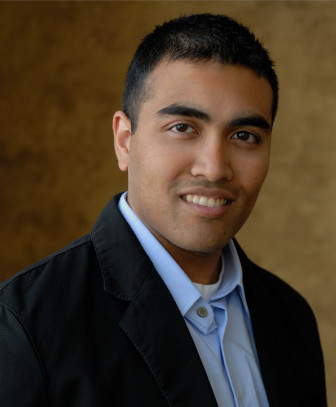
Author Hemant Mehta. Photo by Steve Greiner, courtesy of Mehta

A key will be creating a sense of community for a diverse set of people who are searching for meaning and want to connect with others on a similar path. Whether nonreligious Americans want community is not yet clear.

The Sunday Assembly movement, which tried to create local congregations for nonbelievers, had 70 congregations in the U.S. and the United Kingdom. About half have shut down or gone dormant.

Beyond polls indicating their growing numbers, little is known about the nonreligious or whether they want to engage on issues as a group.

“There are people passionate about secularism, atheism and agnosticism, perhaps because they don’t like what they see about religion in the news,” said Diane Winston, professor of religion and media at the University of Southern California. “But that’s a small minority of the people who make up the unaffiliated or disaffiliated. A lot of those people don’t care one way or another.”

Mehta, however, said he had high hopes.

“There aren’t any media outlets that cater specifically to atheists,” he said. “All the other atheist specific blogging networks are run by volunteers and people who are passionate about the subject but don’t do business-savvy anything, so they falter and die. This one has digital expertise.”

RELATED: The Sunday Assembly hopes to organize a godless future. It’s not easy.

Wednesday, January 05, 2022

Written in Protest
Deconstruction is a valid Christian practice. Ask Martin Luther.
Deconstruction has long been seen as a healthy expression of Christian faithfulness.

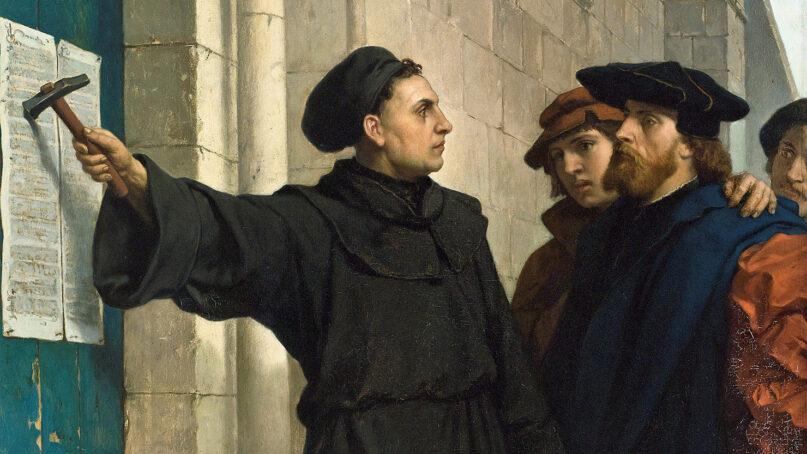
Martin Luther posting his 95 theses in 1517, painted by Ferdinand Pauwels in 1872. 
Image via Wikimedia/Creative Commons

January 5, 2022
By Andre Henry

(RNS) — I wonder what Pope Leo X would’ve tweeted about the Reformation, had Twitter existed in the 16th century. Would he accuse John Calvin of being on a desperate search for street cred? Would he reduce Luther’s 95 critiques of the papacy to “church hurt”?

Such are the epithets Christian leaders today are using against the bogeyman known as “deconstruction.” A buzzword in Christian circles, the term serves as a catchall for the many ways Christians are interrogating, reevaluating and often shedding Christian doctrines, values and practices they find outdated, problematic or just plain harmful.

Those who dismiss deconstruction as “a fancy word for doubt” or demonize it as heresy or apostasy are making a crucial error: Deconstruction has always been part of Christian practice and has been seen through history as a healthy expression of Christian faithfulness.

Parroting the Reformation era slogan sola scriptura (“Scripture alone”), deconstruction’s critics suggest that the Bible is sufficient to provide guidance, not just in matters of faith, but even to remedy social evils that our readings of those very Scriptures have been essential in creating, such as systemic racism.

RELATED: Philip Yancey on the blessing of deconstruction

But the Christian Bible itself contains some of the earliest cases we have of deconstruction. One potent example comes from the Book of Acts, in which the apostle Peter breaks a religious taboo to visit a Roman centurion named Cornelius. “It is against our law for a Jew to associate with or visit a Gentile. But God has shown me that I should not call anyone impure or unclean,” Peter confessed to Cornelius upon his arrival.

The apostle is referring to a vision from God he experienced the previous day, in which he saw a cloth laden with all kinds of animals deemed unclean in the Hebrew Bible. When a heavenly voice told him to eat from the spread of forbidden animals, Peter refused, until the voice admonished Peter, “Do not call anything impure that God has made clean.”

Peter was following Scripture and keeping tradition to the best of his knowledge, but God gave him new information that demanded he reevaluate what those texts and traditions mean, and what faithfulness to God looked liked in his new context. The scene demonstrates that Scripture and tradition are at times insufficient resources to determine what faithfulness to God looks like.

Before the Reformation, Christians relied on church councils, and eventually the authority of bishops and popes, to clarify matters of doctrine and practice. Even after the schism, some Protestants recognized the need for more tools to define orthodoxy. Methodism uses a theological concept called the “Wesleyan quadrilateral,” in which Scripture is the basis for authentic Christian practice, but only in concert with tradition, reason and personal experience.


Photo by CongerDesign/Pixabay/Creative Commons

Indeed, the notion of sola scriptura arises from the greatest deconstruction movements in church history: The reformers called out the church of their day, interrogated and rejected papal authority, wrestled with the nature of the sacraments and reevaluated the place of Scripture in the life of the Christian.

Luther’s case in particular illustrates where the motivation to deconstruct often comes from. A devout biblical translator, he felt that the ecclesial practices of his time were deeply incongruent with the faith he discerned in the pages of Scripture. He called for reform because he took the text and the faith seriously. Had the religious authorities listened to him, Luther might have died a Catholic. Instead, they pressured him to recant and excommunicated him when he wouldn’t.

The Protestant reformers aren’t my heroes, but I relate to this part of their stories. I, too, was once a devout student of theology, poring over the Scriptures in the privacy of my bedroom as a boy, my dorm room as a college student and my apartment as a New York City minister.

So while deconstruction opponents rail against critical race theory, CRT scholar Kimberle Crenshaw didn’t teach me that God cares about social justice; the Book of Exodus did. God heard the cries of a stigmatized and subjugated people in the brickyards of ancient Egypt and rescued them.

The psalms reiterated that lesson when they envision God admonishing Israelite leaders to “defend the weak and the fatherless; uphold the cause of the poor and the oppressed. Rescue the weak and the needy; deliver them from the hand of the wicked.”

The prophets taught me the same lesson when Amos announces on God’s behalf, “Away with the noise of your songs! I will not listen to the music of your harps. But let justice roll on like a river, righteousness like a never-failing stream!”

Jesus taught me that God cares about social justice when he told stories like the one about the good Samaritan or when he told religious leaders that giving to the poor is like giving to Jesus himself. The apostle John taught me this when he presented a vision of God smashing the Roman empire to bits as angels shout “Hallelujah.”

So when recent anti-racist movements made it clear that the violence of chattel slavery has found an afterlife in America’s criminal legal system, I joined the protests and raised my voice against it — not just as an act of self-preservation, but as an act of Christian faithfulness.

I was surprised and disillusioned to see the level of Christian apathy and antipathy in response to the movement for Black lives: to be told that social justice isn’t part of the gospel. Worse, I was demoralized to witness the overwhelming evangelical support for Donald Trump, a candidate praised by the nation’s most overt white nationalists. I tried to reason with my evangelical siblings, until it became clear that the institutions were not likely to change. Had they listened, I might still be an evangelical Christian today.

While I’m thankful for Jemar Tisby’s work, I didn’t need to read his book “The Color of Compromise” to come to the conclusion that Christianity, as understood and articulated by many white Americans, could never be the cure for systemic racism. Those who stole Indigenous land and for centuries killed to oppose Black freedom often did so with the Bible in hand.

Deconstruction is the only logical way for victims of Christian violence to work out liberative Christian traditions of their own. Otherwise, it’s impossible to reconcile the blood-soaked history of Christianity with a healthy and liberating spirituality.

RELATED: With this much rot, there’s no choice but to deconstruct

Despite its urge to demonize deconstruction, the church is to be blamed for losing so many of the faithful. Christian leaders who claim to take Scripture too seriously to abide deconstruction should heed the apostle Paul’s words: “God’s name is blasphemed among the Gentiles because of you.” Christian churches have long participated directly in systems that have harmed and continue to harm millions of marginalized people. They continue to refuse to confess or repent of these sins or to champion the oppressed.

This is why the faith is losing legitimacy. The Christianity preached by the likes of John MacArthur, Josh Buice, Albert Mohler, Mark Driscoll, Matt Chandler and other prominent white pastors has been weighed and found wanting.

Their attempts to get us to stop thinking critically about the sins and shortcomings of their institutions only confirm that something is deeply wrong. As a theology professor of mine once said, “A faith that can’t be tested can’t be trusted.”
The Vatican’s Pontifical Academy for Life takes on vaccine skeptics on social media

The Pontifical Academy for Life has become the most attacked Vatican department online
.
The Pontifical Academy for Life logo, left, and a CDC illustration of a coronavirus. Courtesy images

January 5, 2022
By Claire Giangravé

VATICAN CITY (RNS) — In a tweet laden with backstory and pointed frustration, the Vatican’s Pontifical Academy for Life defended the COVID-19 vaccine and called out those who spread “malinformation” to discredit the vaccine as peddling “pure nonsense.”

The Pontifical Academy for Life, the Vatican’s think tank dedicated to protecting life from conception to natural death, took to Twitter on Tuesday (Jan. 4), using its official account to criticize “Catholics” who insult the think tank and its president, Archbishop Vincenzo Paglia. “#COVID-19 exists, and the only way to return to normal is to get #vaccinated,” read the tweet.

The statement on social media pushed back specifically against critics who draw a direct line from abortions to the vaccines, saying “abortions have nothing to do with” the vaccines, and insinuating the opposition is instead born from the culture wars in the United States, home to many vocal papal critics.

Speaking by phone with Religion News Service on Wednesday, the spokesperson for the academy, Fabrizio Mastrofini, said the tweet — which has generated considerable pushback — was a response to media articles and online critics who oppose the Vatican’s support for vaccines.

On Dec. 22, the academy published a document addressing the impact the pandemic has had on children and advising a more holistic effort by Catholic and lay institutions to promote the well-being of minors. Beyond encouraging the accompaniment of families suffering due to COVID-19, the document seemed to support the vaccination of children over the age of 5, which is already underway in Europe and the United States.

The document was criticized by many who believe the vaccines are immoral. While the vaccines do not contain fetal cells, fetal cell lines were used during testing. The Vatican department overseeing doctrine deemed some vaccines “morally acceptable” and Pope Francis has backed global vaccinations efforts, calling getting jabbed “an act of love.”

The Vatican’s support for vaccination has not convinced some Catholics who have voiced their opposition in news articles, blogs and tweets, which “led to an avalanche of insults toward the academy and the pope on twitter,” Mastrofini said.

Mastrofini acknowledged the Pontifical Academy for Life is “the most attacked department in the Vatican,” but he believes this is because it’s “the only one who answers back.” All Vatican departments have some form of social media presence, but they tend not to engage with their audience and limit themselves to communicating information and updates.


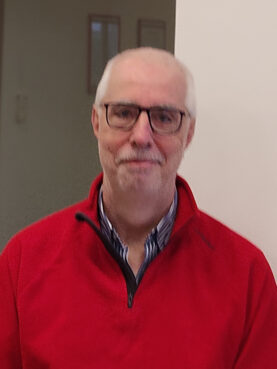
Fabrizio Mastrofini. Photo via the Pontifical Academy for Life

But there are other reasons why the academy is the preferred target of disgruntled Catholics. “We are perceived as the spearhead of Pope Francis’ reform,” Mastrofini said. “This is an attempt to intimidate us. They try to scare us because they want us to be silent and not speak on controversial issues,” he added.

To understand why some Catholics, especially conservatives, hold a grudge against the academy, it’s necessary to go back to 2016 — when Pope Francis enacted a shake-up of the group’s composition, organization and objectives.

Pope Francis chose not to renew the mandate of some of the most vocal culture warriors in the academy and appointed instead academics from a diverse and pragmatic background. He also limited their term to five years and — most significantly — eliminated the oath of fealty to the Catholic magisterium, allowing people of different faiths to become members of the academy.

This last change was considered “the great betrayal for conservative Catholics,” Mastrofini said.

Pope John Paul II created the academy in 1994 to study the legal and moral questions surrounding life in light of Catholic doctrine, but its main priority was combating abortion.

RELATED: Pope on new year: Pandemic is hard, but focus on the good

Francis has expanded the focus of the academy, telling members on the academy’s 25th anniversary they need to embrace a “global bioethic” that addresses human life in its relation to technology and the environment while maintaining “abortion and euthanasia as extremely grave evils.”

“Before all else, we need to enter into the language and lives of men and women today, making the gospel message incarnate in their concrete experiences,” Francis said.

Mastrofini said the academy and Paglia are used to the haters on social media and so far have not held back because of it.

In September 2020, the think tank published a tweet with a picture displaying Michelangelo’s “Pietà” with Mary holding a Black Jesus to raise awareness of racism as it dominated the political discourse in Italy and abroad at the time. The academy published a tweet in April of last year in honor of the late theologian Hans Küng, known for his criticism of papal infallibility as well as his questioning of priestly celibacy and the Catholic ban on contraception. Both these tweets were met with pushback online.

As the Vatican enters a new year and Pope Francis prepares for the next step of his reform, the academy continues to raise the questions of its mandate in this new age — planning conferences and events focused on care for the sick and dying, and equal vaccine distribution globally.

RELATED: Observers, detractors and preachers of religion who died in 2021

‘Refusal to engage’: Gen Z sees gap in support of LGBTQ+ rights among faith groups


Those looking for accepting communities may need to look outside of traditional houses of worship.
LGBTQ+ issues are one of several issues that younger generations feel they care about more than faith groups. (iStock/Getty Images)

January 3, 2022
By Josh Packard, Robyn Henderson-Espinoza

(RNS) — It’s no secret that the young people born in the late 1990s and the first decade of this century are proving to be an activist generation, taking deeply to heart causes such as Black Lives Matter, gender equity, racial justice and environmental justice.

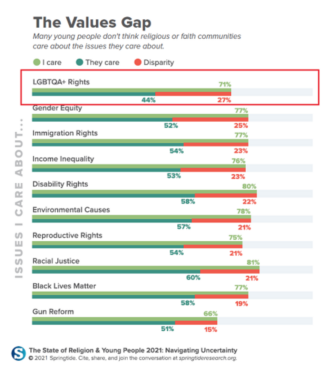
But of the values that they cared about most, a recent report by Springtide Research Institute found, Generation Z believes their faith communities are most falling short when it comes to LBGTQ+ rights. In Springtide’s study, The State of Religion & Young People 2021, the largest gap between what respondents felt “I care” about and “faith groups care” about came in regard to LGBTQ+ rights, showing a 27% difference.

Generation Z is coming of age at a time when the majority of Americans support gay rights, about half a decade after the Supreme Court legalized same-sex marriage. At the same time, a growing percentage of the U.S. population identifies as LGBTQ+, including one in six Gen Zers, according to a recent survey. In all 71% of Gen Zers told Springtide they care about LGBTQ+ rights.


The growing support for LGBTQ+ rights has been occurring among people of all faith groups. A 2018 study from PRRI found that solid majorities of all major religious groups in the U.S. support laws protecting LGBTQ+ people from discrimination. In 2021, hundreds of faith groups and their leaders joined half of Americans in supporting the Equality Act, a bill that would ban discrimination against people based on sexual orientation and gender identity.

RELATED: Students at Catholic colleges leave with less positive attitudes toward gay people than their peers – but that’s not the whole story

This message isn’t getting through to Gen Z. When asked if they think faith groups care about LGBTQ+ rights, only 44% of them agreed.

Why, despite growing support among Americans across all faiths, do less than half of Gen Zers believe faith groups care about LGBTQ+ rights?

“Many people believe that associating with a faith that is anti-LGBTQ+ makes them just as immoral as homophobic and transphobic religious leaders,” shared Faryn, 16, who identifies as Catholic.

“There is a refusal to engage fully,” said Matthew Blasio, age 22, who has no religious affiliation but identifies as spiritual. “There is superficial acceptance of LGBTQ+ identities, but the language regarding LGBTQ+ acceptance in churches is often full of qualifiers, still regarding us as an ‘other.’”


Research focusing on young people and their relationships with religion found a disparity between how much an individual reports to care about and how much they think the faith community cares about different issues. Graphic courtesy of the Springtide Research Institute

When pastors do engage, Blasio said, LGBTQ+ Gen Zers often feel the effort is insincere. “Sometimes religious leaders act with forced love, pretending to lower themselves to our level, just to seem like heroes. It’s more of a selfish love, riddled with misunderstandings.”

These testimonies are not dissimilar from Robyn’s own experience as a young person in church, who was told they had an “allergy to myself” for embracing the term queer. Springtide’s research shows that religious leaders have a long way to go to create the conditions of acceptance that will make LGBTQ+ people feel welcome.

Given the clear evidence that Gen Z genuinely desires community, it is the more astonishing that churches and other faith groups continue to refuse to make room for differently sexed and differently gendered persons. The more work faith communities can do to create containers that can hold folks’ complexities, the better they will be able to present themselves as a true community.

Community is more than gathering; it is more than numbers. Community is about belonging to self and other, a kind of democratized space and place that creates conditions for radical flourishing. The Rev. Richard Rohr says, “Everything belongs”; so how do we belong together? We need to begin asking people what they need in order to belong. If we don’t create the kinds of relationships that help people articulate what they need and want, faith leaders aren’t doing their jobs.

These accepting communities may be outside of traditional houses of worship. Part of Robyn’s work with the Activist Theology Project has been to help create the Activist Theology Porch, an app where we are convening people and having conversations. There are all sorts of folks who have joined in an effort to build a democratized space for spiritual belonging and nourishment. People are finding that yes, they can belong somewhere with other folks who are trying to do good in the world.

Offering anything less, Springtide’s findings suggest, runs the risk of alienating a large portion of Generation Z, who find a lack of support for LGBTQ+ rights to be immoral and hypocritical.

RELATED: Gen Z is looking for meaning this holiday season, but maybe not where we expect

“I have no interest in uprooting my beliefs and values for the benefit of someone else feeling that they’re saving me. If someone is less than, or has less rights, just because of how they were born, yet their god is supposed to love everyone equally, then their god must not be the one for me or my friends,” said Blasio.

Indeed, supporting LGBTQ+ rights could be an opportunity for faith groups to earn the trust of Gen Z.

If faith groups can work toward taking concrete action to dismantle the systems that perpetuate the discrimination LGBTQ+ people continue to experience, it could make the difference between a generation that proceeds into adulthood turned off by institutions or a generation willing to pursue relationships within faith communities and allow faith leaders to walk alongside them.

(Josh Packard is executive director of Springtide Research Institute and the author of “Church Refugees.” He can be contacted @drjoshpackard. Robyn Henderson-Espinoza, (@iRobyn) is a politicized theologian and public ethicist in Nashville, founder of the Activist Theology Project and author of “Body Becoming: A Path to Our Liberation.” The views expressed in this commentary do not necessarily reflect those of Religion News Service.)
NO BORDERS NO WALLS NO ONE IS ILLEGAL
Pope Francis: ‘I Would Like to Present Saint Joseph to You as a Persecuted and Courageous Migrant’

By CNSNews.com Staff | January 5, 2022 


(Screen Capture)

In the audience he held at the Vatican on Dec. 29, Pope Francis presented the Holy Family as a group of migrants, describing St. Joseph in particular as “a persecuted and courageous migrant.”

Today I would like to present Saint Joseph to you as a persecuted and courageous migrant,” said Pope Francis. “This is how the Evangelist Matthew describes him. This particular event in the life of Jesus, which also involves Joseph and Mary, is traditionally known as ‘the flight into Egypt.’”


“King Herod learns from the Magi of the birth of the ‘King of the Jews,’ and the news shocks him,” said the pope. “He feels insecure, he feels that his power is threatened. So, he gathers together all the leaders of Jerusalem to find out the place of His birth, and begs the Magi to inform him of the precise details, so that--he says falsely--he too can go and worship him.

“But when he realised that the Magi had set out in another direction, he conceived a wicked plan: to kill all the children in Bethlehem under the age of two years, which was the period of time, according to the calculations of the Magi, in which Jesus was born,” said Pope Francis.

“In the meantime, an angel orders Joseph: ‘Rise, take the child and his mother, and flee to Egypt, and remain there till I tell you; for Herod is about to search for the child, to destroy him” (Mt 2:13),” said the pope. “Think today of the many people who feel this impulse within: ‘Let’s flee, let’s flee, because there is danger here.’”

The pope eventual spoke of things happening today.

“Today I think we need a prayer for all migrants; migrants and all the persecuted, and all those who are victims of adverse circumstances: be they political, historical or personal circumstances,” said Pope Francis.

“But, let us think of the many people who are victims of wars, who want to flee from their homeland but cannot; let us think of the migrants who set out on that road to be free, so many of whom end up on the street or in the sea; let us think of Jesus in the arms of Joseph and Mary, fleeing, and let us see in him each one of the migrants of today,” he said.

“Migration today is a reality to which we cannot close our eyes. It is a social scandal of humanity,” said the pope.


Here is the full transcript of the English translation of the pope’s address at his audience on Dec. 29:

“Catechesis on Saint Joseph - 5. Saint Joseph, persecuted and courageous migrant

“Dear brothers and sisters, good morning!

“Today I would like to present Saint Joseph to you as a persecuted and courageous migrant. This is how the Evangelist Matthew describes him. This particular event in the life of Jesus, which also involves Joseph and Mary, is traditionally known as ‘the flight into Egypt’ (cf. Mt 2:13-23). The family of Nazareth suffered such humiliation and experienced first-hand the precariousness, fear and pain of having to leave their homeland. Today so many of our brothers and sisters are still forced to experience the same injustice and suffering. The cause is almost always the arrogance and violence of the powerful. This was also the case for Jesus.

“King Herod learns from the Magi of the birth of the ‘King of the Jews,’ and the news shocks him. He feels insecure, he feels that his power is threatened. So, he gathers together all the leaders of Jerusalem to find out the place of His birth, and begs the Magi to inform him of the precise details, so that - he says falsely - he too can go and worship him. But when he realised that the Magi had set out in another direction, he conceived a wicked plan: to kill all the children in Bethlehem under the age of two years, which was the period of time, according to the calculations of the Magi, in which Jesus was born.

“In the meantime, an angel orders Joseph: ‘Rise, take the child and his mother, and flee to Egypt, and remain there till I tell you; for Herod is about to search for the child, to destroy him’ (Mt 2:13). Think today of the many people who feel this impulse within: ‘Let’s flee, let’s flee, because there is danger here.’ Herod’s plan calls to mind that of Pharaoh to throw all the male children of the people of Israel into the Nile (cf. Ex 1:22). The flight into Egypt evokes the whole history of Israel beginning with Abraham, who also sojourned there (cf. Gen 12:10); to Joseph, son of Jacob, sold by his brothers (cf. Gen 37:36) before becoming ‘ruler of the land’ (cf. Gen 41:37-57); and to Moses, who freed his people from the slavery of the Egyptians (cf. Ex 1:18).

“The flight of the Holy Family into Egypt saves Jesus, but unfortunately it does not prevent Herod from carrying out his massacre. We are thus faced with two opposing personalities: on the one hand, Herod with his ferocity, and on the other hand, Joseph with his care and courage. Herod wants to defend his power, his own skin, with ruthless cruelty, as attested to by the execution of one of his wives, some of his children and hundreds of opponents. He was a cruel man: to solve problems, he had just one answer: to kill. He is the symbol of many tyrants of yesteryear and of today. And for them, for these tyrants, people do not count; power is what counts, and if they need space for power, they do away with people. And this happens today: we do not need to look at ancient history, it happens today. He is the man who becomes a ‘wolf’ for other men. History is full of figures who, living at the mercy of their fears, try to conquer them by exercising power despotically and carrying out inhuman acts of violence. But we must not think that we live according to Herod's outlook only if we become tyrants, no; in fact, it is an attitude to which we can all fall prey, every time we try to dispel our fears with arrogance, even if only verbal, or made up of small abuses intended to mortify those close to us. We too have in our heart the possibility of becoming little Herods.

“Joseph is the opposite of Herod: first of all, he is ‘a just man’ (Mt 1:19), and Herod is a dictator. Furthermore, he proves he is courageous in following the Angel’s command. One can imagine the vicissitudes he had to face during the long and dangerous journey and the difficulties involved in staying in a foreign country, with another language: many difficulties. His courage emerges also at the moment of his return, when, reassured by the Angel, he overcomes his understandable fears and settles with Mary and Jesus in Nazareth (cf. Mt 2:19-23). Herod and Joseph are two opposing characters, reflecting the two ever-present faces of humanity. It is a common misconception to consider courage as the exclusive virtue of the hero. In reality, the daily life of every person requires courage. Our way of living – yours, mine, everyone’s: one cannot live without courage, the courage to face each days’ difficulties. In all times and cultures, we find courageous men and women who, in order to be consistent with their beliefs, have overcome all kinds of difficulties, and have endured injustice, condemnation and even death. Courage is synonymous with fortitude, which together with justice, prudence and temperance is part of the group of human virtues known as “cardinal virtues”.

“The lesson Joseph leaves us with today is this: life always holds adversities in store for us, this is true, in the face of which we may also feel threatened and afraid. But it is not by bringing out the worst in ourselves, as Herod does, that we can overcome certain moments, but rather by acting like Joseph, who reacts to fear with the courage to trust in God’s Providence. Today I think we need a prayer for all migrants; migrants and all the persecuted, and all those who are victims of adverse circumstances: be they political, historical or personal circumstances. But, let us think of the many people who are victims of wars, who want to flee from their homeland but cannot; let us think of the migrants who set out on that road to be free, so many of whom end up on the street or in the sea; let us think of Jesus in the arms of Joseph and Mary, fleeing, and let us see in him each one of the migrants of today. Migration today is a reality to which we cannot close our eyes. It is a social scandal of humanity.

Saint Joseph, you who have experienced the suffering of those who must flee you who were forced to flee to save the lives of those dearest to you, protect all those who flee because of war, hatred, hunger. Support them in their difficulties, Strengthen them in hope, and let them find welcome and solidarity. Guide their steps and open the hearts of those who can help them. Amen.”

Violence isn’t the only way Christian nationalism endangers democracy

The threat of voter suppression is perhaps more destructive because its influence is more subtle and its effects more consequential.

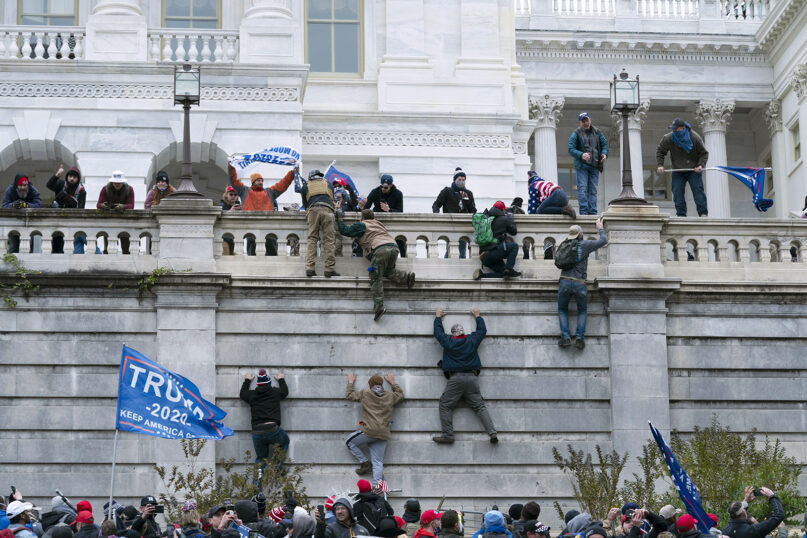
Supporters of President Donald Trump climb the west wall of the U.S. Capitol on Jan. 6, 2021, in Washington. The mob proceeded to breach the Capitol.
 (AP Photo/Jose Luis Magana)

January 5, 2022
By Samuel L. Perry


(RNS) — One year ago at the Capitol riot on Jan. 6, 2021, the world witnessed one way in which Christian nationalism imperils American democracy. We’ve all seen photos and footage of the mob violence perpetrated by Americans waving Christian flags, clad in Christian clothing, saying Christian prayers. As some increasingly isolated and radicalized religious conservatives react to their loss of power, the threat of their political violence is real. But it is not the only way Christian nationalism jeopardizes our democracy.

The fact is, Christian nationalist ideology — particularly when it is held by white Americans — is fundamentally anti-democratic because its goal isn’t “government of the people, by the people, and for the people.” Its goal is power. Specifically, power for “true Americans like us,” Christians in an almost ethnic sense, those who belong — the worthy. Stemming from this, the most salient threat white Christian nationalism poses to democracy is that it seeks to undermine the very foundation of democracy itself: voting.

We can see this connection long before the 2020 presidential election or recent efforts to restrict voter access throughout the country. As historian Anthea Butler recounts, at a 1980 conference Paul Weyrich, co-founder of the Moral Majority, spoke about electoral strategy to Christian right leaders including Tim LaHaye, Phyllis Schlafly, Pat Robertson, Jerry Falwell Sr. and then-presidential candidate Ronald Reagan.

Weyrich famously explained:

“Many of our Christians have what I call the goo-goo syndrome. Good government. They want everybody to vote. I don’t want everybody to vote. Elections are not won by a majority of people. They never have been from the beginning of our country and they are not now. As a matter of fact our leverage in the elections quite candidly goes up as the voting populace goes down.”

In Weyrich’s own words, the goal of these Christian right leaders wasn’t more Americans exercising their democratic rights. The goal is “leverage” and, with it, victory. Over the next few decades, Weyrich and other organizations he co-founded, like the American Legislative Exchange Council, tirelessly promoted legislation to restrict voter access, guided by the belief that voting must be controlled, lest the wrong sorts of people determine the outcome.

In a recent study I conducted with co-authors Andrew Whitehead and Josh Grubbs, we documented this same strong connection between Christian nationalist ideology and wanting to limit voter access. We surveyed Americans just before the November 2020 elections and thus before Donald Trump’s “Big Lie” began to dominate the narrative on the right. We use a scale to measure Christian nationalism that includes questions about the extent to which Americans think the government should declare the U.S. a Christian nation, that America’s success is part of God’s plan and other such views.

Even after we accounted for political partisanship, ideological conservatism and a host of other religious and sociodemographic characteristics, Christian nationalist ideology was the leading predictor that Americans felt we already make it “too easy to vote.”

You may ask, “Who exactly is voting too easily?” The obvious answer is the bogeyman trope of fraudulent voters — those pets, dead people and undocumented immigrants Trump warned about in spring 2020. This myth of widespread voter fraud is decades old and has been thoroughly debunked numerous times. Yet, unsurprisingly, we also found that Christian nationalism is the leading predictor that Americans believe “voter fraud in presidential elections is getting rampant these days.” And it bears repeating: Americans who affirm Christian nationalism already felt this way before the 2020 presidential election.

But other evidence suggests Christian nationalism doesn’t just hope to exclude fraudulent voters. For adults who believe America should be a “Christian nation,” their understanding of who should vote is even more narrow. For example, we asked Americans whether they would support a policy requiring persons to pass a basic civics test in order to vote or a law that would disenfranchise certain criminal offenders for life. These questions hark back to arbitrary Jim Crow restrictions white Southerners used before the Voting Rights Act of 1965. Once again, Christian nationalism is the leading predictor that Americans would prefer both restrictions.

But why?

Part of the reason for this is, as Weyrich explained in 1980, electoral leverage. Americans who subscribe to Christian nationalism likely assume persons excluded by civics tests and lifetime felon disenfranchisement (younger Americans and ex-convicts who are disproportionately Black) would be political threats, not allies.

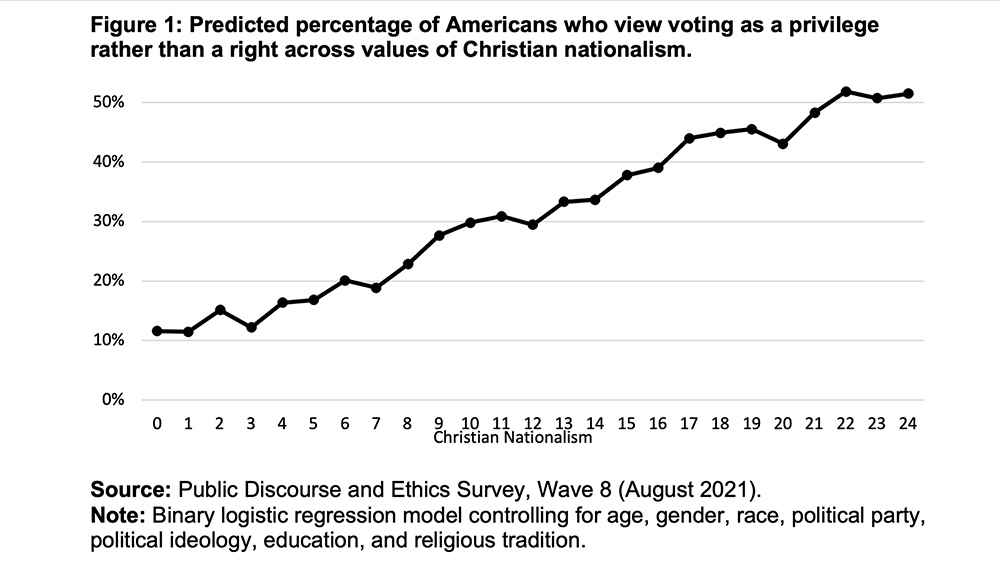
Yet another reason also involves how white Christian nationalists view voting in general. In data we collected in August 2021, we asked Americans to indicate whether they felt voting was a right or a privilege. Though constitutional language repeatedly states voting is a right for citizens, Americans still debate the issue. As I show in Figure 1, the more Americans embrace Christian nationalism, the more likely they are to view voting as a privilege (something that can be extended or taken away) rather than a right (something that shall not be infringed). Indeed, at the extreme end of Christian nationalism, the majority hold this view.


“Figure 1: Predicted percentage of Americans who view voting as a privilege rather than a right across values of Christian nationalism.” Courtesy graphic

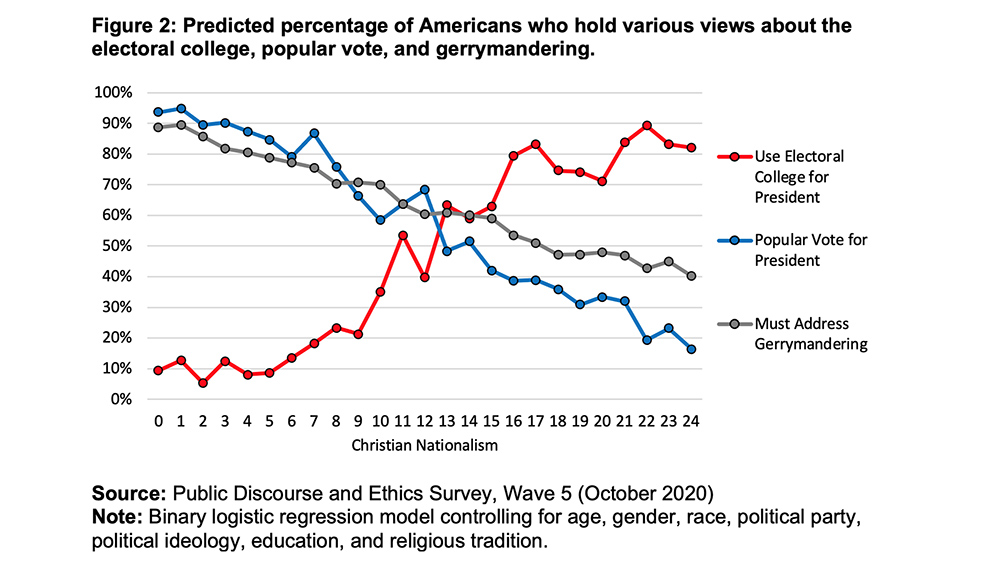
Other evidence beyond voter access suggests Christian nationalism inclines Americans to favor institutional arrangements that preserve their political power. In the same October 2020 survey we used for the earlier study, we found that the more white Americans affirmed Christian nationalist ideology, the more likely they were to reject the popular vote as a means of selecting the president, to favor the Electoral College and to disagree that gerrymandering needed to be addressed to ensure fairer congressional elections (see Figure 2). Why? Almost certainly because these arrangements currently give white, rural, conservative Americans an electoral advantage even when they are numerical minorities. Again, the goal is power, not fairness or democracy.


“Figure 2: Predicted percentage of Americans who hold various views about the electoral college, popular vote, and gerrymandering.” Courtesy graphic

As scholars of right-wing political movements point out, democracy is gradually eroded under some ideological covering, one that stokes populist anxiety with menacing tropes about cultural decline and justifies anti-democratic tactics to “save” or “restore” the nation — to make the nation great again. In the United States, white Christian nationalism is that ideological covering. In the minds of white Americans who believe America should be for “Christians like us,” increasing ethnic and religious diversity is a threat that must be defeated for God to “shed his grace on thee.”

Moreover, Americans who subscribe to Christian nationalism already thought voter fraud was rampant before November 2020. Today, in the aftermath of Trump’s “Big Lie” about a stolen election, which is still believed by over 80% of the most ardent believers in Christian nationalism, electoral integrity is viewed as hopelessly compromised. Thus, they see restricting voter access to those who prove worthy, and maintaining institutional advantages provided by the Electoral College and gerrymandering, as necessary strategies for preserving power and preventing what they see as their own imminent persecution under a Democratic administration.

The threat of Christian nationalist violence like what we saw on Jan. 6 is real. Yet because such threats are so obvious and shocking, and the role of Christian nationalism in them is so blatant, they make gaslighting about them more challenging. (Though Republican leaders are certainly trying, just the same.) In contrast, the threat of Christian nationalism as an ideological covering for voter suppression is perhaps more destructive because its influence is more subtle and its effects (electoral outcomes) are more consequential. Demagogues like Trump will no longer need to mobilize Christian nationalist violence after an electoral loss once they’ve ensured they’ll never lose in the first place.

(Samuel L. Perry is an associate professor of sociology at the University of Oklahoma. He is the author of two books on Christian nationalism, including the award-winning “Taking America Back for God: Christian Nationalism in the United States” (with Andrew L. Whitehead) and the forthcoming “The Flag and the Cross: White Christian Nationalism and the Threat to American Democracy” (with Philip Gorski). The views expressed in this commentary do not necessarily reflect those of Religion News Service.)

Ahead of the Trend is a collaborative effort between Religion News Service and the Association of Religion Data Archives made possible through the support of the John Templeton Foundation. See other Ahead of the Trend articles here.
Blaze TV Host Claims ‘Zionist Movement of America’ is Sponsoring CPAC
By Jackson Richman
MEDIATE
Jan 5th, 2022

BlazeTV host Elijah Schaffer decried foreign influence in U.S. politics while calling out the nonexistent “Zionist Movement of America” for sponsoring the annual Conservative Political Action Conference (CPAC), in addition to blaming Israel and other countries for exploiting “the greed of Americans.”

During Tuesday’s episode of The Blaze’s You Are Here, although Schaffer called out countries – including Qatar, China, Russia – for influencing U.S. politics, by including the Jewish state of Israel in his rant about foreign influence, he echoed the anti-Semitic trope of Jewish and Israeli control of U.S. policy.

Organizations similar to the nonexistent “Zionist Movement of America” that actually exist include the American Zionist Movement and the Zionist Organization of America, with the former being a group that works with both sides of the political aisle and the latter being on the right.

In addition to supporting Zionism, both organizations seek to support the Jewish people not only in Israel but also in the United States — in such was as combating anti-Semitism. Neither organization has been a sponsor at CPAC.

The only Zionist organization to be a sponsor at the conference was the right-wing Chovevei Zion a few years ago. Chovevei Zion is now Amariah, which not only supports Zionism but also conservative principles including limited government and free markets.

After talking about the time he refused $10,000 from Qatar, though he said he initially considered it, Schaffer talked about the time he went “to CPAC and it was like, ‘CPAC, presented by like the Zionist Movement of America. And I’m like ‘Why is the group whose sole interest is the success of Israel the biggest supporter of American conservative politics. That seems super off.'”

He continued:


“Like, I was like, ‘Why is the biggest group not patriots of America or like for Heritage Foundation or like For a Better Country or like the Claremont Institute or just something. I’m like why is it a foreign country who wants their country to be the best is the one promoting and funding our politicians and our groups.’”


“For a Better Country” does not exist.

Schaffer continued:


“And then, I sort of seeing on the Left similarly with like China and similar things, and I’m going ‘So you have like Israel on both sides, China more on the Left but then sometimes China on the Right and then you have Russia more on the Right but sometimes on the Left’ and then I’m going ‘with Israel, China and Russia and some of these smaller countries, I’m going, ‘Everybody’s getting paid from these guys through lobbyists, like they’re funding the lobbyists and the lobbyists are paying the people.’

I’m going ‘Oh my gosh, nobody cares about this country. We’re not America First ‘cause we’re China, Israel and Russia First.’ Like we’re not … people don’t care ‘cause that’s who’s funding. And they’re smart. They took the greed of Americans and they’re selling out our country for the interests of foreign nations.

Saying that Israel, which is America’s closest Mideast ally, “took the greed of Americans and they’re selling out our country for the interests of foreign nations,” as Schaffer did, echoes the anti-Semitic trope of the Jews having influence over foreign governments and global institutions.


MEDIATE AND BLAZE ARE RIGHT WING SITES

Cuban Foreign Minister Denounces US Actions Against Tourism

The U.S. Treasury Department’s Office of Foreign Assets Control (OFAC) is investigating Airbnb’s compliance with U.S. sanctions on Cuba and it could face “significant” lawsuits and fines. | Photo: Twitter @CigarAficMag

Published 5 January 2022 

Recently, the digital lodging platform Airbnb paid a fine of 91,000 dollars imposed by the Office of Foreign Assets Control (OFAC) for accepting guests in Cuba and violating sanctions against Cuba.

Cuban Foreign Minister Bruno Rodriguez on Wednesday denounced the actions by the government of the United States to affect the recovery of Cuba's tourism, as part of its strategy of economic asphyxiation.

RELATED:
Cuba's Monetary Overhaul Enters Second Year Amid US Sanctions

Rodriguez wrote on his Twitter account that these measures are intended to hide the fact that, unlike in the United States, in Cuba the income from that sector is used for the people’s benefit.

Recently, the digital lodging platform Airbnb paid a fine of 91,000 dollars imposed by the Office of Foreign Assets Control (OFAC) for accepting guests in Cuba and violating sanctions against Cuba.

According to the government’s entity, the company admitted having received payments from U.S. travelers to Cuba outside the 12 categories authorized by the White House.


In 2015, the company launched its services in Cuba, but the restrictive measures subsequently adopted during the administration of former President Donald Trump (2017-2021) and maintained by the current Biden administration limit the scope of its business.

Former National Security Advisor under President Barack Obama (2009-2017) Ben Rhodes called the fine “stupid, counterproductive and Trumpian” as it denies U.S. citizens the ability to facilitate revenue directly to Cubans and establish connections between the two peoples.
Progressive Caucus Endorses High Court Expansion

13 A COVEN

The Supreme Court (Samuel Corum/Getty Images)

By Brian Freeman 
NEWSMAX
Wednesday, 05 January 2022 

The Congressional Progressive Caucus on Wednesday endorsed a bill that would expand the Supreme Court by four seats, saying the legislation is needed in order to restore balance to the court, The Hill reported.

Congressional Progressive Caucus Chair Rep. Pramila Jayapal, D-Wash., said the current court, which has a 6-3 conservative majority, was “filled by a partisan, right-wing effort to entrench a radical, anti-democratic faction and erode human rights that have been won over decades.”

Jayapal added in a statement that “in recent years, this court has gutted the Voting Rights Act and public sector unions, entrenched unconstitutional abortion bans, and failed to overturn the blatantly discriminatory Muslim Ban. As a co-equal governing body, Congress cannot sit by while this attack on the Constitution continues unchecked.”

House Democrats introduced the bill, called the Judiciary Act of 2021, last April, but its progress was slowed down over the summer after a presidential commission set up to review the proposal illustrated the lack of academic agreement regarding the wisdom of reforming the bench or what steps would be advisable, according to The Hill.

In October, the bipartisan commission said that one of the main risks in expanding the Supreme Court was potentially undermining its legitimacy.

Sarah Lipton-Lubet, executive director of Take Back the Court Action Fund, expressed support for the endorsement by the Congressional Progressive Caucus, according to Common Dreams.

“Progress on everything from reproductive freedom, to voting rights, to climate change, racial justice, immigration, and the future of democracy itself, requires us to rebalance this court,” she said. “And today’s endorsement from the Progressive Caucus is a loud and clear message that we will not let this hyperpartisan 6-3 stolen court stand in the way of that progress. We will meet the urgency of the moment and expand the court.”