Thursday, January 06, 2022

  • Facebook’s failures with election misinformation contributed to the deadly Capitol insurrection.

    A year later, the platform has failed to fix its problems.

    Media Matters’ latest analysis has identified hundreds of active posts and Facebook groups still pushing “Stop the Steal” lies


    WRITTEN BY KAYLA GOGARTY & CLARA MARTINY

    RESEARCH CONTRIBUTIONS FROM CARLY EVANS, NENA BEECHAM & JEREMY TUTHILL


    PUBLISHED 01/05/22

    Following the deadly insurrection at the U.S. Capitol on January 6, 2021, Facebook vowed to reduce election misinformation and prevent further incitement of violence by removing harmful content and suspending former President Donald Trump. But Media Matters’ latest analysis found that in the year since the January 6 attack, Facebook has not only repeatedly failed to moderate “Stop the Steal” content, baseless claims of election fraud, and other election misinformation, but its algorithm and other features have enabled such content to flourish.

    Key findings:

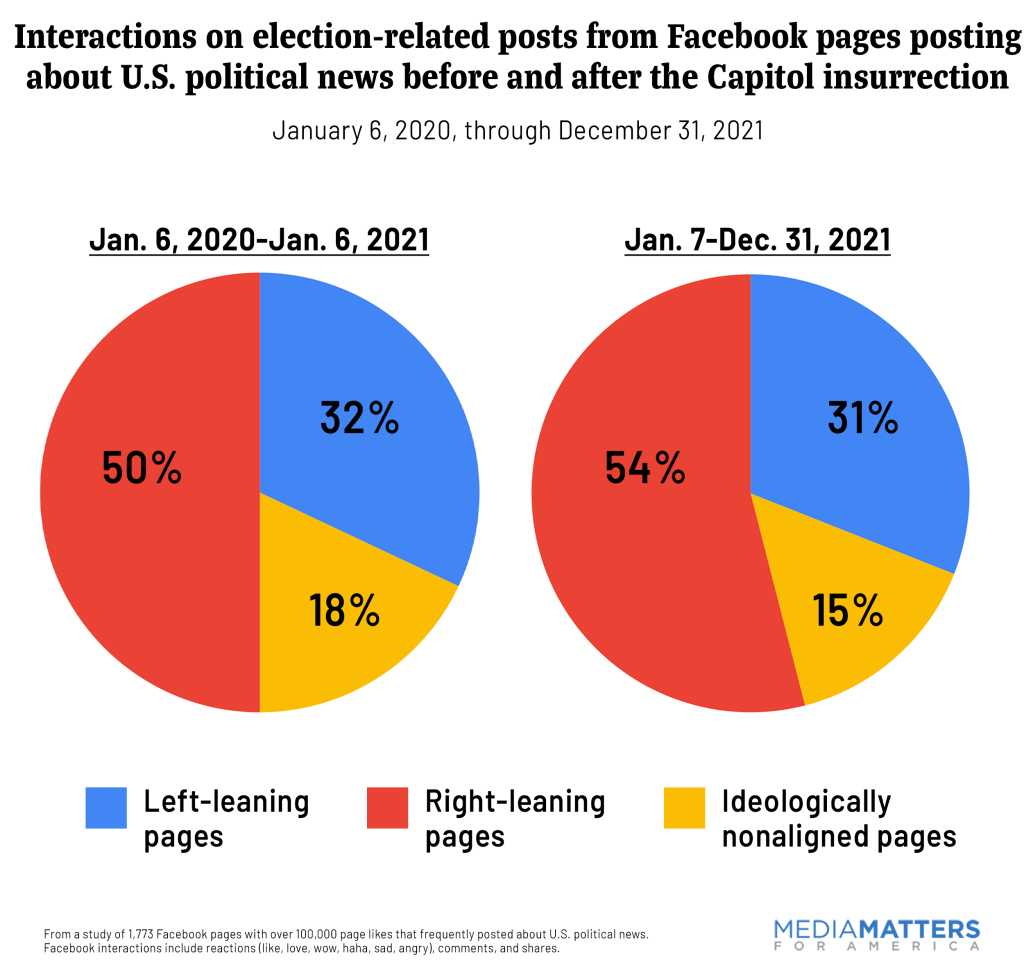
    Right-leaning pages earned a greater proportion of interactions on election-related posts in the year after the January 6 insurrection than in the year before. In fact, these pages earned over 2 billion interactions -- or 54% of total interactions on election-related content -- on nearly 570,000 posts between January 7 and December 31, 2021.
    There are still at least 484 posts referencing “stop the steal” or “sts” still active on Facebook that were created by right-leaning Facebook pages in the year leading up to the insurrection, earning over 2.6 million interactions
  • Since January 7, 2021, another 238 posts with “stop the steal” or “sts” were posted by right-leaning pages and remain on the platform. These posts have earned over 415,000 interactions combined.
  • As of January 3, there were at least 203 groups spreading election misinformation and blatant conspiracy theories, with nearly 240,000 combined members; 18 of them specifically include “Stop the Steal” or mention a “stolen election” in their name

    On November 17, 2020, just weeks after the presidential election, CEO Mark Zuckerberg boasted that Facebook’s “systems performed well” during the election cycle, ignoring the platform’s litany of failures related to election misinformation before and after Joe Biden was elected. In December 2020, Facebook removed the “break glass” measures it had implemented during the campaign to boost authoritative sources and reduce election misinformation -- a move which seemingly contributed to the insurrection on January 6.

    While Facebook had claimed victory, the company failed to recognize what it later called “a coordinated effort to delegitimize the election.” Even more embarrassing for the platform, Facebook researchers clearly had access to troves of data evincing the danger these efforts posed -- even while Media Matters and other external researchers and journalists were sounding the alarm. But Facebook still claimed ignorance when pro-Trump rioters stormed the Capitol on January 6 in an attempt to stop the certification of the election.

    The deadly insurrection on January 6 was aided, in part, by Facebook’s litany of failures before, during, and after the election, which include
  • Allowing Trump and other right-wing pages to push harmful election misinformation -- and other misinformation and extreme rhetoric -- with impunity. Notably, Trump posted 433 times with election-related keywords between November 3, 2020, and November 2, 2021, earning over 176 million interactions, even as 75% of them featured at least one of Facebook's 18 different labels related to the election. Additionally, roughly a quarter of Trump's 6,081 Facebook posts that were created between January 1, 2020, and January 6, 2021, contained COVID-19 misinformation, election lies, or extreme rhetoric about his critics.

  • Failing to enforce its political ad ban and allowing right-wing pages to continue to run political ads with misinformation. Between November 4 and December 8, 2020 -- while the ban was in place -- Facebook enabled right-wing outlet The Daily Wire to earn millions of impressions on 24 political ads before finally removing them. There were another 50 ads that appeared to address social issues, elections, or politics, but ran without a disclaier to circumvent the platform’s ban.
  • Failing to moderate “Stop the Steal” content, even after January 6, when the platform announced it would remove content with the phrase. Between Election Day and January 13, “Sedition Caucus” members -- the 147 Republican members of Congress who voted against certifying the election results after pro-Trump rioters stormed the Capitol -- mentioned keywords related to “Stop the Steal” a total of 193 times on Facebook.
    Earning revenue from ads with election misinformation even after January 6. On November 1 -- nearly 10 months after the January 6 insurrection -- Media Matters found at least 46 ads on Facebook and Instagram calling to “decertify” the 2020 election. The ads earned over 8 million impressions.

    In 2021, Facebook failed to effectively tackle election misinformation and penalize bad actors pushing it. Instead, the company has seemingly prioritized profit and positive PR over addressing the problems that made its platform a hotbed for fomenting political violence. One year after the deadly Capitol riot, these failures continue.

    FAILURE: Right-leaning pages earned more interactions on election-related posts than other political pages -- including by spreading known election misinformation

    Media Matters and other researchers have demonstrated again and again that there is no bias or censorship against conservatives on Facebook, despite right-wing claims to the contrary. In fact, right-leaning pages actually benefit from Facebook’s algorithm, which rewards sensational, divisive, and false content -- and the platform continued to disproportionately benefit right-wing content about voting and elections even after the Capitol attack.

    Between January 7 and December 31, 2021, right-leaning Facebook pages that cover U.S. news and politics posted about election-related topics more frequently than left-leaning or ideologically nonaligned pages, making nearly 570,000 posts, or almost 44% of the total. Notably, right-leaning pages also earned the most interactions -- over 2 billion, or 54%. Left-leaning pages earned over 1.1 billion interactions (31%) on nearly 300,000 election-related posts, while ideologically nonaligned pages earned nearly 560 million interactions (15%) on over 430,000 such posts.

    A similar pattern occurred in the year before the insurrection, as right-leaning pages earned over 3.2 billion interactions on over 750,000 election-related posts created between January 6, 2020, and January 6, 2021 -- earning roughly 50% of total interactions on just over 40% of such posts. Left-leaning pages earned nearly 32% of total interactions on over 25% of election-related posts during this time, and ideologically nonaligned pages earned almost 18% of total interactions on nearly 25% of such posts.


  • FAILURE: Facebook continues to platform numerous posts from right-leaning pages about “Stop the Steal”


    In response to the January 6 Capitol attack, Facebook vowed to remove posts with the phrase “stop the steal” under its Coordinating Harm policy, including retroactive removal. However, Facebook used a very narrow interpretation of its policy, allowing many posts and groups with similar language about a “stolen election” to remain active on the platform. On January 28, 2020, Media Matters reported that over 150 Facebook groups focused on election fraud had avoided removal, including 23 groups that mentioned “stop the steal” or used similar language about a “stolen election” in their name or within posts.

    A year after the January 6 attack, there are still posts with the phrase circulating on Facebook. In fact, we found at least 484 posts with “stop the steal” or “sts” that were created by right-leaning pages in the year before the riot -- between January 6, 2020, and January 6, 2021 -- that Facebook has failed to remove. These posts earned over 2.6 million interactions. Notably, the top 10 “Stop the Steal” posts from this time frame with the most interactions were either posted by Trump, his campaign, or right-wing outlet Newsmax. Five of these posts were from Trump and his campaign.

Additionally, between January 7 and December 31, 2021, right-leaning pages made 238 posts mentioning “stop the steal” or “sts,” which earned over 415,000 interactions combined. These include at least 40 posts that push election misinformation, criticize Facebook for banning the phrase, or contain misinformation about the insurrection.

FAILURE: There are still hundreds of groups filled with election misinformation on Facebook

Two days after Election Day 2020, it was clear that Facebook was already having problems. The platform took down one of the biggest “Stop the Steal” groups at approximately 300,000 members, and it added labels to posts discussing election results. However, like many of Facebook’s actions to stem misinformation, this was too little too late. By then, groups were proliferating on the platform, finding ways around Facebook’s moderation, and using the platform to organize and prepare for violence on January 6.

A year later, election misinformation continues to spread in private and public Facebook groups as administrators only gained more power to evade content moderation.

In October 2021, we identified 203 active groups dedicated to pushing election misinformation -- and that number has increased since then. As of January 3, there are still 203 groups spreading election misinformation and conspiracy theories, with nearly 240,000 members; 18 of them specifically use variations of “stop the steal” or mention a “stolen election” in their name. Another 15 groups spreading election misinformation during that time have since been archived -- meaning that members have access to posts in the groups but can no longer create new ones.

While some of these groups are still focused on the 2020 presidential election, others have pivoted to combat so-called “election fraud” in state-level elections. For example, “NJ Election Integrity Project” has spread misinformation about the 2021 gubernatorial race. It is perhaps Facebook's biggest failures that it has let misinformation about 2020 election seep into 2021 and beyond.

Methodology


Media Matters used the following method to compile and analyze election-related posts from political pages on Facebook:

Using CrowdTangle, Media Matters compiled a list of 1,773 Facebook pages that frequently posted about U.S. politics from January 1 to August 25, 2020.

For an explanation of how we compiled pages and identified them as right-leaning, left-leaning, or ideologically nonaligned, see the methodology here.

The resulting list consisted of 771 right-leaning pages, 497 ideologically nonaligned pages, and 505 left-leaning pages.

Every day, Media Matters also uses Facebook's CrowdTangle tool and this methodology to identify and share the 10 posts with the most interactions from top political and news-related Facebook pages.

Using CrowdTangle, Media Matters compiled all posts for the pages on this list that were posted between January 6, 2020, and December 31, 2021, related to elections and voting. We reviewed data for these posts, including total interactions (reactions, comments, and shares).

We defined posts as related to elections and voting if they had any of the following terms in the message or in the included link, article headline, or article description: “ballot,” “biden,” “democrats,” “dems,” “election,” “general chatter about voting,” “poll watcher,” “polling place,” “polling station,” “republicans,” “the election,” “trump,” “vote,” “voted,” “your state,” “election results,” “rigged,” “election integrity,” “voter,” “voter fraud,” “electoral college,” “ballots,” “certifying,” “chosen electors,” “corrupt,” “corruption,” “count,” “decertification,” “decertify,” “decertifying,” “democratic process,” “dominion,” “election,” “election fraud,” “election victory,” “electoral college,” “found ballots,” “stolen election,” “stop the steal,” “vote dump,” “vote tabulation,” “voter dump,” “voter fraud,” “voter tabulation,” “voting,” “mail-in ballot,” “mail-in box,” “election box,” “election machines,” “stopthesteal,” “#stopthesteal,” “2020 election,” “election 2020,” “mail in ballots,” “mail-in ballots,” “mail in ballot,” “mail-in ballot,” “integrity hearings,” “integrity hearing,” “fraud hearing,” or “fraud hearing.”
Seattle Jewish Federation Outraged After ‘Inadequate’ Response to Police Official Who Displayed Nazi Insignia

by Algemeiner Staff
JANUARY 5, 2022 


Aerial view of Kent, Washington as of 2021. Photo: Imogen Caroline/Wikimedia

A major Seattle Jewish organization criticized city officials in Kent, Washington — part of the Seattle metropolitan area — for their response to an assistant police chief who posted a Nazi military insignia on his office door and allegedly made jokes about the Holocaust.

Assistant Kent Police Chief Derek Kammerzell was suspended for two weeks and ordered to attend cultural sensitivity training last July for violating city policy prohibiting harassment and discrimination and for unbecoming conduct in violation of police policy, according to the Kent Reporter.

Police Chief Rafael Padilla accepted his subordinate’s claim that he did not know the symbol, which indicated a military rank, was of Nazi origin.

A Dec. 28 statement released by Kent’s municipal communications staff said that two independent law firms had reviewed the case and, “based on labor law and the advice of the employment law firm, the city believes a two-week suspension was an appropriate and defensible response to the conduct identified in the investigation.”

The Jewish Federation of Greater Seattle objected, saying, “The City of Kent’s response demonstrates a complete lack of understanding of the impact of these acts by one of its assistant police chiefs on our local Jewish community.”

“We call on the City of Kent to immediately revisit the situation, publicly recognize the harm and hurt caused to our Jewish community, and treat the offenses with the seriousness and care they deserve,” they said.

“This is an affront to the entire Puget Sound Jewish community and inexcusable,” the Federation added. “Synagogues, Jewish community centers, and Jewish organizations rely on law enforcement to help protect them from violent, antisemitic attacks.”

“The two-week suspension and sensitivity training given in response are completely inadequate, especially at a time when incidents of hate against the Jewish people are higher than they’ve been in almost 45 years,” they asserted. “The absence of true accountability demanded of Kammerzell and the sheer lack of consequences in this situation are shocking.”
While isolated from his colleagues as a COVID precaution, Fox's Gutfeld declares “the pandemic is over”

Gutfeld: “This is absolutely great news. This is the double destruction of the pandemic and of the teachers unions”


WRITTEN BY MEDIA MATTERS STAFF
PUBLISHED 01/05/22 
CitationFrom the January 5, 2022, edition of Fox News' The Five

GREG GUTFELD (CO-HOST): You have to look at this from the positive perspective. This is absolutely great news. This is the double destruction of the pandemic and of the teachers unions happening at exactly the same time, right? We now know that the pandemic is over. The teachers unions pushed us over the cliff. It's going to happen February 1st -- this is all going to be behind us. And it's time now to sever the ties with the least competitive entity on the planet since the Washington Generals. Our education -- educational system is just like the Washington Generals in that we pay them to lose. The only thing worse is that they're teaching our children to lose. They're going to lose in life because they're falling behind. We've learned one really important thing from remote learning -- no one is remotely learning. 
CALIFORNIA
Bill To Make It Easier To Sue Gun Makers and Dealers Introduced in Assembly

‘This has to be airtight to succeed and it is far from airtight’


Assemblyman Philip Y. Ting. (Photo: Kevin Sanders for California Globe)

By Evan Symon, January 5, 2022 2:08 pm

A bill to make it easier for local governments and gun violence victims to sue gun makers was introduced in the Assembly on Tuesday.

Assembly Bill 1594, authored by Assemblymen Phil Ting (D-San Francisco), Chris Ward (D-San Diego) and Mike Gipson (D-Carson), closely follows a New York law in allowing victims of gun violence and governments to sue gun manufacturers or dealers for liability when firearms are used in incidents of shooting deaths or injuries. The specific language of the bill reads as “This bill would specify that a gun industry member has created or maintained a public nuisance, as defined, if their failure to follow federal, state, or local law caused injury or death or if the gun industry member engaged in unfair business practices.”

Ting, Ward, and Gipson said that the 2005 Protection of Lawful Commerce in Arms Act, a law that protects gun makers and dealers from liability when weapons are used to kill or injure someone, fails to protects them when they break state law. Armed with a loophole, the three Assemblymen wrote the bill for several different reasons.

One major reason is to follow Governor Gavin Newsom’s push to model a law on the recent Texas abortion law to allow private citizens to sue gun manufacturers. Despite Newsom’s idea clearly breaking federal law, AB 1594 would work within the loophole to avoid any federal problems.

The Assemblymen also pushed for greater public safety with the bill, with the hope that greater legal and financial pressure will have gun makers and dealers follow California firearms laws more closely and lead to a reduction in crime.

“We must make our communities safer. Almost every industry in the United States can be held liable for what their products do, but the gun industry is not held to the same standard,” said Assemblyman Ting on Tuesday. “Financial repercussions may finally push them to be more responsible by improving their practices and adhering to California’s strict gun laws.”

Assemblyman Mike A. Gipson. (Photo: Kevin Sanders for California Globe)

The bill is also fighting against ramped up legal pressure by gun rights organizations against California laws. To the embarrassment of many lawmakers, California gun laws were severely challenged by the courts last year, with a federal judge even overturning the state’s 32-year-old ban on assault weapons in June, with it later being halted due to a stay from an Appeals judge while they decide on it.

“A lot of California legislators and higher lawmakers are frustrated as legal challenges against their gun laws keep coming up almost endlessly,” Los Angeles injury lawyer Marco Ruiz told the Globe on Wednesday. “One is finally decided by the courts and three others seem to spring up. And worse yet, they are starting to win some now, forcing the state to appeal. They’re hoping with AB 1594 and others similar to Newsom’s proposal that a new precedent will come up and that they’ll be beleaguered by so many lawsuits that they’ll play ball, or at the very least put the burden more on guns rights organizations. The state wants to win the war over firearms, and passing this, and it coming through the courts unscathed, would be a big part of it.”

Finally, the bill is personal to Assemblyman Gibson, whose son and future daughter-in-law were injured in a Los Angeles shooting in 2020. Gipson even said of the bill on Tuesday that “This is absolutely personal to me. I will not rest until we put an end to senseless gun violence. Part of the solution is focused on how particular guns are manufactured and distributed in California.”
Support, opposition against AB 1594

The bill received much political support on Tuesday and Wednesday with both Attorney General Rob Bonta and the Brady Campaign getting behind the bill.

Gunmakers, dealers, and guns rights organizations quickly announced opposition to AB 1594, arguing that the vast majority of gun owners and businesses who follow the law would be unduly punished as a result of the bill being passed. Many have already promised lawsuits if the law is passed, with some hoping to petition members of Congress to amend the Lawful Commerce law to remove the state law loophole, thus invalidating any attempt to get past it like AB 1594.

“Law-abiding gun owners and businesses are not the cause of criminal misuse of firearms,” said the California Rifle and Pistol Association last year to Governor Newsom’s plan. “Yet Newsom and other anti-gun politicians seem to believe the threat of frivolous lawsuits will somehow address their own failures.”

In a new statement on Tuesday, a representative for the group added “As a matter of policy, to try and shift the blame for the criminal misuse of a lawful product that is used far more often to save lives and protect lives than to take them is a terrible idea.”

Those in law also said that passing the law could lead to a legal minefield of issues.

“These Assembly members have no idea just what they are doing,” attorney Ruiz added. “Good lawyers could easily argue against this law in court. Should someone be able to sue a restaurant for giving someone a heart attack? Should someone sue a knife maker for the same reasons as AB 1594? The list can go on. It’s not even funny how bogged down this law will be for years under the legal system. Every side will fight hard. There will be stays. Appeals. Arguments over every bit of language. This has to be airtight to succeed and it is far from airtight.”

“We’re in for a bumpy ride on this one, and we haven’t even gotten to committee votes yet. We haven’t gotten final legal word on the New York law that could really change the course of this one. This is far from a done deal.”

AB 1594 is expected to be heard in committees in the coming months.

Author
Recent Posts

Evan Symon is the Senior Editor for the California Globe. Prior to the Globe, he reported for the Pasadena Independent, the Cleveland Plain Dealer, and was head of the Personal Experiences section at Cracked. He can be reached at evan@californiaglobe.com.


South Carolina has experienced 10 earthquakes since late December, confounding experts


The earthquakes may be a long-lasting aftershock following a 3.3 magnitude quake in December

Graig Graziosi
5/01/2022


Related video: 3.5-magnitude quake rocks San Bernardino County

A series of 10 earthquakes have shook the region surrounding South Carolina's capital city Columbia over the past two weeks, and geologists are unsure of what – if anything – the quakes might mean for the area.

The seismic activity began on 27 December, after a 3.3 magnitude earthquake shook the border region between Richland and Kershaw counties.

Geologists believe that quake set in motion an extended period of aftershocks, which explains the recent spate of smaller quakes around the region.

South Carolina is no stranger to earthquakes. The state averages about 20 each year, as part of the state sits atop the Easter Piedmont fault system, which extends from Alabama north into Virginia. The fault system is ancient and likely formed around 480 million years ago, the same time the Appalachian Mountains rose.


While the ancient fault systems in the southeastern US have been largely inactive, Steven Jaume, an associate professor at the College of Charleston, told WYFF that the recent spate of earthquakes may indicate those faults are becoming active.

"The question is are those faults being reactivated," he said. "Are they starting up again in that particular area? That's what we're investigating."

In addition to the number of the quakes, the location is also unusual. Most of the state's earthquakes occur near the coasts, particularly near the Charleston region. The recent group of quakes is much further inland, all occurring around Columbia.

Mr Jaume said that so long as the quakes continue to be minor, there is not likely cause for concern.

The last time the state suffered a major earthquake was 1886. That year, Charleston suffered the largest earthquake ever recorded in the southeastern US when a quake of at least a 7 magnitude rocked the city, leaving dozens dead and hundreds of buildings destroyed.

Most watched

Prior to the quake, several smaller tremors occurred in the region over the course of several days. There was no way to know at the time that the quakes were foreshocks indicating a much large event to come.

Unfortunately, seismologists are still unable to forecast earthquakes. Unlike meteorology, which allows researchers to see storms and other weather events coming, there is no means of measuring data that could foretell the coming of an earthquake.

"You can't see it coming," Mr Jaume told The Associated Press on Wednesday. "There isn’t anything obvious moving or changing that you can put your finger on that you can say, ‘This is leading to this.'"

More about South CarolinaEarthquakes
Don’t Care About the Build Back Better Act? 
Hearing People’s Personal Stories Might Change That

When U.S. Sen. Joe manchin, D-W.VA., said that he wouldn’t support President Joe Biden’s signature build back better act, he set off a wave of breaking news alerts.


January 5, 2022 by Pressenza

Editorial note: The need for constructive information is critical in our decision-making process. When information becomes tainted with special interests, spin, myopic visions for power & control from divisive factions, the intensity shifts from interests of good governance to the politics of street-game “winner or loser” and nowhere near are “for the people” Constitutional claims. A quote from the 13th century Persian poet Rumi starts, “The quieter you become, the more you will be able to ‘hear’…and I would add, to ‘see’. Human perception is being altered, channeled for control. Media din capitalizes on the sensational, the outrageous, with the result being much more emotion-commotion than clarity..of mind, of heart. This article by Professor Angela Bradbery suggests that a focus of people-to-people interest rather than a pay-to-play media machine may be key to reclaiming direction. J.Jill


When U.S. Sen. Joe Manchin, D-W.Va., said that he wouldn’t support President Joe Biden’s signature Build Back Better Act, he set off a wave of breaking news alerts.

It was fitting. For months, media coverage has breathlessly focused on the behind-the-scenes wrangling and hour-by-hour negotiations around the legislation. How much has been slashed from the bill today? What does it mean for the future of the Democratic and Republican parties?

The roughly US$2 trillion proposal is designed to bolster what is widely seen as a frayed social safety net. But most Americans don’t think it will benefit people like them, a recent NPR/Marist poll shows. And a quarter of Americans can’t even say whether they like or dislike the legislation.

It’s no wonder the nation is so indifferent about the sweeping bill, which would change the country’s tax system, increase social services and ramp up efforts to combat climate change.

Largely omitted from news coverage – and consequently, from the national conversation – are the voices and stories of individuals who would be affected by the legislation.
Focusing outside D.C.

What if daily media coverage instead featured those voices? What if reporters and talk show hosts ditched the pundits and issue experts and instead explored the problems that led to the proposed policies – through the eyes and voices of those living with those problems?

That means we would hear from parents who need help paying for child care and elderly people who can’t afford medicines or hearing aids.

We would hear from people who can’t afford health care, people living in their cars or on the streets, and yes, those who earn more than $400,000 a year. Multimillionaires, billionaires and corporations would pay more under the new tax plan.

What if news stories shined a spotlight on these voices, rather than just throwing in an occasional anec
Research shows that they likely would. And that would be good for democracy.
Real stories can spark real engagement

It’s well documented that horse-race journalism – which treats politics as a sport, focusing on who’s ahead or behind, rather than the substance of issues – is associated with an uninformed electorate and elevates public cynicism about politics. Such coverage doesn’t help people understand what proposals could mean to them.

Policy overviews filled with large numbers don’t engage people, either. When discussing the Build Back Better Act, proponents understandably focus on the scope of the problem: 2.2 million low-income Americans couldn’t get health insurance subsidies in 2019 but also weren’t eligible for Medicaid.

Just 23% of civilian workers can take paid family leave, and more than 800,000 seniors and disabled people seeking home health care are on state Medicaid waiting lists.

But science tells us that discussing large-scale suffering makes people turn away. The phenomenon is called psychic numbing. It means the problem is so big that people disengage, because they feel powerless to help. And individuals find it hard to understand the scale of large numbers.

The way to combat this? Journalists can tell stories about real people. Personal stories quickly bring big issues into focus and make them relatable. They make people care.

In 2015, for example, the Syrian refugee crisis had been raging for four years. But it took a picture of 3-year-old Alan Kurdi, whose corpse washed up on a Turkish beach after his family fled Syria by boat, to generate international horror.

After the photo of the young Syrian boy went viral, donations to refugee organizations skyrocketed. The story and photo engaged people who had not yet paid attention to the crisis.

Research backs up the notion that including real people in news stories can spark reader engagement.

A 2012 study compared people’s reactions after they read two versions of a news story detailing how the lack of health care affected one of three groups: immigrants, prisoners or the elderly.

One version presented the issue using quotes from experts. The other version included a story about a specific person’s experiences dealing with that health care issue.

The news pieces that featured people’s stories elicited emotions in readers that the policy pieces did not. That led the participants to be more willing to help the people they read about.

Including real people in news stories doesn’t mean that engaged readers will only feel sympathy for the characters profiled. Engagement could produce support or opposition to proposed policies.
Looking beyond the political play-by-play

The Build Back Better Act – which the U.S. House of Representatives passed in November – comes as civic engagement in the U.S. is low.

Considering the scope and potential impact of this bill, it’s a disservice to the country for news coverage to focus on the play-by-play in Washington, D.C.

If the press eases up on the machinations occurring in the marble halls of Washington, D.C., and instead focuses on real people, the U.S. could perhaps build back something else: civic engagement, a necessary part of our democratic system.


This post was previously published on pressenza.com and under a Creative Commons license CC BY-ND 4.0.
With child tax credit stance, Manchin runs afoul of former faith allies
The senator’s support for work requirements puts him at odds with the U.S. Conference of Catholic Bishops and the National Association of Evangelicals, among other faith groups.

Sen. Joe Manchin, D-W.Va., speaks to reporters at the U.S. Capitol in Washington, Sept. 30, 2021. (AP Photo/J. Scott Applewhite)

January 5, 2022
By Jack Jenkins

WASHINGTON (RNS) — As Democrats struggle to revive talks over the stalled Build Back Better bill, Sen. Joe Manchin is facing pushback from a spectrum of religious groups frustrated by his position on the child tax credit — including conservative-leaning faith organizations whose concerns he has championed in the past.

Debate over the Build Back Better Act, a sweeping social programs proposal and a core part of President Joe Biden’s domestic agenda, ground to a halt in December when Manchin declared he wouldn’t vote for the bill.

According to The Washington Post, negotiations broke down after the West Virginia Democrat floated an alternative proposal to White House officials, which maintained elements of the original legislation but omitted an expansion of the child tax credit, a popular provision that provides financial assistance to parents with children.

This week, Manchin told reporters he supports a child tax credit, which advocates say helps prevent child poverty — but only if it includes a work requirement for parents wishing to receive the benefit.

“I think there should be a work requirement,” Manchin told Business Insider. “I’ve been very, very direct on that.”

RELATED: Faith leaders arrested while protesting in support of Build Back Better bill

The plan would bar some of the poorest families from accessing the benefit, which was expanded last year under Biden’s stimulus law to allow most families to receive monthly payments of up to $300 per child. But the expansion expired last month, and if Manchin’s proposal for a work requirement — which he has suggested for months — were to become the new norm, families that do not pay federal income taxes due to lack of income would not receive the checks.

Manchin, a Catholic Democrat, is now at odds with religious groups such as the U.S. Conference of Catholic Bishops, a group whose positions he has promoted in the past: When the USCCB, National Association of Evangelicals, Orthodox Union and other faith groups raised concerns about a provision of the Build Back Better bill requiring faith-run prekindergarten and child care programs to comply with federal nondiscrimination statutes, the West Virginia senator reportedly advocated for a change.

But when asked about the child tax credit, USCCB spokesperson Chieko Noguchi pointed to a Sept. 7 letter from bishops voicing support for the benefit expansion. The authors argued “it is especially important that the credit remain fully refundable to ensure the most economically vulnerable children benefit from this family support.”

Noguchi said the USCCB is “concerned that work requirements would undermine this goal and put the credit out of reach for those neediest children and their families.”

Manchin’s proposal has also pitted him against the National Association of Evangelicals. While the group has not taken a position on the Build Back Better Act as a whole, Galen Carey, the group’s vice president for government relations, has appeared at faith-themed events to express support for the bill’s child tax credit provision.

Asked this week about tying work requirements to the child tax credit, Carey was quick to express disapproval.

“We support making the child tax credit fully available to the families who need the help the most,” he said in a statement. “Work is critically important to human dignity but having a particular level of earned family income should not be a prerequisite to accessing support for their children. Full CTC refundability is what makes it such a powerful anti-poverty tool.”

In a previous statement sent to Religion News Service in December, Carey noted the benefit has enjoyed bipartisan support in the past and “has been expanded by both Republicans and Democrats.”

“Congress should act urgently to extend the Child Tax Credit, whether as part of a larger package or as a separate bill,” the statement read.

RELATED: As Biden’s agenda navigates Congress, faith groups lobby Manchin

Representatives for Manchin did not immediately respond to questions about the religious pushback, but faith groups have condemned Manchin’s position for months. Chief among them: the Poor People’s Campaign, a faith-led activist group that often advocates for liberal-leaning legislation. Poor People’s Campaign leaders staged large protests decrying Manchin throughout 2021 for several reasons, including opposition to his stance on the child tax credit.

While discussing Manchin’s suggestion of work requirements during a September news conference, the Rev. Liz Theoharis, co-chair of the Poor People’s Campaign, described the idea as a “regression back to the tired debate of deserving and undeserving poor.”

She noted some Republicans have justified work requirements in other contexts by invoking a New Testament Scripture passage, 2 Thessalonians 3:10, which reads: “Anyone unwilling to work should not eat.” She insisted the passage, when taken in context, “does not blame the poor for moral failures that lead to poverty, nor does it suggest that work requirements should be attached to social programs.”

She added: “There is a moral critique, there is a constitutional critique, of the wealthy benefiting off the work of others, and other ways that the rich punish and oppress the poor.”


Can Biden's child tax credit be revived?


Mike Bebernes
·Senior Editor
Wed, January 5, 2022

Biden, Manchin set to resume talks over Build Back Better Act


What’s happening

The expanded child tax credit, a groundbreaking social program that gave millions of American families monthly checks from the federal government, expired at the end of the year.

The U.S. has had a child tax credit since the 1990s, but when Democrats passed their $1.9 trillion economic stimulus package in March, they made three major changes that transformed it from a typical end-of-year tax write-off to the closest thing the country has ever had to a child allowance. The bill increased the size of the credit from $2,000 to up to $3,600, issued checks monthly and changed eligibility rules so low-income parents who had been left out under the previous system could receive the full benefit.

The first checks, for either $250 or $300 depending on the age of the child, went out to about 35 million families in July. Democrats were hoping to include a long-term extension in President Biden’s Build Back Better legislation, but the program expired when they weren’t able to reach an agreement on the sweeping social spending plan before the end of the year. Even though it lasted for only a few months, studies suggest that the monthly checks helped keep struggling families afloat and significantly reduced child poverty.

Disagreement over the child tax credit is reportedly one of the thorniest issues that have prevented a deal from being reached. Conservative Democratic Sen. Joe Manchin, whose vote is needed to pass any version of Biden’s agenda, appears to be particularly opposed to the credit — even reportedly saying that parents would spend the money they received on drugs. In late December, Manchin reportedly presented Biden with a $1.8 trillion package that he’d be willing to support. The expanded child tax credit was not part of that plan.
Why there’s debate

Manchin’s apparent opposition to the expanded child tax credit is considered by many as a signal that the program is gone for good. But there’s some optimism that he could be convinced to include it in a final version of Build Back Better, if a deal is reached at all.

Some political analysts say it’s possible that pressure from his Democratic colleagues and his constituents could push Manchin to drop his objections. Others believe he could be convinced to accept a trimmed-down version of the credit that potentially includes smaller checks, targets support only to the neediest families or imposes other restrictions like a work requirement.

There is also hope for alternative paths to support parents outside of the Build Back Better framework, some say. Specific attention has been paid to a proposal from Republican Sen. Mitt Romney that would create a more direct child allowance system to provide monthly benefits to families through the Social Security Administration rather than as a tax credit. In theory, Romney could give Democrats the 50th vote needed to pass a plan without Manchin’s support. Enthusiasm for the short-lived federal program could also prompt some states and cities to create their own versions, others say.
What’s next

Monthly checks have stopped, but parents can still expect one boost from the expanded child tax credit. The program ran for only half the year, meaning families can claim the other half — up to $1,800 per child — when they file their taxes.
Perspectives

A smaller, more targeted version of the credit might be acceptable to Manchin

“The child tax credit itself should be more targeted and last longer. … The child tax credit increases could also be focused on younger children by retaining the full increase for children under 3 but scaling it back for older children. Finally, the credit could be phased out more rapidly as incomes rise, focusing help on those who need it most.” — Jason Furman, Wall Street Journal

Manchin may be more susceptible to pressure on the child tax credit than other policies

“Normally, Manchin gets pressure on social issues from the more liberal wing of the Democratic Party. This criticism from the wider party is fuel for his positioning and policy goals within the state. On such issues, the more criticism he receives from the left, the better. … The public pressure on child tax credits is not the norm and does not offer the same pivot for Manchin. West Virginians value programs like the child tax credit.” — Samuel Workman, Conversation

It may be impossible to sell Manchin on supporting the child tax credit

“Manchin’s various rationales just don’t add up. Unless his bottom line is that he just doesn’t want to extend the policy no matter what — or even worse wants to kill all of BBB — and is just looking for an excuse to do so.” — Greg Sargent, Washington Post

Lack of full-throated public support limits how much pressure Manchin will feel

“When the policy first passed in March, many experts hailed its potential to cut child poverty and hunger, and many Democrats hoped regular cash in families’ pockets would prove wildly popular. But the public’s appraisal has been less glowing. … As the party continues to debate whether and how to resurrect the expanded credit, polls generally suggest that Americans have reservations about making it a more lasting fixture of the social safety net.” — Ian Prasad Philbrick, New York Times

Romney could prove to be the savior of Biden’s family-benefit agenda

“With Manchin clearly out on child tax credit, it’s time to separate the plan from Build Back Better and work to get it passed with bipartisan support. Romney, to his credit, already has a plan which closely mirrors that of the Democrat party. This option is a clear win-win-win.” — Toph Cottle, Salt Lake Tribune

Replacing the credit with Romney’s plan would be a win for American families

“To be sure, the Romney plan is not perfect. … But even with these flaws, it’s still quite a good benefit that is better than the status quo and, in my view, even better than the CTC the Democrats were trying to pass in the BBB legislation. Democrats should work with Romney to pass this plan.” — Matt Breunig, People’s Policy Project

States could create their own programs

“Frustrated on a national level, some lawmakers are shifting their focus to state-level child tax credits to offer families a safety net.” — Ursula Perano, Daily Beast

The country will be better off if the expanded credit is gone for good

“Why aren’t they making those bigger monthly checks permanent, as President Joe Biden and other key Democrats have said they intend? It’s simple: It would come at a staggering cost.” — Matt Weidinger, Washington Examiner

Is there a topic you’d like to see covered in “The 360”? Send your suggestions to the360@yahoonews.com.

Photo illustration: Yahoo News; photos: Getty Images
Myanmar coup-fuelled poverty pushes thousands to Thailand

PUBLISHED : 6 JAN 2022 
WRITER: AFP
In this file handout photo from the Royal Thai Army released on Oct 25, 2021, a Thai military personnel in protective gear checks the temperature of Myanmar migrants apprehended by Thai military personnel in Kanchanaburi province. (AFP)

Trekking through dense jungle and mountainous terrain at night to avoid arrest, one couple from Myanmar endured a gruelling journey to Thailand -- grasping for an economic lifeline as jobs dry up in their coup-hit home.

Myo Chit and his wife are among thousands of migrants who have made the crossing in recent months, spurred by the twin crises of a pandemic-hit economy and turmoil triggered by the junta's ousting of Aung San Suu Kyi's civilian government.

Their two-day journey from Myanmar's coastal Tanintharyi Region took them through corn farms, rubber plantations and dense jungle before they reached the porous border, where they crossed into Kanchanaburi province with the help of a smuggler.

There they risked arrest and immediate processing for deportation by police.

The couple then travelled to Samut Sakhon province near Bangkok, where Myanmar migrants have historically found work.

But for undocumented migrants in the country, life under the radar is grim.

Many spend their nights in overcrowded housing, or in the homes of friends and relatives, and their days evading authorities.

"But we could not stay (in our town)... we had to think about the future of our children," 45-year-old Myo Chit told AFP, using a pseudonym for fear of being tracked down by authorities.

He eventually secured the job he was desperate for at a clothing dye factory, earning 300 baht a day.

With a six-year-old child and an infant left in his in-laws' care in Myanmar, Myo Chit said leaving was difficult but had to be done.

"We could not stay there because of high prices -- we had to leave our village," he said. "We came here just to earn money."

In this file handout photo from the Royal Thai Army released on Nov 1, 2021, Myanmar migrants sit on the ground after being apprehended by military personnel in Kanchanaburi province.
(AFP)

- 'It is hard' -

Myanmar workers have long sought jobs in Thailand. Pre-pandemic, an estimated two million were living and working in the kingdom.

With borders closed since March 2020, migrants have no choice but to make the journey illegally.

There is no official data on the size of the influx, but experts say one indicator is the number of migrants who have been caught by authorities.

In the months after Myanmar's Feb 1 coup, the number of arrests tripled, according to government figures.

It peaked in November with more than 6,000 migrants intercepted -- more than a 10-fold increase from the 560 people arrested in January 2020.

According to Geraldine Ansart, the International Organization for Migration's Thailand mission chief, for each person arrested, "it is realistic to assume that... at least one other Myanmar national could cross the border without being apprehended".

Migrant rights activist Roisai Wongsuban said the spike in arrivals is due to Myanmar's post-coup economic crisis, which has seen inflation soar and work opportunities evaporate.

With food prices doubling and fuel costs spiking as the value of the kyat, Myanmar's currency, plummeted against the US dollar, many people became destitute, she said.

"It is hard for ordinary people."

Seasonal workers, who for years had travelled in and out of Thailand, were left in the lurch after Covid-spurred border closures.

"The border has been closed for so long that there is no legal pathways for workers who want to come back to Thailand," Ms Roisai added.

Army spokesman Gen Santipong Thammapiya said it was mainly the country's reopening to tourists in November that was drawing Myanmar workers back -- many of whom staff the kingdom's vital industries, including the service and restaurant sector.

"Workers... wanted to come back," he told AFP. "They also trust the Thai healthcare system, which can provide treatment for Covid."

Myanmar refugees, who fled a flare-up in fighting between the Myanmar army and insurgent groups and settled temporarily on the Moei River Bank, receive aid from Thailand on the Thai-Myanmar border, in Mae Sot, Tak province on Tuesday
(Reuters photo)

- Zero tolerance -

Demand for Myanmar workers is high in Thailand, where -- given their status -- they have no choice but to accept lower wages.

According to the labour ministry, there is a shortage of up to 200,000 workers.

But according to Gen Santipong, there is no tolerance in Bangkok for illegal migration, and those arrested making the attempt are sent "for legal processing followed by... repatriation", he said.

Despite the obstacles, two people smugglers operating near Kanchanaburi province's Three Pagodas Pass border crossing told AFP business has been good.

Prices to make the crossing range from 13,000 to 25,000 baht, and desperation drives thousands to pay.

"Some are arrested, but there are even more people who are not," one smuggler told AFP on condition of anonymity.
WW3.0
Can Europe avert a war between US and China?


PUBLISHED : 6 JAN 2022 
NEWSPAPER SECTION: OPED
WRITER: ROBERT WILLIAMS & MORITZ RUDOLF
An attendant walks past EU and China flags ahead of the EU-China High-level Economic Dialogue at Diaoyutai State Guesthouse in Beijing in 2018. (Photo: Reuters)

European countries are currently divided over whether to join US President Joe Biden's diplomatic boycott of the upcoming Winter Olympics in Beijing. The episode underscores yet again that when it comes to dealing with China, Europe and the United States truly are an ocean apart.

Beyond sharing fundamental political values, the US and Europe often employ similar rhetoric about the challenge China poses to the international order. Nonetheless, most European governments cannot reconcile their interests with the vision of a US-led coalition of democracies standing up to the world's autocracies, and European officials baulk at pursuing a China policy focused on containment, under the guise of competition.

While the European Union wants to deepen transatlantic cooperation, there is no consensus on how to do so without alienating China or undermining the very international system it aims to defend. Nor are European governments convinced of America's reliability as a partner. Mr Biden might value the transatlantic relationship, but his predecessor, Donald Trump, did not. Who is to say what the next US president -- possibly Mr Trump himself -- will stand for? This doubt is a key motivation behind the EU's effort to operationalise its vision of "strategic autonomy".

To be sure, there is scope for transatlantic collaboration on China. In fact, efforts to advance such cooperation are already in motion, in the form of initiatives like the US-EU Dialogue on China and the US-EU Trade and Technology Council. Nevertheless, joint action to counter China's anti-competitive commercial and trade practices, export and investment restrictions in response to China's human-rights abuses, and a push for high standards for overseas infrastructure projects should be welcomed.

But the current US-EU agenda on China might be overly ambitious. Clearer prioritisation is needed to maximise the benefits of coordination. Furthermore, differing legal systems and threat perceptions in the US and Europe will make progress in key areas -- such as carbon taxes, antitrust policy, or responses to Chinese disinformation campaigns -- painfully slow.

The prospects for meaningful military and security cooperation vis-à-vis China are especially limited. While European countries have made some symbolic moves -- for example, the German warship Bayern recently demonstrated the right to free passage in the South China Sea -- they are wary of going much further.

This is the case even for France, the only European country with a significant military presence in the Indo-Pacific. As French Foreign Minister Jean-Yves Le Drian recently explained, "We do not underestimate the depth of competition with China, which can be ferocious, and the need for a constant evaluation of risks, but we try to avoid the militarisation of our strategy to allow us to include -- respectful of their sovereignty -- all interested countries."

This unwillingness to take a hard stance on China is set to persist. While Germany's new government does appear likely to adopt a somewhat firmer tone, Chancellor Olaf Scholz has taken a cautious line, making clear that all actions should be "carefully weighed" and emphasising the need to seek a cooperative approach.

So, the US should not expect Germany to start viewing relations with China through a primarily ideological lens any time soon. The communication failures surrounding the Aukus defence agreement between Australia, the UK and the US -- a deal that blindsided France, which lost a major defence contract -- further underscore the limits of US-Europe military cooperation in the Indo-Pacific.

But transatlantic cooperation is hardly the only way Europe can influence the US-China relationship -- and mitigate the risks that its rapid deterioration implies. Strategists are currently scrambling to draw lessons from history and devise an approach that enables the two sides to compete without catastrophe, particularly armed conflict. Europe can help here.

The EU should consider launching a diplomatic initiative reminiscent of the Helsinki Process, credited with reducing tensions between the Soviet and Western blocs in the 1970s. Through such a process, Europe could broker agreements to promote de-escalation, risk reduction, and crisis management, thereby reducing the likelihood of armed conflict.

Europe's limited capacity to project military power in the Indo-Pacific could be an asset in this context, as it bolsters European actors' credibility as honest brokers and trusted intermediaries. Compared to more direct stakeholders, the EU might be better positioned to mediate thorny issues such as Taiwan and the South China Sea. It might even be able to promote constructive diplomacy in the domains of cyber and outer space. In these contexts, American and Chinese forces regularly operate in proximity, and a miscalculation could lead to war.

No one should underestimate the difficulty of establishing rules of the road that are robust enough to avert conflict. But Europe has a comparative advantage in this area -- one that it has demonstrated repeatedly in the past. For example, the European Commission and European countries played a central role in delivering multilateral export-control regimes, such as the Nuclear Suppliers Group and the Wassenaar Arrangement. Europe has also played a critical role in negotiations with Iran over its nuclear programme.

An EU-led de-escalation initiative in the Indo-Pacific is far from a sure thing, especially given the recent increase in tensions between the EU and China. But it would align with the EU's professed goal of pursuing an inclusive approach to the region that strengthens the rules-based international order. More important, it offers perhaps the best chance of averting war between great powers. Is that not why the EU was created? ©2021 Project Syndicate

Robert Williams, a senior research scholar and lecturer at Yale Law School, is Executive Director of Yale Law School's Paul Tsai China Center. Moritz Rudolf is a post-doctoral fellow at Yale Law School's Paul Tsai China Center.
Former New Mexico spaceport CFO alleges fraud, retaliation

FILE - In this Oct. 17, 2011, file photo, guests stand outside the new Spaceport America hangar in Upham, N.M. The former chief financial officer for the New Mexico Spaceport Authority has filed a whistleblower lawsuit, alleging that he was forced to resign after raising concerns about financial malfeasance. (AP Photo/Matt York, File) | Photo: AP


By SUSAN MONTOYA BRYAN
Updated: January 05, 2022 

ALBUQUERQUE, N.M. (AP) - The former chief financial officer for the New Mexico Spaceport Authority filed a whistleblower lawsuit alleging that he was forced to resign after raising concerns about financial malfeasance that he said cost taxpayers millions of dollars.

Among numerous allegations, Zach DeGregorio said in the lawsuit filed Dec. 28 that top officials committed securities fraud by refinancing spaceport gross receipts tax bonds under false pretenses.

He also said secret meetings held between state officials and Spaceport America's most notable tenant - Virgin Galactic - may have resulted in violations of the state's anti-donation law, which restricts government donations to personal and private-sector enterprises as a precaution against graft and corruption.

The civil complaint filed in state district court lists numerous officials, including Gov. Michelle Lujan Grisham, Economic Development Secretary Alicia Keyes, officials with the New Mexico Finance Authority and members of the Spaceport Authority board.


Nora Meyers Sackett, the governor's spokeswoman, said her office will not comment on pending litigation. Other officials did not immediately respond Wednesday to messages seeking comment about the allegations.

DeGregorio, a certified public accountant who had worked for the spaceport authority for more than four years, posted a video statement about his lawsuit on social media. He said he wanted to set the record straight.

"I believe one person can make a difference in this world and I believe it's important to stand up for what is right," he said.

The lawsuit also details alleged procurement violations and retaliation that DeGregorio faced after first reporting his concerns to officials in 2020. DeGregorio asked for a jury trial for the lawsuit, which seeks back pay, lost future earnings and other financial damages, including punitive damages.

DeGregorio's initial complaints triggered a 2020 investigation into allegations of financial mismanagement, ethical violations and abuse of power by former spaceport director Dan Hicks, who was fired in 2021. Hicks has never commented publicly about the claims.

New Mexico Attorney General Hector Balderas' office said Wednesday that prosecutors have reviewed the financial oversight concerns raised during Hicks' tenure and directed the Spaceport Authority to strengthen its governance and oversight structures to ensure the appropriate use of taxpayer dollars.

"However, no conclusion has been reached on any related criminal matter at this time and we are still evaluating the new allegations contained in the complaint and will respond accordingly," the office said in an emailed statement to The Associated Press.

DeGregorio also listed Balderas and State Auditor Brian Colón as officials who were part of what he described as a cover-up involving problems at the spaceport. Colón noted that only the state of New Mexico was named as a party in the civil complaint.

DeGregorio said the 2020 investigative report prepared for the state auditor's office was flawed.

That report alleged DeGregorio assisted Hicks in circumventing procurement policies and evading internal controls. However, DeGregorio in his complaint stated that Hicks had repeatedly tried to get him to skirt the rules and that other spaceport employees were too scared to speak up.

DeGregorio alleged that the procurement violations continued after he resigned.

DeGregorio in the lawsuit accused Keyes - who also was appointed by Lujan Grisham as chair of the spaceport authority board - of ordering him to alter a report that projected the spaceport's economic impact at almost $1 billion between 2016 and 2025. He said he refused and reported the matter to the governor's office.


Sierra and Doña Ana counties both enacted local taxes to help repay bonds that funded construction of Spaceport America, a desert outpost just north of Las Cruces that is designed to support a range of aerospace businesses - from commercial tourism ventures like those planned by Virgin Galactic to vertical rocket launches.

DeGregorio accused state officials of using the Spaceport Authority to refinance the gross receipts tax bonds with the New Mexico Finance Authority under false pretenses.

He said rather than refinancing in the public market, the bonds were refinanced at higher interest rates and under poor loan terms that included a requirement for a large reserve fund.

DeGregorio alleges that Keyes was attempting to perform a sole source refinance directly with the New Mexico Finance Authority rather than putting the refinancing out to bid. If the bonds would have been refinanced in the public markets, he claimed that the Finance Authority would be required to give back millions of dollars in reserve funds and would not receive any future spaceport tax revenues.

According to the lawsuit, the Finance Authority collected the tax revenue from the two counties and repackaged it into low interest loans to provide to other projects in other locations around New Mexico.