Wednesday, June 15, 2022

Climate Change Threatens Archaeology

Researchers’ number-one fear from Syria to Afghanistan is not war or terrorism but the coming shifts in nature itself
June 8, 2022
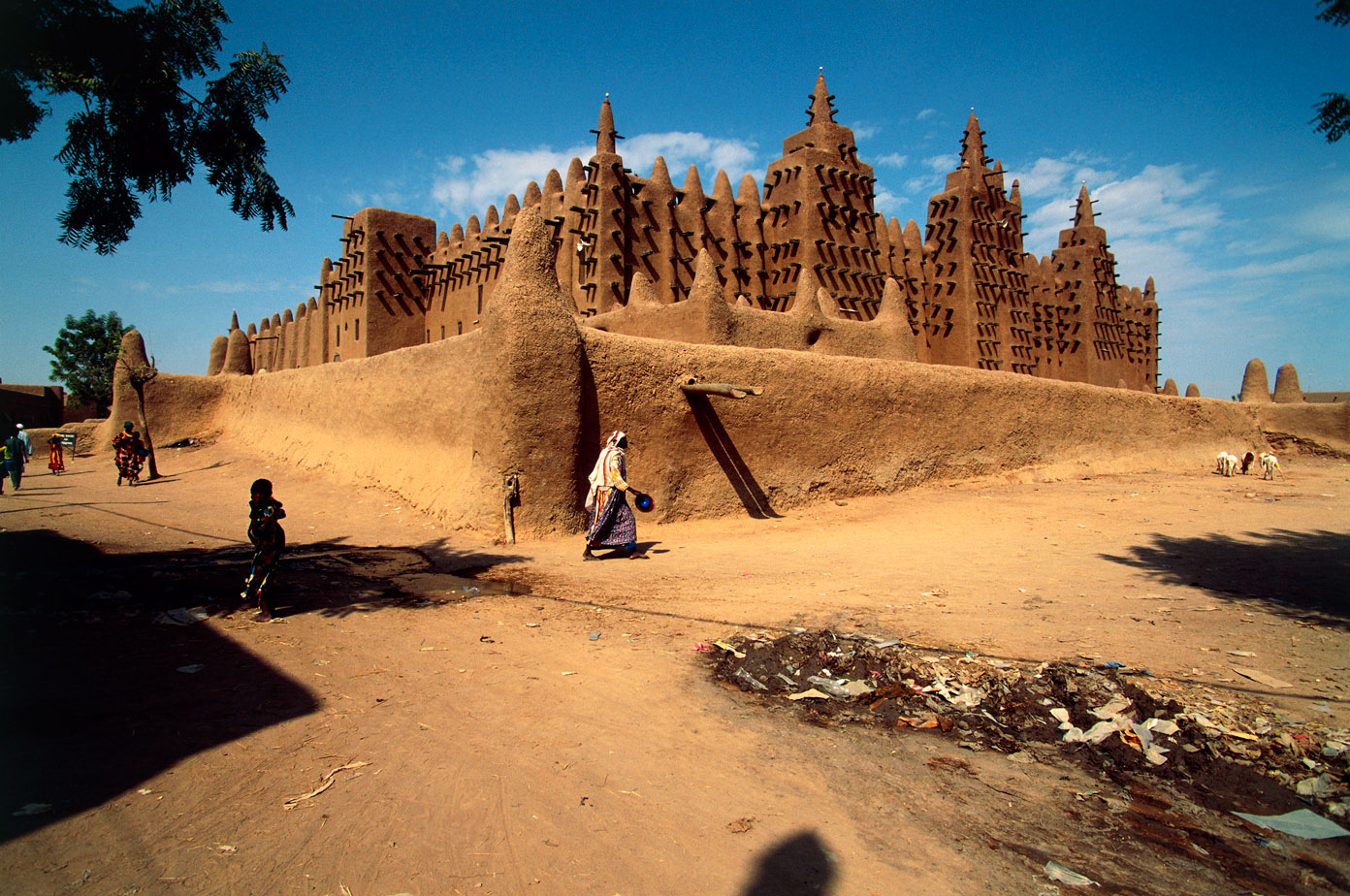
The Great Mosque, 1907, Djenne / DeAgostini / Getty Images


At Bagerhat in southern Bangladesh, a city of 360 mosques from the 15th century, salt water from the encroaching Indian Ocean is damaging the foundations. In Yemen, torrential rains are decimating the improbable mud-brick high-rises of Shibam’s 16th-century architecture, newly exposed owing to strikes from the conflict there. In Iraq, the country’s southern marshes are drying up, causing the Indigenous Bedouins to flee for cities, leading to drastic loss of intangible heritage.

The effects of climate change on cultural heritage vary extensively but are inevitably complex. It acts like a cancer from within, whose steady growth is as difficult to track as it is to solve.

“The effects of climate change cannot be seen from one day to the next,” says Ajmal Maiwandi, director of the Aga Khan Trust for Culture in Afghanistan. “The physical damage to monuments caused by war and natural disaster can often be reversible. However, the gradual changes caused by alteration in the climate often remain unnoticed until it is too late to take action.”

And they are often multiple, with complications that compound one another.

Bagerhat, a UNESCO World Heritage-listed city, has become one of the most famous cases of climate-change-induced peril. Its mosques bear the distinctive domed architecture of the Indo-Islamic style, better known in its later, grander exemplars such as the Taj Mahal. Many of them are still used by members of the public — with the call to prayer given not via recorded messages but by muezzins who climb up the mosques’ squat, red-brick minarets. During cyclones, residents often shelter in the structures, whose solidity provides better protection than their homes.

In addition to the rising sea level, shrimp cultivation and the construction of dikes in the delta are moving salt water closer to the mainland and keeping it there for longer. The salinity creeps into the Bagerhat mosques’ brickwork, in a process called efflorescence, resulting in encrustation and discoloration. The waterlogged ground, meanwhile, threatens the buildings’ structural integrity.

Khandoker Mahfuz-ud-Darain, professor of architecture at nearby Khulna University, says that salination was always a threat, even when the structures were built, because of the tidal rhythms of a now-defunct river that once flowed through the site. Despite its being a rarely used technique in southern Bangladesh, the original architects surrounded the foundations with stone to shield the bricks from the sea water. And as a living city, Bagerhat benefits from having locals who look after the walls by, at least, wiping away the vegetation and dirt.

However, these fixes are proving insufficient against the growing scale of the challenges.

“Local people and the keepers of the mosque told me that 15 to 30 years [ago] there was less need for regular maintenance,” he says. “But now the fungus, efflorescence, encrustation and cracking are increasing rapidly. We have some very nominal budget by the government in this area, but even though the cost of maintenance is low, it is not enough. We need more budget to cover more activities.”

Ongoing local maintenance is a similar bulwark against climate change for mud-brick mosques in places such as Mali and Niger. The Great Mosque of Djenné hosts an annual festival of “crépissage” (plastering), in which the entire Malian city works to replaster the mosque before the annual rainy season begins. In a coordinated effort, teams prepare the mud, transferring it into wicker baskets and giving them to young men who climb up the buildings’ jutting spokes and apply the mixture to the facade. But crépissage cannot keep up with the new pace of rains. Agadez has been a UNESCO World Heritage Site since 2013, with a great mosque and decorated earthen-architecture houses that were built along the caravan routes of Niger in the 15th century. After a series of flash floods in the past few years, local bodies applied to the Swiss cultural agency ALIPH for emergency funding.

“We are using ancient methods,” says Mohammed Alhassane, whose agency, Imane Atarikh, looks after Agadez. He explains that these local techniques of mixing clay and animal dung have proved more effective in safeguarding the structures than ideas developed elsewhere.

But Agadez, like most sites where cultural heritage is under threat, is also vulnerable in terms of the economy and security. One of the cruelest injustices of climate change is the overwhelming effect it has on countries that have contributed the least to carbon emissions. In the realm of cultural heritage, architects and archaeologists are discovering that Indigenous knowledge provides one of the best ways to protect sites against climate change — but it is precisely this knowledge that is being lost amid a wider global displacement in rural communities.

In Agadez, employment is harder to come by, tourism has stalled and Nigerians are emigrating — taking with them the local know-how that would help maintain the Agadez Grand Mosque and its surrounding structures.

“Climate change is a multiplier,” says Andrea Balbo, an archaeologist who leads on the subject at ALIPH. “We’ve been trying to cluster three ways in which climate change, conflict and heritage interact. But these are complex interactions in the sense that it’s not an addition — not like one plus one is two. It’s more like one and one creates 5, 10 or 15.”

Effects traceable to climate change—such as drought and crop failure—fuel conflict, which then destroys or limits access to vulnerable sites of cultural heritage. According to the study “When Rain Turns to Dust,” produced by the International Committee of the Red Cross in 2020, out of the top 20 countries affected by conflict, 12 were also among the most exposed to climate change.

Once the sites are damaged, Balbo adds, some of the meteorological effects that climate change has contributed to, such as torrential rains, then further exacerbate the problems. Shibam’s mud-brick walls, exposed during bombings in Yemen, drip away into gushing streams once their outer layer has been damaged. Strong winds across central Iraq, which scientists attribute to the more extreme weather patterns of climate change, are eroding many of the exposed or hilltop sites in the country that remain difficult to reach for archaeologists.

In the Middle East, North Africa and South Asia, most research focuses not on archaeological sites per se but on the more complex ways that climate change threatens Indigenous communities, intangible heritage and biodiversity. This broad purview comes at a time when understanding of cultural heritage has itself undergone a major shift. For most of the 20th century, cultural patrimony denoted monuments, architecture and tangible artifacts — the temples and statuary that furnished stops on tourist itineraries and the contents of museums in the West.

In the early part of this century, the idea of intangible heritage emerged, covering rituals and practices that are unique to cultures, such as forms of dancing, singing and handicrafts. Now, a third shift is underway that is linking natural and cultural heritage. Heritage experts are thinking not just about depictions like the lamassu (a deity with a human head and animal features) of Nineveh but also the fertile lands around Mosul, as well as how the two combine to create the area’s culture.

In southern Iraq, for example, climate change has exacerbated the already huge losses of the Indigenous marsh people that occurred after the marshes were drained by Saddam Hussein.

“Their traditions were undocumented, so what we Iraqis have lost is a disaster,” says Jaafar Jotheri, a professor at Al-Qadisiyah University and a co-director of the Nahrein Network, a group of archaeologists focused on Iraq that is based at University College London. “We had 300,000 Bedouins before 2003. And now we have around 3,000 or less living in the desert. In 15 years we lost 300,000 people, with their culture, with their community, with their handicrafts. Why? Because of climate change: no rain, high temperatures, no more water in their springs.”

Jotheri estimates that within 10 years, the marsh people and their traditions will have completely disappeared as they emigrate to urban areas and assimilate into mainstream Iraqi culture. He and other members of the Nahrein Network are conserving what practices they can, but he acknowledges it is a race against time.

In Kabul, a key area under threat is the expansive Bagh-e Babur, the Mughal gardens laid out by the ruler Babur in 1504 and 1505. Such gardens are one of the most incredible and long-lasting legacies of the Mughal era. Built across the empire in cities such as Delhi, Agra, Lahore and Srinagar, they transpose the era’s architectural taste for symmetry and geometric rigor into landscaped form.

The Bagh-e Babur offer a prime example of a “chahārbāgh,” a four-quartered rectangular garden that is based on the four gardens of paradise in Islamic tradition. They were added to and maintained throughout Mughal rule in Afghanistan but largely despoiled for firewood over the course of the country’s conflicts in the 20th century. The Aga Khan Trust for Culture began restoring them in 2003.

But now they are again vulnerable — and not because of the return of the Taliban, who have in fact recently submitted a dossier to have the garden registered as a UNESCO World Heritage Site. Rather, decreased snowfall in the mountains and the extraction of water from deep wells by a growing urban population has lowered the water table in the Afghan capital. Maiwandi estimates that in the past 15 years, the water table level in Kabul has dropped, from 7 to 10 feet underground to some 130 to 200 feet below the surface.

The global temperature rise has also meant the introduction of new pests and diseases.

“The increase in new types of resilient diseases affecting the horticulture in the garden is a recent phenomenon — and the maintenance teams are not prepared to address the growing scale of the challenge,” Maiwandi says. “We are finding it more difficult to deal with them as traditional knowledge in treating these afflictions is not effective, and we are having a much higher rate of loss in the trees and plants.”

While monuments and artifacts can be conserved or reconstructed, nothing can be done to conserve the living species of the gardens once the ecology around them changes. As for climate change more broadly, there is both a surge of action and a general feeling of despondency over the chances of success.

Cultural heritage agencies are scrambling to reach out to scientists. The International Council on Museums and Sites (ICOMOS) released a widely read report on climate change and cultural heritage in 2019 (the rather poetically titled “Future of Our Pasts”), and in December last year ICOMOS convened with UNESCO and the Intergovernmental Panel on Climate Change (IPCC), bringing together scientists and those working in the field of cultural protection for the first time. A key outcome of the proceedings was the introduction of culture as a vulnerable category into discussions at the most recent U.N. climate summit, COP26 in Glasgow.

Smaller agencies, too, are creating dedicated stands to combat the threat, even in countries such as Syria and Iraq, where conflict has so far been the undisputedly largest danger to cultural heritage. The new agency Safina Projects is working to conserve traditional Iraqi handicrafts that are being lost because of water scarcity, such as boat-building techniques. The Nahrein Network recently added climate change as a sixth key aim to its charter, which focuses on the sustainable development of Iraqi heritage — an attempt, Jotheri says, to make up for the fact that Iraq still lacks a governmental body that oversees the effect of climate change across various sectors.

Many of the techniques used to address conflict-induced loss are being repositioned for climate change, such as high-data mapping and 3D visualizations that will create records of the vulnerable buildings should they collapse. Iconem, the French photography agency that mapped Aleppo after its siege, has worked on the mosques of Agadez, and the mosque city of Bagerhat partnered with the American company CyArk, which created 3D visualizations of the buildings and documented the process of efflorescence for Google Arts & Culture.

But the complexity of the problem and the fact that many of the most at-risk sites are in poorer countries mean that cultural heritage landscapes vulnerable to climate change will likely fall into the rhythm of reliance on international donor support. As the fallout from the Taliban takeover of Afghanistan shows, this funding is heavily contingent on broader political objectives — Maiwandi says he now spends much of his time persuading donors to resume their support for the preservation of Afghanistan’s heritage irrespective of their political differences with the Taliban.

At the same time, it is important to underline another shift in the cultural heritage sector: toward local knowledge and communities, which had long been sidelined by foreign “experts.” And the resolve among these communities is stronger and longer lasting. Mahfuz-ud-Darain notes that for Bangladeshi people in Bagerhat, the complications from climate change are bigger than just the threat to cultural heritage — and their resolve surpasses the idea of just steady maintenance.

The Bangladeshi people “are actively fighting and adapting to the new harsh climate,” he says, citing floating platforms for houses and new fishing practices alongside the regular activity of wiping down the Bagerhat brickwork. “They do not give up. These are their homelands — their motherland.”

Melissa Gronlund is a London-based writer
In Afghanistan, a Drought Highlights the Climate Crisis

A reservoir on the outskirts of Kabul offers a glimpse into the country’s past and its possible future


Fazelminallah Qazizai    
June 15, 2022
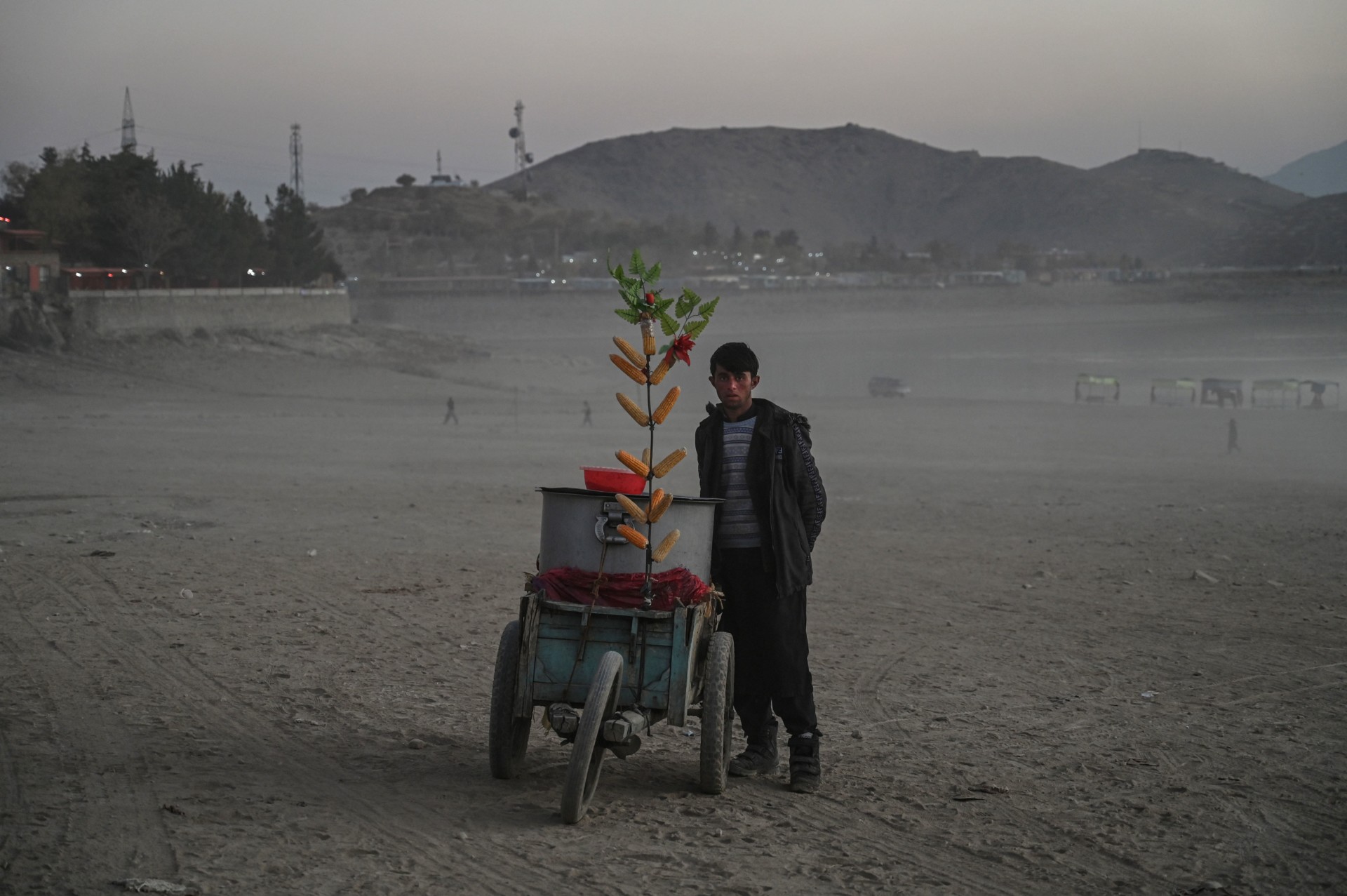
An Afghan youth sells corn at Qargha Lake on the outskirts of Kabul 
/ Hector Retamal / AFP via Getty Images

I have come to think of Qargha, a reservoir on Kabul’s outskirts, as a mirror for our country’s soul. So much of our recent history seems to reside in its waters and the hills and mountains that surround it. There is beauty and hope in the reflection, but there are also the scars of old wounds that have yet to heal and the worry lines of our uncertain future. While decades of war have left their mark on the lake, the worst damage may yet be done by something we Afghans are ill-prepared for: the global climate crisis.

A drought has afflicted Afghanistan for almost two years, crippling food production, killing livestock and plunging the country into a humanitarian emergency made worse by international sanctions imposed on the Taliban government. The water levels at Qargha — some 10 miles outside Kabul — are now pitifully low, exposing the cracked earth and trash that normally lies beneath the surface. Once again, then, we must ask ourselves what the lake says about us. Perhaps people in the West should ask themselves that same question too.

The reservoir and dam at Qargha were built in 1933, during the reign of Afghanistan’s last king, Zahir Shah, to provide water for Kabul. By the 1950s and 1960s it had become a popular picnic spot for Afghans and a tourist resort for the capital’s burgeoning expat community. The king’s prime minister, Daoud Khan, was said to enjoy visiting Qargha to ruminate and relax. But it would be wrong to think of these prewar years as a time of innocence. The U.S. and the Soviet Union were already eyeing Afghanistan as a strategic battleground in the Cold War, using the soft power of economic aid and infrastructure development to gain political influence. In the early 1970s, another drought ravaged the Afghan countryside, displacing thousands of people. As social unrest grew, Khan overthrew the king in 1973. He went on to establish a brutal autocracy that radicalized communists and Islamists alike.

During the Soviet occupation of the 1980s, music concerts were televised live from Qargha. People went there to swim, ride in paddle boats and eat “shor nakhod” — a dish of chickpeas, potatoes and mint — that was served at the lakeside restaurants and food stalls. But even before the reservoir was built, Afghan soldiers had been stationed at a military base nearby, and with the country at war, Qargha became another battlefield. Under the communists, the base was used by the Afghan Army’s 8th Division, while the mujahedeen roamed the surrounding hills and orchards. Inevitably, Qargha started to feel less secure. The military base was repeatedly hit by mortars, and in August 1986, a huge explosion occurred in its ammunition depot, lighting the night sky with flames that were visible in the city.

After the mujahedeen toppled the Afghan communist regime in 1992, Qargha — like Kabul itself — fell into disrepair. The main road to the lake was cratered with shell holes and blocked by the checkpoints of rival militias. In February 1993, one of the worst atrocities of the civil war occurred in the neighborhood of Afshar, on the way to Qargha, when houses were looted, women raped and hundreds of people forcibly disappeared during an operation by two mujahedeen parties, Jamiat-e-Islami and Ittehad-e-Islami. Afterward, a relative of mine saw the naked corpses of several women tied to trees nearby, rotting in the sun.

Under the first Taliban government, Afghans began to return to Qargha for picnics and to enjoy the scenery. But then we had another drought, and the water of the lake began to disappear. This drought, too, lasted for years and devastated the countryside. Much like now, the United Nations pleaded for international donors to send aid, only to be met by casual indifference. I remember visiting the lake and walking across its dry bed to touch a stranded boat that was rumored to belong to Ustad Farida Mahwash, an Afghan singer who had become famous here in the 1980s before she fled to Pakistan and later the U.S. In January 2001, the Taliban’s leader, Mullah Mohammad Omar Mujahid, called for three days of prayer to end the drought. By the time the rains came, the U.S. had invaded, and the Taliban seemed destined to fade into obscurity.

During the U.S. occupation, a small golf course was built on the hill leading up to the lake. A children’s playground opened. Eventually, Qargha came under private ownership, and we had to start paying an entrance fee just to sit next to the water and gaze at the horizon. On June 21, 2012, the Taliban attacked the Spogmai hotel and restaurant, which had been one of the main attractions in Qargha for decades. They accused foreigners and Afghan government officials of using it for illicit activities and killed at least 20 people. In 2013, a U.K.-funded military training academy, clumsily dubbed “Sandhurst in the Sand” by the British, was opened at the former communist base. It soon became the target of insurgent attacks. The official name of the new academy was Marshal Fahim National Defense University, in honor of a Northern Alliance warlord and former vice president disliked by millions of Afghans. On Aug. 5, 2014, a member of the Afghan Army opened fire on a group of dignitaries visiting the academy. He shot dead Maj. Gen. Harold J. Greene, the highest-ranking U.S. service member to be killed in hostilities since the Vietnam War. On the way to the lake from the city, meanwhile, a refugee camp for people displaced by the fighting in the south of the country had taken on a permanent appearance.

The current drought has been going on since early 2021. On Dec. 25 last year, the Taliban again called on people to perform the “istisqa” (rain-seeking prayer), and thousands of worshipers obliged in the city of Kandahar alone. But while March saw rainfall that was above average levels, it was still not enough.

In May, the U.N. warned that 19.7 million Afghans, or 47% of the population, face high levels of acute food insecurity and need urgent help. Of these, almost 6.6 million are in an emergency situation, with the worst hit provinces mostly in the center and north of the country. According to the U.N., the main causes of the food insecurity are lower household incomes, increased food prices and reduced international aid, which have become features of life since the Taliban retook power last summer, as well as the drought. It predicted that the conflict in Ukraine would also hinder wheat supplies to Afghanistan.

At present, the reservoir at Qargha is still privately owned and the Spogmai Hotel is again open for visitors. For a few cents, it is possible to ride a horse on the shore or take a turn on the Ferris wheel at the children’s playground. Every Friday families head to the lake to relax and enjoy themselves in the early summer sunshine. But we all need water to survive and, no matter how hard we try, Qargha will not let us forget our problems for long.

Fazelminallah Qazizai is the Afghanistan correspondent at New Lines
“Letter from Kabul” is a newsletter in which our contributors provide their own unique glimpses into life on the ground in Taliban-controlled Afghanistan
As Jews, We Must Demand Justice for Shireen Abu Akleh

The current situation is appalling not only to Palestinians; it also marks the Jewish community worldwide

May 27, 2022
Mezuzah / Getty Images

Growing up in a Jewish household means engaging in a lot of political discourse: discussions about oppression, death, injustice, guilt. In some Jewish households, we discuss social justice, the need to fight for the rights of the oppressed, taking a lesson from the pain of our own history as a “homeless” and shunned people, ensuring that the destructive authoritarianism and hatred that led to the Holocaust are not repeated anywhere in the world again.

The Jewish-American community maintains a strange position within American society. We are largely an affluent and educated community that can “pass” for white and are therefore seen as not subject to the kind of racism and prejudice experienced by other American communities of color. At the same time, we are not considered part of the predominantly Christian, Anglo-Saxon power structure that has held most of the political power in the United States since its founding, and antisemitism has always been present in the United States, which has only worsened in the past six years: Three quarters of Jewish Americans polled by the Pew Research Center said there is more antisemitism in the U.S. today than there was five years ago. Because of this hybrid place we inhabit within American society, we live with the fear that no matter what our economic and social position, we can become the next German Jews — that is, a highly acculturated group that was sent to the death camps during World War II — should right-wing forces prevail to take control of the federal government.

Overall, the Jewish-American community remains a progressive ideological voting bloc, with seven in 10 Jewish adults identifying with, or leaning toward, the Democratic Party and half describing their political views as liberal. It is these considerations that give rise to a complex and conflicting set of feelings regarding the kind of relationship the Jewish-American community should have with Israel. As an example, the same Pew study found that “58% say they are very or somewhat emotionally attached to Israel.” The numbers regarding Jewish-American feelings toward Israel, especially about emotional attachment, vary by denomination. However, ‌there is no broad consensus within the Jewish-American community about our relationship with Israel.

During Passover in our family, discussions about social justice come to the forefront. Our Seder and Haggadah (the text used to guide the Seder) lean heavily on the story of Passover as an example of why the fight against oppression and for justice is of immense consequence — a never-ending quest. The lessons I learned growing up reading our Haggadah remind me that our history as a people make us sensitive to changes in societies or governments that might signal a slide toward the type of authoritarianism or ethnonationalism that preceded the Holocaust in Europe. It is, therefore, unsurprising that Jewish Americans are often highly progressive and work on social justice issues.

But like all communities that have experienced severe trauma, memories of which are passed down from generation to generation, we have blind spots. In particular, a sizable portion of Jewish Americans still have a blind spot for the increasingly authoritarian and undemocratic actions of the Israeli government.

I am 35 years old and have watched my family’s viewpoints change from cautious but largely uncritical support for Israel to disillusionment and anger with the way the powers in Israel have become anti-democratic and unwilling to engage in any substantive form of negotiations to end the conflict with the Palestinian people. The ‌discriminatory acts by the Israeli state against Palestinians, such as illegal seizure of land and homes, the indefinite jailing (known as administrative detention) of Palestinians and the consistent use of lethal force by Israeli security forces when confronting Palestinian protesters, show the Israeli state’s disregard for Palestinian lives. Most Jewish Americans would oppose these same policies if they were implemented in the United States. So I often ask: At what moment will we address this blind spot? How do we reconcile these structural injustices with our own fight against extremism, disinformation and efforts to silence journalists here at home? There is no straightforward answer, but there must be a conversation. Our values as a community may be at stake if we do not.

The killing of the Palestinian-American journalist Shireen Abu Akleh on May 11 — with mounting evidence that the Israel Defense Forces are culpable — is just the latest example in a string of destructive moments in Israel-Palestine history that should push the Jewish-American community and the Jewish diaspora to contemplate their relationship with Israel. The Jewish-American community in particular — arguably the most influential Jewish community outside Israel — must process some uncomfortable facts: Are Israeli’s policies toward the Palestinian people in sync with our values as Jewish Americans? How can we support the continued dispossession of Palestinians to provide settlements for Jewish Israelis? How has the historic trauma of Jews — especially the Holocaust — distorted the justification for a Jewish-only state that is built on inherently undemocratic values and oppresses portions of the Jewish community in Israel, Palestinians with Israeli citizenship and Palestinians living in the occupied territories? Is the cost of building “Fortress Israel” at the expense of our community values worth it, just to say that we might have a safe haven for Jews to escape to if the worst were to happen in our home countries?

I feel especially heartbroken for the eldest generation of Jewish Americans, who have lived through so much pain and heartbreak over the past century and, in their waning years, now see a modern Israel that seems completely at odds with many of the core values of the community and those at Israel’s founding. It occurred to me, while reading the story of Moses and the freeing of the Israelites from slavery in Egypt with my 97-year-old grandmother at Passover last month, that the current Israeli government’s treatment of the Palestinian people (and the Israelis who support Palestinian rights) has more in common with Pharaoh and his harsh rule than it does with Moses and his righteous quest to free the Jewish people.

I immediately felt a pang of guilt for having this thought. My grandmother experienced discrimination as a Jew in the United States, lived through World War II and experienced the death of family in Europe. Her parents fled tsarist Russia to escape persecution. Prejudice and antisemitism followed Jews to their new homeland in the United States during the first half of the 20th century. Out of the ashes of the Holocaust, the modern Israeli state was born. The birth of Israel was complex and helped sow the seeds of the modern-day Israeli-Palestinian conflict. My grandmother bore witness to this history, and I can only imagine the effect it has had on her views about her community, Israel and the need for a Jewish state as a bulwark against Jewish victimization.

The Jewish diaspora is split in terms of how it internalizes the lessons learned from our history. The first perspective is the “protector”: Under no conditions can we allow Jews to be victimized again, even if it means supporting policies that seem unjust. According to this viewpoint, Israel is the ultimate protector against unending antisemitism. The second is the “empathizer” perspective: As part of a community that has experienced mass societal trauma and persecution, it is the duty of all Jews to ensure that the circumstances that led to the repression of Jews are never replicated for any group.

I think there is a sizable portion of the Jewish community who fall somewhere in between these two major perspectives. These individuals are generally empathetic when they see injustice and repression, whether at home or abroad, but simultaneously worry that the Jewish community is unique in terms of its historic repression and therefore requires special protection. Both outlooks make sense given what the Jewish community has experienced, but the protector viewpoint presents many pitfalls and risks turning Jews from the oppressed into the oppressor. The line between protecting one’s community and committing acts or policies that are ‌unjust is difficult to traverse.

Yet how can we not see parallels between the Israeli state’s actions against the Palestinian people today and the status of the Jews in Egypt under the rule of Pharaoh before our emancipation? I told my grandmother about the shame I feel to see part of the Jewish community participating in the repression of another group of people who struggle with many obstacles, including chronic statelessness. My grandmother is at a loss ‌why Israel has become so politically right wing and why the Israeli government seems incapable of doing the bare minimum to find a peaceful settlement with the Palestinian people.

“If there was any hope or optimism for what Israel could have been … I do not know what will happen to Israel in the future,” she said to me. “The right wing in Israel is terrible, and Jews should know better than to lean toward this ideology. … I have yet to see anyone in Israel who has provided a serious path for peace between the Jews and the Arabs. … The killing is terrible and needs to stop if everyone is to live in peace.”

Like many in the Jewish-American community, her feelings toward Israel are complicated. Over time these attitudes have grown only more complex as the situation on the ground has worsened. While my grandmother considers herself a passive supporter of Israel, she pointed out that her brother was a staunch enthusiast in the early days of its creation. Our family understood the need for a haven for Jews, especially after the Holocaust.

But the subsequent decades of violence have been detrimental. Israel’s ideological change toward a predominantly right-wing polity is at odds with not only our own values but also the broader political leanings of the Jewish-American community. In this way, we see the gap widening‌ between Israel and the Jewish-American community.

When conducting research for my master’s thesis in 2010 on Israeli national identity, I interviewed a range of Israelis — liberals and conservatives, religious and secular, those who live behind the Green Line that demarcated the nation’s more limited boundaries before 1967 as well as those who live in settlements that breach that line and have exploded in number since then.

There was much dispute about the nature of these identities and whether there was such a thing as a singular national identity that incorporated all Jewish citizens within Israel. It was clear from speaking with Palestinians who had Israeli citizenship that they were excluded from that national identity. Ethnically Arab and mostly of Palestinian descent, one-fifth of Israel’s population are nonentities within their own country. And while the Israelis I spoke with could not agree on a cohesive national identity, the subject of victimhood and the specter of being a persecuted community permeated many discussions. Over and over, Jewish Israelis explained that the politics of their country are complex, and although people’s views on the Israeli-Palestinian conflict varied depending on ideology or religious leanings, all grew up in the Holocaust’s shadow.

There has been a radical shift in the politics of both Israel and the United States over the past six years. The long reign of Prime Minister Benjamin Netanyahu saw the unrestrained expansion of Israeli settlements in the West Bank and an increasingly authoritarian bias toward Israelis who protest corruption or demand the expansion of rights. The animosity between Jews and Arabs has inevitably increased under the crushing weight of hardline, right-wing rhetoric and policies. Concurrently in the U.S., the advent of the Trump administration was accompanied by a huge jump in antisemitism. According to the Anti-Defamation League, antisemitic incidents in the U.S. “surged more than one-third in 2016 and jumped 86 percent in the first quarter of 2017.”

During the Trump years, I remember having numerous conversations with my family about this rise in antisemitism and what it said about American society ‌and the future of Jewish Americans: Would we as a community be safe in the United States in the long term? The generational trauma passed down within the Jewish community contributes to a particular feeling of being not quite safe. There is a tendency to scan society and government for any signs of betrayal or victimization as has happened in the past.

While these anxieties are difficult to live with, I hold the empathizer perspective. I firmly believe that the risks and travails of the Jewish people do not mean we can or should give Israel a pass for its horrendous conduct toward the Palestinian people. We can and must demand justice for the Palestinian people and advocate for their human rights. Just as the Holocaust left an indelible mark on our community’s history and psyche, Israel’s treatment of Palestinians will do the same to us. It is important to affirm that while not all Israelis are Jews and not all Jews are Israelis, most of the political and military power vested in the Israeli state is wielded by Israeli citizens who are Jewish. This ties the wider Jewish community to the actions of the State of Israel and affects our relationship with the rest of the world.

Just as important, numerous Israeli politicians over the years have worked hard to create this nationalist myth that Israel speaks on behalf of the entire Jewish people, even though there is no consensus within the diaspora about whether that is the case. Because of these ties, Israel’s continued path could create an irreconcilable schism within the Jewish community in which Israel’s oppression of the Palestinian people overshadows the progressive Jewish values I and others have learned from our families. On the one hand, the Israeli government wants the support of the diaspora — especially the Jewish-American community — but it shows no interest in listening to critiques from this group. This one-sided relationship between Israel and the Jewish-American community is unsustainable, and it helps neither in the long term.

A peaceful settlement with the Palestinian people is necessary not only for Palestinians. The current situation marks the entire Jewish community and undercuts all its achievements. For us, as Jews, to be at peace with ourselves and our values, it is long past time to look in the mirror and ask the hard questions. We can begin by demanding a full investigation into Shireen Abu Akleh’s killing and ensure that those responsible are brought to justice.

Sasha Ghosh-Siminoff is a non-resident fellow at the New Lines Institute

A Tribute to Shireen Abu Akleh, a Journalistic Role Model

The murdered reporter was superbly professional, possessed a rare modesty and unshackled cultural restraints on Arab women

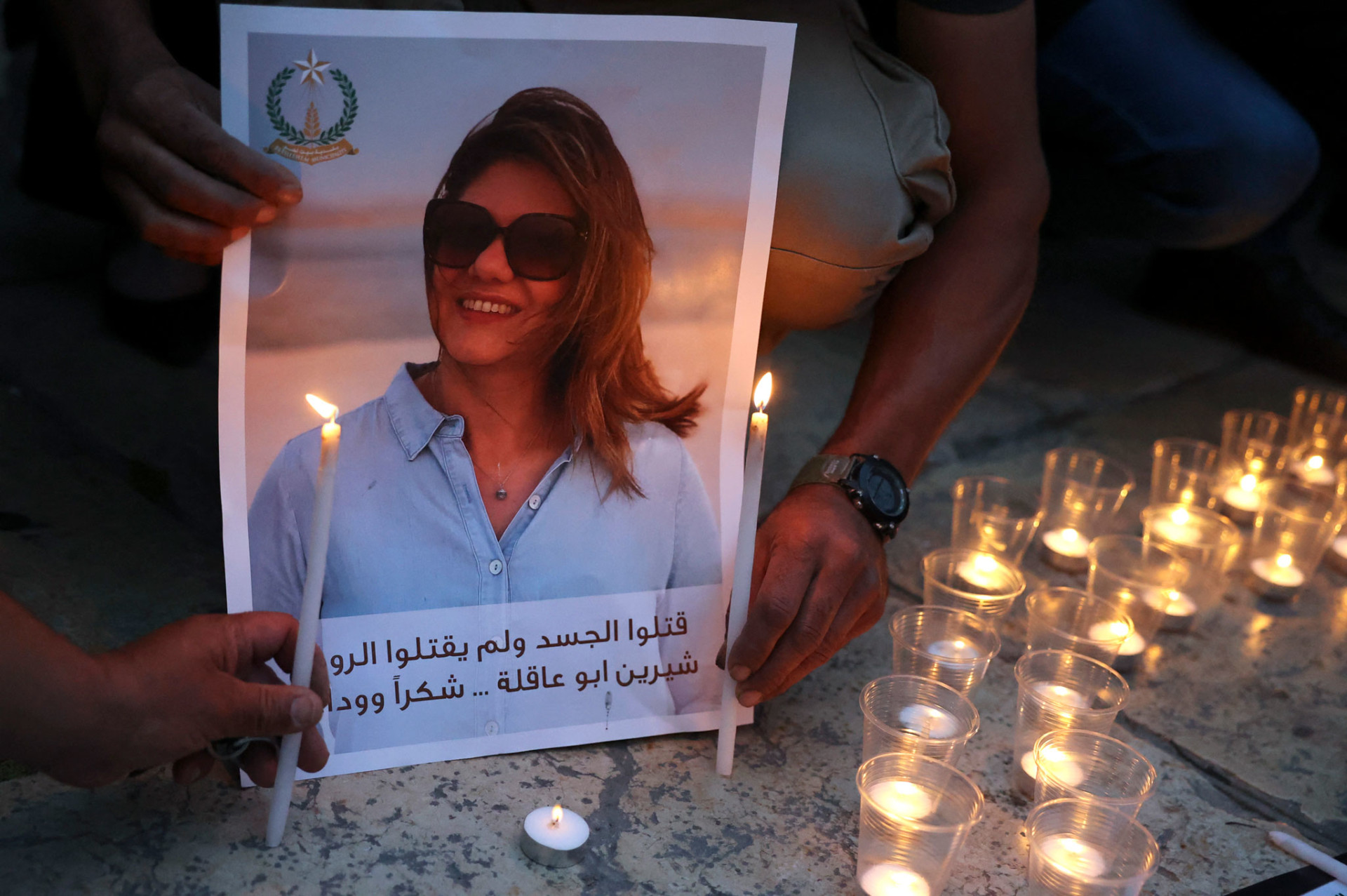
A vigil held for Shireen Abu Akleh outside the Church of the Nativity in the West Bank 
/ Hazem Bader / AFP via Getty Images


Where do girls in closed societies draw inspiration from when television, cinema, literature and culture are state-controlled and role models are carefully crafted? The few who are approved by what I like to call the thought gulag are then subjected to rigorous examination by social norms. The women who pass are often replicas of the women surrounding these little girls: They look, speak and live like their mothers, aunts and sisters. From an early age this drew the boundaries for us girls and young women; at least that was my experience in Mosul in the 1990s. Our destinies and ambitions were chosen for us, and we dared not object. After all, who was there to follow? Then there was Shireen Abu Akleh. Along with her colleague Givara Budeiri, Shireen made her way through the cruel filtering of state and society in Iraq. The Baath regime, like many other dictatorships, adopted the Palestinian cause, and whenever confrontations in the Palestinian territories occurred, they became our main news story during prime-time TV, when the state technicians received orders to briefly bootleg Al Jazeera’s coverage and show it to the people. This is not to say that Iraqis needed Saddam Hussein’s approval to stand in solidarity with Palestinians; all Iraqis sympathized with the Palestinians, but the Baathist regime’s adoption of their suffering as a national cause meant it allowed messaging related to that adopted cause and filtered out other things. The question had long been part of Iraq’s collective consciousness regardless of authoritarian messaging.

To us, Shireen was not a stranger. She looked and sounded as we did, and it didn’t matter that we were not even privy to her religious identity, which we learned after her death when we watched in horror as her coffin made its way to the church despite Israeli soldiers’ beating Shireen’s pallbearers with batons.

Unlike most of the other women on our screens, Shireen had no hidden agenda to corrupt young Iraqi girls, according to our patriarchal society. Her profession was miraculously overlooked. In the late ’90s, female war reporters might have been the subject of movies, but we never saw them in real life. An Arab woman wearing a “Press” vest and helmet — dodging bullets while reporting live — was new, and we were all in awe. In my family, Shireen was particularly loved for another reason: She bore an uncanny resemblance to one of my paternal cousins. My father would proudly announce “Zeena is on TV again!” adding to our sense of Shireen’s familiarity. To say she was a “household name” is an understatement. She was indeed one of us, and she was doing extraordinary things that we could only dream about.

The second intifada and the killing of Muhammad al-Durrah were the talk of school and town for weeks. Hour by hour Shireen again guided viewers through events, her signature sentence etched in our memory: “We will provide more details once we get confirmation.” Though I don’t recall hearing any young Iraqi woman explicitly saying that she wanted to be a war correspondent, the way in which we looked up to Shireen and trusted her words said so much more. Even in a patriarchy like Iraq’s, Shireen commanded respect and acknowledgment for accomplishments beyond society’s restrictive role for women. She empowered us back then in ways we would only realize decades later. I cannot begin to fathom what effect Shireen must have had on young Palestinian girls who lived through the stories that she told to the world.

As the Israeli-Palestinian conflict continued, Shireen’s reporting continued with it. After 2003, I stopped following her coverage as religiously as I used to, not because my admiration for the first female war correspondent to grace the screen of my living room TV had ceased but because our own woes and injustices in Iraq began to consume us. Also, female war reporters became the norm as we finally got to see the world through satellite news channels. Al Jazeera remained center stage, but the unraveling effects of the Iraq war, Israel’s war on Lebanon, the Arab Spring and the war in Syria created rifts and divisions among audiences, many of whom began to eschew the channel itself.

While many of Al Jazeera’s prominent reporters and presenters resorted to sensationalism to express and embrace the causes closest to their hearts, Shireen refrained from the circus. Her focus remained solely on reporting on the struggle and people — her people — of Palestine. Her social media presence was modest and never provocative. She stood with the people in their fight for justice wherever they were, unconditionally.

Her professionalism endured decades of ideological shifts and trends in the media. Yet despite being a pioneer, perhaps the pioneer, of female reporting, Shireen never made her work about herself. She did not endorse the media’s cult-of-personality culture or aspire to be part of it. I do not recall seeing her in a designer dress being honored with media awards at fancy galas, though she would have been most deserving of the recognition. I cannot speak on her behalf either, but the Shireen whom we believe to know was uninterested in vanity. She may have represented Al Jazeera, but she became a reference in her own right.

I saw the news of her murder when I was with another Iraqi friend. It was around midnight, and we were watching Eurovision. We gasped in shock and horror. Though neither of us immediately cried, sadness took over. My friend had spent her teenage years in Libya and held the same fondness and admiration for Shireen. Another friend, a 30-year-old doctor in Kirkuk, recalled to me a few hours later how her mother awakened her with the grave news: “Wake up … wake up. … They killed Shireen.” My immediate reaction was to text one of my dearest friends, a renowned war reporter who happened to be in Palestine at the time. I asked her to be safe that day. It was when she replied that I began crying. War reporting is one of the most dangerous professions in the world, and I salute those killed in the line of duty for their resolve and commitment to telling the story. But the context of how Shireen was killed in cold blood and the unlikelihood of accountability for her murderers only adds sorrow to the pain of losing a reporter who has long graced our homes and felt like family.

The day Shireen was taken to her final resting place in the land where she and her ancestors were born was testament to this woman’s legacy. Thousands of Palestinians accompanied her coffin, which was draped in the Palestinian flag and her press vest. Tens of millions across the Middle East watched the grand funeral procession live on Al Jazeera, and many more millions streamed it on social media. Rarely has a media figure been so unifying in both life and death. Her work, professionalism and prose commanded respect from all sides of the political and ideological spectrum.

The unfortunate confrontation that happened toward the end of the procession, when Israeli police attacked the pallbearers, was a real-life metaphor for the Palestinian struggle. There were clear indications who the aggressor was, though calls for restraint were addressed to both sides, including the one just trying to make it through. Stories of what caused the skirmish varied and changed, and different analyses reflected different biases, all while Palestinians continued to fall victim. Shireen’s coffin did not collapse, because the men carrying her endured the kicking and beatings by Israeli soldiers in riot gear without losing their grip.

How to commemorate such a legacy? The only sentences I felt worthy of Shireen were parts of a prayer that Muslims say before the gravesite of the Prophet Muhammad. It roughly translates to “I bear witness that you have conveyed the message and delivered on the mission you were entrusted with.”

We bear witness that you conveyed the message of journalism and delivered on the trust of your people. Farewell, Shireen.

Rasha Al Aqeedi is the Middle East deputy editor
May 19, 2022


The Deep State: the Conspiratorial Turn in America

The phrase actually referred to a real and shadowy power in Turkey. In America, it’s the preserve of those harboring extreme and unfounded theories

Josef Burton
May 16, 2022
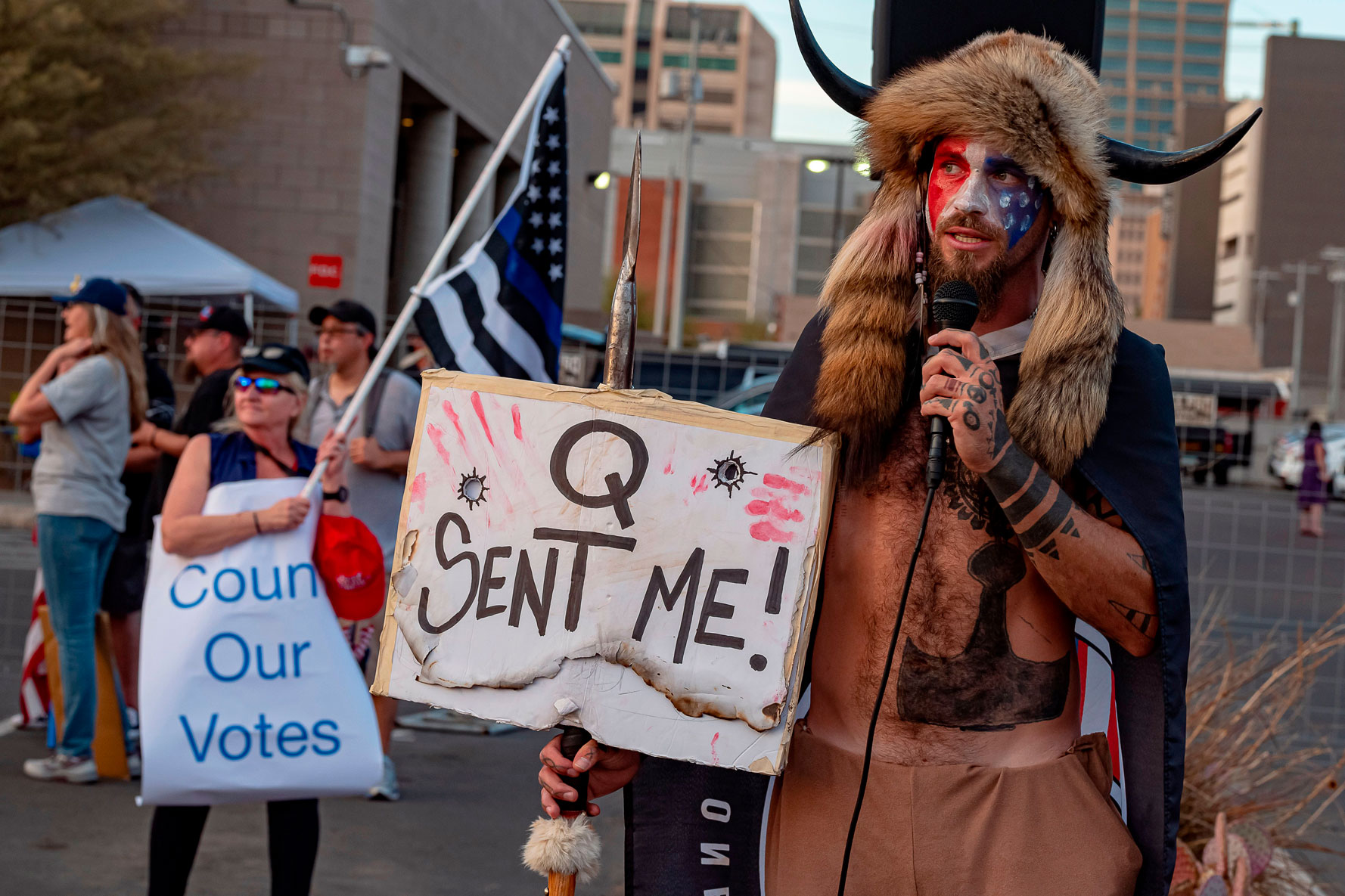
Jake Angeli, known as the “QAnon Shaman” / Olivier Touron / AFP via Getty Images


In politics, fantasies can be a central motivator for taking action. Such was the case on Jan. 6, 2021, when the mob that stormed the U.S. Capitol was animated by fantasy. The motley crew shared a belief that the 2020 election was stolen and could be overturned via obscure constitutional procedure if only a few patriots could take action. Beyond this immediate goal most shared some degree of belief in QAnon — an amorphous set of pseudo-prophetic political beliefs that hold Donald Trump to be a crusader against a satanic, child-sacrificing “Deep State” made up of media elites, Washington insiders and bureaucrats.

Based on anonymous 4Chan posts from a purported administration insider who is codenamed “Q,” QAnon adherents believe that John McCain did not actually die of natural causes but was secretly executed for treason. Some believe that President Kennedy’s son JFK Jr. is still alive, is a covert political operative and will reveal himself as Trump’s new vice president. Others maintain that Robert Mueller was a secret Trump ally investigating the president as a decoy operation. The phantasms that the rioters were fighting had fuzzy edges and definitions as ludicrous and shifting as the rioters themselves. The picturesque blue-painted and fur clad “QAnon Shaman” — Jake Angeli — was better known before Jan. 6 for live-streaming himself entering shopping malls wearing a horned headdress and screaming about how decorative tiles outside bathrooms were coded signals for secret gangs of Deep State child-trafficking pedophiles to abduct children into a cave network to harvest the chemical adrenochrome from their brains. A subset of QAnon followers believes in the existence of the “frazzledrip tape,” a purported video of Hillary Clinton and her assistant Huma Abedin ritually sacrificing and then eating a baby. This chaotic fever dream of demonic imagery is mixed with more prosaic enemies — elitist diplomats, complacent Washington insiders and Trump’s personal enemies list — to make up the shifting cloud of what is called the Deep State, the hidden enemy. The paranoid rage is all-American, but the term is imported.

The Deep State is the Turkish language’s great contribution to political science. The translation from Turkish — “derin devlet” — is literal and direct. A state that exists below and within. The Turkish term, however, doesn’t imply any outside-the-mainstream milieu of ideas, nor does it serve the same role as the American term “conspiracy theory” in describing a way of seeing the political world. “Deep State” in Turkish is not a flight of fancy or an alternative belief; rather, it describes a very specific set of historical actors in a specific time and place. Who is included within the bounds of the term is of course up for debate, because the Deep State is secretive by definition, but the term describes unauthorized and unknown networks of power operating independently of official political leadership. The Turkish Deep State has imprecise boundaries and includes state-aligned mafia figures as well as industrialists and conservative economic elites, but it is not a catchall term for status quo power structures or hegemonic institutions. The Deep State is a shadowy parallel system of power, not the power structure that you can openly see.

There is credible evidence that some of these covert power networks in Turkey have lineages that go back to the 19th century, to secret political organizations among modernizing Turkish nationalist army officers in the last days of the Ottoman Empire. This history does not mean that the Deep State has been the secret hand behind Turkey’s national destiny from the dawn of time but points to the more reasonable fact that parallel power structures form during times of crisis. It is precisely during these crises in Turkey that the Deep State became something named and observed in political life. The left-right political violence of the 1970s and ’80s that resulted in a series of brutal military coups was a time of pervasive covert state violence and Deep State activity. Leftists and students were disappeared, and in 1977 dozens of trade unionists in Istanbul’s Taksim Square were mowed down by gunmen whose identities and motivations remain unknown to this day. In the 1990s, during the Turkish state’s struggle against the Kurdistan Workers’ Party (PKK) — a fight that broadened into a state assault on Kurdish civil society — the Deep State once again slithered out of the depths and onto the streets. The jarring 1996 “Susurluk incident” was a freak car accident involving a BMW full of cash, guns, drugs, and a notorious mafia drug baron and police general somehow driving together. Susurluk revealed the depths of the connection between the Turkish security services and right-wing organized crime elements in their mutual war against the PKK.

The Deep State is not a fantastic conspiracy but something tangible and real. Parliamentary investigations in Turkey in the early 2000s confirmed the existence of whole military units and intelligence bureaus whose very existence was unknown to the elected government. Some Deep State structures, like the national gendarmarie’s secret intelligence unit JİTEM, have been fully exposed. For others, mystery remains. Turkey’s U.S.-trained counter-guerrilla unit, known variously as the Special Warfare Department or Tactical Mobilization Group, was instrumental to Turkey’s Cold War anticommunist violence. It remains unclear whether that unit operated under Turkish government authority, with some anonymous former members claiming that they answered only to NATO while also readily confessing to involvement in torture and instigating Istanbul’s 1955 anti-Greek pogroms.

Although the Deep State in Turkey refers to a secret network, it is actually very well documented and proven. The term Deep State has left Turkish history and entered into global political discourse because it is a useful and accurate tool to describe specific forms of state and para-state violence that actually happen. The concept is not specific to Turkey or the Middle East. Criminal investigations in Italy and Belgium have uncovered similar Cold War-era networks in Europe under the codename Operation Gladio.

I was very much surprised, then, to see “Deep State” emerge in post-2016 American politics as an explicitly Trumpist term. Devoid of context, Trump administration figures used the phrase initially in much the same way that Barack Obama coined the phrase “the blob” — as shorthand for the Washington establishment consensus. Google searches for “Deep State” spike in April 2017 shortly after Trump’s administration started. In October 2017, posts from “Q Clearance Patriot” appeared for the first time on 4chan, setting the QAnon mythos into motion. Searches for Deep State spiked again and, with time, the phrase has become more sinister and accusatory.

It would be easy enough to write a taxonomy of the term “Deep State,” tracing how it entered into Trumpworld and shifted its meaning therein. There is even a prime candidate for who brought the phrase into the White House: Gen. Mike Flynn, who lasted as Trump’s national security adviser for all of 22 days and who had deep and possibly illegal connections to Turkish politics.

Flynn initially made a name for himself within the U.S. military and the Defense Intelligence Agency (DIA) as a hawk’s hawk, fixated on the threat of militant Islamism. Before he was forced out of the DIA in 2014 for his chaotic and abusive management style, Flynn frequently accused Turkish President Recep Tayyip Erdoğan of being a crypto-jihadist and a threat to the West. In 2016 Flynn initially hailed the abortive Turkish coup d’état as an attempt (he assumed) to defend secularism.

Mike Flynn’s tune quickly changed when he launched his consulting company and quickly became one of the most ardent pro-Turkish government lobbyists in Washington. Flynn published editorials denouncing cleric and Erdoğan rival Fethullah Gülen as the puppet master of dark and shadowy forces. Flynn’s reversal was as adamant as it was sudden. The Turkish government would eventually offer the general $15 million cash to kidnap Gülen (a U.S. permanent resident) and transport the cultish and reclusive cleric to Turkey to stand trial for instigating that same coup attempt Flynn once praised. Unbelievably, accepting cash from a foreign government to stage a kidnapping on U.S. soil was not actually the reason Flynn eventually had to resign. His time in the Trump White House was short, but it was only after this brief stint that the administration began to use the phrase Deep State.

This could be a tidy and convenient story: A conspiracy-minded operative falls into the orbit of Erdoğan and picks up a very politically useful narrative of a shadowy conspiracy by hidden establishment actors against democracy. But Flynn was not young and innocent, and his hobnobbing with Turkish government bigwigs was not his introduction to the idea of a Deep State. Before he was a “consultant,” and before he was assistant director of the DIA, Flynn made a career as a young staff officer in the then-small and close-knit U.S. special warfare community. He trained and made plans at Fort Bragg’s John F. Kennedy Special Warfare Center in the 1980s. The center was previously known as the U.S. Army Institute for Military Assistance, and the generation of men who trained the young Flynn were veterans of dozens of American covert efforts to fight communism — the men who ran the Phoenix Project death squads in South Vietnam and trained anticommunist secret police and commandos in Thailand, Iran, Italy, Greece, Guatemala and a dozen other countries, including Turkey.

The Turkish Special Warfare Department and its larger counter-guerrilla program, when they functioned openly in the ’50s and ’60s, were supported and organized directly by the American special warfare community via the U.S. military assistance mission. The Green Berets who trained the Turkish operatives who instigated the Istanbul pogroms and tortured dissidents at the Zivirbey Villa in 1971 would, in the twilight of their careers, rotate back to the Kennedy Special Warfare Center to train the next generation of American covert warriors — men like Flynn. The mania for conspiracy and Deep State suspicion is not something Flynn contracted from Turkey like some Oriental disease, but he was shaped and molded within real existing conspiracies. Deep states are not fantastic when they are something you have been trained to construct and support.

In American and Turkish conversations about the Deep State, everything is reversed. In America real and specific Deep State agents — celebrities, politicians, institutions — purportedly commit horrific torture on abstract categories of victims (patriots, children, etc.) who can never be specifically named or seen. Nobody has successfully proved voter fraud in the 2020 election. No child survivor of the elite Soros adrenochrome harvest has come forward.

The victims of the Turkish Deep State, on the other hand, are not hypothetical or mythical. From the 1970s hundreds of people, mostly leftists and minorities, were murdered by state or para-state gangs. When encountering a real Deep State the question is never if what is happening is real, but to what degree it will do harm. Were the masked men who threw grenades into a Kurdish bookstore undercover military, or were they a far-right mafia gang? Or were they from a conservative Kurdish clan given money and arms to suppress separatists? The fear and doubt that an unknown perpetrator provokes is a key part of Deep State violence. Only the victims are real: A comrade’s body is dumped outside the union office; protesters die after being gunned down in a rainy square; a reporter simply never comes home one day. You do not have to posit the existence of underground child-abuse tunnel networks when there are funerals to go to.

Almost as if they have become sensitive to the absurdity and implausibility of many contemporary conspiracy theories, there is a strain within the Jan. 6/QAnon world who are much less prone to the fantastic and make more concrete (although still totally baseless) claims. The events that they claim happened, the jargon they use to impart verisimilitude to their stories, and frequently the conspiracy theorists themselves are linked to the U.S. military or security services.

A month before Jan. 6, rumors swirled among the Telegram channels and yet-unbanned Facebook groups where the Capitol rioters mobilized. For example, a specific military unit, the 305th Military Intelligence Battalion, was reported as having raided a secret underground server farm in Frankfurt, Germany. It was there, the story went, that the CIA had secreted away a server farm full of voting data with incontrovertible proof that the 2020 election had been stolen from Donald Trump. There had been casualties, but the raid was a success. The 305th had captured CIA Director Gina Haspell, and she had already been flown to Guantánamo Bay and been executed for high treason. While the real public affairs officer for the actual battalion was busy drafting a statement explaining that no, the Arizona-based unit of analysts was not a secret shock troop tasked with overturning the 2020 election and had not been engaged in a subterranean battle with the CIA in Germany, a retired lieutenant general, Thomas McInerney, was solemnly intoning that the 305th had taken heavy casualties. A month later, while the QAnon Shaman stood shirtless on the Speaker’s rostrum in the House of Representatives chamber in a horned headdress and howled about impending doom for traitors, Larry Rendall Brock stood on the House floor in a tactical plate carrier and helmet giving instructions to other rioters. A former Air Force lieutenant colonel, Brock had tucked into his vest a bundle of zip ties meant to restrain detainees. (After his arrest, he claimed he actually had no targets for detention in mind but wanted to give the zip ties to the police.)

Seven percent of Americans are veterans, but almost 20 percent of the Jan. 6 rioters had served in the military. A midlevel State Department official who covered South American affairs has now been charged with assaulting a police officer during the riot. This strike against the American Deep State on Jan. 6 was therefore demographically closer to any putative Deep State than to the general public. Not all American security institutions are bad in this fantasy world.

Guantánamo Bay looms especially large in the fantasies of QAnon. It will be the site of execution, trials, extrajudicial torture and retribution visited on the Deep State child abuse mainstream media globalist sickos. Hillary Clinton and George Soros will be hanged there. There is a good reason that the lurid fantasies of revenge and torture in “The Storm” — the QAnon day of judgment when Trump and his patriotic allies defeat the Deep State — all take place at Gitmo: Everybody in America knows that Gitmo is where the United States actually sends people to be extra-judicially tortured. Men held there are fed out of dog bowls. They are hooded and kept in sensory deprivation. They are subject to sexualized abuse and kept in solitary confinement for years at a time and detained for decades without trial. The place of Guantánamo Bay in QAnon mythos tells us something very important about the actual American Deep State, the one that ran a torture camp outside Kabul, the ruins of which you can now find on Google maps (it has a one-star review), and the actual secret intelligence services that are probably skimming metadata off the device you are using to read this article. Indeed, since 9/11, what would amount to a Deep State in the U.S. is no longer deep. It functions brazenly, right in the open, without any conspiracy or concealment, in places you can find on Google maps. Former Army officers Brock and McInerney want to send their enemies there.

In the days after Jan. 6, the entire U.S. military was tasked with addressing extremist infiltration within their ranks. The Joint Chiefs of Staff in the Pentagon met behind closed doors to privately reaffirm their commitment to a constitutional transfer of power. It has become clear that conspiracy theories like QAnon and militias like the Oath Keepers that participated in the Jan. 6 insurrection have found fertile recruiting ground within the ranks of law enforcement and the military. Indeed, when investigating far-right domestic terrorism, the FBI no longer shares suspect information with local police departments, assuming a level of sympathy among local cops. U.S. President Joe Biden took the oath of office surrounded by tens of thousands of troops, the individual loyalties of whom were not entirely certain.

When I was serving at the U.S. Embassy in Ankara, my job was mostly administering the Trump-era Muslim ban as it applied to thousands of would-be immigrants from Iran. It was a disgusting, bigoted policy I made no secret of opposing. My newly arrived boss, who I forgot also spoke Farsi, overheard me being too sympathetic to a family I had just banned. My supervisor took me aside. “No trash-talking policy in front of applicants.” He also hated the ban. “If you are going to be a Deep Stater, do it in private.” Outside of the conspiratorial fringe, this is what we mean when we say Deep State in America. Obstructionist insiders. Two multilingual bureaucrats from “The Blob” in J. Crew suits trying to pull a little polite veneer over their opposition to Trump.

I walked away from my desk into the old embassy grounds, shrugging off the incident in the same cafeteria garden in which generations of American officials had sat while mulling over their own pet issues in Turkish-American relations. It was the same garden where U.S. officials celebrated after the 1980 Turkish coup d’état — the height of Deep State power in Turkey — which arrested tens of thousands overnight and crushed the left in that country for a generation. It was where the legendary Radio Free Europe psychological operations expert and self-identified CIA official Paul Henze had probably sat to relax during his own Cold War assignment in Ankara. After his work in Ankara was done, Henze would be the man who would lean over to Jimmy Carter and gleefully proclaim that “the boys in Ankara have done it!” as they watched American-trained officers overthrow an elected government in 1980.

The situation in which I found myself exemplifies the exact problem with translating the idea of Deep State between the U.S. and Turkey. There are two versions of this term now: a Turkish one that describes something horrifyingly real and an American one that stands for either stodgy bureaucratic annoyance or lurid fantasy. This gap in translation is not a linguistic inadequacy. Rather it masks a central truth: that the Turkish Deep State was an American-backed project. The most dangerous, capable and avid adherents of Deep State conspiracies in the U.S. are themselves products of the same military and security institutions that supported the Deep State in Turkey. The targets of the real existing Turkish Deep State and the Americans who regard themselves as fighting against a fictional Deep State are the same. They are democracy, minority rights and the left.

Standing in the U.S. Embassy in Ankara, a place as tied to the Turkish Deep State as any American building can be, while being half-scolded by a supervisor who calls us Deep Staters with a hint of pride, illustrates the poverty of American understanding of this term, which should be taken seriously. As it meanders in translation, Deep State loses useful meaning and becomes the territory of wingnuts and cranks. If this continues to happen, we will lose sight of one last terrifying irony: that with their infiltration of the military and the security services, contempt for democratic processes and willingness to use political violence, the anti-Deep State conspiracists in the United States are well on their way to creating the unauthorized and unknown networks of power that the term Deep State was coined to describe.

Years after Ankara, on my way to work at another diplomatic post, I watched Jan. 6 unfold on my phone. The rioters stormed up the steps of the Capitol with the same vigor any U.S. trained officer might have displayed while overturning a Cold War-era election in some foreign country. America’s support for anti-democratic violence has finally come home. I think of Paul Henze as the rioters breach the Capitol doors. The boys have indeed done it.


Josef Burton is a former American diplomat. He worked on Iranian and Afghan immigration issues during the Trump presidency
How Wahhabism Led the Fight Against the British in the Gulf

At the end of the 18th century, the empire’s trade began to encroach on the routes of the kingdoms and sultanates of the Arabian Peninsula. It was Wahhabism that gave religious justification to their anti-colonial resistance
 is a scholar and author on the history and culture of the Middle East
June 10, 2022
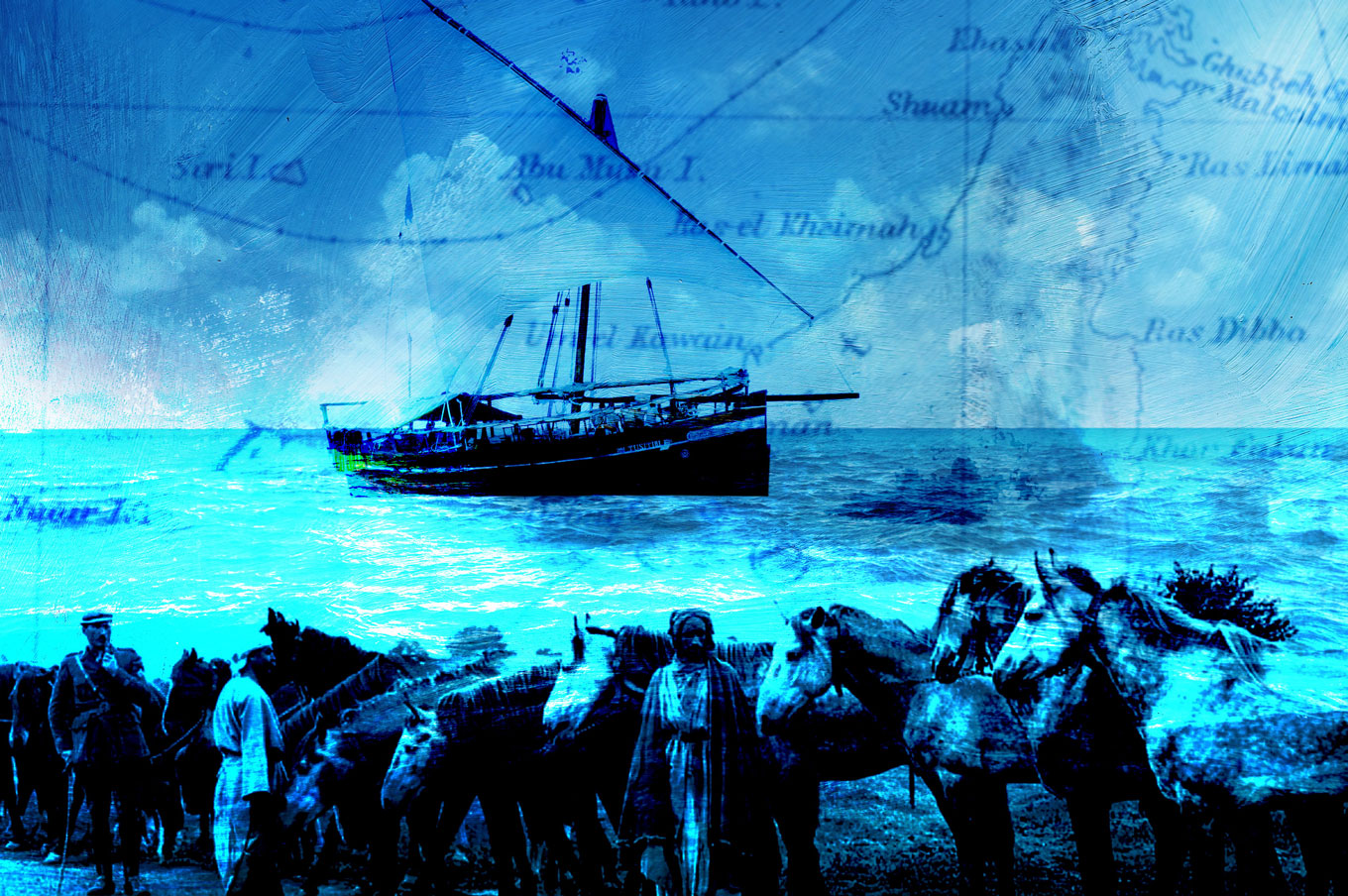
Illustrated by Joanna Andreasson for New Lines


On a hot day in March 1813 in the area of Bidiyyah, located in what is today the Eastern Region of the Sultanate of Oman, the renowned Wahhabi military leader Mutlaq bin Mohammed al-Mutairi and his forces arrived near the Gulf of Oman. This occurred more than 50 years after the founding of the first Saudi kingdom, a dynasty based on the Salafist reform movement known as Wahhabism. Since that time, al-Mutairi’s strong leadership and fearsome reputation had helped expand and consolidate Saudi influence in the region, including the areas under the control of the Qasimi clan (the Qasimis or Qawasim) in Ras Al Khaimah and Sharjah.

But his power came with cruelty, and ultimately this led to his demise, with the locals of Bidiyyah vowing to take revenge no matter the cost. In his book “The Clear Victory of the House of Busaid,” the Omani historian Hamid bin Raziq (1783-1874) recounts the battle that put an end to this most famous of Wahhabi leaders. Bin Raziq states that al-Mutairi arrived with his forces in the Bidiyyah region at sunrise, setting up his camp in a nearby area known as Al Wasil. When al-Mutairi’s army launched raids on the villages of the area, the local citizens were determined to attack him at all costs, victory or martyrdom. “They vowed and swore to God that they would not bend to him, even if it meant their deaths.” Bin Raziq then writes about six rounds of fighting against al-Mutairi’s army that day. The first three rounds targeted the camp of his brother, Batal bin Mohammed al-Mutairi, whom they defeated, followed by occupation of his camp. The locals then attacked al-Mutairi’s own camp during the last three rounds of fighting. Al-Mutairi repelled the first two attacks, while the third ended with his death and the defeat of his army. One eyewitness recounted with amazement and admiration the resolve and determination of the Hajiri warriors, residents of this region, in confronting the Saudis and fighting them to the death.

This battle was a turning point in pushing back the tide of Saudi Wahhabi influence before the ultimate demise of the First Saudi State five years later, in 1818, at the hands of Egyptian-Ottoman forces. And it wasn’t the only time that local tribes rose against invading forces. The Qasimis were to prove formidable opponents to the increasing hegemony of the British along the Oman coast, though this time the fight did not, despite fierce resistance, go in their favor. The British gained the upper hand and, consequently, full control of the seas and trade from India.

The history of Wahhabism is often told exclusively in the context of Saudi Arabia, with occasional references to its attempted expansion north, into Iraq and the Levant. Contemporary Wahhabi influence in other corners of the Arabian Peninsula is often understood as a product of later proselytization. But Wahhabism’s expansion south, all the way to Oman and today’s United Arab Emirates, is an overlooked part of the history of the region: how Wahhabism was first defeated but then took root as a local resistance ideology against the British and how Wahhabi “piracy” along the Persian Gulf caused the British Empire to turn its attention to the Gulf region and strike deals that shaped the formation of the modern Arab states of the Gulf.

But the British presence in that region was not an extension of its colonialism in Iraq and the Levant north of the Arabian Peninsula. In fact, it preceded it, and came through the Indian Ocean from the south. Wahhabism gave a religious flavor to the resistance against the infidel invaders, but the Qasimis and other local tribes were already experienced in standing up for their land and way of life and did so until the British turned the full weight of the world’s most powerful army against them. And so began British influence in the Arabian Gulf.

In 1727, Muhammad bin Saud (1710-1765), whose lineage can be traced back to the Banu Hanifa, one of the ancient Arab tribes of Bakr bin Wael, and who would later become the founder of the First Saudi State, assumed control over his tribe in the region of old Diriyah, a mere 12 miles from the modern-day capital of Riyadh. At the same time, a reformer emerged who had been educated in Najd, Hejaz and Iraq. His name was Muhammad ibn Abd al-Wahhab (1703-1791), a descendant of the famous Tamim tribe of Najd, located in the heart of the Arabian Peninsula. He issued an urgent plea to return to the foundations of Islam from which these tribes, in his view, had strayed far away. He also believed that these same tribes must try again to do what the Prophet and his companions after him had done before: unify the Arabian Peninsula.

Ibn Abd al-Wahhab realized that his reformist message would not resonate much within the Arabian Peninsula, especially among hostile and infighting tribes, without the support of an armed power on his side. After several failed attempts, he went to Emir Muhammad bin Saud in Diriyah and convinced him of his ideas, which relied upon a Hanbali Salafist methodology as the basis for reforming and redeploying Islam throughout the Arabian Peninsula. In doing so, he also promised the emir that he would become the indisputable lord of the Arabian Peninsula.

When reading Wahhabi literature and sources from that time, whether written by Ibn Abd al-Wahhab himself or his offspring who later became religious leaders at the founding of the Third Saudi State, we find the recurring concept of “invasion to spread the message.” This principle is — and has always been — central to early Wahhabism. All four emirs of the First Saudi State believed in the firm relationship between the sheikh’s religious leadership and the emir’s political leadership to achieve the goals of his reformist message.

In the earliest historical Wahhabi literature, such as “The History of Najd” by Ibn Ghannam, one of Ibn Abd al-Wahhab’s pupils, we find a description of converts to Wahhabism as “Muslims.” It appears that this description is used exclusively for adherents of Wahhabism, which shows the extent of religious fervor and responsibility possessed by Wahhabis at that time. According to their faith, they were reenacting the first invasions of the Prophet to once again restore the people and tribes of the Arabian Peninsula to their conception of the creeds of “Islam” and “monotheism.” This religious zeal was undoubtedly the main reason behind the expansion of the First Saudi State and the people’s adherence to it, willingly or coercively.

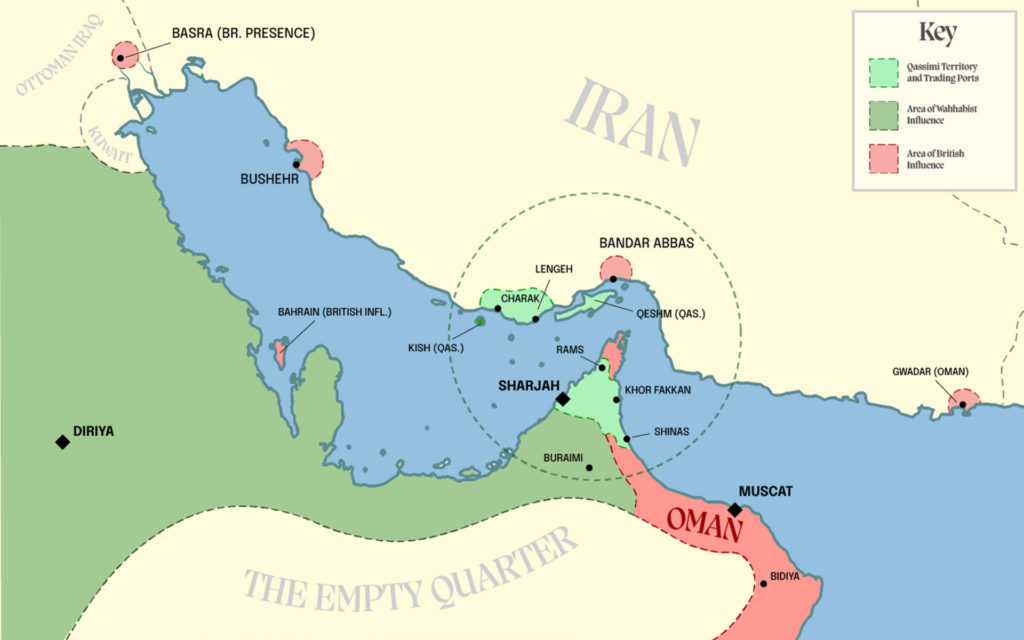
The subsequent string of military successes of the Saudis resulted from armed force combined with the strength of religious persuasion and advocacy of the Sunni Wahhabi doctrine, which was tempting to many Arab tribes in its call to return to the pure Islam that was brought by the Prophet Muhammad. It was an appealing message, and it allowed the First Saudi State to expand its sphere of influence in all directions. It stretched to Al-Qatif, Al-Ahsa and Bahrain to the east; to the borders of Kuwait, Iraq and southern Syria to the north; to the outskirts of Hejaz and the Red Sea to the west; then to inner Oman, Muscat and the UAE (known then as the Omani Coast or Coastal Oman) to the south and southeast. The Saudis also saw it necessary to control the strategic Al-Buraimi Oasis, which is now divided between the Emirati city of Al Ain and the Omani Al-Buraimi Governorate. 

The so-called “Pirate Coast” around the turn of the 19th century. 
Borders approximate. 
Map by Joshua Martin / MapTiler / OpenStreetMap contributors

Abu Dhabi was the first of the emirates to meet with the Saudi campaigns along the Omani Coast. In his book “The Meteor’s Gleam,” the Wahhabi historian Al-Rikki mentions that while the commander Ibrahim bin Suleiman bin Ufaisan was waging Saudi expansion campaigns in Qatar in 1793, orders came from Abdulaziz bin Muhammad bin Saud (1721-1803), the second leader of the First Saudi State in Diriyah, Najd, commanding him to direct al-Mutairi to invade Oman and go as far as the land of Sir (today where Oman and Sharjah meet).

And so the First Saudi State reached the Al-Buraimi Oasis in 1795, led by bin Ufaisan, and the Saudis subsequently dispatched several military campaigns to the same region led by Salem bin Bilal al-Harq, one in 1800 and another in 1803. During each of those campaigns, the tribes of that region became indebted in allegiance to the Saudis, sometimes through soft power employed by the Wahhabi sheikhs and other times through armed military might and coercion. The tribes of the Banu Yas, Banu Na‘im, Banu Qutb and the Qasimis were quickly incorporated into the First Saudi State. In 1809, the Saudis sent their most famous military leader, al-Mutairi, whose raids reached and subdued Muscat for a time. He remained the most influential of the Saudis in that region until his death in 1813.

From their important and stable foothold in the Al-Buraimi Oasis, the Wahhabis were able to reinforce their influence, religious/political messaging and military movements throughout all of Oman, Sir and the Omani Coast. After several military confrontations, they were able to coerce the Qasimis and their supporters into adopting Wahhabism. However, there is some disagreement among historians about the date of this conversion, with various writers dating it to 1797, 1800 or 1803.

Historian Charles Rathborn Low referenced this three-to-six-year discrepancy in his book “History of the Indian Navy 1613-1862.” The Qasimi tribes, in fact, resisted the Wahhabi invasion in this region during that period. Russian historian Viktor Leonovich Mikhin confirms as much in his book “The Qawasim Alliance,” stating that the chief of the Qasimis at that time, Sheikh Saqr bin Rashid Al Qasimi, refused to convert to Wahhabism. This refusal came when Emir Abdulaziz bin Muhammad bin Saud, the second leader of the First Saudi State, issued his decree to the Banu Na‘im in Ajman and the eastern Arabian Peninsula to attack the Qasimis and subjugate them, which they failed to do. Afterward, bin Saud sent forces from Diriyah to join with those of the Banu Na‘im and his Wahhabi commander, al-Mutairi, who were stationed in Al-Buraimi. Yet their attack failed a second time because of the Qasimis’ fierce resistance in Ras Al Khaimah.

The Wahhabis never gave up on the idea of conquering the Qasimis. This time, however, once again under the leadership of al-Mutairi and with the support of several tribes loyal to the Saudis, the Wahhabis laid siege to Ras Al Khaimah with 4,000 soldiers for 17 days. Although they succeeded in defeating the Qasimis, a new conflict and war erupted between the two sides because of the Wahhabis’ handling of the Qasimis’ religious affairs and their destruction of some shrines and graves. Once again, the Wahhabis subdued the Qasimis, aided by their allied tribes. However, a sizable portion of the Qasimis’ supporters from the Zaab tribe in Al Jazirah Al Hamra and the Tunaij tribe in Rams continued to stubbornly resist the Wahhabis until they were forcibly defeated. With this definitive defeat, all of them became adherents of Wahhabism — for a while.

After the Qasimis were brought into the fold under Saudi Wahhabi control, their attacks against the British in the Gulf took on a religious tone. According to historical and literary texts from that time, their raids against British warships and commercial vessels were a stand against the “Christian enemies of the faith.” As a result of this new policy, the Qasimis expanded their maritime activity into the Indian Ocean, where their ships appeared along the Malabar Coast north of Bombay (present-day Mumbai), India, for the first time in 1808. The Qasimis used to send a fifth of the spoils they got from their naval operations to the Saudis as a confirmation of their faith in the Wahhabi message and their submission to the House of Saud.

At that time, the British were keeping track of developments in the important regions of the Gulf from the safety of British-controlled India. Their greatest concern was stable security and business conditions to ensure the uninterrupted flow of commerce for the British East India Co. (EIC) from Bombay to Basra via the waters of the Gulf. For this reason, the British understood the importance of Oman and the Omani Coast in securing their presence, commerce and ships.

This formed the basis of Omani-British relations, which began during the start of the Yarubid dynasty in the 1650s. They held talks about the establishment of a British center in Muscat, but the Yarubids refused to allow any European base or presence there because of their experiences under Portuguese occupation in the 16th and 17th centuries. The situation changed with the arrival of Ahmad bin Said in 1741, the first imam of Oman from the House of Busaid, which still rules today. After his ascent to power, Omani-British relations took shape surprisingly quickly.

On Oct. 12, 1798, the British brokered a commercial and political pact with the House of Busaid in the Sultanate of Oman. This treaty stipulated ‌the latter allow the British to have a military presence in the port of Bandar Abbas along the Iranian coast, which was under Omani control‌. It also required the sultanate not to interact with any other European powers present in the Gulf, especially the French and Dutch, and to forbid them from setting up shop in Muscat and Bandar Abbas. In short, the Busaidis could only deal with the British.

The British had achieved a massive, easy win through this agreement. Researchers conclude that the pact successfully hampered French activity in the Gulf ‌and in Oman in particular. The signing of this agreement was extremely important for travel to India as it allowed the British to broaden their political, commercial and military sphere of influence, not only in Oman but also across the Gulf. Oman’s geographical position forced the British to focus their movements throughout the region in Oman, especially in the Qasimis’ territories of Ras Al Khaimah and Sharjah. Thus, the Qasimis had genuine reasons to resist the British presence.

The first half century ‌of this agreement (1741-1798) was a period in which the House of Busaid consolidated its rule over the sultanate. They were converts to the Ibadi sect of Islam, which differed from orthodox Sunnism on various points. They faced challenges from an alliance of Sunni Ghafiri tribes along the Omani Coast, spearheaded by the Qasimis tribes in Ras Al Khaimah and Sharjah, as well as regions within Oman, such as Samail, the area south of Muscat called Al Dhahirah and other areas in northern Oman. This alliance collided with the Ibadi Hinawi confederation led by the House of Busaid, and the two sides fought in several armed conflicts that ended with the latter overcoming all the Ghafiri tribes along the coast and within Oman, except for the Qasimis. For this reason, the Omani-British alliance was not only geared against the French but also the Qasimis. The Wahhabi Saudis supported the Qasimis against this alliance, as they had supported the Qasimis since the French conquest of the Qasimis in the 19th century, even though the Qasimis had initially resisted Saudi rule and dominance in the region.

The British exploited this complex, competitive political situation in the Gulf, working with the commercial and military fleets of Oman to attract another important power to its side: Bahrain. Since 1783, the rulers of that island had been the House of Khalifa, who were allied to the Banu Utbah tribes that had immigrated from Kuwait to Bahrain and Zubarah (a port town across from Bahrain in Qatar) in 1763. Britain tried to court the House of Khalifa to join their side, even though Bahrain was another area of the eastern Arabian Peninsula under Wahhabi control, one that the sultan of Muscat attacked from time to time. Nudged and pressured by the British, the Banu Utbah and rulers of Bahrain joined the sultan of Muscat in 1813 by launching a naval and ground assault on the Qasimis in Ras Al Khaimah. However, the attack failed because of the Qasimis’ fierce resistance, as recounted by historian and the colonial administrator in British-occupied India, J.G. Lorimer (1870-1914), in his book “Gazetteer of the Persian Gulf, Oman and Central Arabia.”

The British continued employing a pernicious policy aimed at exaggerating the risk of the Qasimi fleets to both sides. They initiated a smear campaign against the Qasimis to portray them as pirates, even calling the areas under the Qasimis’ control (Ras Al Khaimah, Sharjah, Umm al-Quwain, Ajman, Al Hamriya, and Al Jazirah Al Hamra) the “Pirate Coast.” Remarkably, the Qasimis’ control during the 18th century and first quarter of the 19th century stretched all the way to the Iranian coast, on the other side of the Gulf.

However, before exploring the reasons for the tense relations between the British and the Qasimis tribal confederacy, we must first familiarize ourselves with the origins of these tribes and how they came to power in the southeast Arabian Peninsula and Omani Coast. Historians are divided over the origin of the Qasimis tribes. Some believe that the tribe’s name goes back to a tribe of the Banu Ghafir in Najd that emigrated to the Omani Coast in the 17th century, while others think ‌they are descendants of the Arab Huwala tribes that used to reside along the eastern coast of the Gulf in what is now Iran. The current ruler of Sharjah, Sheikh Sultan bin Muhammad Al Qasimi, states in a small note titled “The Definitive History and Origin of the Qasimis” that the foundations of his tribe go back to the Ahl al-Bayt, the family of the Prophet Muhammad, as the descendants of Hassan bin Ali bin Abu Talib and Fatima bint Muhammad.

In exploring the documents of the British National Archives from the 18th century, we discover that the term “the Qasimis” became a banner for all the Qasimis together with their allied tribes in the regions of Ras Al Khaimah, Sharjah and the Omani Coast. This emphasizes the sway and control that this tribe had over this region, the main reason its members became the vanguard in resisting the British presence in the Gulf.

With the Qasimis living on barren land unsuitable for agriculture, maritime trade represented their only source of income and wealth. Their business with Indian ports, in particular, was extremely important, as they had brought back from there the most important supplies and timber needed to build their ships. As such, they saw the British as stiff competitors who could deprive them of their livelihoods‌. Foreign commercial competition had been a way of life for a long time, and local residents had become used to living under those circumstances. However, the British added an extra element to the mix. They started demanding that all ships trading in the Gulf carry British permits to do so, indicating that they considered themselves the masters over these waters, as Mikhin notes in his book, “The Qasimis Alliance and British Policy in the Arab Gulf.”

Toward the end of the 18th century, the British finally cemented their control over India, overcoming all their other European competitors, such as the French. Around the turn of the century, British commercial agents in countries connected to the Gulf began turning one after another into political pawns. In 1798, Britain signed a treaty with the rulers of Muscat aimed squarely against the French, but in reality, the treaty meant the start of Muscat’s submission to British rule, and their eventual transformation into an auxiliary unit against the Qasimis.

The charges made against the Qasimis were ostensibly part of Britain’s intentional and systematic policy to curb piracy, crafted by the British EIC. British residents and agents repeated these charges vigorously, working to spread this lie to create the pretext for using British sailors and ships to protect their trade. After a thorough examination of all the naval activities conducted by the Qasimis in the Gulf at that time, Mikhin confirms in his book that all instances in which the Qasimis were accused of piracy by the British were actually acts of self-defense.

In Lorimer’s “Gazetteer,” we find an entire chapter dedicated to the “Rise and Suppression of Piracy” between the years 1778 and 1820, the year in which the British destroyed the Qasimis fleets and imposed an armistice treaty upon them, making the British the true lords over the eastern coast of the Gulf. Lorimer describes the region as the Pirate Coast, as was common in British propaganda at the time, and details all the Qasimis acts of aggression, year by year, against British trade ships or the ships of their allies in the region‌. In one case, he states:

On the 18th of May 1797, off Rams, a fleet of Al Qawasim boats attacked and captured the snow [ship] ‘Bassein,’ though under British colours and carrying public dispatches, and took her to Ras Al Khaimah, where she was detained for two days and then released by order of the Shaikh. No reparation seems to have been exacted for this insult to the British flag. Impunity bore its natural fruit.

In this passage, he means to say that this instance led to many more Qasimi attacks on British trade ships.

Numerous British historical sources and documents indicate that the British deliberately attempted to depict the Qasimis as pirates, but this description is questionable for several reasons. The concept of piracy during the Middle and Modern Ages used to mean, and still evokes, an image of roving gangs operating in a specific area to plunder and pillage. While the Qasimis (and allied tribes) were engaging in acts that could be described as piracy, the attacks were driven by ideology rather than the aim of simply looting by sea. The Qasimis, just like the other Arabs of the Arabian Peninsula, had lived on these lands for hundreds of years before Britain ever considered establishing a presence in India and expanding their commerce in the Gulf, and their actions were part of a resistance against them, a resistance, moreover, that gained religious legitimacy from Wahhabi doctrine. As a British resident of Muscat, Francis Warden, noted in 1809: “The Qasimis’ piracy is nothing more than the result of the Wahhabis’ inducing them to do so.” This was jihad against the British, and the spoils from their actions on the seas but a (licensed) part of this sanctioned resistance against the infidel.

The reasons behind the British depiction of the Qasimis were either that Britain did not understand them very well, or that they knew them and intentionally distorted the truth. We must realize that the Qasimis’ subservience to the Wahhabis, and conversion to their sect, forced them to engage in the holy war that the Wahhabis had declared against the “enemies of the faith,” i.e., the British, among others. The British were also allies with the Qasimis’ regional and ideological archenemies, ‌the House of Busaid in Oman. The war between those regional enemies had gone on since 1741, when the Busaidis seized control of Muscat. The Omani-British alliance led to wider British commercial, political and military activity in the southern Gulf, which represented a serious threat to the Qasimis’ trade and fleets in that region.

In light of the Qasimis’ subordination to the First Saudi State and harsh Wahhabi supervision over them, their sheikh, ‌Sultan bin Saqr Al Qasimi, longed for independence. He grew tired of the Wahhabis’ ever-increasing influence and direct intervention in the affairs of Ras Al Khaimah and Sharjah, namely through the Wahhabi commander in the Al-Buraimi Oasis, al-Mutairi. The Saudis then decided to strip Sheikh Sultan bin Saqr of his authority, summoning him to their capital in Diriyah in late 1808. He was arrested and imprisoned but managed to escape in 1812, seeking refuge in the Egyptian military camp in Jeddah on the Red Sea coast. The camp was under the command of Tusun ibn Muhammad Ali Pasha, who led the Egyptian-Ottoman military campaign of 1808-1811, which resulted in the demise of the First Saudi State.

After arresting Sultan bin Saqr Al Qasimi, replacing him with another person more loyal to the Wahhabis, the Qasimis’ attacks on British ships intensified in the Indian Ocean and Arabian Sea, during which ‌they seized several British ships. By 1809, the Qasimis fleet in Ras Al Khaimah on the Gulf coast and Bandar Lengeh on the Persian coast had reached 630 large ships, 810 smaller crafts, and 8,700 sailors. The leader of the Qasimis relied upon them in demanding that the British government in India pay a tax to allow British ships to freely pass through the Gulf. For this reason, Britain prepared for a military naval campaign, armed with 13 warships bearing cannons, 1,500 soldiers, a campaign officer, and four troop-carrying vessels. Their mission was to destroy the Qasimis’ naval might and force them into a treaty on British terms.

Between 1811 and 1818, the First Saudi State entered into a risky open conflict against Muhammad Ali Pasha of Egypt, who waged war at the behest of the Ottoman Empire. Under the influence of British propaganda, the Ottomans were convinced they had to confront the Wahhabi threat. This campaign culminated in Ottoman-Egyptian forces entering Diriyah and eliminating the First Saudi State in 1818. The Qasimis’ attacks on British ships did not cease with the fall of the Wahhabis, but rather after the fall of the Saudi State. These raids continued for genuine and possibly more profound reasons than the Qasimis subordination to the Wahhabis. The British were the ones who started harassing the Qasimis ships, accused them of piracy, and demanded that they comply by bearing British permits when conducting their trade in international waters. They were also the ones who allied themselves with the sultan of Muscat, who was launching attacks on Ras Al Khaimah periodically. All of this forced them to continue what may be described as attacks, carried out as an effective means of self-defense.

In the end, after the fall of the Saudi State, the British government dispatched a large military campaign to destroy the Qasimis’ forces once and for all, even though the latter had broken their alliance with the Saudis. In November 1819, this campaign was launched from Bombay, India, under the command of Gen. William Keir Grant, whose mission was to destroy all the Qasimis’ fleets in Ras Al Khaimah, be they commercial or military. After that, he was ordered to destroy the Qasimis’ boats, bases and ports in Umm al-Quwain, Rams, Al Hamriya, Al Jazirah Al Hamra, Ajman and Sharjah, then attack their ports on the Iranian coast, such as Maghoh, Bandar Lengeh and Kharaj. Grant was even given the authority to make any necessary political decisions.

On Dec. 2, English cannons fired a barrage at Ras Al Khaimah for seven consecutive days. Despite their staunch and bold resistance, the Qasimis began running low on ammunition and lost dozens of men to the English cannons, especially the large ones, forcing them to retreat. The city suffered massive looting and vandalism, and 80 of their large ships were seized. After negotiations concluded between the two sides, the English imposed a treaty on the leaders of Sharjah, Ras Al Khaimah, Abu Dhabi, Dubai, Ajman, Umm al-Quwain and Al Jazirah Al Hamra.

The Ras Al Khaimah Agreement was signed on Jan. 20, 1820, and formed the basis for Britain’s political and economic hegemony over the nations of the Gulf. Britain’s position in the region was an indispensable part of its empire in India, aside from its successful and brutal naval and land power. With the help of other regional parties, the British destroyed the Qasimis naval forces and required them and the other emirates to submit to British authority in the Gulf.

Despite this outcome, the Qasimis continue to take pride in their decades long resistance against the mightiest empire of the time to defend their right to trade and ensure their survival.

HIS LAST LETTER BEFORE BEING DISAPPEARED
Russia's Navalny scolds Google and Meta for helping Putin


LONDON (Reuters) - Jailed Russian opposition leader Alexei Navalny scolded Google and Meta Platforms Inc on Thursday for shutting down advertising, a step he said had undermined the opposition and thus was a gift to President Vladimir Putin.

Navalny, by far Russia's most prominent opposition leader, casts Putin's Russia as a dystopian state run by thieves and criminals where wrong is cast as right and judges are in fact representatives of a doomed lawless country.

In a written address to the Copenhagen Democracy Summit, Navalny, who is currently in a Russian jail, said technology was being used by the state to arrest dissidents but that it also gave an opportunity to get to the truth.

"The Internet gives us the ability to circumvent censorship," Navalny said in the address, a copy of which was posted on his official blog.

"Yet, at the same time, Google and Meta, by shutting down their advertising in Russia, have deprived the opposition of the opportunity to conduct anti-war campaigns, giving a grandiose gift to Putin."


Neither Google nor Meta immediately responded to a request for comment on Navalny's remarks. Both companies paused advertising targetting users in Russia in March, just days after Russia invaded Ukraine.

Navalny earned admiration from the disparate Russian opposition for voluntarily returning to Russia in 2021 from Germany, where he had undergone treatment for what Western laboratory tests showed was an attempt to poison him with a nerve agent in Siberia.

The Kremlin has repeatedly dismissed Navalny's claims about Putin, who it says has won numerous elections in Russia since 2000 and remains by far the country's most popular politician. It has dismissed Navalny's assertion that Russia poisoned him.

Navalny, a former lawyer who rose to prominence more than a decade ago by lampooning Putin's elite and voicing allegations of corruption on a vast scale, said the titans of Silicon Valley had a lot of questions to answer.

They would have to decide, he said, whether or not they were really "neutral platforms" and whether or not users in democracies should operate under the same rules as those in repressive societies.

"How should the internet treat government directives, given that Norway and Uganda seem to have slightly different ideas about the role of the internet and democracy?" he asked.

"We love technology. We love social networks. We want to live in a free informational society. So let's figure out how to keep the bad guys from using the information society to drive their nations and all of us into the dark ages."

(Reporting by Guy Faulconbridge; Editing by Mark Heinrich)