Thursday, June 16, 2022

How Islam Settled Roe v. Wade Centuries Ago

Equating its repeal to ‘Shariah’ drags Muslims into a culture war they do not deserve
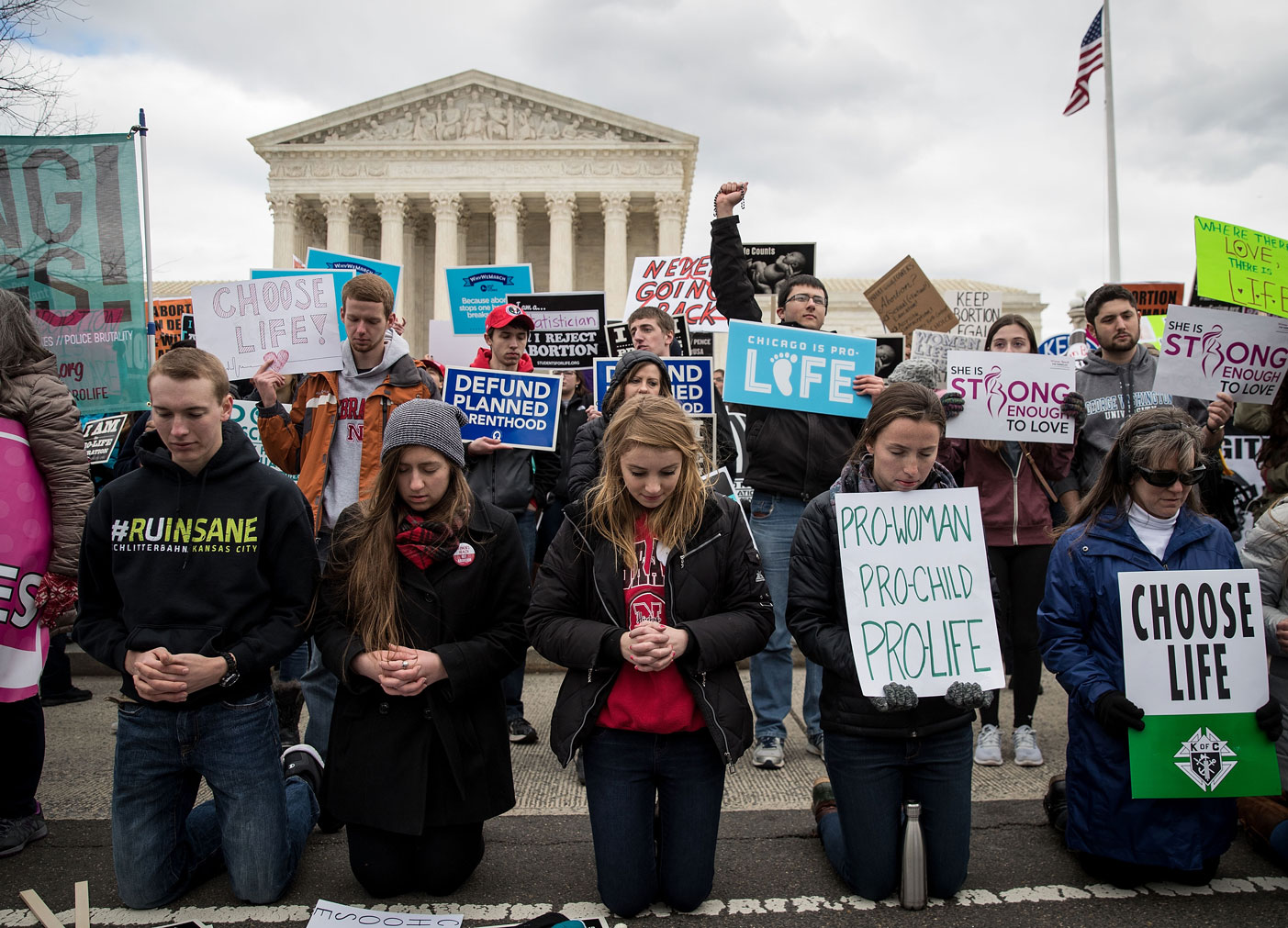
Anti-abortion advocates kneel and pray outside of the Supreme Court during the March for Life / Drew Angerer / Getty Images


As soon as the news broke that Supreme Court Justice Samuel Alito is trying to overturn Roe v. Wade, familiar — and troubling — Islamophobic tropes began to emerge in the discourse.

“America’s Taliban really hates women and minorities,” wrote Daily Beast editor Naveed Jamali on Twitter, harkening back to late September when dozens of commentators, including MSNBC’s Rachel Maddow, started referring to Texas lawmakers as the “American Taliban” — a trope that Muslim leaders are still trying to come back from.

Meanwhile, The Daily Show’s Trevor Noah gave it his own comedic twist: “All across the country, women in places like Missouri or even Texas will have the same abortion rights as women under the Taliban in Afghanistan. Think about it. We just evacuated people out of Afghanistan, and now we are going to evacuate them out of Tennessee?” he quipped — up until this point walking the fine line between humor and accidental Islamophobia. “After all these years of the right screaming about Shariah law, it turns out they were just jealous.”

Never mind the fact that this comparison is insulting to Muslims — it is also blatantly false. Rather than point out the hypocrisy of the way that the far right has spent the past 20 years criticizing the Taliban for its record on women’s rights only to turn around and enact its own brand of religious fundamentalism, this commentary misses the mark and lands as a lazy insult, akin to “you crazies are even crazier than those brown crazies!” It unwittingly drags Muslims into the so-called “culture wars,” hurling them into the fray of the right wing’s crackdown on LGBTQ and women’s rights, their faith no more than an argument to prove a point.

It wouldn’t be the first time that Muslims have had their faith exploited as a political pawn in bipartisan politics. Sometimes it is left-leaning Democrats who uphold them as an underrepresented minority in a sea of white supremacy, all the while refusing to take account of their faith and values that might not as cleanly line up with their agenda. Other times, it is the Christian far right that superimposes its conservative viewpoints onto them as fellow people of faith, assuming their faith-based politics will align.

Some conservatives are taking the bait. Jordan Peterson, who is openly suspicious of modern science, also conveniently believes that the truth and wisdom found in religion are the guidance that lost young men need in the world. He believes this so much that he has even defended anti-democratic, Salafi preachers. Other Muslims — even some scholars — have adopted the extreme far right stance that abortion is the equivalent of murder.

Ironically, these views could not be further than the actual Islamic views on abortion—which are extremely diverse, and historically a subject of constant debate and consideration across schools of thought, from fringe Islamic jurists to the mainstays of Sunni and Shia scholarship. Often it is considered from both a religious and practical standpoint — guided by the hadith (the Prophet Muhammad’s sayings and acts) but also informed by someone’s ability to give birth, and any complications that a pregnant woman might face. It is hotly debated — but it is the presence of this debate — and the breadth of nuance among different schools of thought — that makes it so different from the polarizing forces of the U.S. culture wars that is driving the debate to the brink of absolutism.

If Muslims are going to get dragged into this particular front of America’s culture wars, it is time to set the record straight. There is no debate today in Muslim-majority countries about the permissibility of abortion when the mother’s health is in jeopardy, which means that abortion remains an integral and noncontroversial part of women’s health. Modern states may grapple with social and moral dilemmas when the abortion is elective, but there is a rich tradition of Islamic law to draw on that has addressed many of the questions with which the U.S. Supreme Court is grappling.

According to Islamic tradition — and the view of the majority of Sunni Muslim scholarship — life begins not at the moment of conception nor even in the first stage of development (known as the “nutfa,” or drop) nor with the presence of the “alaqa” (that which hangs) or the “mudgha,” which literally translates to a clump of flesh that looks like chewed skin. Rather, it is the “khalqan” that describes the moment that it becomes a separate creation. This is the moment that the Archangel Gabriel breathes a soul into the embryo, creating a connection with God and the universe that gives it life. According to the hadith, this moment happens at 120 days — or approximately four months — into the pregnancy. While Islamic scholars are known for debating scripture at length, the idea that a cluster of cells does not become a person until the soul meets the body is widely agreed upon, a rare moment of almost absolute consensus.

Based on this idea, Muslim scholars largely agree that abortion should be illegal after 120 days into the pregnancy. However, it is the debate surrounding abortion before the 120-day mark where it becomes interesting. According to the Hanafi School of thought — one of the four major Sunni schools of Islamic rite and religious law — abortion should be permissible so long as there is a sound reason for the abortion. In contrast to today’s conservative positions, some Hanafi scholars permitted abortion without any restrictions at any point. Traditionally, reasons have often been a fear of being unable to provide for the child, such as the case with a lack of wet nurses or the presence of other children that depend on the mother’s milk. “Zina” or sex outside of marriage also falls into this category — and on the Indian subcontinent, there is a fatwa from the prominent scholar Ahmad Raza Khan that states that abortion is fine for a single mother and maybe even better given social stigma. It is also permissible in cases of rape. Meanwhile, the Shafi school didn’t need a reason at all.

Others are more restrictive, such as some scholars within the Shafi and Hanbali schools popular in the Kingdom of Saudi Arabia and the Gulf states, as well as prominent Shia schools, which typically limit abortion to up to 40 days after conception. Other schools, like the Maliki, forbid it entirely. But it has never been compared to murder — and, even in most conservative views, it is permitted if it is needed to save a woman’s life. This is theologically justified as being a “lesser of two evils,” according to scholars such as the late chief cleric of Egypt’s Al Azhar institution Mahmud Shaultut, Syrian cleric Mustafa al-Zarqa and Egyptian cleric Yusuf al-Qaradawi.

Meanwhile in the United States, the pro-life movement has a long history of referring to abortion as murder, even in instances where it could save a woman’s life. Roe v. Wade pushed back against this narrative by establishing that foetuses are not people under the U.S. Constitution. Now that it could be repealed, politicians like Louisiana state Rep. Danny McCormick are jumping on the opportunity to push forward legislation that would establish that fetuses are unborn children whose right to life is protected by law, making abortion — no matter how soon after conception — a homicide. It follows a troubling trend that has seen a woman in Texas handed over to the police after needing to go to the hospital following a self-induced abortion, though charges have since been dropped.

It doesn’t stop at abortion, either. Last year, a woman in Oklahoma was convicted of manslaughter after she suffered a miscarriage and was sentenced to four years in jail. Prosecutors said her methamphetamine use caused the miscarriage; the defense argued that other factors could have been at play. Now that the right to life is being reconsidered in the Supreme Court, pro-life groups are starting to push the narrative that emergency contraception — or as it is commonly known, Plan B — is akin to an abortion pill. Recently, U.S. Rep. Marjorie Taylor Greene told the House floor that Plan B kills a baby in the womb once a woman is pregnant, a statement that reproductive health advocates have long demonstrated to be a lie. Meanwhile, Idaho state Rep. Brent Crane recently gave an interview in which he announced that he is considering a state law to ban both emergency contraception and intrauterine devices (IUDs). These moves arise from the worst nightmares of an assault on reproductive freedoms, and no comparison to the Taliban is needed to make this point.

Needless to say, miscarriage and birth control are treated much differently in Islamic jurisprudence. One of the most famous stories involves the seventh-century second caliph, Umar ibn al-Khattab, summoning a woman to his court and then learning that, upon his summons, she suffered a miscarriage. Consumed with guilt, he consulted the Prophet Muhammad’s son-in-law and the would-be fourth caliph, Ali ibn Abi Talib, who had high stature and reverence in the court and whose opinion he respected. As the caliph expected, Ali told him that he needed to recognize that he held a position of power, which inevitably colored his summons, even when that was not his intention. Ali argued that Umar should pay the woman an indemnity to compensate for her miscarriage. It is a legal decision that went on to form the basis for determining that should a woman miscarry due to circumstance, it is her right to be compensated for being harmed. Islamic jurists also considered that the father should also have the right to compensation. However, the famous conservative jurists from the 14th-century Ibn Taymiyya and 19th-century Deobandis, the scholars of the Indian subcontinent that allegedly gave rise to the Taliban, ruled that as long as both the man and woman agreed with each other, it would not be necessary.

As for birth control, most attitudes were relatively liberal. While bearing children was often seen as the preferable outcome of sex, contraception was largely seen as normal as was the idea that it is God’s decree to give people control over when they start a family. Still, some treated it as “makruh” (undesirable), as it interfered with building a family, which was seen as the preferable path, the one more conducive to building the Muslim community or umma.

One of the most entertaining examples of this particular attitude comes from 12th-century historian Ibn ul-Jawzi’s book “Talbis Iblis” (The Trappings of the Devil), in which a man sleeps with a woman outside of marriage, then discovers that she has fallen pregnant. When he confesses his sin to a compatriot, the compatriot asks why he did not practice coitus interruptus. “But isn’t coitus interruptus undesirable?” he asks. His compatriot laughs. “Didn’t it reach you that adultery was forbidden altogether?”

In Islam, discussions about abortion or miscarriage have traditionally been legal — not moral — debates. While opinions varied, most conversations were grounded in an intellectual effort to consider the practicalities of a pregnancy in addition to the Quranic narrative and hadith. While “ensoulment” is the moment life begins, a mother’s life is just as important as that of the unborn child, allowing for most an abortion even after 120 days if the mother’s life was in danger, a view that values the woman’s life in ways alarmingly missing among some parts of the “pro-life” movement in the U.S.

Americans themselves often have mixed views about abortion. A recent Pew Research study found that the majority of Americans believe that abortion should be legal in some cases and illegal in others, yet the far right evangelical movement, along with those making the nation’s laws, has plundered this debate of any common sense or nuance. Instead, they are paving the way forward for an absolutist view by which people are arrested for homicide for undergoing or providing abortion or suffering a miscarriage.

So again, rather than smear the Christian far right as “no better than the Taliban,” pro-choice advocates in the United States could turn to the Islamic tradition — and for that matter, the Bible itself — for an example of how religiosity doesn’t always have to be diametrically opposed to a person’s right to choose. While a terminated pregnancy — whether an abortion or miscarriage — was given value in Islam, either legally or financially, it was never treated as “munkar” (an absolute religious evil), and those seeking them were never seen as morally repugnant. As the well-known Islamic scholar Imam al-Izz bin Abdul-Salam explained in his two-volume work, moral goodness or even awareness of something that is beneficial is rarely an absolute or without its negative consequences, and not every religious injunction is rational or moral.

What might it look like if we applied this kind of flexibility to the abortion debate in the United States? While we are discussing religious edicts that were devised before the nation-state, many of these edicts have been revised to inform Islamic law today, meaning that many people across the Middle East are able to access legal and safe abortion, as long as it is early in the pregnancy. With this in mind, it is useful to think about how this holistic approach to the intersections of faith and an unwanted — or unsafe — pregnancy could be applied to the abortion debate in the United States. A wet nurse might not be as much of a concern in the age of baby formula and breast pumping, but a person’s finances, or whether or not they will have to raise the child as a single parent, are just as important to a child’s future and a parent’s ability to provide for them. An unplanned pregnancy can get in the way of a young person’s plans to pursue an education, putting dreams on hold, often forever. Enjoying the right to choose can make the difference between raising a child in poverty or in comfort, between a person being satisfied with their choices or living with regret. When it comes to abortion, traditional Islamic authorities have much to teach us about being both “pro-choice” and “pro-life.”

Rashad Ali is resident senior fellow at the Institute for Strategic Dialogue
Anna Lekas Miller is a London-based journalist, covering borders and migration

May 20, 2022


Working 24/7 to save baby manatee orphaned in Colombia
Agence France-Presse
June 15, 2022

Tasajerito the manatee was found lost and orphaned in a Colombian swamp last September 
Juan BARRETO AFP

Last September, Tasajerito the manatee was found lost in a Colombian swamp, just three days old and separated from his mother.

Nine months later, the baby sea cow weighs as much as an adult woman and is bottle fed round the clock by doting aquarium staff.

Though much stronger now, Tasajerito's prognosis is still touch-and-go, said Angela Davila, a veterinarian at the Rodadero Aquarium in Santa Marta in northern Colombia, near where he was found.

"Tasajerito is... still considered critical," Davila told AFP. "He appears strong, he appears lively and to be feeding well, but things can change in a heartbeat."

Rescued by fishermen, Tasajerito was brought to the aquarium with little hope of survival.

A search for his mother proved fruitless

Now safely ensconced in a dedicated pool at the aquarium, he has clung to life -- increasing his consumption of a special vitamin-boosted milk formula six-fold in a few months.


Juan BARRETO AFP

Today, Tasajerito measures over 1.5 meters (4.9 feet) in length and weighs 53 kilograms (117 pounds).

Yet, he is still "a newborn," said Rodadero marine biologist Julieth Prieto, who noted that manatees are raised by their mothers for five years and suckle for half that time.

"This makes the rehabilitation process... a challenge because we have to meet those needs that the mother usually provides," she said.

'Vulnerable' species


Tasajerito's human foster parents are also teaching him to float, dive and swim.

To be released into the wild one day -- hopefully in about two years' time -- he will have to grow to between three and four meters in length and weigh some 600 kg.

The American Manatee species (Trichechus manatus), to which Tasajerito belongs, is listed as "vulnerable" to extinction on the International Union for Conservation of Nature (IUCN) Red List, its population of some 10,000 individuals on the decline.

Threats include residential and commercial development, aquaculture and shipping lanes, with watercraft strikes responsible for a large number of deaths, according to the IUCN.

In Colombia, hunting by humans is a major threat, as are hippos -- a foreign species introduced by drug trafficker Pablo Escobar, who imported some as pets in the 1980s.

The hippos now number more than 100, competing for food and space with manatees.

The manatee is one of the world's largest aquatic mammals, and according to Prieto, fulfils "irreplaceable ecological functions" in its population area that stretches from Brazil's east coast all the way to the southeastern United States.

Seasonal migrants, they help keep rivers and water channels clear, devouring as much as 50 kg of aquatic plants each every day.


"If this species were to become extinct, we would have to dredge to restore water flow between rivers, swamps and the sea," Prieto said.

© 2022 AFP


Ginni Thomas corresponded with John Eastman, sources in Jan. 6 House investigation say


By Jacqueline AlemanyJosh Dawsey and Emma Brown
WASHINGTON POST
June 15, 2022 


Virginia “Ginni” Thomas, wife of Supreme Court Justice Clarence Thomas, moderates a panel discussion during the 2017 Conservative Political Action Conference in National Harbor, Md. (Chip Somodevilla/Getty Images)

The House committee investigating the Jan. 6, 2021, attack on the Capitol has obtained email correspondence between Virginia “Ginni” Thomas, the wife of Supreme Court Justice Clarence Thomas, and lawyer John Eastman, who played a key role in efforts to pressure Vice President Mike Pence to block the certification of Joe Biden’s victory, according to three people involved in the committee’s investigation.

The emails show that Thomas’s efforts to overturn the election were more extensive than previously known, two of the people said. The three declined to provide details and spoke on the condition of anonymity to discuss sensitive matters.

The committee’s members and staffers are now discussing whether to spend time during their public hearings exploring Ginni Thomas’s role in the attempt to overturn the outcome of the 2020 election, the three people said. The Washington Post previously reported that the committee had not sought an interview with Thomas and was leaning against pursuing her cooperation with its investigation.

The two people said the emails were among documents obtained by the committee and reviewed recently. Last week, a federal judge ordered Eastman to turn more than 100 documents over to the committee. Eastman had tried to block the release of those and other documents by arguing that they were privileged communications and therefore should be protected.

Thomas also sent messages to President Donald Trump’s White House chief of staff, Mark Meadows, and to Arizona lawmakers, pressing them to help overturn the election, The Post has previously reported.

While Thomas has maintained that she and her husband operate in separate professional lanes, her activities as a conservative political activist have long distinguished her from other spouses of Supreme Court justices. Any new revelations about Thomas’s actions after the 2020 presidential election are likely to further intensify questions about whether Clarence Thomas should recuse himself from cases related to the election and attempts to subvert it.

In January, the Supreme Court rejected a request by Trump to block the release of his White House records to the House committee investigating Jan. 6. Clarence Thomas was the only justice to dissent, siding with Trump.

Lawyer John Eastman, left, speaks alongside Rudy Giuliani, then a personal attorney to President Donald Trump, at a rally of Trump supporters in D.C. on Jan. 6, 2021. (Jim Bourg/Reuters)

Ginni Thomas did not immediately respond to requests for comment, nor did Eastman or his lawyer. A spokeswoman for the Supreme Court did not respond to questions for Clarence Thomas.

A Jan. 6 committee spokesman declined to comment.

Eastman, who once served as clerk for Clarence Thomas at the Supreme Court, outlined scenarios for denying Biden the presidency in legal memos and in an Oval Office meeting on Jan. 4 with Trump and Pence, The Post and other outlets have previously reported. Eastman has said that Trump was his client at the time.

Earlier this year, U.S. District Judge David O. Carter ordered Eastman to release numerous documents to the committee, rejecting privilege claims Eastman had asserted. In April and May, Eastman turned over more than 1,000 documents to the committee.

In a 26-page ruling last week, Carter addressed another 599 documents that Eastman sought to shield. Carter ruled that more than 400 of those documents were protected by attorney-client or other privilege and should not be released.

But he ordered the remainder, including correspondence with state legislators and documents related to alleged election fraud and the plan to disrupt the joint session of Congress on Jan. 6, be turned over to the committee last week and early this week.

Carter described some of the documents in more detail than others.

He ordered Eastman to turn over documents regarding three December 2020 meetings of a group that Eastman described as “civic minded citizens of a conservative viewpoint,” including messages from a person Carter described as the group’s “high-profile leader” inviting Eastman to speak at a meeting on Dec. 8, 2020. The meeting agenda indicates that Eastman discussed “State legislative actions that can reverse the media-called election for Joe Biden.”

“The Select Committee has a substantial interest in these three meetings because the presentations furthered a critical objective of the January 6 plan: to have contested states certify alternate slates of electors for President Trump,” Carter wrote.

It is not clear what the group is or who its high-profile leader is.

Carter also ordered the release of part of a Dec. 22 email written by an attorney he did not identify. The attorney encouraged Trump’s legal team not to pursue litigation that might “tank the January 6 strategy” by making clear that Pence did not have the ability to intervene in the counting of electoral votes. “Lawyers are free not to bring cases; they are not free to evade judicial review to overturn a democratic election,” Carter wrote.

And the judge ordered the release of several communications that shared news stories or tweets.

In the weeks after the 2020 election, Ginni Thomas repeatedly pressed Meadows to overturn the outcome, according to text messages obtained by The Post and CBS News. After Jan. 6, she told Meadows in a text that she was “disgusted” with Pence, who had refused to help block the certification of Biden’s electoral college victory. She wrote, “We are living through what feels like the end of America.”

During that same post-election period, Thomas also pressed Republican lawmakers in Arizona to help keep Trump in office by setting aside Biden’s popular-vote win and to “choose” their own electors, The Post has reported, based on documents obtained via a public records request. Thomas sent the emails via FreeRoots, an online platform designed to facilitate sending pre-written messages to multiple elected officials.

In an email on Nov. 9, just days after media organizations called the race in Arizona and nationally for Biden, Thomas sent identical emails to 27 lawmakers in the Arizona House and Senate urging them to “stand strong in the face of political and media pressure.” The email claimed that the responsibility to choose electors — which belongs to voters under Arizona state law — was “yours and yours alone,” and claimed that the legislature had the “power to fight back against fraud” and “ensure that a clean slate of Electors is chosen.”

In a follow-up email to one of the recipients, state Rep. Shawnna Bolick, Thomas described the email as “part of our campaign to help states feel America’s eyes.”

Bolick (R), who provided Thomas with links she could use to report any fraud she had experienced in Arizona, previously told The Post that she received tens of thousands of emails after the election and that she responded to Thomas in the same way she responded to everyone else.

On Dec. 13, the day before presidential electors were scheduled to cast their votes and seal Biden’s victory, Thomas emailed 21 of those lawmakers plus two others. “Before you choose your state’s Electors … consider what will happen to the nation we all love if you don’t stand up and lead,” the email said. It linked to a video of a man urging swing-state lawmakers to “put things right” and “not give in to cowardice.”

The next day, Democratic electors in Arizona cast their votes for Biden. Republican electors met separately and signed a document declaring themselves to be the state’s “duly elected and qualified Electors.” More than a dozen Arizona lawmakers signed on to a letter to Congress for the state’s electoral votes to go to Trump or “be nullified completely until a full forensic audit can be conducted.

Wednesday, June 15, 2022

Fascism expert: Trump was ‘extremely disciplined’ as he sought ‘private profit off of public office’


Bob Brigham
June 15, 2022

One of America's leading academics on fascism explained how Donald Trump used public office to personally enrich himself.

New York University Prof. Ruth Ben-Ghiat discussed Trump's fundraising with Business Insider.

"Trump's aims as president were totally different from any other president, Republican or Democrat," she explained. "His aims were autocratic in that he wanted to turn public office into a vessel of making money for himself; to have private profit off of public office."

"He was extremely disciplined in grifting and in trying to use the presidency to make money," she explained. "The sad thing is that autocrats can be very loved by their followers, and people genuinely love Trump. He has a real personality cult. But they despise their followers and they use them. And that's where him grifting off of his followers [comes in]. Because he is not grifting off of Democrats; he's grifting off of his followers, he's bilking his own followers."

Ben-Ghiat was also interviewed on Wednesday by MSNBC's Ari Melber.

"So one lesson for Americans is these things happen slowly and sometimes you have a shock event like Jan. 6th which greatly further radicalized the GOP, but it's a combination of a process where local election by local election your rights are stripped away and you may not notice it because it's been happening at the state level, and then this is all a rehearsal for bringing it national," she said. "And so we see these things happen in a continuum and over time, but we have to be alert to the warning signs and we have a lot of warning signs and they're coming out with these hearings."


Watch: Ruth Ben Ghiawww.youtube.com


National hate group monitor unmasks a Lehigh Valley-area publishing company peddling Nazi and fascist literature

By Daniel Patrick Sheehan
The Morning Call
LEHIGH VALLEY NEWS
Jun 15, 2022 

“In His Own Words: The Essential Speeches of Adolf Hitler.”

“Burning Souls,” described as a “poetic memoir” by Leon Degrelle, a Belgian who enlisted in the German army during World War II, became an officer in the Waffen SS and — sentenced to death in absentia — lived out his days in the fascist Spain of Francisco Franco.

“A Handbook for Right-wing Youth” by Julius Evola, an antisemite and Nazi sympathizer considered a hero among the “alt-right,” a group that embraces racism, white nationalism, antisemitism and populism.

Antelope Hill’s owners — Macungie native Vincent Cucchiara, 24, his wife, Sarah Cucchiara, 25, and their partner, Dimitri Anatolievich Loutsik — operated anonymously until this week, when the Southern Poverty Law Center, a nonprofit civil rights foundation that tracks hate groups, published a lengthy story about the business and its principals on its Hatewatch blog.

The four reporters identified the owners through document searches and by navigating a labyrinth of websites and podcasts where the Cucchiaras, who appear to be more active in the business than Loutsik, have periodically done interviews under pseudonyms.

Vincent Cucchiara graduated from Emmaus High School. He was a Boy Scout and became an Eagle Scout in January 2016, earning the rank with a project that restored trees to part of a community park. He also served as a VFW bugler.

None of the owners spoke to Hatewatch. Two reporters who visited a house in the tiny Montgomery County borough of Green Lane, which is listed in public records as the Cucchiaras’ address, met a man who didn’t identify himself.

“I know who you are. I know who both of you guys are,” the man told the reporters during the June 10 encounter, after indicating he was familiar with the SPLC. “We’ll see each other again one day.”

The Cucchiaras blocked a Morning Call reporter who contacted them through their Facebook pages, and no contact information was available for Loutsik.

This striving for anonymity is typical of white supremacist culture, said Michael Edison Hayden, a senior investigative reporter and spokesperson for the Southern Poverty Law Center’s Intelligence Project. Few supremacists ever use their real names in communications or publications.

“The most important thing to understand about pseudonyms and white supremacy is that they know what they’re doing is wrong,” said Hayden, who began covering white supremacy in the wake of the violent 2017 “Unite the Right” rally in Charlottesville, Virginia.

“They may tell you it’s not wrong, but they know it’s anti-social behavior,” he said. “If they felt that this was something they wanted to put their names to they would do it. This is something they want to do to people.”

Hayden said the Hatewatch team started looking into Antelope Hill because the publisher’s titles ― which include children’s books under the company’s “Little Frog” imprint — kept cropping up at white supremacist rallies. And recently, an Antelope Hill author who goes by “Raw Egg Nationalist” appeared in a preview for a documentary on masculinity by Tucker Carlson of Fox News.

Hayden said investigations of white supremacists and other hate groups can take many months or even years, but he and the three other reporters on the inquiry pulled this one together in a few months after getting some leads on the publishers’ identities.

The reporters determined that the Cucchiaras and Loutsik, who were friends at Penn State, started the company in early 2020, concealing ownership information by using an out-of-state business registration and listing the address as a private mailbox at a UPS Store in Quakertown.

It didn’t take long for the publisher to find its audience.

“Antelope Hill has profited from hate by translating historical works by 20th-century Nazis and fascists, offering a publishing platform to contemporary white power propagandists and shipping books around the world using selling platforms including Amazon,” the article says.

Hatewatch also found “considerable evidence of close cooperation between the Antelope Hill principals and a network of far-right actors associated with the white supremacist National Justice Party (NJP) and The Right Stuff (TRS) podcast network.”


Neo-Nazis, alt-Right and white supremacists march in Charlottesville, Virginia, the night before the "Unite the Right" rally in 2017. The Southern Poverty Law Center says a Montgomery County publisher has ties to groups that took part in the rally.
(TNS)

The National Justice Party, which was suspended from Twitter, was formed in 2020 by white supremacists who attended the “Unite The Right” rally. The Anti-Defamation League calls the group “virulently anti-Semitic.” Among its platform positions is a 2% cap on Jewish employment in “vital institutions.” The party was formed by members of The Right Stuff network.

The Cucchiaras and Loutsik haven’t always worked in the shadows. During their Penn State days, Loutsik and Vincent Cucchiara organized a pro-Trump movement called the Bull-Moose Party and occasionally landed on the pages of the college paper.

On one occasion, two students who vandalized Trump signs at one of the group’s rallies were fined more than $700. They mounted an online campaign to raise twice that amount and donate the extra money to Planned Parenthood in Loutsik’s name.

In 2016, Loutsik resigned from the Bull-Moose Party when someone leaked a transcript of the group’s private chats, which were full of homophobic and racist slurs.

Vincent Cucchiara is a real estate agent, according to Hatewatch, and helped Loutsik buy a $290,000 house in Harleysville, Montgomery County, this year.

Sarah Cucchiara was a teacher in the Norristown Area School District but left in 2020 after racist postings on her Facebook wall became public, Hatewatch said. Public records show she once lived in Macungie.

Hatewatch linked her to a Twitter account under the name Maggie, where she frequently decries mixed-race marriages and makes antisemitic comments.

Hatewatch notes that the number 88 in Maggie’s Twitter handle is often used by neo-Nazis as code for “Heil Hitler,” because H is the eighth letter of the alphabet. A previous Twitter account linked to Sarah Cucchiara contained the number 14 in its handle, commonly used to refer to a 14-word statement of white supremacy, Hatewatch said.

Hayden said the white supremacist movement is smaller now than it used to be in terms of organized hate groups, but at the same time, the level of conflict it promotes has increased. One explanation is that white supremacists in the social media age no longer need in-person groups surreptitiously distributing hate literature to spread their message.

“There is an entire subculture around putting a pseudointellectual sheen on what is essentially just racism,” Hayden said. “To people who are predisposed to a simplistic way of looking at things, they can really believe they are doing something impressive or cutting edge.

“They refer to themselves as dissidents. Pardon the language, but it’s really just a-hole behavior.”

Morning Call reporter Daniel Patrick Sheehan can be reached at 610-820-6598 or dsheehan@mcall.com
U.S. issues new warnings on 'forever chemicals' in drinking water

Reuters
June 15, 2022


The U.S. Environmental Protection Agency on Wednesday released new warnings for synthetic pollutants in drinking water known as "forever chemicals" saying the toxins can still be harmful even at levels so low they are not detectable.

The family of toxic chemicals known as per-and polyfluoroalkyl substances, or PFAS, have been used for decades in household products such as non-stick cookware, stain- and water-resistant textiles and in firefighting foam and industrial products.

Scientists have linked some PFAS to cancers, liver damage, low birth weight and other health problems. But the chemicals which do not break down easily, are not yet regulated.

The agency is set to issue proposed rules in coming months to regulate PFAS. Until the regulations come into effect, the advisories are meant to provide information to states, tribes and water systems to address PFAS contamination.

The EPA also said it would roll out the first $1 billion to tackle PFAS in drinking water, from a total of $5 billion in funding in last year's infrastructure law. The funds would provide states technical assistance, water quality testing and installation of centralized treatment systems.

The updated drinking water health advisories for perfluorooctanoic acid (PFOA) and perfluorooctane sulfonic acid (PFOS) replace ones EPA issued in 2016. The advisory levels, based on new science that considers lifetime exposure, indicate that some health problems may still occur with concentrations of PFOA or PFOS in water that are near zero and below EPA’s ability to detect.

"Today's actions highlight EPA's commitment to use the best available science to tackle PFAS pollution, protect public health, and provide critical information quickly and transparently," said Radhika Fox, the EPA's assistant administrator for water.

The agency encourages entities that find PFAS in drinking water to inform residents and undertake monitoring and take actions to reduce exposure. Individuals concerned with PFAS found in their drinking water should consider installing a home filter, it said.

INDUSTRY WHINERS

The American Chemistry Council industry group - whose members include 3M and DuPont among others - said the EPA rushed the notices by not waiting for a review by the agency's Science Advisory Board. The group said it is concerned that the process for developing the advisories was "fundamentally flawed."

(Reporting by Timothy Gardner; Editing by Aurora Ellis)
Kremlin critic Navalny confirms move to ‘one of Russia’s scariest prisons’

Agence France-Presse
June 15, 2022

Alexei Navalny. © AFP

Jailed Kremlin critic Alexei Navalny said Wednesday he had been transferred to a strict-regime penal colony described by his allies as “one of Russia’s scariest prisons”.

Last month President Vladimir Putin’s top foe, citing inmates, said Russian authorities had been preparing a “prison within a prison” for him.

Navalny had been serving two-and-a-half years at a jail in the town of Pokrov, 100 kilometers (60 miles) east of Moscow, for violating parole on old fraud charges in what his allies say is punishment for challenging the Kremlin.

In March, the 46-year-old had his jail time extended to nine years after he was found guilty of embezzling donations to his political organizations and contempt of court.
“Hello to everyone from the strict regime zone,” Navalny said in a statement posted on Instagram on Wednesday.

“Yesterday I was transferred to IK-6 ‘Melekhovo’,” Navalny said, adding he was in quarantine and did not have “much to say”.

The penal colony near the town of Vladimir and about 250 kilometers east of Moscow has been subject to multiple media investigations into the abuse of inmates.

Navalny’s spokeswoman, Kira Yarmysh, said in May that “the place where he is to be transferred is notorious for its prisoners being tortured and killed”.

She described the Melekhovo prison colony as “one of Russia’s scariest prisons.”

Navalny rose to prominence as an anti-corruption blogger and, before his imprisonment, mobilized anti-government protests across Russia.


In 2020, he barely survived a poisoning attack with Novichok, a Soviet-designed military-grade nerve agent. Navalny has accused Russian authorities, but the Kremlin has denied any involvement.

He was arrested last year on his return from treatment in Germany, sparking widespread condemnation abroad and sanctions from Western capitals.

(AFP)
Boris Johnson never took full control of the Tory party – uniting it now seems impossible

THE CONVERSATION
Published: June 9, 2022 
Does Johnson have enough power behind him?
PA Images / Alamy Stock Photo

Boris Johnson is a weakened prime minister after the recent confidence vote by his party’s MPs. The view among many political analysts and academics is that the 211-148 vote in his favour is too damaging, and he is unlikely to turn things around. Some backbenchers expect him to be replaced by the summer – and lessons from academic research suggest they are right.

For many, Johnson was once a strong leader, at least during the first six months of his leadership. However, my own view of strong leadership is that it goes above and beyond delivering strong electoral results. As Eoin O'Malley and I have argued in our research on leadership, a strong party leader is both in control of the organisation of their party, and can set and articulate the party’s priorities.

According to this definition, Johnson was never a strong leader. He delivered a large electoral victory to the party, but lacked a clear vision and policy message. He has been unable to express the party’s vision and ideology, and to articulate what the Conservative party stands for beyond “get Brexit done”.

A strong leader gains control of the party because of the organisational, electoral and policy benefits they bring, which is why strong leaders often end up damaging their party electorally when they step down, as our research shows. Johnson has not taken any such control – if he had, he would not have suffered a vote of no confidence by 41% of his MPs.

Barely three years into his party leadership, Johnson’s authority is so damaged that it seems almost impossible for him to survive as PM to the next election.

Perhaps we got here because his MPs and voters distrust him due to partygate and other corruption allegations. This is not just down to bad luck, but his inability to unite the party behind him during his premiership – Conservative MPs have organised into different, quite polarising ideological groups.

As party leader, he should also connect with the public. Perhaps he did in 2019, but polls suggest that this is not the case any more.
Time to turn the page

The big question then is whether the Conservative party, and the country as a whole, are better off replacing Johnson or uniting behind him until the end of the government term.

A prime minister leading a deeply divided party is not able to govern successfully. Instead of being responsive to the public or staying true to the party’s electoral promises such as achieving net zero by 2050 or fixing social care, he is likely to adopt policies that primarily seek to appease the different Conservative party factions.

More likely, Johnson will be unable to initiate any policy at all. There are already suggestions that rebel Tory MPs will abstain from voting on key parts of Johnson’s legislative agenda.

Theresa May’s second government suffered from inaction due to party divisions. She stayed in office six months after winning a confidence vote, but ultimately resigned after failing to gain support for her Brexit agreement.

Theresa May resigned as prime minister after winning a confidence vote. Is Johnson next? 
Will Oliver / EPA-EFE

Johnson’s government is more likely to be one where money is sent to constituencies that serve party unity instead of the country’s and citizens’ needs. Research into Italian governments finds that when parties in government are divided, spending increases and policy reform is less likely.

In fact, there is speculation that party-motivated spending is already happening, with many of the funds dedicated for the government’s levelling-up agenda given to better-off constituencies of government ministers.

A day after the confidence vote, ministers and backbenchers from the right wing of the party called for drastic tax cuts and even demanded Johnson overrule his chancellor. With MPs from northern constituencies expecting investment and funding of projects as per the levelling-up agenda on the one hand and demands for tax cuts on the other, it becomes quite hard to balance the books.

Those optimistic about Johnson might argue he could unite the party behind a new vision for the country. This is extremely unlikely, as it would require Johnson appointing a cabinet that reflects the party’s views and divisions. Successful PMs did that – even strong leaders such as Margaret Thatcher. It has been shown that most British PMs have appointed cabinets that reflect the party’s ideological position rather than their own.

However, Johnson appointed his loyal supporters, people who stood by him during his leadership and pro-Brexit campaigns, and relies on their backing so is unlikely to replace them. If he cannot unite the party at the cabinet level, which he does control, he is unlikely to ever unite it across the legislative chamber.

Author
Despina Alexiadou
Senior Lecturer at the School of Government and Public Policy, University of Strathclyde
Why can’t you remember being born, learning to walk or saying your first words? What scientists know about ‘infantile amnesia’

The Conversation
June 08, 2022

Baby with a bottle (Shutterstock.com)

Whenever I teach about memory in my child development class at Rutgers University, I open by asking my students to recall their very first memories. Some students talk about their first day of pre-K; others talk about a time when they got hurt or upset; some cite the day their younger sibling was born.

Despite vast differences in the details, these memories do have a couple of things in common: They’re all autobiographical, or memories of significant experiences in a person’s life, and they typically didn’t happen before the age of 2 or 3. In fact, most people can’t remember events from the first few years of their lives – a phenomenon researchers have dubbed infantile amnesia. But why can’t we remember the things that happened to us when we were infants? Does memory start to work only at a certain age?

Here’s what researchers know about babies and memory.

Infants can form memories

Despite the fact that people can’t remember much before the age of 2 or 3, research suggests that infants can form memories – just not the kinds of memories you tell about yourself. Within the first few days of life, infants can recall their own mother’s face and distinguish it from the face of a stranger. A few months later, infants can demonstrate that they remember lots of familiar faces by smiling most at the ones they see most often.

In fact, there are lots of different kinds of memories besides those that are autobiographical. There are semantic memories, or memories of facts, like the names for different varieties of apples, or the capital of your home state. There are also procedural memories, or memories for how to perform an action, like opening your front door or driving a car.

Research from psychologist Carolyn Rovee-Collier’s lab in the 1980s and 1990s famously showed that infants can form some of these other kinds of memories from an early age. Of course, infants can’t exactly tell you what they remember. So the key to Rovee-Collier’s research was devising a task that was sensitive to babies’ rapidly changing bodies and abilities in order to assess their memories over a long period.


A mobile in motion can keep a baby entertained.


In the version for 2- to 6-month-old infants, researchers place an infant in a crib with a mobile hanging overhead. They measure how much the baby kicks to get an idea of their natural propensity to move their legs. Next, they tie a string from the baby’s leg to the end of the mobile, so that whenever the baby kicks, the mobile moves. As you might imagine, infants quickly learn that they’re in control – they like seeing the mobile move and so they kick more than before the string was attached to their leg, showing they’ve learned that kicking makes the mobile move.

The version for 6- to 18-month-old infants is similar. But instead of lying in a crib – which this age group just won’t do for very long – the infant sits on their parent’s lap with their hands on a lever that will eventually make a train move around a track. At first, the lever doesn’t work, and the experimenters measure how much a baby naturally presses down. Next, they turn the lever on. Now every time the infant presses on it, the train will move around its track. Infants again learn the game quickly, and press on the lever significantly more when it makes the train move.

What does this have to do with memory? The cleverest part of this research is that after training infants on one of these tasks for a couple of days, Rovee-Collier later tested whether they remembered it. When infants came back into the lab, researchers simply showed them the mobile or train and measured if they still kicked and pressed the lever.

Using this method, Rovee-Collier and colleagues found that at 6 months, if infants are trained for one minute, they can remember an event a day later. The older infants were, the longer they remembered. She also found that you can get infants to remember events for longer by training them for longer periods of time, and by giving them reminders – for example, by showing them the mobile moving very briefly on its own.

Why not autobiographical memories?


If infants can form memories in their first few months, why don’t people remember things from that earliest stage of life? It still isn’t clear whether people experience infantile amnesia because we can’t form autobiographical memories, or whether we just have no way to retrieve them. No one knows for sure what’s going on, but scientists have a few guesses.


A lot of development needs to happen for him to remember an exciting experience.

One is that autobiographical memories require you to have some sense of self. You need to be able to think about your behavior with respect to how it relates to others. Researchers have tested this ability in the past using a mirror recognition task called the rouge test. It involves marking a baby’s nose with a spot of red lipstick or blush – or “rouge” as they said in the 1970s when the task was created.

Then researchers place the infant in front of a mirror. Infants younger than 18 months just smile at the cute baby in the reflection, not showing any evidence that they recognize themselves or the red mark on their face. Between 18 and 24 months, toddlers touch their own nose, even looking embarrassed, suggesting that they connect the red dot in the mirror with their own face – they have some sense of self.

Another possible explanation for infantile amnesia is that because infants don’t have language until later in the second year of life, they can’t form narratives about their own lives that they can later recall.

Finally, the hippocampus, which is the region of the brain that’s largely responsible for memory, isn’t fully developed in the infancy period.

Scientists will continue to investigate how each of these factors might contribute to why you can’t remember much, if anything, about your life before the age of 2.

Vanessa LoBue, Assistant Professor of Psychology, Rutgers University - Newark
Scientists map brain network linked to addiction

Agence France-Presse
June 13, 2022

Human anatomy illustration, central nervous system with a visible brain (Shutterstock)


Researchers said on Monday they had mapped the network in the brain linked to addiction by studying long-time smokers who abruptly quit after suffering brain lesions.

They hope the research will give future treatments a target to aim for in the fight against addiction to a range of substances.

To find out where addiction resides in the brain, the researchers studied 129 patients who were daily smokers when they had a brain lesion.

While more than half kept on smoking as normal after getting the lesion, a quarter immediately quit without any problem -- even reporting an "absence of craving", according to a new study in the journal Nature Medicine.

While the lesions of those who stopped smoking were not located in one specific region of the brain, they mapped them to a number of areas -- what they called the "addiction remission network".

They found that a lesion that would cause someone to give up an addiction would probably affect parts of the brain like the dorsal cingulate, lateral prefrontal cortex and insula -- but not the medial prefrontal cortex.

Previous research has shown that lesions affecting the insula relieve addiction. But it failed to take into account other parts of the brain identified in the new study.

To confirm their findings, the researchers studied 186 lesion patients who completed an alcohol risk assessment.

They found that lesions in the patients' addiction remission network also reduced the risk of alcoholism, "suggesting a shared network for addiction across these substances of abuse", the study said.

Juho Joutsa, a neurologist at Finland's University of Turku and the study's author, told AFP "the identified network provides a testable target for treatment efforts".

"Some of the hubs of the network were located in the cortex, which could be targeted even with non-invasive neuromodulation techniques," he added.

Neuromodulation involves stimulating nerves to treat a range of ailments.

One such technique is the transcranial magnetic stimulation (TMS) coil, which was approved by the US Food and Drug Administration last month for obsessive-compulsive disorder.

It already targets many of the same areas of the brain as the addiction remission network identified in Monday's study.

Joutsa said he hoped his research would contribute to a TMS coil targeting addiction.

"However, we still need to figure what is the best way to modulate this network and conduct carefully designed, randomized, controlled trials to test if targeting the network is clinically beneficial," he added.

© 2022 AFP